Skip to content

Posts from the ‘Folklore’ Category

UBIQUI-TEE: T-Shirts Design Culture

I was happy tonight to attend the opening for a great new exhibition organized by the Sage Collection and presented at the Indiana University Center for Art and Design Columbus (IUCA+D Columbus). Curated by Sage Assistant Curator Kelly Richardson, the exhibition is titled UBIQUI-TEE: T-Shirts Design Culture. It does a great job of framing the diversity of t-shirts and their many uses in global culture. The show was strikingly presented in a beautiful setting, the still relatively new design-focused center in beautiful downtown Columbus, Indiana.

Extensive Sage collections were supplemented by loans from a number of individuals and institutions, including the Mathers Museum of World Cultures, which lent shirts collected in Native American and African contexts as well as two wonderful, recently collected t-shirt quilts.

Congratulations to Kelly and everyone involved in the new show.

(Columbus had a great downtown. Go see the show.)

Coconut Rattles in Florida and Oklahoma

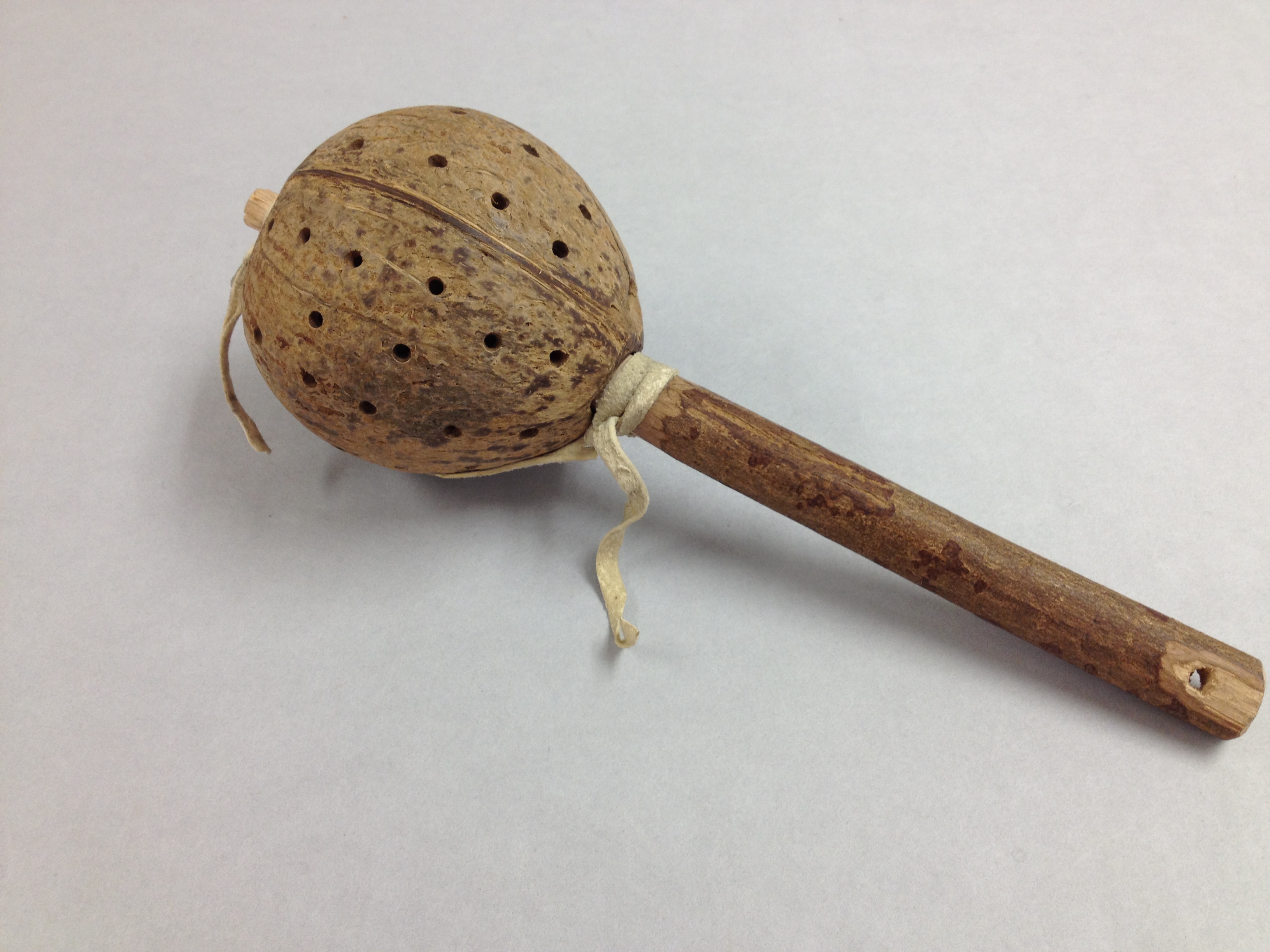
The diversity of materials used by Native peoples in the Americas to make hand rattles is pretty staggering. Among the farming peoples of the Southwest, Plains, Northeast and Southeast, gourds are one important material used for this purpose. Having the same basic form as gourd rattles, but unique to some Southeastern Indian peoples, are rattles, such as this Florida Seminole example, made from coconuts. William C. Sturtevant provided the coconut used here to Jack Motlow, from whom he commissioned it for $2.00 in 1951. This Florida Seminole example is made exactly like those used among the Southeastern peoples in Oklahoma, including among the Yuchi. (I commissioned Yuchi examples for the Gilcrease Museum in Tulsa during the later 1990s.) Such rattles are called “gourds” in English in Oklahoma and are particularly suited to the outdoor dances of the region. Such rattles are loud and thus sound great when used, as they most often are, outside, in open spaces. (The holes drilled in the coconut amplify the rattle’s sound.)

This example is #301 in the William C. Sturtevant Collection, Department of Anthropology, National Museum of Natural History, Smithsonian Institution.

(The Seminole Tribune has published biographical profiles of two of Jack and Lena Motlow’s daughters. These profiles are of Louise Motlow and Mary Motlow Sanchez and are online.)

A Chitimacha Basket

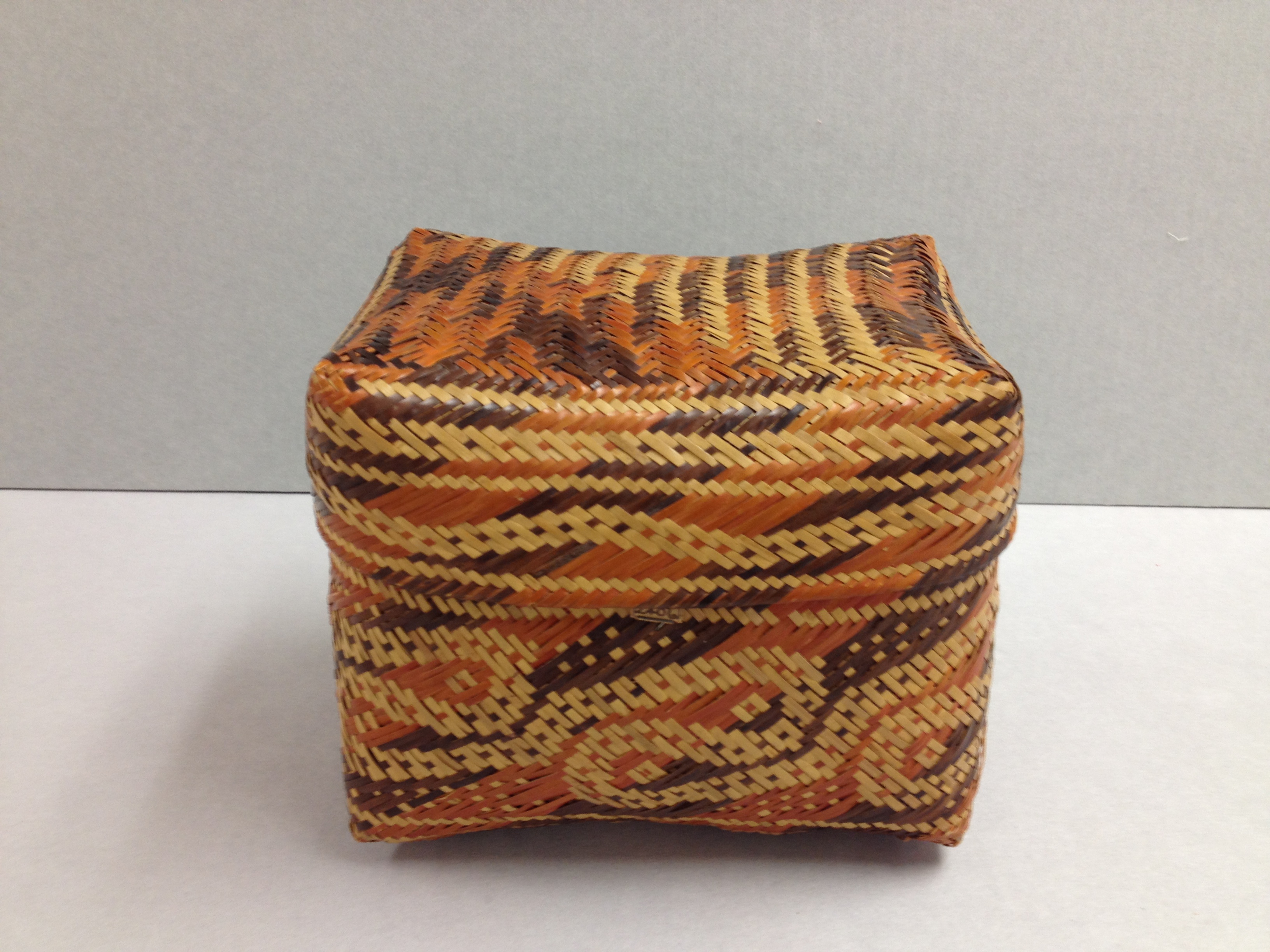
Here is an image of a double woven river cane basket with lid from the Chitimacha people of Louisiana. It was purchased at auction in 1972 by William C. Sturtevant and is now in the collections of the Department of Anthropology, National Museum of Natural History, Smithsonian Institution (T070).

Baskets from Choctaw Fair, 1961

William C. Sturtevant’s collection includes a group of baskets purchased in 1961 at the Choctaw Indian Fair near Philadelphia, Mississippi. This example (above) is part of this group. It is number 580 and I have not yet learned who the artist who made it is. This basket is made from rivercane, a plant related to bamboo that is indigenous to the Southeast of North America.

To gain a sense of native basket making in the South as a dynamic cultural activity, check out these photographs from the 1st Gathering of Southeastern Indian Basketweavers in 2002. This was an event organized by the Louisiana Regional Folklife Program and the Williamson Museum.

Here is another basket from this group. A rivercane tray, it is number 576. Both are in the collections of the Department of Anthropology, National Museum of Natural History, Smithsonian Institution.

People Love Tiny Baskets

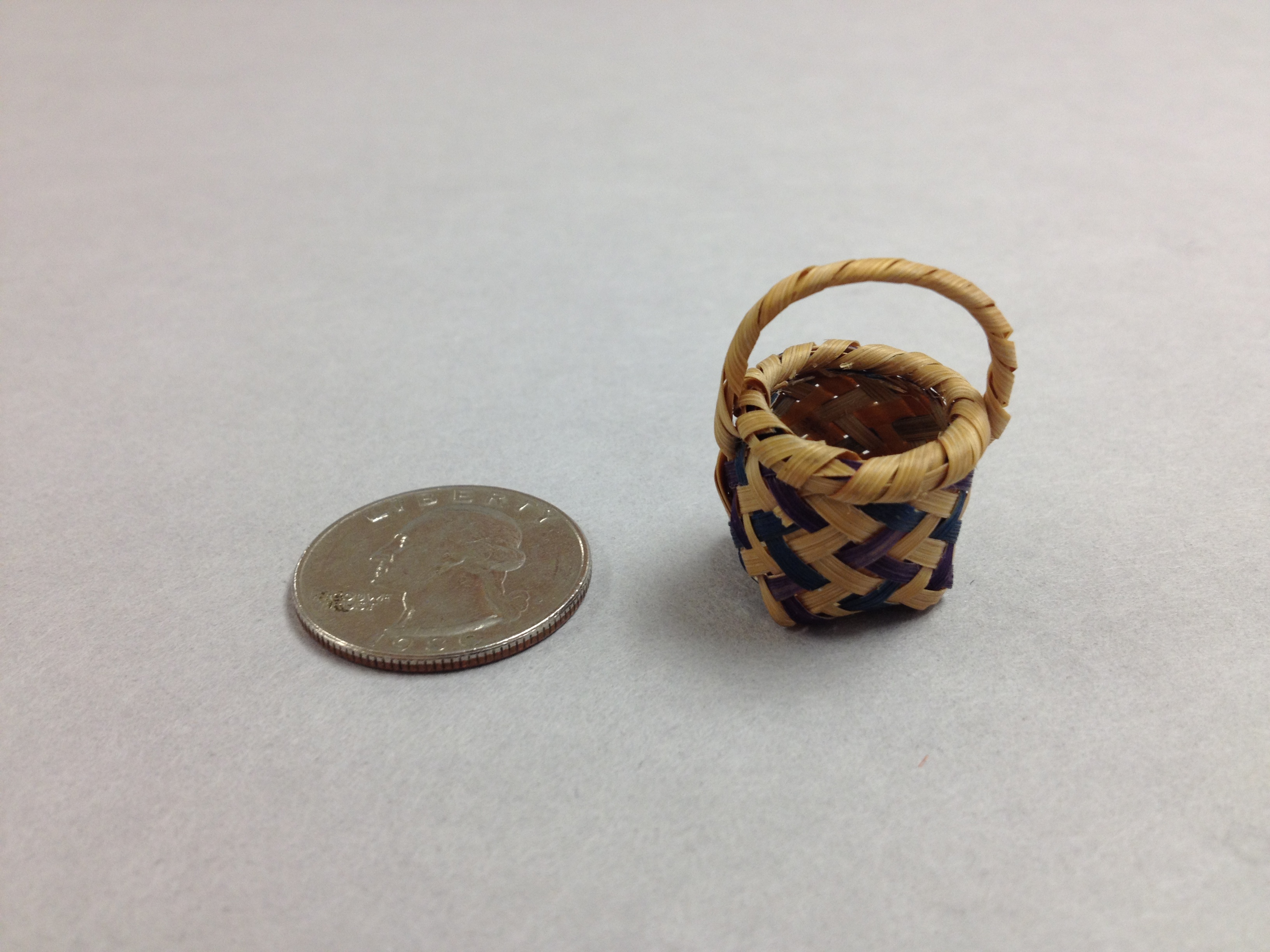
When wearing my curator hat, I have seen how ubiquitous love of tiny baskets seems to be, at least among fans of hand made objects. While I am sure that some engineer is doing nano-scale weaving already, tiny-scale seems good enough for fans of Native American basketry. The best known heroes in this area are the basket weavers of California, particularly the Pomo with their amazing feather covered baskets, but the art of the tiny basket has also been pursued in the native South. This impulse is reflected in this Choctaw basket by “Sweeny Willis” that was collected by John Mann Goggin among the Choctaw residing near Philadelphia, Mississippi. Ms. Willis’s name is spelled “Sweenie” elsewhere, such as in the records associated with pottery that she made that is in the collections of the National Museum of the American Indian.

This single weave river cane basket is currently referred to as #494 in the William C. Sturtevant Collection, Department of Anthropology, National Museum of Natural History, Smithsonian Institution.

For a bit of theorizing, look below the fold.

Read more

Folklorist and Technology Writer Audrey Watters @audreywatters Now Blogging at Insider Higher Education

Folklorist (M.A. in folklore from the University of Oregon, 2000) and technology writer Audrey Watters has a new column/blog at Inside Higher Education, the free daily newspaper for the higher education community. It is called Hack [Higher] Education. Describing the goals for the blog, she writes:

In this blog, I plan to address some of the developments in the tech industry and analyze how these might impact teaching, learning, institutions, teachers, students. But I’m also just as intrigued by the possibilities of the inverse:  how will education “hack” technology?  In other words, how will teachers and students and institutions “hack” technology back? How will a new era of technology and a new generation of technology users challenge some of the institutional practices, policies, and power-players both in education and in education technology? … My posts on Inside Higher Ed will — like me — traverse both the worlds of academia and the worlds of “hackers” (or at least the worlds of technology companies, both established and upstart).

Her first column/post can be found here. Congratulations Audrey.

A Day of Pre- Pre-conference Activities at #AFS11

Today, out of town folklorists started appearing around Bloomington for a series of events designed to rally the local troops and welcome the earliest of the visitors coming to Bloomington for the American Folklore Society meetings. I spent the early afternoon in a fruitful Open Folklore planning meeting, but my colleagues welcomed Dr. Fekade Azeze, Associate Associate Professor of Ethiopian Literature and Folklore, and Coordinator of the Folklore Graduate Programme, at Addis Adeba University in Ethiopia. USC Folklorist Tok Thompson moderated a discussion with Dr. Azeze at midday and then he delivered a lecture on customary dispute resolution in the afternoon. I made it to the talk and it was very stimulating material. Dr. Azeze described the customary legal system of two of the largest Ethiopian peoples and situated these practices in the contemporary context, describing efforts to study such systems as a means of indigenizing the national legal system, which is largely founded on non-Eithiopian principles and practices.

Immediately after the lecture, there was an opening reception for the Faces of Fieldwork exhibition curated by Pravina Shukla, Michael Lee, and Carrie Hertz and on exhibition at the Mathers Museum. The portrait photographs submitted by the contributing ethnographers were stunning, the exhibition was well mounted by the Mathers staff, and the reception was a nice opportunity to experience the exhibition and welcome guests to town for the meetings.

I had to get home for family responsibilities, by a departmental reception for early-arriving alumni (Department of Folklore and Ethnomusicology) was held. I am sure that a good time was had by all.

Tomorrow things begin in earnest, with pre-conference tours both on-campus (IU research collections and archives) and off (Southern Indiana regional sights focusing on the limestone industry). The meeting will open formally tomorrow night, with the highlight being Henry Glassie’s plenary lecture and a big welcoming reception. I will spend the day in an AFS board meeting.

Safe travels and welcome!
Peace, War, Folklore: Themester + #AFS11

Soon a large group of folklorists, from the U.S. and from many countries, will be visiting my adopted home town of Bloomington, Indiana. The 2011 American Folklore Society meetings are returning to Indiana University for the first time since 1968. There is much history that could be recounted, but it seems very salient that 1968 is a year famous for its protests and revolutions. 2011 is shaping up as a revolutionary year as well. This convergence relates to the conference theme (which was chosen well over a year ago)–Peace, War, Folklore.

How did the conference planners come to select this theme? Its a timely one and, as the program it prompted shows, a fruitful one. The immediate inspiration came from a desire to tie in to a semester-long program at Indiana University (organized by the College of Arts and Sciences) called Themester. As the name suggests, a themester is a semester theme that provides a basis for campus-wide activities, courses, and programs. At IU the Themesters happen during fall semesters. The theme for 2011 is Making War, Making Peace.

It is exciting that the AFS meetings can stand out as one of the big Themester events for 2011. The Themester program maintains a blog and the two most recent posts are by members of the AFS planning committee. In his post, conference chair Michael Dylan Foster explains the conference theme in light of folkloristics on the one hand and Themester on the other. In a second post, Jon Kay, Director of Traditional Arts Indiana and a member of the conference committee describes a TAI-organized, Themester-supported exhibition on the art of Gustav Potthoff, a man who paints to preserve and convey personal memories of the horrors of war and the prisoner-of-war experience based on his internment during World War II, during which he was among those forced to build the notorious “bridge over the River Kwai.”

To learn more about Themester at IU, see the program website. Thanks go to the Themester leadership for its engagement with the 2011 AFS meetings. (Public conference events relating to the Themester are listed here.)

New Open Access Tools, Resources, Partnerships, and Content Announced @openfolklore

I am happy to report that real and significant progress in the Open Folklore project continues to be made. A year ago (October 13, to be exact) the American Folklore Society and the Indiana University Bloomington Libraries launched the Open Folklore project and its associated web portal. Open Folklore is about promoting open access in the field of folklore studies (/ethnology) and about fostering partnerships among those working towards the goals of open access in the field. On behalf of the OF project team, I was the author of a news release/project report on the most recent accomplishments of the project and the most recent content additions accessible via the portal site. This was published this morning and is available from the Open Folklore portal.

As readers of the news release will discover, highlights over the past six months include making programs and reports related to the annual meetings of the American Folklore Society (going back to 1889) freely accessible, the launch of the AFS Ethnographic Thesaurus, and the continued growth in the number of AFS section journals being made freely accessible in digital form. The big picture is that the community is continuing to come together to advance the goal of making folklore scholarship and resources more discoverable and accessible to community members, students, tradition bearers, and scholars worldwide. As was recognized this summer when OF was recognized with the Outstanding Collaboration Award by the Association for Library Collections and Technical Services (ALCTS) during the American Library Association meetings, folklorists have a lot to be proud of. We are pioneering in many parts of the scholarly communications world, from the development of open access journals, books, repositories and archives to developing generalizable collaboration strategies for organizational partnership, especially between libraries, non-commercial publishers, and scholarly societies.

I encourage everyone to get caught up with what OF has been up to over the past six months and to continue to spread the word about the project while putting the tools and resources available at http://openfolklore.org to use in your work.

Streaming Video from #AFS11: Attend a Folklore Meeting Online!

Let the #AFS11 posts begin. The 2011 American Folklore Society meetings will be held here in Bloomington on the campus of Indiana University. This is the 1st time since 1968 that the meetings have been held on a college campus (that 1968 meeting was also here at IU). It may be a record meeting in terms of attendance and many innovative program items are going to be debuted. The first of these to mention, and the one of greatest potential interest to those who cannot attend, is the news that selected portions of the meeting will be accessible online via streaming video. In the remainder of this post (below the fold, so to speak) I will share the details. Highlights include the Opening Plenary Address by Henry Glassie  (“War, Peace, and the Folklorist’s Mission”), The Francis Lee Utley Memorial Lecture of the AFS Fellows by Margaret Mills “Achieving the Human: Strategic Essentialism and the Problematics of Communicating across Cultures in Traumatic Times”, and the AFS Presidential Address by C. Kurt Dewhurst “Museums and Folkloristics: Folklorists’ Legacy and Future in Museum Theory and Practice.” This is just a portion of the events that are scheduled to be streamed. Learn the details on how to do it and what is going to be accessible below. (The first two of these three major addresses relate to the conference theme–Peace, War, Folklore. This theme was chosen to articulate with the IU “Themester” theme of Making War, Making Peace. The full conference program is freely accessible here. It contains abstracts for all events.) Read more