Skip to content

Posts from the ‘Folklore Studies’ Category

Highlights from #AFS68: The View from #AFS11

The last time AFS met in Bloomington was 1968. Studying the program for that meeting (which is now freely accessible in IUScholarWorks Repository and discoverable in Open Folklore Search), is very interesting. I cannot resist noting some highlights.

At that meeting, Bess Lomax Hawes showed her new film on the rhyming games of African American girls, Pizza Pizza Daddy-o. This is one of my absolute favorites and can be watched today online via FolkStreams.

Pizza Pizza Daddy-o was shown are the opening act for Richard Dorson’s AFS Presidential Address. The keynote was published under the same title that it had in the program “A Theory for American Folklore Reviewed.” This address was published in the Journal of American Folklore, where it can be found today via JSTOR.

With so many folklorists doing digital and computational work, it is interesting to note that one presentation on the program treated “The Use of a Computer in a Belief Collection.” That paper was by Samuel J. Sackett  then of Fort Hays Kansas State College. That paper also went on to be published, in this instance in Western Folklore, where it can also be found via JSTOR. Think about it.  Folklorists were doing computational work in the 1960s and presenting it at their meetings! Folklorists are digital humanities pioneers.

The program included many well-known names presenting on work that would go on to become canonical. Michael Owen Jones talked about Appalachian chairmaking, Richard Bauman theorized folklore and community, Kenny Goldstein spoke on the study of singer repertoires, Roger Welsch addressed on Nebraska architecture, Barre Toelken examined metaphor, Joann Kealiinohomoku explored Hopi arts, Dan Ben-Amos lectured on storytelling, William Wilson pursued Finnish nationalism, while Peter Furst looked at Huichol mythology, William Bascom tackled African Cinderellas, Daniel Crowley addressed diffusionist studies of African expressive culture, and Jan Brunvand treated Mormon jokes. It is exciting to think that so many of these scholars will have the opportunity to return, after the passage of 43 years, to Bloomington for another AFS meeting.

I will be 85 in 2054, so I guess that there is bit of a chance that I might also get to see a second AFS meeting in Bloomington. Whether meetings as we know them will exist then, is a topic for another post.


Peace, War, Folklore: Themester + #AFS11

Soon a large group of folklorists, from the U.S. and from many countries, will be visiting my adopted home town of Bloomington, Indiana. The 2011 American Folklore Society meetings are returning to Indiana University for the first time since 1968. There is much history that could be recounted, but it seems very salient that 1968 is a year famous for its protests and revolutions. 2011 is shaping up as a revolutionary year as well. This convergence relates to the conference theme (which was chosen well over a year ago)–Peace, War, Folklore.

How did the conference planners come to select this theme? Its a timely one and, as the program it prompted shows, a fruitful one. The immediate inspiration came from a desire to tie in to a semester-long program at Indiana University (organized by the College of Arts and Sciences) called Themester. As the name suggests, a themester is a semester theme that provides a basis for campus-wide activities, courses, and programs. At IU the Themesters happen during fall semesters. The theme for 2011 is Making War, Making Peace.

It is exciting that the AFS meetings can stand out as one of the big Themester events for 2011. The Themester program maintains a blog and the two most recent posts are by members of the AFS planning committee. In his post, conference chair Michael Dylan Foster explains the conference theme in light of folkloristics on the one hand and Themester on the other. In a second post, Jon Kay, Director of Traditional Arts Indiana and a member of the conference committee describes a TAI-organized, Themester-supported exhibition on the art of Gustav Potthoff, a man who paints to preserve and convey personal memories of the horrors of war and the prisoner-of-war experience based on his internment during World War II, during which he was among those forced to build the notorious “bridge over the River Kwai.”

To learn more about Themester at IU, see the program website. Thanks go to the Themester leadership for its engagement with the 2011 AFS meetings. (Public conference events relating to the Themester are listed here.)

New Open Access Tools, Resources, Partnerships, and Content Announced @openfolklore

I am happy to report that real and significant progress in the Open Folklore project continues to be made. A year ago (October 13, to be exact) the American Folklore Society and the Indiana University Bloomington Libraries launched the Open Folklore project and its associated web portal. Open Folklore is about promoting open access in the field of folklore studies (/ethnology) and about fostering partnerships among those working towards the goals of open access in the field. On behalf of the OF project team, I was the author of a news release/project report on the most recent accomplishments of the project and the most recent content additions accessible via the portal site. This was published this morning and is available from the Open Folklore portal.

As readers of the news release will discover, highlights over the past six months include making programs and reports related to the annual meetings of the American Folklore Society (going back to 1889) freely accessible, the launch of the AFS Ethnographic Thesaurus, and the continued growth in the number of AFS section journals being made freely accessible in digital form. The big picture is that the community is continuing to come together to advance the goal of making folklore scholarship and resources more discoverable and accessible to community members, students, tradition bearers, and scholars worldwide. As was recognized this summer when OF was recognized with the Outstanding Collaboration Award by the Association for Library Collections and Technical Services (ALCTS) during the American Library Association meetings, folklorists have a lot to be proud of. We are pioneering in many parts of the scholarly communications world, from the development of open access journals, books, repositories and archives to developing generalizable collaboration strategies for organizational partnership, especially between libraries, non-commercial publishers, and scholarly societies.

I encourage everyone to get caught up with what OF has been up to over the past six months and to continue to spread the word about the project while putting the tools and resources available at http://openfolklore.org to use in your work.

Streaming Video from #AFS11: Attend a Folklore Meeting Online!

Let the #AFS11 posts begin. The 2011 American Folklore Society meetings will be held here in Bloomington on the campus of Indiana University. This is the 1st time since 1968 that the meetings have been held on a college campus (that 1968 meeting was also here at IU). It may be a record meeting in terms of attendance and many innovative program items are going to be debuted. The first of these to mention, and the one of greatest potential interest to those who cannot attend, is the news that selected portions of the meeting will be accessible online via streaming video. In the remainder of this post (below the fold, so to speak) I will share the details. Highlights include the Opening Plenary Address by Henry Glassie  (“War, Peace, and the Folklorist’s Mission”), The Francis Lee Utley Memorial Lecture of the AFS Fellows by Margaret Mills “Achieving the Human: Strategic Essentialism and the Problematics of Communicating across Cultures in Traumatic Times”, and the AFS Presidential Address by C. Kurt Dewhurst “Museums and Folkloristics: Folklorists’ Legacy and Future in Museum Theory and Practice.” This is just a portion of the events that are scheduled to be streamed. Learn the details on how to do it and what is going to be accessible below. (The first two of these three major addresses relate to the conference theme–Peace, War, Folklore. This theme was chosen to articulate with the IU “Themester” theme of Making War, Making Peace. The full conference program is freely accessible here. It contains abstracts for all events.) Read more

Digital Humanities, Digital Culture Studies, and Computational Folklore at #AFS11

Dan Cohen recently wrote with enthusiasm about this year’s American Historical Association’s meetings being an inflection point in which digital humanities work in history has finally shown up on the meeting program in a significant way. (For DH at the MLA, see Ryan Cordell here.) Because it has been a steady presence for many years, the 2011 American Folklore Society meetings do not represent such a breakthrough moment, but such work is very much present on this year’s program. Importantly, such work is taking special advantage of the new poster exhibition and diamond (slide-driven, quick) formats. There are digital humanities presentations scattered throughout the program but here are some all-digital gatherings at #afs11:

  • Poster Exhibition: Folklore Studies and the Digital Humanities
  • Workshop: Introduction to Digital Audio Field Recording
  • Workshop: Preparing and Preserving Digital Folklife Fieldwork Materials
  • Author Meets Critics: Robert Glenn Howard’s Digital Jesus: The Making of a New Christian Fundamentalist Community on the Internet
  • Workshop: Learning with Librarians I: An Introduction to Copyright and Intellectual Property/ An Introduction to Open Folklore
  • Workshop: Learning with Librarians II: An Introduction to Digital Humanities and Online Information Resources
  • Diamond Session: Digital and Computational Approaches to Folklore I
  • Diamond Session: Digital and Computational Approaches to Folklore II
  • Paper Panel:  Media Culture and Multimodality in the Play and Games of Schoolchildren in the New Media Age

The entire conference program, with abstracts, is available form the AFS website, here: http://www.afsnet.org/?2011AM4

PS/Update:  Here is one that I missed:

  • Paper Panel: Mediated Affiliations and the Electronic Vernacular

5th IU-OSU Folklore and Ethnomusicology Student Conference: (Re)Framing & (Un)Mapping

(Re)Framing & (Un)Mapping
The Ohio State University, Columbus, OH

February 17-18, 2012

Keynote address by
Dr. Michael Ann Williams
(Western Kentucky University)

We are happy to announce the 5th annual collaborative conference between The Ohio State University Folklore Student Association and the Folklore & Ethnomusicology Student Associations at Indiana University. This conference aims to create a space for graduate and undergraduate students to share their research in folklore, ethnomusicology, cultural studies, material culture, performance studies, and related disciplines connected to the study of academic and vernacular interpretation(s) of everyday life.

In “A Theory of Play and Fantasy” (1955), Gregory Bateson makes reference to an Andaman Island peace-making ceremony in which participants strike one another to enact, then dispel their anger. Investigating the fine line between play and aggression, Bateson writes, “(t)he discrimination between map and territory is always liable to break down, and the ritual blows of peace-making are always liable to be mistaken for the ‘real’ blows of combat.” Bateson’s example leads us to think about the “maps” that organize our interpretations of cultural “territories”: systems of meaning, practices of communication, and theoretical and ideological frames. Inspired by Bateson’s seminal text, this year’s conference seeks to explore the following questions and themes:

  • What devices do folklorists and ethnomusicologists use to (re)frame and (un)map? How are these concepts used to decontextualize, entextualize, and recontextualize?
  • How do ideological frames and maps translate to concrete realities, and vice versa?
  • What effect do frames and maps have on folk groups, music and culture?
  • What are the politics of mapping? How do previously unmappable things become mappable? How do things fall off the map? How do frames and maps work as boundaries that define what lies within and without, sameness and difference?
  • How have concepts of performance, play, ritual and literal frames affected theory and practice in folklore and ethnomusicology?
  • How have frames and maps guided thinking about space, place, land(scape), region and nation-state, and how have the latter complicated our understanding of the former?
  • In what other ways does current research engage with (re)framing and (un)mapping?

*We also welcome submissions on other topics.

The conference will have four opportunities for participation: 20-minute paper presentations, a poster session, 10-minute experimental panels for works-in-progress, and a discussion forum for all attendees. We will be accepting 250-word abstracts for all presentation formats, apart from the forum.

Abstracts must be submitted by November 18, 2011. Please email submissions to osu.iu.2012conference@gmail.com.

Register for this event for free at
http://osuiu2012conference.eventbrite.com/. For more information on the details of the conference visit http://cfs.osu.edu/fsa/studentconference in the coming months.

Center for Folklore Studies
Ohio State University
308 Dulles Hall
230 W. 17th Avenue
Columbus, OH 43210-1340
Phone: 614-688-3639
Fax: 614-292-1599
Email: osu.iu.2012conference@gmail.com
Visit the website at http://cfs.osu.edu/fsa/studentconference

Regular People Don’t Need Access to Scholarship

In his widely circulated counter-rant, titled “Uninformed, Unhinged, and Unfair–The Monbiot Rant,” Kent Anderson, publisher of the Journal of Bone and Joint Surgery and the Editor-in-Chief of The Scholarly Kitchen, attacks George Monbiot’s 29 August 2011 Guardian article “Academic Publishers Make Murdock Look Like a Socialist.” Fundamental to his argument is claiming that Monbiot is mistaken to believe that non-scholars need access to scholarly knowledge to be engaged citizens. He wants to show that non-specialists do not need access to specialist knowledge and one way to do this is to show that if they had such access that they would not know what to do with it. To achieve this rhetorical effect, he quotes from a scholarly paper in medicine discussing “inthrathoracic herniation of the liver” and makes the case that only deep specialists could make any sense of it. He notes: “Specialist knowledge is a prerequisite.”

This thread in the argument–and he is not alone in making such a case–is just bogus. While social work, history, law, education (consider the literature on home-schooling, for instance) and countless other fields have scholarly literatures of immediate relevance to, and that are understandable by, literate members of the non-scholarly community, it is easiest to illustrate my point with work in ethnographic fields like folklore studies and anthropology.

It would have been particularly fun to look deeply enough and to find a lost or not-so-lost relative of Kent Anderson’s who has been a consultant for ethnographic research that has gone on to be published, but a more generic example will serve. The the Journal of Bone and Joint Surgery is published outside Boston, MA. Lets assume that someone associated with the journal actually lives and works there. A hypothetical worker in the JBJS workplace hears, at a family reunion, that an important member of the family had a scholarly article written about them back in the 1970s. Curious (they are writing a family history, after all) they get online and they discover the paper about a beloved family member. It might read something like this Massachusetts example, the first example that I could find, found in a folklore journal and accessed via JSTOR.

Ron is in his thirties, married, with two children. He attended high school in a large New England city during the fifties, and his interests led him to the city’s vocational school from which he graduated having completed the welding program. Bright, well-spoken and articulate, he is aware that during his high school career vocational high schools were viewed with suspicion and generally thought to be reserved for “dummies.” His present success proves this over-simplification to be at least occasionally inaccurate.

After graduating from high school, Ron enlisted in the Air Force where he continued his training in welding. Aircraft quality welding requires a high degree of expertise and close attention to quality control, and materials used in this type of welding are frequently exotic metals which must be welded in an inert gas environment to avoid oxidation of the metals which would cause unsafe, brittle welds. Ron’s Air Force experience did much to increase the level of his skills.

The subject of this article is/would now probably be in his 60s and his children and grandchildren are probably internet users.  Can they understand this deeply arcane prose, this jargon-rich scholarly language?  Do they really have any legitimate right to, or need to, be able to access an article about their father?

The economics of scholarly publishing are complex, but the ethical and moral issues are not. Arguments that claim that regular people have no need for the scholarly literature are bunk.

Badges! (with Special Reference to Public Folklore) #dmlbadges

As if the worlds that I try to keep up with were not overflowing already, more and more stuff to keep track of keeps coming. For several months I have wanted to take a few hours to get up to speed on the basics relating to the newer life-long-learning/educational reform/online meaning of badges. I had not quite done this, although I had read a few small online accounts and grasped the concept. I still had not taken time to do this background reading when today the phenomena took on a bigger life today.

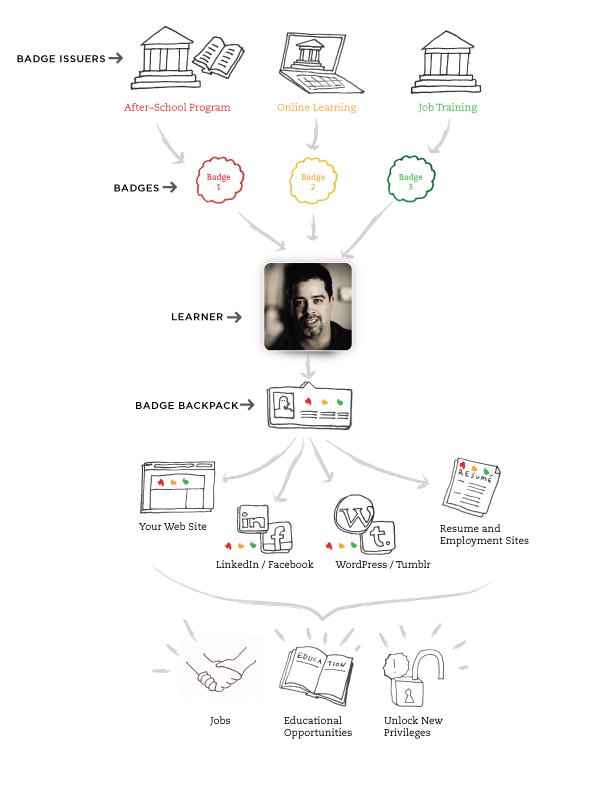
The MacArthur Foundation awarded a two million dollar grant to HASTAC and the Mozilla Foundation (the Firefox people) for the purpose of funding a Digital Media and Learning Competition centered on the building of badge projects and the associated open technical infrastructure to make it all work. Here is how the MacArthur release begins:

Learning happens everywhere and at every age. Traditional measures of achievement, like high school diplomas, GEDs and college degrees, cannot convey the full range of knowledge and skills that students and workers master. To address this issue, the John D. and Catherine T. MacArthur Foundation, HASTAC and Mozilla today announced a $2 million Digital Media and Learning Competition for leading organizations, learning and assessment specialists, designers and technologists to create and test badges and badge systems. The competition will explore ways digital badges can be used to help people learn; demonstrate their skills and knowledge; unlock job, educational and civic opportunities; and open new pipelines to talent.

There is a great deal of discussion of this new program going on online and the conversation suggests that many folks have already invested a lot of brain power into working out the norms, forms, and aims of the emergent badge-based education and credentialing landscape. I am interested and sympathetic but too new to have any deeply informed opinions (beyond my support for the open source software/open standards aspects, my overall belief in the importance of life long learning, and my recognition of plural educational pathways and diverse learning styles/goals).

As I begin to make sense of the badges approach, I can immediately see some ways that the approach would particularly serve some sectors of the world in which I work. Public folklorists have long pursued for themselves and built for their colleagues robust continuing education opportunities of diverse sorts. Public folklorists are very good at continuing to study and master a range of practical skills of a general sort that can apply to their work–video production, GIS systems, database development, etc. They are also good at providing to their professional community field-specific training events outside of the walls of formal higher education. Workshops and similar events are a staple activity whenever public folklorists gather. While these could be seen as standard continuing education activities typical of any profession, they go along with another dimension that is not so uniformly present in professional life, and that is mentoring and collegial support of a real and meaningful sort. Public folklorists to a high degree help, lookout for, coach, and support one another. Resource scarcity could have produced high levels of competition, but in my estimation it has instead fostered a strong communitarian ethos among U.S. public folklorists. (Its not an absolute quality but a relative one.)

It seems to me that this is an ideal kind of environment for badges to strengthen the the workings of what is present already. Public folklorists in particular learn by doing–in internships and in their jobs (something central to the badge scheme), learn through informal channels and in continuing education formats, and learn within a supportive community of practice. As a very clear way of gaining formal recognition for one’s ever growing skill set and as a way of conveying these skills in online and offline ways to employers, granting agencies, community partners, etc. badges seem very promising to me as a framework for strengthening public sector folklore work. Many of these same points could be made in connection to other areas to which I have ties–museum work and applied anthropology. The digital humanities people are of course already very aware of the badges discussion.

One of the best things about badge programs is that they can be organized by a diversity of groups and agencies (unlike formal higher education, which is built around colleges and universities and their slow moving practices).

In addition to the MacArthur release, see also the Mozilla announcement and their “About Open Badges” page, the competition announcement at HASTAC, and these these posts [1] [2] by Audrey Watters at Hack Education.

I know that the badge business will seem crazy based only on my post (what is it? are they patches?). It will make more sense if one goes to these core sources and check it out firsthand.

Want the downside? Want the “What is totally wrong with all of this?” assessment? For a compelling account of the dystopic potential of badges, check out Alex Ried at Digital Digs.

On Museum Anthropology Review

I am very happy to report that the final material for Museum Anthropology Review 5(1-2) was published today, bringing the 2011 volume/issues to a close.

This was the first time that an issue was published with an initial bundle of content and then added to as the year progressed. This represents a kind of transitional strategy bridging older journal publishing norms, in which an issue is prepared and then released into the world as a fully prepared bundle, and the newer pattern in which content is prepared and released into the world as soon as it is ready, item by item. The older pattern has certain hallmarks that many are still fond of, including sequentially paginated pages (in paper-like PDF format) and a table of contents in which articles appear at the top and reviews appear at the bottom. For authors, this format makes for objects that look familiar (to custom-minded observers) on such things as C.V. and annual reports. The cost, of course, is delay in publication, as works pile up in preparation for being bundled up as issues.

The newer approaches leverages the advantages of digital publication platforms and get information in circulation as quickly as possible, something that helps the research community in many ways.

MAR is moving from the older to the newer framework and will probably use the approach adopted for volume 5 again at least for volume 6 next year. This means that volume 6(1) will appear as soon as possible and will initially contain a group of materials from the “top” of the table of contents. Additional reviews will be added to the issue’s table of contents up until the point that additional articles or other content from the top of the table of contents are ready. At that point the effort will switch over to issue 6(2).

Publishing a combined “1-2” issue for 2011 was a valuable step for me personally–beyond these considerations. It allowed me a bit more time this summer to work on other projects, something that I have sorely needed to do. While I had the help of a wonderful graduate student/editorial assistant through the middle of 2010, last academic year (2010-2011) was the first in which I handled the day to day editorial tasks on my own. This was fun and informative, of course, but there is only so much time in the day and it was nice to be able to focus this past summer on other obligations. The combined issue helped make that possible.

From a substantive point of view, 5(1-2) is full of interesting stuff and I am very thankful to the many authors, peer-reviewers, librarians, editorial board members, publishers, and other friends of MAR who have made it possible.

At 154 pages volume 5 is only #4 of 5 in terms of page length, but with 42 discrete contributions it covers a lot of interesting territory, from Captain Cook to the alternative globalization movement; from the history of shoes to the material realities of the current economic crisis. As has been true throughout the MAR experiment, contributions cover a wide diversity of world regions and theoretical, topical, and disciplinary concerns. I am especially proud of the ways that the journal continues to showcase work by the most distinguished senior scholars–generous colleagues such as Richard Bauman, Keith Hart, Marsha MacDowell, Edward T. Linenthal, and Aldona Jonaitis–alongside leading younger scholars, including folks like Karin Zitzewitz, Beth A. Buggenhagen, Elizabeth Hutchinson and so many others. I am also happy that the journal brings together, in what I think is a healthy way, the twinned and entwined concerns that are its focus—museum studies and material culture studies. Rooted in anthropology and folklore studies, MAR has been an effective meeting ground for scholars working in a great many fields. Alongside its folklorists and anthropologists, 5(1-2) features scholars representing the fields of comparative literature, history, art history, fashion studies, architecture, design, communications studies, and religious studies. This diversity is a great strength.

Also speaking to the journal’s diversity aspirations, 5(1-2) was the second issue to feature content in a language other than English. MAR 4(1) had included both French and English versions of Christian Bromberger’s commentrary on the Musée du Quai Branly and now, with 5(1-2) MAR has published a book review concurrently in Portuguese and English. Thanks go to author Lori Hall-Araujo and translator Roberta Crelier for the work on Lori’s review of Mestre Vitalino e artistas pernambucanos.

In conclusion, I wish to especially thank the authors of the issue’s peer-reviewed articles. Richard Bauman’s “Better than any monument”: Envisioning Museums of the Spoken Word is a great contribution to the history of the field, exploring the intersections of linguistic anthropology and museum anthropology. The paper continues his vital research work on the social history of early recording technologies and their intellectual and cultural ramifications. Thanks go to Carrie Hertz’ for her Costuming Potential: Accommodating Unworn Clothes. The article is a rich contribution to contemporary material culture studies, particularly relating to questions of consumption, circulation, reuse, and disposal.

The submission mailbox is always open. Please consider Museum Anthropology Review as a robust not-for-profit, gold open access publishing option for your work in museum and material culture studies.
Florida Folklorist Stetson Kennedy (1916-2011)

I wish to note the passing of fellow Floridian and folklorist Stetson Kennedy. I did not know him, but I admire his work and his remarkable career. As the detailed obituary published Tuesday in the New York Times will suggest, he is very much a person worth knowing about. To have hung out with Woody Guthrie and Zora Neale Hurston, married seven times, and crippled the Ku Klux Klan via a Superman radio show and lived to 94–that’s a life. Rest in Peace.