Skip to content

Posts from the ‘Digital Projects’ Category

On the Harvesting of Low Hanging Fruit #oaweek

In disciplinary contexts, community discussions of open access and related issues in scholarly communications often get bogged down and then stall out. The reasons for this seem to me to be many. For example, participants rooted in their own particular discipline often guess about the meanings attached to key terms rather than finding, and then working from, common definitions established outside their own fields. Similarly, they often approach the various issues as if their subject area was the first, or only, field confronting these issues. In this spirit, considerable effort is then devoted to reinventing the wheel. Beyond the simple fact that the issues are really complicated and can be approached from a large number of perspectives, another problem stems from an all or nothing sensibility. The largest or most intractable problem is often quickly put on the table for consideration and proceeds to becomes a conversation stopper.

Its this last dynamic that I would like to briefly address. Put simply, we do not have to solve the most difficult problems first. Instead, we can search out and harvest the low hanging fruit. Low hanging fruit is easy and inexpensive to gather. Gathering it, we learn and gain experiences (and buy time) that will allow us, eventually, to tackle bigger challenges on the basis of experience gained and lessons learned. When we spend little or no time/money pursuing the smaller, easier prospects, we put less at risk and we can afford to learn from our mistakes. A single fall out of the top of a tree can be catastrophic. Standing on the ground, we can usually stumble and fall countless times without doing ourselves any great harm.

It is in the spirit of making progress in the harvesting of low hanging fruit–wherein significant good can be done in an easy and inexpensive way–that I recently suggested a way in which the conference programs and abstracts of the American Anthropological Association could be made freely available online to all interested users as part of the HathiTrust Digital Library. My recent suggestion of this strategy was offered as small part of an important discussion of the future of the AAA publishing program that was begun on the AAA weblog. It can be found there attached to the first of two posts by Michael F. Brown. The first (on which I commented) can be found here and a second post, dealing with the expense picture for the total AAA publishing program, is here.

Starting with the easier and less risky tasks is also the strategy underpinning the American Folklore Society/Indiana University Bloomington Libraries’ joint project called Open Folklore. Now entering its second year, most of the progress that the project has made so far could be understood as gathering low hanging fruit. What is exciting is that if enough such modest efforts are pursued concurrently, they add up to results that are definitely not a small matter.

Readers interested in looking at the basket into which a large amount of low hanging fruit has been gathered, can consult the project reports of the Open Folklore project. Over the course of three narrative accounts–the first offered at launch, the second offered at the six month mark, and the most recent at the twelve month point–a large diversity of open access accomplishments are described. In and of themselves, each represents a relatively modest resource and a readily accomplished task. Taken together, they represent significant progress towards the goal of making folklore studies a more accessible discipline. No make-or-break revenue streams were harmed in the making of the Open Folklore portal and the work that has been accomplished is as robustly and professionally preserved as is possible in the year 2011.

Like all scholarly societies confronting these questions, the AFS faces giant uncertainties in the years and decades ahead. There are many questions that will eventually need to be faced. For instance, will it ever be possible to make The Journal of American Folklore accessible in a gold OA fashion? Probably, but the pathway to getting there is hardly clear and, for the present, solving the riddles of revenue, expense and organizational sustainability in that context is too big a task. My argument is that there are other ways to make steady progress that do not require us to take on excessive risk or to immediately untie the tightest, most complicated knots.

I encourage interested anthropologists to join the conversation that Michael F. Brown is hosting at the AAA weblog. Folklorists with thoughts on the future of scholarly communications in our field are invited to comment here or to write to me privately.

This post reflects my own thinking on the questions that it addresses and should not be read as an official statement by any of the organizations or projects with which I am associated.
Streaming Video from #AFS11: Attend a Folklore Meeting Online!

Let the #AFS11 posts begin. The 2011 American Folklore Society meetings will be held here in Bloomington on the campus of Indiana University. This is the 1st time since 1968 that the meetings have been held on a college campus (that 1968 meeting was also here at IU). It may be a record meeting in terms of attendance and many innovative program items are going to be debuted. The first of these to mention, and the one of greatest potential interest to those who cannot attend, is the news that selected portions of the meeting will be accessible online via streaming video. In the remainder of this post (below the fold, so to speak) I will share the details. Highlights include the Opening Plenary Address by Henry Glassie  (“War, Peace, and the Folklorist’s Mission”), The Francis Lee Utley Memorial Lecture of the AFS Fellows by Margaret Mills “Achieving the Human: Strategic Essentialism and the Problematics of Communicating across Cultures in Traumatic Times”, and the AFS Presidential Address by C. Kurt Dewhurst “Museums and Folkloristics: Folklorists’ Legacy and Future in Museum Theory and Practice.” This is just a portion of the events that are scheduled to be streamed. Learn the details on how to do it and what is going to be accessible below. (The first two of these three major addresses relate to the conference theme–Peace, War, Folklore. This theme was chosen to articulate with the IU “Themester” theme of Making War, Making Peace. The full conference program is freely accessible here. It contains abstracts for all events.) Read more

@Mukurtu Project Wins Major IMLS Grant

Congratulations to Kim Christen and everyone working on the Mukurtu project on news that the effort has received a major grant from the (U.S.) Institute for Museum and Library Services (announced here). This is a major development for a major project.

As noted on the Mukurtu project site, Mukurtu is “A free and open source community content management system that provides international standards-based tools adaptable to the local cultural protocols and intellectual property systems of Indigenous communities, libraries, archives, and museums.” It is “a flexible archival tool that allows users to protect, preserve and share digital cultural heritage through Mukurtu Core steps and unique Traditional Knowledge licenses.”

Badges! (with Special Reference to Public Folklore) #dmlbadges

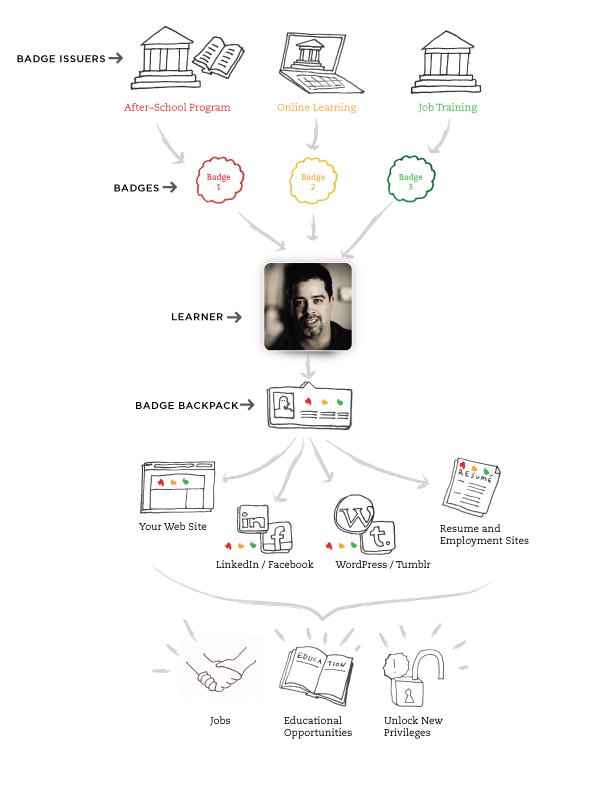
As if the worlds that I try to keep up with were not overflowing already, more and more stuff to keep track of keeps coming. For several months I have wanted to take a few hours to get up to speed on the basics relating to the newer life-long-learning/educational reform/online meaning of badges. I had not quite done this, although I had read a few small online accounts and grasped the concept. I still had not taken time to do this background reading when today the phenomena took on a bigger life today.

The MacArthur Foundation awarded a two million dollar grant to HASTAC and the Mozilla Foundation (the Firefox people) for the purpose of funding a Digital Media and Learning Competition centered on the building of badge projects and the associated open technical infrastructure to make it all work. Here is how the MacArthur release begins:

Learning happens everywhere and at every age. Traditional measures of achievement, like high school diplomas, GEDs and college degrees, cannot convey the full range of knowledge and skills that students and workers master. To address this issue, the John D. and Catherine T. MacArthur Foundation, HASTAC and Mozilla today announced a $2 million Digital Media and Learning Competition for leading organizations, learning and assessment specialists, designers and technologists to create and test badges and badge systems. The competition will explore ways digital badges can be used to help people learn; demonstrate their skills and knowledge; unlock job, educational and civic opportunities; and open new pipelines to talent.

There is a great deal of discussion of this new program going on online and the conversation suggests that many folks have already invested a lot of brain power into working out the norms, forms, and aims of the emergent badge-based education and credentialing landscape. I am interested and sympathetic but too new to have any deeply informed opinions (beyond my support for the open source software/open standards aspects, my overall belief in the importance of life long learning, and my recognition of plural educational pathways and diverse learning styles/goals).

As I begin to make sense of the badges approach, I can immediately see some ways that the approach would particularly serve some sectors of the world in which I work. Public folklorists have long pursued for themselves and built for their colleagues robust continuing education opportunities of diverse sorts. Public folklorists are very good at continuing to study and master a range of practical skills of a general sort that can apply to their work–video production, GIS systems, database development, etc. They are also good at providing to their professional community field-specific training events outside of the walls of formal higher education. Workshops and similar events are a staple activity whenever public folklorists gather. While these could be seen as standard continuing education activities typical of any profession, they go along with another dimension that is not so uniformly present in professional life, and that is mentoring and collegial support of a real and meaningful sort. Public folklorists to a high degree help, lookout for, coach, and support one another. Resource scarcity could have produced high levels of competition, but in my estimation it has instead fostered a strong communitarian ethos among U.S. public folklorists. (Its not an absolute quality but a relative one.)

It seems to me that this is an ideal kind of environment for badges to strengthen the the workings of what is present already. Public folklorists in particular learn by doing–in internships and in their jobs (something central to the badge scheme), learn through informal channels and in continuing education formats, and learn within a supportive community of practice. As a very clear way of gaining formal recognition for one’s ever growing skill set and as a way of conveying these skills in online and offline ways to employers, granting agencies, community partners, etc. badges seem very promising to me as a framework for strengthening public sector folklore work. Many of these same points could be made in connection to other areas to which I have ties–museum work and applied anthropology. The digital humanities people are of course already very aware of the badges discussion.

One of the best things about badge programs is that they can be organized by a diversity of groups and agencies (unlike formal higher education, which is built around colleges and universities and their slow moving practices).

In addition to the MacArthur release, see also the Mozilla announcement and their “About Open Badges” page, the competition announcement at HASTAC, and these these posts [1] [2] by Audrey Watters at Hack Education.

I know that the badge business will seem crazy based only on my post (what is it? are they patches?). It will make more sense if one goes to these core sources and check it out firsthand.

Want the downside? Want the “What is totally wrong with all of this?” assessment? For a compelling account of the dystopic potential of badges, check out Alex Ried at Digital Digs.

On Duke University Press’ Partnership with HathiTrust

News of Duke University Press’ new partnership with HathiTrust Digital Library is discussed [behind a paywall] in a new story by Jennifer Howard in the Chronicle of Higher Education. When an openly accessible press release is issued by HathiTrust or by Duke University Press, I will add a link to it.

This agreement is very promising, as it indicates that a significant body of in-copyright Duke titles are going to be made freely available via HathiTrust.

On Hacking the Academy #hackacad

I am very pleased to note that the edited book version of Hacking the Academy appeared online today. The online version lives on a site built by the volume’s publisher Digital Culture Books, an imprint of the University of Michigan Press. The volume has been edited by Dan Cohen and Tom Scheinfeldt, both of the Center for History and New Media. It is based on contributions submitted during one week–May 21-28, 2010.

I am very pleased to have been included in this volume and I want to thank the editors, the publisher, and all those who supported the project, including the many readers and cheerleaders who offered encouragement to the effort.

My chapter in the volume is based on an essay that originally appeared on this site (where the longer, older version can still be found). In the book, it is the first chapter of the “Hacking Scholarship” section. As with the earlier version, it is titled “Getting Yourself Out of the Business in Five Easy Steps” and it offers an argument for withdrawing, where possible, from entanglements with commercial academic publishing in favor of lending energy, support, and resources to the strengthening of the existing public-sector scholarly communications system and to the building of a more democratic, ethical, sustainable, and open one for the future. It thus relates directly to my more recent post on the enclosure of scholarly journals in anthropology (and to other things that I do, including working on the Open Folklore project and editing Museum Anthropology Review.

I am so thankful to everyone who has engaged not only with the essay but with me in the larger work of understanding and reshaping the ways scholars share their work with the world. The biggest shout out of all, in this regards, goes to my colleagues at the Indiana University Libraries and the IUScholarWorks program. They have been my teachers and tremendous partners in the work. They are awesome!

The old-fashioned version of Hacking the Academy will be published next year. Find the online version here: http://www.digitalculture.org/hacking-the-academy/

Dan Cohen’s reflections on the project can be found online here: http://www.dancohen.org/2011/09/08/some-thoughts-on-the-hacking-the-academy-process-and-model/

Oklahoma Native Language and History Projects Making Progress

A round up of some good news Oklahoma.

The team at the Euchee (Yuchi) History Project has published an account of the project’s work in the prestigious journal Native South. Native South is published by the University of Nebraska Press and is made available electronically via Project Muse. The article, by Stephen A. Martin and Adam Recvlohe,  is titled, appropriately enough “The Euchee (Yuchi) History Project.” It is accessible (toll access) here: http://muse.jhu.edu/journals/native_south/v004/4.martin.html

The National Endowment for the Humanities and the National Science Foundation have announced a series of grant awards under the Documenting Endangered Languages program. I would like to highlight the following projects pursued by friends and acquaintances and to congratulate all the grantees. Durbin Feeling (Cherokee Nation) and colleagues have received funding for “Collaborative Research: Documenting Cherokee Tone and Vowel Length.” James Rementer and colleagues at the Delaware Tribe have been awarded a grant for “Lenape Language Database Project.” Mary Linn and Amber Neely have been funded for Amber’s dissertation research on “Speaking Kiowa Today” and Sean O’Neill and Elizabeth Kickham have received support for “Choctaw Language Ideologies and their Impact on Teaching and Learning,” Elizabeth’s doctoral research. Rounding out the good news for Oklahoma language efforts, Mary Linn and Colleen Fitzgerald have received additional support for the ongoing “Oklahoma Breath of Life Workshop and Documentation Project.” Congratulations to all of these language workers and the communities that stand behind them in support! Read the NEH/NSF press release here: http://www.neh.gov/news/archive/20110809.html

The Program for #AAA2011

Just got access to the preliminary program for the 2011 American Anthropological Association meetings this November in Montreal.

I will be participating in a AAA organized forum called The Future of AAA Publishing: A Forum for Discussion. In this event, I will address issues associated with green open access and the use of institutional (and other kinds of) repositories. This event begins at 1:45 on Friday afternoon.

I will also be part of a panel titled Digital Anthropology: Projects and Projections that has been organized by Kim Fortun. My presentation is Another World Is Possible: Open Folklore As Library-Scholarly Society Partnership. This panel happens first thing on Sunday morning.

I have only begun scouting out the program, but I see a lot of friends are scattered across it. I look forward to figuring out what is what and to attending.

AFS Ethnographic Thesaurus Now Part of @openfolklore

An exciting development in the Open Folklore project is the inclusion of the AFS Ethnographic Thesaurus within the Open Folklore portal. This great advance was announced on the AFS website and at the Open Folklore portal. The ET is a valuable resource for folklore studies, ethnomusicology, cultural anthropology, and other ethnographic disciplines. Thanks to everyone at AFS, LoC, and IU who worked to make this next phase of both projects possible.

Recording of the Creative Commons Webinar Now Online

I should have noted it previously, but the excellent folks at Traditional Arts Indiana have gotten the recording of my early summer webinar on the Creative Commons up online. If you missed it and are just dying to check it out, the details (and a link to the recording) can be found on the TAI website here. Thanks to TAI for organizing this event. I am glad that the more recent TAI Webinars that have been successful. Details on all this activity can be found on the TAI webpage at http://www.traditionalartsindiana.org.

See my earlier post on this event here.