Skip to content

Regular People Don’t Need Access to Scholarship

In his widely circulated counter-rant, titled “Uninformed, Unhinged, and Unfair–The Monbiot Rant,” Kent Anderson, publisher of the Journal of Bone and Joint Surgery and the Editor-in-Chief of The Scholarly Kitchen, attacks George Monbiot’s 29 August 2011 Guardian article “Academic Publishers Make Murdock Look Like a Socialist.” Fundamental to his argument is claiming that Monbiot is mistaken to believe that non-scholars need access to scholarly knowledge to be engaged citizens. He wants to show that non-specialists do not need access to specialist knowledge and one way to do this is to show that if they had such access that they would not know what to do with it. To achieve this rhetorical effect, he quotes from a scholarly paper in medicine discussing “inthrathoracic herniation of the liver” and makes the case that only deep specialists could make any sense of it. He notes: “Specialist knowledge is a prerequisite.”

This thread in the argument–and he is not alone in making such a case–is just bogus. While social work, history, law, education (consider the literature on home-schooling, for instance) and countless other fields have scholarly literatures of immediate relevance to, and that are understandable by, literate members of the non-scholarly community, it is easiest to illustrate my point with work in ethnographic fields like folklore studies and anthropology.

It would have been particularly fun to look deeply enough and to find a lost or not-so-lost relative of Kent Anderson’s who has been a consultant for ethnographic research that has gone on to be published, but a more generic example will serve. The the Journal of Bone and Joint Surgery is published outside Boston, MA. Lets assume that someone associated with the journal actually lives and works there. A hypothetical worker in the JBJS workplace hears, at a family reunion, that an important member of the family had a scholarly article written about them back in the 1970s. Curious (they are writing a family history, after all) they get online and they discover the paper about a beloved family member. It might read something like this Massachusetts example, the first example that I could find, found in a folklore journal and accessed via JSTOR.

Ron is in his thirties, married, with two children. He attended high school in a large New England city during the fifties, and his interests led him to the city’s vocational school from which he graduated having completed the welding program. Bright, well-spoken and articulate, he is aware that during his high school career vocational high schools were viewed with suspicion and generally thought to be reserved for “dummies.” His present success proves this over-simplification to be at least occasionally inaccurate.

After graduating from high school, Ron enlisted in the Air Force where he continued his training in welding. Aircraft quality welding requires a high degree of expertise and close attention to quality control, and materials used in this type of welding are frequently exotic metals which must be welded in an inert gas environment to avoid oxidation of the metals which would cause unsafe, brittle welds. Ron’s Air Force experience did much to increase the level of his skills.

The subject of this article is/would now probably be in his 60s and his children and grandchildren are probably internet users.  Can they understand this deeply arcane prose, this jargon-rich scholarly language?  Do they really have any legitimate right to, or need to, be able to access an article about their father?

The economics of scholarly publishing are complex, but the ethical and moral issues are not. Arguments that claim that regular people have no need for the scholarly literature are bunk.
#HathiTrust Partnering with Rights-holders

This note represents my own personal views and is not an official organizational statement of any kind.

It is a terrible shame that so many scholars, as well as members of the broader public, are only learning about the important public-interest work of the HathiTrust Digital Library as a consequence of the unfortunate and counter-productive (in my view) lawsuit brought against the organization and its university partners by The Authors Guild and a group of associates. More articulate voices than mine have been speaking of this issue and there are now many discussions available online. A summary story by Steve Kolowich is freely available via Inside Higher Education. Reflecting my perspective is the remarkable piece, “An Open Letter to J.R. Salamanca” by Kevin Smith, the Scholarly Communications Officer at Duke University.

What I want to flag here in the smaller corner of the larger landscape in which I work is the very important work that HathiTrust is doing in cooperation with rights-holders to in-copyright works. My case is from the Open Folklore project on which I work. On both our end (the Open Folklore project team) and on the HathiTrust end, we are still working out strategies, processes, and techniques, but already we have succeeded in partnering together with rights-holders to make very important journal titles for the field of folklore studies freely available to interested users. This is done with the full involvement and consent of the copyright holders and the outcome is a real gain for the world of scholarship and for the many communities who look with interest to the documentary record of human culture and creativity that folklorists have compiled.

HathiTrust is a human-built institution and like other human-built institutions, including most especially The Author’s Guild and U.S. copyright law, it has flaws. When considering the loud noises being made by those seeking to call these flaws to the world’s attention, keep in mind the purposes that HathiTrust was established to address: “The mission of HathiTrust is to contribute to the common good by collecting, organizing, preserving, communicating, and sharing the record of human knowledge.” What purposes do those who are working to shame and discredit HathiTrust serve?

Want to see full text of journals that the Open Folklore project and HathiTrust have made available through generous partnership with the relevant rights-holders?

As is shown on the Open Folklore portal site, we have a very significant number of other in-copyright journal titles ready to be made openly accessible in this way. The rights-holders have already said yes. Its just a matter of moving these works through the relevant permissions and technical systems with HathiTrust. It is deeply discouraging that so many resources–time and attention most of all–are having to be redeployed to deal with The Author’s Guild’s suit (when, The Author’s Guild could instead be a partner and join collaboratively in this work). These resources could be better used for advancing shared goals, such as the desire by rights-holders to make scholarly journals (and books) freely available via HathiTrust.

Given The Author’s Guild’s apparent love of official snarky comments published online, I’ll just close by saying that you could not pay me (as an author of books) to join the The Author’s Guild after watching the organization at work over the past week or so.

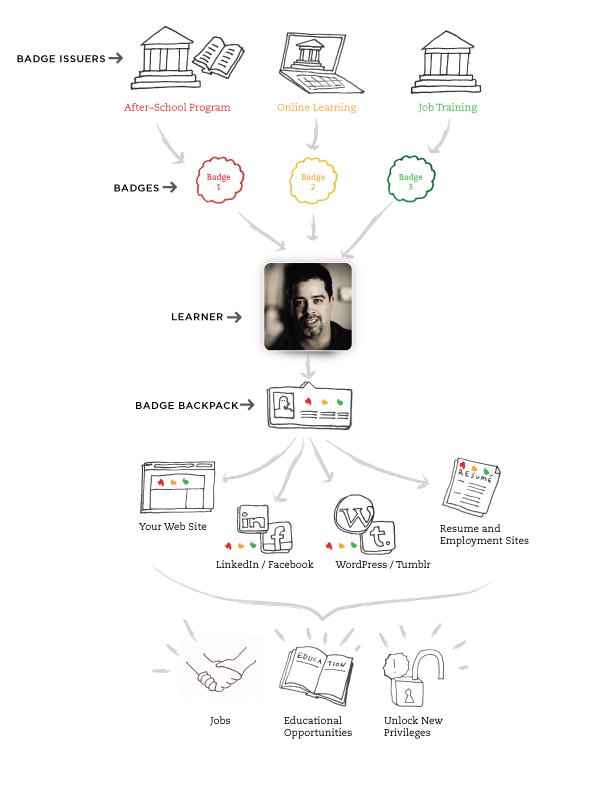
Badges! (with Special Reference to Public Folklore) #dmlbadges

As if the worlds that I try to keep up with were not overflowing already, more and more stuff to keep track of keeps coming. For several months I have wanted to take a few hours to get up to speed on the basics relating to the newer life-long-learning/educational reform/online meaning of badges. I had not quite done this, although I had read a few small online accounts and grasped the concept. I still had not taken time to do this background reading when today the phenomena took on a bigger life today.

The MacArthur Foundation awarded a two million dollar grant to HASTAC and the Mozilla Foundation (the Firefox people) for the purpose of funding a Digital Media and Learning Competition centered on the building of badge projects and the associated open technical infrastructure to make it all work. Here is how the MacArthur release begins:

Learning happens everywhere and at every age. Traditional measures of achievement, like high school diplomas, GEDs and college degrees, cannot convey the full range of knowledge and skills that students and workers master. To address this issue, the John D. and Catherine T. MacArthur Foundation, HASTAC and Mozilla today announced a $2 million Digital Media and Learning Competition for leading organizations, learning and assessment specialists, designers and technologists to create and test badges and badge systems. The competition will explore ways digital badges can be used to help people learn; demonstrate their skills and knowledge; unlock job, educational and civic opportunities; and open new pipelines to talent.

There is a great deal of discussion of this new program going on online and the conversation suggests that many folks have already invested a lot of brain power into working out the norms, forms, and aims of the emergent badge-based education and credentialing landscape. I am interested and sympathetic but too new to have any deeply informed opinions (beyond my support for the open source software/open standards aspects, my overall belief in the importance of life long learning, and my recognition of plural educational pathways and diverse learning styles/goals).

As I begin to make sense of the badges approach, I can immediately see some ways that the approach would particularly serve some sectors of the world in which I work. Public folklorists have long pursued for themselves and built for their colleagues robust continuing education opportunities of diverse sorts. Public folklorists are very good at continuing to study and master a range of practical skills of a general sort that can apply to their work–video production, GIS systems, database development, etc. They are also good at providing to their professional community field-specific training events outside of the walls of formal higher education. Workshops and similar events are a staple activity whenever public folklorists gather. While these could be seen as standard continuing education activities typical of any profession, they go along with another dimension that is not so uniformly present in professional life, and that is mentoring and collegial support of a real and meaningful sort. Public folklorists to a high degree help, lookout for, coach, and support one another. Resource scarcity could have produced high levels of competition, but in my estimation it has instead fostered a strong communitarian ethos among U.S. public folklorists. (Its not an absolute quality but a relative one.)

It seems to me that this is an ideal kind of environment for badges to strengthen the the workings of what is present already. Public folklorists in particular learn by doing–in internships and in their jobs (something central to the badge scheme), learn through informal channels and in continuing education formats, and learn within a supportive community of practice. As a very clear way of gaining formal recognition for one’s ever growing skill set and as a way of conveying these skills in online and offline ways to employers, granting agencies, community partners, etc. badges seem very promising to me as a framework for strengthening public sector folklore work. Many of these same points could be made in connection to other areas to which I have ties–museum work and applied anthropology. The digital humanities people are of course already very aware of the badges discussion.

One of the best things about badge programs is that they can be organized by a diversity of groups and agencies (unlike formal higher education, which is built around colleges and universities and their slow moving practices).

In addition to the MacArthur release, see also the Mozilla announcement and their “About Open Badges” page, the competition announcement at HASTAC, and these these posts [1] [2] by Audrey Watters at Hack Education.

I know that the badge business will seem crazy based only on my post (what is it? are they patches?). It will make more sense if one goes to these core sources and check it out firsthand.

Want the downside? Want the “What is totally wrong with all of this?” assessment? For a compelling account of the dystopic potential of badges, check out Alex Ried at Digital Digs.

On “Visualizing the Uneven Geographies of Knowledge Production and Circulation”

Last night I had a chance to attend the Richard Bauman Lecture, a wonderful annual event in the Department of Communication and Culture at Indiana University that honors one of my teachers-turned-colleagues Richard Bauman. This year’s lecture was delivered by anthropologist (and friend of folklore studies) Don Brenneis of the Department of Anthropology at UC Santa Cruz. I hope to reflect more on his lecture soon, but some visualization graphics published in today’s issue of Inside Higher Education relate closely to his talk, which dealt broadly (and critically) with current transformations in knowledge work and higher education. He had come critical things to say about the growing hegemony of such processes  (recently discussed here, on Savage Minds, and elsewhere) as Impact Factor analysis, journal rankings, etc. Subject to the kind of critique that Brenneis was offering in his talk, the three images published today in IHE also speak to the transformations that he was describing.

Most relevant here is the way that the third graph (shown above) pictures the scale and centrality of the big five commercial publishers that I also discussed in the recent post that has gotten so much attention from readers (thanks all). Everyone should look at the original images in IHE, but the one shown in a small format above is the third of the three. The five largest rectangles represent Elsevier (upper left corner), Springer (to Elsevier’s right), Wiley (middle left), Taylor and Francis (bottom left) and Sage (on the inner corner adjacent to Elsevier, Springer, and Wiley). These are the same five who between them control just under half of the anthropology journals tracked and ranked by Thompson Reuters for such metrics as Impact Factor and Half-Life. I point to the image here because it speaks to the dominance of these large firms over all of scholarly publishing. Burying the lead again, I’ll just say that I resist rather than stand with these publishers.

Visualizing the uneven geographies of knowledge production and circulation – Inside Higher Ed.

PS: I should have noted that the IHE gleaning comes originally from a full report:

Graham, M., Hale, S. A., and Stephens, M. (2011) Geographies of the World’s Knowledge, London, Convoco! Edition.

I consulted the original version of the image shown above to see who some of the smaller publishers shown are. Not-for-profits who are large enough to be labeled include Annual Reviews and the University of Chicago Press (about the same size) and slightly smaller, MIT Press and Johns Hopkins University Press. Chicago, MIT, and JHU are among the largest of the university press journal publishers. It is in the nature of the visualization that the many smaller publishers are represented with squares/rectangles that are too small to label.

How to Hack Academic Book Publishing in Two (Not So) Easy Steps – IHE #hackacad

A wonderfully engaged, positive review of Hacking the Academy by Barbara Fister is in today’s issue of Inside Higher Education. Thank you Barbara.

How to Hack Academic Book Publishing in Two (Not So) Easy Steps – Inside Higher Ed.

Authors Guild Sues HathiTrust and 5 Universities Over Digitized Books

Boo. Authors Guild and others are suing HathiTrust, U Michigan, Indiana U, etc.
http://chronicle.com/blogs/ticker/authors-guild-sues-hathitrust-5-universities-over-digitized-books/36178

Folklore Studies and Anthropology Journals included in JSTOR Early Journal Content Program

Among the folklore and anthropology journals included in the JSTOR Early Journal Content Program are the following key titles. Journal of American Folklore (1888-1922), American Anthropologist (1879-1922),  The Journal of the Royal Anthropological Institute (1848-1869) and the International Journal of American Linguistics (1917-1922),  Today JSTOR released an announcement indicating that the release of content was complete and providing an announcement that included lists by discipline and title.

Numerous other titles of relevance in archaeology, history, geography, etc. are also included, of course.

On Duke University Press’ Partnership with HathiTrust

News of Duke University Press’ new partnership with HathiTrust Digital Library is discussed [behind a paywall] in a new story by Jennifer Howard in the Chronicle of Higher Education. When an openly accessible press release is issued by HathiTrust or by Duke University Press, I will add a link to it.

This agreement is very promising, as it indicates that a significant body of in-copyright Duke titles are going to be made freely available via HathiTrust.

When Ads Attack

Sometime last week I happened to see what my website looks like when I am not logged in and I discovered the new [or new to me] feature in which wordpress.com serves up ads to [not-logged-in] wordpress.com visitors. As the WP folks note: “At WordPress.com, we sometimes display discreet AdSense advertisements on your blog to help pay the bills. This keeps free features free!”

I appreciate the service that wordpress provides to me but I also do not wish to have ads on my website, thus happily I discovered today that I can pay a yearly fee to remove the ads from the site. I have done this and hopefully this step will keep the ads away going forward. I apologize for the ads that have been present in recent weeks (months?). I did not see them on my side or I would have taken care of this sooner.

While it was already newly arrived on my radar, thanks go to Adam Fish for noticing this phenomena and highlighting the discordance of the ads in the context of my website given the kinds of open access, open source, public-interest topics that I often reflect on here. As a specialist in the cultures of media and media production, Adam would be better prepared than I am to reflect on the wider implications of the “discreet AdSense advertisements” (to use WP’s language) that are now a part of the wordpress ecology.

I value many services that are supported through underwriting and advertisements so I am not against ads in a wholesale way. Its just not what I want here and I am very glad that I have the option of paying to make them disappear.

WP.com users can learn more here: http://en.support.wordpress.com/no-ads/

Barbara Kirshenblatt-Gimblett and the Museum of the History of Polish Jews

Barbara Kirshenblatt-Gimblett and the Museum of the History of Polish Jews [A discussion of her current museum project in the online journal Habitus.]