Skip to content

Matthew Guterl on The Future of the Library/Libraries

A fellow faculty participant in the November 2, 2011 “Faculty Discussion on the Future of University Libraries” held at Indiana University under the sponsorship of the Dean of Libraries and the Provost was my Department of American Studies colleague Matthew Guterl. Matt is Rudy Professor of American Studies and History and the Chair of the the Department of American Studies. A historian of race and race-relations in the Americas, he is the author of numerous key works in American Studies, including The Color of Race in America, 1900-1940 (Harvard University Press, 2001) and American Mediterranean: Southern Slaveholders in the Age of Emancipation (Harvard University Press, 2008). This site does not have a flashy title like The Edge of the American West, Crooked Timber, or Savage Minds but it is fun to welcome such a talented guest contributor to the blog part of my website. Rather than see them filed away unread, here are Matt’s thoughtful reflections on the future of libraries at IU and everywhere.

“The Future of the Library/Libraries”

Matthew Pratt Guterl

I haven’t been to the big limestone box on Jordan in over a year, but I use the library every day.

Once I needed to use the Reader’s Guide to Periodical Literature; now I use Google.  I used to check the stacks; now I just search by keyword on Project Muse, or wait for a Google Scholar alert to arrive in my inbox.  I used to store my handwritten notes and copies in fireproof boxes or plastic crates; now I have digital reproductions of the entire archive of my current project stored on my phone.

The last time I was there, in the Wells Library, it was for coffee and donuts.

Maybe the future of the library is not the same thing as the future of that building.
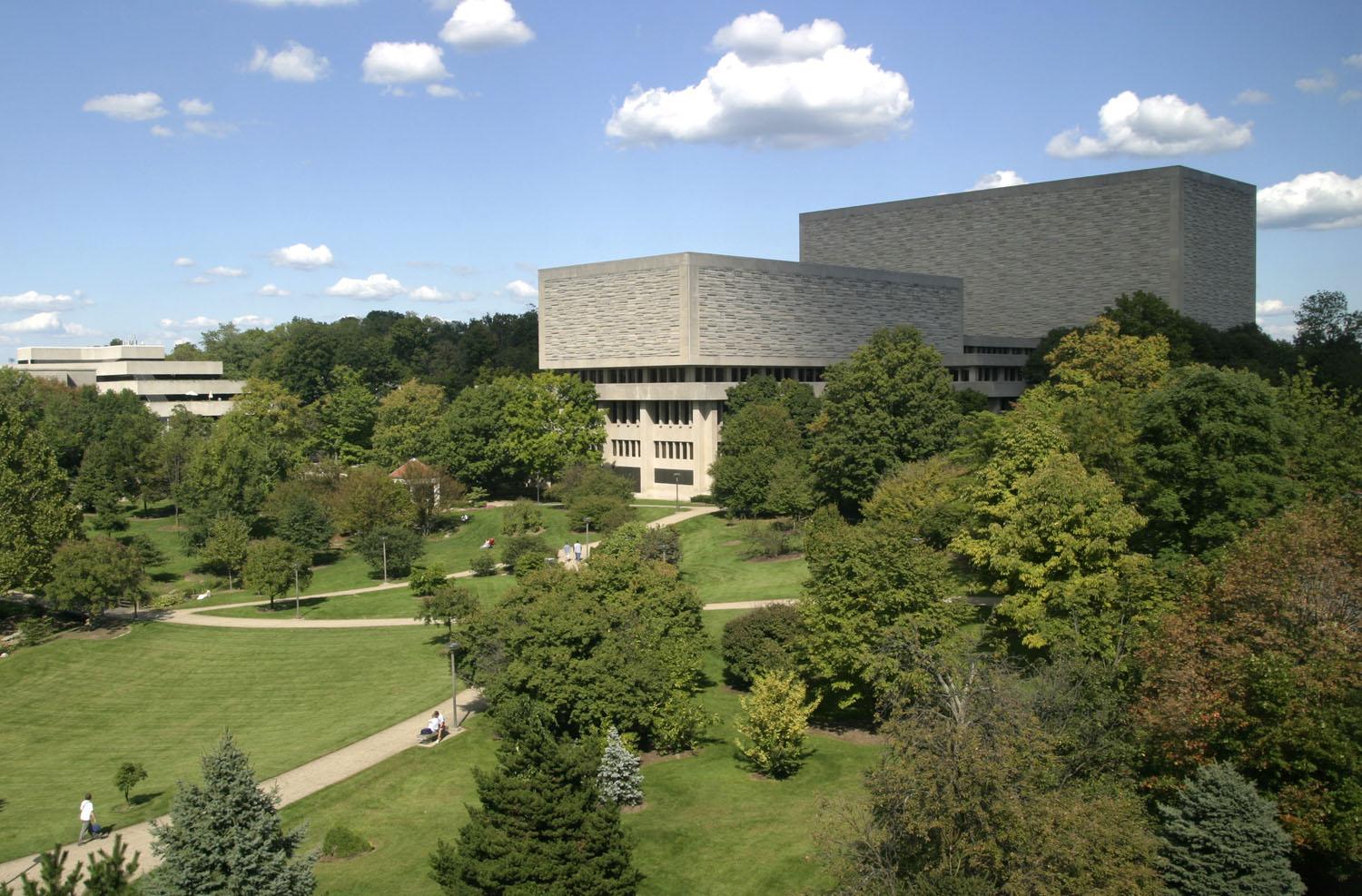
Wells Library, Bloomington, Indiana. Courtesy of Indiana University.

After all, even if I’ve been absent physically, I’ve clicked on the IU Libraries link more times than I can count, and trolled through its rich databases with great delight.  I have more need of the library-in-the-abstract than ever before.

The big limestone box – and all that it includes – is still important.  But ours is not the Fitchburg State library, and IU isn’t a second tier, branch campus.  When I wonder about the short-term future of “real” academic libraries with walls and windows and floors, my thoughts race to Rutgers-Newark, to IU-East, or Washington State-Tri-Cities, or Lincoln University, the places most likely to be first erased by budget cutting and spatial reallocation.  I think about small town libraries in places less well off than Bloomington.  I think about corporate libraries and law firm libraries and museum libraries.  I think about the impending extinction of the bookshelf at the old ski lodge, or the hotel lobby, where the accidental discovery of some old Faulkner text, or some Philip K. Dick collection, encourages a new thought. Our research library – the Wells Library – may be safe, for now.  These other, less secure sites, are not.

I worry, after thinking about all of this, about the right now, and about short term access for the less fortunate, confronted with the boxing up of the local library stacks, however meager, or the end of the hard copy, however scarce, and about the corresponding absence of laptops and ipads and wifi, which we imagine as open substitutes, available to anyone, in this age of receding material reality.

Yes, the Wells Library will survive for some time, much like the 42nd Street Branch of the New York Public Library, or the Library Company in Philadelphia.  The scale of the architecture ensures that, as does the vastness of the collections and the professionalism of the research faculty.  Such places, awe-inspiring and beautiful, still generate new knowledge, even while they also encourage new and necessarily generous donations, and serve as delightful backdrops for critical fundraising campaigns.  But eventually, perhaps inevitably, as the library becomes ever more disembodied, even these historic buildings may become repurposed reliquaries, like old Masonic temples turned into state office buildings, or old movie theatres turned into restaurants, or old plantations turned into museums and beds and breakfasts.  Or, like abandoned factories, they will simply be emptied of content and left to fall apart, or turned into loft apartments.

Of course, for those of us caught up in the past, it is easy to get nostalgic about what is lost in this transition.  I remember the smell of my first public library, nestled in a retrofitted old fire station next to my childhood home.  I remember reading Santayana on the steps of the New York Public Library, waiting for the doors to open, and excited about what might be revealed within.  I remember the pleasure of waiting for something to arrive, for my call number to light up, or of finding something unexpected, and of the pervasive smell of glue and paper and ink.   I remember discovering a letter, misfiled under the wrong name, proving what I thought to be a powerful point.   In my most troubled moments, I grow concerned that all of this – this set of possibilities, this travail – will be lost.

Nostalgia, though, is the conservative reflex of those confronted by rapid change.  And so I push back against it.  I imagine what is possible in our future.  And I think, instead, of how cool it will be when the poorest person in the world can press a button – even if the button is worn, and the screen is dingy – and call up the complete works of Toni Morrison, linked to every video interview she’s ever given, and joined with her correspondence, archived in public and for free.  As a public university now more indebted than ever to a bigger, more global “public,” we have a big role in making this future possible.

I’m not sure that this utopic vision includes the bricks-and-mortar of the Wells Library, though it surely includes research librarians.  In many ways, it is the antithesis of this place, which has more in common with the Royal Library at Alexandria than it does with Google books.  And I remember that when the College’s Strategic Planning Committee met a few years ago, we half-joked about creating a rooftop biergarten, with crystal slides to the ground floor.  But this vision most certainly includes the library as a liberal ideal, with a social function worth expanding, a political mission worth protecting, and a research agenda that deserves better articulation.

Open Access Proposals Made at an IU Faculty Forum on the Future of Libraries

What follows are the remarks and proposals that I offered during the libraries-focused event held today at Indiana University. Hosted by IU Provost Karen Hansen and Dean of the Libraries Brenda Johnson, the event was framed as “A Faculty Discussion on the Future of University Libraries.” I was one of eight members of the faculty invited to offer 5 minute reflections on the questions before the assembly. I took the opportunity to suggest that the time has come for the IU faculty to get moving toward a green OA mandate. A proposal towards that goal, and two related ends, are expressed in my comments, which I share here for those who might be interested. The opening remarks and slides by the Provost and the Dean did a nice job framing the issues and my fellow panelists all offered important reflections and goals. The event was very well attended and I thank everyone involved in organizing and attending the gathering. I think that the event was a good step forward towards additional discussions and the work ahead.

I want to thank Dean Johnson and Provost Hansen for their kind invitation to participate in today’s discussion. This afternoon, I wish to carefully offer three proposals while keeping to the allotted five minutes. This context explains my pre-preparation of these remarks.

I am not speaking on anyone else’s behalf, but my suggestions are conditioned by my past experiences, present commitments, and the collaborative projects on which I am working. My efforts as a curator, teacher, researcher, journal editor, library committee member, scholarly society board member, and collaborator working with disadvantaged communities still dealing with the legacies of colonialism, all shape my concerns and motivate my efforts as an activist for scholarly communications reform. My knowledge of the current scholarly communications system and its prospects have been profoundly shaped through my collaborations with librarians and technologists at the IU Libraries and I appreciate the many ways that they have supported and taught me. I have tremendous appreciation for all that the Libraries are doing to support my work and that of my students and colleagues.

I look forward to our discussions of the full range of topics surveyed by the Provost and the Dean, but my proposals focus on the activity that we once called publishing and the changing ways that the libraries engage with it. My hope is to provoke the faculty to take greater ownership in the work of scholarly communication and thereby to partner more meaningfully with our library in fostering a more equitable, ethical, sustainable and sensible communications and learning environment for ourselves, for the communities that need our work, for our debt-crushed students, and for every lifelong learner, regardless of their ability to pay to access our scholarship.

Later I will be very willing to provide needed background, but the most economical approach for me now is to just offer my three proposals for the faculty to consider. The IU Libraries are contributing in a number of key ways to an international effort to protect and improve the scholarly communications system, but without broader leadership here on our campus, there are limits to what can be accomplished. I have tremendous hope for what we might do by working together. Here goes:

  1. I propose that the Bloomington Faculty Council, in consultation with the Dean of the Libraries, the Office of the Provost, and the Vice Provost for Faculty and Academic Affairs, begin formal work towards what is known as a green open access mandate for faculty on the Bloomington campus. With mandates already in place at Harvard, MIT, California, Oberlin, Kansas and hundreds of other institutions worldwide, we are prepared to take advantage of the experiences of those who have preceded us on this path. Our leadership in IT, our international commitments, the prominence of our scholarship, and the stature of our library insure our success in such a venture. Delay wrongly suggests that we are not an institution of the first rank. Read more

Remembering Kara Bayless (1982-2010)

The wonderful memorial statements authored by American Folklore Society members and read publicly at the opening ceremonies of the 2011 AFS meetings are now online on the AFS website. Among them is a beautifully written statement about Kara Bayless an amazing Oklahoman, folklorist, and doctoral student in my home department. A star student, Kara was enrolled in my seminar at the time of her tragic passing last year during the 2010 AFS meetings. She is so missed by her many friends and colleagues.

Also remembered at the meetings, with statements now on the website were three distinguished elders in the field. Stetson Kennedy (1916-2011), Roger E. Mitchell (1925-2011) and Kathryn Tucker Windham (1918-2011).

Learn about their lives and work here: http://www.afsnet.org/?InMemorium

Libraries’ Collections and Services: Changing Expectations

Here at Indiana University, I am really looking forward to being part of a campus-wide discussion tomorrow that has been organized by the Provost and the Dean of the Libraries. The focus of the event is the future of research libraries in general and at Indiana University in particular. Much time will be devoted to general discussion with attendees, but the Provost and Dean will offer framing comments and I am part of a faculty panel with great campus colleagues. We will each offer five minutes of commentary to foster the general discussion. I am very appreciative of the Provost and Dean for organizing this event on questions so crucial to the future of the university and of scholarship in general. It will be interesting to see where things will go through and beyond this gathering.

Our Provost is headed to a position at her alma matter, the University of Minnesota. Having myself participated as a guest in cognate discussions with excellent librarians and faculty there, I have hope that our discussions in Bloomington will serve her well when she gets to Minnesota. IU and UM are both amazingly fortunate to have such excellent, forward looking librarians and great libraries.

Folklorist and Technology Writer Audrey Watters @audreywatters Now Blogging at Insider Higher Education

Folklorist (M.A. in folklore from the University of Oregon, 2000) and technology writer Audrey Watters has a new column/blog at Inside Higher Education, the free daily newspaper for the higher education community. It is called Hack [Higher] Education. Describing the goals for the blog, she writes:

In this blog, I plan to address some of the developments in the tech industry and analyze how these might impact teaching, learning, institutions, teachers, students. But I’m also just as intrigued by the possibilities of the inverse:  how will education “hack” technology?  In other words, how will teachers and students and institutions “hack” technology back? How will a new era of technology and a new generation of technology users challenge some of the institutional practices, policies, and power-players both in education and in education technology? … My posts on Inside Higher Ed will — like me — traverse both the worlds of academia and the worlds of “hackers” (or at least the worlds of technology companies, both established and upstart).

Her first column/post can be found here. Congratulations Audrey.

If robots write one of these biographies about you, will you purchase it?

Its crazy stuff like this that makes my senior colleagues so dubious about the internet in general and the changing publications landscape in particular.

I follow a twitter feed called Anthropology Books. I have never investigated who put it together and I do not know anything about it except that it has been useful to me. Using some kind of automated approach, the person or software behind Anthropology Books has been very usefully telling me (and about 1000 other folks) about “All new anthropology books posted on their publication day.” If a title seems interesting, there is a link that takes one to the book’s Amazon.com page.

Today, books with the names of famous and not-so-famous anthropologists (and folklorists) started showing up in the stream today. Alan Dundes was one that caught my eye first. He is very important figure in folklore studies and a very good candidate for a proper biography. Other names started showing up, including those of active colleagues who are basically my own age! They all had unfamiliar to me authors and publishers.  There was a flood of them today.

Looking at the books on Amazon.com, one is (sometimes) confronted with the information that “the content of this book primarily consists of articles available from Wikipedia or other free sources online.” I took this quote from the book on Dorothy Eggan. This 84 page book is selling for $47.00 and has been published by Lect Publishing. The book is credited to the editorship of Nuadha Trev. This editor shows up in Amazon.com as the person behind about 3000 books. Lect Publishing is only one of several names associated with the same basic project and Nuadha Trev is only one of several editors.

I know that others have been writing a lot recently about Amazon’s publishing toolkit. Also at issue here is the CC licensing of Wikipedia etc. content. The student publishing group that I work with here at Indiana–Trickster Press–makes great use of CreateSpace+Amazon for the publication of real peer-reviewed monographs and I am certainly appreciative of, and in debt to, the Creative Commons. These resources are not to blame for the creation of this kind of spam-like books, but I think that they represent a problem on several fronts. Perhaps it is enough to say that they give the Creative Commons, Wikipedia, Amazon, remix, and scholarly communications reform a bad name.

I would love to know who would purchase one of these books. Maybe some of them are traps designed to extract cash out of their living subjects. Here is an example. The publisher “Fedel” has just published a 108 page/$54 book on ethnomusicologist/linguist/anthropologist Aaron Fox. (He and I know people in common but are not yet acquainted.) Would Professor Fox feel like he had no choice but to purchase this book to see what it said about him? Would I feel similarly compelled if one were published on me? His is one of about 3000 titles edited by “Christabel Donatienne Ruby”, but does Christabel Donatienne Ruby actually exist?

I would also love to know about the technical infrastructure that automatically (?) assembles these books and feeds them into Amazon. Anybody understand this stuff?

Update:  Thankfully the people behind the wikipedia article for VDM Publishing seem to understand it pretty well. For background, see the entry here. See also the discussion on slashdot here.

AFS Releases Lay and Expert Knowledge Project Reports #oaweek

In time for Open Access Week, the American Folklore Society and the Center for Folklore Studies at The Ohio State University have just made available a collection of reports and working papers derived from the Society’s project on Lay and Expert Knowledge in a Complex Society. This two-year project was funded by the Teagle Foundation as part of its “Big Questions and the Disciplines” program and focused examined undergraduate teaching of folklore in the contemporary world.

These materials are available now as volume 2 of the series Working Papers of the Center for Folklore Studies under the editorship of PIs Dorothy Noyes and Timothy Lloyd. This working paper series is made available through the OSU KnowledgeBank (the OSU institutional repository) and are harvested for search (OAI-PMH interoperability!) through the Open Folklore portal.

It has been an honor to participate in this project and I am super happy that first rate open access strategies are being used to make the work more accessible.

Know Your Publisher: Annual Reports Edition #oaweek #oa

Have you read the annual reports for the largest commercial scholarly publishers? I have and I hope that you will too. These publishers generously make these key documents freely available on the open web. Here they are for some of the largest scholarly publishers, with a few notes of anthropological interest along the way.

Springer

As noted in its 2010 Annual Report, Springer established an agreement with the Anthropological Society of Paris.

Springer reported revenues of 866 million Euros for 2010. (about 1.2 billion dollars)

Annual Reports:  http://www.springer.com/about+springer/company+information/annual+report?SGWID=0-175705-0-0-0

Reed Elsevier

While it did not note any specific anthropology oriented activities in its 2010 annual report, Reed Elsevier does publish a number of scientifically oriented anthropology journals.

Reed Elsevier reported revenues of 7 billion 84 million Euros for 2010 (about 10 billion dollars)

Annual Reports: http://www.reedelsevier.com/investorcentre/reports%202007/Pages/Home.aspx

Informa (home to Taylor and Francis, which is home to Routledge)

While it did not note any specific anthropology oriented activities in its 2010 annual report, Informa does publish a variety of anthropology journals (Visual Anthropology, Medical Anthropology, Anthropological Forum, etc.) and many relevant books via its Routledge unit.

Informa reported revenues of 1 billion 226.5 million Euros for 2010 (about 1.7 billion dollars)

Annual Reports: http://www.informa.com/Investor-relations/Results–Reporting/

Sage

I cannot find an annual report for Sage Publishers. I think that this is because they are not (I think) a publicly traded company. Big news for Sage was partnering with the American Sociological Association to publish its journals beginning in 2010. Sage publishes such anthropology journals as Critique of Anthropology, Field Methods, and Anthropological Theory.

Company Information:  http://www.sagepublications.com/

Wiley

Wiley is a central partner for a number of anthropology societies, including the Australian Anthropological Society, the American Anthropological Association, the Royal Anthropological Institute. They did not specifically note any anthropological activity in their annuall report for 2010.

Wiley reported revenues of 1 billion 699 million Dollars for 2010.

Annual Report:  http://www.wiley.com/legacy/annual_reports/ar_2010/financial.html

On the Harvesting of Low Hanging Fruit #oaweek

In disciplinary contexts, community discussions of open access and related issues in scholarly communications often get bogged down and then stall out. The reasons for this seem to me to be many. For example, participants rooted in their own particular discipline often guess about the meanings attached to key terms rather than finding, and then working from, common definitions established outside their own fields. Similarly, they often approach the various issues as if their subject area was the first, or only, field confronting these issues. In this spirit, considerable effort is then devoted to reinventing the wheel. Beyond the simple fact that the issues are really complicated and can be approached from a large number of perspectives, another problem stems from an all or nothing sensibility. The largest or most intractable problem is often quickly put on the table for consideration and proceeds to becomes a conversation stopper.

Its this last dynamic that I would like to briefly address. Put simply, we do not have to solve the most difficult problems first. Instead, we can search out and harvest the low hanging fruit. Low hanging fruit is easy and inexpensive to gather. Gathering it, we learn and gain experiences (and buy time) that will allow us, eventually, to tackle bigger challenges on the basis of experience gained and lessons learned. When we spend little or no time/money pursuing the smaller, easier prospects, we put less at risk and we can afford to learn from our mistakes. A single fall out of the top of a tree can be catastrophic. Standing on the ground, we can usually stumble and fall countless times without doing ourselves any great harm.

It is in the spirit of making progress in the harvesting of low hanging fruit–wherein significant good can be done in an easy and inexpensive way–that I recently suggested a way in which the conference programs and abstracts of the American Anthropological Association could be made freely available online to all interested users as part of the HathiTrust Digital Library. My recent suggestion of this strategy was offered as small part of an important discussion of the future of the AAA publishing program that was begun on the AAA weblog. It can be found there attached to the first of two posts by Michael F. Brown. The first (on which I commented) can be found here and a second post, dealing with the expense picture for the total AAA publishing program, is here.

Starting with the easier and less risky tasks is also the strategy underpinning the American Folklore Society/Indiana University Bloomington Libraries’ joint project called Open Folklore. Now entering its second year, most of the progress that the project has made so far could be understood as gathering low hanging fruit. What is exciting is that if enough such modest efforts are pursued concurrently, they add up to results that are definitely not a small matter.

Readers interested in looking at the basket into which a large amount of low hanging fruit has been gathered, can consult the project reports of the Open Folklore project. Over the course of three narrative accounts–the first offered at launch, the second offered at the six month mark, and the most recent at the twelve month point–a large diversity of open access accomplishments are described. In and of themselves, each represents a relatively modest resource and a readily accomplished task. Taken together, they represent significant progress towards the goal of making folklore studies a more accessible discipline. No make-or-break revenue streams were harmed in the making of the Open Folklore portal and the work that has been accomplished is as robustly and professionally preserved as is possible in the year 2011.

Like all scholarly societies confronting these questions, the AFS faces giant uncertainties in the years and decades ahead. There are many questions that will eventually need to be faced. For instance, will it ever be possible to make The Journal of American Folklore accessible in a gold OA fashion? Probably, but the pathway to getting there is hardly clear and, for the present, solving the riddles of revenue, expense and organizational sustainability in that context is too big a task. My argument is that there are other ways to make steady progress that do not require us to take on excessive risk or to immediately untie the tightest, most complicated knots.

I encourage interested anthropologists to join the conversation that Michael F. Brown is hosting at the AAA weblog. Folklorists with thoughts on the future of scholarly communications in our field are invited to comment here or to write to me privately.

This post reflects my own thinking on the questions that it addresses and should not be read as an official statement by any of the organizations or projects with which I am associated.

Appreciation for those Working on Protection of Human Subjects Reform

Here are two sentences of appreciation for those working hard to educate policy makers at the U.S. Department of Health and Human Services about the complexities of human subjects protections policies vis-a-vis ethnography and other humanities and social science methods. I very much appreciate the important work of the American Anthropological Association and the American Folklore Society in this area. Find the recent AAA statement here and the new AFS one here.