Skip to content

MLA and AAA Author Agreements Revisited (Plus Improvements to the AAA Agreement)

This note is an update to yesterday’s post regarding comments made comparing the author agreement used by the American Anthropological Association to the newly changed agreement announced by the Modern Language Association.

In a comment on the original AAA blog post, MLA Executive Director Rosemary Feal confirmed that under the new MLA agreement authors retain their original copyright and are not asked to transfer it to the association in order to be published in its journals.

In a later comment to that AAA blog post and in a follow up posting, Joslyn Osten of the AAA staff confirmed that the AAA author agreement does transfer copyright in accepted works from the author to the association

These confirmations indicate that my observation that the two agreements were distinctive (in a way that I judge to to significant) is accurate.

Along the way, I was pleased to discover something new (to me) about the AAA author agreement. As a former AAA editor, I spent a good bit of time with the author agreements in use during that period (2005-2009). The agreement in use during most of this period is the agreement that has been celebrated as SHERPA/RoMEO green. A key concern that I have had about that agreement was that it did not clarify for potential authors what form (post-print, publisher version, etc.) was allowed to circulate outside the official publications channels. In the new AAA blog post, a link is given to the current AAA author agreement and this document is different from earlier versions in this regard (the relevant language is quoted in the post itself, as well). Clarifying language has been added to item three under the heading “Author’s Rights.” The older version of the author agreement is presently available from the SHERPA/RoMEO website (look up American Anthropological Association to find it). Comparing the recent to the current agreement shows that what was previously called an “article” (in the contexts of retained author rights) is now described as either a “post-print” (a term of art now clearly defined in the agreement) or (quite generously) “uncorrected page proofs”. Allowing authors to circulate “uncorrected page proofs” along the green OA path represents a significant step above and beyond the minimum threshold required to qualify as a green OA publisher. (Post-print is the threshold for green OA. For further information, consult the SHERPA/RoMEO database, particularly its section on “RoMEO Colours.”

I commend the AAA on these improvements to its author agreement. As an observer of such things, I would have been satisfied with the clarification embodied in the move from “article” to “post-print”. That the association has agreed to allow uncorrected page proofs to circulate represents a noteworthy additional step. (I am sure that this shift to include “uncorrected page proofs” is not totally new, its just new to my awareness. It seems likely that it has happened in the past six months given that the change was not discussed at the time of the 2011 AAA meetings at which I spoke on the subject of green OA in the AAA. Allowing the circulation of uncorrected page proofs has its pros and (significant) cons, of course, but, be they what they may, this is what many AAA authors are doing anyway and this shift thus effectively “decriminalizes” a widespread practice among association members.

The AAA Author Agreement is Not the Same as the New MLA Author Agreement

If I am wrong about this, I hope that someone in a position of authority will explain clearly why my understanding is in error.

As I have discussed previously, the American Anthropological Association has an author agreement that allows for the circulation of author post-prints down the “green” OA (open access) path. It has had this author agreement for a number of years and it is a worthy thing that the association can be proud of.

The Modern Languages Association has recently announced changes to its author agreement. These changes are also designed to facilitate green open access practices. (For the announcement see here. For reporting in Inside Higher Education see here. For commentary from Kevin Smith at Duke, see here.)

The MLA has been receiving a lot of positive attention in the wake of its announcement.

Commenting on the story presented in Inside Higher Education Hugh Gusterson credited the MLA with making a positive step, but chided IHE for suggesting that this move was novel among scholarly societies, pointing to the green status of the AAA policy. The suggestion of Gusterson’s comment is that the two policies are equivalent because they both allow authors to post articles on websites and in repositories. Gusterson is someone whose research I respect and who is working hard on AAA publishing issues as a member of the association’s Anthropological Communications Committee.

More recently, on the AAA blog and in a tweet from the AAA twitter account, this argument is made in more elaborate terms. The AAA is basically saying that its author agreement is equivalent to the new MLA one and that anthropologists should be proud (rather than alarmed) that the AAA got there first. The blog post notes: “AAA members should rest assured that such an agreement is not new to publishing; in fact AAA journal authors have enjoyed this practice for quite a while.” There is no need for me to quote extensively from the blog post. It is there for interested readers to consult. To see the relevant tweets, the twitter account to look for is @AmericanAnthro.

I stand ready to be corrected and I have not seen the actual MLA author agreement, but the MLA’s language is clear on the following point: “The revised agreements leave copyright with the authors…”. This is clear language on a major point. If it means what it says (and I have every reason to believe it does given that Kathleen Fitzpatrick is the Director of Scholarly Communication for the MLA), then it means that the MLA agreement and the AAA agreement should not be treated as equivalent. Unless things have changed since the last time I saw a AAA author agreement, it does not leave copyright in the hands of an author but instead serves as an instrument by which copyright was transferred to the association. While the agreements may be alike in having the effect of allowing authors to circulate their work outside the society’s publication channel, retaining copyright and granting a license to your scholarly society to do something with your work is very different from signing away your copyright and retaining (i.e. being granted back) certain rights to use the work in which you formerly held copyright.

I hope that raising this distinction (something smarter people than me can explain more effectively) is not seen as snarky. As a board member that helped implement it, I am proud of the green author agreement that the American Folklore Society has and am quick to celebrate its strengths (i.e. it allows authors to circulate the publication version rather than just the post-print version of an accepted manuscript). I can also acknowledge that the AFS did not take the further step of defaulting to author-retained copyright. I am cognizant of the arguments for and against societies gathering in copyrights (and for the opposite position in which authors are allowed to retain them). My point here is just that, unless I am wrong, it is not accurate and thus not helpful to describe the AAA and MLA frameworks as being the same.

If I am reading the MLA language incorrectly and the association is actually obtaining copyright is the customary way, then it would be good if I were corrected on this point and for the accurate word to get out.

If I am wrong about the AAA author agreement and it does not now serve as a means by which copyright is transferred to the association, that too would be good to know. It would be an amazing and unlikely development.

If I am right and there is a difference between the two frameworks, then it would be beneficial for all interested parties to think about their implications and to discuss them with as much clarity as possible.

Despite the ways that my attempts to clarify its specifics have gone nowhere, I am glad that so many AAA anthropologists worked hard and early to establish a green author agreement for their association. It is a worthwhile accomplishment, for certain. Progress on open access can, of course, be incremental.

At the same time, I think that the MLA should be commended for its systematic reform efforts across the scholarly communications spectrum. If I am right and the copyright transfer aspects of their new agreement are distinctive, then they deserve particular credit for the kind of innovation that the recent AAA postings have aimed to diminish.

Smithsonian Thanks

I have recently returned from my research work at the Museum Support Center of the National Museum of Natural History, Smithsonian Institution. My work with William C. Sturtevant collection was very fruitful and I want to thank he many people who helped make it happen.

A Very Small Pot by Maude Welch, Eastern Cherokee Potter

A very small “wedding jug” by Eastern Cherokee potter Maude Welch (1894-1953). William C. Sturtevant collected this piece from Ms. Welch on September 15, 1951, about two years before her death. Drawing upon her experience visiting Catawba potters, Mrs. Welch was central to the revitalization of pottery making among the Eastern Cherokee.  A rich profile of her and her work is available online from the Western Carolina University library. It was authored by M. Anna Fariello.

This piece (which is only about 2″ in all dimensions) is in the William C. Sturtevant Collection, Department of Anthropology, National Museum of Natural History, Smithsonian Institution. For those who are interested in such things, Sturtevant paid Mrs. Welch’s asking price of 50 cents. (Fifty cents is about $4.00 today, if adjusted for inflation.)

A Sea Island Basket by National Heritage Fellow Mary Jane Manigault

The William C. Sturtevant collection includes a nice group of coiled, sea grass baskets created by the African American weavers of the Sea Island region near Charleston, South Carolina. The better documented of these were collected by William C. Sturtevant in 1959. In this group is the basket shown above. It was made by Mary Jane Manigault (1913-2010), a basket maker who would go on (25 years later) to be awarded a National Heritage Fellowship from the National Endowment for the Arts in 1984.

There is a rich literature about the Sea Island basketry tradition. A recent work is the exhibition catalog Grass Roots: The African Origins of an American Art. The volume was edited by Dale Rosengarten, Theodore Rosengarten, and Enid Schildkrout and published by the Museum of African Art in 2008. The associated exhibition led to free online resources on the subject being made available through the Museum of African Art, the National Museum of African Art, and the McKissick Museum at the University of South Carolina.

Interestingly, one of William Sturtevant’s photographs from his 1959 visit to the Sea Island region was featured in the Grass Roots exhibition’s online presence. It is an image of Pearl Dingle weaving a basket at her family’s stand in Mt. Pleasant South Carolina. You can see it on the McKissick website.

The rich obituary for Mrs. Manigault published on the website for the documentary film Bin Yah: There is No Place Like Home is definitely worth checking out. It notes that her baskets are among those in the amazing Sea Island collection curated at the Mathers Museum (at Indiana University) where I work as a Faculty Curator. The NEA National Heritage Fellow profile for her is another great online resource.

This basket is currently identified as T331 and is from the William C. Sturtevant Collection, Department of Anthropology, National Museum of Natural History, Smithsonian Institution.

Coconut Rattles in Florida and Oklahoma

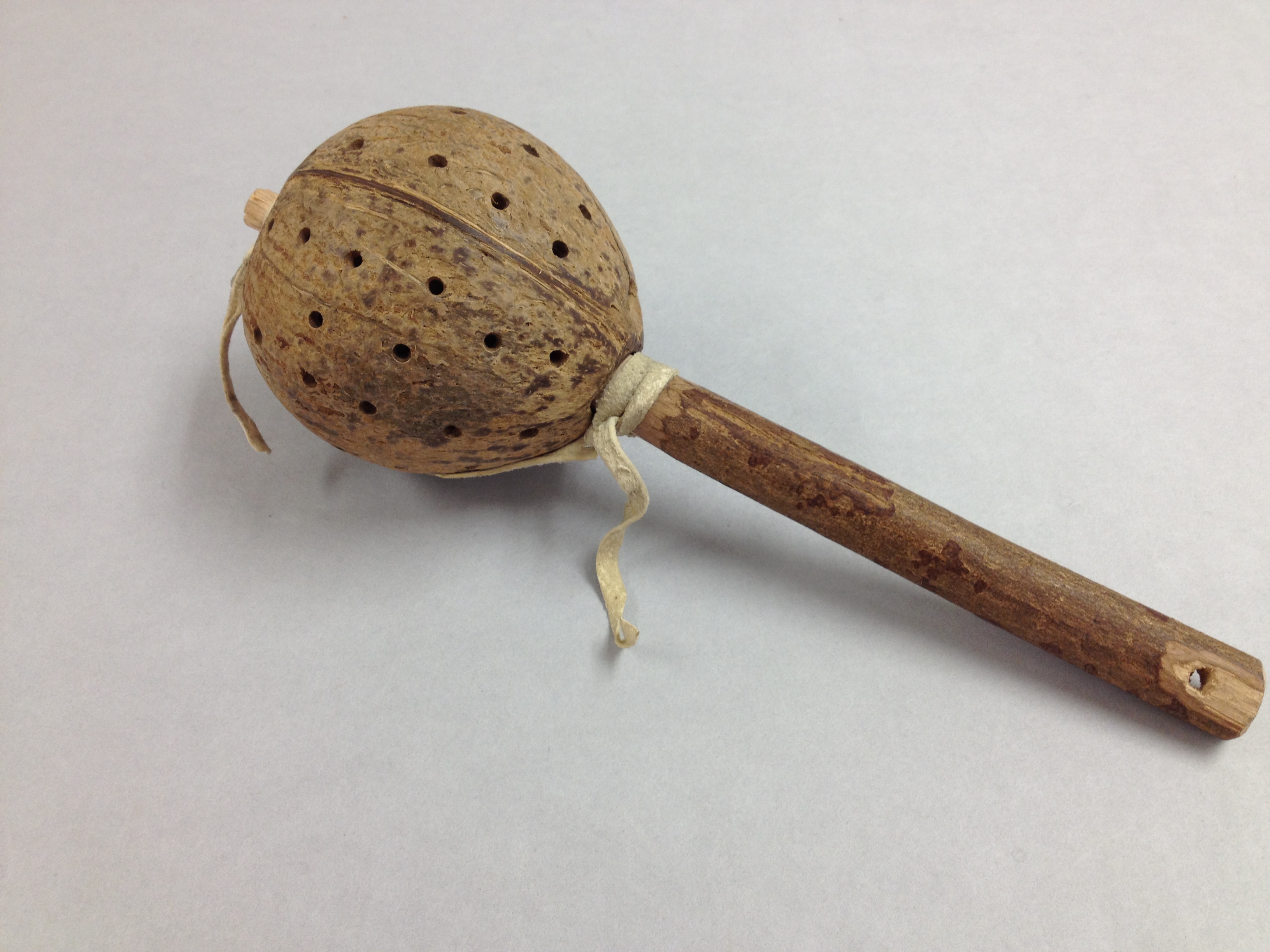
The diversity of materials used by Native peoples in the Americas to make hand rattles is pretty staggering. Among the farming peoples of the Southwest, Plains, Northeast and Southeast, gourds are one important material used for this purpose. Having the same basic form as gourd rattles, but unique to some Southeastern Indian peoples, are rattles, such as this Florida Seminole example, made from coconuts. William C. Sturtevant provided the coconut used here to Jack Motlow, from whom he commissioned it for $2.00 in 1951. This Florida Seminole example is made exactly like those used among the Southeastern peoples in Oklahoma, including among the Yuchi. (I commissioned Yuchi examples for the Gilcrease Museum in Tulsa during the later 1990s.) Such rattles are called “gourds” in English in Oklahoma and are particularly suited to the outdoor dances of the region. Such rattles are loud and thus sound great when used, as they most often are, outside, in open spaces. (The holes drilled in the coconut amplify the rattle’s sound.)

This example is #301 in the William C. Sturtevant Collection, Department of Anthropology, National Museum of Natural History, Smithsonian Institution.

(The Seminole Tribune has published biographical profiles of two of Jack and Lena Motlow’s daughters. These profiles are of Louise Motlow and Mary Motlow Sanchez and are online.)

A Chitimacha Basket

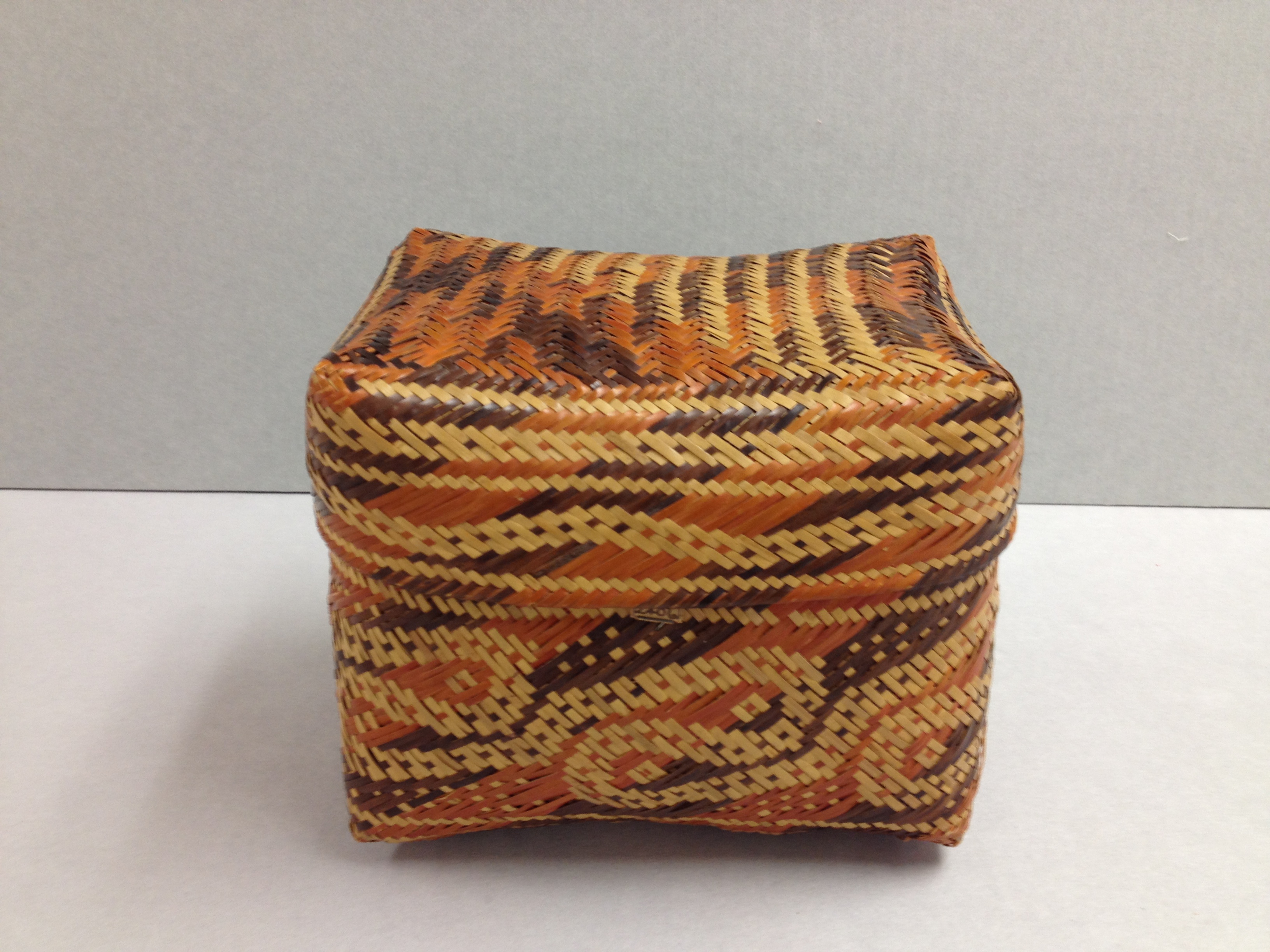
Here is an image of a double woven river cane basket with lid from the Chitimacha people of Louisiana. It was purchased at auction in 1972 by William C. Sturtevant and is now in the collections of the Department of Anthropology, National Museum of Natural History, Smithsonian Institution (T070).

Baskets from Choctaw Fair, 1961

William C. Sturtevant’s collection includes a group of baskets purchased in 1961 at the Choctaw Indian Fair near Philadelphia, Mississippi. This example (above) is part of this group. It is number 580 and I have not yet learned who the artist who made it is. This basket is made from rivercane, a plant related to bamboo that is indigenous to the Southeast of North America.

To gain a sense of native basket making in the South as a dynamic cultural activity, check out these photographs from the 1st Gathering of Southeastern Indian Basketweavers in 2002. This was an event organized by the Louisiana Regional Folklife Program and the Williamson Museum.

Here is another basket from this group. A rivercane tray, it is number 576. Both are in the collections of the Department of Anthropology, National Museum of Natural History, Smithsonian Institution.

People Love Tiny Baskets

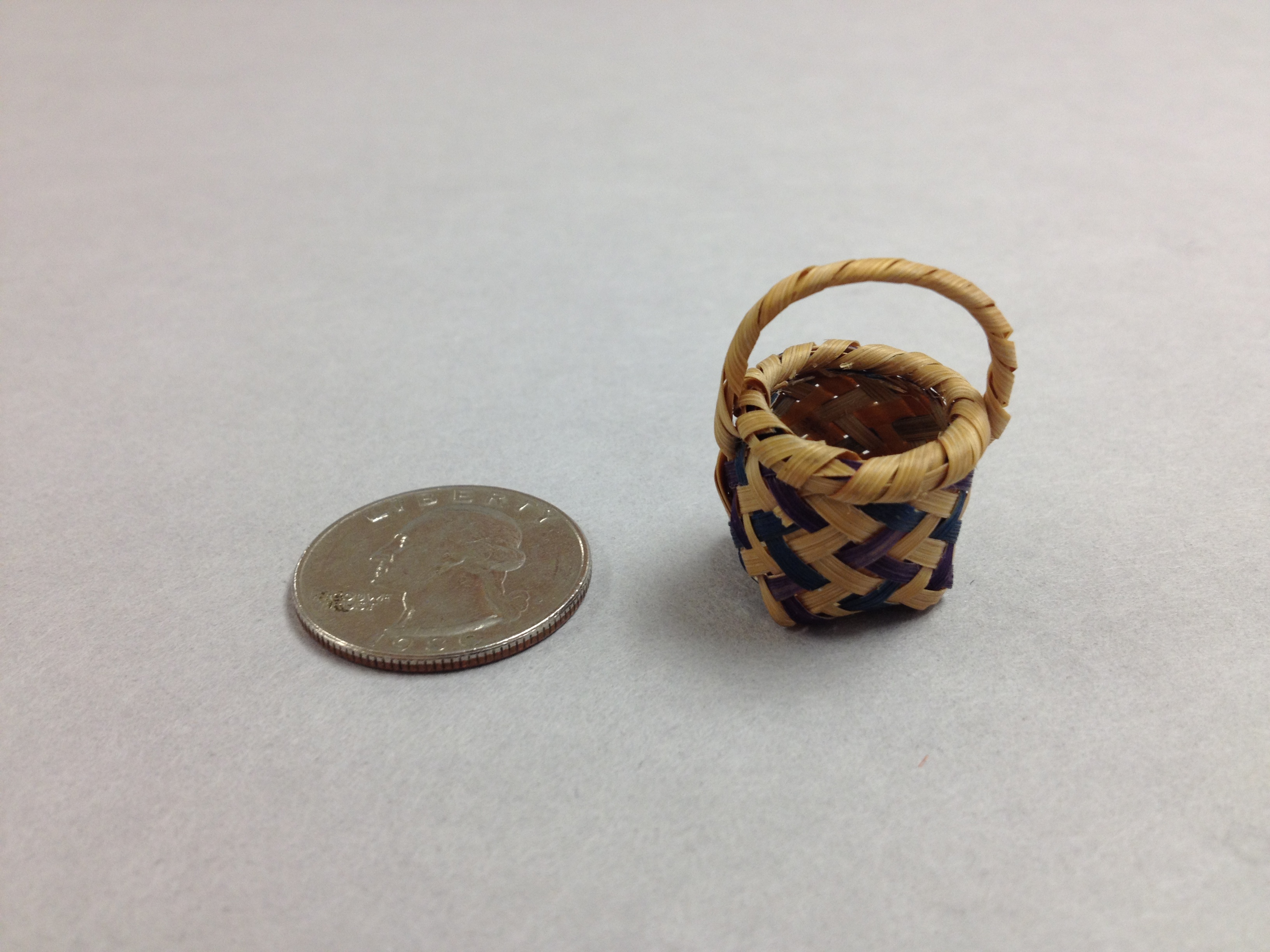
When wearing my curator hat, I have seen how ubiquitous love of tiny baskets seems to be, at least among fans of hand made objects. While I am sure that some engineer is doing nano-scale weaving already, tiny-scale seems good enough for fans of Native American basketry. The best known heroes in this area are the basket weavers of California, particularly the Pomo with their amazing feather covered baskets, but the art of the tiny basket has also been pursued in the native South. This impulse is reflected in this Choctaw basket by “Sweeny Willis” that was collected by John Mann Goggin among the Choctaw residing near Philadelphia, Mississippi. Ms. Willis’s name is spelled “Sweenie” elsewhere, such as in the records associated with pottery that she made that is in the collections of the National Museum of the American Indian.

This single weave river cane basket is currently referred to as #494 in the William C. Sturtevant Collection, Department of Anthropology, National Museum of Natural History, Smithsonian Institution.

For a bit of theorizing, look below the fold.

Read more

Put a Bird On It

I have been offline and not able to post on the Smithsonian work over the past few days. Today I need to get back to work, so here is a quick picture post. Shown above is a pine needle basket made by Rosa J. Pierite. In the artist’s information tag that accompanies the basket, she (?) identifies her tribal background as Choctaw-Tunica. Elsewhere (as in this Louisiana Folklife Center artist profile of Mrs. Pierite’s daughter, also a basketweaver), her tribal heritage has been noted as Choctaw-Biloxi.

Such pine needle baskets in the shape of a variety of animals–turkeys, alligators, etc.–are a remarkable basketry innovation from the Native peoples of Louisiana, but they are poorly represented in museum collections because earlier collectors and curators often ignored them as tourist arts. It is great that this example, along with three other pine needle baskets by Mrs. Pierite (not animal shaped) will be joining the collections of the Department of Anthropology, National Museum of Natural History, Smithsonian Institution. This example is currently accounted as number T-006.

Please forgive the pop culture reference in my post title.