Skip to content

Posts from the ‘social media’ Category

Scholarly Society-Library Partnerships Webcast Now Online

The video archive version of the recent Association for Research Libraries (ARL) webcast on “Reaching Out to Leaders of Scholarly Societies at Research Institutions” to which I contributed is now available online.  It can be gotten to for free, all that is required is signing in for ARL headcounting purposes.  Watching it in this way provides the same content experienced when the program was being done live.  The event lasted one hour.  Jennifer Laherty and I were the first of two pairs of speakers.  We present after about five minutes of introduction from the ARL staff organizers who spoke on the general goals of the initiative of which the program was a part.  Q&A follows the second presentation on data projects in astronomy (by Sayeed Choudhury and Robert Hanisch). Find the webcast via a link available here:  http://www.arl.org/sc/faculty/coi/COIwebcast2009.shtml.

Friends at the IU Libraries

I think that today’s ARL webcast went pretty well.  I am frankly unsure because I am not 100% certain of what I said.  Nobody has yet pointed out any gaffes that I (might have) made. It was amazing that we as a group were able to hit the one hour mark exactly.  The ARL staff did a great job organizing the event.  Thanks to all the people who attended/listened in. The presentation will get posted to the web as a video sometime soon and I’ll get to feel self-conscious about it, but for now I am happy about how things seemed to have gone.  The other participants did a wonderful job and I learned not only from them but from the process in general.  While I may not have hit the nail on the head, the technology itself is pretty awesome and I can imagine all sorts of uses for it or similar systems.  Thanks to Jennifer Laherty for being a great partner in the project and to all of my many friends at the IUB libraries for supporting the many projects that we spoke of briefly.  You’re all awesome.

Speaking of the Libraries, I was saddened to learn recently that Library Dean Patricia Steele would be leaving IU for the Deanship at the University of Maryland.  Pat was been an amazing supporter of progressive reform in scholarly communications and has been a real leader in cultivating new roles for the library in this domain.  She has led or supported many general initiatives of great importance to me and she has been a great patron for Museum Anthropology Review.  Maryland is very lucky.

In the great news department, Carolyn Walters was named Interim Dean today.  Carolyn shares Pat’s commitments and enthusiasms for scholarly communications issues and I look forward to supporting her own efforts in the months ahead.

Three cheers for libraries and librarians (especially those at IU).

My First Webcast

I have been honored with an invitation to participate in a webcast being organized by the Association of Research Libraries (ARL). The hour-long event is focused on the ways that librarians at research libraries can assist and partner with faculty members who play leadership roles in scholarly societies, particularly in the areas of scholarly communications and large-scale discipline-wide data curation projects. The story of my work partnering with my friends at the IUB libraries is intended to explicate the first of these two foci. Astronomy-related projects at Johns Hopkins will relate to the second emphasis. My conversation partner Jennifer Laherty (IUScholarWorks Librarian) and I will chat for about 20 minutes followed by the team from Johns Hopkins.  There will be questions from the “audience” at the end.  Beyond the significance of the key issues the event aims to address, the technology to be used is really interesting to me.  I’ll be on the phone, but those who sign up (its free) to participate, will experience the event through their web browsers.  Questions can be asked online and will be presented by the moderator from ARL.  When it is all over, the webcast may get repackaged as a video and made available via ARL’s (or SPARC’s?) video offerings online.

Information on the event, including sign up information, can be found here:
http://www.arl.org/sc/faculty/coi/COIwebcast2009.shtml

This link will also lead you to related materials that ARL has developed as part of its Campus Outreach Intiative.

Thanks to Jennifer and the good people at ARL for this opportunity. I hope that I can say some things of wider value.

Two Bits by Chris Kelty is Great

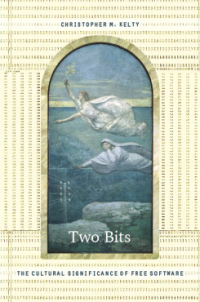
kelty_cvr_medA few days ago I finished reading Chris Kelty‘s wonderful book Two Bits: The Cultural Significance of Free Software (Duke University Press, 2008).  During the academic year, I could not get to it but it was a treat to read it at a time in which it could be the only big thing that I was reading (as opposed to reading it alongside course readings).  While I would have benefited greatly from reading it last year (when my involvement in the issues that it treats really began to expand), it will do me much good in the days ahead, as it relates very centrally to the work that I am now doing on scholarly communications issues.  It provides invaluable context on the emergence and present-day life of open source software, but it also offers a range of valuable theoretical, interpretive and methodological tools that are portable to other contexts.  The book also examines, in a very sophisticated way, the manner in which the processes and ideas and values of free and open source software have been extended into projects like Connexions (about which my department held a really fruitful meetup recently) and the Creative Commons license system.  All of this work is done very artfully and in ways that we can all learn from.

This post is no surogate for a careful review, but I want to flag the book’s importance to me and to suggest that it is going to be touchstone work for many of the projects that I am increasingly involved in. More ambitiously, I want to plead with my friends and colleagues to read it so that we can talk about it and draw upon it in our efforts together and in our conversations. It is a great work of ethnography, history, and theory.  It is also an experiment that modulates the very processes that it describes, as is evident on the excellent and innovative website that Chris has built to extend the book.  One can purchase the book the conventional way, but it is also available to freely read and remix in a variety for formats via the website.  Some of the background for this is also provided in the “Anthropology of/in Circulation” project that Chris led and that I particupated in.  Find the article version of that project here in IUScholarWorks Repository.

Thank you Chris.
Open Anthropology Cooperative

It has been talked about in depth in a number of places already, but I want to highlight the remarkable developments unfolding in and around the newly formed Open Anthropology Cooperative. The number and diversity and energy of the people who have been rapidly showing up at the new ning site and who have started rolling up their sleeves to build something new and interesting is remarkable. Congratulations to all who are engaging with this experiment in reorganizing an entire discipline at a worldwide level.