Skip to content

Posts from the ‘Scholars to Know’ Category

Jethro Gaede Awarded Ph.D.

Congratulations go to Jethro Gaede*, who has today successfully defended his dissertation and earned the Ph.D. in anthropology at the University of Oklahoma.  Jethro’s dissertation is titled “An Ethnohistory of the American Indian Exposition at Anadarko Oklahoma: 1932-2003.” I was honored to serve on Jethro’s committee, both as an OU faculty member and as a visiting member since my move to Indiana. Well done.

*Jethro is an instructor of anthropology at Monroe Community College.

Congratulations to Arle Lommel

Congratulations go to Arle Lommel, a Ph.D. student in the Department of Folklore and Ethnomusicology, for very successfully completing his doctoral exams and reaching candidacy. Arle’s dissertation project is tentatively titled “Ancient Instruments: The Hungarian Folk Revival and the Search for Authenticity.”

New Exhibits!

I am late posting on them, but I want to celebrate two new exhibitions at the Mathers Museum that were curated by IU doctoral students, both of whom are minoring in Folklore. Jim Seaver (an alum of my Curatorship and Theories of Material Culture courses and a history doctoral student) curated “A World of His Own: The Uncommon Artisty of Chester Cornett.” The exhibition looks at the work of a Kentucky chairmaker whose life and art were originaly documented in the dissertation and later books produced by folklorist Michael Owen Jones. The Mathers staff really outdid itself in helping Jim realize his vision. The exhibition includes a number of innovate custom display elements, incuding a shotgun house with a front poarch on which to display Cornett’s chairs.

The second new exhibition is “Clothes, Collections and Culture… What is a Curator? Undertaken by Lori Hall-Araujo, a doctoral student in the Department of Communication and Cuture, the exhibition utilizes the Royce Collection of Isthmus Zapotec Textiles and Clothing to examine the behind the scenes work of museum curators.

Both exhibitions are visiually and intellectually compelling and both were vigorously celebrated at a joint exhibition openning last Friday evening. Congratulations to Lori and to Jim and to the entire Mathers Museum staff. Wonderful!  Learn more here and here.

Anthropological Linguist Mary Linn Named DaVinci Fellow

I am so pleased to note that my friend and collaborator Mary Linn (Associate Curator of Native American Languages at the Sam Noble Oklahoma Museum of Natural History) has been named as one of five 2009 DaVinci Fellows by the DaVinci Institute. Mary is the founding curator of the museum’s Native American Languages program and has done amazing outreach work with American Indian communities across Oklahoma and the whole of the United States. Among the innovative efforts that she has stewarded is the museum’s annual Native American Youth Language Fair, which, each spring, attracts close to 1,000 American Indian students to the museum for two days of programs in which they make public presentations in the languages of their home communities.

Thanks to Indian Country Today for getting out the news of this well-deserved award. Find their story here. Congratulations Mary! An honor well bestowed.

Latrinalia Revisited

My IU folklore colleague John McDowell was featured prominently in a recent April Fools Day news feature on NPR affiliate WFIU exploring the nature of latrinalia, more commonly known as bathroom graffiti.  John did a great job as a consultant to the station’s news staff.  If you missed it, you can see, hear, and read the story online here:

http://www.newsmatters.org/the-writing-on-the-bathroom-wall/

3403918775_a86a5398ae_o

Christen and Hennessy on Issues in Digital Ethnography

The new (April 2009) issue of Anthropology News features an exceptionally large amount of interesting material. I have not digested it all, but I want to point to the first two articles. Leading the issue is a piece by Kimblery Christen titled “Access and Accountability: The Ecology of Information Sharing in the Digital Age. It is a great short and accessible summary of her key arguements about possibility and responsibility in collaborative ethnographic work. It builds on the remarkable range of practical, technical and theoretical projects that she has been pursuing for a number of years.  (These have been a regular topic on this site and her own website provides a rich introduction.)

The second paper–a wonderful companion to the first–is “Virtual Repatriation and Digital Cultural Heritage” by Kate Hennessy. I builds on collaborative media projects that she and Amber Ridington have been pursuing with a Canadian First Nations community.  This piece is a powerful complement to the  Dane Wajich site and other projects that they have pursued because it offers a glimpse behind the scenes at the kinds of challenges these efforts can entail.

I recommend both of these contributions highly.  They showed up in my mailbox on Monday and I was teaching with them on Tuesday. Kim and Kate (and their project partners) are doing amazing work.

Neely and Palmer on Kiowa Language Ideology

I am happy to note the publication of a book chapter by my friends Amber A. Neely and Gus Palmer, Jr. Titled “Which Way Is the Kiowa Way? Orthography Choices, Ideologies, and Language Renewal,” their paper appears in the new volume  Native American Language Ideologies: Beliefs, Practices, and Struggles in Indian Country edited by Paul V. Kroskrity and Margaret C. Field  (Tucson: The University of Arizona Press, 2009). I was lucky enough to read the paper in manuscript and can report that it is a valuable and insightful account of language revitalization efforts among the Kiowa people of Oklahoma undertaken in light of contemporary work on language ideology and language politics in Indigenous communities.

Linguistic Diversity in the South: Changing Codes, Practices, and Ideology

Not long after the publication of Linguistic Diversity in the South: Changing Codes, Practices, and Ideology, I was asked by an anthropology journal to review the book. The subject interested me greatly and I was acquainted with the work of the editor and several of the volume’s contributors. In a relatively timely fashion, I submitted the brief review that follows here. At the time, the journal’s editors asked that I expand the review to focus on the contents of the volume in greater detail, thereby bulking what amounts to a book note up to the scale of a full scholarly review. I fully intended to give this a try, but in the constant flow of new tasks, the matter was delayed so long that it was lost sight of. Rediscovering the review today, in the course of organizing my writing-related files, I experienced regret that I did not follow through and see the review through to publication. Rather that attempt to expand it at this stage and secure journal publication for it, I offer it here for those who know my interest in Southern cultural studies and linguistic anthropology and for those web searching researchers whose queries may lead them to the book or my comments on it. I apologize to the volume’s editor, contributors, and publisher for my lack of follow through. Thanks go to all involved for assembling a valuable contribution to the literatures in these fields. The actual review follows.

Linguistic Diversity in the South:  Changing Codes, Practices, and Ideology.  Southern Anthropological Society Proceedings, No. 37.  MARGARET BENDER, editor.  Athens:  University of Georgia Press, 2004.  Pp. 141.  $19.95 (paper).

Reviewed by Jason Baird Jackson, Indiana University

Linguistic Diversity in the South is comprised of eight fine essays and a solid introduction contextualizing the volume’s contents and its place in contemporary sociolinguistics and linguistic anthropology.  The papers gathered in the volume were originally delivered at the Southern Anthropological Society’s 2002 keynote symposium, which was organized by the volume’s editor, Margaret Bender.  Contributors range from enterprising graduate student researchers to distinguished senior scholars.  All offer brief, nuanced ethnographic or sociolinguistic treatments of language use in the southern United States.
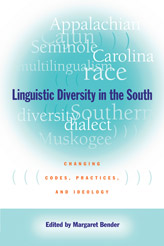
0820325856A great strength of the volume is the manner in which it, without attempting to be a comprehensive survey, offers a rich sampling of Southern speech-communities, ways of speaking, and language ideologies.  The papers explore language in Native American [Lumbee (Walt Wolfram), Muscogee/Creek (Pamela Innes), Seminole (Susan E. Stans and Louise Gopher)], Mulungeon (Anita Puckett), Scotch Irish (Puckett), Cajun (Shana Walton), Appalachian (Kirk Hazen and Ellen Fluharty), Outer Banks (Wolfram), and North Carolina African American communities (Christine Mallinson).  Blair Rudes contributes a paper historically surveying multilingualism, linguistic complexity and change in the Carolinas since contact.  Bender’s introduction reflects experiences gained in her own work among the North Carolina Cherokee and links the volume’s contributions to contemporary theoretical concerns in linguistic anthropology, especially research on discourse, contact, maintenance, shift, and ideology.

It is exciting that the volume provides evidence that a critical mass of contextual research on language use in the Southern United States has been reached.  Because of the conference proceedings format shared by all Southern Anthropological Society volumes, the papers contained within Linguistic Diversity in the South represent short, accessible samplings of broader, more detailed research programs.  In this instance, this is a virtue, as, for instance, scholars consulting the book for its studies of language in Native American communities, easily also gain concise accounts of other Southern peoples and varieties.  While many interesting and important communities are not treated in the volume, as Bender is quick to note, it does offer a clear picture of how linguistically and cultural complex the contemporary South is.  The book thus counters conventional assumptions of Southern linguistic homogeneity at the same time that it proves to the fields of linguistics and linguistic anthropology that key general issues can be very productively examined from the perspective of the region’s ethnography.
Christen on Alliances in [and Beyond] a Remote Australian Town

untitledI am happy to report that Kimberly Christen’s new book Aboriginal Business: Alliances in a Remote Australian Town has just been released by The School for Advanced Research Press. Rather than go on and on, I’ll just say that it is really, really great and that you can get the details on Kim’s super website/weblog Long Road.  For the long haul, find it in Open World Cat (and your local library) here.  Congratulations Kim!

[Kim and I work together on Museum Anthropology Review, for which she is the Associate Editor. She is  also an Assistant Professor of Comparative Ethnic Studies at Washington State University.]

The Form of Value in Globalized Traditions

Recently, I had a unique and wonderful opportunity to participate in a small conference and workshop hosted by the Center for Folklore Studies at The Ohio State University (in partnership with the Berkeley Folklore Program).  Titled “The Form of Value in Globalized Traditions,” the workshop continued an ongoing series of discussions that were inaugurated in 2007 by Charles L. Briggs at the University of California, Berkeley.  The program for the public presentations (which were held on Friday, March 6, 2009), along with paper abstracts, can be found online at here. The overview summary describing what we were up to read:

This international working group considers the career of vernacular traditions under globalization. As cultural forms circulate ever more widely, recycled, restructured, and hybridized as they travel, regimes of value insist increasingly on point of origin. Since economic value is predicated upon scarcity, in a global framework cultural objects are marked—and marketed—as local. Form itself is fetishized as social interaction becomes attenuated. Rather than contesting the reification of culture into exchangeable goods, the resistance of impoverished groups and social movements increasingly takes shape as a struggle for control over the manner of commodification and the profits thereof. In the face of restructurings of value initiated by the World Trade Organization, the World Intellectual Property Organization, free trade agreements, and transnational corporations, intellectual property rights become a key locus of contention between distributors and cultural producers. The public component of this year’s group meeting will explore form and value as both categories of action and tools of analysis. We hope that attendees will help us with the work of comparison and synthesis.

My own presentation considered the current reshaping of the system of scholarly communications in which folklorists and ethnologists circulate (and find expanded publics for) their work in an era of corporate enclosure, media consolidation, and library crises on the one hand and open source technologies and open access movements on the other. The participants were a great group. In addition to many wonderful students and faculty members from the OSU folklore program, the participants were: Sadhana Naithani (Jawaharlal Nehru University, New Delhi), Lee Haring, City College, CUNY), Mbugua wa-Mungai (Kenyatta University, Nairobi), Galit Hasan-Rokem (Hebrew University of Jerusalem), Candace Slater (University of California, Berkeley), Amy Shuman (The Ohio State University), Dorothy Noyes (The Ohio State University), Javier León (Indiana University), Diarmuid Ó Giolláin (University College Cork), and Charles L. Briggs (University of California, Berkeley).

Thanks to everyone who helped bring this great event into existence. Thanks especially to the OSU folklore students who brought great energy (and a great Saturday lunch) to the event.