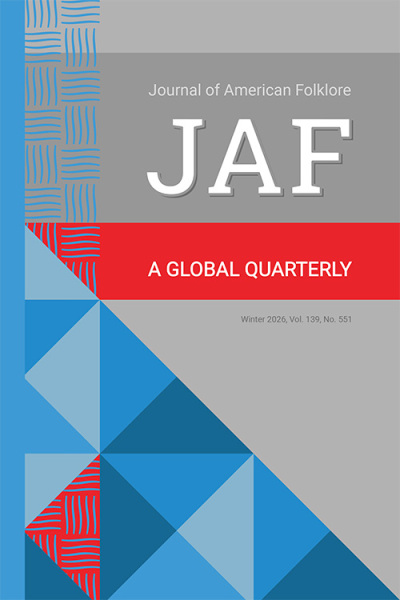
Even before 2026 began, many American Folklore Society (AFS) members were already getting a first glimpse of Journal of American Folklore (JAF) 139 (551), the Winter 2026 issue. I have started reading it via Project Muse, but JAF readers experience the journal in a variety of formats, including print. If you have not seen it yet, I am sure that you will be checking it out soon. There is much to consider and think about in the issue. I am tempted to start writing here about contributions of special interest—many very timely and important—but I instead wish to use this space to acknowledge and thank two groups of colleagues.
George Mason University folklore studies faculty members Lisa Gilman (Editor-in-Chief), along with Ben Gatling, Debra Lattanzi Shutika and Lijun Zhang (Co-Associate Editors) worked with a range of colleagues across the field, within AFS, and at the University of Illinois Press, to steward and advance the journal over several years (2020-2025). Their term of service concluded at the end of 2025, with the new issue being the first led by the new editorial collective. Thus, 2025 was—as suggested by the new issue just out—a fruitful year of collaboration and overlap between the outgoing editors and the incoming ones. My first order of business is to join the new editors (Cantú et al. 2026) to thank Lisa, Ben, Debra, and Lijun for their exemplary service stewarding and advancing JAF throughout their term as the JAF editorial team. Editing almost any journal is a challenge and editing a global English flagship journal with four issues a year, in this time and place, is a particularly daunting task. AFS and the whole global folklore studies community is fortunate to have benefitted from their leadership across many endeavors and we were fortunate that they chose to take up the work of editing JAF at a crucial time. Helping them were many peer-reviewers, editorial assistants, University of Illinois Press colleagues, freelance publishing professionals, and others. It takes a village to publish a journal.
A crucial bridge between the outgoing and incoming editorial teams is JAF’s Senior Managing Editor Lorraine Walsh Cashman, whom I thank here in the liminal space within this post!
Which brings me to the new editorial collective. I here want to express appreciation for colleagues Norma E. Cantú (Trinity University), Coppélie Cocq (Umeå University), Tim Frandy (University of British Columbia), Lisa Gabbert, (Utah State University) and Shelley Ingram (University of Louisiana at Lafayette) for their willingness to take on our most important AFS publication and to pioneer a new distributed editorial team model. As reflected in the new issue of JAF, they have already been hard at work since early in 2025 and it is exciting to now see and read the first fruits of their labors.
With their diverse talents, backgrounds, and interests, and Lorraine’s experience linking the journal’s excellent past work to their promising present efforts, JAF is well positioned to thrive in the year, and the years, ahead, despite the many challenges that our field, our society, and our wider calling as humanists and interpretive social scientists will face in the period ahead. My thanks go not only to the new editorial team, but also to Lorraine and the various student assistants, peer-reviewers, deans, departmental staffers, University of Illinois Press colleagues, and others who have already helped the team to succeed and who will do so in the years ahead.
Please do not flood their email boxes but do look for opportunities in the year ahead to thank both sets of editors for their valuable service on behalf of the American Folklore Society and all those whom we serve and support.
Reference Cited
Cantú, Norma E., Coppélie Cocq, Tim Frandy, Lisa Gabbert, and Shelley Ingram. 2026. “From the Editors.” Journal of American Folklore 139 (551): 3–4.
Jon Kay with Jason Baird Jackson Indiana University Bloomington
Jon Kay is Director of Traditional Arts Indiana and an Associate Professor of Folklore at Indiana University Bloomington. In this exchange I pose questions to him about the new Smithsonian exhibition and catalogue State Fairs: Growing American Craft. Find details about the exhibition at the end of the interview.
Jason Baird Jackson (JBJ):Jon, you have just returned from a trip to Washington, DC for the opening of the exhibition State Fairs: Growing American Craft, which will run through September 7, 2026 at the Smithsonian American Art Museum’s Renwick Gallery. The Renwick is the part of the Smithsonian devoted to craft. Before I ask you about your role in the exhibition and the associated catalogue (Mary Savig, ed., State Fairs: Growing American Craft. Smithsonian Books, 2025), can you tell me about the opening? What did you see? What did you do? Who went with you? What was most memorable?
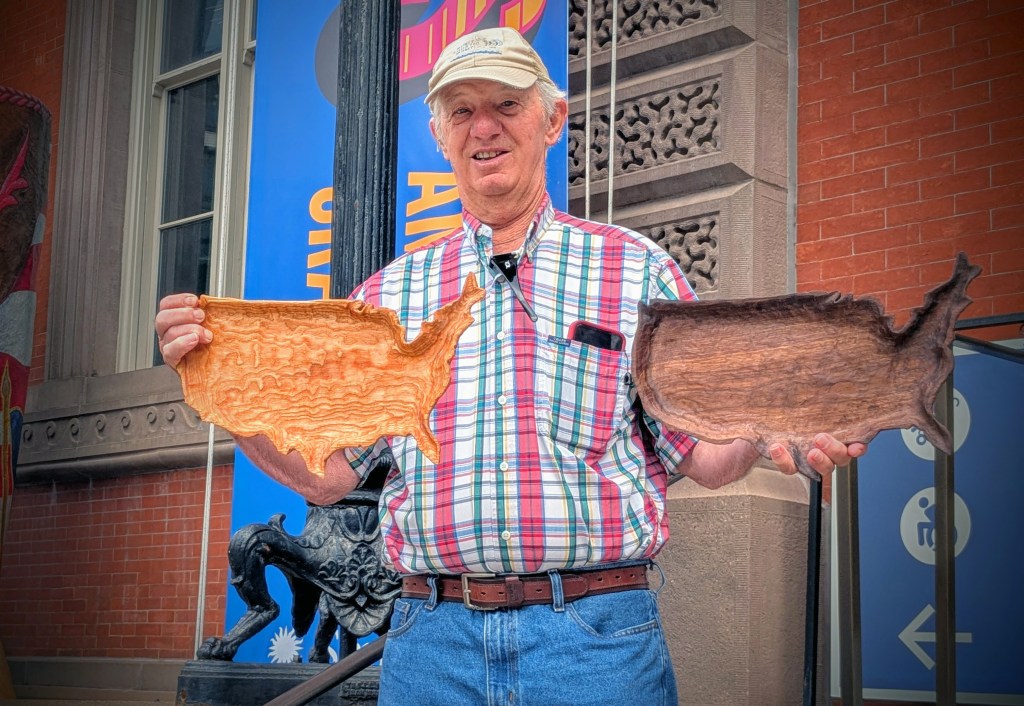
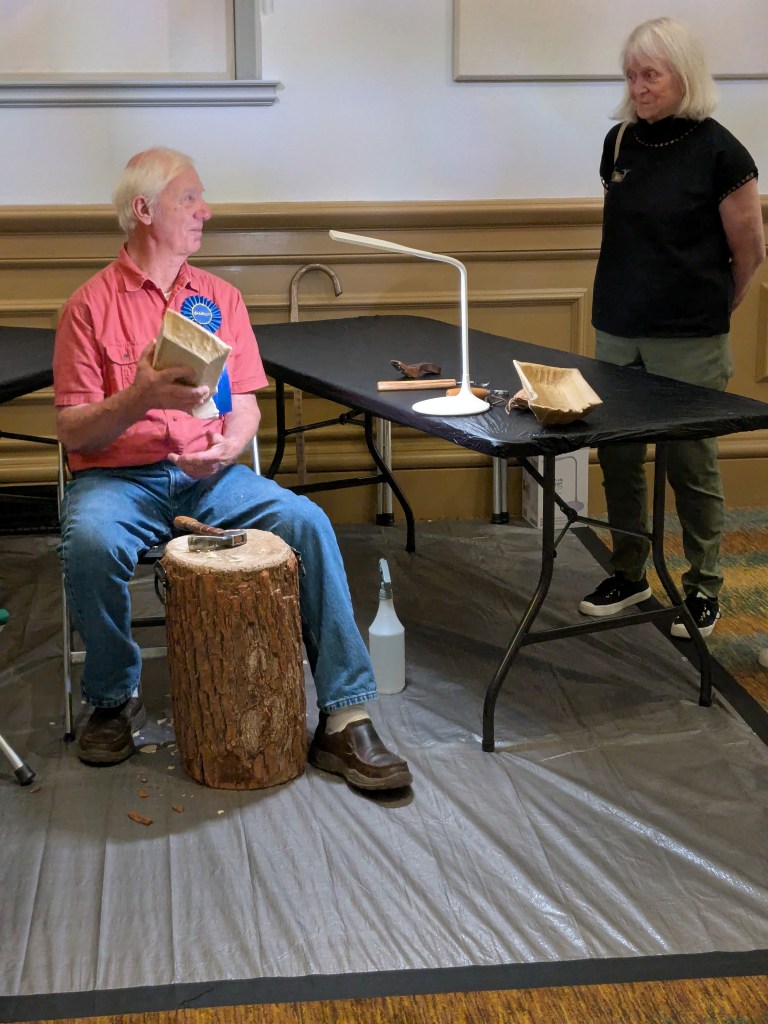
Jon Kay (JK): Thank you for the opportunity to reflect on my recent trip to Washington, DC, where I attended the Smithsonian American Art Museum (SAAM)’s after-hours celebration of the exhibition State Fairs: Growing American Craft at the Renwick Gallery. I participated in the event with Keith Ruble, a bowl hewer and longtime demonstrator in the Indiana State Fair’s Pioneer Village (Figure 1). Keith was named a State Fair Master in 2001—well before I became director of Traditional Arts Indiana (TAI)—a testament to the longstanding recognition of his work.
From 2001 to 2021, TAI partnered with the Indiana State Fair to honor its veteran participants through the State Fair Masters program. Each honoree was selected for their skill, excellence, and deep knowledge in their discipline, as well as for their commitment to passing on that knowledge within their communities. The program emerged in the years following the untimely death of Bill Day, an early Pioneer Village demonstrator and Keith Ruble’s bowl-hewing mentor. It was fitting, then, that both Keith’s and Bill’s bowls were featured in the Renwick’s exhibition (Figure 2).
Keith had been invited to demonstrate at the exhibition, but initially declined—he and his wife, Susie, don’t fly, and he didn’t feel up to driving to DC. When he told me this, I offered to take him. He agreed. So, the day before the celebration, Keith, Susie, my wife Mandy, and I made the twelve-hour trip to the Renwick.
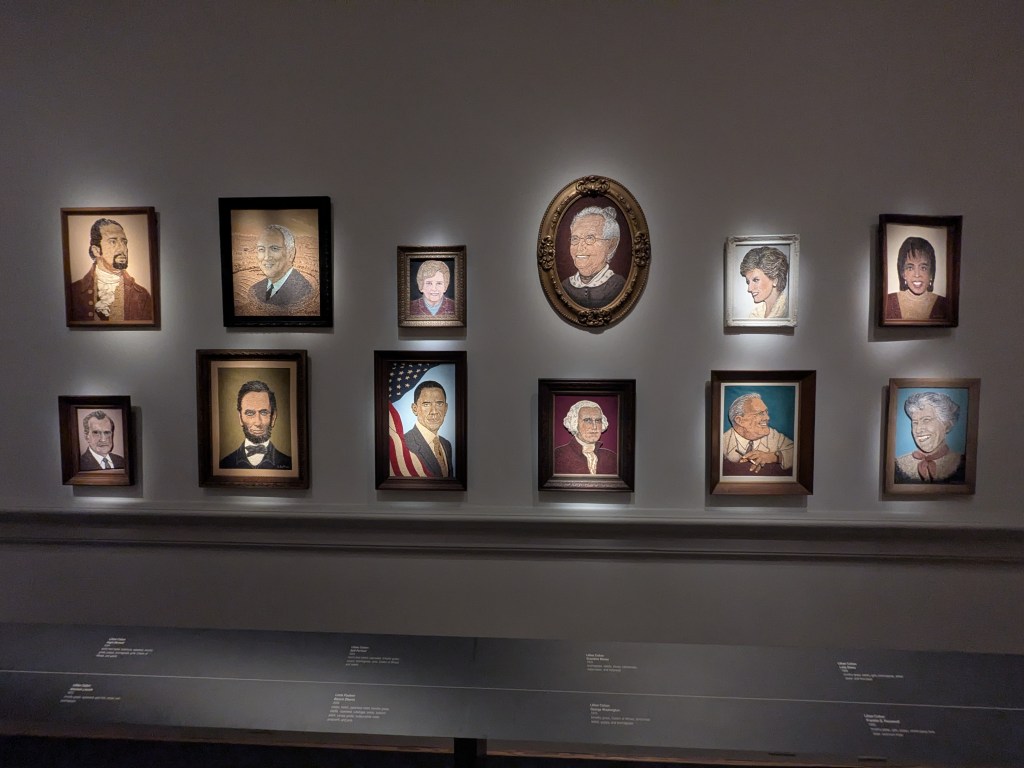
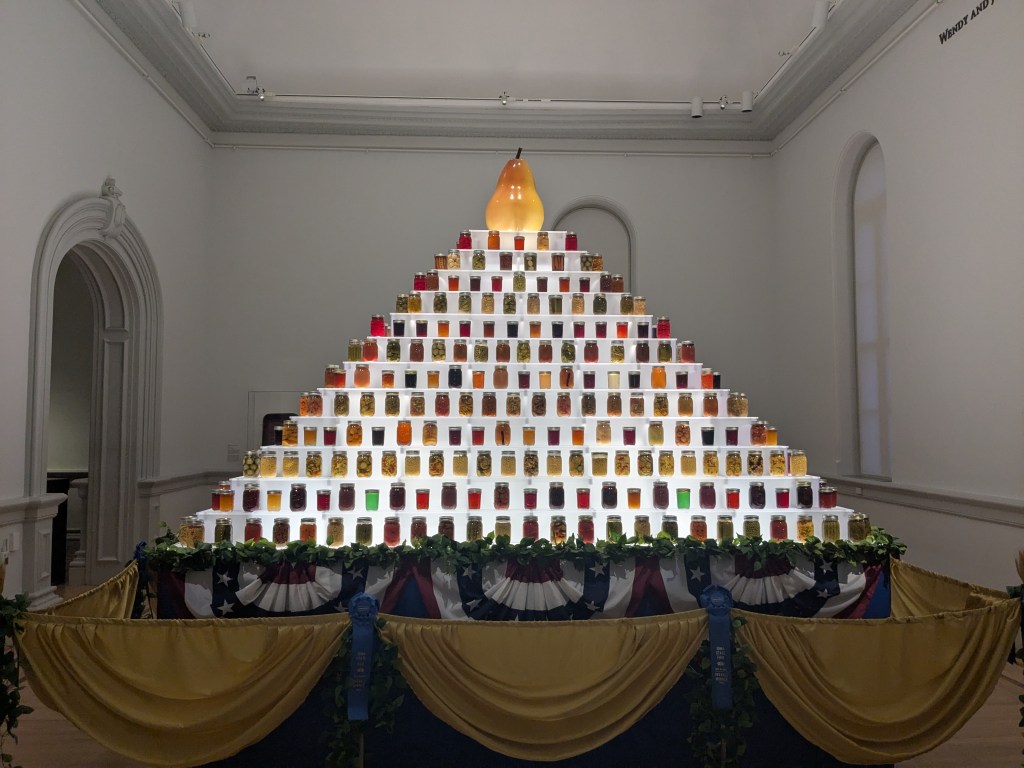
On our first morning in DC, we walked to the Renwick Gallery to view the exhibition and deliver several hand-hewn bowls that Keith had made for the museum’s gift shop (Figures 3 and 4). I imagine your future questions will explore the exhibition’s content in more detail, but for now, I’ll say it was a remarkable showcase of crafts by artists who have exhibited, competed, and demonstrated at state fairs—past and present. From pottery and crop art to canned goods and quilts, the exhibition underscored the central role of craft in state fairs since their inception in 1841 (Figures 5, 6, 7, and 8).
The celebration brought together many of the featured artists and their families, including saddle maker Bob Klenda from Kimball, Nebraska; canner Rod Zeitler from Coralville, Iowa; and basket maker Polly Adams Sutton from Seattle, Washington (Figures 9, 10, 11). While the artists enjoyed seeing their work on display, the event also created a meaningful space for state fair craftspeople from across the country to connect and share stories. The atmosphere was one of mutual appreciation. In a culinary nod to fair traditions, the Renwick served corndogs, cornbread, corn pudding, and other fair staples. It was a festive and memorable evening.
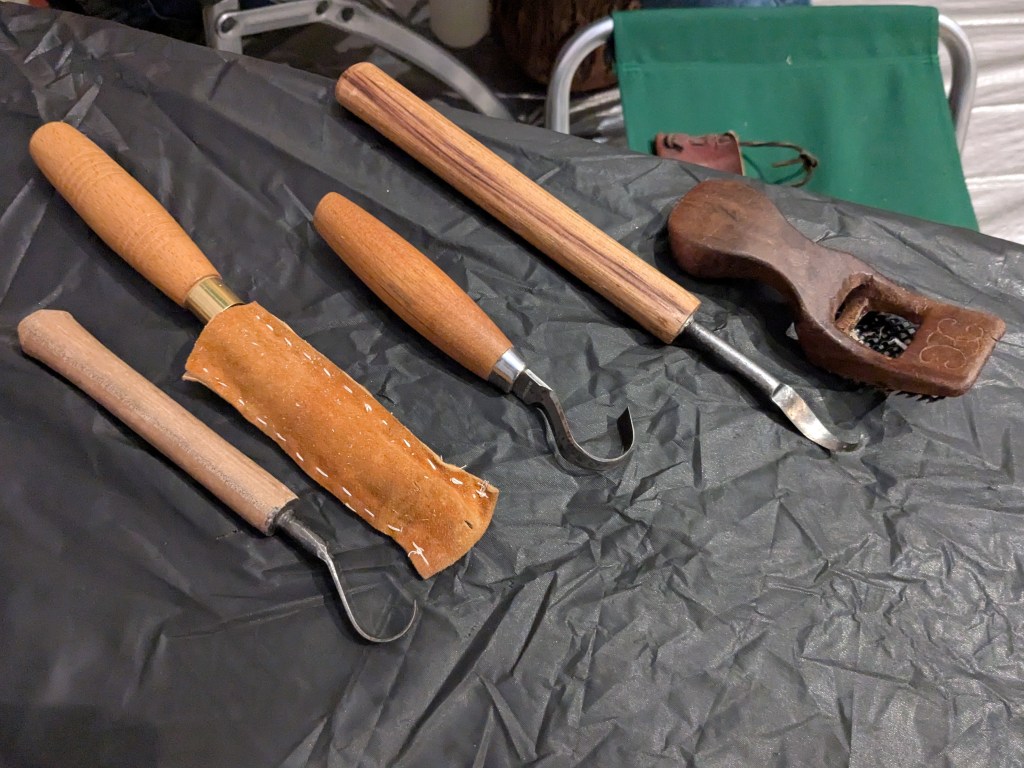
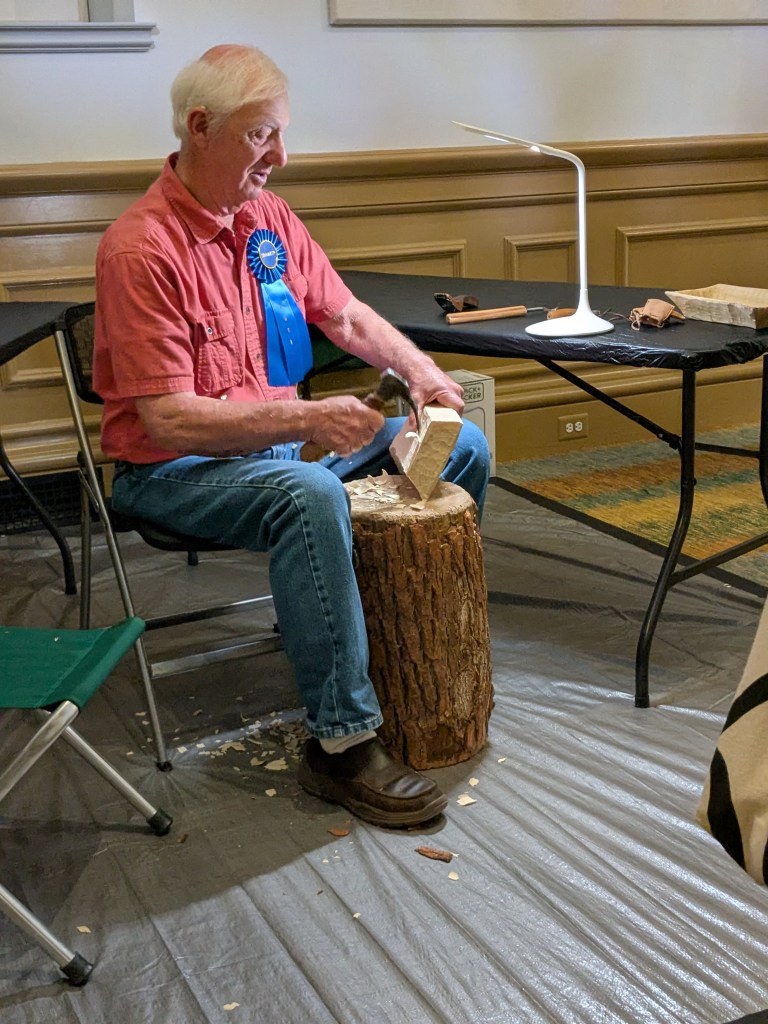
The following day, Keith demonstrated his craft at the Renwick. Concerned about wood chips, the events team taped down tarps and provided tables and chairs. Keith’s setup was minimal—just a few tools: a bowl adze fashioned from a ball-peen hammer, a bent gouge, a couple of spoon knives, and a hand-rasp scraper (Figure 12). But what really caught people’s attention was his sassafras stump with luggage handles, which he uses as a chopping block (Figure 13).
Throughout the day, Keith worked on an Indiana-shaped bowl, answered questions, and shared stories. He spoke about his mentor, Bill Day; his wife’s tolerance for him chopping in the living room; and his “mother-in-law” bowls—his name for the ones that crack (Figure 14).
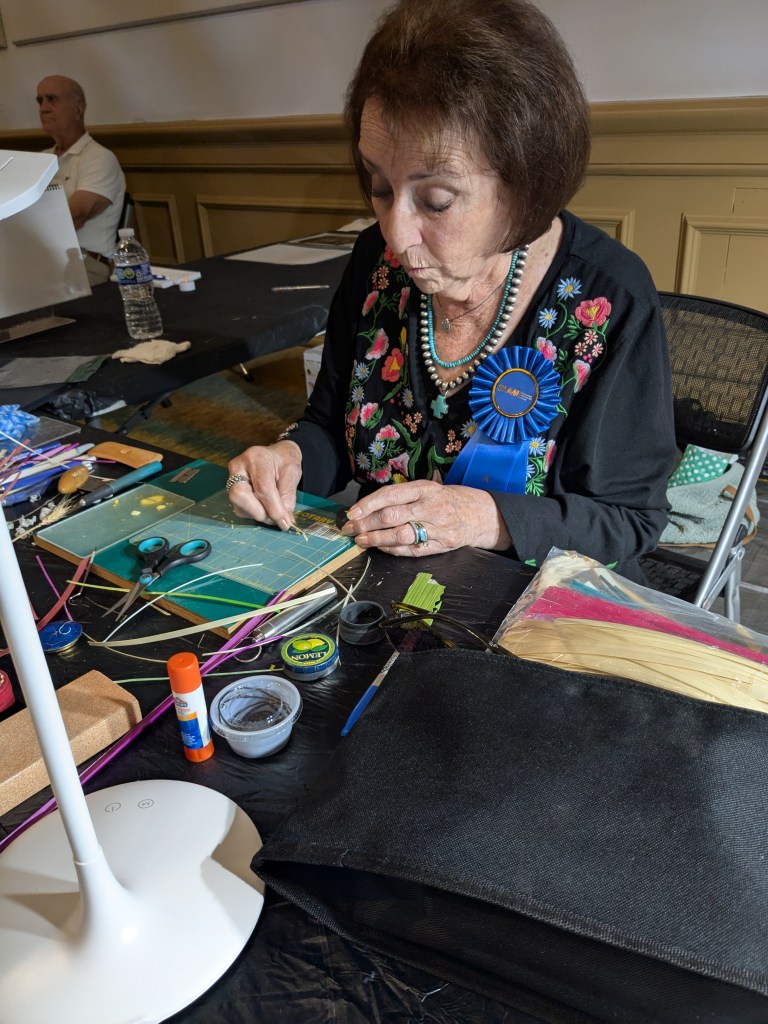
Alongside Keith were two other demonstrators: Martha Varoz Ewing from Santa Fe, New Mexico, who practices traditional straw appliqué, and Samuel Barsky from Baltimore, Maryland, known for knitting custom sweaters of his own design (Figure 15 and 16).
Soon after Keith began, the rhythmic chop, chop, chop of his adze echoed through the gallery, drawing visitors to the demonstration area. From 10 a.m. to 2 p.m., the artists worked and engaged with the public. Keith noted that he didn’t even finish the bowl he brought to work on. I assured him that the Smithsonian didn’t mind. There was a steady stream of visitors throughout the day, and the exhibition, as a whole, was very well attended.
JBJ: I am glad that you and Mandy, Keith and Susie had a great time at the exhibition and its opening events! With the scene set now, can you tell me about your role as one of the “contributing curators” working with lead curator Mary Savig?
JK: From 2004 to 2022, I coordinated the Indiana State Fair Masters Program as part of my work directing Traditional Arts Indiana. For this program, I conducted oral history interviews, created exhibition panels, and produced documentary films.* My friend Betty Belanus, a retired curator at the Smithsonian Institution’s Center for Folklife and Cultural Heritage and Indiana’s first state folklorist in the 1980s, was aware of my long-standing work with the Indiana State Fair. When Mary Savig, Chief Curator of the Renwick Gallery, began planning the exhibition State Fairs: Growing American Craft, Betty suggested that she reach out to me to help identify potential Indiana craftspeople to feature.
Mary and I met at the 2023 Indiana State Fair, where I gave her a tour of the fairgrounds. The State Fair Masters program, as I mentioned earlier, celebrated the work of longtime fair participants—from apple growers and hog breeders to pie bakers and weavers—highlighting the artistry embedded in fair traditions. While many of these practices have aesthetic dimensions, the Renwick is a craft gallery, so performance-based traditions, such as baton twirling, clogging, and washboard playing, were outside the scope. I joked that while I could make a case for seedstock swine breeding or miniature donkey husbandry as art forms, jars of jelly and pickles were probably as close as the exhibition would get to these more ephemeral crafts.
As we walked the fairgrounds, Mary and I discussed her vision for the exhibition and my nearly two decades of work with the Indiana State Fair. The State Fair Masters program had ended in 2023, so I was especially reflective during our visit.
Our first stop was the Indiana Arts Building, formerly known as the Home and Family Arts Building. In the basement, baked goods and canned items were exhibited; the main floor featured quilts, needlepoint, weaving, crochet, and knitting. The building also featured paintings, photographs, and other artworks that had been entered in various fair competitions. I introduced Mary to longtime building coordinator Nancy Leonard, and then we talked with Mary Schwartz, a 2013 State Fair Master who was recognized for her needlepoint artistry.
Next, we visited the Pioneer Village, located across the fairgrounds and surrounded by antique tractors and historic farm implements. The Village showcases farming practices, music, and crafts from Indiana’s Depression Era and earlier. I introduced Mary to the wheelwrights and blacksmiths, and Charlie Carson who trains oxen and makes yokes. In the Pioneer Village Building, Mary talked with quilters, weavers, and broom makers—but what truly captured her interest was the bowl hewing.
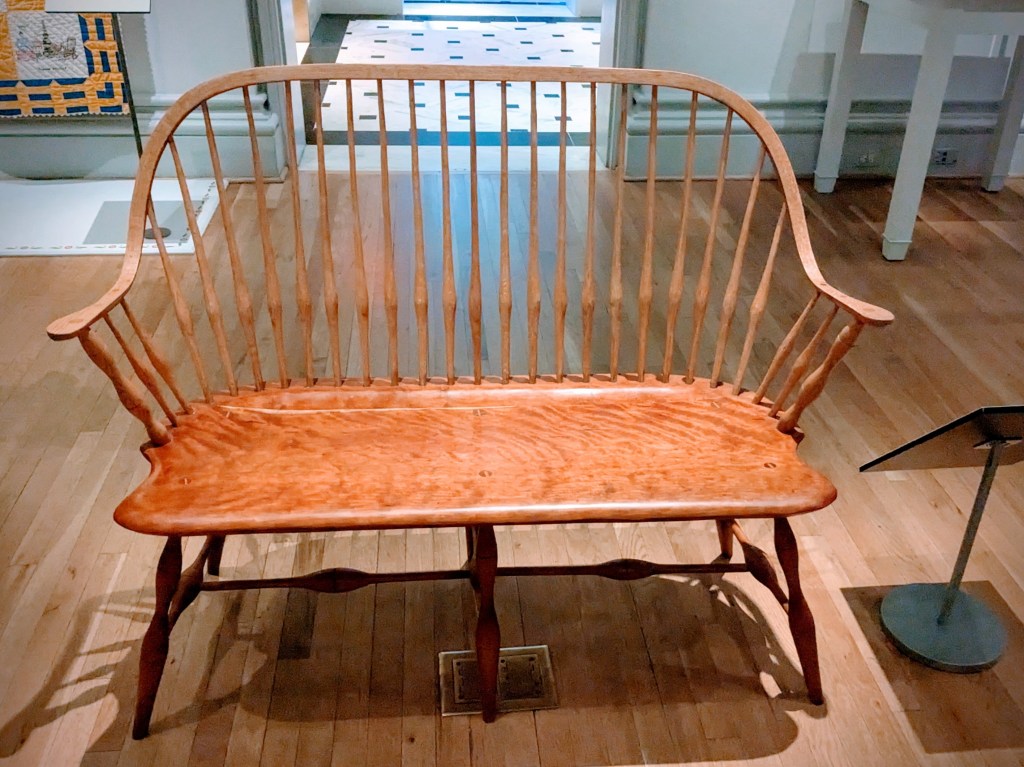
I had recently curated an exhibition at the Swope Art Museum in Terre Haute, Indiana that featured several bowl makers who demonstrated at the fair. I introduced Mary to Keith Ruble and Blaine Berry, both of whom would later be featured in the Renwick exhibition. I also secured a large sassafras bowl made by Bill Day for the exhibition. I loaned the gallery a tulip poplar bowl shaped like Indiana, which Keith had made for me for the 2016 Bicentennial of Indiana Statehood. In addition to recommending artists, I shared ideas for potential craft inclusions. Mary ultimately acquired a settee and two Windsor chairs from Blaine, which the Smithsonian purchased (Figure 17).
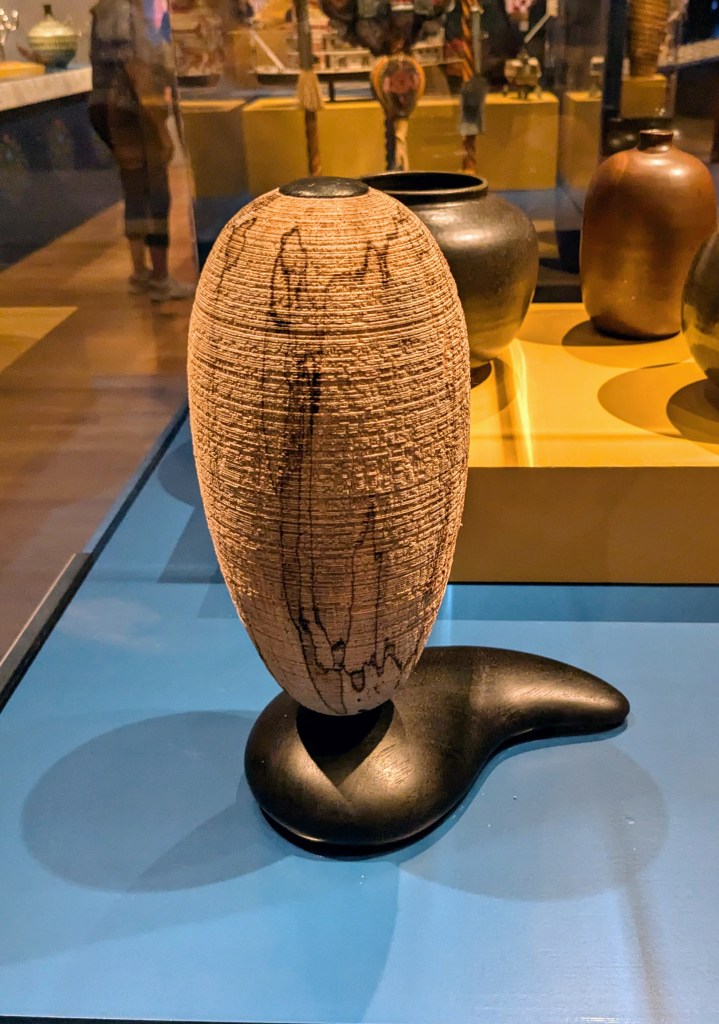
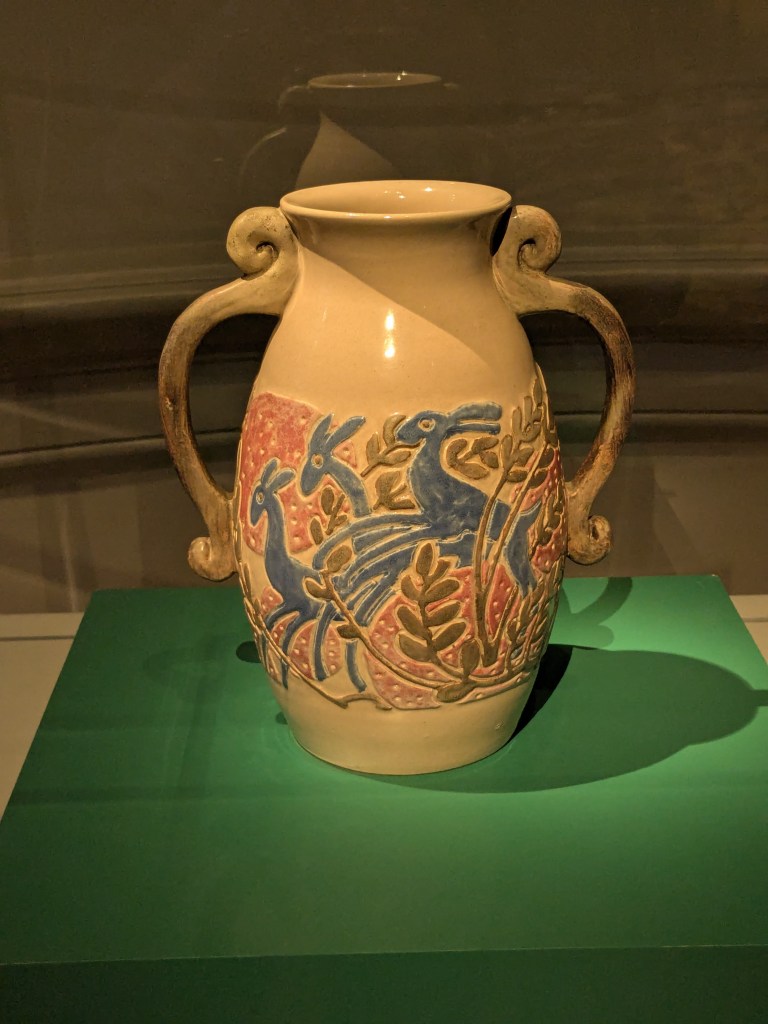
By the end of our visit, Mary had identified about ten potential Indiana artists for the exhibition. A few months later, she told me that she needed to pare down the list, because the exhibit included more craftspeople from Indiana than any other state. The final roster included bowl maker Keith Ruble, chairmaker Blaine Berry, basket weaver Viki Graber, woodturner Betty J. Scarpino, and potter Kelly Bohnenkamp, who loaned her whimsical “corndog vase” (Figures 18-20). The exhibition also included works by two historical Indiana craftspeople: a vase by Mary Overbeck (1878–1955) and the large bowl made by Bill Day (1915-1999) (Figure 21).
JBJ:I am glad that you could help the craftspeople of Indiana gain recognition from this major exhibition at a key world museum devoted to craft. I mentioned the catalogue for the exhibition at the start. Can you tell readers what they will find in that catalogue and what your contribution to it is?
JK: The exhibition catalog, State Fairs: Growing American Crafts, is a companion book published by Smithsonian Press (Savig 2025). It connects the narrative threads of the exhibition, as outlined by editor Mary Savig in the introduction. The chapters then highlight key themes, including “4-H and Youth Participation,” “Creative Arts Competitions and Women’s Collectivity,” “Indigenous Fashion Shows,” and “Studio Craft Competitions.” My chapter ended up being more focused than the others, centering on the Pioneer Village at the Indiana State Fair.
Mary and I initially discussed framing the essay around creative aging in heritage events, but ultimately, she felt a tighter focus on the Pioneer Village would serve the book better. For my chapter, I drew on decades of interviews with participants in the Pioneer Village. In fact, I had to work hard to stay within the word count. I hadn’t realized at the time that mine would be the only chapter focused on a specific event. While the other essays explore broader themes across multiple fairs, mine is grounded in my long-term work at the Indiana State Fair—and especially in the Pioneer Village.
I feel fortunate to have served as a contributing curator for the exhibition. Much of my role involved sharing nearly two decades of research into craft traditions at the Indiana State Fair. I’ll be returning to the Renwick Gallery this winter to participate in a panel discussion, where I’ll speak about my work in arts and aging, drawing on experiences with longtime fair participants, including those in the Indiana Arts Building and across the fairgrounds.
JBJ:The new exhibition, book and public program series at the Renwick Gallery is one of scores of projects that you have pursued related to craft and craftspeople in Indiana, in the United States, and overseas. Looking ahead, what is your next big project related to craft all about?
JK: As you know, I tend to keep several projects going at once, so questions like this always make my head spin a bit. I recently submitted a manuscript for a book on Indiana basketry, which is currently under review at the press. It examines the social function of craft in everyday life and the cultural changes that have undermined it.
In addition, I co-authored a new, public-facing book, Lifelong Arts: A Creative Aging Handbook, for the Indiana Arts Commission. The Indiana Arts Commission will publish it. I wrote it with Stephanie Haines and Anna Ross, and it explores creative aging practices. The book is based on a series of public workshops and trainings that we conducted across the state in 2022-23. Lifelong Arts will be my third public-facing creative aging guide. This one is a more general guide to arts and aging. In contrast, my other two projects were regional and based on traditional arts and everyday creative practices: Memory, Art & Aging (Kay 2020) and Everyday Arts in Later Life (Kay, Jackson, and Islam 2024).
So, I am in the starting phase of two larger projects. One explores bowl hewing in Indiana, which connects to Keith Ruble, Bill Day, and the State Fair. While this tradition is deeply rooted in Indiana, I’ve also discovered that bowl hewing is part of a broader international network of green woodworkers, toolmakers, and heritage events. Many of these makers speak about how the craft supports their emotional, physical, and social well-being, which aligns with my ongoing interest in craft and wellness. The second project, which may eventually merge with the bowl hewing project, is a scholarly study on “Folklife and Creative Aging” (Figure 22).
Of course, my academic research runs in parallel with (and within) my work directing Traditional Arts Indiana at Indiana University. TAI continues to operate the TAI Apprenticeship and the Indiana Heritage Fellowships. I am also exploring the development of an online version of TAI’s Community Scholar Training. It’s a lot to think about and seeing it all laid out like this feels a bit daunting.
In closing, Jason, thanks for your ongoing interest in craft, museums, and folklore. It was great to reflect on this moment and to think about my years at the fair and the exhibition at the Renwick. I know that the exhibition has helped me approach the fair with fresh eyes and to see the many crafts and communities that the fair has helped cultivate.
JBJ: Thanks Jon for sharing these valuable reflections and thanks for all that you do for Indiana and its peoples.
Notes *Twenty documentary videos profiling State Fair Masters are accessible via Indiana University’s Media Collections Online. See the “Traditional Arts Indiana’s State Fair Master Documentaries” collection via https://media.dlib.indiana.edu/.
References Cited
Kay, Jon, ed. 2020. Memory, Art, and Aging: A Resource and Activity Guide. Traditional Arts Indiana. https://hdl.handle.net/2022/33323
Kay, Jon, Joelle Jackson, and Touhidul Islam. 2024. Everyday Arts in Later Life. Traditional Arts Indiana. https://hdl.handle.net/2022/33322
Savig, Marty, ed. 2025. State Fairs: Growing American Craft. Smithsonian Books.
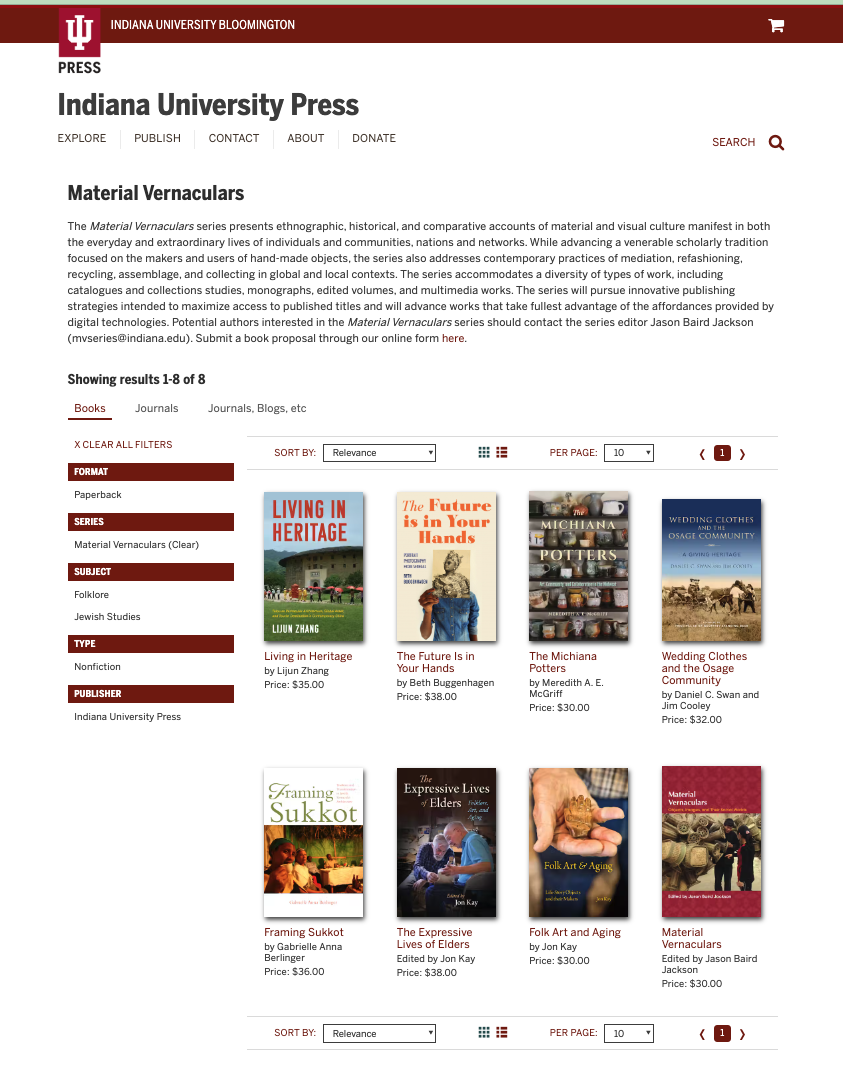
Good news is scarce in my world right now, but I am really very pleased to share that Lijun Zhang’s latest book Living in Heritage: Tulou as Vernacular Architecture, Global Asset, and Tourist Destination in Contemporary China has now been published by Indiana University Press in the Material Vernaculars series. It has to be auspicious that Lijun’s important book was officially published on September 17, 2024, which this year was the Mid-Autumn Festival or Moon Festival (did you see that moon?!?). I may share more about the book later, but for today, here is the description and the link to its page at IU Press.
Yongding County in southeast China is famous for its large, multistory communal vernacular buildings known as tulou, translated “rammed earth building.” These structures were designated a UNESCO World Heritage Site in 2008. Living in Heritage introduces readers outside of China to this classic example of local Chinese architecture in the context of contemporary heritage preservation and tourism.
Focusing on the Yongding Hakka Tulou Folk Culture Village, which is part of Hongkeng Village, author Lijun Zhang examines the on-the-ground processes and effects of heritage-making, UNESCO-inspired tourism, and how locals negotiate the dramatic transformation of their daily, social, and economic lives. Within an age of cultural change beginning at the start of the 21st century, Living in Heritage explores how the tulou phenomenon as heritage has and continues to be transformed into cultural, economic, or political capital. Through her careful study, Zhang reveals how the blurring of formerly distinct domains—private and public, local and global—gives rise to a living museum that now relies on insiders and outsiders to preserve their way of life.
Living in Heritage offers an in-depth ethnographic account of the people dwelling and working within traditional tulou architecture in the 21st century.
Lijun Zhang is Assistant Professor of Folklore at George Mason University. She is author of Chinese Folk Art and Crafts and editor (with Marsha MacDowell) of Quilts of Southwest China and (with Ziying You) of Chinese Folklore Studies Today: Discourse and Practice.
Please consider purchasing a copy from IU Press here https://iupress.org/9780253070975/living-in-heritage/ (or wherever you get your books). Doing so supports not only the press in general but the free-to-readers versions of Material Vernacular titles. (More on that when the free version becomes available.)
Jon Kay is Director of Traditional Arts Indiana, an Associate Professor of Folklore, and Interim Executive Director of Arts and Humanities, all at Indiana University Bloomington. In this exchange, I pose questions to him about his new exhibition A Culture Carried: Chin Basketry in Central Indiana. Find details about the exhibition and associated opening program at the end of the interview.
Jason Baird Jackson (JBJ): Thanks for taking time to field a few questions about the upcoming exhibition “A Culture Carried: Chin Basketry in Central Indiana.” For Shreds and Patches readers, I’ll share all the practical details about the show and the opening celebration below. Here, let’s jump right to an initial question about this exhibition and the work on which it is built.
Who are the basket makers whose work centers the upcoming exhibition at the Cook Center for Public Arts and Humanities in Bloomington?
Jon Kay (JK): The exhibition features the work of Pu Ngai Chum and Reverend Ceu Hlei, lifelong friends from Chin State, Myanmar. Both are Zophei basket makers who now reside in Southport, Indiana, a suburb of Indianapolis with a large Chin refugee community. Pu Ngai Chum has lived in Indiana for over ten years, while Reverend Ceu Hlei came to visit his daughter in 2020 just before the pandemic began and ended up staying due to the ongoing turmoil in Myanmar. Following the military coup, civil unrest, and persistent violence against the Chin, he decided to remain in the United States with his family.
Pu Ngai Chum started making baskets for his Chin community after his children encouraged him to leave his job during the pandemic. Similarly, Reverend Ceu Hlei, feeling bored and depressed as a newcomer to Indiana and unable to leave the house, was encouraged by his son-in-law to start basket making. His son-in-law suggested he try using recycled polypropylene packing ribbon from local warehouses, just as Pu Ngai Chum was doing.
I met Pu Ngai Chum and Reverend Ceu Hlei about a year later while conducting a folklife survey on arts and aging in Central Indiana, funded by the Allen Whitehill Clowes Charitable Foundation. Since then, I have worked with them to coordinate basket classes, workshops, and demonstrations. All the while, I was buying baskets and documenting their craft, which led to this exhibition.
JBJ: I know that visitors will enjoy seeing their work presented in the new exhibition. Hopefully there will be a good turnout for the opening event where they will be demonstrating their skills publicly. That will be a great opportunity.
It seems to me that many people take baskets for granted. They are a kind of thing that one sees readily available in a store like Target. We rarely know where such baskets came from or who the people were who made them. When discussing your work with talented basket makers in Indiana, how do you find ways to shake people out of this passive relationship to this venerable craft?
JK: Other than the molded plastic laundry baskets and hampers sold by big box retailers—which arguably are not baskets— every basket is handmade. Today, their making may include special jigs, tools and machinery, but to some degree all baskets require some handwork and specialized knowledge. In the United States, some discount stores sell inexpensive baskets that are made in distant places where labor costs are low and manual skill is high. So, it is easy to speculate why baskets are met with apathy or even disdain.
When people want to invoke the idea that something is outmoded or simple, they may compare it to “underwater basket weaving” or call it “Basketmaking 101.” This position assumes that anyone can do it. While it is true that almost anyone could learn to weave basic baskets, few do. But if you look deeper into these woven vessels you begin to see they hold so much more. The sheer diversity of materials, patterns, aesthetics, and uses is staggering. From carrying eggs and catching fish, storing grain or serving food, holding babies to burying the dead, baskets for millennia have held our most precious possessions.
Moreover, the work that baskets and basketmaking does in the world is still needed. In many places baskets remain a part of everyday life. They are the perfect thing to carry to the market—no need for plastic bags. The feel of the twisted handle in my hand as I work in my garden each summer reminds me of how this old technology is perfectly designed for the work that baskets do in the world. But, more than the physical nature of baskets, basket making is needed now more than ever. In my arts and aging research, I see the value and power of creative pursuit in later life; something you can devote your time and attention to, a practice that gives you satisfaction and purposes, an activity that coaxes you into a state of flow. All of which support our wellbeing in later life…or for that matter throughout the life cycle. Too many young folks and elders in the United States, for example, are struggling with feelings of depression, boredom, and loneliness. Many find it difficult to forge meaningful relationships. Some are perpetual distracted with social media and portable technologies, and struggle with the basic human skill of human interaction with the world around us. Basket making is just one craft that requires mind and hand to work in concert. In addition, basket making can connect generations. Makers learn when they are young, often from grandparents or nearby elders then, when they grow old, they return to the craft to fill their lives with purpose in meaning. Moreover, when an elder teaches a younger person to focus and make a basket, they are also demonstrating them how to age well. In this light, I think we need more baskets, and for sure we need more people making baskets.
A glimpse of the exhibition, “A Culture Carried: Chin Basketry in Central Indiana”.
JBJ: Well said! And I think that your arguments about making and meaning also help us understand the remarkable transformations underway now at the intersection of craft and making activities and social media, particularly how-to videos for would-be craftspeople and makers, but also making-videos-as-entertainment, especially very short format videos of the kind visible on platforms like TikToc and Instagram. We can explore those themes another time but, building on them, could you say something about how you yourself use video and photography as part of your studies with basket makers such as Pu Ngai Chum and Reverend Ceu Hlei?
JK: Yes, you are exactly right. I have witnessed over and over how the documentary impulse is one of the ways that intergenerational bonds are strengthened. We could talk for hours about that, for sure. In the exhibition I include two documentaries that my research assistant Touhidul Islam and I made featuring the work of the two makers. They are great ways for exhibition goers to see how a basket comes together. Both videos compress a half day of work into a few minutes. And while I made them to share in the exhibition and online, that was just one of the reasons that I undertook those video making projects. First, the making of the video gave me a reason for engagement with the artists. I could tell them about my work, show them my publications, and visit with them, but when we collaborate in the making of the video, we learn about each other, and our trust grows. I have done five basket-making video projects all for the same reason. The first was with Viki Graber a Mennonite willow bask maker from Goshen, Indiana. The next was with Li Guicai a Baiku Yao basket maker who makes bamboo rice baskets in Southwest China. In addition to the two basket videos with the basket makers in the current exhibition, I recently produced a video that follows Myaamia artisan Dani Tippmann through the making of an elm bark basket. Each of these making projects (both the making of the basket and the making of the video) allowed the maker and the me to deepen our research relationship. It gave us a reason to work together. It was valuable to the maker, but also to me as video producer. Whether it is hosting a craft workshop, curating an exhibition, or making a video, my public-facing folklore work is more than just doing public programs, each activity creates a context for deep learning with my interlocutors.
I focus on process-centered documentaries. When I began this approach, it was less common for an ethnographic video to concentrate on a creative process. Instead, films would use footage of making as a backdrop for telling the maker’s story. However, in recent years process-centered videos have become popular. My social media feed is full of them. These videos are also very popular in the home communities where these tradition bearers are from.
I prefer making process-centered videos in part because the researcher and maker roles are even— the maker makes, and the documentarian shoots and edits. While we are working together; the maker knows what I am doing and what they need to do for it to be successful. As we work together, the maker tries to make the best basket possible, and I try to capture the best footage I can.*
JBJ: It is great to gain this sense of your process and your priorities in the work. That the videos will have multiple uses, both now and in the future, is a key factor. A classic gallery exhibition is a unique and wonderful thing—I have devoted my life to making them—but they cannot reach all audiences and they are very time and place limited. Your videos will do varied work around the world and in the Indiana Chin community itself. I look forward to watching them!
Can you say something about how this project and exhibition intersects specifically with Indiana University Bloomington, above and beyond its relevance to the Chin community, to Indiana as a state, and to TAI as the state public folklore program? Put another way, what connections already exist between IU Bloomington and the Chin people in Indianapolis and around the state? This is not the first time IU is engaging with Chin people, is it?
Yes, exhibitions have a limited reach, but they can signal to a community or group that we see them and that their work and culture is valuable both in their community and beyond. I have successfully used campus venues to prototype exhibitions, that I later expand and tour to venues nearer to the makers’ home communities. I did this with an exhibition about oak-rod basketry that was at Indiana University’s Mathers Museum of World Cultures but that was later installed at the Historic Brown County Art Gallery in Nashville, Indiana. Similarly, I did a small proof of concept exhibition on bowl hewing in Indiana at the Herman B Wells Library’s Scholar’s Commons that then was expanded to tour to the Swope Museum of Art. Just as video making is a process for fostering creative collaborations with the artists that I work with, so are exhibitions. Developing an exhibition, growing the exhibition, touring and programming the exhibition—all contribute to my greater understanding of the art form and the makers with whom I collaborate.
Back to your real question though… Back in 2010, Traditional Arts Indiana did its first project with the Chin community in Indiana. My graduate assistant at the time, Anna Mulé took the lead on that project, and we created a community exhibition and festival about Chin culture. Back then there were just a few thousand Chin living in Central Indiana. Today there are more than 30,000. I wish I could tell you that we continued to work with the Chin through the years, but we didn’t. In 2021, I received a grant to do work in Central Indiana focused on how everyday arts support elder wellbeing. It was then that I met my collaborator Kelly Berkson, an IU linguistics professor and the director of the Chin Languages Research Project (CLRP). It was in working with her that I learned about how much larger the Chin Population had grown. CLRP is doing amazing work documenting the diverse languages being spoken by the Chin peoples living in Indiana. Through Kelly and CLRP, I discovered that there were dozens of Chin students studying at Indiana University. Kelly had enlisted a strong team of Chin students to support her linguistic research and to understand what Chin languages are being spoken in Indiana. After meeting Kelly and her team, we decided TAI and CLRP needed to work together. Kelly and I received campus funds to support a summer collaborative project, the Chin Folklife Survey. The Chin students, Kelly, and Chin linguist Kenneth Van Bik, and I conducted interviews with elders in the Chin community. By recording their life stories, we developed a robust collection ethnographic interviews and linguistic data. The students loved the project. After that summer project, I began working one of Kelly’s students, Em Em, who graduated from IU with a degree in Public Health. She helped pilot a series of creative aging programs for Chin elders at the Chin Center of Indiana. From there, Em and community scholar Anna Biak helped start the Winding Wednesday group, a weekly gathering of Chin back-strap weavers living in Central Indiana. Pi Nah Sung has emerged as the lead teacher of that group. I say all of this to make clear that there is a network of students, community scholars, nonprofits, and university partners working with the greater Chin community in Indiana.
This exhibition would not exist if it was not for that constellation of collaborators. Kelly and her students introduced me to the community, students assisted me with translations and helped me understand the significance of basketry in their community. Em organized and facilitated basket workshops with the two makers, and her insights and knowledge supported this exhibition throughout its creation. This exhibition is not an expression of my “great curatorial understanding of Chin basketry,” rather it is a humble offering of respect and appreciation to the Chin community in general and to Pu Ngai Chum and Reverend Ceu Hlei specifically. It is my scholarly way of thanking them for their time and talent. I also hope the exhibit captures the interest of Chin students and that they might be inspired to learn more about the traditional arts of their community.
JBJ: It is super to get the wider Indiana University and Chin community contexts for the exhibition and for the larger project. That background really brings to life what is meant when we describe a research project as being a community collaboration.
You have been very patient with my questions at a busy time. You are not only finishing the exhibition and starting a new semester at Indiana University, but you are also working as Interim Executive Director for Arts and Humanities on the Bloomington campus. Take off your hat as Director of Traditional Arts Indiana and put on the A&H director’s hat. From the perspective of your new role, how does an exhibition like this one articulate with the larger body of work that faculty, staff and students at Indiana University Bloomington are now pursuing?
JK: The Arts and Humanities have long been one of Indiana University’s strengths. I feel very fortunate to be serving in this new role at this critical time. While I have been on the faculty at IU for twenty years, I have always identified as a public folklorist/humanist. My work has always aimed to serve the state, communities, and tradition bearers with whom I collaborate. Our university has undertaken of a seven-year initiative called the IU 2030 plan, which has three priorities. “Student Success & Opportunity,” “Transformational Research and Creativity,” and “Service to Our State and Beyond.” In some ways, this is just a rearticulation of the existing areas of review for university faculty: teaching, research, and service. The exhibition and the work that surrounds it delivers on the IU 2030 promise. I outline this below, not as a way of championing IU’s initiative or my work but rather to present how public humanities can work in a university context.
Student Success and Opportunity
Students were involved on all levels with the research, curation, and programs associated with the Chin basket exhibition. Chin students helped identify the basket makers and served as translators and fieldwork assistants. They worked with the Chin Folklife Survey, and gained insight into the fieldwork process, oral history skills, and how to translate field research into accessible content for their community. Folklore students worked alongside me in drafting the exhibition script, editing fieldwork video to be shown in the gallery, and selecting photographs to be included. These “real-world” experiences foster community pride and help develop important professional skills. In addition, they develop a portfolio of career-ready competencies to add to their resume before they leave the academy.
Transformational Research and Creativity
The exhibition also is an example of transformative arts and humanities research. While much of IU’s emphasis is in the biomedical and technology sector, one of the priorities of the 2030 plan is to “Improve the health and well-being of older adults through expansion of IU’s nationally recognized programs in aging research.” Since 2013, Traditional Arts Indiana has worked to research and present the ways that older adults employ traditional arts to resist feelings of isolation, boredom, and helplessness that beset so many older adults.**
The exhibition tells the story of older Chin who make baskets to give their lives purpose and meaning. Through baskets, and by extension all traditional arts, the exhibition shows how community-based arts work to connect elders to their community, fill them with a sense of satisfaction and mastery, and offers them a positive and culturally validating way to devote their time and attention. Over and over, my ethnographic projects focused on the expressive lives of elders reveal how traditional arts support elder wellbeing. Since “creative aging” is culturally situated and individually experienced, however, there needs to more research with and for the diverse communities we serve.
Service to Our State and Beyond
With recent changes at the National Endowment for the Arts, each U.S. state and territory is required to have a plan for supporting the folk and traditional arts practiced in their jurisdiction. In Indiana, Traditional Arts Indiana has done this work since 1998. This is one way that we serve the state. We host apprenticeships, award Heritage Fellowships, and produce exhibitions, recordings, and scholarship-based, public-facing works. The new exhibition is one of the ways Traditional Arts Indiana is serving our state. In addition to the service that our work provides to the state and for the Indiana Arts Commission, the state arts agency, the work that we do related to traditional arts and creative aging has helped shape arts and aging policies and programs across the United States. Moreover, our primary effort is always to serve the people of Indiana, including the Chin community in Central Indiana.
I should say that these are the way that I am framing my work given the current priorities of our University, but as a public humanist, I really have not done anything different than what I have done in the dozens of exhibitions, videos, publications, and projects that I have undertaken in since joining the faculty—I research, I teach, I serve.
JBJ: Jon, thank you so much for your time and for all that you do to support so many different communities and constituencies! As promised, I will now share the exhibition details. I look forward to seeing you at the opening events!
* Readers can learn more about Jon Kay’s approach to ethnographic video production with makers in his contribution to Asian Ethnology. See:
Kay, Jon. 2022. “Craft and Fieldwork: Making Baskets, Mallets, and Videos in Upland Southwest China.” Asian Ethnology 81 (1–2): 273–78.
** In addition to major lectures in venues such as the Library of Congress, sources related to Jon Kay’s work on creative aging include the following two books:
Kay, Jon. 2016. Folk Art and Aging: Life-Story Objects and Their Makers. Bloomington: Indiana University Press.
Kay, Jon, ed. 2018. The Expressive Lives of Elders: Folklore, Art, and Aging. Material Vernaculars. Bloomington: Indiana University Press.
A Culture Carried: Chin Basketry in Central Indiana
OPENING SEPTEMBER 5, 2024
Chin Basket Weaving Demonstration by Pu Ngai Chum and Reverend Ceu Hlei at the “First Thursdays” Festival on the IU Bloomington Campus
Thursday, September 5th from 4 to 7pm on the Arts Plaza, Indiana University Bloomington
Bloomington Gallery Walk Exhibition Opening
Friday, September 6th from 5-8pm at the Cook Center for Public Arts & Humanities in Maxwell Hall (750 E. Kirkwood Ave, Bloomington, Indiana)
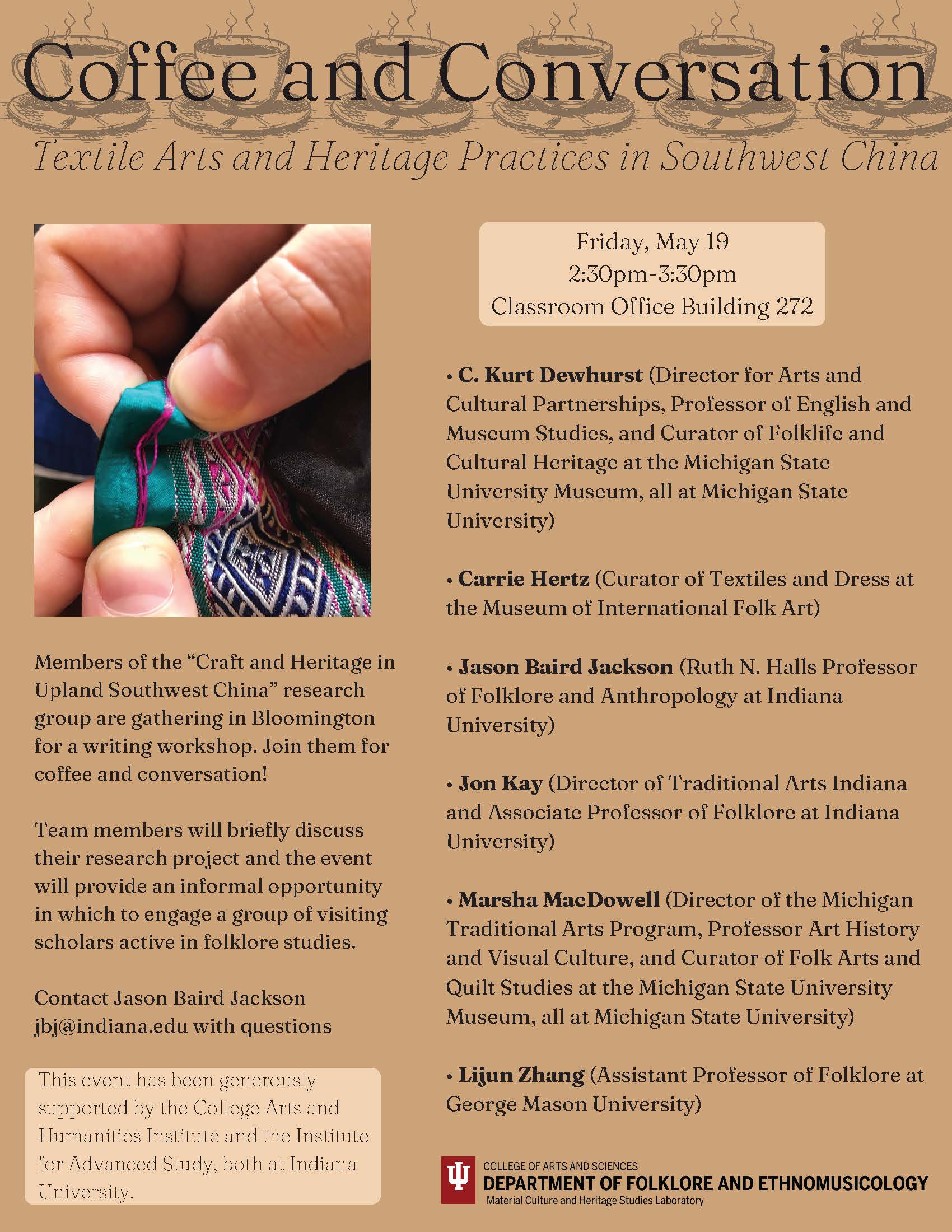
I am happy to be hosting a group of colleagues in Bloomington this week for a long-delayed (COVID…) writing workshop on “Textile Arts and Heritage Practices in Southwest China.” This grows out of the work of the “China-US Folklore and Intangible Cultural Heritage Project,” a joint project of the China Folklore Society and the American Folklore Society. Specifically, the effort arises from that project’s “Collaborative Work in Museum Folklore and Heritage Studies” sub-project (2017-2021), an effort now extended through the “Craft and Heritage in Upland Southwest China” project (2022-present) of the Material Culture and Heritage Studies Research Laboratory. The generous funders and partners for these various projects are discussed in Jackson 2023. This week’s workshop has been supported by the College Arts and Humanities Institute and the Institute for Advanced Study, both at Indiana University. Thank you to all of those who have supported these projects.
There will be a campus event associated with the workshop on Friday, May 19, 2023 at 2:30 pm. Read about it here at this calendar link and in the flyer posted below.
Below find the ninth in a series of posts offered in celebration on the occasion of our colleague and friend Daniel C. Swan’s retirement from the University of Oklahoma, where he has served with distinction as a Professor of Anthropology, Curator of Ethnology, and Interim Director of the Sam Noble Oklahoma Museum of Natural History. Here I take a turn reflecting on an an aspect of Dan’s work and his personal impact. This series of guest posts has been organized in partnership with Michael Paul Jordan. –Jason Baird Jackson
Daniel C. Swan, Museum Leader
by Jason Baird Jackson
Earlier posts in this series in celebration of Daniel C. Swan’s retirement from the Sam Noble Museum, and from the University of Oklahoma where it is based, have emphasized mentoring. To impact a more junior colleague positively and to help launch them, or to advance them, in their career is particularly noble work. Since we met one another in the spring of 1994, Dan has been an extraordinary mentor to me and an energetic advocate for me and my work. My career has followed the particular—and wonderful—pathways that it has because of Dan’s deep influence on me and on my lifecourse. This observation could easily be the stepping off point for an essay on Dan’s outsized role as a mentor and supporter to me and to many others. I would love to write that essay.
For others, as for myself, a key part of Dan’s influence as a mentor relates to his providing an observable, emulatable model for collaborations that link communities and cultural organizations for work that addresses the needs or goals of the partner community and that serves society more broadly, while also advancing collaborative scholarly research. While Dan’s involvement in a wide range of such projects in Indian Country are perhaps best known, he has been involved in partnerships and initiatives connecting to, and serving, a still wider range of constituencies and communities. This was true, for instance, in his work as a curator in a an extremely diverse city, while at the Science Museum of Minnesota and I saw it first hand in his work as Senior Curator at the Gilcrease Museum.
In 1999, for instance, we worked together to raise funds for an “Oklahoma African American Folk Arts Survey” aimed at addressing the Gilcrease Museum’s historic neglect of African American cultural life in the state and in the Americas. We brought the Smithsonian exhibition Creativity and Resistance: Maroon Cultures in the Americas to the Gilcrease the following year for the same reason. At a much larger scale, one of his most ambitious and far reaching Gilcrease projects was the major permanent exhibition Las Artes de Mexico. Opened in 1996 and co-curated with Kevin Smith, that project shook things up for Gilcrease and leavened an excellent but little-known collection of Mexican art and documents with contemporary collections and contemporary voices—including Indigenous ones. It was perhaps the first time that a major Gilcrease Museum exhibition was informed by new, project-based ethnographic field research. It was also innovative not just for the museum but for the field in the way that it snuck in a wide range of then emerging best practices and subverted, in a fruitful and innovative way, the then-standard conventions of art-museum-based exhibition presentation and planning. Even the staid Tulsa World captured the sense of what I am getting at here in this June 9, 1996 report by arts reporter James D. Watts, Jr.
Mentoring. Museum collaboration. Exhibitions. Dan’s accomplishments in these areas warrant extensive discussion. So too with his own research and writing. If you have not read Peyote Religious Art: Symbols of Faith and Belief(University Press of Mississippi, 1999) or Wedding Clothes and the Osage Community (co-authored with Jim Cooley) (Indiana University Press, 2019) yet, I really urge you to do so. On the article side, my favorites include “Early Osage Peyotism” (Plains Anthropologist, 1998), “The North American Lotus (Nelumbo lutea (Wild.) Pers.) – Sacred Food of the Osage (Ethnobotany Research and Applications, 2010), and (with Michael Paul Jordan) “Contingent Collaborations: Patterns of Reciprocity in Museum–Community Partnerships” (Journal of Folklore Research, 2015). It is hard to fathom how Dan found time for so much writing when his administrative, curatorial, teaching, and collaboration duties were so extensive across so many years. His larger oeuvre is remarkable and really warrants separate discussion. I hope to help with that and with helping surface the ways that all of these activities intersected with his teaching work at the universities of Tulsa, Memphis, and Oklahoma.
I am cheating by evoking those other areas here in brief as I do not want them to go unmentioned in the series. But the focus of my thinking today is in museum leadership. Between 2013 and 2019, I served as Director of the Mathers Museum of World Cultures (MMWC). Almost daily during those years, I thought about Dan and about all of the things that I learned from him about leading teams of colleagues within museums. I was really fortunate to have been hired by Dan to work as his understudy and assistant at the Gilcrease Museum during his tenure there as Senior Curator. Dan had begun his own museum career at the Oklahoma Historical Society’s main facility in Oklahoma City and then at the White Hair Memorial, an OHS state historic site and community learning center in the Osage Nation. Before returning to Oklahoma to work at Gilcrease Museum as Senior Cuator, Dan was Curator of Ethnology at the Science Museum of Minnesota. After Gilcrease he served as Director of the University of Memphis’ Chucalissa Museum and finally returned again to Oklahoma to follow me as the Sam Noble Museum’s Curator of Ethnology. Yesterday was his last day in that role and as the museum’s Interim Director. I write this reflection on his first day of retirement.
Museum leadership is often hard, especially in moments such as the current one. In each of his museum leadership roles, Dan made difficult choices with his eyes focused on how to advance the community-service mission of these museums. When I became Director at MMWC, I thought often about how I so regularly watched Dan turn bad news into good news and how he stayed positive and good humored even when this could not be done. There was almost always another day to try again. Every problem could be approached from a new angle. New friends, new funds, new relationships, new ways of organizing the team, new ways of organizing the day, new ways of organizing the collections, could almost always be found and, with them, new progress could eventually be made. The time that I spent at Gilcrease working with Dan and with our colleagues of that period was the most formative in my career. Despite all of the good things that have happened to me since, it remains my own personal golden age. I was shown how to do the work of a curator and given ever more expansive opportunities to do it. I had so much fun to work with Dan and with my other Gilcrease colleagues of that time.
But, I was also watching how the museum’s senior staff, its directors (there were several in a brief period) and especially how Dan, as Senior Curator, did their work. How did museum leaders interact with the board and with funders? Where did the funding come from? How did the leadership group work with the media? With city officials? How were staffing problems dealt with? Controversies? Mistakes? The usual physical plant crises? How did the museum present itself to its audiences and was it diversifying those? With respect to Dan in particular, how did he pull off major projects (the Thomas Moran exhibition, for instance) that went beyond the skills and experiences that the museum’s staff already had? How did he help the teams that he led innovate? I learned so much from watching him and from being involved in the group work that he led the Gilcrease Museum’s curatorial, registration, education, conservation, and programs staff in.
There are many lessons, but one that I thought about most often in my own directorship was the balance that a museum leader has to try to strike between firmness and flexibility, seriousness and fun, expectations (of growth, of productivity, of commitment, of progress) and acceptance (of personality differences, of relative skills, of career investment, of hard realities). In striking this balance, Dan always displayed an equanimity that I never came close to. With the staff, he knew just when the best course of action was to lighten the mood with appropriate humor. Inversely, he knew when frank words were necessary and how to convey them constructively. From my perspective, he knew just when he needed to roll up his own sleeves and join in the physical work of lifting a crate or painting a wall and when he needed to straighten his tie and leave such work to those for whom it was an assigned duty. I wish I had words adequate to describe what I am getting at, but the key thing is that Dan was a model museum leader not just in the sense that he was an excellent one, but in the sense that he literally provided the model by which I and others learned how to also be museum leaders ourselves through his example and influence.
While my time as a museum director is concluded, for now at least, I still use the lessons that I gained form Dan daily. They appear in my courses about museums and curatorship, certainly. They appear in my own mentoring of students and colleagues. But they also permeate my day-to-day work. At present, I am returning to my own research and my own collaborations. In doing so, I am trying to build a new team of collaborators and to revitalize relationships with partners for a post-MMWC period. I am trying to keep existing efforts going while looking ahead to new ones. Doing just this is fundamental to the work that I have watched Dan do for all of the twenty-six years that I have known him.
I am thrilled at the prospect of Dan having, at last, the freedom to take up his projects and pursue his collaborations out of pure interest and commitment without the burden of having to feed a museum’s insatiable demand for new exhibitions, new grants, new reports, new budgets, new donations, and all of the rest.
Dan—thank you for all that you have given and all that you have done. Congratulations!
During the Osage Weddings Project, which led to the exhibition “A Giving Heritage: Wedding Clothes and the Osage Community” and to the book Wedding Clothes and the Osage Community, project participants, including Dan Swan, held consultative events in the Osage community, such as this discussion in May 2015 at the Wah-Zha-Zhi Cultural Center in Pawhuska.
Below find the eighth in a series of guest posts offered in celebration on the occasion of our colleague and friend Daniel C. Swan’s retirement from the University of Oklahoma, where he has served with distinction as a Professor of Anthropology, Curator of Ethnology, and Interim Director of the Sam Noble Oklahoma Museum of Natural History. Reflecting here on an aspect of Dan’s work and his personal impact is Abby Wightman, who is Associate Professor of Anthropology at Mary Baldwin College. This series of guest posts has been organized in partnership with Michael Paul Jordan. –Jason Baird Jackson
Thank You, Dan, For All The Keys
by Abby Wightman
When my friends Michael Jordan and Jason Jackson asked me to write this piece in honor of Dan Swan, I was surprised – honored and pleased, but still surprised. Dan did not serve on my dissertation committee. We have never been work colleagues. I am not a museum anthropologist, and we have never co-authored a publication. In anthropological terms, we did not have formally-defined roles with assigned duties and reciprocal obligations. Yet it is precisely this list of “nots” – of all the ways Dan and I are not connected – that is so important here.
When Dan arrived at the University of Oklahoma in 2007, I was nearing the end of my doctoral studies in cultural anthropology, so he did not serve on my dissertation committee. Despite this, Dan reached out to me twice in later years – first, to ask me to participate on a conference panel and then several years later to work with him on a bigger, but also more complex and delicate project.
At the Sam Noble Oklahoma Museum of Natural History, Dan had inherited a binder full of photographs of the Plains Apache community of Oklahoma, taken by anthropologist J. Gilbert McAllister in 1933. McAllister spent one year collecting kinship data among the Plains Apache, and this fieldwork became the basis for an important chapter in the well-known volume Social Organization of North American Tribes, edited by Fred Eggan (1937). As part of his research, McAllister also took many photographs of the Apache people and families he came to know. These photographs, through a rather circuitous route, came to the Sam Noble Museum and eventually to Dan’s care.
Together, Dan and I developed a modest pilot project with three goals: to learn more about the context and people featured in McAllister’s photographs, to ascertain community interest in the collection, and to find a place to archive the collection. In the summer of 2013, with the support of the Sam Noble Museum and a small grant, I spent a summer of fieldwork in Anadarko and Caddo County, visiting with Apache friends. Apache folks patiently went through each photograph to provide the context missing from McAllister’s sparse annotations. The majority of unknown individuals were identified, as were location and context. The results were pretty astonishing, considering the age of the collection and the poor quality of some photographs.
Unsurprisingly, McAllister’s photographs strongly appealed to many Apache people. Unlike anthropologists, who might value historic images for their ethnographic value, Apache people primarily valued McAllister’s photographs for their social value. Although some of McAllister’s photos feature examples of material or expressive culture, the majority of the collection, over 60 photographs, are portraits. These photographs emphasize individuals and families in everyday dress, posed in front of homes, camps, cars, or – rarely – tipis. For many Apache people, McAllister’s photographs were valuable because of these portraits and their kinship ties to people in the present. While the photographs were visual representations of beloved relatives, they also had a material value and use beyond the image, as evidence of kinship claims and connections.
Like most fieldwork, however, this project wasn’t wrapped up tidily in one summer. While we made both hard and digital copies of photographs available to participants, I knew the entire collection should be stored in the community. In 2013, however, that was not possible. For six years, the binder with copies of the collection sat in my office, a constant reminder of my unfinished obligations to the Apache community. Last year, after checking with Dan, I was able to deposit hard and digital copies of the McAllister collection to the Apache Tribe of Oklahoma Cultural Preservation Office. The negatives will be archived, and accessible to the community and scholars, at the Western History Collection at the University of Oklahoma.
As the latest in a line of University of Oklahoma graduate students working with the Plains Apache, it made sense, perhaps, that Dan would ask me to help with McAllister’s photographs. But in a very real way, it also didn’t make sense. At my small university, requirements for tenure and promotion prioritize teaching and advising undergraduates. Dan knew that I could not reciprocate his offer of research support with support from my own institution – yet he offered me opportunities anyway, even without a formal student-advisor relationship. He became an invaluable connection back to Southern Plains scholarship and to the institution where I received my doctorate when I had few other links to this world.
Writing one of the later pieces in this blog series, I have had the opportunity to read previous posts that celebrated Dan as a dissertation advisor, mentor, confidant, father figure, and colleague. Like others, I have benefited and learned from Dan’s expansive knowledge, inclusivity, and respectful collaboration with the communities in which he works. To me, though, Dan’s lasting impact was as a generous provider of opportunities, opening doors to new possibilities without expectation of return. Perhaps a better analogy is that Dan handed you the key and trusted you to unlock the door yourself. It is an advising model based on mutual respect, and it has inspired how I advise undergraduates – providing students with the keys to opportunities and experiences, trusting their judgement and abilities.
Thank you, Dan, for all those keys. Best wishes on all your future adventures!
Photograph by the author. Anadarko, Oklahoma. 2013.
The Chickasaw Cultural Center in Sulphur, Oklahoma via WikiMedia Commons (CC-BY-SA 3.0).
Dan –
So when I heard that you were going to retire it seemed good to me. I know you’ve worked tirelessly, and that you’ve done your work well. Your coworkers, your students, your friends – we all wish you well. Be good as you’re going along.
That’s it.
Sincerest thanks
Lokosh (Joshua D Hinson, PhD)
*Above find the seventh in a series of guest posts offered in celebration on the occasion of our colleague and friend Daniel C. Swan’s retirement from the University of Oklahoma, where he has served with distinction as a Professor of Anthropology, Curator of Ethnology, and Interim Director of the Sam Noble Oklahoma Museum of Natural History. Lokosh (Dr. Joshua D Hinson), Director of the Chickasaw Language Revitalization Program, does the important work of reminding us of the importance of keeping Turtle Island’s first languages in use. This series of guest posts has been organized in partnership with Michael Paul Jordan. –Jason Baird Jackson
Below find the sixth in a series of guest posts offered in celebration on the occasion of our colleague and friend Daniel C. Swan’s retirement from the University of Oklahoma, where he has served with distinction as a Professor of Anthropology, Curator of Ethnology, and Interim Director of the Sam Noble Oklahoma Museum of Natural History. Reflecting here on an aspect of Dan’s work and his personal impact is Kimberly J. Marshall, Associate Professor of Anthropology at the University of Oklahoma. This series of guest posts has been organized in partnership with Michael Paul Jordan. –Jason Baird Jackson
Attention Drivers: Extremely Rough Road Ahead
by Kimberly J. Marshall
About the same time I landed a tenure-track job at the University of Oklahoma, researchers at the University of California, Berkeley published an important book called Do Babies Matter: Gender and Family in the Ivory Tower (Rutgers University Press, 2013). In this book, the authors draw upon a very large body of data to conclude that, more often than not, women’s academic careers are harmed by family formation. Although women and men enter PhD programs at relatively equal rates, women are far less likely to achieve tenure in their fields. The researchers found that a critical juncture in determining a female faculty member’s career trajectory happens during the pre-tenure probationary period, a 5-7 year pressure cooker when the expectations for performance at the highest academic levels often collide (for women) with the intense pressures of mothering babies and toddlers.
I never read that book, because I was just starting a tenure-track job with a 2-year old at home (see: pressure cooker, above). But this is the precise juncture in my life when I met Dan Swan, who was assigned as my “tenure mentor.” I don’t know if Dan Swan ever read that book either, but I suspect that he was keenly aware of the kinds of challenges I was likely to face. I do know that without Dan’s mentorship, my road to tenure would have been extremely bumpy. During my first year at OU, Dan simply let me get a feel for the wheel. But at the end of that year, he asked me one of the most important questions I have ever been asked, and one that would prove to have a major influence in determining my tenure trajectory.
Midway through that first summer, after I had a chance to catch my breath, I started to think about the upper-division class I was finally getting to teach, and emailed Dan to get a sense of departmental reading expectations for such a class. He wrote back to me with some general guidance (the specifics of which I can’t recall), but he ended the email with explicit instructions to stop focusing on my teaching. Instead, he challenged me with this question: “What have you been writing lately?”
Honestly, I was irritated. He was implying I didn’t know that publications (not good teaching) are required for tenure. He was suggesting that I didn’t know how to prioritize my time. I was so irritated, in fact, that I sat down right then and there and banged out my first article in three days. After that, writing became less hard. In 2016, my book was published. And in 2018, I earned tenure and was promoted to Associate Professor.
Being a mentor isn’t always about dispensing pearls of wisdom (although faced with persistent university politicking I have repeated Dan’s prescient motto for me “keep your head down, and do your work” more times than I care to repeat). Sometimes being a good mentor is knowing the potholes in the road ahead and helping people be prepared to steer around them. Dan is well aware of the statistics about female junior faculty and was the kind of mentor who cared enough to see that I was going to have a hard time navigating the road. He knew that as a mother of a young child, as someone who cared deeply about student learning and service to the department that I was at high risk for falling into one of those potholes and subsequently falling short of tenure. And with some good-humored prodding, he persisted in helping me keep my nose pointed in the right direction.
I will always be thankful that he remembered to ask me that question. And now it is my turn. Hey Dan, what have you been writing lately?
I can’t wait to see what he will.
“Signs and wildflowers” by The Greater Southwestern Exploration Company via Flickr under the terms of a CC BY 2.0 license.
Below find the fifth in a series of guest posts offered in celebration on the occasion of our colleague and friend Daniel C. Swan’s retirement from the University of Oklahoma, where he has served with distinction as a Professor of Anthropology, Curator of Ethnology, and Interim Director of the Sam Noble Oklahoma Museum of Natural History. Reflecting here on an aspect of Dan’s work and his personal impact is John Lukavic, Andrew W. Mellon Curator of Native Arts at the Denver Art Museum. This series of guest posts has been organized in partnership with Michael Paul Jordan. –Jason Baird Jackson
Thanks, Dad.
By John Lukavic
Each year in mid-June I send two Father’s Day messages: one to my own father and one to Dan Swan. Even before Dan and I met professionally, he and I shared a bond through common friends and relations back in New York where we both were raised. While I was a graduate student just a few years into my doctoral program in the mid-2000s, Dan arrived at (or rather, returned to) the University of Oklahoma as curator of ethnology and professor of anthropology and immediately agreed to serve as chair of my graduate committee. It seemed that fate finally brought us together.
Dan loves to tell stories like any father does (ask him about his old friend, a machine gun, and a bar somewhere in Mexico). I cannot count how many times he told Mike Jordan and me about the tasks his own advisor, John Moore, assigned to him while in graduate school: he had to babysit Moore’s kids while Moore was duck hunting; he had to help carry loads of wood so Moore could calculate how much labor was required to do certain tasks—as anthropologists do. But these were just great stories to me—myths and legends of adversity and triumph. My experiences as a graduate student were very different from Dan’s experience because Dan was there to support ME. He babysat MY kids. He read them books and took the time to be part of their lives. He was there through challenging times always to lend support and compassion.
“Doing” is central to Dan’s way of teaching. He understands that experience comes from opportunities and he is always generous with sharing his own opportunities with others. During our time together at OU Dan invited me to co-curate an exhibition of pottery and baskets at the Sam Nobel Museum. He guided me through the entire process from beginning to end. He helped me learn by doing. Way too often new curators are thrown into the fire and asked to navigate such a process without help or mentorship. I cannot express how valuable this was as a young professional. He shared his experiences and opportunities with me which provided a foundation on which I have built my career.
In terms of exhibitions and museum work, I learned from Dan the importance of relationships, responsibility, and respect. He instilled in me a strong belief that my first responsibility is to the artists and communities with whom I work, and the work I do in communities requires building strong relationships and trust. As a non-Indigenous curator who works with Indigenous arts, artists, and communities I embrace this responsibility—the feeling of “walking on egg shells” in everything I do—because I want individuals and communities to hold me responsible. Trust is earned by actions taken and must be renewed and maintained constantly. There is no taking a day off or doing what is easy because no one is looking. Dan instilled in me integrity in both my professional and personal life and, like any good son, I don’t want to let dad down.
All students love a pop quiz, do they not? Well as one of Dan’s students, I can tell you quizzes are frequent and not ever when you expect them. Years ago Dan invited Mike Jordan and me to accompany him to the Ilonska dance in Hominy, OK. We were going to see Osage people he has spent a lifetime getting to know and working with. A lot was on the line for him because he was bringing two students into a part of his life, and his reputation was on the line. Mike and I showed up to Dan’s house, grabbed our chairs out of the car and Dan just smiled. “You two pass,” he said. Bringing your own chair to a dance is like wearing pants and shoes. It is just something you do. Dan was testing us on such a basic thing before he let us get in his car to head up to Hominy. We had to earn his trust by our actions—something that I remind myself of constantly. Once he trusted us we learned so much—important things, such as where to get the best cream pie in Oklahoma and the Okie ritual of standing outside to watch a tornado approach. Typical things a dad teaches his sons.
In 2018 Dan flew to Denver, Colorado to attend an exhibition opening of a show I curated. Hundreds of people came to that opening and dozens of journalists came from all over to cover it. But, it was Dan’s words “I’m so proud of you” that will stay with me always. Professors teach, mentors guide, and fathers care. I mean really care. Fathers also give their kids a hard time every now and then—but it’s done with love. They teach life lessons as much as anything else because, at the end of the day, we are all just humans trying to navigate this path we call life.
Congratulations, Dan, on your retirement, successful career, all the scholarship you have put out into the world, all the lives you have touched, and all the relationships you have developed and maintained. You have given me so much and touched my life in so many ways. My family will always have an extra bed, hot pot of coffee, and cream pie waiting for you when you come to visit.
Thanks, Dad.
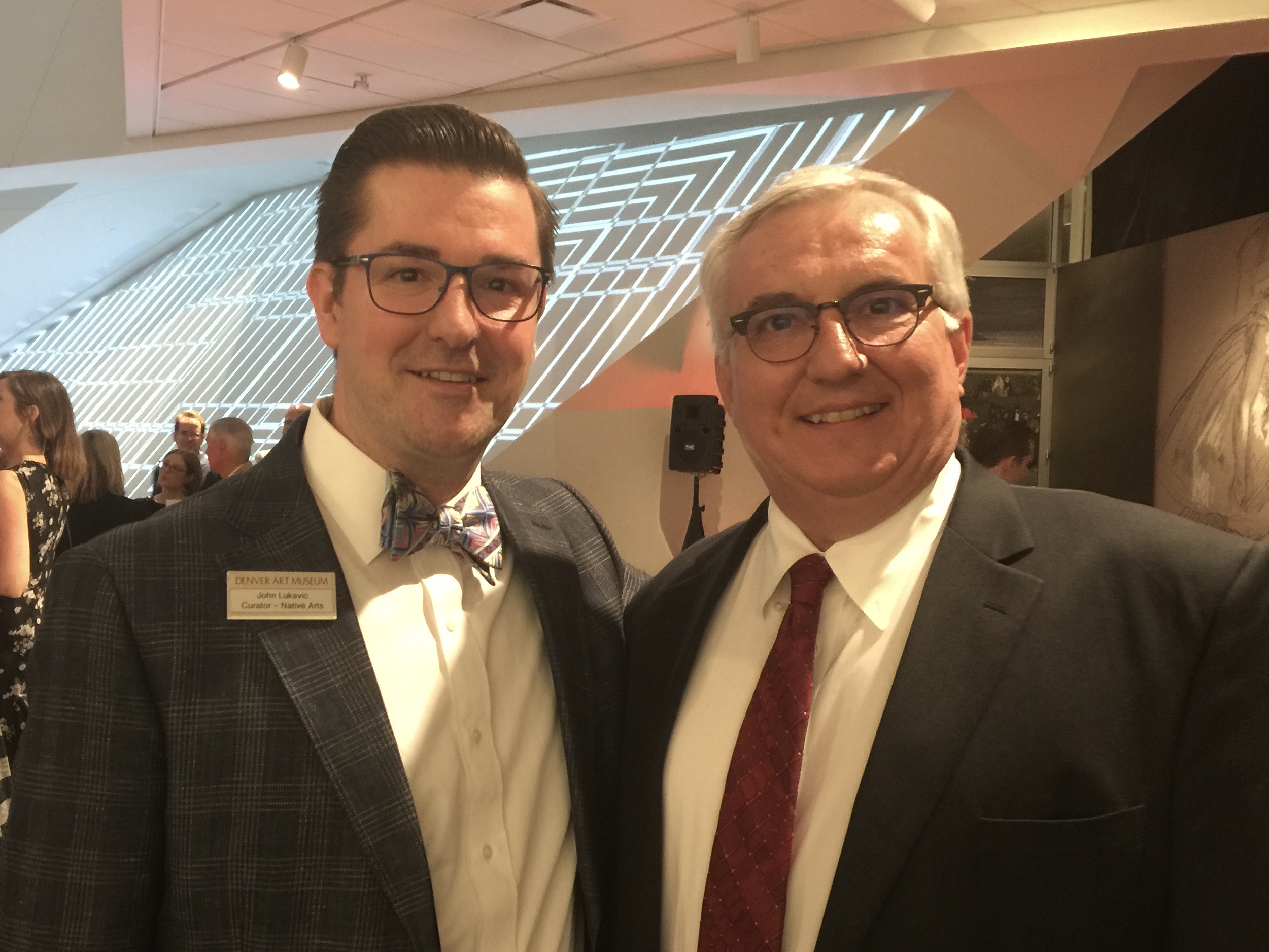
John Lukavic (left) and Dan C. Swan (right) at the opening of the exhibition “Jeffrey Gibson: Like A Hammer” at the Denver Art Museum in May 2018.

















 Shreds and Patches