Skip to content

Posts from the ‘OA Books’ Category

Museum Anthropology 32(2) Now In AnthroSource, Mailboxes

As I noted in a previous post, the final issue of Museum Anthropology for my editorship is out in the world. It is there now, but it took much longer than I expected to get posted in AnthroSource. I am happy that the issue features the valuable work of so many great colleagues. I am less happy with how the issue appears on the printed page and especially in AnthroSource, where thus usual metadata inconsistencies are ubiquitous. I will miss working with my CMA colleagues on Museum Anthropology but I will not miss being disappointed by the many value-added enhancements that the AAA’s toll access publishing system is supposed to deliver.

In happier news, its only 17 more days until the beginning of Open Access Week.

Two Bits by Chris Kelty is Great

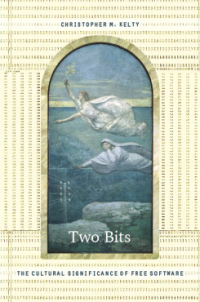
kelty_cvr_medA few days ago I finished reading Chris Kelty‘s wonderful book Two Bits: The Cultural Significance of Free Software (Duke University Press, 2008).  During the academic year, I could not get to it but it was a treat to read it at a time in which it could be the only big thing that I was reading (as opposed to reading it alongside course readings).  While I would have benefited greatly from reading it last year (when my involvement in the issues that it treats really began to expand), it will do me much good in the days ahead, as it relates very centrally to the work that I am now doing on scholarly communications issues.  It provides invaluable context on the emergence and present-day life of open source software, but it also offers a range of valuable theoretical, interpretive and methodological tools that are portable to other contexts.  The book also examines, in a very sophisticated way, the manner in which the processes and ideas and values of free and open source software have been extended into projects like Connexions (about which my department held a really fruitful meetup recently) and the Creative Commons license system.  All of this work is done very artfully and in ways that we can all learn from.

This post is no surogate for a careful review, but I want to flag the book’s importance to me and to suggest that it is going to be touchstone work for many of the projects that I am increasingly involved in. More ambitiously, I want to plead with my friends and colleagues to read it so that we can talk about it and draw upon it in our efforts together and in our conversations. It is a great work of ethnography, history, and theory.  It is also an experiment that modulates the very processes that it describes, as is evident on the excellent and innovative website that Chris has built to extend the book.  One can purchase the book the conventional way, but it is also available to freely read and remix in a variety for formats via the website.  Some of the background for this is also provided in the “Anthropology of/in Circulation” project that Chris led and that I particupated in.  Find the article version of that project here in IUScholarWorks Repository.

Thank you Chris.

10 Publishers Moving in the Right Direction

At Open Access Anthropology, I (re-)posted news of an key pro-OA announcement by 10 North American university presses. It is found here.

The Form of Value in Globalized Traditions

Recently, I had a unique and wonderful opportunity to participate in a small conference and workshop hosted by the Center for Folklore Studies at The Ohio State University (in partnership with the Berkeley Folklore Program).  Titled “The Form of Value in Globalized Traditions,” the workshop continued an ongoing series of discussions that were inaugurated in 2007 by Charles L. Briggs at the University of California, Berkeley.  The program for the public presentations (which were held on Friday, March 6, 2009), along with paper abstracts, can be found online at here. The overview summary describing what we were up to read:

This international working group considers the career of vernacular traditions under globalization. As cultural forms circulate ever more widely, recycled, restructured, and hybridized as they travel, regimes of value insist increasingly on point of origin. Since economic value is predicated upon scarcity, in a global framework cultural objects are marked—and marketed—as local. Form itself is fetishized as social interaction becomes attenuated. Rather than contesting the reification of culture into exchangeable goods, the resistance of impoverished groups and social movements increasingly takes shape as a struggle for control over the manner of commodification and the profits thereof. In the face of restructurings of value initiated by the World Trade Organization, the World Intellectual Property Organization, free trade agreements, and transnational corporations, intellectual property rights become a key locus of contention between distributors and cultural producers. The public component of this year’s group meeting will explore form and value as both categories of action and tools of analysis. We hope that attendees will help us with the work of comparison and synthesis.

My own presentation considered the current reshaping of the system of scholarly communications in which folklorists and ethnologists circulate (and find expanded publics for) their work in an era of corporate enclosure, media consolidation, and library crises on the one hand and open source technologies and open access movements on the other. The participants were a great group. In addition to many wonderful students and faculty members from the OSU folklore program, the participants were: Sadhana Naithani (Jawaharlal Nehru University, New Delhi), Lee Haring, City College, CUNY), Mbugua wa-Mungai (Kenyatta University, Nairobi), Galit Hasan-Rokem (Hebrew University of Jerusalem), Candace Slater (University of California, Berkeley), Amy Shuman (The Ohio State University), Dorothy Noyes (The Ohio State University), Javier León (Indiana University), Diarmuid Ó Giolláin (University College Cork), and Charles L. Briggs (University of California, Berkeley).

Thanks to everyone who helped bring this great event into existence. Thanks especially to the OSU folklore students who brought great energy (and a great Saturday lunch) to the event.
Chris Kelty’s Two Bits

Those friends and colleagues who have followed my adventures in open access publishing or who have participated with me in discussions such as those that unfolded in my graduate seminar Contesting Culture as Property may find Chris Kelty’s new book Two Bits: The Cultural Significance of Free Software of particular interest. Chris’ book has just been published by Duke University Press and Duke has signed off on an innovative series of experiments that Chris is orchestrating in connection with the book’s publication. In addition to traditional purchase of the print object, Chris and Duke have made the book available for download as a free PDF. Even more interesting is its availability in a CommentPress and html format. Chris encourages interested readers to “modulate” the book in a wide range of ways–something that is possible given its Creative Commons license. Rather that read me talking about it, I urge folks to visit the book’s website at http://twobits.net/. Congratulations go to Chris and thanks go to Duke University Press for its openness to innovation.