Skip to content

Posts from the ‘New Publications’ Category

On The Grace of Four Moons

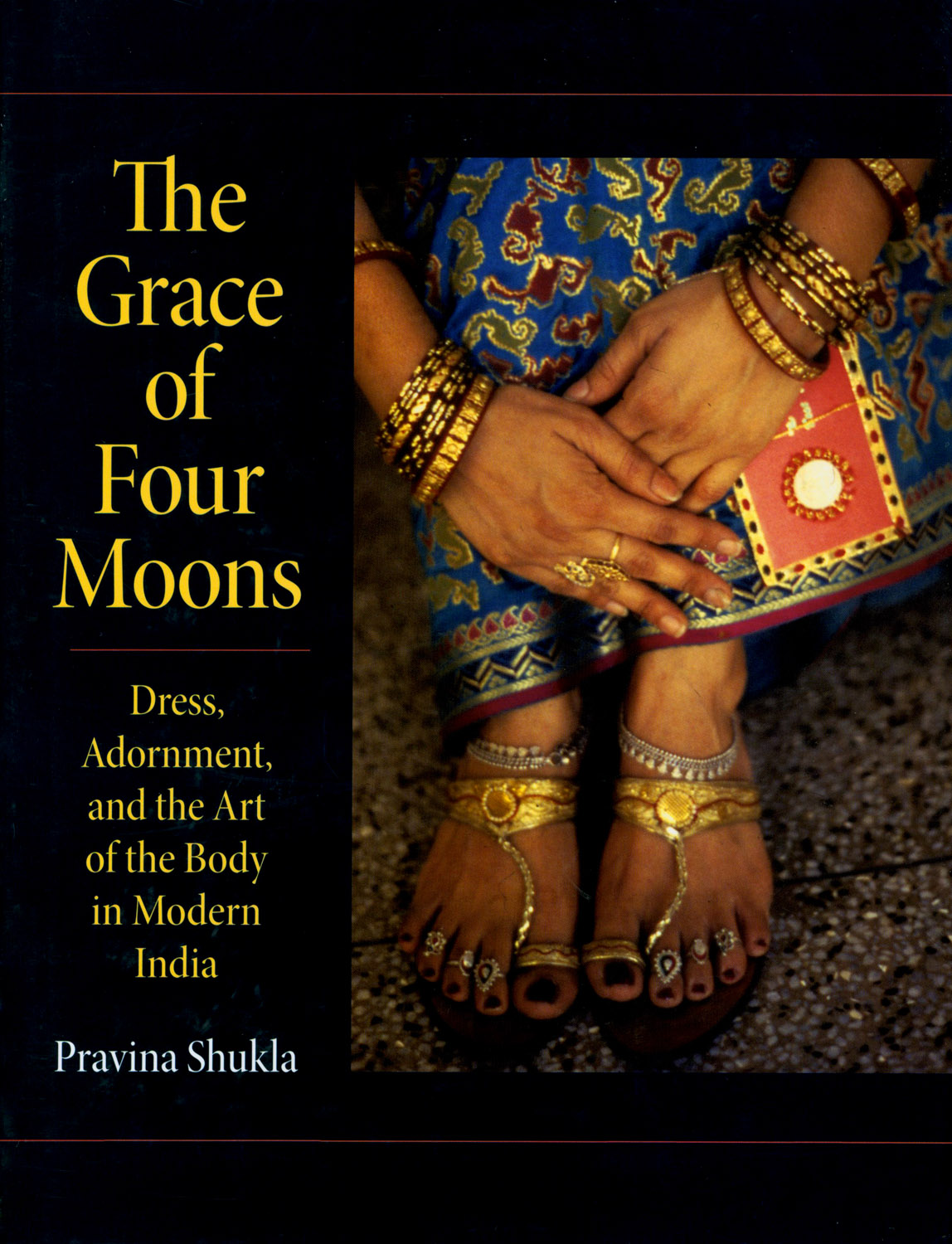
IU media relations has distributed a press release profiling my colleague Pravina Shukla’s fine ethnography of dress and adornment in India, The Grace of Four Moons, recently published by Indiana University Press. Find the release online here. (Image: Courtesy of Indiana University.)

The Grace of Four Moons (cover)

The Grace of Four Moons (cover)

Museum Anthropology 32(1)

mua32_1

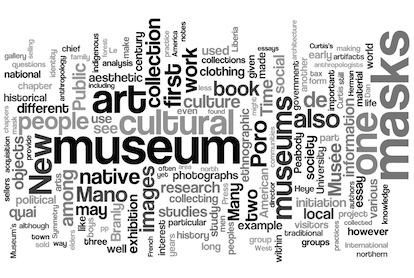
Editorial work on Musueum Anthropology volume 32, number 1 is almost complete. The issue will soon go to the publisher. As a preview, here is a Wordle of the issue’s contents.

Find the full-size version online here. Thanks http://www.wordle.net/ Thanks as well to the authors and peer-reviewers whose work will be showcased in this, the Spring 2009, issue.

Religion among the Folk in Egypt

Heartfelt congratulations to my colleague Hasan M. El-Shamy on the publication of his brand new book Religion Among the Folk in Egypt.

Questions for Anthropology Now

I originally wrote the following as a comment to a post on the blog Savage Minds. Find it in context here.

On the launch of Anthropology Now. I have been contemplating a blog post motivated not only by the launch of Anthropology Now at the AAAs, but by the remarkably high number of new journals generally and especially the number launched at the AAAs this year. For now, this comment will probably have to suffice.

I like magazines. I like anthropology. Inspired by similar publications in neighboring fields, I have long wished for an anthropology magazine that was both serious and Border’s magazine rack friendly. I have not had the luxury of speaking to any of the excellent people who are throwing their weight behind Anthropology Now, but I would like to ask them to explain publicly their business model in a way that is both clear and that allows the community to compute the costs and benefits of their approach. On the surface of things, I am disappointed that such excellent people are working so hard on a project that seems both late 20th century in approach and potentially harmful to the ecology of scholarly communication in anthropology.

They would like me to pay $55 a year to subscribe as an individual. This is a bit steep for me, but it is within the realm of the possible. On the other hand, they would like me (as would all of the non-OA journal publishers) to go pester my university librarian to subscribe. The rates for this range from $341 per year for online only to $394 per year for print and online combined.  This institutional rate is, of course, modest when compared to the costs of big science journals, but it still arrives in a time in which excellent R1 universities find themselves canceling a significant number of anthropology journal subscriptions each year. Who is taking this toll and what value added benefits will my library be getting when it invests this much money and, along the way, subsidizes either my below-cost subscription or provides the profit margin for a for-profit publisher?

I have nothing against Paradigm Publishers per se. I am glad that they care enough about our field to publish books in it and to, now, engage with this journal/magazine effort. But why them? Were no university presses willing to undertake this effort? The Anthropology Now PR materials compare the new effort to “sociology’s Contexts“. If the goal is to be the anthropological equivalent to Contexts, wouldn’t it have been great to have worked with the University of California Press–Contexts‘ publisher. Or if that were too close to home, with a not-for-profit publisher with similar experience working on scholarly magazines? Maybe Paradigm Publishers will be able to offer something that other publishers will not (or would not) be able to offer, but before pressing our libraries to buy in, I would like to know a bit about what the upsides here are. On the library side, aren’t we just making a bad journal ecology worse? Read more
“Sheer Erudition”

As my IU folklore colleague Hasan El-Shamy continues publishing a steady stream of major works in international folkloristics, a steady stream of favorable reviews are flowing back to him from the field. His book Types of the Folktale in the Arab World (Bloomington: Indiana University Press, 2004) has recently been reviewed in the journal Marvels and Tales (available in Project MUSE) by Roger Allen of the University of Pennsylvania. (see volume 21, number 2, 2007, pp. 288-291). Of this work, Allen writes:

Once in a blue moon, a reviewer is privileged to recieve for evaluation a work that in its sheer erudition and comprehensiveness is clearly destined immediately to become the major source text in its field. The name of Hasan El-Shamy is, of course, already known in the field of folklore studies, but with this particular tome (and with its 1,255 pages and tiny print, it deserves that designation)–coupled with his previous and already much utilized two-volume study Folk Traditions of the Arab World: A Guide to Motif Classification (Bloomington: Indiana University Press, 1995)–he has now presented the field of Arabic studies in general and folklore studies in particular with a major source that will remain the primary resort of scholars for years to come (288-289).

Congratulations to Professor El-Shamy for this continued success and for such well-deserved accolades. Find the book here. Find the review here. (The journal is not open access, thus not everyone will have access to the review, unfortunately.)

Contemporary Navajo Peyote Arts

My friend and collaborator Daniel C. Swan has a new paper out in American Indian Art Magazine. It is “Contemporary Navajo Peyote Arts” and it appears in Winter 2008 issue (pages 44-55, 94). The saying “on newsstands now” actually applies, as American Indian Art Magazine is sold in places like Borders and Barnes and Noble. The paper is great and it is illustrated beautifully with many bright color images of wonderful works now in the Gilcrease Museum and Sam Noble Oklahoma Museum of Natural History collections. The paper draws on interviews that Dan has been doing for many years with active artists in Navajoland, on his many years of close collaboration with members of the Native American Church, and on the spectacular collections that he has purchased from contemporary artists for the museums where he has worked.

Catching up with FolkPub

The student editors and publishers in the Folklore and Ethnomusicology Publications Group (a.k.a. FolkPub) have been very busy in recent months. An enterprise of the graduate students in IU’s Department of Folklore and Ethnomusicology, FolkPub is the publisher of the venerable journal Folklore Forum and of books under the Trickster Press imprint. Much of their work has been migrating online in recent days and I wanted to note some highlights.

Current articles and reviews–in open full-text– in Folklore Forum are appearing at a new website: http://folkloreforum.net/ . The new site offers an RSS feed, so you can easily keep up with new content in a feed reader. Earlier this year, the new site and format debuted with an issue on folklore studies in East Asia in honor of Roger L. Janelli. In recent days, several new reviews have been added to the site and new contributions are expected on a continuing basis. Several special issues are in the works.

The entire back run of Folklore Forum back to its beginnings in 1968 have been made freely and fully available in the IUScholarWorks Repository service here at Indiana University. Find the whole collection, in searchable form here.

Work on the book side continues as well. At the recent American Folklore Society meetings, the FolkPub crew were an active presence, selling backlist titles and unveilling both a new title and a new business model. They were proud to release a a new, enhanced edition of Sandra Dolby’s classic work Literary Folkloristics and the Personal Narrative. This title returns to print re-typeset with a new preface by the author and a foreward by Richard Bauman. Unlike past Trickster Press titles, this work has been published using a Print-on-Demand approach which means that it can be offerred at modest cost, that it should be available forever and that the students will not need to worry about managing complex shipping and storage problems. Literary Folkloristics and the Personal Narrative is available directly from Amazon.com here. Also available in this new format is Trickster Press’ best-selling textbook The Emergence of Folklore in Everyday Life: A Fieldguide and Sourcebook, edited by George H. Schoemaker. It too is now available via Amazon.com. Find it here.

Information on the entire Trickster Press backlist can be found on the Press’ website at: https://www.indiana.edu/~folkpub/trickster/

One Trickster Press book title has already joined Folklore Forum as an open access resource in IUScholarWorks Repository. The book The Old Traditional Way of Life: Essays in Honor of Warren E. Roberts edited by Robert E. Walls and George H. Schoemaker and published in 1989 can not be found in its entirity here. (Find its open worldcat record here.)

Congratulations to the current FolkPub staff on all this good work. Well-wishes go as well to FolkPub staff who served in recent years. Their efforts provided a significant foundation for present accomplishments.

More Published Book Reviews

I am happy to note the publication of some more reviews by some current and former student colleagues. Teri Klassen and Rhonda Fair both have reviews in the new issue of Museum Anthropology Review. Carrie Hertz has a review in the latest issue of Material Culture. Jodine Perkins has a review out today in JFRR.

Teri’s review is of Gee’s Bend: The Architecture of the Quilt and Rhonda’s is of Playing Ourselves: Interpreting Native Histories at Historic Reconstructions. Because MAR is an open access journal, these reviews are available at no cost online. Carrie’s review is of The Silk Weavers of Kyoto: Family and Work in a Changing Traditional Industry. Material Culture is, to the best of my knowledge, a print-only journal. Find it in your nearest library here on Open WorldCat. Jodine’s review is of Long Gone, a narrative account of American farm life in the 1930s and 1940s. Like all JFRR reviews, hers is available for free online.

Museum Anthropology Review 2(2)

I am happy to announce the publication of Volume 2, Number 2 of Museum Anthropology Review. This issue features eight smart reviews and two fine articles. Please check it out here. Huge thanks go to everyone who has been supporting the effort–readers, reviewers, boosters, publishers, the IU LIbraries, and especially the journal’s generous authors.

Two Reviews

Congratulations to Suzanne Ingalsbe and Teri Klassen for each publishing book reviews this week. Suzanne reviewed Yard Art and Handmade Places: Extraordinary Expressions of Home (Austin: University of Texas Press, 2008) by Jill Nokes with Pat Jasper in JFR Reviews. This review is available open access online here.

Teri reviewed Quilts in a Material World: Selections from the Winterthur Collection by Linda Eaton (New York: Abrams, 2007) for the July 2008 issue of Textile: The Journal of Cloth and Culture 6(2):205-207. Textile, published by Berg, is a commercial journal and the review is only available online in a toll access format. ($29.99 in pay per view!) Some libraries may provide electronic access at this point. The means by which the IU Bloomington libraries provide IU folks will electronic access can not yet get us to the latest issue (there is a 6 month delay for electronic access at IUB).

Congratulations to both reviewers. The hassle of getting to Teri’s review and the ease with which we can all read Suzanne’s reveals again the virtues of open access publishing in folklore, ethnomusicology and anthropology. Lets show JFRR some love!