Skip to content

Posts from the ‘Museum Anthropology’ Category

AFS “Folklore and Museums Section” Founded, AFS Members (and Non-Members too) are Welcome to Join

I am happy to note here that the Executive Board of the American Folklore Society has endorsed a proposal put forward by the Folklore and Museum Policy and Practice Working Group to establish a Folklore and Museums section within the society. The section came into existence as of the Executive Board’s November 2014 meeting in Santa Fe. I am very pleased to serve as the new section’s first convener and to invite everyone with an interest in the intersection of museum practice and folklore (/folklife/ethnology) to join the new section.

As noted in the call for members on the AFS website:

the Folklore and Museums Section exists to foster communication and cooperation among museum-oriented folklorists, to advance the contribution of folklore studies scholarship and practice in museum settings, and to articulate museum-oriented folklorists with other colleagues, institutions, and organizations in the museum sector. The section aims, whenever possible, to cooperate with other sections of the American Folklore Society and with peer-organizations in the field.

The public web home for the new section can be found online here: http://www.afsnet.org/?page=MuseumSection and the member’s group space is accessible to members who are logged into the AFS website.

While I am very eager for all interested colleagues to join AFS, I want to note that the AFS has a free “Section Only” membership category by which non-AFS members can sign-up with sections such as the new Folklore and Museums section. This might be of particular value to non-folklorists who wish to keep up with the section’s work. Information on the Sections Only “membership” is available on the Membership Categories page of the AFS website. There is no cost to join the Folklore and Museums section.

The Santa Fe meetings were a great gathering for museum-minded folklorists. I am optimistic that the new section can help make the 2015 meetings even richer for our corner of the field. Thanks to all who have contributed to the momentum behind the new section and to the growth of folklore and museums work.
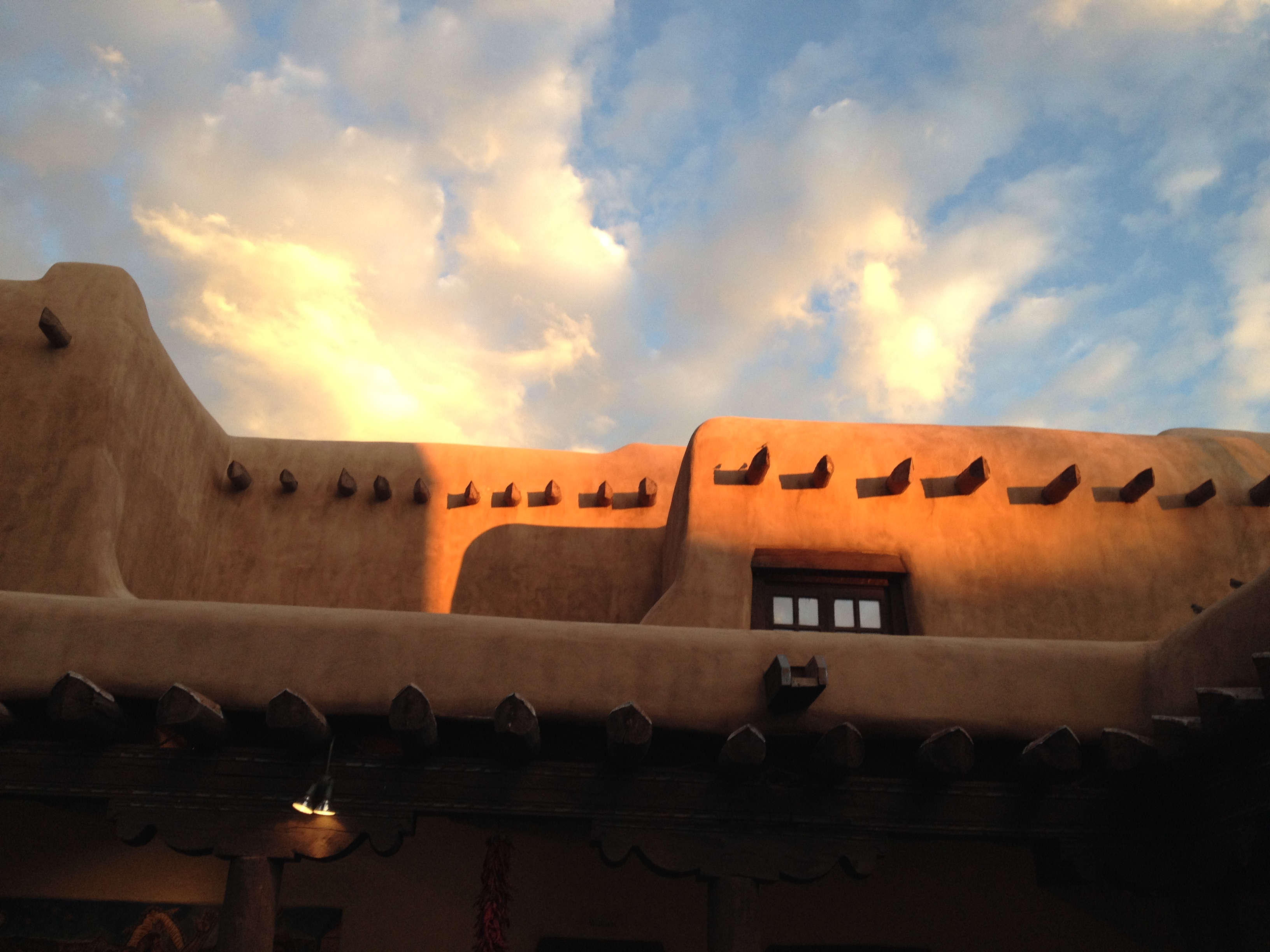
Sky Above New Mexico Museum of Art

Sky Above New Mexico Museum of Art, November 2014

Collaborative for Cultural Heritage Management and Policy

The Collaborative for Cultural Heritage Management and Policy (aka CHAMP) is a very active initiative at the at the University of Illinois. Led by anthropologist Helaine Silverman, it involves a huge number of Illinois faculty and organizes a wide range of conferences, talks, and projects. CHAMP has announced a busy series of lectures for October. Check out its website for more information on CHAMP’s activities. Here are the upcoming lectures.

THURSDAY, OCTOBER 16
3 p.m.
DAVENPORT HALL, room 109A
Food, heritage and intellectual property in Europe
Lecture by Dr. Erica Farmer (James Smithson Postdoctoral Fellow, Smithsonian Institution)

FRIDAY, OCTOBER 17
4 p.m.
DAVENPORT HALL, room 109A
Negotiating the “increase and diffusion of knowledge”: Policy, practice, and values around cultural heritage at the Smithsonian Institution
Lecture by Dr. Erica Farmer (James Smithson Postdoctoral Fellow, Smithsonian Institution)

TUESDAY, OCTOBER 21
5 p.m.
GSLIS 126 (501 E. Daniel)
Why UNESCO Matters: The Destruction of Cultural Heritage around the World
A panel presentation:
Lynne Dearborn (Architecture): The destruction of vernacular architecture
Laila Moustafa (LIS): The loss of Islamic manuscripts
Helaine Silverman (Anthropology): Looting the archaeological record
Kari Zobler (Anthropology): The devastation of Syria’s cultural heritage
Co-sponsored with the UNESCO Center for Global Citizenship

WEDNESDAY, OCTOBER 22
4 p.m.
Lucy Ellis Lounge, first floor in FLB
Vikings in America? Swedes in the American Ethno-Racial Hierarchies in the 19th Century
Lecture by Dr. Dag Blanck (English Department, Stockholm University)

MONDAY, OCTOBER 28
4:30
Lincoln Hall room 1064
The Colonial Occupation of Piura: The Historical Archaeology of the First Spanish Settlement in Peru
Lecture by Dr. Fernando Vela (Universidad Complutense de Madrid)

On the New Volume of Museum Anthropology Review

Museum Anthropology Review (MAR) has just published a new double issue—its first themed collection. Volume 7, number 1-2 of MAR collects papers originally presented at a January 2012 workshop titled “After the Return: Digital Repatriation and the Circulation of Indigenous Knowledge.” Hosted by the National Museum of Natural History, Smithsonian Institution and funded by the (U.S.) National Science Foundation and the Understanding the American Experience and World Cultures Consortia of the Smithsonian Institution, the workshop was organized by Kimberly Christen (Washington State University), Joshua Bell (Smithsonian Institution), and Mark Turin (Yale University). The workshop brought together scholars from indigenous communities, cultural anthropology, folklore studies, ethnomusicology, linguistics, and collecting institutions to document best practices and case studies of digital repatriation in order to theorize the broad impacts of such processes in relation to: linguistic revitalization of endangered languages, cultural revitalization of traditional practices, and the creation of new knowledge stemming from the return of digitized material culture. Like the workshop itself, the peer-reviewed and revised papers collected in MAR ask how, and if, marginalized communities can reinvigorate their local knowledge practices, languages, and cultural products through the reuse of digitally repatriated materials and distributed technologies. The authors of the collected papers all have expertise in applied digital repatriation projects and share theoretical concerns that locate knowledge creation within both culturally specific dynamics and technological applications.

Find this special issue of MAR online at: http://scholarworks.iu.edu/journals/index.php/mar/issue/view/233

As it has always been, MAR is an open access, peer-reviewed journal free to all readers. With volume 8, to be published in 2014, MAR is becoming the journal of the Mathers Museum of World Cultures. It will continue to be published in partnership with the Indiana University Libraries with assistance from the IU Department of Folklore and Ethnomusicology and other partners.

2014 will bring new enhancements to MAR. To keep up with the journal, please sign up as a reader, follow it on Twitter @museanthrev, and/or like it on Facebook.

Its Summer Institute in Museum Anthropology (SIMA) Applicaton Time Again

Its time for graduate students with material culture interests to think about, and follow through on, applying to participate in the 2014 Summer Institute in Museum Anthropology. This is a four-week training program focusing on the methods needed to incorporate museum collections into broader research efforts in cultural anthropology and in cognate ethnographic fields such as folklore studies.

Funded by the National Science Foundation and held at the Smithsonian Institution, the program covers students’ room, board, and tuition. Housing is provided as is a small stipend for food and other local expenses. Participants are individually responsible for the cost of travel to and from Washington, DC. This is an intensive residential program and the participants are expected to devote full time to the training. Anyone working with, or interested in working with, material culture collections in their research should check out the program. Details are on the SIMA website.

Applications are due on March 1, 2014.

For other NSF funded training programs in cultural anthropology, see the Methods Mall website.


2013 at the Mathers Museum of World Cultures

The Mathers Museum of World Cultures (MMWC) is Indiana University‘s museum of ethnography, ethnology, and cultural history. Yesterday, the museum began its 51st year. Today I begin my second year as the museum’s director. It was an honor to have been named to this role and, as I reflect on my first year, I am really happy about where the museum is in its journey.

In a pair of posts, I would like to reflect upon the year just concluded and the year ahead. Not everyone is an excited about the details as I am, so I will place them below the “more” button. For those just skimming, I wish to thank you for keeping up with Shreds and Patches and for supporting the MMWC and the various projects that I am involved in. Thanks go as well to the museum’s staff, collaborators, students, policy committee members, donors, friends, funders, visitors and supporters. I extend special appreciation here to the leadership of the Office of the Vice Provost for Research (the IU unit of which the MMWC is a part) and to Director Emeritus Geoffrey Conrad. Read more

Museums of Ethnography and Cultural History Celebrate Fiftieth Anniversaries and Welcome New Directors

I will say more detailed things about the Mathers Museum of World Cultures during 2013 in later posts. Here I just want to flag a few happy curiosities.

Today is the last day of 2013 and 2013 marked the 50th anniversary of the Mathers Museum of World Cultures. This fact made it an extra wonderful year to begin service as the museum’s Director. The exhibition Treasures of the Mathers Museum was the centerpiece of our celebratory activities and a new strategic plan was the fruit of our reflections on the past and our goal setting for the future. We have made good progress on our goals for the second half century, but that is for a future post.

We were not alone among museums of ethnography, cultural history, and world cultures celebrating golden anniversaries in 2013. Joining us in such celebrations were the Fowler Museum at UCLA, the Wake Forest Museum of Anthropology, and the Cherokee Heritage Center. (2013 saw other notable 50th anniversaries in the broader museum world, including the 50th anniversary of the University of Wisconsin Milwaukee/Milwaukee Public Museum museum studies program.) Congratulations to all of the half century celebrants, especially to these museums in our corner of the field.

2013 was also a year for new directors among such museums. I am happy to be among them. My friend Candessa Tehee and I shared the experience of becoming directors during a 50th anniversary. Candessa is the new Executive Director of the Cherokee Heritage Center. Robert Preucel was named the new Director of the Haffenreffer Museum of Anthropology at Brown University and Patrick Lyons was named the new Director of the Arizona State Museum at the University of Arizona. The Cherokee Heritage Center was not the only Cherokee museum to get a new director, The Museum of the Cherokee Indian named James “Bo” Taylor as Executive Director. I am sure that I missed someone (please add them in the comments), but I want to wish all of these new directors well. It is an exciting time for our field and I look forward to seeing where we all collectively go during 2014.

Reblogged: “Thoughts on How to Get a Museum Job” by Robert Connolly

For those seeking museum jobs or who are training and mentoring junior colleagues for such work, check out Robert Connolly’s recent post “Thoughts on How to Get a Museum Job.”

Find it here: http://rcnnolly.wordpress.com/2013/09/02/thoughts-on-how-to-get-a-museum-job/

My older list of Web Resources for Museum Job Seekers can be found here: https://jasonbairdjackson.com/2012/12/04/web-resources-for-museum-job-seekers/

The Textile Museum | Out of Southeast Asia: Art that Sustains

While in Washington, I had a chance to visit The Textile Museum in its historical location amid the city’s embassies. I say historical because the museum is now preparing to move to the George Washington University campus.* I had not been to the museum previously (although I follow its work at a distance) and was eager to see it as it has been before it becomes what it will be next. The logic of the move is apparent, but the “old” museum had many charms. It is obvious that the museum’s building–a beautiful and stately old home–has been taken as far as it can be taken as a museum site. It was warm (in the good sense) and comfortable and attractive, but it is surely a challenge to use as a site for research, collections care, and public programs and exhibitions. That said, the facility seemed optimized within the scope of its limitations and I am certain that longtime visitors will miss the old site, as it really was comfortable and nice for small groups of visitors coming and going on a weekend morning. (With the preparations for the move, only the first floor is being used for public visitation, so I cannot comment on the upstairs areas.)

A main first floor exhibition gallery was renovated at some point to make it into a typical art museum gallery, disguising its presence in a large historic home. This space hosted the last temporary exhibition to be staged at the old location–Out of Southeast Asia: Art that Sustains.

Also accessible on the first floor was a welcoming desk and a truly remarkable gift shop where a pair of very kind museum staff members were stationed. Further back on the first floor was a “family room” space where guests were treated to cookies and lemonade. This room led to the back garden–a beautiful green space from which one can see glimpses of the embassies surrounding the museum. (Returning to the subject of the shop, it is a real model of the genre–well stocked, beautifully arranged, well staffed. Sourced globally, the shop offered beautiful and diverse textiles and textile-related objects, along with books at many different price levels. Even a hardened museum professional with little interest in textiles would be impressed by the shop.)

The exhibition focused on Southeast Asian textile traditions as inspiration for contemporary textile design and construction in the work of batik artist Vernal Bogren Swift (whose work draws upon the example of Javanese batiks), weaver Carol Cassidy (whose work draws upon her engagements with Lao weavers and weaving), and a husband and wife team working in batik–Agus Ismoyo and Nia Fliam. Contemporary work by these artists were exhibited alongside historical pieces from the museum’s collection and private collectors.

The work was impressive and the interpretation sound, but I focused my attention on the display strategies used for the display of these attractive works. Textiles are challenging to exhibit and The Textile Museum clearly has cultivated skills needed for first rate display. I filled several pages of my notebook trying to record the techniques used in impressive, conservation-friendly, presentations of these often delicate textiles. Hopefully we can draw upon these inspirations in future textile projects at the MMWC.

The exhibition was accompanied by a gallery guide, which is available online. A family guide was also available, as is a general educational room with adult-level books on world textiles and a range of hands on displays explaining weaving and other textile-related topics to children.

I am glad that I was able to visit the museum in its old location. The current exhibition and the museum as a whole were impressive. This is what I expected on the basis of the museum’s past projects and publications.

*See The Textile Museum’s press release for details on the move and a recent Inside Higher Education story by Kevin Kiley on the subject of U.S. museums being incorporated into colleges and universities.

Excellent Symposium Concludes 2013 Summer Institute in Museum Anthropology

Many things have been happening lately–so many that keeping up with them here has been difficult. Many good things have gone unreported and some bad current events (global and national, not personal) have gone un-commented upon. I am pleased though to celebrate the conclusion of the 2013 Summer Institute in Museum Anthropology. I was invited to join the institute for its last week and a half and to participate in its concluding symposium at the National Museum of Natural History (NMNH) on the Mall in Washington. In the symposium, SIMA’s twelve graduate student participants presented the initial findings of their four-week research projects utilizing the (amazing) collections–both objects and archival materials–of the NMNH Department of Anthropology. The students came to SIMA from many different graduate programs and backgrounds and possessed a diversity of historical, ethnographic, topical, and theoretical interests. They did wonderful work and I learned a lot from their studies and from their careful and compelling reporting. While they have further to go, of course, with their projects, I think that it is pretty exciting to hear the results of four intensive weeks of research as the concluding act of that same four week process. Quite remarkable.

I am very appreciative of my continued association with this wonderful program. I am glad that I have been able to help it continue moving along so well.

SIMA will happen again next summer. Details will be posted here on the SIMA website in the months ahead.

Good News | Bad News

On the good news front, students, faculty, staff, and friends associated with the Mathers Museum of World Cultures continue to come together to do good work and illustrate why museums are good places to gather, talk, think, study, and try to make a difference. As I move into my fourth month as the museum’s director, I feel so thankful for everyone’s interest in, and support of, the museum’s efforts. Here are some highlights from recent days.

Last Saturday the museum hosted a great “Meet the Collection” event. The focus was the museum’s collection of handmade chairs by Chester Cornett. This collection was assembled by folklorist Michael Owen Jones during his doctoral research at Indiana. Some chairs came to the museum at the time of Jones’ initial student research, but others were recently donated by this now distinguished UCLA scholar. Jon Kay, James Seaver, and Ellen Sieber all contributed remarks that led to a wider group conversation to which Joanne Stuttgen, Pravina Shukla, Henry Glassie and others contributed valuable questions, observations, and historical reflections.

A recent IU press release describes a 2nd Meet the Collection event as part of the series of events celebrating the museum’s 50th anniversary. The next gathering focuses on the museum’s collection of Aboriginal Australian bark paintings and will feature remarks by Earlham College art historian Julia May. The gathering will be held at the museum from 2 to 3 pm on Saturday, April 27. Please join us if you can. (The IU press release linked to here focuses on the upcoming Treasures of the Mathers Museum exhibition. I will focus on that in an future post.)

More good news at the museum was reported in the latest issue of Inside IU Bloomington. Bethany Nolan wrote a great article profiling the work the students in my Curatorship are doing studying the ethnographic collection given to the museum by the late Vincent and Elinor Ostrom. The quotes that the students gave Bethany would be music to any teacher’s ears. Alumni of this graduate course are now doing great things as museum professionals and it is exciting to teaching it again, particularly in a spirit of hopefulness. Public folklore and museum anthropology–these are fields that have roots that extend back to the time before the fields became rooted in academia. They were alt-ac (ie. alternative to academic careers) before these fields even had an “ac” track. As neighboring humanities disciplines begin (sometimes for the first time and in a spirit of panic and despair) to seriously consider non-academic careers for their graduate students, it is great to point to a deep tradition of engaged research-based public humanities work in museums and to be able to illustrate the skills required and the path ways that can be taken.

It helps to have role models. A graduate of my department, Michael Mason, has just been named Director of the Center for Folklife and Cultural Heritage at the Smithsonian. He is moving over to this new leadership role from the National Museum of Natural History, also at the Smithsonian, where he has been serving as Assistant Director for Exhibitions. (Read all about it in a recent Smithsonian press release.) I do not want to get ahead of the institution that has just hired her, but a current student in my department has just been hired into an impressive postdoctoral fellowship aimed at bridging academic and museum work in New York City. At the other most distinguished end of the career spectrum, one of our department’s most innovative and impactful graduates is Barbara Kirshenblatt-Gimblett. Barbara is in the news constantly now because she is playing a central role in the development of the (soon to open) Museum of the History of Polish Jews. As core exhibition designer for the museum, she is drawing upon all the lessons she has learned over an amazing career as a Jewish ethnographer, cultural theorist, museums studies specialist, public folklorist, and NYU professor of performance studies. Reporting on the (incredible) museum (to be) and her work is ubiquitous, but one can dip into it in a recent Tablet magazine story “Curator of Joy and Ashes” to gain a sense of the amazing effort.

Back home at the Mathers, I feel like we are having success.

Read more