Skip to content

Posts from the ‘Mathers Museum’ Category

2013 at the Mathers Museum of World Cultures

The Mathers Museum of World Cultures (MMWC) is Indiana University‘s museum of ethnography, ethnology, and cultural history. Yesterday, the museum began its 51st year. Today I begin my second year as the museum’s director. It was an honor to have been named to this role and, as I reflect on my first year, I am really happy about where the museum is in its journey.

In a pair of posts, I would like to reflect upon the year just concluded and the year ahead. Not everyone is an excited about the details as I am, so I will place them below the “more” button. For those just skimming, I wish to thank you for keeping up with Shreds and Patches and for supporting the MMWC and the various projects that I am involved in. Thanks go as well to the museum’s staff, collaborators, students, policy committee members, donors, friends, funders, visitors and supporters. I extend special appreciation here to the leadership of the Office of the Vice Provost for Research (the IU unit of which the MMWC is a part) and to Director Emeritus Geoffrey Conrad. Read more

Museums of Ethnography and Cultural History Celebrate Fiftieth Anniversaries and Welcome New Directors

I will say more detailed things about the Mathers Museum of World Cultures during 2013 in later posts. Here I just want to flag a few happy curiosities.

Today is the last day of 2013 and 2013 marked the 50th anniversary of the Mathers Museum of World Cultures. This fact made it an extra wonderful year to begin service as the museum’s Director. The exhibition Treasures of the Mathers Museum was the centerpiece of our celebratory activities and a new strategic plan was the fruit of our reflections on the past and our goal setting for the future. We have made good progress on our goals for the second half century, but that is for a future post.

We were not alone among museums of ethnography, cultural history, and world cultures celebrating golden anniversaries in 2013. Joining us in such celebrations were the Fowler Museum at UCLA, the Wake Forest Museum of Anthropology, and the Cherokee Heritage Center. (2013 saw other notable 50th anniversaries in the broader museum world, including the 50th anniversary of the University of Wisconsin Milwaukee/Milwaukee Public Museum museum studies program.) Congratulations to all of the half century celebrants, especially to these museums in our corner of the field.

2013 was also a year for new directors among such museums. I am happy to be among them. My friend Candessa Tehee and I shared the experience of becoming directors during a 50th anniversary. Candessa is the new Executive Director of the Cherokee Heritage Center. Robert Preucel was named the new Director of the Haffenreffer Museum of Anthropology at Brown University and Patrick Lyons was named the new Director of the Arizona State Museum at the University of Arizona. The Cherokee Heritage Center was not the only Cherokee museum to get a new director, The Museum of the Cherokee Indian named James “Bo” Taylor as Executive Director. I am sure that I missed someone (please add them in the comments), but I want to wish all of these new directors well. It is an exciting time for our field and I look forward to seeing where we all collectively go during 2014.

Good News Roundup

There is way too much stuff going on in my life and work these days. Most of it is really good stuff, but it is hard to keep up. Before moving on to new reporting, here are some good news highlights from recent weeks.

Colleagues and I shepherded into print the 50th volume (=golden anniversary) of the Journal of Folklore Research, for which I serve as Interim Editor. JFR 50(1-3), a triple issue (!), is a special one titled Ethnopoetics, Narrative Inequality, and Voice: The Legacy of Dell Hymes and is guest edited by Paul V. Kroskrity (UCLA) and Anthony Webster (Texas). The guest editors contributed a post about the issue for the IU Press Journals Blog and the triple issue itself is can be found on the Project Muse and JSTOR digital platforms. Thanks to all who have supported JFR over its first five decades.

The Open Folklore project recently released a new version of the OF portal site. The new site incorporates a range of new features and is built upon the latest version of Drupal. I hope that it is already helping you with your own research efforts. If you have not seen it yet, check it out at http://openfolklore.org/

In September, two scholars whose Ph.D. committees I chaired finished their doctorates. Congratulations to Dr. Flory Gingging and Dr. Gabrielle Berlinger!

I noted the award quickly previously, but I had a great time attending the Indiana Governor’s Arts Awards where Traditional Arts Indiana, led by my friend and colleague Jon Kay, was recognized.

The new issue of Ethnohistory is out and it includes a generous and positive review of Yuchi Indian Histories Before the Removal Era. The reviewer is Marvin T. Smith, author of several key works on the archaeology and ethnohistory of the Native South. Find it (behind a paywall) here: http://ethnohistory.dukejournals.org/content/60/4.toc

A while back, the Mathers Museum of World Cultures opened a fine exhibition curated by IU Folklore graduate student Meredith McGriff. It is Melted Ash: Michiana Wood Fired Pottery and it is a sight to behold. If you have not seen it, stop by the museum and check it out.

Open Access week just kicked off and there are a lot of activities planned for the IUB campus. To get things started my friend and collaborator Jennifer Laherty did an interview with WFHB. It is about 8 minutes long and it can be found on the station’s website: http://wfhb.org/news/open-access-week/

The very talented Bethany Nolan was kind enough to talk to me about Yuchi Folklore and to write about our discussion for her Art at IU blog.

The Euchee (Yuchi) Tribe of Indians just held its 17th (!!!!) annual Heritage Days festival. A few years ago a Miss Yuchi/Euchee was added to the festivities and the young women chosen have been great representatives of their nation. This year another awesome young woman was selected. Congratulations to A.S. on being selected for this big honor and big responsibility.

Exhibition Opening Reception | Photos in Black and White

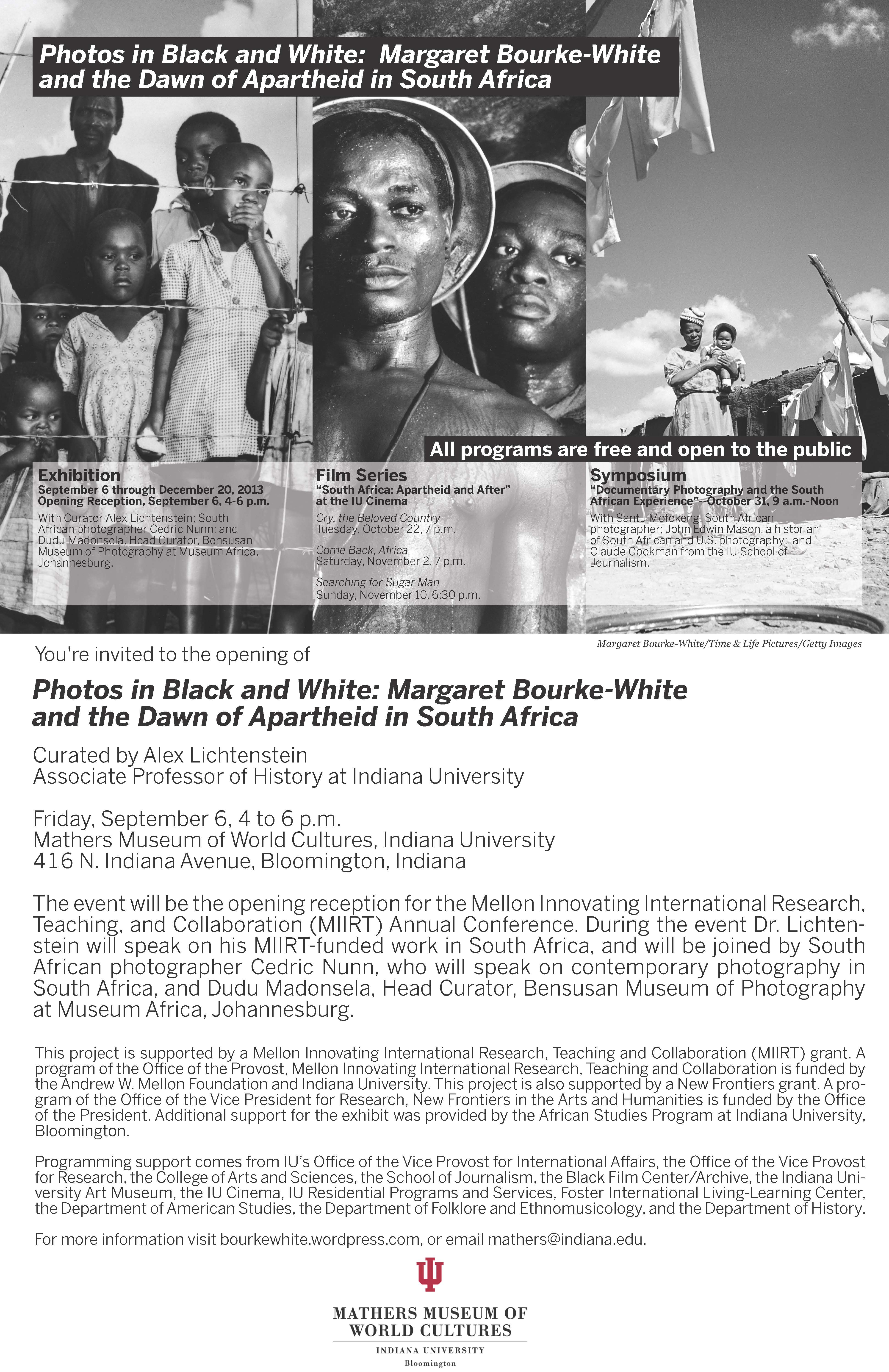
Photos in Black and White: Margaret Bourke-White and the Dawn of Apartheid in South Africa opens this coming Friday at the Mathers Museum of World Cultures in Bloomington, Indiana. Everyone is welcome to attend the opening. Details on the opening and other events associated with the exhibition are shown below. Information can also be found on the MMWC website.

MBW Exhibition Invitation

An Inaugural Voyage for the IQ-Wall at MMWC with @lichtensmbw and the Freshmen of COLL-S 104

Detailed accounts of the MMWC’s partnership with University Information Technology Services and its Advanced Visualization Lab will come in time, but I cannot resist quickly sharing here this tweet from @MathersMuseum from earlier in the day.

The course kicking off the IQ-Wall era at MMWC is COLL-S 104, The Struggle for Civil Rights: Reacting to the Past, an Intensive Freshman Seminar taught by MMWC guest curator Alex Lichtenstein.

Unless you are social media adverse, you really should be following MMWC on Facebook and Twitter so that you can keep up with all that is happening at the museum. Thanks to everyone who is supporting the museum’s continued growth and development.

The MMWC Newsletter and Other Infrastructure: Building our Bazaar

mmwc1_Page_1

The Mathers Museum of World Cultures (MMWC) has a new newsletter. The cover for MMWC #1 is shown above. Clicking on it should take you to the whole issue as it appears on the online publishing platform Issuu. To add the newsletter to your hoard of PDFs, you can download it from the MMWC website download it here. For the long haul, we will soon add the newsletter to the museum’s “community” in the IUScholarWorks Repository.

Before talking about the newsletter as infrastructure, I want to thank MMWC Assistant Director Judy Kirk for her great work getting it edited and launched. This is a small summer issue that recaps some recent MMWC developments. A forward-looking fall issue will follow it very soon. While thanking Judy, I want to also thank the whole MMWC community–staff, volunteers, students, researchers, advisory board members, donors–for the work that we begin reporting in this first issue of the newsletter.

One of the museum’s accomplishments of the first half of 2013 was the establishment of an ambitious strategic plan. One thread running through that plan is work aimed at putting into place a range of kinds of museum “infrastructure.” Some of this will be very visible to the museum’s friends and supporters, other kinds of infrastructure will help the museum do its behind-the-scenes work more effectively. As I can, I will try to tell the story of our infrastructure work here. I have found the public reporting of my colleagues and of peer-institutions extremely helpful and my aim here is to reciprocate in appreciation for what I have learned from them. (For a recent example, consider this great account of the building of a teaching lab at the Penn Museum.) Read more

UBIQUI-TEE: T-Shirts Design Culture

I was happy tonight to attend the opening for a great new exhibition organized by the Sage Collection and presented at the Indiana University Center for Art and Design Columbus (IUCA+D Columbus). Curated by Sage Assistant Curator Kelly Richardson, the exhibition is titled UBIQUI-TEE: T-Shirts Design Culture. It does a great job of framing the diversity of t-shirts and their many uses in global culture. The show was strikingly presented in a beautiful setting, the still relatively new design-focused center in beautiful downtown Columbus, Indiana.

Extensive Sage collections were supplemented by loans from a number of individuals and institutions, including the Mathers Museum of World Cultures, which lent shirts collected in Native American and African contexts as well as two wonderful, recently collected t-shirt quilts.

Congratulations to Kelly and everyone involved in the new show.

(Columbus had a great downtown. Go see the show.)

Good News | Bad News

On the good news front, students, faculty, staff, and friends associated with the Mathers Museum of World Cultures continue to come together to do good work and illustrate why museums are good places to gather, talk, think, study, and try to make a difference. As I move into my fourth month as the museum’s director, I feel so thankful for everyone’s interest in, and support of, the museum’s efforts. Here are some highlights from recent days.

Last Saturday the museum hosted a great “Meet the Collection” event. The focus was the museum’s collection of handmade chairs by Chester Cornett. This collection was assembled by folklorist Michael Owen Jones during his doctoral research at Indiana. Some chairs came to the museum at the time of Jones’ initial student research, but others were recently donated by this now distinguished UCLA scholar. Jon Kay, James Seaver, and Ellen Sieber all contributed remarks that led to a wider group conversation to which Joanne Stuttgen, Pravina Shukla, Henry Glassie and others contributed valuable questions, observations, and historical reflections.

A recent IU press release describes a 2nd Meet the Collection event as part of the series of events celebrating the museum’s 50th anniversary. The next gathering focuses on the museum’s collection of Aboriginal Australian bark paintings and will feature remarks by Earlham College art historian Julia May. The gathering will be held at the museum from 2 to 3 pm on Saturday, April 27. Please join us if you can. (The IU press release linked to here focuses on the upcoming Treasures of the Mathers Museum exhibition. I will focus on that in an future post.)

More good news at the museum was reported in the latest issue of Inside IU Bloomington. Bethany Nolan wrote a great article profiling the work the students in my Curatorship are doing studying the ethnographic collection given to the museum by the late Vincent and Elinor Ostrom. The quotes that the students gave Bethany would be music to any teacher’s ears. Alumni of this graduate course are now doing great things as museum professionals and it is exciting to teaching it again, particularly in a spirit of hopefulness. Public folklore and museum anthropology–these are fields that have roots that extend back to the time before the fields became rooted in academia. They were alt-ac (ie. alternative to academic careers) before these fields even had an “ac” track. As neighboring humanities disciplines begin (sometimes for the first time and in a spirit of panic and despair) to seriously consider non-academic careers for their graduate students, it is great to point to a deep tradition of engaged research-based public humanities work in museums and to be able to illustrate the skills required and the path ways that can be taken.

It helps to have role models. A graduate of my department, Michael Mason, has just been named Director of the Center for Folklife and Cultural Heritage at the Smithsonian. He is moving over to this new leadership role from the National Museum of Natural History, also at the Smithsonian, where he has been serving as Assistant Director for Exhibitions. (Read all about it in a recent Smithsonian press release.) I do not want to get ahead of the institution that has just hired her, but a current student in my department has just been hired into an impressive postdoctoral fellowship aimed at bridging academic and museum work in New York City. At the other most distinguished end of the career spectrum, one of our department’s most innovative and impactful graduates is Barbara Kirshenblatt-Gimblett. Barbara is in the news constantly now because she is playing a central role in the development of the (soon to open) Museum of the History of Polish Jews. As core exhibition designer for the museum, she is drawing upon all the lessons she has learned over an amazing career as a Jewish ethnographer, cultural theorist, museums studies specialist, public folklorist, and NYU professor of performance studies. Reporting on the (incredible) museum (to be) and her work is ubiquitous, but one can dip into it in a recent Tablet magazine story “Curator of Joy and Ashes” to gain a sense of the amazing effort.

Back home at the Mathers, I feel like we are having success.

Read more
New Beginnings: Mathers Museum of World Cultures

Today I had the privilege of beginning work as Director of the Mathers Museum of World Cultures. I will surely write about the work of the museum extensively in the months ahead. Here I just want to thank the museum’s staff for welcoming me and thank the Indiana University administration for giving me this exceptional opportunity to do the  work that I love.

I could single out countless museum objects, collections, colleagues, goals, or aspirations to write about here, but I will use this post to acknowledge the long and important service of my predecessor Geoffrey W. Conrad. The Mathers Museum celebrates its 50th anniversary this year, and Geoff led the museum for nearly 30 of those years. The museum accomplished a tremendous amount over those three decades and it is exciting to have a chance to collaborate in building upon the solid foundation that Geoff and the staff built over the span of his long and distinguished career leading the museum.