Skip to content

Posts from the ‘Material Culture’ Category

Material Vernaculars: Objects, Images, and Their Social Worlds (is out now)

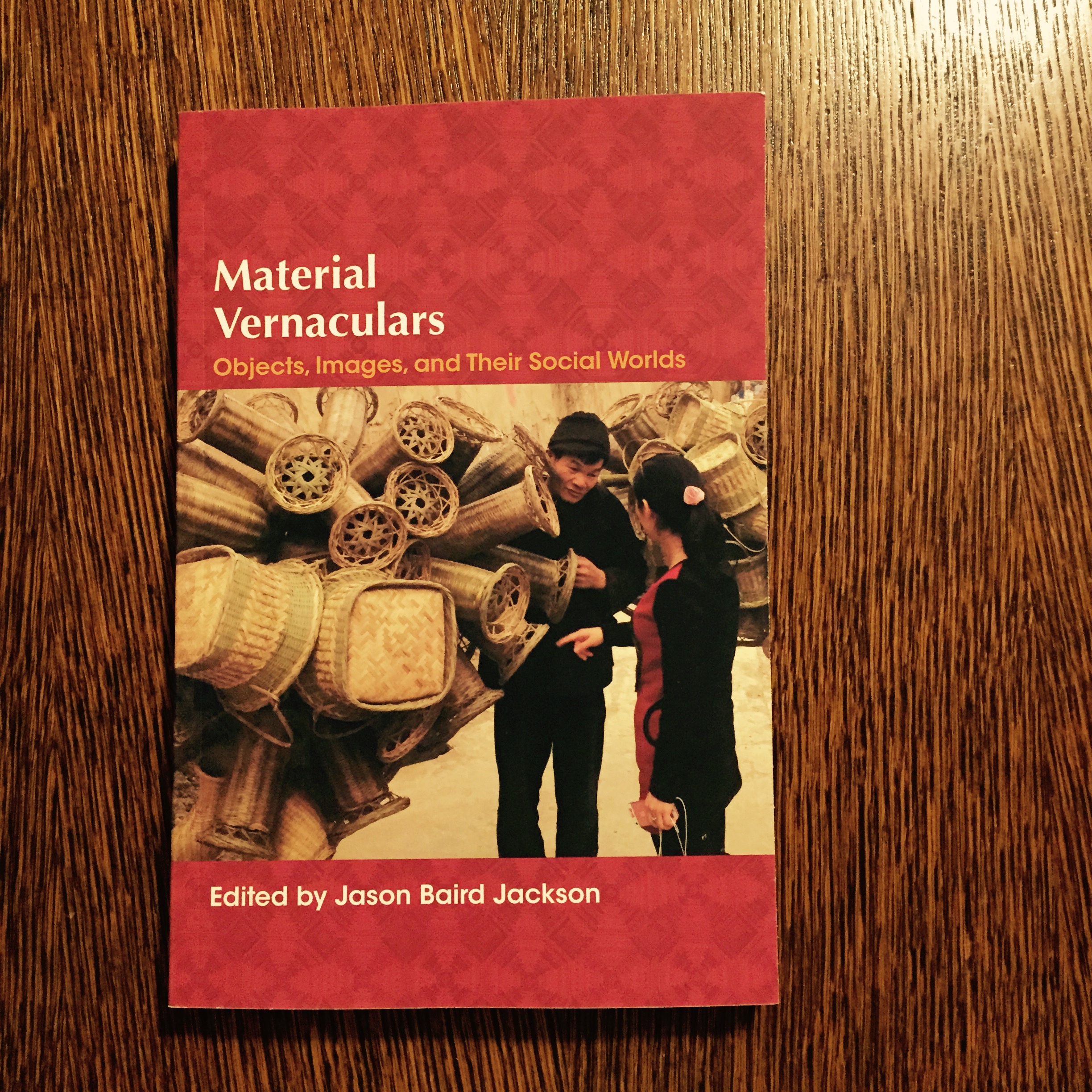
I am happy to share this note to report that the edited collection Material Vernaculars: Objects, Images, and Their Social Worlds has now been published. I am the editor of this volume, which includes contributions to material culture studies from Dan Swan and Jim Cooley, Jon Kay, Michael Paul Jordan, Danille Elise Christensen, and Gabrielle Berlinger. I love the work that my colleagues contributed to the book. In addition to sharing their scholarship, the volume serves to launch the Material Vernaculars book series of which it is a part. Also appearing in the new series, is Jon Kay’s Folk Art and Aging: Life-Story Objects and Their Makers (it was published last month).

The new series is published by the Indiana University Press in cooperation with the Mathers Museum of World Cultures. IU Press is to be commended for its hard work bringing Material Vernaculars to press. Most of the papers in the volume were presented last fall at the 2015 Annual Meetings of the American Folklore Society. The papers were presented, revised, peer-reviewed, revised again, copy edited, typeset, proof-read, corrected and processed for final publication (etc.) in less than a year, a scenario that is simply unprecedented in the world of academic book publishing. And the results are great–a well-designed, well-edited book that is rich with color images. Its all first rate.

IU Press has a big sale going through tomorrow (October 30). Its a perfect time to check out their list and perhaps purchase this new title. Paperback and Hardback editions are now available. Electronic editions are on their way. (More on that asap.)

fullsizerender19

Who Cares About Craft as Traditional Knowledge?

This fall has been a particularly busy season for research-based programs at the Mathers Museum of World Cultures. An an outgrowth of our Indiana Folk Arts: 200 Years of Tradition and Innovation exhibition and our participation in classes and programs for Themester, we will have hosted, by semester’s end, a very large number craftspeople or groups of craftspeople representative of a broad swath of vernacular making in Indiana. Because of our Themester mandate to focus on questions of Beauty in our engagements with these artist-craftspeople, our discussions with them have always had an aesthetic component. We have asked, for instance, questions like: “What characteristics do you associate with a beautiful weaving [or chair, or drum, or pottery bowl, or…]?” or “When producing for the marketplace, how do you balance functional use and aesthetic impact?” Art and aesthetics are a crucial part of the human experience and of what makes cultures distinctive and meaningful.

But the objects that we curate and interpret, and the makers of things with whom we engage, are not only about art. Even while many have both aesthetic and functional purposes, many others of our museum’s objects are not reasonably framed as art and some of our interlocutors are talented, knowledgeable makers and users of things, without being artists. Our work is bigger than art, as important as art is. Aesthetic values are part of larger cultural systems and those larger wholes are our focus. Whether in China or in Indiana, our work is about local knowledge, including traditional cultural knowledge. A big part of our engagements with makers focuses on the knowledge that goes into making–craft expertise along with local environmental and contextual knowledge concerned with uses, meanings, significances.

A detailed story in last Saturday’s Independent by Amalia Illgner is a good evocation of the kinds of concern we (particularly Traditional Arts Indiana, led ably by my colleague Jon Kay) try to bring to our work with craft objects, craft knowledge, and craftspeople. (I appreciate Matthew Bradley for sharing it with me.) Read the story (“Raiders of the Lost Crafts”) here. (I note here that, despite the declensionist hook and playful title, the author is not so obsessed with authenticity discourses that she disregards fruitful rediscovery of older craft knowledge through the study of museum collections and documentary materials. The story is a rare and rather sophisticated treatment of its subject.)

raiders-of-the-lost-crafts

Who cares about craft as traditional knowledge? My colleagues and I do. We also like art and we also love seeing where contemporary craftspeople, including studio craft, DIY craft, and many others, are taking their passions–but documenting what people know and have long known is important and helping foster environments where those who have traditional cultural knowledge are supported and encouraged is key part of our mission. If you care about such things, you still have lots of chances to engage your interests at the museum this year. This week we will host a wonderful group of African American quilters and a talented maker of African drums. In following weeks, we offer chances to connect with Indiana limestone carvers, a hoop-net maker, a rosemaler, a pysanky artist, a Native American potter, a Zapotec weaver, and an Orthodox iconographer. Learning from such craftspeople is something we intend to keep doing as along as we can.

Reflections on The Mind is a Collection

On September 22, 2016 Indiana University’s Center for Eighteenth Century Studies held the 2016 Kenshur Prize celebration at the Mathers Museum of World Cultures. The museum was an especially appropriate setting because the prize winning book was The Mind is a Collection: Case Studies in Eighteenth Century Thought (University of Pennsylvania Press, 2015) by Sean Silver (English, University of Michigan). It was an honor to be asked by Center Director Rebecca Spang to join a panel of discussants of Silver’s book. What follows here are the remarks that I prepared for this occasion. Those paragraphs preceded by XX were not read in oral presentation but are noted here. Silver’s book, and companion digital exhibition, are an important contribution to material culture and museum studies, in addition to being significant in the fields of Eighteenth Century Studies and the history of ideas. My notes here presume a context present at the event but absent here–a general introduction to the author’s work and project, relevant commentary by the author, and commentary by my colleagues on the panel (who were chosen to represent a diversity of relevant perspectives on the book and project). I preceded my own remarks by welcoming the students and faculty of the Center to the museum and congratulating Sean on this important recognition for his book and exhibition.

***

I lack sufficient knowledge of the science, history, culture, and literature of this period, as well as of the relevant parts of cognitive science, to knowledgeably engage the heart of Sean’s remarkable work. Reflecting it central organizing device and thematic concern though, the project’s literal and conceptual organization as a museum-minded exhibition of museum mindedness does offer me a way in. I fear though that I have proven to be one of those rushed museum visitors trying to squeeze in a stop at the big city museum while in route to the airport, roller bag in tow. Passionately interested and markedly impressed, but also nervous and feeling pressed for time, here are a few reflections on my hurried visit. They address smaller vitrines and displays around the edges rather than the main exhibition hall with the core of the story. In the end, such sites of engagement are, of course, a specialty of my own field of folklore studies.

I was struck by the degree to which this is a book and digital exhibition (among the most sophisticated that I have encountered) of our moment. This is not in itself a complete surprise, of course (all of our writings would similarly qualify in degrees), but it does warrant closer acknowledgement. Those who work in museums have a love/not-love relationship with the museum-ification of everything that western societies (and others as well) are in the midst of right now. This is easiest to see in the proliferation of settings in which the word curator is made to apply. TED talks are curated as are meals, fashion shows, and car insurance options. What Barbara Kishenblatt-Gimblett speaks of as the curation of the life world is manifest in the extreme when we speak of curating’s one’s own person brand through, for instance, one’s social media engagements. When it comes to more-than-just-museums curating, there are many very cool things happening on this front in The Mind is a Collection—both the book and the digital exhibition. Like I am, Sean is a part of the zeitgeist. He has interests and passions that are socio-culturally and historically conditioned and he knows the mood of the present so as to anticipate the interests of his readers; but at the same time, his book is fundamentally about the curation of the life world and is a valuable reminder that there is much more to this than a present-day sensibility. I loved learning about the degree to which the curatorial style was a past-day sensibility for learned London, if not for the mass of the city’s residents. Something special happens when a well conceived, well executed project is perfectly calibrated between the ethos of its present and the ethos of the other time or place or context with which it is concerned.  Such dynamics could be investigated in any scholarly project, but here they just ring clear as a bell for me.

XX Another instance of this calibration of then and now ethoses concerns what here at IU we call—as reflected in our strategic plan, for instance—“a culture of making.” Even when Sean is discussing unfamiliar matters, I sense that nearly any practicing museum curator would swoon in response to his manifest love of objects, particularly in their status as manifestations of craft. This is a book and digital exhibition for material culture specialists, even if it deals with materials and concerns not uniformly familiar to the most established material culture disciplines. But outside the scholarly realm, ours is a moment of craft in countless guises, from molecular baskets concocted in materials engineering laboratories to yarn bombing on the streets of Bloomington. I have a friend who crafts artisanal reproductions of the earliest telescopes—the kinds of objects that would seemingly belong in the cabinets of Sean’s subjects. As my own students are documenting ethnographically in a wide range of domains and as the programs of the Mathers Museum reveal, a significant portion of our fellows of the present are in love with the hand made thing and, sometimes, with making things by hand. Such enthusiasms surely persist in a core of actors in each period and place, but they also go in and out of wider fashion. Ours is a maker-minded moment and this is an engaging book and digital exhibition written about the maker-minded living in another maker minded-moment by a maker-minded author. My pleasure again arises in part from the parallelisms found here. I also look forward to learning more about Sean’s in-progress work The Crafts of Enlightenment.

website

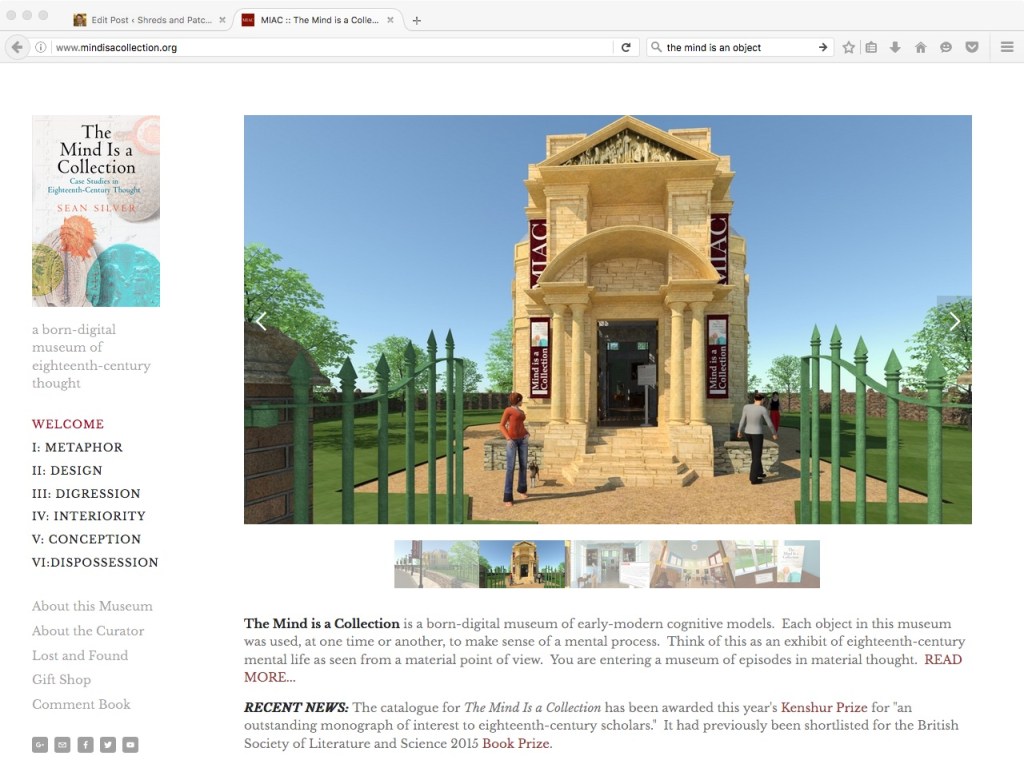
Figure: The landing page for Silver’s digital exhibition The Mind is a Collection.


XX For the social scientific reader, I also think that this book and digital exhibition participates in the contemporary conversation in the human sciences in a novel and interesting way. Like other particularly noteworthy works of our moment, it is a book about the recursive entanglement and co-constitution of humans (as individuals and in groups), objects, and ideas occurring together in particular environments. (For instance, consider Anna Tsing’s The Mushroom at the End of the World.) Its central concepts are shared keywords of our moment: design, complexity, network, embodiment, scale… Such matters interest many of us broadly, but in Sean’s project I find that they are being approached in fresh and new ways that I can happily begin carrying back into my own disciplinary conversations. His website and book are just the kinds of works that I could recommend to the graduate students with whom I work, as an anecdote to conventional approaches to conventional topics addressed with the help of canonical works. Put another way, the book and website engage shared interests in fresh ways. I say this from the perspective of someone who teaches a graduate course on Theories of Material Culture. I would welcome the challenge of working with students in that course in study of The Mind is a Collection.

XX The term material culture arose in the disciplinary context of anthropology. It fits and doesn’t fit in that field in a number of different ways in different times and places. In one now moribund American formulation, material culture was part of a triumvirate that also included mental culture and social culture. The phrase material culture persists despite our shedding of these two companion terms.  During the height of ideas and symbols-centric anthropology, material culture studies faced hard times in social and cultural anthropology. Folklore studies became a key contributor to the study of material culture during the time of its neglect in cultural anthropology.  Today, matters have changed again and material culture is front and center in anthropology and anthropologists face a changed landscape outside their field. The English Department at the University of Michigan has a nice website. When looking at the department’s faculty, one can sort them easily by research interests. In the past, but even today, many cultural anthropologists would be surprised to see that material culture is one of these departmental research foci. They would be even more surprised to see that twelve core faculty members in English—Sean among them—identify with this interest. The same dynamic is now active in many fields lacking deep histories of work in this area. Those who long studied material culture alone in a tiny disciplinary node now operate in a field that is broad and deep. Sean’s book arrives in this new context, one that is driven home each day when my editorial assistant and I open envelopes containing books sent to Museum Anthropology Review for review. If a skeptic asked me for an illustration of what a scholar of English could contribute to the material culture studies commons, The Mind is a Collection offers an incredible answer. But it also reveals the newer challenge for anyone working in material culture studies—this interdisciplinary field is now vast and sophisticated beyond the practical ability of most practitioners to keep up. Material culture studies has entered a new era.

15446

Figure: The cover of The Mind is a Collection (Penn Press, 2015).

Let me close with a reflection on “thinkering” this is a great word prominent in a great project. In the contexts in which it comes up here, this neologism caused me to think of a pronouncement that I always make when discussing the pleasures of being a curator. It comes up sometimes when I am discussing careers with graduate students. It always comes up in my graduate course in Curatorship, and it certainly has popped out when a non-museum friend or colleague finds me at work cleaning a vitrine with Windex or measuring a gallery wall with a tape measure. What I have said countless times is that the special pleasure of being a curator is that it is the perfect mix of brain work and of hand work—hammering one minute, studying in next. Now this dualism participates in exactly the problematic conceptualizations that are at issue in Sean’s study, but he is generous and, in my reading, he gives our folk psychology back to us and lets us get on with the work. While he holds a professorship and not, to my knowledge, a curatorship, it is a pleasure to have engaged with the work of someone whose brain work and hand work are so well integrated and so well executed. I hope that soon Sean will get the chance to build a physical exhibition to go along with his book-as-catalogue and his digital exhibition.

Don’t Miss the Great Mathers Museum Building Debate

brutalism

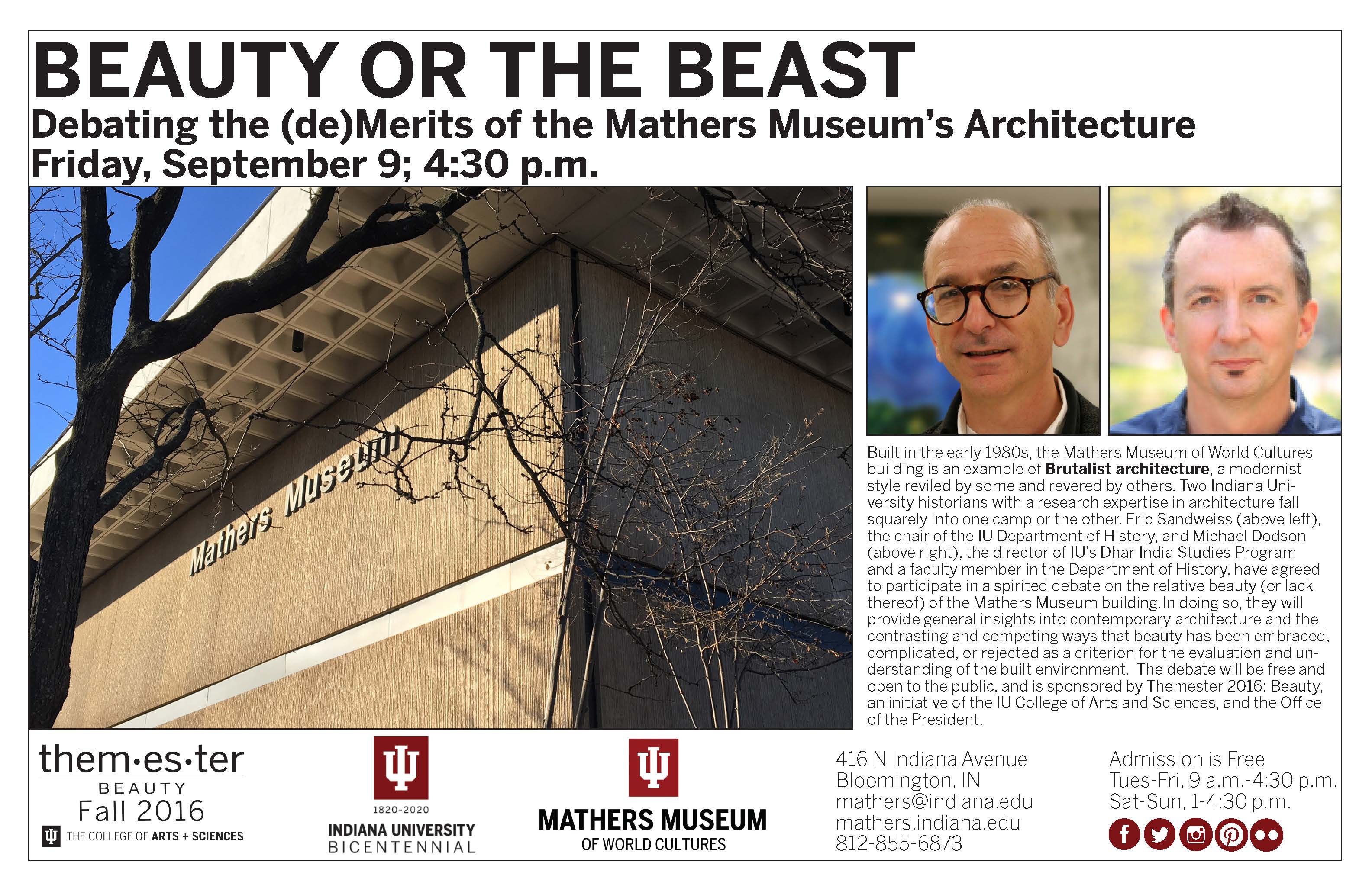
Built in the early 1980s, the Mathers Museum of World Cultures building is an example of Brutalist architecture, a modernist style reviled by some and revered by others. Two Indiana University historians with a research expertise in architecture fall squarely into one camp or the other. Eric Sandweiss, the current chair of the Department of History, and Michael Dodson, the current chair of the Dhar India Studies Program and a faculty member in the Department of History, have agreed to participate in a spirited debate on the relative beauty (or lack thereof) of the Mathers Museum building. In doing so, they will provide general insights into contemporary architecture and the contrasting and competing ways that beauty has been embraced, complicated, or rejected as a criterion for the evaluation and understanding of the built environment. The debate will be free and open to the public, and is sponsored by Themester 2016: Beauty, an initiative of the IU College of Arts and Sciences and the Office of the President.

See also the Themester and Museum events pages for this big event.

Siyazama: Traditional Arts, Education, and AIDS in South Africa

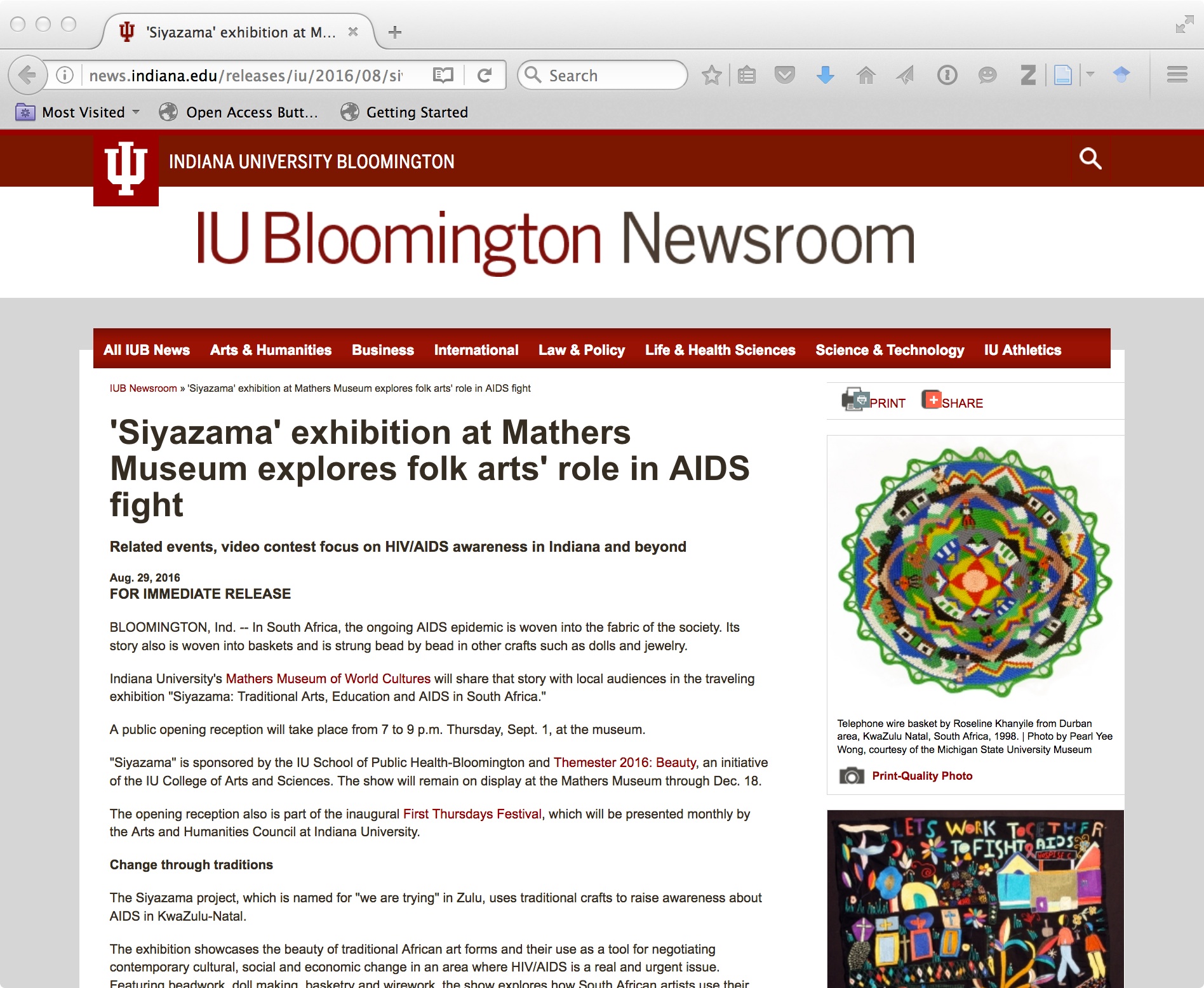
Get all the details by checking out the new press release announcing the Mathers Museum of World Cultures’ programs and activities in support of the exhibition Siyazama: Traditional Arts, Education, and AIDS in South Africa. This wonderful exhibition is part of a great fall at the museum, now underway. I hope to see everyone at the opening at the museum right after the First Thursdays Festival. Thanks to Themester 2016 and the School of Public Health for supporting this exhibition and its programs and to the Michigan State University Museum for curating it.

Siyazama Release

Material Vernaculars: Institutional Role, Review, Authors, and Genres

The new Material Vernaculars series is co-published by the Mathers Museum of World Cultures with a huge amount of heavy lifting from our partner, the Indiana University Press. The first two volumes in the series are Folk Art and Aging by Jon Kay and the eponymous edited volume Material Vernaculars: Objects, Images, and Their Social Worlds. Jon Kay is the author of the first of these and I am the editor of the second. Jon and I are both on the IU faculty (in the Department of Folklore and Ethnomusicology) and in the MMWC, where Jon is Director of Traditional Arts Indiana and Curator of Folklife and Cultural Heritage and I am the museum’s director. As the new series becomes known, it is reasonable to ask—is it just a publishing venue for the museum and its associates and partners?

MW Website

The answer here is no, but as you might guess, the series is intended to be the go to place when the museum does have its own publishing projects. This answer prompts then a couple of more points needing to be made. Peer-review for the series is fully managed by the IU Press and editorial review is a joint matter, thus it is quite conceivable that a museum project might be passed on by the press either at the early editorial review stage or at the peer-review stage. (I note that the press has already passed on one possible project, to illustrate this point tangibly.) Thus the series will hopefully be the home for additional MMWC authors and projects, but this is not guaranteed—and should not be.

The other side of this is that the series will hopefully come to publish authors without ties to museum, including colleagues not yet known to me. As the series homepage presently notes, “Potential authors interested in the Material Vernaculars series should contact the series editor Jason Baird Jackson via mvseries [at] indiana.edu and Aquisitions Editor Janice Frisch at frischj [at] indiana.edu.” That phrase, and the series overview, are available here.

As noted there, a new series also poses genre questions. Here, my intentions as editor are broad. “The series accommodates a diversity of types of work, including catalogues and collections studies, monographs, edited volumes, and multimedia works.” To me, these are the key genres of relevance for research museum practice in ethnography, ethnology, and cultural history (our museum’s fields), but it could be that new, as yet not fully recognized genres could also find a home in the series. While the forthcoming edited volume is something of a sampler, future edited volumes will likely have a strong thematic focus. Stand alone essays will continue to find a home in the museum’s journal, Museum Anthropology Review.

I hope to hear from potential authors and editors interested in learning more about the series. Thanks to all who have supported this new effort.


Improving Access to Scholarship: Material Vernaculars as Milestone and Experiment

First the take away, then the story. While produced in very nice and reasonably priced hardback, paperback, and ebook editions, works in the new Material Vernaculars series are also being made available in free-to-the-reader PDF versions. This is a great thing and, if you agree with me about that, and can afford to do so, I really hope that you will purchase the edition of your choice, thereby signaling your support for making such works freely accessible to those who cannot afford to purchase them. If this seems strange to you, its a lot like community and public radio in the United States. Those who can support these services help make them accessible to those who cannot afford to make their own donations. We all gently nudge those who use them and could, but don’t, support them. (Called free riders.) Its not utopia, but its what we have and its better than the vast majority of people being locked out of non-commercial arts and education programming (and scholarly books). Now you can skip to the end for the link if you are in a rush.

Slide1

Those who know about my work know that I have been focused on promoting free and open access to scholarly work for a relatively long time. My advocacy efforts followed soon after I began work as a scholarly journal editor. At that time, I was drawn into a diverse range of problems, opportunities, and paradoxes that the transformation of scholarly communication was (and is still) engendering. Probably the best place to find the things that I have written on this theme is to look at the interview that I did with Ryan Anderson (published in Cultural Anthropology in 2014)

In 2015, my focus in this work shifted to books when I was a participant in a project funded by the Mellon Foundation. The results of that project were reported in: A Study of Direct Author Subvention for Publishing Humanities Books at Two Universities: A Report to the Andrew W. Mellon Foundation by Indiana University and University of Michigan.

Concurrent with such advocacy work, I have tried to build real-world projects that could advance scholarship while testing strategies for increasing public access to research. Now in its tenth year, Museum Anthropology Review (now the journal of the Mathers Museum of World Cultures) is the best example of this. On the book side, there is now the Material Vernaculars series co-published by the museum and the Indiana University Press. In my previous post, I highlighted the series first title—Folk Art and Aging: Life-Story Objects and their Makers by Jon Kay and the series’ scholarly mandate. Here I am flagging the series’ relationship to free and open access movements.

Books cost a lot of money to make. In a peer-reviewed article, based on our humanities book research studying publishing work of the Indiana University Press and University of Michigan Press, my colleagues report that the zero copy cost for a typical humanities book is about $27,000. Efforts to increase access to scholarship have to find ways to confront these costs from all sides—finding ways to lower prices but also new ways of funding the professional work that it takes to make a quality book.

For me, for the museum, and especially for the IU Press, the Material Vernaculars series is an experiment. If we get past talking about it and actually begin doing it, what can we learn that will, we hope, help us learn to do it more and better? This is part of what is at stake for IU Press and for the whole world of university press humanities book publishing. I am thrilled to be a part of a new series that has a secondary role (beyond its primarily scholarly one) of finding ways to make scholarly books more widely and openly accessible.

So paradoxically, if you believe (for example) that the communities about whom ethnographers write should have access to what they write, then I call on you, paradoxically, to purchase a copy of Folk Art and Aging and the other other books that are in the pipeline. Your purchase helps support the goals of the series and it demonstrates that paid-for print editions or e-book editions are not mutually exclusive of free-to-readers electronic editions. If it helps, think of the print edition as a thank you gift for your donation to this cause rather than as a commodity that you are purchasing in the marketplace. You can feel particularly good about it if you purchase it directly from the Indiana University Press, thereby cutting out one or more commercial intermediaries.

It (PDF) won’t always be the file format of choice, but for now the free editions of Material Vernaculars titles will be circulated in PDF form via the IUScholarWorks Repository. When people download the books from IUScholarWorks, there is a download count, which helps us learn how many people, over what time period, showed interest in the book(s). (So, send your friends to the link rather than passing around the PDF…)

If you are wondering how to download the book, see the picture above for the place to click.

Here is the link. Two actually. The first is durable but enigmatic. The second is more human readable, but potentially less permanent.

http://hdl.handle.net/2022/20906
https://scholarworks.iu.edu/dspace/handle/2022/20906

Happy reading.

Material Vernaculars Series Launches with Jon Kay’s Folk Art and Aging

This fall I will be talking a lot about the new book series that the Indiana University Press and the Mathers Museum of World Cultures are jointly publishing. I am the series’ editor and my friend and colleague Jon Kay is its first author. I will frame the series here, before I conclude this post, but I do not want to bury the lead, which is that there is a great new book in the world and you should buy and learn from it.

Jon Kay is Director of Traditional Arts Indiana, Curator of Folklife and Cultural Heritage at the Mathers Museum of World Cultures, and Professor of Practice in the Department of Folklore and Ethnomusicology, Indiana University. His book is Folk Art and Aging: Life-Story Objects and Their Makers. (Jon’s content rich book website is here.) It is the fruit of many years of work exploring the creative lives of older adults in Indiana and in other parts of the United States. Jon has much to say about the ways that material culture and narrative come together in social encounters and in unfolding lives, as well as about about the ways that more attentive scholarship on the verbal and material life, as well as the memory, work, of elders can shape more humane and sensible approaches to what is increasingly referred to as creative aging, as well as to social gerontology more generally. The book is a folklorist’s book, but it also speaks very generatively to a range of neighboring disciplines. Written in a very clear and engaging style, it is the kind of book that lots of people (not just scholars) can read and both enjoy and learn from. At its center are profiles of five incredibly interesting creators of objects, stories, and lives. Jon helps share their stories and their creations in a really engaging way. The book has many beautiful color images and at 133 pages, it never gets bogged down.

9780253022165_lrg

The hardback, paperback, and ebook editions are beautiful and they can be purchased from the Indiana University Press, from Amazon, from Google, and from many other retailers. I’ll tell you next time where to get the free PDF edition, but here I want to urge everyone who can to purchase one of the paper or ebook editions. Why? Paradoxically, because I believe in open access. If those who can do so purchase the modestly priced print or e-book editions, the IU Press will secure the revenue that it needs to produce more books such as Folk Art and Aging and to make them freely available to those who otherwise could not afford to purchase them. More on such questions next time.

Having introduced Folk Art and Aging to you, let me introduce the series quickly. The series précis reads:

The Material Vernaculars series presents ethnographic, historical, and comparative accounts of material and visual culture manifest in both the everyday and extraordinary lives of individuals and communities, nations and networks. While advancing a venerable scholarly tradition focused on the makers and users of hand-made objects, the series also addresses contemporary practices of mediation, refashioning, recycling, assemblage, and collecting in global and local contexts. Indiana University Press publishes the Material Vernaculars series in partnership with the Mathers Museum of World Cultures at Indiana University. The series accommodates a diversity of types of work, including catalogues and collections studies, monographs, edited volumes, and multimedia works. The series will pursue innovative publishing strategies intended to maximize access to published titles and will advance works that take fullest advantage of the affordances provided by digital technologies.

The series second title is an eponymous edited volume—Material Vernaculars: Objects, Images, and Their Social Worlds. That collection is due out in a few days (September 5, 2016). In its introduction, I characterize in more detail the goals of the series as well as situate its disciplinary (cultural anthropology, folklore studies, ethnology, culture history) engagements as well as its place in the larger research work of the MMWC. I look forward to sharing it with you.

Congratulations to Jon Kay on his second book of the summer (see Indiana Folk Art) and to all of our friends at the Indiana University Press.

An Interview with Sterling Jenson of the March Field Air Museum

20160704_133838[4]

Sterling Jenson is the Collections Manager at the March Field Air Museum in Riverside, California. He earned a B.A. degree in folklore and an M.A. degree in arts administration at Indiana University. While at IU, he was graduate assistant in the registration department at the Mathers Museum of World Cultures (MMWC) and a volunteer in its education department. He was also an intern at Traditional Arts Indiana, which is now a department of the MMWC.

Jason Baird Jackson (JJ): Thank you Sterling for your willingness to talk to me about your work as a museum professional and Indiana University alumnus. We’ll go back in time shortly, but could you tell me a bit about the March Field Air Museum and your work as its Collections Manager?

Sterling Jenson (SJ): The March Field Air Museum celebrates the history of aviation with a focus on one of the historical military airfields of the United States, the March Air Reserve Base. March Field was founded in 1918 and since that time has been an important part of the history of the [U.S.] Air Force and the Air Force Reserves, which means that the museum has an important legacy to present to the public. The museum has on display over seventy aircraft, including one of the two A-9s in existence, a SR-71 Blackbird, and, a PT-6 biplane trainer from 1930. The collections range in size from a B-52 on our flight line to ribbons awarded to airmen for their service. In order to house these objects, the museum has two hangars, an exhibit hall, and a library.

As Collections Manager, I am in charge of the processing of the objects, loan paperwork, and ensuring that the collections are organized. Currently, I am building upon my predecessor’s work in order to make the collections more accessible. Prior to my arrival, the museum was using an [Microsoft] Access database to keep track of the objects and the books in our library. In order to better serve the museum, I am migrating the database from Access to CollectiveAccess in the case of objects and to Koha for the library books. Both programs are open source software that we will be able to upload to the museum’s website in order to make the collections more accessible. I am also in the process of overseeing an inventory and standardizing the disposition system, both of which I learned from my time working as a Graduate Assistant at the MMWC.

JJ: A B-52! I know that you did not get experience in caring for a 132-ton bomber during your time at the MMWC! How did your experience as a student at IU prepare you for the challenging museum work that you are doing now?

SJ: At Indiana University, I studied folklore as an undergraduate and then went back to get my Masters of Arts in arts administration. Due to my studies in folklore, I love collecting information that describes the context of the object, especially personal narratives or biographies. While I never know if these stories will ever be utilized in the exhibits, trying to collect them when the objects arrive is the best time to get this kind of documentation. For one donation, the son emailed me a document he created for his father’s funeral, which helps explain the history of the man who wore the uniform.

My studies in arts administration have helped me immensely because the program focused on both the practical components as well as the theoretical ones. I have been working on preparing grant proposals in order to better manage the objects within the collections. The course [MMWC Assistant Director] Judy Kirk taught on Museum Management will be helpful in the near future as I go through and update the collections policies, plans, and procedures. During my graduate studies, I worked at MMWC in the Registrar’s office as the Graduate Assistant. I loved my time there because [Registrar] Terry Harley-Wilson gave me hands-on projects, including working with loan agreements and working with an inventory.

At my current position, I am try to emulate Terry by giving my interns and volunteers important tasks and seeking their opinions to better improve the department. As many of our aircraft are on loan from the National Museum of the United States Air Force, including the B-52, I am using what I learned at MMWC regarding loans frequently. I am grateful we have a Restoration Department to deal with repairs to the aircraft, so my focus can be on the smaller objects within the collection. In short, my experience dealing with loans and other institutions at MMWC has been valuable in this position.

JJ: I am a big advocate for the combination of disciplinary training in folklore studies and professional training in arts administration, thus it is great for me to hear how you bring them together everyday in your current role. I am, of course, also thrilled that your work with MMWC Registrar Terry Harley-Wilson has proved to be so valuable in your current efforts. Courses like Judy Kirk’s combined with hands-on experiences at the museum are a big part of our mission. Is there something about your current role that has surprised you or that you initially felt less prepared to address? We are all, of course, constantly learning new things on the job.

SJ: One of the areas that I feel less prepared for is needing to explain why all of my projects in my department need to be so thorough and why they take so long. As you know, the standards in the museum world have been set high because of past mistakes in the field. In order to achieve these standards takes work, care, and persistence. I hope that I am slowly making progress in explaining the importance of collections care.

JJ: I have been there with you, for sure. Unfortunately we live in an impatient moment in which time is money, talent is money, attention is money, and money is money. We are expected to be good stewards of all of them but it is often hard to explain to those not working alongside us why being careful the first time is so crucial. We cannot un-break an ancient Greek vase or recover an un-digitized analog oral history recording destroyed in a fire or flood or misplaced and discarded through careless handling. As you note so well, past mistakes haunt us and we want and need to get it right the first time.

In closing, can you tell me about your favorite item or collection at the March Field Air Museum?

SJ: My favorite items are part of the Collection relating to Orla Bridges and as you can see in the photograph (Figure 1), the curator decided that these items were important enough to put right into the cases. Wagoner Orla Bridges’ uniform and Victory in Europe Medal from the Great War for Civilization were donated to our museum within the last year. Mr. Bridges was stationed at March Field about the time when it opened in 1918 and his family owned the farm across the street from the front gates of the base. He is a great example of someone who has ties to both local history as well as international history.

JJ: Well said. That is a great example of what we do—connecting the little and the big, the local and the global. Thank you so much for taking the time to talk with me about your work and your career. Good luck with all that you and your March Field Air Museum colleagues are pursuing.

BridgesFigure 1. A uniform coat and military medal from the collection of Wagoner Orla Bridges, now in the collections of the March Field Air Museum.

An Interview with Dr. Lori Hall-Araujo, Curator and Assistant Professor at Stephens College

In fall 2016, Lori Hall-Araujo will begin a position as Assistant Professor and Curator in the School of Design and the Costume Museum at Stephens College in Columbia, Missouri. She recently concluded a year as Anawalt Postdoctoral Fellow in the Center for the Study of Regional Dress at UCLA’s Fowler Museum in Los Angeles, California. She holds the Ph.D. in Communication and Culture from Indiana University as well as an M.A. in the History of Religions from the University of Chicago, and a B.A. in Philosophy from Michigan State University. She has extensive experience as a museum professional and, during her time in Bloomington, she curated the exhibition Clothes, Collections, and Culture . . . What is a Curator? for the Mathers Museum of World Cultures. Learn more about her work at http://www.lorihallaraujo.com/.

Jason Baird Jackson (JJ): Thank you so much for agreeing to this interview. I know I will want to ask about the varied things that you have been doing in the museum world since you left Bloomington, but I have to begin with a big CONGRATULATIONS on the news of your tenure-track position at Stephens College. As you look ahead to moving to Missouri and getting started there, can you describe your new position?

Lori Hall-Araujo (LH-A): Thanks so much for the well wishes. I’m absolutely thrilled about embarking on this next phase of my career and feel very fortunate. The Atlantic recently published an article about how colleges and universities are offering buyouts to senior faculty and staff to encourage retirement and save on spending. While Oberlin, the story’s featured college, is promising not to replace its tenured faculty with part-time instructors and non-tenure-track faculty, that’s the direction many colleges and universities are heading. Most academic jobs now are either part-time or non-tenure track so I feel extraordinarily lucky to have been on the job market just as the Stephens position opened up.

My role at Stephens College calls on me to wear two hats, one as professor in the fashion program and the other as curator for the Costume Museum and Research Library (CMRL). Stephens’ fashion program emphasizes practice within a liberal arts environment. The classes I teach will tend towards the academic side. This year I teach writing intensive courses on dress history that situate changing modes of dress within their cultural and sociopolitical contexts. For my course on 20th century dress I plan to use the Costume Museum’s collections in my teaching.

The Costume Museum and Research Library at Stephens has over 13,000 objects from the mid-18th century to the present and includes designer and everyday attire. As curator I am responsible for mounting two exhibitions each academic year though my ambitions for the CMRL go well beyond that. This fall I will work with staff to conduct an overall assessment of the facilities and collections to determine ways we can improve storage and increase access for students, faculty, and outside researchers. Finding ways to incorporate the collections into the curriculum is a top priority. The fashion program recently earned an affiliation with the Council of Fashion Designers of America (CFDA). This is a highly coveted and prestigious affiliation as it provides students with scholarships as well as industry opportunities. The CFDA tapped Stephens to participate in its scholarship competition based on the strength of student portfolios and the Costume Museum’s collections so the work I do as curator has real potential to resonate in our students’ futures.

JJ: That sounds great on every front. I love my dual museum-faculty role and I feel confident that you will really thrive in that environment too. Before we get to what you have been doing most recently, can you reflect a bit about the ways that your studies at Indiana contributed to the work that you are being called to do at Stephens? This matters not only in a MMWC context, where we are always seeking to be more impactful in the careers of museum professionals-in-training, but also in the context of Indiana University’s new School of Art and Design, where students and faculty share so many interests in common with you. You came to IU with a lot of museum background. What did IU add to the equation?

LH-A: I had been Collection Manager for Costume and Textiles at the Chicago History Museum before enrolling in my IU doctoral program. One of the reasons I chose IU was for its museums. I wanted to dip my feet into curatorial waters and the Mathers Museum gave me that opportunity. Working closely with [MMWC Chief Curator] Ellen Sieber and other Mathers staff, I was able to experience first hand how a well run university museum operates. The Mathers offers credit-granting practica for students, which are a great way to learn about the collections and to gain hands-on supervised museum experience. At Stephens the Costume Museum offers work-study positions in its collections. In the future I’d like to see us offer museum practica along the lines of the year-long cataloging and curating project I worked on at the Mathers.

JJ: You came to IU as a doctoral student in the Department of Communication and Culture. As a Ph.D. student you thus had a research agenda that you hoped to establish and then carry forward into your career. Do you feel that you were able to integrate your training as a researcher and your museum interests? One of your foci is dress in Latin American contexts. How did this interest mature at IU and how has it carried forward through your work at the Fowler Museum and up to the present?

LH-A: While there was no museum studies track in my department per se, I was able to get the support I needed. Before his retirement, Dick Bauman was my advisor and he really pointed me in the right direction as far as coursework and training went. Beverly Stoeltje in Folklore was my earliest advocate for writing a dissertation that incorporated my interests in dress theory, film, performance studies, and museum studies. I took a short exploratory visit to Rio de Janeiro, Brazil in my second year at IU and it was Beverly who urged me to check out the Carmen Miranda Museum there. From that kernel of an idea my research and dissertation bloomed.

Dick encouraged me to do a practicum at the Mathers, which I did thanks to the faculty sponsorship of Pravina Shukla. Several years before enrolling at IU I had spent some time in Oaxaca, Mexico making art and learning about indigenous textiles. When I met with Ellen Sieber I expressed my interest in Latin American textiles and she suggested I work with one of two sizable collections. I chose to work with the Royce Collection as it includes Zapotec clothing and objects from Juchitán, Oaxaca. My work on that project was incredibly rewarding in terms of the intellectual and creative freedom it provided. My exhibition was highly reflexive and examined how the meaning of objects changes depending on context–art, wearable garment, museum object, and so on.

The themes I addressed for the Mathers practicum have informed my research at the Fowler Museum where I have been studying two significant collections of objects collected in Mesoamerica throughout the 20th century. I ask questions such as, “Why does the collector collect what she collects? What does it mean for outsiders to come into indigenous Mesoamerican communities and buy clothing? What happens when the collector’s cultural biases cause her to misinterpret or misrepresent other cultures?” These are difficult and sensitive topics but I think there’s a way for productive dialogue to emerge from this project. Ideally these issues would be addressed not just between academics but also in a more public way such as a museum exhibition.

JJ: Needless to say, hearing you recount your experience at IU is very gratifying. We can’t let your Carmen Miranda research go unexplored, but you have just referred to your Mesoamerican clothing research, including your earlier visits to Oaxaca, your work with Chancellor’s Professor Anya Royce’s collection at the MMWC, and your more recent work on such collections at the Fowler Museum. In my corner of the field, the Fowler Museum has a strong reputation as a leading university museum of world cultures. When administrators here ask me to identify aspirational peers for the MMWC, it is always on my list. How did you secure a postdoctoral fellowship there? What was it like to work there? What’s next for you Mesoamerican research?

LH-A: From 2014 to 2015 I worked on the Hollywood Costume exhibition organized by the Victoria and Albert Museum and hosted in Los Angeles by the Academy of Motion Picture Arts and Sciences. Just prior to the exhibition’s closing, the curator, Deborah Nadoolman Landis (professor in UCLA’s Theater, Film and Television Department and founding director and chair of the David C. Copley Center for Costume Design), invited the Fowler staff to come check out the exhibition. That was when I first met the Fowler director, Marla Berns, who suggested I stay in touch. After Hollywood Costume closed I visited the Fowler and got to see their many treasures in storage. Marla told me they were planning to offer their first ever post doc fellowship and invited me to apply. Happily they offered me the fellowship and in September I hit the ground running.

During my time at the Fowler I’ve been impressed by how much they accomplish with such a small staff. They have an incredibly full exhibition schedule for their own galleries and of course have any number of objects out on loan at any given time. The first six months were magical when I got to throw myself fully into research. Then from March to June I had the opportunity to teach an undergraduate class for the World Arts and Cultures Department, “Collecting Indigenous Mesoamerican Dress.” The class was essentially the research I’d been working on in the preceding six months. Every week we looked at objects from the collections and addressed issues of collecting practices, interpretation, and different theme-driven exhibitions. My students were amazing. Their final projects asked them to conduct original research in the Fowler archives and to discuss the objects. The questions they raised and the discoveries they made have been so helpful to me as I write about my own research.

This past January I had the opportunity to look at pieces in the Fowler collections with the Oaxaca Textile Museum‘s founder, Alejandro de Ávila Blomberg. He’s been an ideal colleague, so generous. He’s invited me to attend a textile conference in Oaxaca this October so I’ll be there and plan to do a little exploratory research while in Mexico.

JJ: That is great to hear. I hope that you can continue your work with Oaxacan textiles while based at Stephens. People are understandably passionate about them and they both raise and help address so many key questions, as your comments reflect. Selfishly, we would love for you to weave our collections into your ongoing work. Happily, I can report that Professor Royce is continuing to add new works to our collections on the basis of her still active research and her strong relationships with friends in Oaxaca.

While many of your projects are getting short changed here, we can’t conclude without giving your dissertation research and its famous subject—Carmen Miranda—its due. Brazil is about to host the world for the 2016 Summer Olympics. I recently heard an interview with vocalist Carla Hassett. She was discussing Carmen Miranda on NPR and cited Brazilian composer “Caetano Veloso [whom she said] said, [she] is the original tropicalista, meaning she was really the first artist to leave Brazil and influence and bring the culture to outside of Brazil. She was really our pioneer of that.” Hearing that interview, I immediately thought of your work and how you have tried to understand the role of dress in how the world made sense of Carmen Miranda and, by extension, all of Brazil. As Brazil is now a focus of much global attention for so many reasons, what does your research tell us about Carmen Miranda’s legacy?

LH-A: What can I say?  I could fill a book addressing your question and am in the midst of doing so!

As far as Carmen Miranda being the original tropicalista goes, I can say this. The tropicalistas of the late 1960s and early 1970s inherited a Brazilian tradition of “cultural cannibalism.” Brazilians have long understood that their land and people have been acted upon whether via slavery or environmental or cultural exploitation. Yet rather than allow themselves to simply be the passive subjects of external fantasies and oppression, they have taken those external fantasies and turned them on their heads. Carmen was European born but she fully embraced the Brazilian feijoada and considered herself a Brazilian. When Caetano Veloso called her the original tropicalista he was saying that she wasn’t a sell-out to Hollywood as some suggested but instead was consuming Hollywood versions of Brazilians and regurgitating them in unique and distinctly Brazilian ways to create a kind of cultural chaos for global audiences. I’ve no doubt Brazil and its culture will surprise and confuse Olympics tourists this summer.

JJ: That is good food for thought as we all gather around screens to consume the spectacle in Brazil this summer. We can watch and look forward to your book. You will face the challenge of moving to Missouri and getting situated in your new post while also taking notes on those themes in the Brazil context. I can hardly imagine that the costumes worn in the opening and closing ceremonies won’t be ringing these bells and playing again off the tradition of cultural cannibalism you note.
 
I want to thank you so much for sharing these glimpses of some of your work in progress. Good luck with your new position and with your exciting research. We hope you are able to get back to the MMWC very soon.