Skip to content

Posts from the ‘Material Culture’ Category

Bamboo Basket Hampers Used by Tobacco Farmers in Nanhua County, Yunnan, China

While doing background work on FEI Xiaotong and ZHANG Zhiyi’s studies of the basketry industry(*) in Yunnan, China, my colleague W. discovered this webpage with a pair of images and a little bit of information on the production, sale, and use of large, oval-bottomed, oval-mouthed, open work bamboo tobacco hampers used by tobacco farmers to gather and transport mature tobacco leaves.

I will take down the screenshot below if called upon by the publisher to do so. Hopefully it is ok to share the page in its Google Translate version. The original Chinese text is available on the actual website, which is here: http://www.djcx.com/file_read.aspx?id=31810. The place pictured is Wudingshan town in Nanhua County, which is part of Chuxiong Yi Autonomous Prefecture, in Yunnan, China. During our team‘s travels in Yunnan, Guizhou, and Guangxi, we have not visited any tobacco producing regions and we have not ourselves documented this basket type, either in museum collections or in town or village settings.

*Fei, Hsiao-tung, and Tse-i Chang. Earthbound China: A Study of Rural Economy in Yunnan. Chicago: University of Chicago Press, 1945.

A Pack Basket Among the Lisu in Yunnan, 2004

If you click here, you will be taken to a Getty Images photograph by Zhang Peng/Light Rocket. The image shows a Lisu woman on her way to a market in Liuku, the prefecture seat for Nujiang Lisu Autonomous Prefecture in Yunnan, China. This autonomous prefecture is located northwest of Dali Bai Autonomous Prefecture, where a group of research collaborators and I visited in 2013 and 2019. Nujiang Lisu Autonomous Prefecture is bordered on the west by Myanmar (Burma), on the north by Tibet Autonomous Region, on the Northeast by Diqing Tibetan Autonomous Prefecture (Yunnan), and by Lijiang Prefecture-Level City (Yunnan) to the east and Dali Bai Autonomous Prefecture (Yunnan) to the southeast.

Go look at the basket. I’ll wait.

Work on the manuscript dealing with basketry in Southwest China is, happily, now underway. While the study draws on work in communities that my collaborators and I have visited in Yunnan, Guizhou, and Guangxi, I am working to gather information from other parts of the Southwest. I am reading the ethnographies available in English (the Chinese language sources will come later) and finding what I can in museum databases and on the Internet. As I am reading Michele Zack’s The Lisu: Far From the Ruler (Boulder: University Press of Colorado, 2017) at present, I have been looking for Lisu examples online. This Getty photograph provides a particularly useful example to consider.

The woman in the picture is wearing a pack basket. She is about 250 kilometers west (and a little north) of the Erhai Lake/Old Dali area where our group has documented and collected pack baskets among the Bai. (There are some Bai, speaking a different Bai dialect, among the Lisu in Nujiang Lisu Autonomous Prefecture.)

The basket that she wears is different from those of the Dali area in a number of ways. Even using just the picture, some of these can be observed. In common with Dali-area backpacks, hers is also generally “square” (/rectanguar) in profile rather than having a round opening, as among the Baiku Yao in Nandan County, Guangxi. But the two Northwest Yunnan types are different in several other ways. Dali-area backpacks have four sturdy bamboo feet, which hold the backpack level and off of the earth when it is set down. The Liuku are example lacks this feature.

Such feet would not work with the Liuku example because it is less of a rectangular solid and more of a trapizoidal prizm (if I am remembering my geography properly), with a rectangular opening at the top that is larger than the rectangular base at the bottom. This is a feature (manifest more generally in narrowing-to-the-bottom forms) seen in pack baskets from (nearby) highland Myanmar and elsewhere in mainland Southeast Asia.

In addition to differing in shape, the weave of the Liuku area basket is also very different. It is more open, with larger bamboo strips but also larger spaces in between them. The key difference is the way that the vertical elements that run from the base to the rim work. A proper analysis of the weaving techniques in both types would be instructive, but the provisional way to put this is that the Liuku basket seems dependent on these vertical elements, which weave in and out around the static horizontal elements. In Dali-area baskets, in contrast, the vertical elements are static and the weaving is primarily done with very thin horizontal strips that encircle the basket, working upward from the base and producing a basket without large openings.

Comparing the Liuku basket with my own market shopping basket from Xizhouzhen near Dali, I see that the two use the same olive green commercial fabric straps. This commonality is very different, again, from the pack baskets of Nandan County, Guangxi, where the straps are themselves woven out of narrow strips of bamboo.

I wish I could have included the photograph here, but the whole point of Getty Images is to sell use rights to images. I hope that you went and checked out the picture. The picture is worth more than my words, but these words help move the basket study along.

3-2-1 Launch! Material Culture and Heritage Studies Laboratory

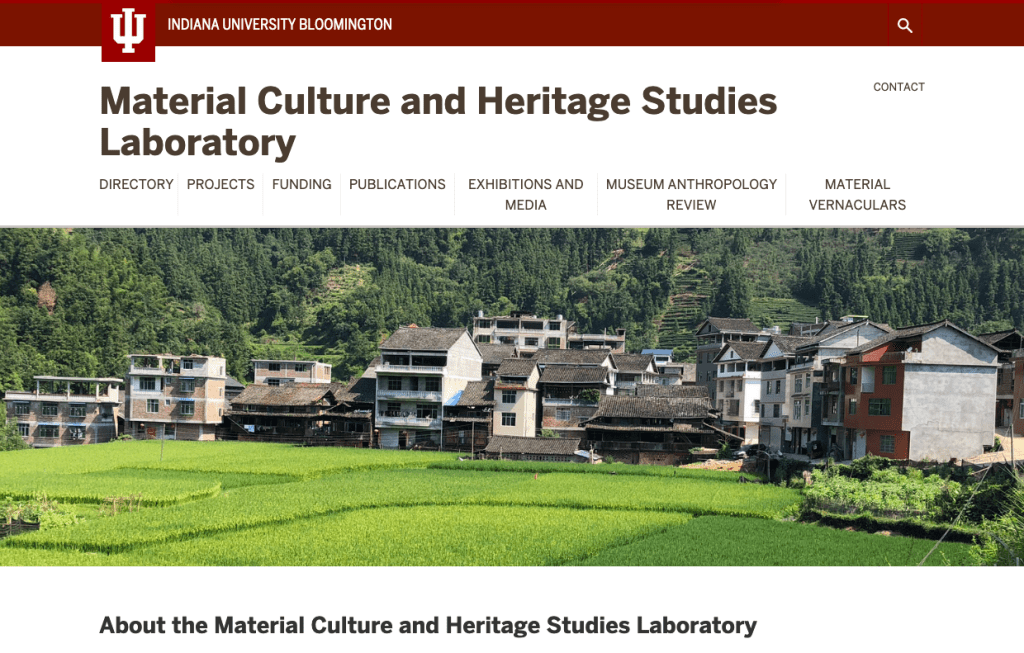
The pandemic slows all work beyond bare necessity, but good things can happen amid the difficulties of the present. Over the summer, with a small but mighty crew and some generous grants-in-hand, I did what the sailors call a shakedown cruise for the new Material Culture and Heritage Studies Laboratory that I founded at summer’s start. With great helpers, it was fun to return to research that had been set aside in 2012 when my MMWC era began. I am thankful for those organizations investing in this new work and for those colleagues and friends encouraging and participating in it. Last Friday the lab’s website launched bringing the quiet phase to an end. Check out the new website here: https://mchslab.folklore.indiana.edu/index.html  

A screenshot from the MSHSL website. The image is of Tongle as viewed across a rice paddy from Zhiacong Village in Guangxi Zhuang Autonomous Region.

Thanks to all who have helped!

It is Time to Check Out The Michiana Potters: Art, Community, and Collaboration in the Midwest

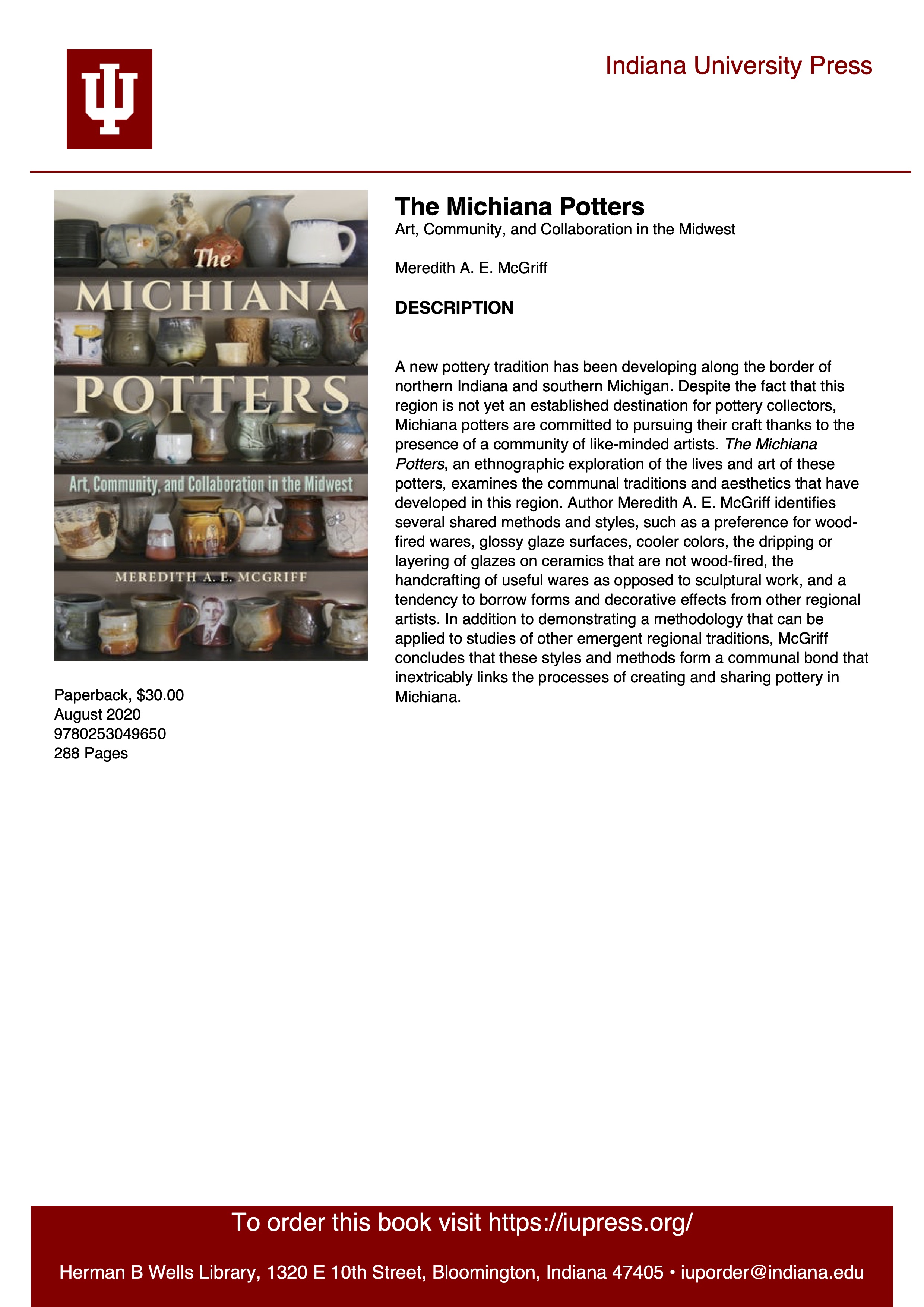
Hi everyone. Some of you already know that The Michiana Potters: Art, Community, and Collaboration in the Midwest by Meredith A. E. McGriff came out recently from Indiana University Press. It’s great. You should read it asap. This is an exciting milestone not only for Meredith and her collaborators, but also for the Material Vernaculars book series that I edit for the IU Press. The Michiana Potters is the sixth title in the series. I am really happy about the work that the series is doing and I really appreciate both the IU Press and everyone who has supported the series as readers, reviewers, authors, and especially purchasers.

Why do a single out purchasers? Well, as I have noted previously, the MV series is an unusual experiment in scholarly publishing. Because those of us involved in the series want to make sure that potential readers are not hindered from reading series titles because of lack of library access or the inability to purchase the book, MV titles are offered for sale in beautiful print editions and also offered in free-to-readers editions online. When you choose to purchase one of those beautiful print books (or a commercial ebook edition), you are helping subsidize the digital free-to-readers edition. The granddaughter of one of the potters profiled in Meredith’s book, for instance, can click here and get access to the book and carry it around on her phone, show it to her art teacher, and use it for a class project. When someone who can afford to buy the book–a pottery collector getting excited about Michiana ceramics or a professor working in material culture studies, to give two obvious examples–buys the book, they are helping fund the production of the book so that others can also read and enjoy and learn from it. In fields such a folklore studies and cultural anthropology, maximizing access, especially for members of those communities from which we learn, is a crucial ethical consideration.

I have basically told this same story every time an MV title has appeared. The good news is that the system seems to be working. I hope that you will keep it working by purchasing Meredith’s fine book if you can.

As I will describe below, things are actually more complicated than I have evoked above. It is not actually the case that a book is either in print form or in the free digital form. There are other versions in the world too. Some of you can help the cause by using those other versions. I will now reveal some of these other ways.

First, the buyers. You can get a handsome paperback or hardback version of The Michiana Potters from a wide range of booksellers. The IU Press links to some of them on its webpage for the book. Pretty much any brick and mortar or online bookseller should be able to get it for you. If you are an ebook reader, you can also get an ebook edition from the usual sources of ebooks. So, book buyers, get busy. Thank you for making the series possible.

If you need or want to check out the free-to-readers edition of The Michiana Potters, it is now posted to the MV section of the IUScholarWorks repository. You can find its repository page here. If you know someone who really needs to read this or another MV title, please help them find this page. The series page with all six books in IUScholarWorks is here.

Now, lets get fancy. If you teach at a university or college and you wanted to assign The Michiana Potters or another MV title to your students, you can probably do this in a way that saves them money while also contributing financially to the work of the IU Press as the series publisher. “How can that be?” you ask. Well, series titles are also published as part of services that are relatively common in college and university libraries. One colleague of mine, for example, is teaching the inaugural series volume Material Vernaculars: Objects, Images, and Their Social Worlds this fall. Students in that colleague’s class will be reading the book via a JSTOR, a key service making journal and book content available on in university and college libraries. Other libraries have purchased eBook access using other services. For professors and students, your university library may or may not have purchased any one MV title in this form, but some have and more could. Usually all you need to do is look it up in your college or university library catalog.

So, if you are a university person, you can use a JSTOR or a university library ebook version for yourself or for your students. When you do, you are contributing, just by that use, to supporting the publishing work of IU Press, including the MV series. If you can do so, please use such library provisioned versions. They save your students money but they still help support the press. Doing so is better than pointing your students to the IUScholarWorks version. But, if you cannot arrange other access for your students or yourself, go ahead, of course, and use the Free-to-Readers version. That is what it is there for.

You can find The Michiana Potters in JSTOR here: https://www.jstor.org/stable/j.ctv14npjxm

One source that I would really like to discourage you from using are the ever growing number of dubious file sharing sites. There really is no justification for getting The Michiana Potter from a Russian hacker when the IU Press and the IU Scholarly Communications Department, both at the IU Libraries, have worked to share a safe and easy version with you.

Happy reading to everyone! Congratulations to Meredith!

9780253049650-2

The IU Press flyer promoting The Michiana Potters.


On Taking Credit: Textile Traditions and Fashion Rip-Offs

Below find a guest post by Carrie Hertz, Curator of Dress and Textiles at the Museum of International Folk Art in Santa Fe, New Mexico, USA. –Jason Baird Jackson

On Taking Credit: Textile Traditions and Fashion Rip-Offs

by Carrie Hertz

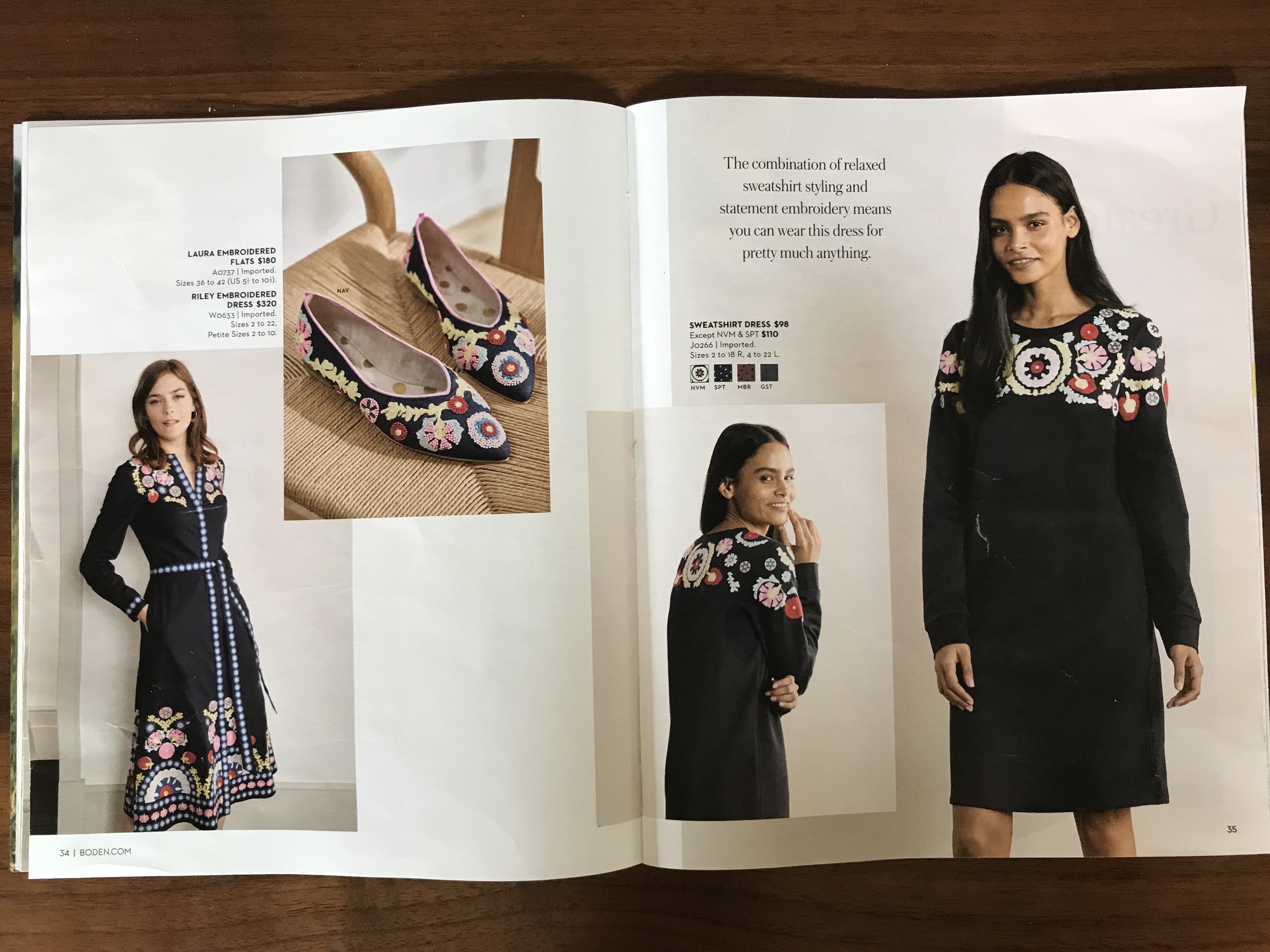
On August 13, the mail carrier delivered the most recent catalog for Boden, a British fashion brand. While flipping through its pages that evening, I stopped dead on a spread for a new “limited-edition collection” of clothes featuring very familiar embroidery patterns. In explanation, the copy reads:

Our designers were so inspired by a vintage rug they discovered on their travels, they dreamed up this limited-edition collection of exquisitely embroidered pieces.

Let’s unpack this.

The Boden designers, clearly positioned here as worldly travelers, admit foreign “inspiration” for their ideas without actually revealing any valuable details about the source. The mention of a “vintage rug” not only suggests a possibly singular, idiosyncratic item, it places that rug’s creation far in the past, likely made by an anonymous and untraceable craftsperson now lost to history. As a limited-edition line of clothes, potential customers could be led to believe these designs are rare, exclusive, and fleeting, requiring their urgent action. These designs, however, are not unique. They are rip-offs.

IMG_8683As a folklorist and curator of textiles and dress, I engage and partner with artists around the globe who often struggle against the living legacies of colonial structures and the inequalities endemic to Western cultural imperialism. Western fashion corporations repeatedly claim the rights of “discovery” to the world’s textile traditions, capitalizing on unfair advantages constructed over centuries of imperial exploitation, profiting off the creative work of others, and actively concealing the sources of their theft.

Perhaps most painful to many of the artists and communities that I work with is the public erasure of their cultural contributions. In this case, Boden didn’t provide proper credit, not even naming the exquisite embroidery tradition it found so inspirational, perhaps because to do so would immediately shatter the illusion of their design team’s innovation, the elite exclusivity of their garments, or even their relative beauty in comparison to much higher quality versions readily available at affordable prices in the global market place.

So, I offer a small piece of this context now.

Suzani (from the Persian word for needle) embroidery has been developed over centuries in Central Asia, traded along the Silk Road, and later survived Communist attempts to suppress it during the Soviet era in places like Uzbekistan. According to Mary Littrell, a textile scholar and research associate for the Museum of International Folk Art:

In the 20th century, Communist rulers in Uzbekistan equated handcrafts with a feudal past. Handcrafts, associated by the Soviets with individual creativity and private production, served no purpose in a unified and mechanized future. Craft production was forbidden or forced underground as the workers turned to mass production. With the fall of the Soviet Union in 1991, Uzbek artisans began the long process of reviving their centuries-old craft traditions and transforming them in new directions for domestic, tourist, and international markets. (http://handeyemagazine.com/content/past-and-future-suzani)

Today, you can readily find gorgeous hand-embroidered garments made with naturally-dyed silks and cottons being sold on sites like Etsy and produced by living artists for which this artform represents multigenerational cultural memory and skill. During every non-pandemic year, the International Folk Art Market (IFAM, https://folkartmarket.org/) features numerous Uzbek artists selling handcrafted rugs, bedspreads, pillows, clothing and accessories. For examples:

Check out the beautiful designs at Bibi Hanum (https://bibihanum.com/) founded by Muhayo Aliyeva and her sisters (http://ifamstories.org/artists/muhayo-aliyeva/);

or the stunning work of Sanjar Ravshanovich Nazarov (http://ifamstories.org/artists/sanjar-ravshanovich-nazarov/);

or the truly exquisitely-embroidered coats produced in Madina Kasimbaeva’s workshop (https://www.instagram.com/madina.kasimbaeva_suzani/?hl=en) in Tashkent (http://ifamstories.org/artists/madina-kasimbaeva/).

These are only a few of the talented and dedicated artists “dreaming up” suzani designs today. Uzbek artists and others have fought hard to sustain and revitalize suzani tradition. At the very least, they deserve credit for their efforts.

IMG_8684

My Dad’s Shoes

The following is re-posted from my personal Facebook page (June 9, 2020). It was pecked out quickly with my thumbs on my mobile phone. Many friends and colleagues appreciated it and two asked if they could use it in their work with students in relation to the idea of biographical objects (see, for example, Hoskins 1998: Kay 2016). To make such use easier, I reproduce the short essay and photographs here. I appreciate everyone who expressed such kind interest in this post.

<><><><><><><><><><><><><><><><><><><><><><>

My Dad’s Shoes

The day after my father’s passing, my mother and brother and I began sorting his clothes and belongings. Among his shoes was a pair that was quite atypical for him (and me). They were these simple, espadrille-like slip ons. The WallMart house brand. On a lark I tried them on and they fit comfortably. They felt great. I asked my mom if I could have them. She said yes. I have basically worn them everyday since then, a fact facilitated by the quarantine lifestyle. I have pretty much walked in my fathers footsteps for 105 days. Because of how we live now, that has meant wearing them for walks around my neighborhood. I’ve been averaging about four miles per day, which means I’ve walked about 400 miles in them. For the first time in my life I have worn a hole all the way through a pair of shoes. I have even worn a hole through the two insoles. To keep going I have taken to putting a piece of cardboard between the insoles and soles. This will get them through one walk each patching, but the sole is getting so thin that I won’t be able to keep this up much longer. I don’t want to give them up but that moment is arriving. It has been good to think of my dad with these shoes over the past three challenging months. These shoes are now what my colleagues call biographical objects, despite the fact that my dad seems not to have actually bonded with them particularly. (The were barely worn and my mom could not recall the circumstances of his getting them.) I will miss walking with them, and him.

<><><><><><><><><><><><><><><><><><><><><><>

References Cites (in the Headnote)

Hoskins, Janet. 1998. Biographical Objects: How Things Tell the Stories of Peoples’ Lives. New York: Routledge.

Kay, Jon. 2016.  Folk Art and Aging: Life-Story Objects and their Makers. Bloomington: Indiana University Press.

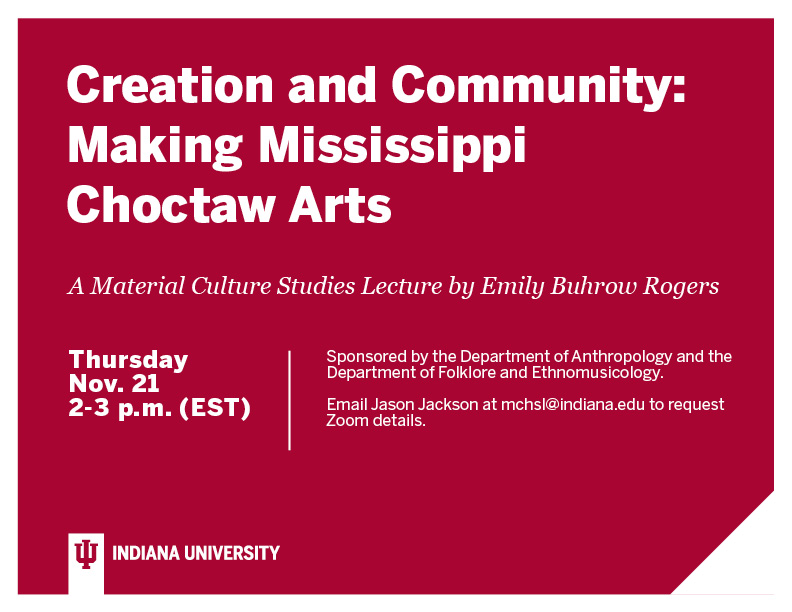
Creation and Community: Making Mississippi Choctaw Arts

Creation and Community: Making Mississippi Choctaw Arts

A Material Culture Studies Lecture by Emily Buhrow Rogers

Thursday May 21, 2020
2–3 p.m. (EST)

Email Jason Jackson at mchsl@indiana.edu to request Zoom details.

This talk examines how Mississippi Choctaw basket weavers, sewers, and beaders innovatively navigate myriad complex landscapes through their acts of creation. It reconceptualizes scholarly beliefs about the nature of material gathering, focuses on the lived realities of individual’s creative efforts, and brings into focus makers’ acts as future oriented and constitutive of the important rhythms of Choctaw social life.

Emily Buhrow Rogers holds a doctorate in anthropology and a master’s degree in folklore from Indiana University. She is currently an editor of the journal Mississippi Folklife and a researcher in the Material Culture and Heritage Studies Laboratory at Indiana University. She carried out her ethnographic research on the expressive practices of the Mississippi Band of Choctaw Indians (MBCI) from 2017-2018 with the generous approval and support of the MBCI’s Chief’s Office and Tribal Council. This work was funded by grants from the Center for Craft, Creativity, and Design; the American Philosophical Society; and the Whatcom Museum.

Sponsored by the Department of Anthropology and the Department of Folklore and Ethnomusicology at Indiana University.

2020-05-21 Rogers Lecture2

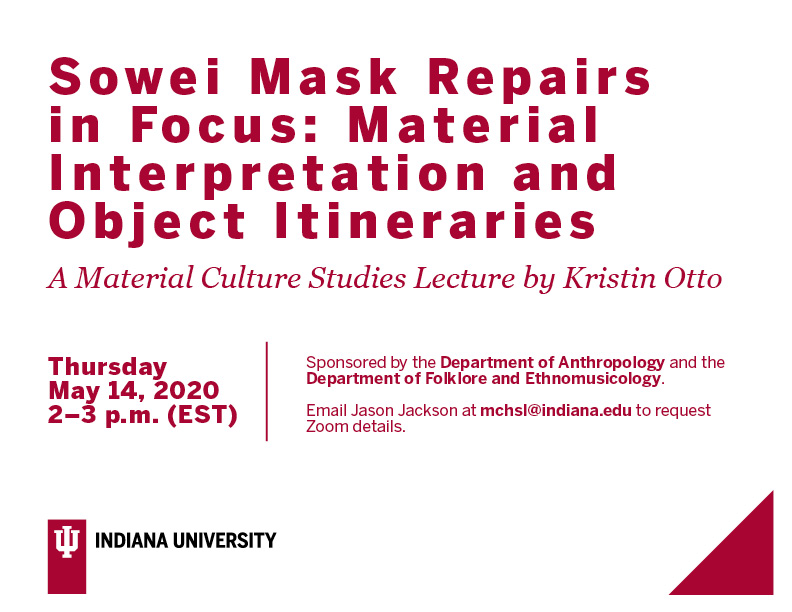
Sowei Mask Repairs in Focus: Material Interpretation and Object Itineraries (Lecture)

2020-05-14 Otto Lecture

Sowei Mask Repairs in Focus: Material Interpretation and Object Itineraries

A Material Culture Studies Lecture by Kristin Otto

Thursday May 14, 2020
2–3 p.m. (EST)

Email Jason Jackson at mchsl@indiana.edu to request Zoom details.

Following the emergence of repair as a topic of interest for material culture scholars, this talk examines the significance of repair for the “lives” / biographies / itineraries of ethnographic material culture in museum collections. Sowei masks (also known as Sande or Bundu masks) are among the most widely collected and easily recognizable objects from Africa in museum collections around the world. Repair proved to be a common experience for the masks as they circulated from performative contexts in West Africa into Western markets, collections, and institutions. Through in-depth case studies of five sowei masks in museum collections around the world, Otto examines how repair shapes the material and immaterial lives of the masks in new contexts and transactional spaces.

Kristin Otto is a Ph.D. candidate in Indiana University’s Department of Anthropology and a National Science Foundation Graduate Research Fellow. Her work as a museum anthropologist and curator focuses on how processes of making and repair impact our understandings of museum collections and material culture.

Sponsored by the Department of Anthropology and the Department of Folklore and Ethnomusicology.

Two Collections of Florida Seminole Dolls

Since beginning the social distancing era, I have taken on a small, personal project to photograph and share two collections of Florida Seminole dolls from my life. Building on the post I wrote soon after my father’s passing, I began by posting (Facebook, WeChat) images of his second collection of such dolls. After picturing those eleven dolls, I did the same for the eight dolls in the personal collection that my wife Amy and I share. These all date to my graduate school days, before I became a museum curator and had to stop growing such a collection. For the interest of those outside my narrower social media circles, I share these two groups below. I am now starting on the grimmer task of taking images and inventorying the larger group of Florida Seminole dolls that were in my father’s initial collection. These all suffered smoke damage and associated chemical contamination when they were caught up in a house fire. While marred by this, they still hold scholarly and humanistic interest and there are things to be learned from them. I will share more about those dolls later.

The Second Kendall Jackson Collection of Florida Seminole Dolls

The Amy and Jason Jackson Collection of Florida Seminole Dolls

Material Culture and Heritage Studies in Northern Guangxi, China at #AFSAM19

I am here using a blog post not to share current news, but to get an older document online and linkable. What follows is the short (public) and long (unseen, for peer-review) abstracts from the panel “Material Culture and Heritage Studies in Northern Guangxi, China: Ethnographic Reports from the China-US Folklore and Intangible Cultural Heritage Project” presented at the 2019 American Folklore Society Annual Meeting (October 17, 2019, Baltimore, Maryland). My intention is to link to this post from a new (February 2020) page for the “Collaborative Work in Museum Folklore and Heritage Studies” (sub-)project. An earlier post on the panel appeared here.

Material Culture and Heritage Studies in Northern Guangxi, China: Ethnographic Reports from the China-US Folklore and Intangible Cultural Heritage Project

In a three-year phase of the China-US Folklore and Intangible Cultural Heritage Project, researchers from six museums have collaborated in a binational program of ethnographic research in China’s Guangxi Zhuang Autonomous Region. In this panel, project participants will report on the research, sometimes emphasizing textile practices such as embroidery and basketry, sometimes focusing on heritage issues, sometimes discussing the lessons of the collaboration. The presenters will share their findings in accessible ways but China specialists may wish to know that research has taken place among the Dong people of Sanjiang Dong Autonomous County and the Baiku Yao people living in Nandan County.

Material Culture and Heritage Studies in Northern Guangxi, China: Ethnographic Reports from the China-US Folklore and Intangible Cultural Heritage Project

In a three-year phase (2017-2019) of the China-US Folklore and Intangible Cultural Heritage Project of the American Folklore Society and the China Folklore Society, researchers from six museums have collaborated in a bi-national program of ethnographic research in two counties in northern Guangxi Zhuang Autonomous Region. In keeping with the larger project of which it is a part, this museum sub-project has focused on questions of cultural heritage policy and practice. The researchers have paid particular attention to various local textile practices in local Yao and Dong communities, considering these practices in their own terms and in relation to the ways that they are being impacted by such heritage practices as cultural tourism, master artist designations, eco-museum development, and formal training initiatives. In this panel, project participants will report on aspects of the joint work, sometimes emphasizing studies of such textile practices as weaving, embroidery, and basketry, sometimes focusing on heritage phenomena, sometimes discussing the lessons of the joint work. In most instances, presenters will touch on all of these aspects in varying degrees. Reporting on a period of field research recently completed, the presentations will be an early stage in a process that will lead to formal publications drawing on the research project. The presenters welcome feedback on these early reports of work recently concluded. The presenters will share their findings in ways that will be accessible to those without knowledge of Chinese ethnography. Specialists may wish to know that the research team’s work has taken place among the Dong people of Sanjiang County, particularly those living in and around the town of Tongle and among the Baiku Yao people living near Lihu town in Nandan County. These communities are home to the Sanjiang Dong Eco-Museum and the Nandan Baiku Yao Eco-Museum, key institutional partners in the research collaboration.

Sources on the larger collaborations that contextualize this specific project include volumes by J. Zhang and Song (2017) and MacDowell and L. Zhang (2016) and an overview by Lloyd (2017). Relevant works in material culture studies include books by Formoso (2013) and L. Zhang (2010). Studies of cultural heritage topics of relevance to the panel include Chio (2014) and a volume edited by Bumenfield and Silverman (2013).

References Cited

Blumenfield, Tami and Helaine Silverman, eds. 2013. Cultural Heritage Politics in China. New York: Springer.

Chio, Jenny. 2014. A Landscape of Travel: The Work of Tourism in Rural Ethnic China. Seattle: University of Washington Press.

Formoso, Bernard. 2013. Costume du Yunnan. Nanterre: Société d’ethnologie.

Lloyd, Tim. 2017. “The Inside Story of the AFS China-US Project.” AFS Review. June 12, 2017. https://www.afsnet.org/news/349609/The-Inside-Story-of-the-AFS-China-US-Project.htm

MacDowell, Marsha, and Lijun Zhang, eds. 2016 中国西南拼布 | Quilts of Southwest China. Nanning: Guangxi Museum of Nationalities.

Zhang, Juwen and Song Junhua, eds. 2017. Metafolklore: Stories of Sino-US Folkloristic Cooperation | 文化对话:中美非物质文化遗产论坛. Guangzhou: Sun Yat-sen University Press.

Lijun Zhang. 2010. China Folk Art Crafts. Beijing: China Agriculture Press.

The schedule of presentation from the conference program follows:

Diamond Session: Material Culture and Heritage Studies in Northern Guangxi, China: Ethnographic Reports from the China-U.S. Folklore and Intangible Cultural Heritage Project

Sponsored by the American Folklore Society, the Folklore and Museums Section, and the Transnational Asia/Pacific Section

Sarah Junk Hatcher (Indiana University), chair

8:00 The Fabric of Life: Baiku Yao Textiles in Huaili Village
Carrie Hertz (Museum of International Folk Art)

8:15 Field Research on Dong Textiles in the Tongle Area of Sanjiang County
Miaomiao Fan (Anthropology Museum of Guangxi)

8:30 Mijiu and Mai Wup: Trilingual Fieldwork and an Indigo Dying Method
MicahJ.Ling (Indiana University)

8:45 Imagination and Enlargement: Daily Performance and Life History in Ethnographic Video
Xiaoyan Liang (Anthropology Museum of Guangxi)

9:00 Notes on Basketry among the Dong People of Sanjiang County, Guangxi Zhuang Autonomous Region
C.KurtDewhurst (Michigan State University Museum)and Jason Baird Jackson (Indiana University)

9:15 Building a Museum Collection of Work Baskets in Northern Guangxi Zhuang Autonomous Region
Jason Baird Jackson (Indiana University) and Lijun Zhang (George Mason University)

9:30 A Rice Basket: Basketmaking in a Baiku Yao Community (Film Screening)
Jon Kay (Indiana University)

9:45 discussion

Hertz - The Fabric of Life

The title slide from Carrie Hertz’ presentation to the #AFSAM19 panel.