Skip to content

Posts from the ‘For the Record’ Category

Thanks, Dad.

Below find the fifth in a series of guest posts offered in celebration on the occasion of our colleague and friend Daniel C. Swan’s retirement from the University of Oklahoma, where he has served with distinction as a Professor of Anthropology, Curator of Ethnology, and Interim Director of the Sam Noble Oklahoma Museum of Natural History. Reflecting here on an aspect of Dan’s work and his personal impact is John Lukavic, Andrew W. Mellon Curator of Native Arts at the Denver Art Museum. This series of guest posts has been organized in partnership with Michael Paul Jordan. –Jason Baird Jackson

Thanks, Dad.

By John Lukavic

Each year in mid-June I send two Father’s Day messages: one to my own father and one to Dan Swan. Even before Dan and I met professionally, he and I shared a bond through common friends and relations back in New York where we both were raised. While I was a graduate student just a few years into my doctoral program in the mid-2000s, Dan arrived at (or rather, returned to) the University of Oklahoma as curator of ethnology and professor of anthropology and immediately agreed to serve as chair of my graduate committee. It seemed that fate finally brought us together.

Dan loves to tell stories like any father does (ask him about his old friend, a machine gun, and a bar somewhere in Mexico). I cannot count how many times he told Mike Jordan and me about the tasks his own advisor, John Moore, assigned to him while in graduate school: he had to babysit Moore’s kids while Moore was duck hunting; he had to help carry loads of wood so Moore could calculate how much labor was required to do certain tasks—as anthropologists do. But these were just great stories to me—myths and legends of adversity and triumph. My experiences as a graduate student were very different from Dan’s experience because Dan was there to support ME. He babysat MY kids. He read them books and took the time to be part of their lives. He was there through challenging times always to lend support and compassion.

“Doing” is central to Dan’s way of teaching. He understands that experience comes from opportunities and he is always generous with sharing his own opportunities with others. During our time together at OU Dan invited me to co-curate an exhibition of pottery and baskets at the Sam Nobel Museum. He guided me through the entire process from beginning to end. He helped me learn by doing. Way too often new curators are thrown into the fire and asked to navigate such a process without help or mentorship. I cannot express how valuable this was as a young professional. He shared his experiences and opportunities with me which provided a foundation on which I have built my career.

In terms of exhibitions and museum work, I learned from Dan the importance of relationships, responsibility, and respect. He instilled in me a strong belief that my first responsibility is to the artists and communities with whom I work, and the work I do in communities requires building strong relationships and trust. As a non-Indigenous curator who works with Indigenous arts, artists, and communities I embrace this responsibility—the feeling of “walking on egg shells” in everything I do—because I want individuals and communities to hold me responsible. Trust is earned by actions taken and must be renewed and maintained constantly. There is no taking a day off or doing what is easy because no one is looking. Dan instilled in me integrity in both my professional and personal life and, like any good son, I don’t want to let dad down.

All students love a pop quiz, do they not? Well as one of Dan’s students, I can tell you quizzes are frequent and not ever when you expect them. Years ago Dan invited Mike Jordan and me to accompany him to the Ilonska dance in Hominy, OK. We were going to see Osage people he has spent a lifetime getting to know and working with. A lot was on the line for him because he was bringing two students into a part of his life, and his reputation was on the line. Mike and I showed up to Dan’s house, grabbed our chairs out of the car and Dan just smiled. “You two pass,” he said. Bringing your own chair to a dance is like wearing pants and shoes. It is just something you do. Dan was testing us on such a basic thing before he let us get in his car to head up to Hominy. We had to earn his trust by our actions—something that I remind myself of constantly. Once he trusted us we learned so much—important things, such as where to get the best cream pie in Oklahoma and the Okie ritual of standing outside to watch a tornado approach. Typical things a dad teaches his sons.

In 2018 Dan flew to Denver, Colorado to attend an exhibition opening of a show I curated. Hundreds of people came to that opening and dozens of journalists came from all over to cover it. But, it was Dan’s words “I’m so proud of you” that will stay with me always. Professors teach, mentors guide, and fathers care. I mean really care. Fathers also give their kids a hard time every now and then—but it’s done with love. They teach life lessons as much as anything else because, at the end of the day, we are all just humans trying to navigate this path we call life.

Congratulations, Dan, on your retirement, successful career, all the scholarship you have put out into the world, all the lives you have touched, and all the relationships you have developed and maintained. You have given me so much and touched my life in so many ways. My family will always have an extra bed, hot pot of coffee, and cream pie waiting for you when you come to visit.

Thanks, Dad.

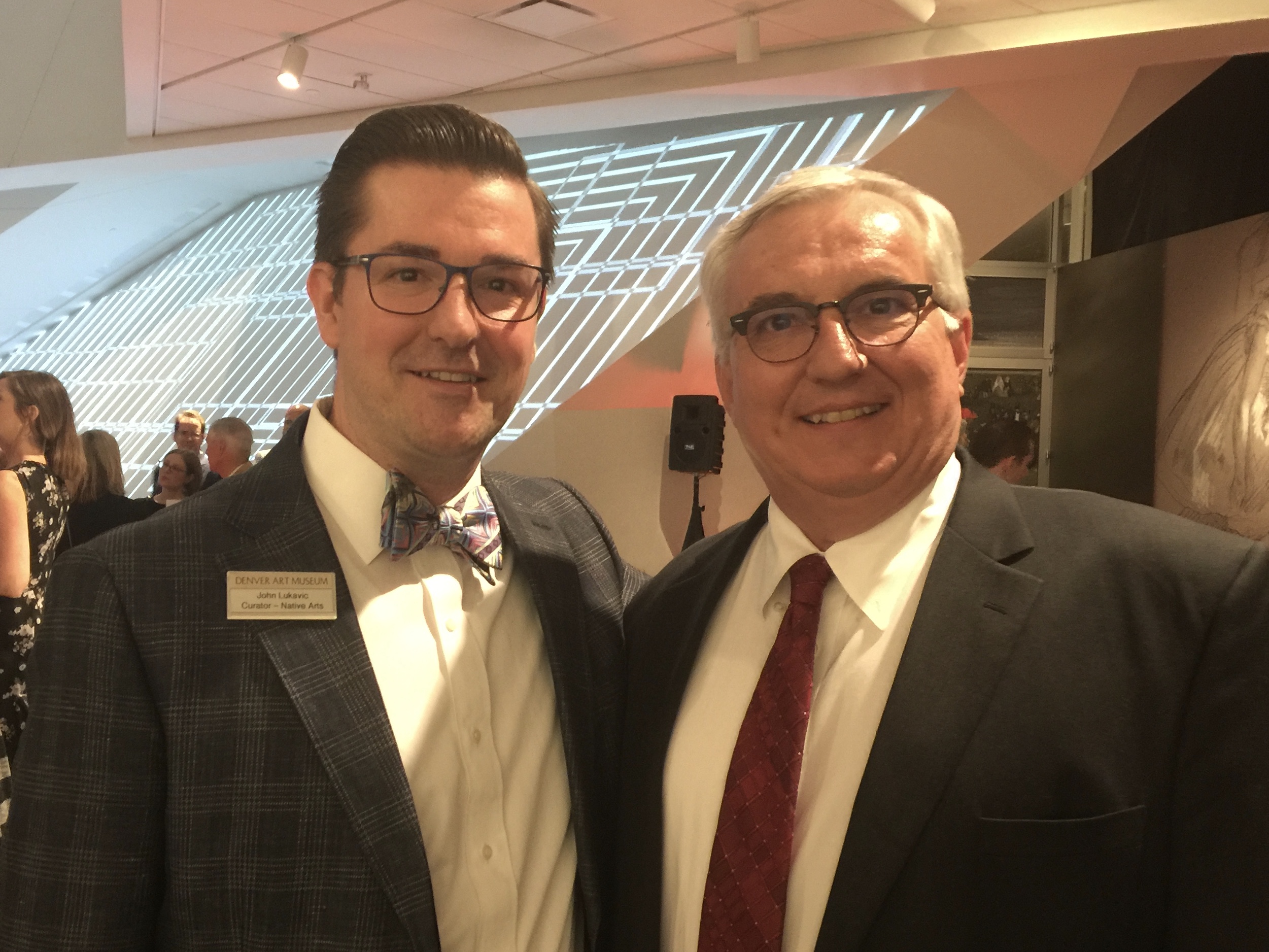
IMG_4566 (JL and DCS at DAM)

John Lukavic (left) and Dan C. Swan (right) at the opening of the exhibition “Jeffrey Gibson: Like A Hammer” at the Denver Art Museum in May 2018.


My Apprenticeship with Dan

Below find the fourth of a series of guest posts offered in celebration on the occasion of our colleague and friend Daniel C. Swan’s retirement from the University of Oklahoma, where he has served with distinction as a Professor of Anthropology, Curator of Ethnology, and Interim Director of the Sam Noble Oklahoma Museum of Natural History. Reflecting here on an aspect of Dan’s work and his personal impact is Michael Paul Jordan, Associate Professor of Ethnology in the Department of Sociology, Anthropology, and Social Work at Texas Tech University. With me, he has co-organizied this series of guest posts. –Jason Baird Jackson

My Apprenticeship with Dan

by Michael Paul Jordan

I must admit that I approached the writing of this blog post with a great deal of trepidation. How does one distill a relationship into a piece of prose? You see, as an anthropologist, I have accrued debts, which I will never be able to fully repay. I owe a debt to the individuals, especially the many elders, who have shared their knowledge with me. I owe a debt to the communities that have welcomed me into their midst. And, I owe a tremendous debt to Daniel C. Swan. Understanding that whatever I wrote would fall short of capturing not only the profound influence Dan has had on my life, but also how much his mentorship and friendship mean to me, I decided to press on.

As a scholar who has devoted my career to studying expressive culture, I have an affinity for the master-apprentice model. I marvel at the Traditional Arts Indiana Apprenticeship Program, which pairs accomplished folk artists with eager students, facilitating the transmission of knowledge and skills to the next generation. If you look at the biographies of the artists, including the many Native American artists, who have been recognized as Heritage Fellows by the National Endowment for the Arts, you will see that many have been honored not only for their mastery of the mediums and genres in which they work but also for their efforts in perpetuating these artistic traditions. I count myself incredibly fortunate to have learned my craft from Dan Swan. At its best, graduate education resembles the master-apprentice model and I believe this is especially true when it comes to learning how to conduct ethnographic fieldwork.

I want to describe my own apprenticeship as a doctoral student at the University of Oklahoma and the lessons Dan taught me. Dan served as the chair of my dissertation committee. However, that official title cannot fully convey the influence and impact that he has had on my life. Over the past thirteen years, Dan has served as an incredible mentor and has become a dear friend.

Looking back, we can sometimes pinpoint the precise moment when a new chapter in our lives unfolded. A conversation with Dan in his office at the Sam Noble Museum marks such a moment in my own life. It was 2007 and Dan had just arrived at the University of Oklahoma. He had offered me a position as graduate research assistant, working with the museum’s ethnology department. He had also agreed to oversee an independent study course focusing on material culture studies. We were meeting to discuss the position and to hammer out a reading list. Much to my surprise, Dan didn’t usher me out of his office after thirty minutes. Hours passed and we kept talking. Dan’s enthusiasm was contagious. Here was someone who shared my interests. It was long after 5pm when we finally wrapped up. I left excited about the projects that I would be assisting with at the museum and eager to dive into the literature that we had discussed. This was exactly how I had hoped graduate school would be. I could hardly contain myself.

When I arrived home, hours later than my wife had expected, she could immediately see the change in my demeanor. My conversation with Dan had left me energized. This would not be the last time that Dan and I got carried away talking and lost track of time. In fact, that has become something of a running joke between my wife and I. It also would not be the last time that I emerged from a conversation with Dan feeling more optimistic, more confident, and more enthused than beforehand. There would be many such conversations. They occurred over lunch at places like Jump’s in Fairfax, Oklahoma or in the car driving to events in southwest Oklahoma. Such conversations have shaped who I am.

Shortly after Dan had agreed to chair my dissertation committee, we embarked on a series of projects that would have a profound effect on my understanding of what it means to be an ethnographer. The Brooklyn Museum had asked Dan to write a chapter on tipis and the warrior tradition for the catalog that would accompany the exhibit Tipis: Heritage of the Great Plains. He was kind enough to offer me a chance to coauthor the essay. We decided that we wanted to discuss the Kiowa Black Leggings Society’s (KBLWS) tipi, which had been painted by Dixon Palmer, a Kiowa WWII veteran. The tipi was inspired by the nineteenth century Kiowa chief Dohasan’s distinctive Tipi with Battle Pictures, which featured depictions of Kiowa warriors’ martial accomplishments. When Dixon painted the society’s tipi in 1974, he included battle scenes inspired by Kiowa veterans’ service in WWII, including paratroopers, Sherman tanks, and bombers.

During our interview with Dixon Palmer and his nephew Lyndreth Palmer, Commander of the KBLWS, we learned that the society had commissioned the painting of a new tipi to mark the 50th anniversary of the society’s revival. Subsequently, we received permission to film and document the painting of the new tipi.

At that time, the Sam Noble Museum was developing the exhibit One Hundred Summers: A Kiowa Calendar Record, which focused on a recently restored set of drawings created by the Kiowa artist Silver Horn to record 100 years of Kiowa history. Dan envisioned incorporating a series of short videos into the exhibit to highlight contemporary tribal members efforts to preserve their history. Footage of the painting of the new KBLWS tipi, which would depict Kiowa veterans’ service from the nineteenth century to the present, would enable us to discuss the ongoing relationship between art and historical memory in the Kiowa community.

Over the course of the project, we made multiple visits to Anadarko to document the progress of the painting. Dan and I interviewed the artists, Sherman Chaddlesone and Jeff Yellowhair, as well as Commander Lyndreth Palmer. On one of our visits, Commander Palmer asked Dan if the museum would be willing to film the society’s upcoming ceremonial. The Society does not allow filming of its ceremonies, so this request reflected the trust that had been established as we worked on the tipi documentary. Commander Palmer made it clear that the KBLWS would retain control of the footage and hold the copyright of the finished film.

Dan agreed and, in the process, he taught me an important lesson about relinquishing control and sharing ethnographic authority. At its core, Dan’s decision was about reciprocity and about honoring relationships. Commander Palmer and the KBLWS had supported our efforts, permitting us to document the painting of the Battle Tipi. Now, they were asking for Dan’s help. Would the museum support a community led initiative? Would it allocate resources for a project that was not tied directly to its own programming and exhibition goals? Dan, Mike McCarty, and I spent October 10 and 11, 2008 filming the society’s ceremonial. The museum would go on to produce a six-DVD box set for the KBLWS, featuring nine hours of footage.

Working on the exhibit, I also learned an important lesson about integrity and honoring one’s commitments to community members. As I noted, when we started working on the One Hundred Summers exhibit, we intended to create a series of videos highlighting community members’ grassroot efforts to preserve Kiowa history. Early on, Kiowa elder Florene Whitehorse-Taylor expressed her interest in documenting information regarding her ancestor, Chief Dohasan, who had led the tribe from 1833-1866. This seemed like the perfect fit, as Dohasan featured prominently in several events documented in the Silver Horn calendar.

As the opening of the exhibit grew closer, the curatorial team decided to focus exclusively on the painting of the Battle Tipi. While the museum’s plans had changed, Dan was adamant that we would make good on our commitment to Florene Whitehorse-Taylor and her family. Consequently, the museum produced Dohasan’s Legacy, a two DVD compilation of oral history interviews created exclusively for the descendants.

During these projects, Dan imparted lessons that continue to inform and guide my own work with Native American communities. These include lessons about the importance of relationships and of reciprocity. The project also taught me much about collaboration. In the years since the exhibit, Dan and I have spent time reflecting on the project and the lessons that we learned. We have even written about those lessons in the hopes that they might inform broader debates regarding museum-community collaborations.

Dan has done more than anyone else to shape my view of anthropology and my understanding of my role and ethical responsibilities as an ethnographer. By his example, he has challenged me to look for ways in which I can address the needs of the Indigenous communities in my own work. While Dan is retiring, I am confident that he is note done teaching. He still has lessons to impart and many of us, myself included, still have much to learn from him.

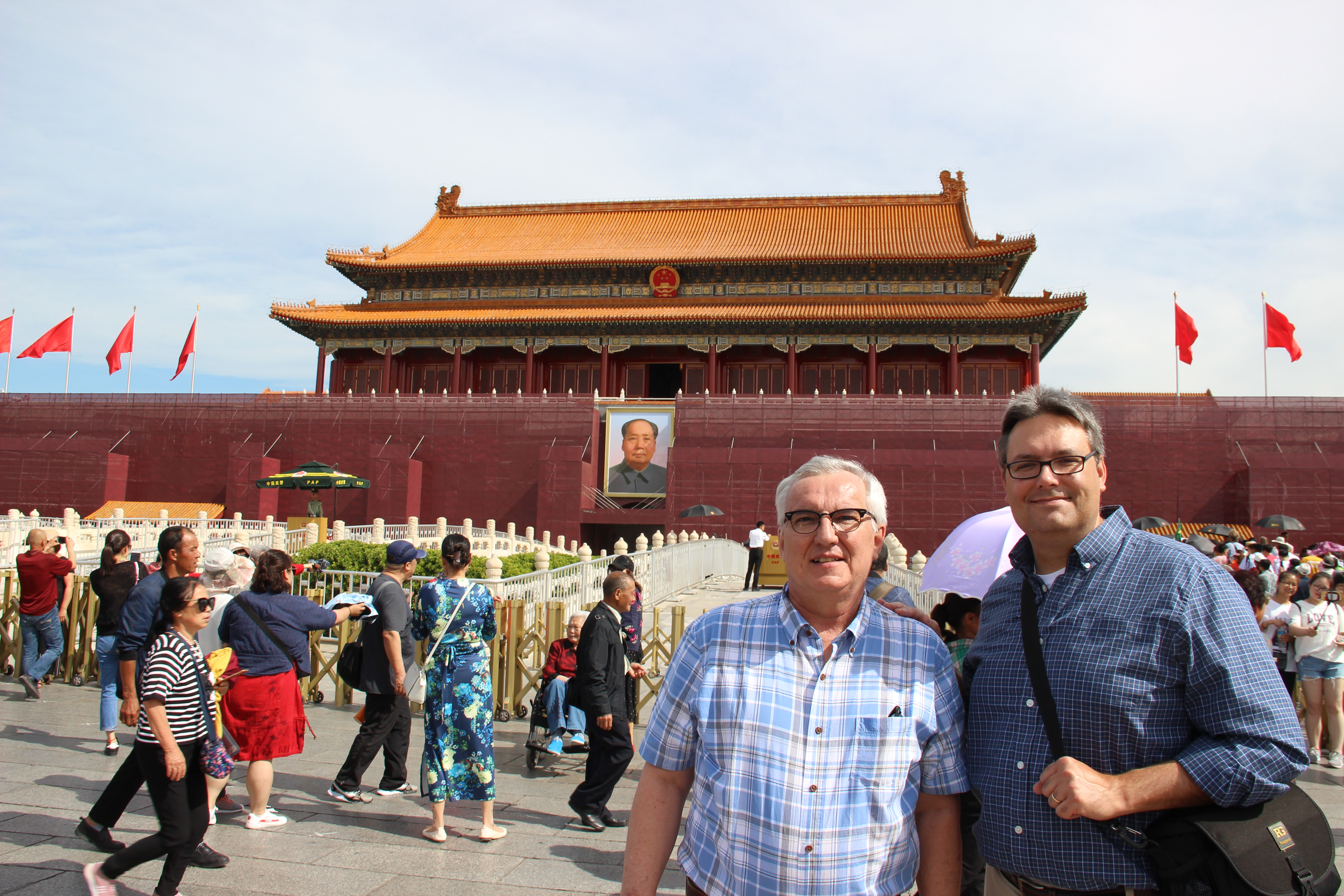
IMG_3209

Dan and I standing outside the Forbidden City in Beijing, China. In 2019, Dan and I participated in the Seventh Forum on China-U.S. Folklore and Intangible Cultural Heritage, co-sponsored by the American Folklore Society and China Folklore Society. The conference theme was “Collaborative Work in Museum Folklore and Heritage Studies” and Dan’s presentation focused, in part, on the museum-community collaborations discussed in this post. Photograph by Dr. Kristin Otto

You Got Kitty Bombed!

Below find the third of a series of guest posts offered in celebration on the occasion of our colleague and friend Daniel C. Swan’s retirement from the University of Oklahoma, where he has served with distinction as a Professor of Anthropology, Curator of Ethnology, and Interim Director of the Sam Noble Oklahoma Museum of Natural History. Reflecting here on an aspect of Dan’s work and his personal impact is Mary S. Linn, Curator of Cultural and Linguistic Revitalization at the Smithsonian Institution’s Center for Folklife and Cultural Heritage. She served previously as Curator of Native American Languages at the Sam Noble Oklahoma Museum of Natural History. This series of guest posts has been organized in partnership with Michael Paul Jordan. –Jason Baird Jackson

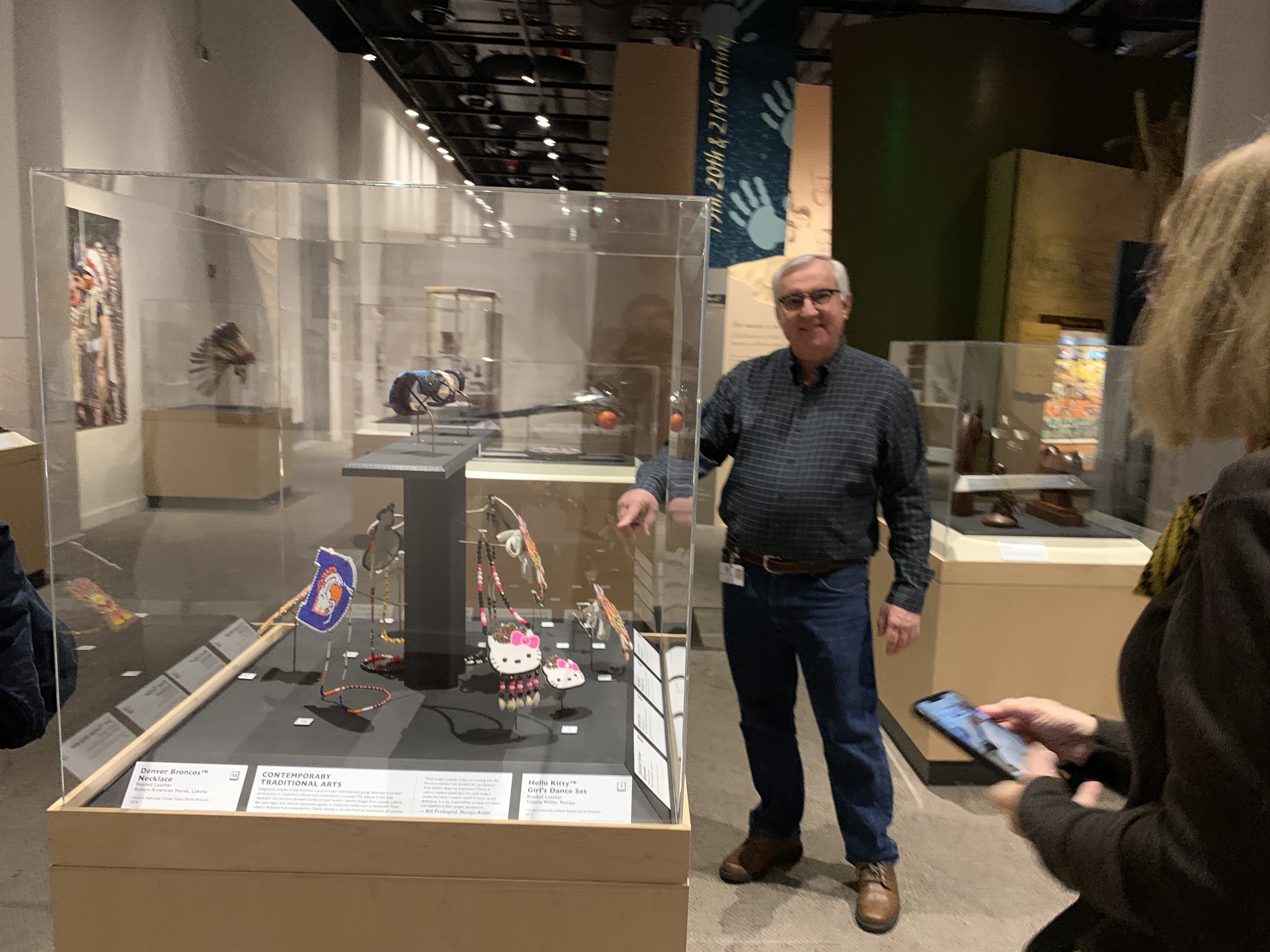
DCS_SNM_112419_Linn

 Dan Swan showing exhibited Hello Kitty beadwork to Julie Droke, Sam Noble Museum, November 24, 2019. Photo by Mary Linn.

You Got Kitty Bombed!

by Mary Linn

What does one write about when considering Daniel C. Swan’s eminent career and imminent retirement?  Why, Hello Kitty, of course.

Dan hadn’t been at the Sam Noble Museum as Curator of Ethnology very long when a group of us women in the anthropology ‘pod’ went out to lunch. A normal day. Next door to the chosen restaurant was a comic book store, and as we passed the window after eating, I exclaimed, “Oh, they have Hello Kitty – I love Hello Kitty! Did you know that most consumers of Hello Kitty are professional women over 30?”[1] We piled in and came out with matching Hello Kitty pinky rings and with Grrrl Power.

Back at work, we enthusiastically showed off our rings and assorted Hello Kitty office supplies to Dan, who rolled his eyes. He would quickly retreat to his office when we greeted each other with ‘Hello, Kitty!’ in the mornings or showed off new Hello Kitty additions (such as Hello Kitty walkie-talkies, our analog version of messaging across offices). That could have been the end of it, or at least Dan’s part in the story, had Olivia Sammons (my graduate research assistant at the time) not gotten a Hello Kitty coloring book and stickers, had I not a penchant for practical jokes, and if Julie Droke (the registrar) had not had the keys to his office. So, we Kitty-Bombed his office, putting  Hello Kitty sticky notes and stickers on his computer and book cases, and adding Hello Kitty pictures in books and files.  Apparently, he was still finding Hello Kitty when he moved his office years later. I am sure some grad student in the future will be amazed at his fortune of inheriting an antique anthropology book with the name Daniel C. Swan inside, and then wonder why there is a picture of Hello Kitty in a tutu stuck in the pages.

How did Dan react? He took it in stride and laughingly admitted defeat for the current round of jokes, and there were many times he would laugh at himself with us over the years.

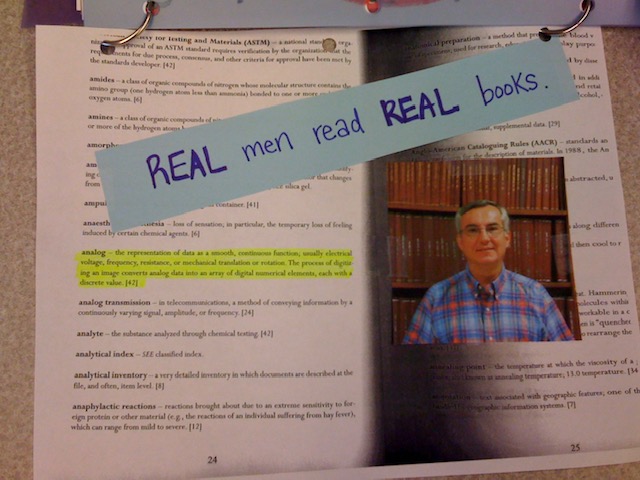
DCS_RealMen_Sammons_ca2010

Real Men Read Real Books, part of a humorous series on Dan and his tribulations with born digital content, created by Olivia Sammons ca. 2010.

And – and this is important here – he embraced Hello Kitty and the Grrrl Power around him. He became an honorary ‘Kitty’ and was/is totally comfortable with his membership in this group.  No, he wouldn’t wear the pinky ring, but he started noticing what we were saying with Hello Kitty and noticing Hello Kitty in the world, especially in the beadwork adorning Powwow regalia.  A few years later, I found myself the recipient of a beaded Hello Kitty lanyard with my museum badge given to me from Dan. This lanyard now proudly holds my Smithsonian id, and Hello Kitty regularly rides the metro, attends meetings with the European presidents and multi-millionaire donors, and dances at the Smithsonian Folklife Festival. It is art, it is Grrrl Power, and it represents my history and friendships in Oklahoma. A funny thing: no man has ever asked me about it. Only women.

That Dan was able to embrace Hello Kitty in our pod is telling of his openness to seeing the world in new ways.  He enthusiastically devours new artistic expressions in Indian Country, and delights in discovering the new in the old and the old in the new. His additions of airbrushed Peyote boxes, youth skateboard art, and beadwork of angry bird, athletic teams, and portraits of popular culture icons, to name only a few of his focused collecting at all the museums he has worked at, have significantly changed the anthropological record and conversations. He listens to the artists, the artisans, the practitioners, the youth, the elders, the cooks, the dancers, the vets… I can go on, but you get the point. He listens and lets them talk through their record.

More importantly, his support of our Grrrl Power shows how Dan has never shied away from what makes him uncomfortable. He examines himself and simply tries to do better the next day. And that, my Kitty Friends, is something that we all need more of today.

ddcc01133b5407fe700f1508797b72d2

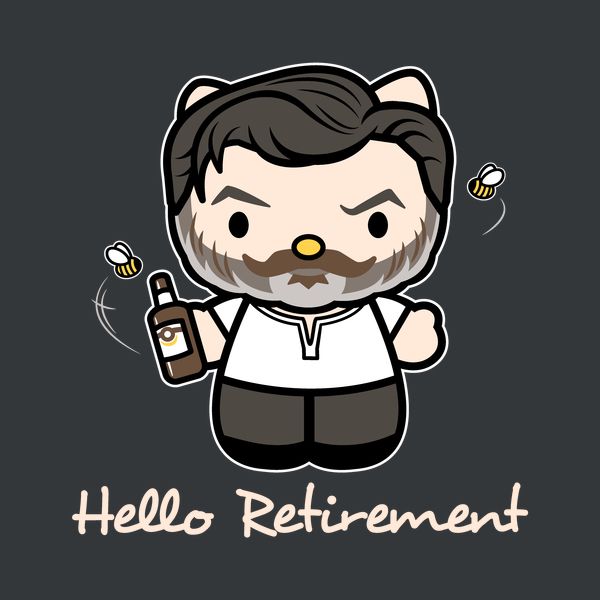
Hello Retirement – you got Kitty-Bombed, from Mary, Julie, and Olivia.  https://www.pinterest.com/pin/363665738634814337/

Endnote

1. Please don’t ask me to cite this.  I had probably heard it on NPR, but that was a long time ago. Wherever I heard or read it, it impressed me enough to stick in my mind.

Lessons of Accountability

Below find the second of a series of guest posts offered in celebration on the occasion of our colleague and friend Daniel C. Swan’s retirement from the University of Oklahoma, where he has served with distinction as a Professor of Anthropology, Curator of Ethnology, and Interim Director of the Sam Noble Oklahoma Museum of Natural History. Reflecting here on an aspect of Dan’s work and his personal impact is heather ahtone, senior curator at the First Americans Museum. She served previously as James T. Bialac Curator of Native American and Non-Western Art at the University of Oklahoma’s Fred Jones, Jr. Museum of Art. This series of guest posts has been organized in partnership with Michael Paul Jordan. –Jason Baird Jackson

Lessons of Accountability

by heather ahtone

As a young professional in 2012, Dan Swan was one of the first in the museum community who helped me feel like a professional. That may seem redundant, how does one not feel like a professional if one is? But I think that for many Native folks coming into the museum field, like myself, it is common to feel like an imposter. I came to my professional field as a matter of accidents and curiosity, with few mentors in the actual field. I didn’t have a cadre of Native folks to help me navigate the museum field’s history of colonialism, authoritarianism, and dismissal of Indigenous agency. Stepping into an institution as the only Person of Color at a level with some capacity for bringing an Indigenous presence into the conversation, I felt a significant amount of pressure. Those pressures were purely internally driven. I could have gone with the flow. But it was clear to me that I had a level of accountability. It would never be imposed by the institution but would always be present for me as a lone representative as I assumed responsibilities curating the collections representing all the brown folks (my position was as curator of Native American and Non-Western arts).

The first part of the lesson of accountability Dan taught was mutual respect. It was a hard lesson emotionally. I wanted to earn a doctoral degree and needed a committee member. I asked Dan to join my committee. He declined. In the most Dan-like way, he declined by expressing that as a respected colleague it was inappropriate for him to be in a position of power over my scholarly work. I can only say that I was broken-hearted by his decision. But I was humbled by his acknowledgment of me as an equal (of sorts – he will always be someone I look up to!). His expression of respect gave me a courage that became a driving force in my work. It made me see that I also had responsibilities as an equal to him–not as a measure of myself, but as a measure of all the goodness he has done for our Native community. That courage was needed to serve the Native folks who were not standing in those meeting rooms, sitting at the table, and having a voice (quivering as I often felt). His respect held me up on many days.

The second part of the lesson of accountability was service. As I assumed the responsibilities and provided leadership in my curatorial position, I pushed myself and the institution to meet the accountability I felt on behalf of the Indigenous community. This appeared to me as service, until the museum field response became an unquenchable demand for more. More work. More writing. More of my voice to fill the silence of Indigenous invisibility. And this was how I learned about my real service to the field. I witnessed Dan creating opportunities for his students, for his peers, and for me. I realized that my true service to the field would not come from the “doing.” Service would come from putting others forward and nurturing a broad voice from the community, not just my voice. He taught by example that the work could never be for myself, but always to serve the community. He wasn’t the only one teaching me this point, I have to acknowledge that I needed two teachers for this particular lesson, Dr. Gregory Cajete was the other. Between the two, I found that truly serving the community was found in nurturing a broader body of servants to our Native community.

The final part of the lesson of accountability was in speaking the truth. Dan has been a champion for my projects for a long while. During one project, fairly early in my curating path, Dan used my work as a teaching tool for his students. He was openly proud of the project, and I appreciated that. It was during a class visit with his students after visiting the exhibition that we discussed openly the successes and failures of the project. The successes were fairly public and I had more practice speaking to these. In conversation in front of his students, Dan asked questions about the failures. This was a challenge to me in the moment. I had less practice speaking to my failures openly. I’m not sure if I spoke the whole truth in that moment, I am sure I was incredibly uncomfortable. But the discomfort with the questions exposed to me that this was where the real learning rests. That when we can honestly assess our failures, we lay a path to confront them and genuinely improve our practice. I have since incorporated my failures with my successes as a part of my public speaking practice. The response to the failures has never ceased to be one of people embracing that truth as “refreshing” and as a moment of strength. My grandmother’s lessons on honesty laid a foundation that Dan’s lesson on truth have fortified.

With all that said, I have learned so many more lessons from Dan. I will always be grateful for his kindness, generosity, and support. He has never let me take the easy path. Our conversations are a source of personal joy and intellectual growth. I believe I will be learning from him for years to come. And if I have listened to what he taught well, I will be able to pass those lessons along to another generation for even more.

God bless you, friend, enjoy all the beauty that the world has to offer.

americanindianculturalcentermuseum

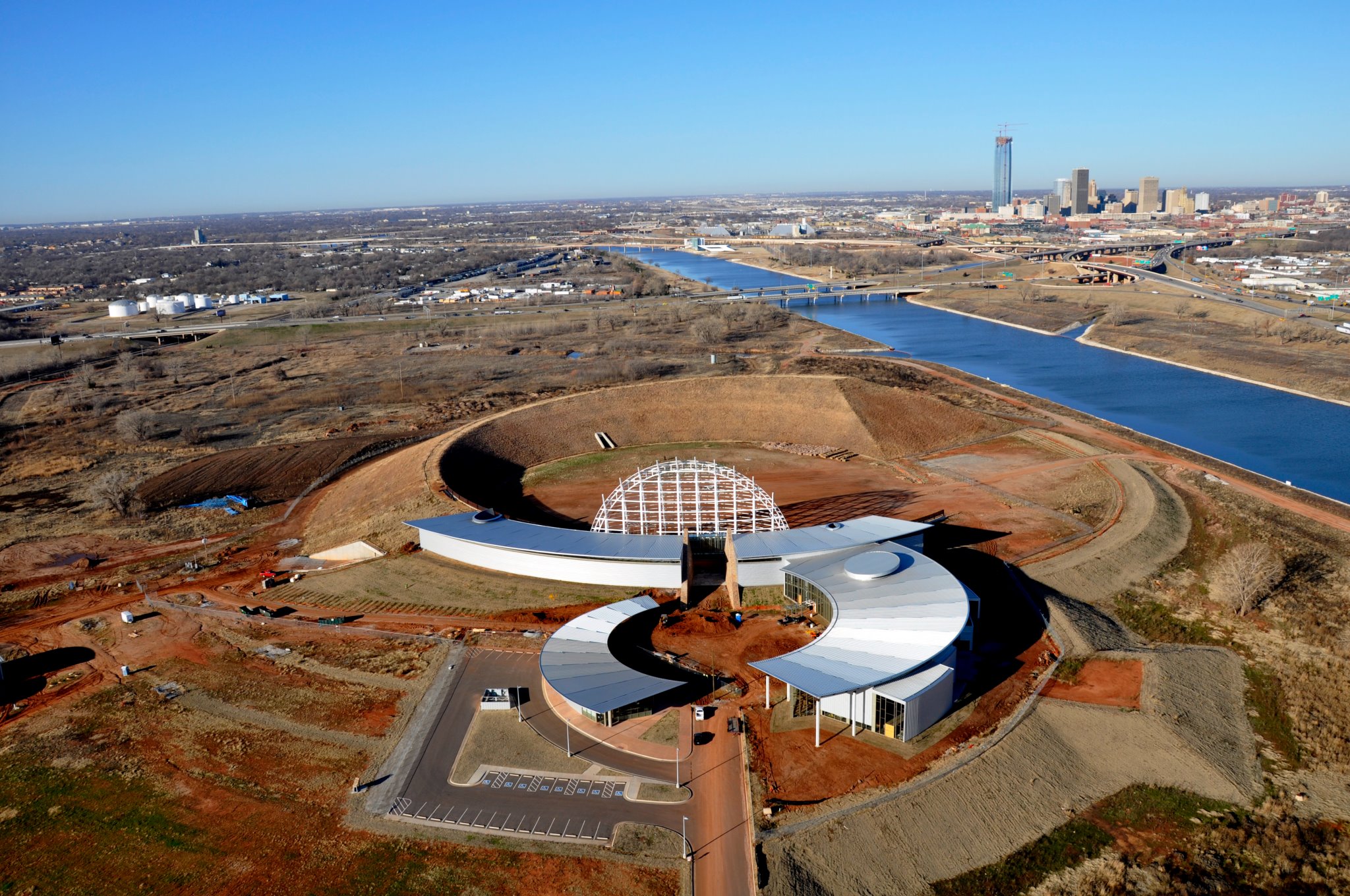
An in-process photograph of the First Americans Museum in Oklahoma City. FAM is slated to open in Spring 2021. FAM press photograph via https://www.indianz.com/News/2018/03/19/american-indian-cultural-center-and-muse.asp


Cracking the Vault: A Celebration of Daniel Swan

Below find the first of a series of guest posts offered in celebration on the occasion of our colleague and friend Daniel C. Swan’s retirement from the University of Oklahoma, where he has served with distinction as a Professor of Anthropology, Curator of Ethnology, and Interim Director of the Sam Noble Oklahoma Museum of Natural History. First to reflect on an aspect of Dan’s work and his personal impact is Jessica W. Blanchard. Jessica is a Research Scientist at the University of Oklahoma’s Center for Applied Social Research. This series of guest posts has been organized in partnership with Michael Paul Jordan. –Jason Baird Jackson

Cracking the Vault: A Celebration of Daniel Swan

By Jessica W. Blanchard

Reflecting on the years I have known Dr. Daniel Swan brings to mind so many wonderful stories. Dan joined as a member of my doctoral committee just as I was rounding third base of the dissertation, and so it was really during the years following the completion of my degree that I came to enjoy Dan as a friend, a colleague, and of course, a ceaseless mentor. He has imparted years of stories and lessons from the field–and from life–and yet, I am unable to share most of these with you here. For you see, any really good story by, or about Dan Swan, inevitably begins and ends with the shared reassurance, “This stays in the vault.” I remember the first time I heard about said “vault” and wondered what in the world kinds of secrets of the academy I was about to learn. I listened with eager anticipation, feeling sure that I was about to be privy to something none of my peers yet knew. As it turns out, for those peers who never had a mentor like Dan Swan, I was indeed privy to a piece of the academy that made it bearable, possible, and simply better.

I entered graduate school, as many do, with a fair dose of naïve optimism and self-centered drive, and was fortunate early to have the mentorship of Dr. Jason Jackson to nurture and guide my focus away from priorities of self toward priorities of communities. His departure to a new institution left a giant hole in my committee and left me wondering how to navigate out of this tunnel known as the dissertation. Enter: Dan Swan. Upon Jason’s recommendation, I asked Dan to join my committee. Right away, Dan asked to read my work. Right away, Dan set up a lunch appointment and gave me feedback. I am not sure if he knows how much it meant to have him jump on board right away. He invested time in understanding the communities with whom I worked so that his feedback was informed and meaningful. He joined me on trips to the field, made all the better by his willingness to indulge in local all-you-can-eat catfish diners. He listened to my stories about the tiniest of Oklahoma towns, and was happy to venture there to meet the community members with whom I had grown close over the years. I watched as he did the same for other students, uplifting them any chance he got and mostly in ways that they were unaware. This, in no uncertain terms, is precisely the kind of support that makes academia bearable, possible, and simply better.

Dan’s advice to me during my time as a graduate student was decisive and clear: just do it. Get finished. Be confident in the hard work you have done. We eventually became departmental colleagues for a time, and Dan’s advice to me was again decisive and clear: worry less about those who do not deserve worry (summarizing here) and work on your face (verbatim). Apparently, I needed to learn how to express less with my face in professional situations. I still hear Dan’s voice saying “work on your face” at just the right times. I see now that Dan’s plain-spoken candor is simply part of what it means to “keep it in the vault.” The vault is simply a blueprint for how to build a circle of supportive colleagues and friends: be selective yet forgiving, invest in one another, support one another, learn from one another, defend each other when needed, hold each other accountable, and always celebrate the wins.

I referred earlier to the dissertation process as a tunnel. The thing about a tunnel is that there is always light on both sides of it. Navigating the tunnel is easier to do with encouragement and good guidance from those who have done it before. Dan helped me find the focus and grit–the tunnel vision, so to speak–I needed to get through it. Tunnel vision is a good thing when it means you are focused and productive, but it is also impossible to sustain and can limit what we can see around us. We eventually come out on the other side of the tunnel and we begin to understand that it was merely a place to gather new tools, perspective and purpose. Thank goodness for those who support our journey into the tunnel, those who cheer and pick us up as we navigate our way through, and most assuredly for those who celebrate as we emerge on the other side.

Today, I celebrate the career and mentorship of my friend, Dr. Daniel Swan. I celebrate his tireless devotion to students. I celebrate his achievements in building an approach to ethnography and curation grounded in community and relationships. I celebrate what is yet to come for him and his family! Dan, if you ever find yourself reflecting on the impact you may have had on others, let me crack the vault a bit to tell you that it was tremendous. Cheers to you!

Bank_of_the_West_Los_Altos_branch_vault

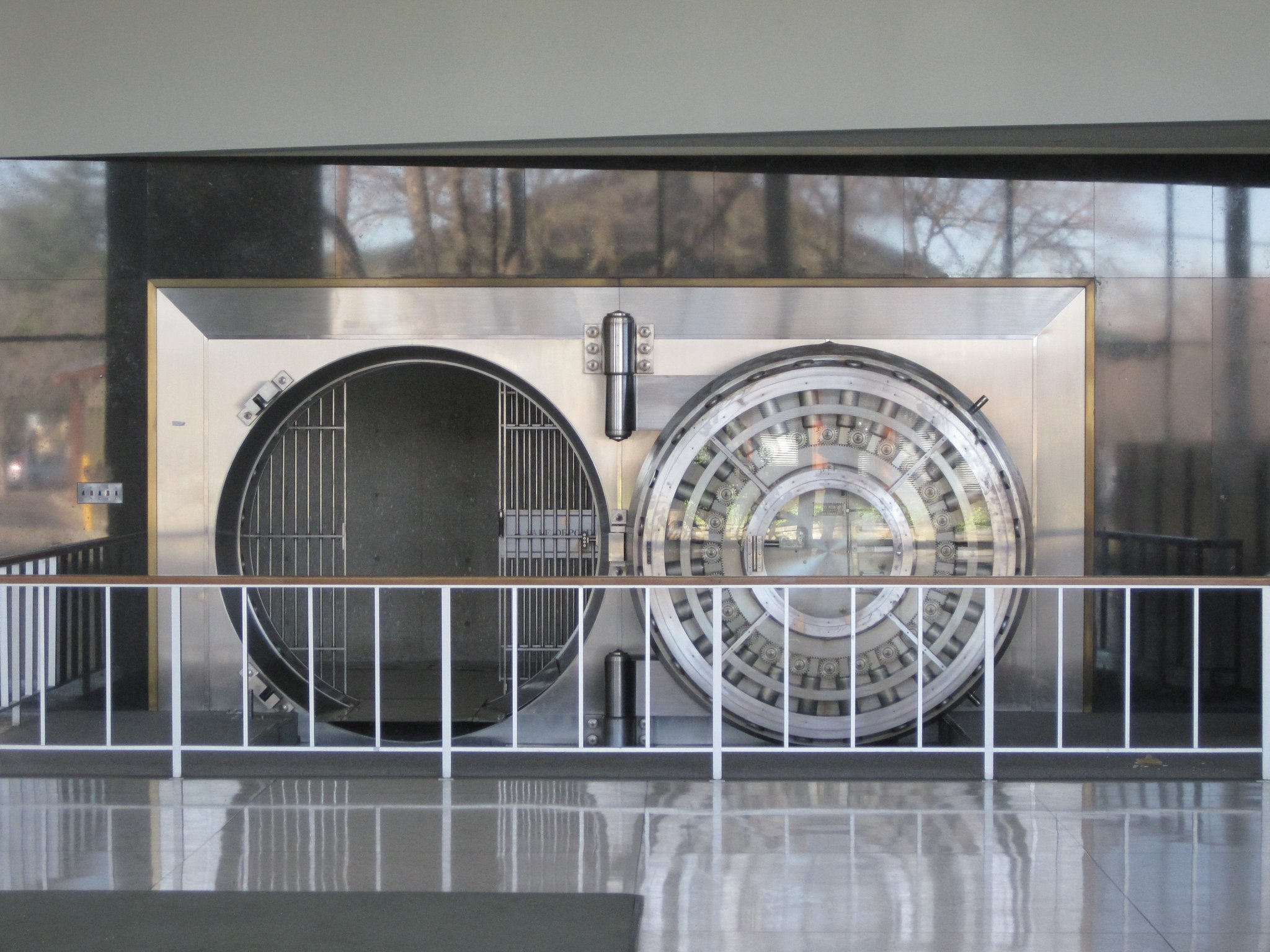
(Former) Bank of the West vault in downtown Los Altos, California via WikiMedia Commons (CC0 1.0 Universal Public Domain Dedication)


The Seventh Forum on China-US Folklore and Intangible Cultural Heritage: Collaborative Work in Museum Folklore and Heritage Studies

The following is a report on The Seventh Forum on China-US Folklore and Intangible Cultural Heritage: Collaborative Work in Museum Folklore and Heritage Studies (第七届中美民俗学与非物质文化遗产论坛: 博物馆民俗与遗产研究的协作工作). The version of record appears on the website of the American Folklore Society. This version adds more images. You can find a copy of the conference program here. –Jason Baird Jackson (杰森. 拜尔德. 杰克逊)

During three beautiful spring days in Beijing, a group of Chinese and American scholars and cultural workers gathered to discuss practices of collaboration in folklore studies and intangible cultural heritage work, with a focus on collaborations between ethnographic museums and between such museums and other groups in society. Held on May 19-22, 2019, this was the Seventh Forum on China-US Folklore and Intangible Cultural Heritage, one of a long-running series of conferences organized cooperatively by the China Folklore Society (CFS) and the American Folklore Society (AFS), as part of a broader binational collaboration begun in 2007. These forums have explored various aspects of cultural heritage policy, practice, and theory, giving US and Chinese participants an opportunity to learn about the state of the field as pursued in the national context that is not their own (Lloyd 2017).

This Seventh Forum, focusing on Collaborative Work in Museum Folklore and Heritage Studies, was held at the Indiana University China Gateway office in Beijing. Meeting under the auspices of the CFS and the AFS, the conference’s program was organized by the Mathers Museum of World Cultures and the Anthropology Museum of Guangxi (Guangxi Museum of Nationalities), with extensive logistical and practical support provided by the two societies and the gateway office staff. Generous financial support was provided by the Henry Luce Foundation and the Office of the Vice President for International Affairs at Indiana University.

Delegates to the forum came from a diversity of American and Chinese museums and universities. Chinese institutions represented included the Chinese Academy of Social Sciences, Sun Yat-sen University, the Anthropology Museum of Guangxi, the Nandan Baiku Yao Ecomuseum, Beijing Normal University, the Sanjiang Dong Ecomuseum, East China Normal University, Fudan University, the Guizhou Nationalities Museum, Minzu University of China, Shandong University, and the Yunnan Nationalities Museum. American institutions represented included the Michigan State University Museum, the Museum of International Folk Art, Texas Tech University, the Mathers Museum of World Cultures (Indiana University), History Miami, the Sam Noble Oklahoma Museum of Natural History (University of Oklahoma), and the American Folklore Society (Figure 1).

IMG_2160 copy_ed

Figure 1. Delegates to the Seventh Forum on China-US Folklore and Intangible Cultural Heritage held at the Indiana University Gateway Office in Beijing, May 19, 2019. Shu Caiqian (Guizhou Nationalities Museum), Zhang Yibing (Guizhou Nationalities Museum, Zhu Gang (Chinese Academy of Social Sciences), Li Mingjie (East China Normal University), Wang Wei (Shandong University), Jessica Anderson Turner (American Folklore Society), An Deming (Chinese Academy of Social Sciences), Luo Wenhong (Fudan University), Marsha MacDowell (Michigan State University Museum), Surna (Minzu University of China), Kristin Otto (Mathers Museum of World Cultures), Felicia Katz-Harris (Museum of International Folk Art), Sarah Hatcher (Mathers Museum of World Cultures), Yang Lihui (Beijing Normal University), Lu Chaoming (Nandan Baiku Yao Ecomuseum), Jason Baird Jackson (Mathers Museum of World Cultures), Chen Xi (Sun Yet-sen University), Carrie Hertz (Museum of International Folk Art), Chao Gejin (Chinese Academy of Social Sciences), Wuerxiya (Mathers Museum of World Cultures), Fan Miaomiao (Anthropology Museum of Guangxi), C. Kurt Dewhurst (Michigan State University Museum), Yang Quanzhong (Sanjang Dong Ecomuseum), He Chun (Nandan Baiku Yao Ecomuseum), Michael Paul Jordan (Texas Tech University), Wu Dawei (Sanjang Dong Ecomuseum), Ou Bo (Anthropology Museum of Guangxi), Michael Knoll (History Miami), Lan Yuanyuan (Sanjang Dong Ecomuseum), Gong Shiyang (Anthropology Museum of Guangxi), Jon Kay (Mathers Museum of World Cultures), Luo Yong (Nandan Baiku Yao Ecomuseum), Mai Xi (Anthropology Museum of Guangxi), Zhao Fei (Yunnan Nationalities Museum), Wang Yucheng (Anthropology Museum of Guangxi).

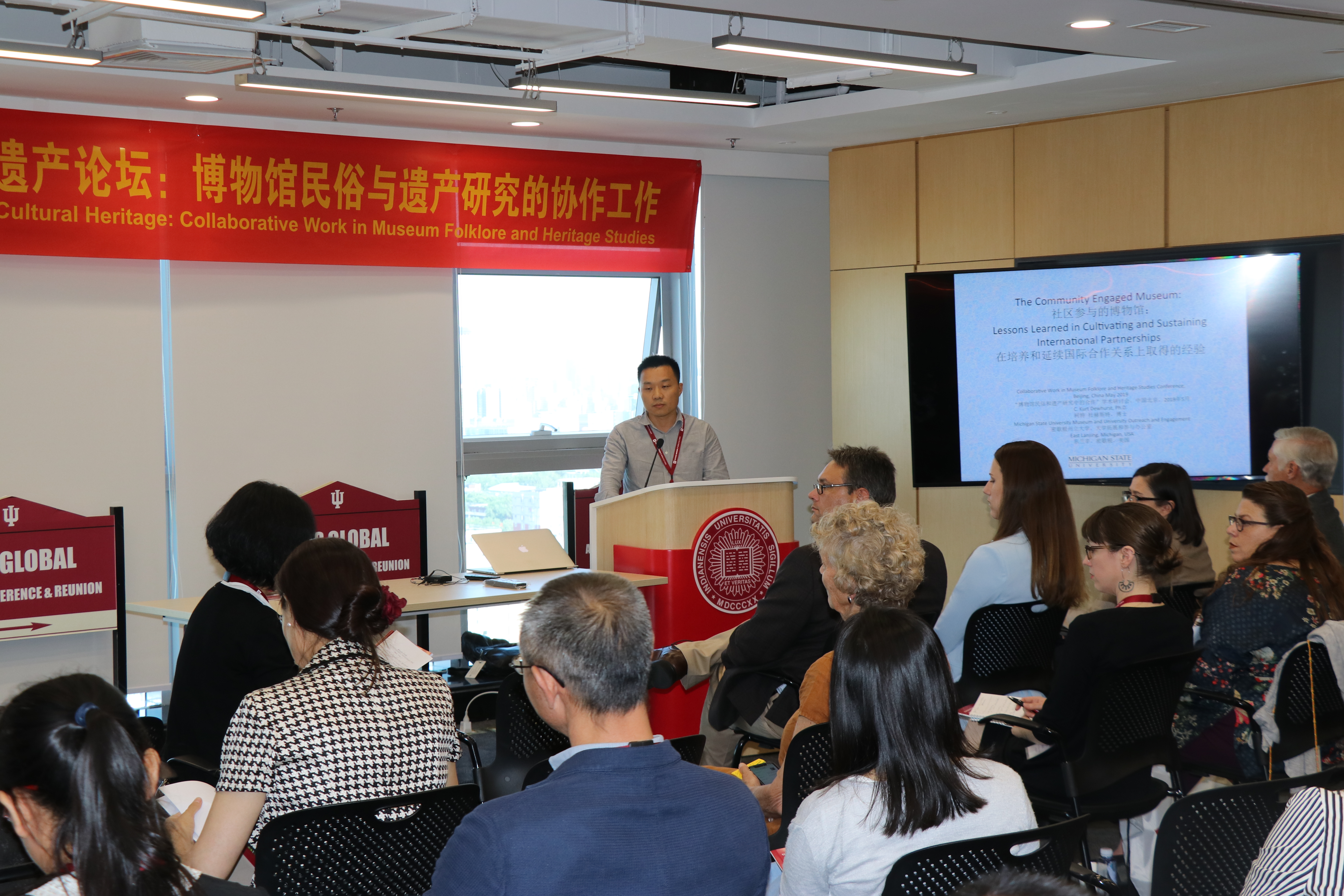
On the afternoon of May 19, the conference began with warm words of welcome from AFS Executive Director Jessica Turner and CFS Past President Chao Gajin (Chinese Academy of Social Sciences), standing in for current CFS President Ye Tao (Chinese Academy of Social Sciences) who was unable to attend (Figure 2). Also offering brief opening remarks on behalf of the program committee were Jason Baird Jackson (Mathers Museum of World Cultures) and Gong Shiyang (Anthropology Museum of Guangxi) (Figure 3). These remarks preceded the forum’s keynote address by C. Kurt Dewhurst (Michigan State University Museum). Extending an earlier discussion of principles for museum collaboration (Dewhurt and MacDowell 2015), Dewhurt reflected on a range of museum collaborations in which he and the MSU Museum have participated. Among the collaborations that Dewhurst addressed were earlier phases of the AFS-CFS partnership, which has included two museum sub-projects (2013-2016; 2017-2019). The first of these encompassed the Fifth and Sixth forum events, the traveling exhibition and bilingual catalogue Quilts of Southwest China (MacDowell and Zhang 2015), and numerous other elements (Lloyd 2017). In this phase, three Chinese museums and three US museums partnered together (Dewhurst and Lloyd 2019). In the more recent phase, collaborators from the three U.S. museums have joined with the Anthropology Museum of Guangxi for a program of joint research focused on textiles and intangible cultural heritage policy in two northern counties of the Guangxi Zhuang Autonomous Region. Central to this new phase of work are the Nandan Baiku Yao Ecomuseum and the Sanjiang Dong Ecomuseum. Thus, while Dewhurst’s keynote was a general reflection on museum collaboration, his presentation also served to orient conferees to the specific joint AFS-CFS supported projects that gave the forum its organizational context.

The keynote address was followed by a panel discussion in which representatives from the Sanjiang Dong Ecomuseum and Nandan Baiku Yao Ecomuseum described their work and the community and organizational collaborations in which they participate (Figure 4). American participants appreciated this opportunity to learn about the innovative work of these ecomuseums first-hand and drew comparisons to various kind of community-based museums in the US. While Chinese delegates were more knowledgeable about the form that ecomuseums take in China, they also appreciated the chance to engage with the ecomuseum leaders directly in a comparative scholarly context.

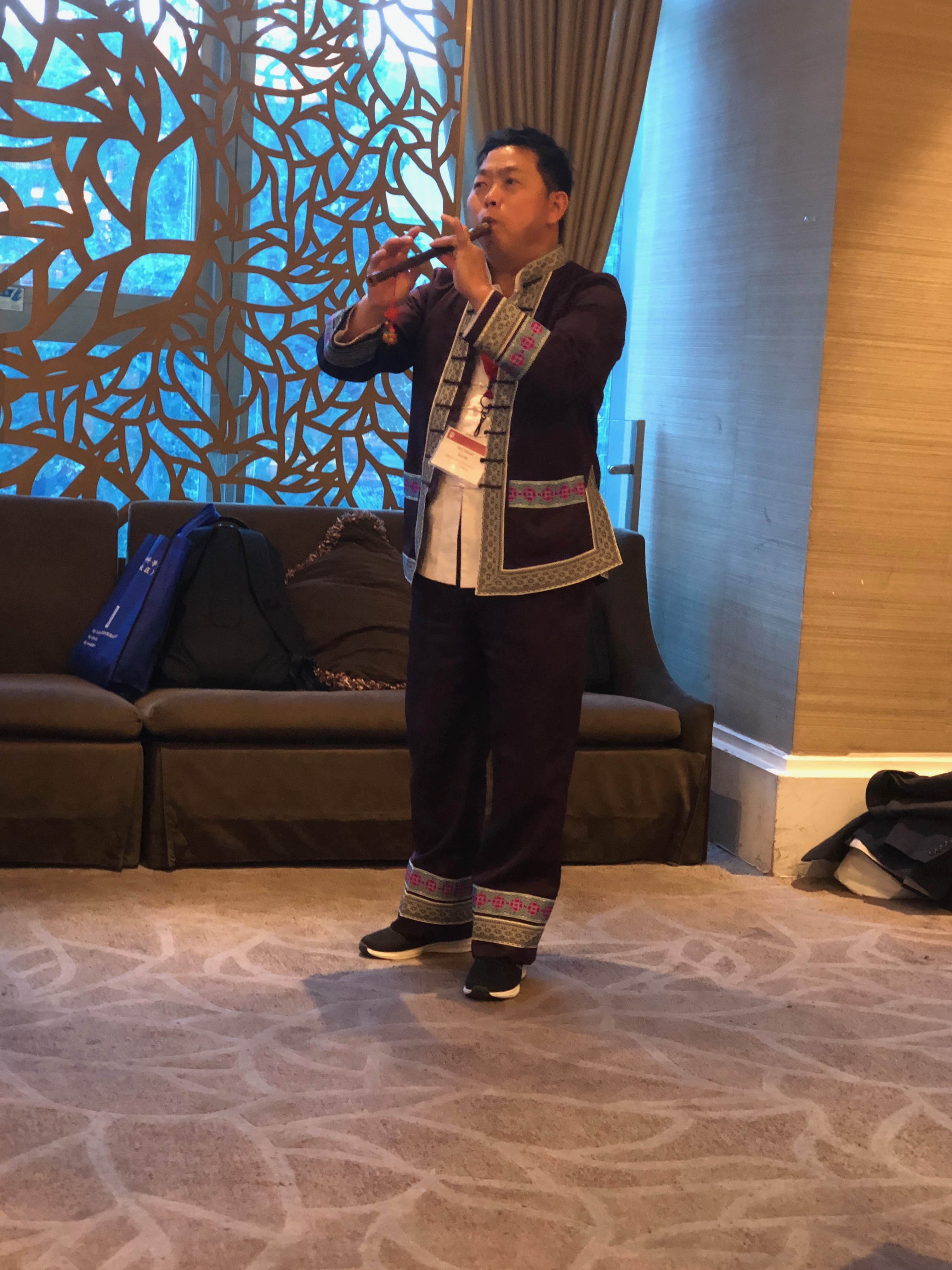
It was an honor that many Beijing-based leaders in the CFS and in Chinese folklore studies overall could attend these opening events, which also included a welcoming banquet generously hosted by the CFS. This gathering was enlivened further when the leaders of the Sanjiang Dong Ecomuseum introduced both Dong flute music and toasting songs to the group. For many American delegates, this was a memorable first experience with the richness of Chinese banquet customs and the beauty of Dong music (Figure 5).

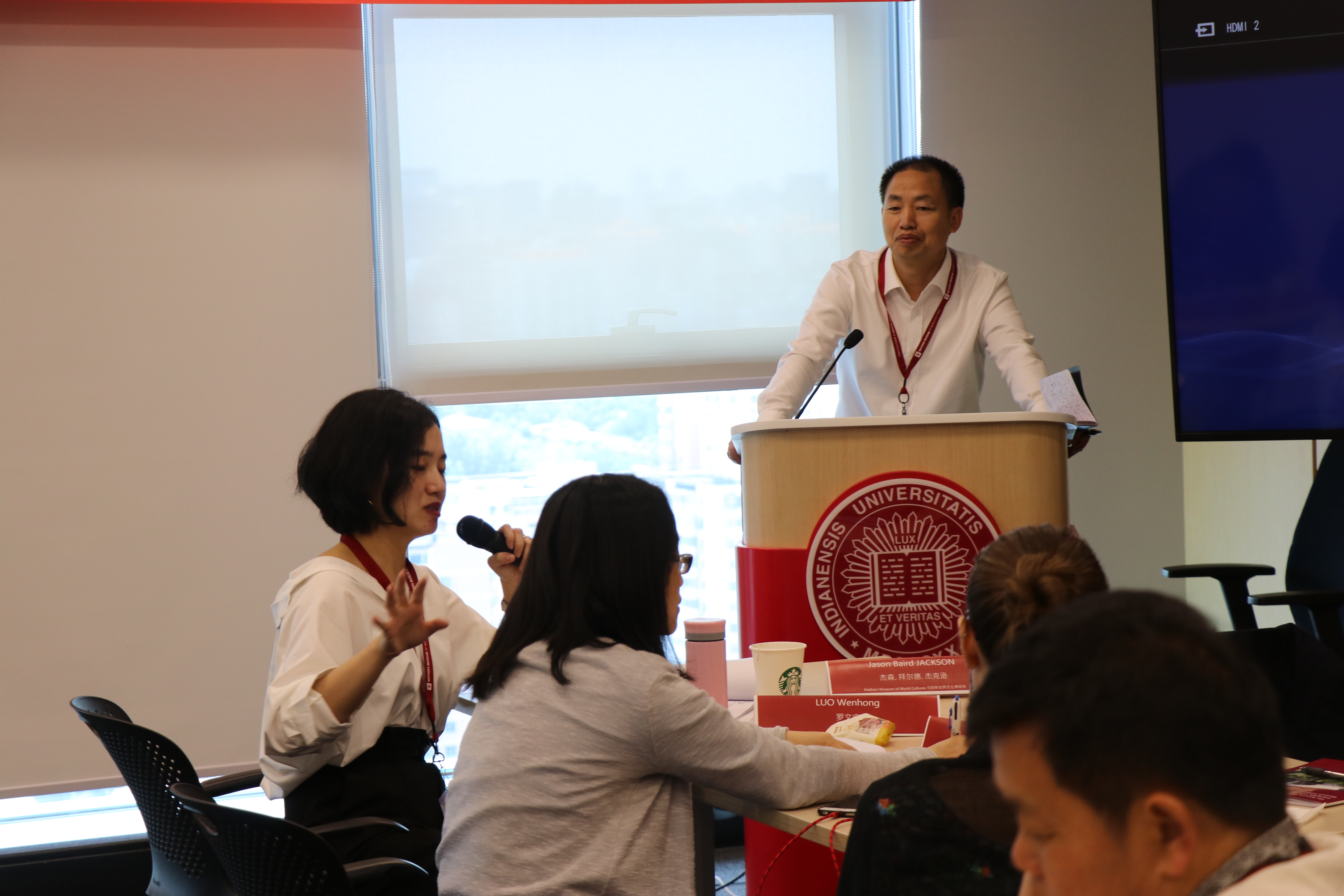
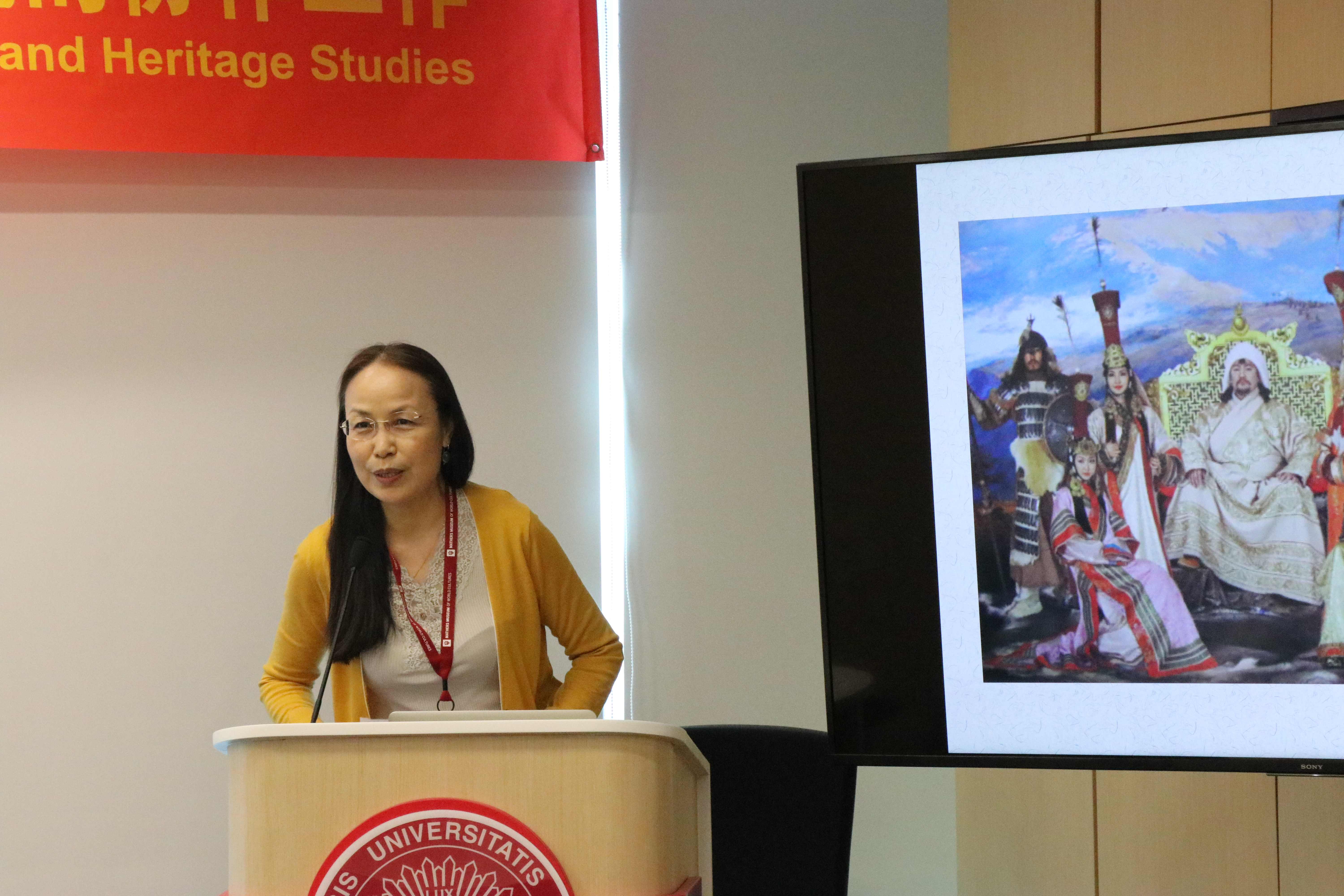
The second day of the conference was a full day featuring presentations from Chinese and American delegates. In line with the goals of the forum, the presenters described specific museum collaboration projects, using them as the basis for broader reflections on the work of museum ethnography and heritage studies today. Translation for most conference presentations was very ably done by Chen Xi (Sun Yat-sen University) and Luo Wenhong (Fudan University) (Figure 6). A number of themes emerged through the juxtaposition of presentations throughout the conference. These included: (1) the nature of museum-based ethnographic and exhibition projects in urban contexts, (2) the dynamics unique to heritage-oriented fieldwork pursued across differences of language, culture, and institutional context, (3) the place of objects and material culture studies within museum collaborations, (4) the use of exhibitions as catalysts for broader collaborations and relationship building, (5) the value of older museum collections for contemporary communities and craftspeople, (6) the place of documentary video in museum ethnography, and (7) the special importance that attaches to national folk costume in diverse museum and local cultural contexts in the current era (Figure 7).

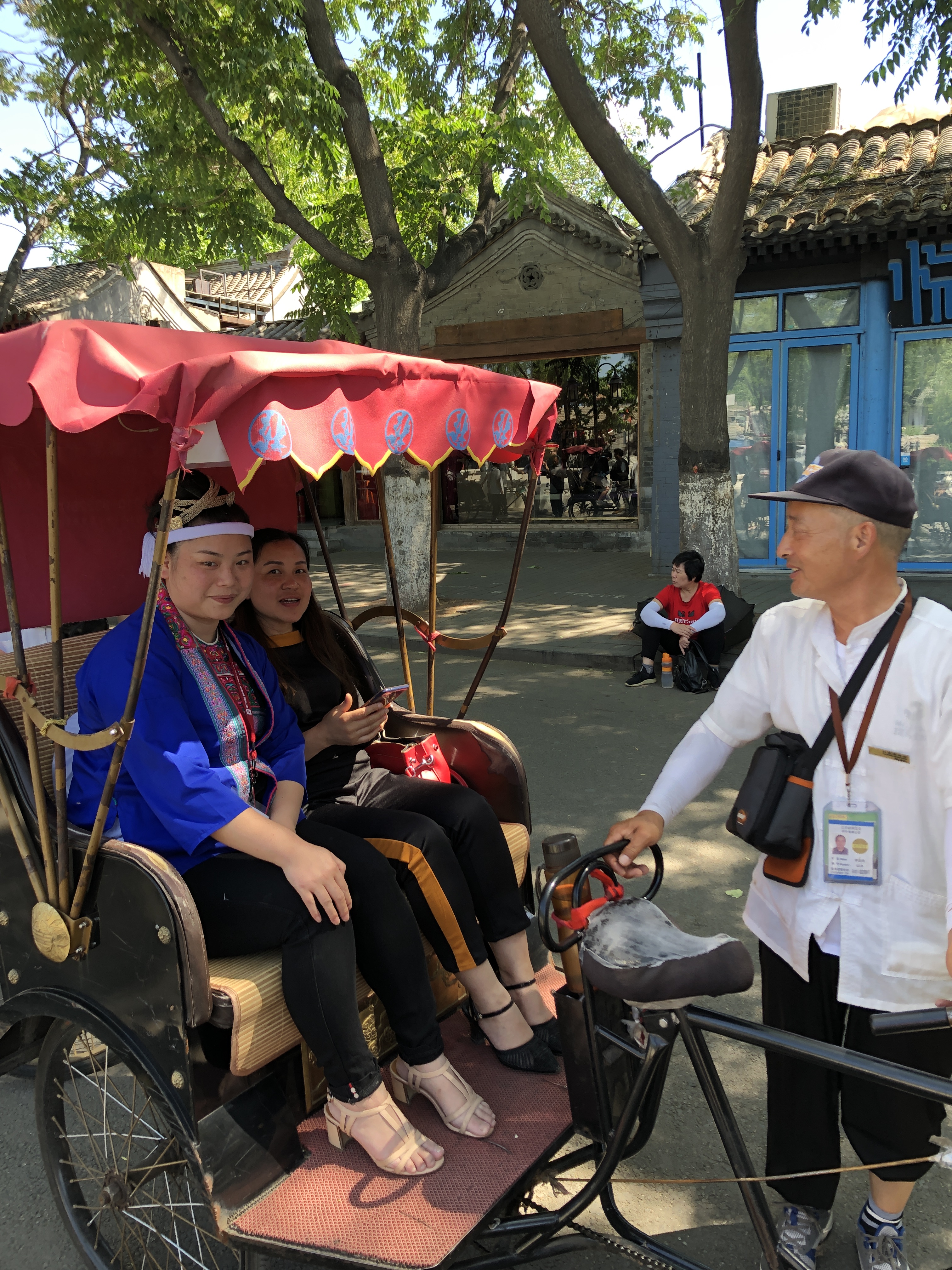
The conference’s third day featured a morning of additional presentations followed by a special outing in which conferees visited Beijing’s Shichahai historic area to learn about cultural preservation and heritage tourism activities centered there (Figures 8-9). Participants enjoyed a hutong tour and a visit to the Drum Towner of Beijing (Gulou). While she could not attend the forum, this outing was curated by Zhang Lijun (George Mason University) and drew upon her folklore research interpreting the narrative performances of hutong tour guides (Zhang 2016, 2019). The conference concluded with a banquet, hosted by AFS and featuring Yunnan cuisine. Highpoints of this concluding gathering were many individual expressions of friendship and goodwill as well as a vigorous singing competition staged between the binational groups gathered around two large banquet tables. Heartfelt singing in Dong, Yao, Mandarin, Mongolian and English brought the seventh forum to a joyful close.

References Cited

Dewhurst, C. Kurt, and Timothy Lloyd. 2019. “The American Folklore Society-China Folklore Society Folklore and Intangible Cultural Heritage Project, 2013-2016.” Museum Anthropology Review 13 (1): 59-68. https://doi.org/10.14434/mar.v13i1.25405

Dewhurst, C. Kurt, and Marsha MacDowell. 2015. “Strategies for Creating and Sustaining Museum-Based International Collaborative Partnerships.” Practicing Anthropology 37 (3): 54–55. https://doi.org/10.17730/0888-4552-37.3.54

Lloyd, Tim. 2017 “The Inside Story of the AFS China-US Project.” https://www.afsnet.org/news/349609/The-Inside-Story-of-the-AFS-China-US-Project.htm, accessed June 12, 2019.

MacDowell, Marsha, and Lijun Zhang, eds. 2016. 中国西南拼布 | Quilts of Southwest China. Nanning: Guangxi Museum of Nationalities. [Distributed in the United States by Indiana University Press.]

Zhang, Lijun. 2016. “Performing Locality and Identity: Rickshaw Driver, Narratives, and Tourism.” Cambridge Journal of China Studies 11 (1): 88-104. https://www.repository.cam.ac.uk/handle/1810/260292

Zhang, Lijun. 2019. “A Brief Guide to Shichahai.” Video Presentation Prepared for The Seventh Forum on China-US Folklore and Intangible Cultural Heritage: Collaborative Work in Museum Folklore and Heritage Studies, Beijing, China.

IMG_1984

Figure 2. Figure 2. Chao Gajin welcomes delegates to the Seventh Forum on China-US Folklore and Intangible Cultural Heritage: Collaborative Work in Museum Folklore and Heritage Studies. May 19, 2019. Photograph by Jon Kay.

IMG_2001

Figure 3. Figure 3. Gong Shiyang addresses delegates to the Seventh Forum on China-US Folklore and Intangible Cultural Heritage. May 19, 2019. Photograph by Jon Kay.

IMG_2072 copy

Figure 4. Wu Dawei offers remarks on the work of the Sanjang Dong Ecomuseum during the ecomuseum panel discussion. Left to Right: Lu Chaoming, He Chun, Lan Yuanyuan, Yang Quanzhong, Wu Dawei, Luo Wenhong (translating), Jason Baird Jackson. May 19, 2019. Photograph by Jon Kay.

IMG_2434

Figure 5. Wu Dawei performs Dong flute music at the opening banquet. May 19, 2019. Photograph by C. Kurt Dewhurst.

IMG_2297

Figure 6. Zhang Yibing discusses the work of the Guizhou Nationalities Museum with Luo Wenhong providing English translation.. May 20, 2019. Photograph by Jon Kay.

IMG_2320

Figure 7. Carrie Hertz discusses research related to the exhibition Dressing with Purpose. May 20, 2019. Photograph by Jon Kay.

IMG_2475

Figure 8. Surna discusses her research on Mongol national dress. May 21, 2019. Photograph by Jon Kay.

IMG_7434

Figure 9. Lan Yuanyuan and He Chun begin a rickshaw tour of the Shichahai neighborhood in Beijing. May 21, 2019. Photography by Jason Baird Jackson.

Help! Really. The Mathers Museum of World Cultures Needs You!

An Indiana University event known as #IUDay is nearly here. Scheduled for Wednesday, April 10, 2019, #IUDay is a celebration of Indiana University. It is a day of special events, of sharing stories of the university, and for gathering together friends and supporters to work together to achieve special goals. Last year, in the days right before, and on, #IUDay, sixty-one friends donated to the Mathers Museum’s first #IUDay crowdfunding campaign. Working together, they contributed funds to enable us to launch Traditional Arts Indiana’s Indiana Heritage Fellowship program. Ours was a successful first effort. It was so successful that the Indiana University Foundation encouraged us to take on two campaigns this year, a fact that means that we are seeking to raise more than double the level of funding we received last year. This is an exciting prospect, but it is also daunting. I hope that everyone who reads this post can help us meet our goals. They are good goals. Let me describe them.

Building on the success of last year’s effort launching the Indiana Heritage Fellowship program, we are this year seeking support for its companion program, also new. This is the TAI Master-Apprentice program. The goal here is $2500 and, as of the moment that I am writing this, we have raised $567 from 11 generous donors. With two days to go, we really need your help. Please consider making a gift large or small. Last year 61 donors supported our efforts and we are eager to (=need to) increase this number this year. The good news is that, when successful, this effort will do great work across Indiana communities, providing resources and support for diverse tradition bearers to transmit their skills and knowledge to eager apprentices. This work benefits Indiana communities, the state and ultimately the whole country. If you would like to learn about the first class of TAI masters and apprentices, check out this year’s booklet and learn about the beadwork artists, netmakers, drummakers, ironsmiths, and ballet folklórico performers working together this year.

To learn more and to, if you chose, make a contribution, you can find this campaign site here: https://iufoundation.fundly.com/support-the-next-great-folk-artists

Our other campaign aims to fund K-12 field trips to visit the Mathers Museum on campus in Bloomington. Field trips are an impactful highlight for most school students, but they have become increasingly rare for most students, as budget cuts continue to take their toll. Visits to the Mathers Museum introduce students to cultural diversity worldwide and in Indiana and the US. Museum visits also introduce students to the commonalities of the human experience and to the disciplines–folklore studies, anthropology, ethnomusicology, history, etc.–that build up our understandings of human existence, past and present. As of the time of this writing, this campaign has gathered $1220 from 18 friends of the museum. Here too our goal is $2500, thus we need your help in this effort also. (This funding will enable us to provide the funds that schools need in order to come to the museum and engage with our programs and exhibitions.

To learn more and to, if you chose, make a contribution, you can find this campaign site here: https://iufoundation.fundly.com/mathers-museum-of-world-cultures

Thanks to all who have given so far. Thanks to all who will consider giving. Whether you give or do not give, please, please share these links online and urge others to support the museum’s work. When an #IUDay link is shared online it results in an average of $97 dollars in support, so even if you cannot give $10 or more dollars now, you can help the museum and these worthy projects by spreading the word.

ihfa

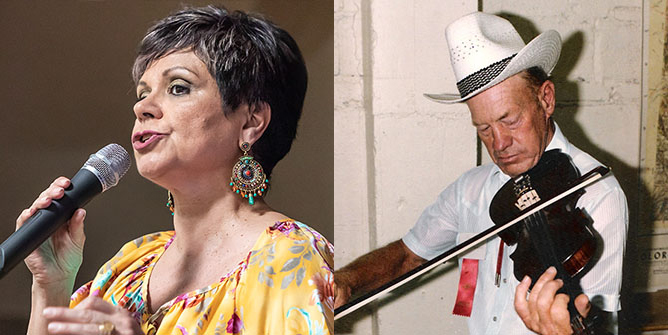
Debra Bolaños (left), a ballet folklórico dancer and instructor in East Chicago, Indiana, and Harold Klosterkemper (right), a fiddle player from Decatur County, Indiana, will soon be honored for their lifetime achievement as Indiana traditional artists. They will be recognized as Indiana Heritage Fellows in a special ceremony on April 27, 2019. Learn more about the event here.


What is the Museum Anthropology Review Business (Labor) Model?

Alternate title: How to give away $99,000 worth of articles.

Although it has become normalized in open access/scholarly publication reform discussions to speak in this way, it often seems laughable to use the phrase ‘business model” in the context of many open access projects. Business model implies more modeling and more business that are often found in these efforts. When the eye-rolling or chuckling stops, the business school talk does remind prompt us to try to figure out what we are doing and how we are doing it. This is good even for tiny projects held together (often happily) with just a bit of used string and some tape. (Thank goodness that we do not all want to become the next oversized thing.)

I write the following as founding editor of Museum Anthropology Review, an open access journal supporting scholarly and public-facing work in museum anthropology, museum-based folklore studies, and material culture studies. In an immediate context of painful collective disciplinary assessment, debate, and reflection (#hautalk) on scholarly communication work (and labor practices, and power, and hierarchy, and practices of discrimination, etc.) in the ethnographic disciplines, I thought it might be useful to be more explicit about labor and funding underpinning MAR). While the journal has a complex origin story and has changed alongside other changes (in my career, at Indiana University, in the fields that it serves, etc.), the so-called business model has remained pretty consistent, making this small task easier. It is not the business school way, but it may be easiest and most contextually relevant in MAR and disciplinary context to track labor and money using participant roles. It is hard to do this in a way that will not seem either self-promoting or defensive, but it has to be done. I have stressed throughout my wider engagements with open access that projects such as MAR need to try to be intentional in their experimental work and in reporting back to the field for collective benefit. The need for more of this is more pressing now than ever and I have been relatively silent on open access issues since finishing what I thought of as capstone activities in two pieces written with colleague-collaborators (Jackson and Anderson 2014; Walters et al. 2015 [for this project, see also here]).

MAR Screenshot

Readers: The journal does have readers. I and others involved in the journal know this from digital statistics (like Google Analytics), citations to work published, and word of mouth. Accessing MAR requires internet access but does not cost readers anything. Everyone involved is pleased to know that the work is worth doing, so I say thank you to the readers who have spent their time and attention on MAR. (I invite you to sign up as a reader and get free tables of contents for MAR by email.)

Authors: The journal does have authors. Authors are not paid for their contributions to MAR, but they are also not charged author fees or article processing charges, as is common in some other kinds of open access projects. In MAR we have so-far published 33 peer-reviewed articles. Had the authors of those articles published them in Curator and paid to make them open via Wiley’s Online Open program, the total cost to authors would have been $2500 x 33 = $82,500. Author-pays open publication in Museum Anthropology would have cost $3000 x 33 = $99,000 (See Wiley-Journal-APCs-2018MAY24 (a spreadsheet) via https://authorservices.wiley.com/author-resources/Journal-Authors/licensing-open-access/open-access/onlineopen.html, accessed June 16, 2018). Those of us in other MAR other roles wish, of course, that authors were more aware of these taken-for-granted things. Hopefully this post will help a bit. I am proud that the MAR community has been able to make publication happen for these authors and their readers without ability-to-pay being a factor shaping the publication process. I also thank journal’s authors for sharing their valuable work widely through publication in MAR.

Peer-Reviewers:  The journal definitely has peer-reviewers. They are generous and thoughtful and they are essential. I thank them here for their contributions to MAR. MAR peer-reviewers are not paid for their contributions. This is the current scholarly publishing norm for journals. I track the debate on the ethics of this. We are in a bind. Peer-review is hard, important labor. My opposition to industrial scale commercial scholarly publishing is based in part on the relationship between free labor of some participants and the huge profits that these firms reap (sample rants here and here). If paying peer-reviewers were to become the norm, then small community-based journals such as MAR would not be able to do it and corporate run and co-published journals would have an even bigger slice of the scholarly publishing pie (the enclosure of anthropology was at issue here). It is a conundrum at the heart of scholarly communications reform. For now, know that MAR peer-reviewers are valued and unpaid. The cash/gift economy status of the other roles is probably relevant to their feelings about this. My hope is that one feels relatively less exploited about peer-reviewing for a journal that looks like the one that I am describing here.)

Editorial Board: As is normal, MAR has a valued editorial board. As is common, I have not turned to them for structural, business or governance issues as much as I might have. As in other journals, they often serve as a kind of meta- peer-reviewers. For instance, serving as a source of editorial advice when I need help figuring something out or as a source of recommendations for reviewers. Sometimes editorial board members are called upon to undertake peer-reviews themselves. As with all journals that I know (and this is relevant in the context of the current journal controversies in the ethnographic fields), they also lend their reputations to the journal as a project. This is not inherently bad and it has a function beyond the accumulation of symbolic capital. When a potential author considers making a submission to any journal, they can review the masthead and ask: “Does my work resonate with the work of some of the people identified here?” Editorial Board Members are not paid for their MAR service. I thank them for encouraging and supporting the journal and helping it go.

A special member of the editorial board during the initial years of MAR was Associate Editor Kimberly Christen. As reflected also in her important scholarship (example here) and her own large and innovative projects (example here), Kim was a key interlocutor for me on (then new) questions of open access, helping me make sense of the shifting terrain across which MAR would travel.

Editor: At the most, two people have worked in the editorial office. Quite often, one person works in the editorial office. If there is just one person, then that person has been me. MAR launched in 2007. The story of its birth and its transformation is a different story and I postpone telling it here. A large number of friends and colleagues have helped by occupying the roles that I have noted above and by offering a range of encouragements and words of appreciation. The duties that traditionally fall to an editor are the ones that I have pursued. In the MAR case, this also includes overseeing the journal’s reviews work (book, exhibitions, etc.). This is a smaller setup than is normal even in smaller journals, which typically have a book review editor and other separated roles. There is no doubt that a critic would say that this concatenation of roles represents a concentration of power. I hope that close independent analysis would suggest that no pronounced problems flowed from this fact. For better or worse, it was also a concentration of so-called “service” labor. Understanding the finances of the editorial office can help readers judge the risks and ethics.

The actual production of the journal is also done in the editorial office. Content does not get handed off to a publishing partner for formatting, metadata coding, assignment of DOI numbers, etc. That work happens in-house and it is the editor and (when existing) the editorial assistant that do that work. As described below, Indiana University has created an excellent open access publishing environment that makes this possible.

As I still do, I held a tenured professorship when MAR sprang up into existence. As reflected by my notes above (and the points remaining to be made below), no money comes into MAR and no money goes out of MAR. There is no direct financial benefit to me to work on MAR. I acknowledge that I am paid well by Indiana University in support of the range of teaching, research, and service activities in which I engage and that I am reviewed annually and in the context of promotion decisions. No pressure to stop doing MAR has ever arisen (although my colleagues may privately question my judgement vis-à-vis excess editorial activity) and no special reward for doing it has been provided. My departments are home to a lot of editorial activity and mine just conforms to this local norm. This is a longstanding tradition, with many journals previously edited in them (Museum Anthropology, International Journal of American Linguistics, American Ethnologist, etc.) and many founded in them (Ethnohistory, Anthropological Linguistics, Journal of Folklore Research, etc.). If I did not do work on MAR I would be working on other things and my salary would not, I think, be any different. [I am mindful of the luxuries of choice available to me in my position.) MAR keeps me connected to my scholarly community and has brought a huge range of valuable experiences and relationships into my life. But there is no money to follow. Before 2013, MAR had only a kind of informal social base. It was produced by me and my friends with help from the IUScholarWorks program at the Indiana University libraries (see below). After 2013, MAR became the journal of the the Mathers Museum of World Cultures (MMWC). This was a positive byproduct of my becoming the MMWC’s Director. When my Directorship ends, MAR will remain at the museum and will be the responsibility of its next Director to continue, expand, shrink, change, or shutter. (Note: If the journal were to end next month or next year or next decade, the robust preservation and continued public accessibility of its backfiles is one of the durable commitments that IU Libraries have made to the project. See IU ScholarWorks below).

Editorial Assistant: When I was help in the work of the Editorial Office, it was by a graduate student from the Department of Folklore and Ethnomusicology or Department of Anthropology at Indiana University holding an .5 FTE (half of fulltime) graduate assistantship. Whereas the College of Arts and Sciences at Indiana University specifically funded a .5 FTE graduate assistantship for the work of supporting my previous editorship (2005-2009) of Museum Anthropology (the journal of the Council for Museum of Anthropology), MAR was never directly supported in this way. During a year serving as a department chair (2009-2010), a graduate assistant was assigned to support me in my scholarly activities. Helping with MAR became this colleague’s key duty. Between becoming Director of the MMWC in 2013 and the end of Spring 2017, the primary duty of a graduate student similarly appointed has also been to help with the journal. During fall 2017 and spring 2018, the work of the MMWC Director’s Office graduate assistantship has broadened to other projects, but the incumbent did do some MAR work. When a graduate student was working primarily on the journal, they held the title Editorial Assistant and appeared thus on the MAR masthead.

When filled, this Editorial Assistant role was a 20 hour per week position held during the fall and spring semesters. Those holding it have had the same stipends as their classmates holding similar appointments in the Department of Folklore and Ethnomusicology. They also hold fee waivers that pay for a significant portion of their course work for the full year (including summer courses) and they have a university health insurance plan. I wish that all of the assistantships held by students in my home departments (Folklore and Ethnomusicology, Anthropology) were better paid and offered better benefits, but I am happy that those student colleagues who worked with me on MAR had as good of a deal as any of their classmates. They can speak for themselves, but I think that they appreciated the experiences that they had while working on the journal. The rich range of publishing opportunities provided to graduate students in my departments have, over time, made (what I perceive to be) a significant difference in the career outcomes of the graduate students with whom my faculty colleagues and I have thus worked.

The key thing to note here vis-à-vis broader debates in anthropology publishing right now is that MAR’s basic editorial office work (correspondence, copyediting, layout and formatting, social media stuff, etc.) was either done by me or by a graduate student being paid to work with me.* Given its small scale and lack of cash in and cash out practices, MAR could have been done with a wider pool of volunteer laborers. I actually support this model and have spoken up for it often, but in the actual doing, the mix of roles described here made sense to me for MAR. In part, this stemmed from MAR being an off-shoot of Museum Anthropology which, for a time, was run with as many variables as possible being held constant so as to provide a kind of natural experiment to contrast open access and conventional publishing in the sub-field that both journals served. The mode of editor (or pair of editors) plus assistant has been constant with Museum Anthropology from the time of my editorship and thus through the period of MAR’s history at issue here. Creating opportunities to support the work of graduate students interested in museum ethnography was always a key concern of mine in this work. It motivated my seeking the Museum Anthropology editorship in 2005 and it has remained a prominent goal throughout. I thank the College of Arts and Sciences and the Office of the Vice Provost for Research for supporting the assistantship positions that have at various points helped MAR prosper. I thank Janice Frisch (2019-2010), Teri Klassen (2014), and Emily Buhrow Rogers (2014-2017) for their hard work as editorial assistants with MAR.

IUScholarWorks:  MAR would not be possible without the extraordinary vision, investment, and labor gathered in the IUScholarWorks program of the Indiana University Libraries. Focused on supporting open access scholarly communications efforts, IUScholarWorks (IUSW) has a number of signature projects, including Indiana University’s institutional repository and the IUScholarWorks Journals program. MAR was the first of the IUSW supported journals. This program has grown to include more than forty open access journal titles, including others of relevance to the ethnographic disciplines (Anthropology of East Europe Review, Ethnomusicology Translations, Studies in Digital Heritage, etc.).

I am not able to quantify the financial investments that the IU Libraries have made in MAR via the IUSW program, but the investment is significant and important. Most crucially, it is via IUSW that MAR has access to the incredible open access journal hosting and workflow software known as Open Journal Systems (OJS). OJS makes MAR possible and the IUSW librarians and staff make MAR on OJS possible. I want to express appreciation for the investment and incredible support that the IU Libraries have provided to me and to the MAR project. I hope to say more about the details of this support in the future and to quantify the technical and staff costs underlying it. For now, it may be enough to know that just as MAR tries to serve the field without charging fees for that service, IUSW tries to serve projects like MAR without charging fees for that service. It is certainly the case that economies of scale have been realized by having library-based publishing support services that can concurrently help a wide range of (mostly small) journal projects.

Indiana University Press: Technically, I could speak of the IU Press alongside IUScholarWorks. At Indiana University, our wonderful press is now a unit inside the IU Libraries. In this position, there is significant overlap and interdigitation between the open access publishing support work of IUScholarWorks and the general publishing work of the IU Press. But the two efforts also preserve some distinction. One way that MAR is increasingly being served by the IU Press is through promotion. As an outgrowth of the Press’ own commitment to fostering open access publishing, the Press has generously promoted MAR alongside its full suite of scholarly journals. As with the libraries as a whole and IUSW in particular, I cannot say enough good things about our press. The open access-fostering work of the Press, IUSW and the libraries in general are an outgrowth of a larger campus-wide and university-wide commitment that has been a key factor in the success of MAR and other OA (related) projects (JFRR, Material Vernaculars, Open Folklore) in which I have participated. I am appreciative of this support even as I cannot put a dollar figure on it. The key thing here is that MAR had not had to pay the IU Press to promote the journal (through print and web ads) just as it has not had to pay the libraries for IUSW services.

Conclusion: Responding to current calls for transparency in the work of open access journals is important. When I edited Museum Anthropology for the Council for Museum Anthropology Review, I was required to prepare and present annual editor’s reports that provided the board, the membership, and the AAA an auditable record of the journal’s editorial work and the financial realities of the journal in relation to the finances of AAA vis-à-vis its (then) publishing partners (University of California Press –> Blackwell/Wiley-Blackwell). By their nature, more emergent and grassroots projects (like MAR) lack formal institutional structures and thus they lack baked-in prompts for recording and reporting the facts of their existence. I hope that the accounting that I have provided here shows how one such project has functioned, particularly in terms of the flow of in-kind services. If cognate projects to MAR can also respond to calls for more public sharing of their underlying circumstances, the larger project of building a more equitable and sustainable system of scholarly communication can be advanced. I regret now not putting the facts noted above into written form sooner. Rather than end though on regret, let me close with a final word of appreciation to all of those who have provided the in-kind labor or financial support or technical infrastructure that has made MAR possible. See what you think of the results at: https://scholarworks.iu.edu/journals/index.php/mar/issue/archive.


Note

*For the first time in MAR’s history, I paid a freelance copyeditor to edit three article manuscripts last month. Other duties prevented me from doing this work in a timely way and the assistantship role is not filled during the summer months. I paid for these edits out of discretionary funds raised through my involvement in other non-journal projects. Noting this fact allows me to record the value I place on the contributions that publishing professionals make in scholarly communication work. The DIY nature of MAR is an outgrowth of its nature and scale and is not a repudiation of professionalism in publishing work. Opposition to large corporate publishers is not the same thing as opposition to all publishers. I have devoted significant effort to supporting university presses and I try to be an ally to university press colleagues.

[Jason Baird Jackson is the author of this post. It was initially written on June 16-17, 2018 and published on Shreds and Patches on June 17, 2018. It is released under a CC BY-NC-SA 3.0 license. At the time of its publication, his twitter account “handle” is @jasonjackson116]
Plethora of Patrons and Programs Prompts Parking Progress

(Sorry about that headline. I could not control myself.) This fall there will be an extraordinary number of programs at the Mathers Museum of World Cultures. We hope to see you here for many of them. The wave begins in the week ahead. Before we get there, I want to reach out especially to Bloomington and Indiana friends who do not work at Indiana University and who sometimes find visiting the museum difficult for lack of close-to-the-museum parking. This is especially a concern for those with mobility issues. The museum has consistently advocated for increased near-museum visitor parking and I am happy to note that–with quite engaged support from the relevant university offices–we have recently made some solid progress forward.

IMG_2186

Until recently, the museum and the Glenn A. Black Laboratory of Archaeology shared five visitors spaces on the west side of the lab and museum, on the circular drive that is entered northbound on Indiana Avenue (and that one exits westbound on 9th Street). There were five IU staff spaces also located on this drive. Those staff spaces have been moved a bit north to the McCalla School lot (between 9th and 10th, off Indiana) and converted to five more Museum/Lab visitor spaces. In addition to doubling the near-museum parking, happily all of the metered visitor spaces at the McCalla School lot remain in service.

The number of events that we are hosting–especially since the move of Traditional Arts Indiana–to the museum and the increased numbers of people who are joining us (or who express a desire to join us, if they could just park more easily)–is a key factor in the addition of these spaces, but I note quickly here that work is underway to make the museum building more accessible and that the increased parking is part of a larger effort in that realm. More on that asap.

Of course, we would love for you to walk, bus, bike, skateboard, etc. to the museum. That is great for the earth and great for you and for the museum too. When you take a scooter to the museum instead of driving, you are freeing up one of those spaces for a person who can only get here by car. Even if they do not know to appreciate your effort, I appreciate it on their behalf. Carpooling helps too for the same reason. And if you are an IU person with an IU parking pass, you can help as well by parking in staff spaces around the museum rather than taking one of the visitor spots.

We are going to continue working to make the museum easier to visit. You can help us by spreading the word. It is sad when people say to me that they have never come to the museum because they just don’t want to fool with the parking issues. If you know someone who says such things, tell them the good news and encourage them to make their first visit. We’ll be glad to see them–and you.

Collaborative for Cultural Heritage Management and Policy

The Collaborative for Cultural Heritage Management and Policy (aka CHAMP) is a very active initiative at the at the University of Illinois. Led by anthropologist Helaine Silverman, it involves a huge number of Illinois faculty and organizes a wide range of conferences, talks, and projects. CHAMP has announced a busy series of lectures for October. Check out its website for more information on CHAMP’s activities. Here are the upcoming lectures.

THURSDAY, OCTOBER 16
3 p.m.
DAVENPORT HALL, room 109A
Food, heritage and intellectual property in Europe
Lecture by Dr. Erica Farmer (James Smithson Postdoctoral Fellow, Smithsonian Institution)

FRIDAY, OCTOBER 17
4 p.m.
DAVENPORT HALL, room 109A
Negotiating the “increase and diffusion of knowledge”: Policy, practice, and values around cultural heritage at the Smithsonian Institution
Lecture by Dr. Erica Farmer (James Smithson Postdoctoral Fellow, Smithsonian Institution)

TUESDAY, OCTOBER 21
5 p.m.
GSLIS 126 (501 E. Daniel)
Why UNESCO Matters: The Destruction of Cultural Heritage around the World
A panel presentation:
Lynne Dearborn (Architecture): The destruction of vernacular architecture
Laila Moustafa (LIS): The loss of Islamic manuscripts
Helaine Silverman (Anthropology): Looting the archaeological record
Kari Zobler (Anthropology): The devastation of Syria’s cultural heritage
Co-sponsored with the UNESCO Center for Global Citizenship

WEDNESDAY, OCTOBER 22
4 p.m.
Lucy Ellis Lounge, first floor in FLB
Vikings in America? Swedes in the American Ethno-Racial Hierarchies in the 19th Century
Lecture by Dr. Dag Blanck (English Department, Stockholm University)

MONDAY, OCTOBER 28
4:30
Lincoln Hall room 1064
The Colonial Occupation of Piura: The Historical Archaeology of the First Spanish Settlement in Peru
Lecture by Dr. Fernando Vela (Universidad Complutense de Madrid)