Skip to content

Posts from the ‘Exhibitions’ Category

Don’t Miss Viki Graber’s Artist in Residence Visit to the Mathers Museum of World Cultures, Exhibition Opening

It will be a great semester at the Mathers Museum of World Cultures. The first of our three At Work with Basketry on a Changing Planet exhibitions has already opened. Willow Work: Viki Graber, Basketmaker opened on August 18, but it is just getting started. This coming week will feature Viki Graber visiting the museum and demonstrating her work as Artist in Residence. Come meet her and see her work 11 am-2 pm on Wednesday (26th), Thursday (27th) or Friday (28th). On Wednesday the 26th at 4:30, we’ll formally open the exhibition with a reception. Everyone is welcome!!!!!

See the whole fall lineup below. The front and back of our postcard here are jpg files. If you have difficulty reading them, full details are on the museum website. Learn more about Viki Graber’s work on her website and Facebook page.

Putting Baskets to Work in Southwest China will open September 1st. Working Wood: Oak Rod Baskets in Indiana will open on September 8. (The photograph on the postcard, showing Bruce Hovis making an oak rod basket, relates to this final exhibition of the three part series.)

The exhibitions and associated programs have been supported by the 2015 Themester program of the College of Arts and Sciences, Indiana University. (The Themester theme for this year is @Work: The Nature of Labor on a Changing Planet.)

The front of the At Work with Basketry on a Changing Planet postcard.

The front of the At Work with Basketry on a Changing Planet postcard.

The back of the At Work with Basketry on a Changing Planet postcard.

The back of the At Work with Basketry on a Changing Planet postcard.

Summer 2015 Roundup

Sherds and Patches has been neglected. My summers are always busy, but this year has been really busy. As the fall semester is about to begin, I feel like I should at least take stock of where I have been. A surprising number of folks visit this site and seemingly find something that they are looking for. In hopes of leading online visitors to some of the exhibitions, projects, etc. that I have been involved in this summer, I offer this roundup with relevant links. Packing a summer into one post, please excuse the length (about 1600 words). Skimmers welcome.

When the spring semester ended, my Mathers Museum of World Cultures colleagues and I, together with MMWC Policy Committee Chair Eric Sandweiss, poured our energies into hosting Museums at the Crossroads: Local Encounters, Global Knowledge. Held at the museum between May 14 and 21, the workshop was supported by the IU School of Global and International Studies and the College of Arts and Sciences. It gathered museum professionals and other scholars from numerous institutions and various countries for generative discussions and activities aimed at considering the state of museums in changing social contexts around the world. I am thankful for all who journeyed to Bloomington to join the discussion. Thanks too go to the MMWC staff members who helped organize the gathering and to the School and College for their generous support. Learn a bit more about Museums at the Crossroads from this IU press release. SGIS published a wrap-up story about Crossroads.

Before and after Museums at the Crossroads, I worked as a lead investigator on a Andrew W. Mellon Foundation-funded research/planning project considering the viability of alternative, sustainable financial models for university press monograph publishing in the humanities and interpretive social sciences. This is a project being pursued concurrently on the University of Michigan and Indiana University campuses. I am the researcher for the IU component of the project. A glimpse of the project is available in this IU press release (where our project is the second of two being discussed). A story last summer in the Chronicle of Higher Education provides additional context for the models that I have been discussing with IU faculty and administrators as well as with our UM/IU, research team.

Another big project that came to fruition in the days after Museums at the Crossroads is the Mathers Museum of World Cultures exhibition Cherokee Craft, 1973. This is an exhibition that I have looked forward to doing since the early 1990s. As I student, I first studied the museum’s collections made among the Eastern Cherokee. I knew then that they would make a great exhibition. That moment came this summer. Originally, I was going to curate the exhibition with help from graduate students Emily Buhrow Rogers and Kelley Totten but by the time we finished, it was Kelly and I helping Emily with her exhibition. What Kelly and Emily came up with is infinitely better than the simple exhibition that I had originally imagined. Cherokee Craft, 1973 opened June 16. Here is how we have described the exhibition in promotional materials.

Cherokee Craft, 1973 offers a snapshot of craft production among the Eastern Band Cherokee at a key moment in both an ongoing Appalachian craft revival and the specific cultural and economic life of the Cherokee people in western North Carolina. The exhibition showcases woodcarvings, masks, ceramics, finger woven textiles, basketry, and dolls. The works presented are all rooted in Cherokee cultural tradition but all also bear the imprint of the specific individuals who crafted them and the particular circumstances in which these craftspeople made and circulated their handwork.

What that description does not explain is that the presentation for the exhibition creatively evokes the Qualla Arts and Crafts Mutual, Inc. gallery (ca. 1973), from which the museum obtained its collection. Come by and see the exhibition at MMWC and find the real co-op as it is today on its website.

After a quick but wonderful visit to Oklahoma for Green Corn, I headed off to the Smithsonian Institution to again serve as a visiting faculty member at the Summer Institute in Museum Anthropology, which is led by Candace Greene and funded by the National Science Foundation. I have discussed SIMA previously. It is a great program and this was a another great year. If you are new to SIMA, check out the SIMA information page. On top of the great SIMA stuff, I even had a bit of time to see the Chinese basketry in the NMNH collections!
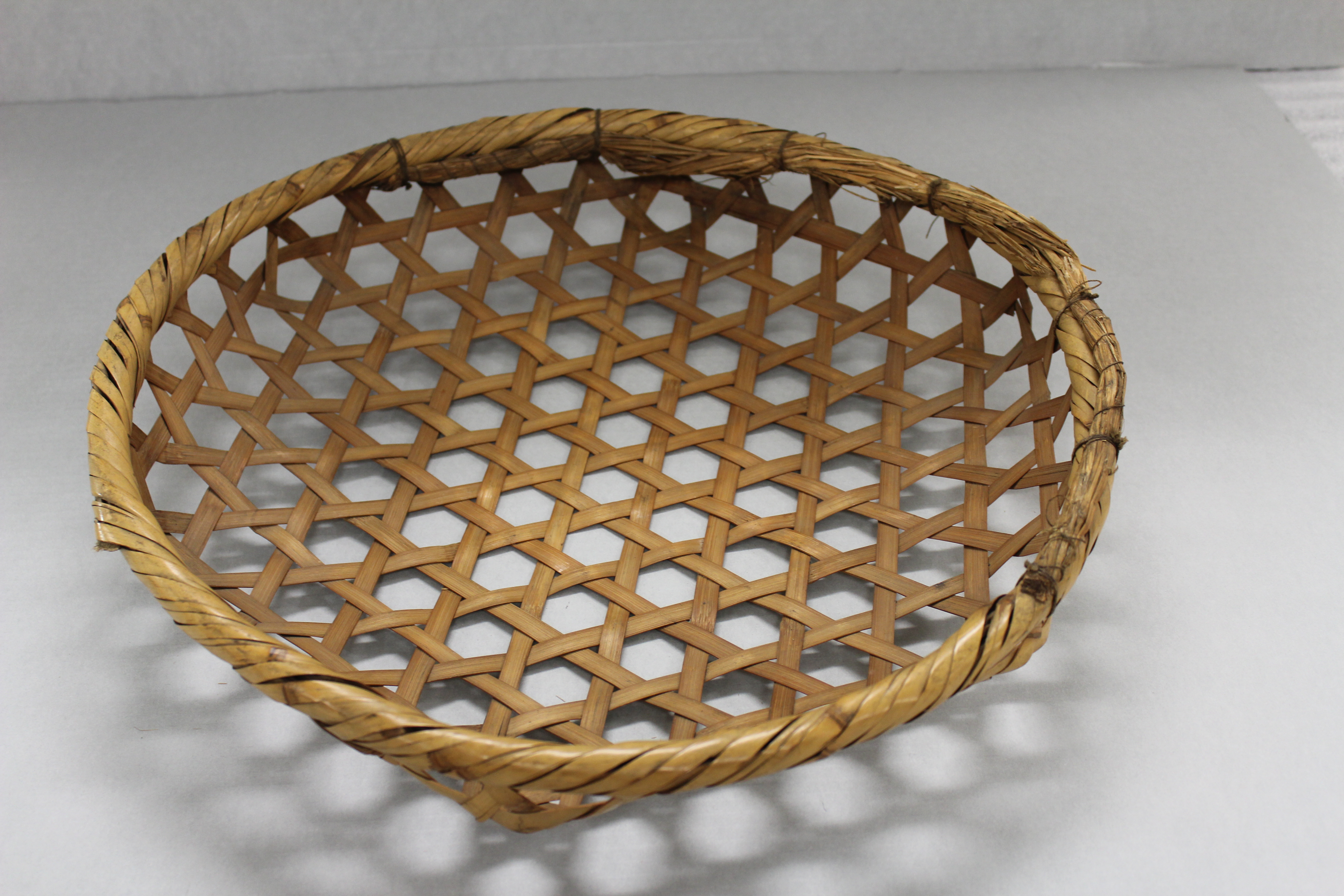
A basket cataloged as Chinese in the collections of the National Museum of Natural History, Smithsonian Institution. ET08510

A basket cataloged as Chinese in the collections of the National Museum of Natural History, Smithsonian Institution. ET08510

SIMA was followed by a quick family trip to Santa Fe, where I got to attend the International Folk Art Market (which was great as always) and see the exhibition “The Red that Colored the World” at the Museum of International Folk Art. The “Red” exhibition is a tour de force. Simply amazing. I hope that many many more people get to see it in Santa Fe or on the tour to come. You can read about the Red exhibition in many places, including this NEH story by Peter BG Shoemaker in Humanities magazine.

While in Santa Fe, I purchased (at the market) two willow baskets by Blaise Cayol, a remarkable French basket maker. Learn about his basketry on his website Celui qui Tresse.

I collected Blaise Cayol’s baskets for a lot of reasons, including wanting them to help expand on the story that the Mathers Museum of World Cultures is telling in the exhibition Willow Work: Viki Graber, Basketmaker, which opens tomorrow. It is a great exhibition focused on the work of a great basket maker. Quoting from our exhibition announcement:

Willow Work: Viki Graber, Basketmaker presents a weaver of willow baskets from the Mennonite community of Goshen, Indiana, where she has lived for 25 years. Graber learned willow basket weaving at the age of twelve from her father, who was recognized by the National Endowment for the Arts as a 2009 National Heritage Fellow. Where once her family plied their talents to make utilitarian workbaskets, today she works full-time weaving baskets for collectors and to sell at art shows and galleries. While using the same tools and methods as her great-grandfather, Graber’s keen sense of color and innovative designs have elevated her family’s craft to a new aesthetic level.

Jon Kay curated Willow Work, drawing upon work done for Traditional Arts Indiana. Get details on the exhibition on the MMWC website. Learn more about Viki’s basketry on her website, Confluence of Willows.

Willow Work: Viki Graber, Basketmaker is one of three exhibitions that we (MMWC) are organizing for Themester. I will post (I hope) about the two that are still to come, but I note here that a second one has been curated by Jon Kay. Here is the description. Working Wood opens on September 8.

Working Wood: Oak-Rod Baskets in Indiana presents the work of the Hovis and Bohall families of Brown County, Indiana, who made distinctive white-oak baskets for their neighbors to carry everyday items and to gather corn. However, by the 1930s, the interest of urban tourists transformed these sturdy workbaskets into desirable souvenirs and art objects. In recent years, these baskets have come to be called “Brown County” and “Bohall” baskets, perhaps because of the great number of baskets made by the Bohall family in Brown county during the 1920s and 1930s. Nevertheless, the history of this craft is more complex these names reveal. Using artifacts and historic photographs, this exhibit explores the shifts in the uses and meanings of these baskets as they changed from obsolete, agricultural implements, into a tourist commodity. Using the lens of work, this exhibition tells the story of these oak-rod baskets and the people who made and used them, and how local makers strived to find a new audience for their old craft, and how ultimately the lure of steady work in the city contributed to the end of this tradition.

Between now and then, we will be working to finalize an third basketry exhibition that I have co-curated with Lijun Zhang of the Guangxi Museum of Nationalities. Opening September 1, It focuses on work baskets in Southwestern China. We describe it in this way.

Putting Baskets to Work in Southwestern China explores the contemporary the use of basketry in urban and rural labor in contemporary China drawing upon a newly acquired representative collection of bamboo baskets documented as active tools of labor in the region around Dali, in Yunnan province, and in Guizhou and Guangxi provinces. The collection was acquired and documented by Jason Baird Jackson, Director of the Mathers Museum of World Cultures, who will co-curate the exhibit with Lijun Zhang, Research Curator at the Guangxi Museum of Nationalities in Guangxi, China.

All three of these work-related basketry exhibitions have been organized for the Fall 2015 Themester, which is themed “@Work: The Nature of Labor on a Changing Planet.” Our museum programs are organized under the rubric “@Work with Basketry on a Changing Planet.” The College of Arts and Sciences at IU has contributed to these projects and the public programs that will accompany them. Learn more about Themester 2015 on the Themester website. Learn more about the exhibitions and programs on the MMWC website.

In the background, Emily Buhrow Rogers and I have been finalizing a double issue of Museum Anthropology Review. We look forward to sharing it in the next couple of weeks. See some of its content online in preview mode at the journal website.

In the midst of all of this, I have—with the support of numerous friends and colleagues—been preparing my faculty promotion case. Time will tell how that turns out.

This is just some of the high points. Its been a busy summer. Whether relaxing or busy, I hope that your summer was excellent.

Chief’s Coats, Brides, and Drumkeepers: The Development of Osage Bridal Attire

NAL15_OsageWeddingFlier_Color[1]Another community gathering for the Osage Weddings project is scheduled for this Sunday. This is a really exciting project with lots of opportunities for community involvement.

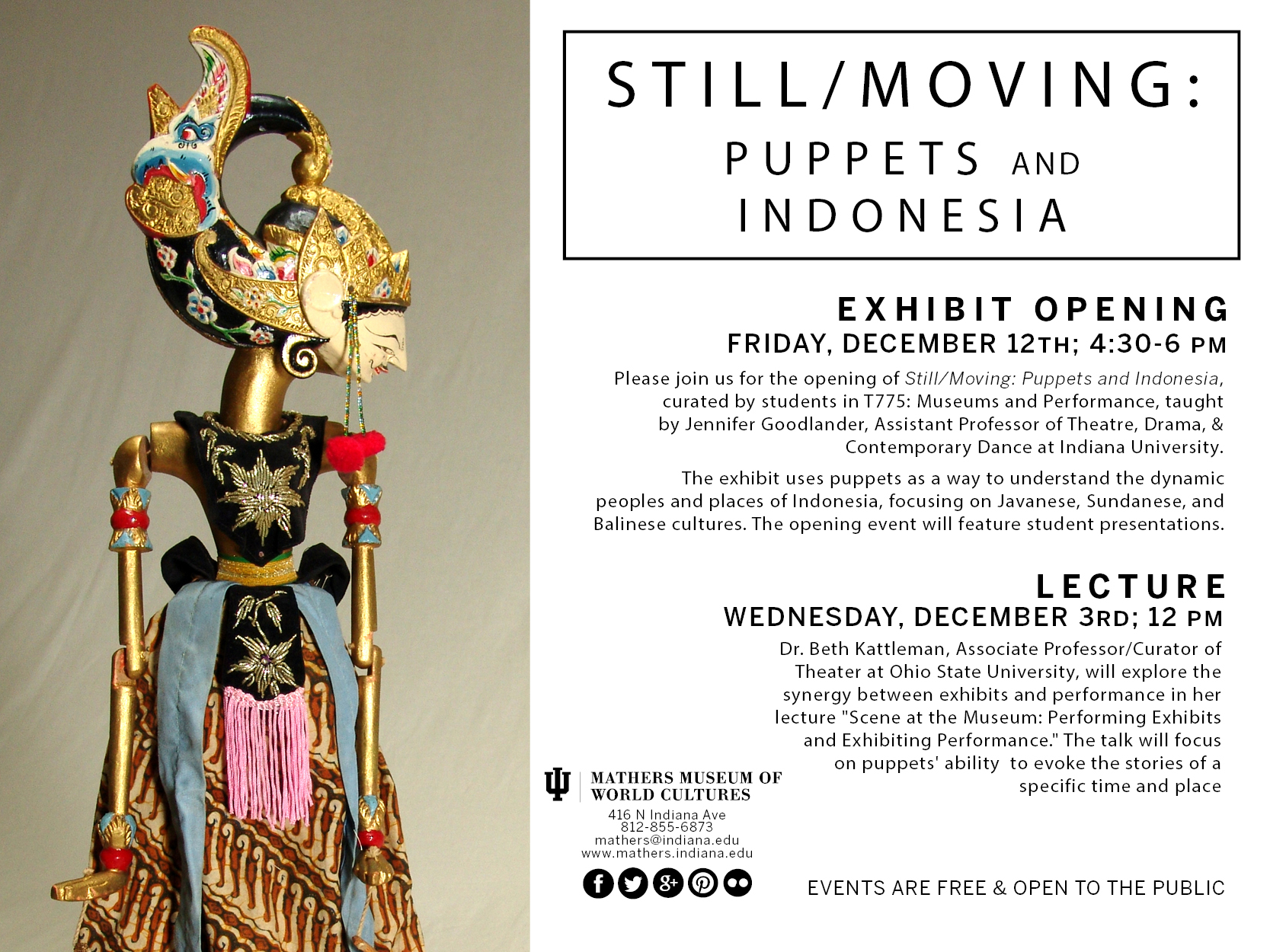
Still/Moving: Puppets and Indonesia Lecture and Exhibition Opening

Still/Moving Lecture & Exhibition Invite

Contemporary International Basketmaking by Mary Butcher

I mentioned in my previous post purchasing a number of basketry books in route to catching up on neglected topic of longstanding interest. Among those in my recent haul is Contemporary International Basketmaking by Mary Butcher, with contributions by Laurel Reuter and many artists contributing to the 1999-2000 UK exhibition for which this book was the catalog (London: Mary Holberton Publishers with the Crafts Council, 1999). I have not read it cover-to-cover yet, but I can note here that it is a fine publication–well produced and image/object rich. Along with a long essay on the past and present of international basketmaking and a collection of overviews of basketry techniques, the Artists’ Voices section is particularly compelling. It is useful as a research document because it presents individual artists’ answers to a range of fixed and compelling questions. While asked here of basketmakers active on the contemporary craft/studio craft/critical craft ends of the basketmaking spectrum, these questions (or a parallel set) could similarly be asked of basketmakers working less individualistically within particular vernacular/local/historical basketry “traditions.”

In the latest issue of Museum Anthropology Review, I published a review of Basketry: Making Human Nature. Readers of that review will notice that I gave special attention and praise to the long essay therein on East Anglia basketry written by Mary Butcher. It was wonderful and now I find that she is also the scholar-maker-curator behind the older catalogue being discussed here. It has been a pleasure to learn from, and engage her fine work as a basket scholar.

Mary Butcher’s website is here: http://www.marybutcher.net/
Her blog is here: http://marybutcher.wordpress.com/

Exhibition Opening: Operation AB – Katyn–The Destruction of the Polish Elite at the Beginning of WWII

Thank you to all everyone who traveled, from near and far, to attend last night’s exhibition opening of “Operation AB – Katyn: The Destruction of the Polish Elite at the Beginning of WWII,” at the Mathers Museum of World Cultures. The exhibition, organized by, and circulated to the MMWC by, the Institute of National Remembrance, Poland is an important effort to report on a tragic, important, and poorly understood phase in WWII-era European history, particularly the terrible Katyn massacre. It is an honor to host this important historical exhibition and it was an honor to welcome so many guests to the museum for the opening.

Among the special visitors attending the exhibition opening was Dr. Łukasz Andrzej Kamiński, the President of the Institute of National Remembrance. It was a great experience to welcome Dr. Kaminski and his colleagues to the museum and to Indiana University.

The IU Polish Studies Center, led by Padraic Kenney, was the leader of this local effort and the MMWC is thankful for the opportunity to pursue this partnership.

IU and MMWC in Ghana

IU President McRobbie’s recent trip to South Africa, Kenya, and Ghana has proven incredibly timely for projects coming to fruition at the Mathers Museum of World Cultures. The IU delegation began its trip with extensive consultations in South Africa and this linked up nicely with the Margaret Bourke-White exhibition that we opened today. In one of his many compelling stories from the trip, Ryan Piurek recounted the deep history of positive university involvement in South African partnerships and projects, concluding his story with reflections on the Bourke-White exhibition as a current collaboration, one that will see the exhibition travel to two South African venues.

House Painting in Ghana

The President’s trip is concluding with a visit to another African nation where IU has deep ties and a long history of collaboration–Ghana. At MMWC, we are very excited that the museum is also connecting with audiences, communities, collaborators, and research opportunities in Ghana. While the museum’s ties to Ghana and scholars of the nation are multiple, the story right now centers on the work of IU art history graduate student, and MMWC collaborator, Brittany Sheldon. With MMWC help, Brittany has developed an exhibition based on her research on traditional decoratively painted houses. The exhibition State of an Art: Contemporary Ghanaian Bambɔlse will be presented this fall at the Ghana Museums and Monuments Board. The exhibition features Sheldon’s photographs documenting the red, black, and white designs (bambɔlse) that adorn the earthen walls of houses in the Upper East Region in Ghana.

Brittany is in Ghana now and is documenting her continued studies on her blog. For details on the exhibition that she has worked with the MMWC to develop, see the museum’s website.

Congratulations to Brittany on her exhibition and good luck to her in her continued studies with Ghanaian artists and tradition bearers.

Bourke-White Exhibition Opening

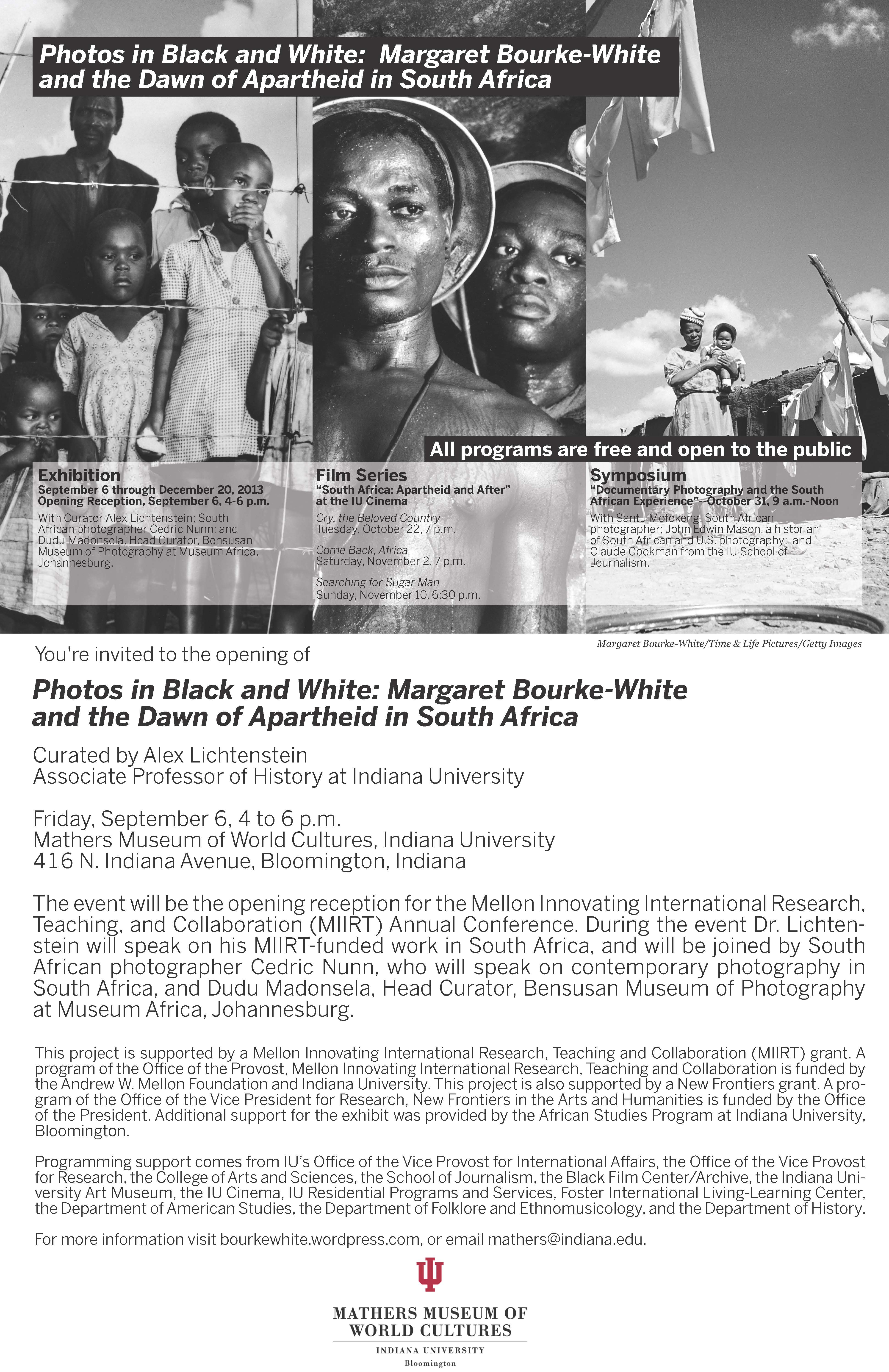
Congratulations to exhibition curator Alex Lichtenstein on the very successful opening, this evening, of “Photos in Black and White: Margaret Bourke-White and the Dawn of Apartheid in South Africa.” More than 130 students, community members, photography enthusiasts, faculty members, Mathers Museum boosters, and Mellon Innovating International Research, Teaching and Collaboration (MIIRT) conference participants converged on the MMWC from 4 to 6 pm today to see, and learn from, Alex’s exhibition, to discuss South Africa, past and present, and to hear from Alex and two special guests from South Africa–Dudu Madonsela, Chief Curator at the Bensusan Museum of Photography in Johannesburg, and leading contemporary photographer Cedric Nunn. Thanks to everyone who participated in the opening and who lent support to the exhibition and its associated activities.

If you missed the opening, or just want to go further with it, you can check out the companion website, attend the upcoming symposium or film series, and, for the truly ambitious, see the exhibition when it travels to South Africa next year. The exhibition can, of course, be seen at the MMWC throughout the rest of 2013.

Exhibition Opening Reception | Photos in Black and White

Photos in Black and White: Margaret Bourke-White and the Dawn of Apartheid in South Africa opens this coming Friday at the Mathers Museum of World Cultures in Bloomington, Indiana. Everyone is welcome to attend the opening. Details on the opening and other events associated with the exhibition are shown below. Information can also be found on the MMWC website.

MBW Exhibition Invitation

The Textile Museum | Out of Southeast Asia: Art that Sustains

While in Washington, I had a chance to visit The Textile Museum in its historical location amid the city’s embassies. I say historical because the museum is now preparing to move to the George Washington University campus.* I had not been to the museum previously (although I follow its work at a distance) and was eager to see it as it has been before it becomes what it will be next. The logic of the move is apparent, but the “old” museum had many charms. It is obvious that the museum’s building–a beautiful and stately old home–has been taken as far as it can be taken as a museum site. It was warm (in the good sense) and comfortable and attractive, but it is surely a challenge to use as a site for research, collections care, and public programs and exhibitions. That said, the facility seemed optimized within the scope of its limitations and I am certain that longtime visitors will miss the old site, as it really was comfortable and nice for small groups of visitors coming and going on a weekend morning. (With the preparations for the move, only the first floor is being used for public visitation, so I cannot comment on the upstairs areas.)

A main first floor exhibition gallery was renovated at some point to make it into a typical art museum gallery, disguising its presence in a large historic home. This space hosted the last temporary exhibition to be staged at the old location–Out of Southeast Asia: Art that Sustains.

Also accessible on the first floor was a welcoming desk and a truly remarkable gift shop where a pair of very kind museum staff members were stationed. Further back on the first floor was a “family room” space where guests were treated to cookies and lemonade. This room led to the back garden–a beautiful green space from which one can see glimpses of the embassies surrounding the museum. (Returning to the subject of the shop, it is a real model of the genre–well stocked, beautifully arranged, well staffed. Sourced globally, the shop offered beautiful and diverse textiles and textile-related objects, along with books at many different price levels. Even a hardened museum professional with little interest in textiles would be impressed by the shop.)

The exhibition focused on Southeast Asian textile traditions as inspiration for contemporary textile design and construction in the work of batik artist Vernal Bogren Swift (whose work draws upon the example of Javanese batiks), weaver Carol Cassidy (whose work draws upon her engagements with Lao weavers and weaving), and a husband and wife team working in batik–Agus Ismoyo and Nia Fliam. Contemporary work by these artists were exhibited alongside historical pieces from the museum’s collection and private collectors.

The work was impressive and the interpretation sound, but I focused my attention on the display strategies used for the display of these attractive works. Textiles are challenging to exhibit and The Textile Museum clearly has cultivated skills needed for first rate display. I filled several pages of my notebook trying to record the techniques used in impressive, conservation-friendly, presentations of these often delicate textiles. Hopefully we can draw upon these inspirations in future textile projects at the MMWC.

The exhibition was accompanied by a gallery guide, which is available online. A family guide was also available, as is a general educational room with adult-level books on world textiles and a range of hands on displays explaining weaving and other textile-related topics to children.

I am glad that I was able to visit the museum in its old location. The current exhibition and the museum as a whole were impressive. This is what I expected on the basis of the museum’s past projects and publications.

*See The Textile Museum’s press release for details on the move and a recent Inside Higher Education story by Kevin Kiley on the subject of U.S. museums being incorporated into colleges and universities.