Skip to content

Posts from the ‘Ethnology’ Category

Tipi: Heritage of the Great Plains

I am very pleased to note the publication of the exhibition catalog Tipi: Heritage of the Great Plains. This book has been published by the Brooklyn Museum in cooperation with the University of Washington Press on the occasion of an exhibition of the same name that has been organized by the Brooklyn Museum and that will travel to the Autry National Center for the American West in LA and the Minnesota History Center in St. Paul. It is a beautiful book on a topic that long been of scholarly and general interest. The project has been organized by and the catalog edited by Nancy B. Rosoff and Suzan Zeller of the Brooklyn Museum. I am taking special notice of the book here because it includes contributions from three of my close friends and collaborators.  Daniel C. Swan and Michael P. Jordan (Sam Noble Oklahoma Museum of Natural History) have published a chapter titled “Tipis and the Warrior Tradition,” which focused on their collaborative work with Kiowa people and organizations and Christina E. Burke (Philbrook Museum) has published a chapter on “Growing Up on the Plains,” which explores child raising and associated material culture among the Native peoples of the Plains in the context of the tipi as vernacular architecture.

Time to Apply: Summer Institute in Museum Anthropology #SIMA

Summer Institute in Museum Anthropology (SIMA)
Supported by the Smithsonian Institution and the National Science Foundation
June 27 – July 22, 2011
Application deadline: MARCH 1

SIMA is a graduate student training program in museum research methods offered through the Department of Anthropology at the Smithsonian Institution’s National Museum of Natural History.  During four weeks of intensive training in seminars and hands-on workshops at the museum and at an off-site collections facility, students are introduced to the scope of collections and their potential as data.  Students become acquainted with strategies for navigating museum systems, learn to select methods to examine and analyze museum specimens, and consider a range of theoretical issues that collections-based research may address.  In consultation with faculty, each student carries out preliminary data collection on a topic of their own choice and develops (and continually refines) a prospectus for research to be implemented upon return to their home university.

Application Information

Who should apply?

Graduate students preparing for research careers in cultural anthropology who are interested in using museum collections as a data source. The program is not designed to serve students seeking careers in museum management. Students at both the masters and doctoral level will be considered for acceptance. Students in related interdisciplinary programs (Indigenous Studies, Folklore, etc.) are welcome to apply if the proposed project is anthropological in nature. All U.S. students are eligible for acceptance, even if studying abroad, as are international students enrolled in universities in the U.S.A. NOTE: First Nations people of Canada are eligible.

Costs

The program covers students’ tuition and housing, which is provided at a local university. A small stipend will be provided to assist with the cost of food and other local expenses. Participants are individually responsible for the cost of travel to and from Washington, DC.

Application deadline – MARCH 1, 2011

SIMA dates for 2011: June 27 – July 22

For more information and to apply, please visit http://anthropology.si.edu/summerinstitute/
Additional questions? Email SIMA@si.edu

Wenner-Gren Foundation Takes Major Step for Open Access

Anthropologists have reason to cheer with news from the Wenner-Gren Foundation for Anthropological Research that the biannual symposium proceedings published by the Foundation as an extension of the journal Current Anthropology will now be made available in open access form. Wenner-Gren Foundation President Leslie Aiello describes the move and the rationale behind it in a [toll wall protected] contribution to the latest issue of Current Anthropology [volume 51, page 727, December 2010] See: DOI: 10.1086/657920.

The two supplements published in 2010 are freely available via the journal’s page at the University of Chicago Press.  Formatted like the journal, these are book-sized edited collections organized thematically. Discussing the history of the Foundation’s Symposium efforts, Aiello writes:

The first Wenner-Gren Symposium was in 1952, and since then, more than 170 symposia and workshops have been sponsored by the foundation. Many of these have resulted in landmark edited volumes that have made significant contributions to the development of our field (see http://www.wennergren.org/history). In today’s electronic age, the foundation wants to ensure that its symposia continue to have a significant impact and reach the broadest possible international audience. We believe that open-access publication in Current Anthropology is the best way to achieve this goal.

This is wonderful news and a real advancement. One more reason to say thank you to Wenner-Gren for its dedication to the discipline of anthropology. Wenner-Gren joins other scholarly foundations working to advance the cause of a more just, rational, and effective system of scholarly communication.

Note:  While there is not a press-release on the Foundation website regarding this shift, there is a discussion of the move to publishing the symposium in connection with the journal (rather than as edited books). This announcement also discusses several recent symposium volumes.

Daniel Swan on Osage Uses of the North American Lotus

Ethnobotany Research and Applications is an important gold open access journal in the field of ethnobotany. It is now in the midst of publishing its 8th volume. I am pleased to note that my friend and collaborator Daniel C. Swan has just published a paper in this journal. “The North American Lotus (Nelumbo lutea Willd Pers.) – Sacred Food of the Osage People” draws upon his long-term research with Osage people in present-day Oklahoma and grows out of his studies of both Osage cultural performance and expressive culture and his interest in plant use in Native North America. The paper also reflects Dan’s commitment to open access publishing. It has been a good month for him in this connection, as earlier this month another paper of his appeared in Museum Anthropology Review, this one on the decorated boxes made and used by members of the Native American Church.

Congratulations Dan!  Congratulations too to all those countless folks who would like to read such papers but who usually cannot afford to access them.

Read Frank Speck’s Oklahoma Essays on your Phone, Free (Connexions)

The Connexions project headquartered at Rice University is great. I tried it out as a book publishing platform last year by editing into existence a book composed of Frank G. Speck’s essays on Oklahoma and Indian Territories originally published in The Southern Workman. Speck was a anthropologist and folklorist who visited the twin territories just before statehood.  The essays are really interesting for a lot of reasons that I try to describe in my introduction to the volume.  Today I am just noting that Connexions has added EPUB format to the range of ways that you can freely read and use (and remix) Connexions content.  This means that the little Speck book can be read using a e-reader on fancy phones and other mobile devices.  Connexions also serves up content in free PDF files and free dynamic webpages.  Any work can be purchased as a print on demand book too. If you do not know about Connexions, you really should check it out.

Fall Conference #4: The Legacy of Claude Lévi-Strauss’ Work

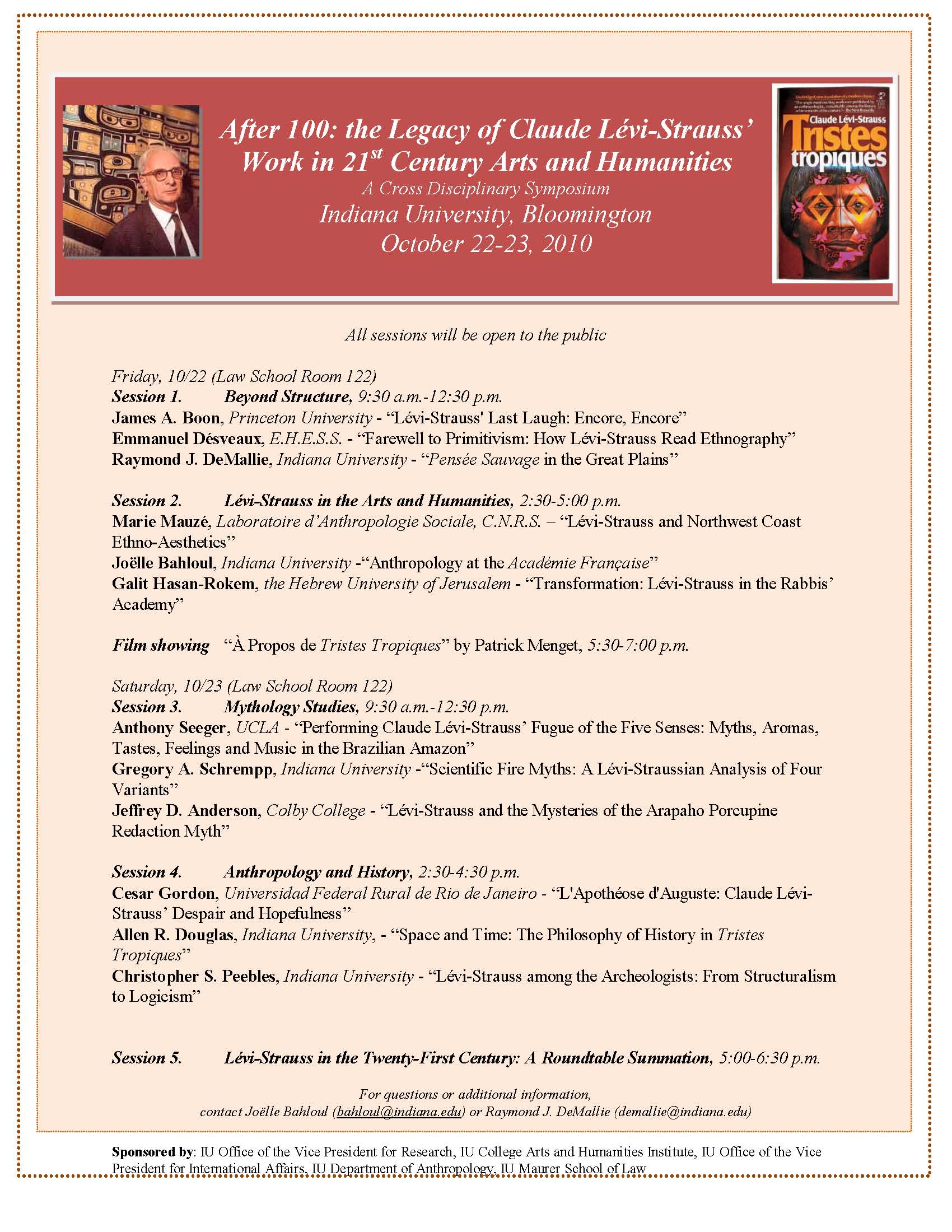
Soon after returning from the AFS meeting, I was fortunate to be a participant in an conference at IU organized by Joëlle Bahloul and Raymond J. DeMallie. The symposium was called After 100: The Legacy of Claude Lévi-Strauss’ Work in 21st Century Arts and Humanities and it brought a large and diverse group of scholars to our campus to talk about the ramifications of Claude Lévi-Strauss’ scholarship. I enjoyed meeting some colleagues for the first time and reconnecting with some others. I also enjoyed returning to interests that I have had throughout the career. I appreciated being included and having the chance to host one of the panels. My thanks go to the organizers and all of the participants.

Excellence in Folklore Scholarship Leads to Utah State University Joining HathiTrust

An important Utah State University Press release:

LOGAN — In an agreement called transformative, Utah State University Libraries has joined the HathiTrust, a shared digital repository that more than doubles the available books in USU’s collection.

“With the scope and range of HathiTrust, a national digital library is coming into being and Utah State University is among the first ranks in that effort,” said Rick Clement, dean of libraries at USU. “This is an exciting development, not only for the main campus but for the five other campuses in the USU system and for our distance education students.”

Utah State University signed a partnership agreement with HathiTrust, becoming the 35th school in the country to become a partner institution. The previous three partners to join HathiTrust are Cornell, Dartmouth, and the Triangle Research Libraries Network (including Duke, North Carolina at Chapel Hill, North Carolina Central and North Carolina State).

“Utah State University now has a seat at the table at this important enterprise,” Clement said. “We join important and diverse partners, including Google, Microsoft and the Internet Archive.”

HathiTrust is a partnership of major academic and research libraries collaborating in a digital library initiative to preserve and provide access to the published record in digital form. It was launched in 2008 and has a growing membership of visionary schools.

Utah State University is the first university in the state of Utah and the region to become a partner member of HathiTrust.

“Utah State brings a unique perspective to the HathiTrust,” said John Wilkin, executive director of HathiTrust. “Our collection will be enhanced by the hundreds of open access titles that USU Press will deposit, and we welcome their contribution to digital preservation and services as a sustaining partner.”

HathiTrust was originally conceived as a collaboration of the 13 universities of the Committee on Institutional Cooperation (the Big Ten schools) and the University of California system to establish a repository for the universities to archive and share their digitized collections.

As the 35th partner school, Utah State University has access to 1.6 million electronic, or digitized, items in the public domain. For comparison, on-site, USU has the same number of books in the Merrill-Cazier Library collection.

“This doubles the number of books in our collection,” Clement said. “For a university like Utah State University, this is such a good fit.”

The move is not only a valuable resource for students and faculty at the Logan campus, but at the five other campuses and distance education sites throughout the state.

“The access this provides is invaluable for our students,” Clement said. “The library is being used more, but not always by students coming through the door. Library usage is up but there is more and more available in the electronic world. The resources made available through HathiTrust can be tapped via our library website by students throughout the USU system.”

Over the past two years, HathiTrust member schools have contributed more than 7 million volumes to the digital library, digitized from their library collections through a number of means, including Google and Internet Archive digitization and in-house initiatives. Of that 7 million, more than 1.6 million of the contributed volumes are in the public domain and are freely available on the Web.

An advantage of being a partner school is that students and faculty at USU can both view and print all or a portion of each available book. Non-member schools can view the items but cannot produce printed copies. And while a book from the stacks of the Merrill-Cazier Library can only be used by one individual at a time, the digital volumes in HathiTrust can be viewed and used by an infinite number at the same time.

HathiTrust serves a dual role. First, as a trusted repository it guarantees the long-term preservation of the materials it holds, providing the expert curation and consistent access long associated with research libraries. Second, as a service for partners and a public good, HathiTrust offers persistent access to the digital collections. This includes viewing, downloading and searching access to public domain volumes and searching access to copyright volumes.

USU’s road to joining HathiTrust began with a partnership with Indiana University, Clement said. Indiana, among the founding schools of HathiTrust, has digitized its folklore collection creating an Open Folklore website.

“Indiana and USU are considered among the top folklore programs in the country,” Clement said. “We’re digitizing a great deal of our folklore archive, and Indiana was interested in making available the folklore books published by USU Press. Indiana’s request for this material morphed into our full partner association with HathiTrust.”

USU Libraries’ effort to join HathiTrust was supported by two important offices on campus.

“Executive Vice President and Provost Raymond Coward and the Vice President for Research Brent Miller have been extremely supportive in this move,” Clement said. “USU Libraries appreciates their support and effort in this endeavor. When the partnership agreement was announced, President Albrecht was highly enthused.
“Our partnership with the HathiTrust will bring an ever-growing number of digital books to our students, faculty and staff,” Clement said. “While we continue to value traditional books, we also understand that the HathiTrust is the future for providing access to our multi-campus system and our many distance-education students. It is truly transformational.”

New Book: Die Konstituierung von Cultural Property: Forschungsperspektiven

The Göttingen Interdisciplinary Research Group on Cultural Property is happy to announce the publication of an edited volume on the constitution of cultural property:

Regina Bendix, Kilian Bizer, Stefan Groth (Hg.)
Die Konstituierung von Cultural Property: Forschungsperspektiven.
Göttinger Studien zu Cultural Property, Band 1. Göttingen: Universitätsverlag Göttingen 2010, 320 Seiten, Softcover, 30,00 EUR
ISBN 978-3-941875-61-6

Kann Eigentum an Kultur sinnvoll sein? Das Interesse, Cultural Property dem Markt zuzuführen oder dies zu verhindern und hierdurch kollektiven oder individuellen, ideologischen oder ökonomischen Gewinn zu schaffen, gestaltet sich unter den stark divergierenden Bedingungen, die Akteure in einer postkolonialen, spätmodernen Welt vorfinden.

Die interdisziplinäre DFG-Forschergruppe zur Konstituierung von Cultural Property beleuchtet diese seit einigen Jahren in der Öffentlichkeit mit wachsender Brisanz verhandelte Frage. Die Forschergruppe fragt nach der Konstituierung von Cultural Property im Spannungsfeld von kulturellen, wirtschaftlichen, juristischen und hiermit auch gesellschaftspolitischen Diskursen. Dies bedingt auch die in dieser fokussierten Form neue Zusammenarbeit von Fachwissenschaftler/innen aus Kultur- und Sozialwissenschaften sowie Rechts- und Wirtschaftswissenschaften. Die Unterschiedlichkeit des disziplinären Zugriffs auf einen Forschungsbereich zeigt sich in den in diesem Band vermittelten ersten Ergebnissen aus der laufenden Forschung genauso deutlich wie die Notwendigkeit, disziplinäre Standpunkte in gemeinsamer Arbeit zusammenzuführen, um den Konstituierungsprozess von Cultural Property zu verstehen.

Der erste Teil versammelt Beiträge, die den Zusammenhang zwischen Heritage Praxen und der Formierung von Interessen an Cultural Property anhand von Fallstudien aus Indonesien, Kambodscha und Deutschland  beleuchten. Im zweiten Teil werden existierende Parameter des Schutzes von Cultural Property aus der Sicht von Völkerrecht, Verfüungsrecht und visueller Anthropologie untersucht. Der dritte Teil widmet sich Erkenntnissen aus internationalen Verhandlungsprozessen und ein vierter Abschnitt zeigt unterschiedliche Forschungsperspektiven auf Cultural Property.

Der Band kann auf den Seiten des Göttinger Universitätsverlages bestellt werden und ist zudem unter einer Creative-Commons-Lizenz als PDF verfügbar:
http://bit.ly/gscp01
Read more

[New, Open Access] Culture Archives and the State: Between Nationalism, Socialism, and the Global Market

From a CFS News Release:

The Center for Folklore Studies at the Ohio State University is delighted to announce the online publication of

Culture Archives and the State: Between Nationalism, Socialism, and the Global Market

Proceedings of an international conference held May 3-5, 2007, at the Mershon Center for International Security Studies, The Ohio State University, Columbus. Ohio.

Columbus: The OSU Knowledge Bank, 2010. https://kb.osu.edu/dspace/handle/1811/46896

The papers address the political uses of ethnographic archives from the late nineteenth century to the present. Archives keep tabs on populations, define and discipline national identities, shape and censor public memories, but also shelter discredited alternative accounts for future recovery. Today their contents and uses are tensely negotiated between states, scholars, and citizens as folklore archives become key resources for the reconstruction of lifeworlds in transition.

Case studies and reports come from China, India (Bengal), Afghanistan, Spain, Finland, Estonia, Romania, Croatia, the US, and the German-speaking lands.

In a keynote address, Regina Bendix provides a general account of “property and propriety” in archival practice.

Klassen, Ingalsbe Awarded Research Support

Congratulation to Teri Klassen on being named the IU Department of Folklore and Ethnomusicology’s Harry M. and Alma Egan Hyatt Graduate Fellow for 2010-2011. Teri is completing work on her dissertation, a historical and material culture studies focused project that explores quilting by African American and European American members of a rural community in western Tennessee.

Congratulations to Suzanne Ingalsbe on being awarded a travel grant from the Council for Museum Anthropology. This CMA funding will help Suzanne attend the 2010 American Anthropological Association meetings in New Orleans in November. At these meetings she will present collections and archival research that she conducted at the National Museum of Natural History, Smithsonian Institution. The focus is on so-called “prayer rugs” in the NMNH Collection, particularly those collected for the museum by Ethel-Jane Westfeldt Bunting. Suzanne is a doctoral student in the IU Department of Folklore and Ethnomusicology focused on the architecture and material culture of religious spaces vis-a-vis museum spaces.