Skip to content

Posts from the ‘Databases’ Category

Mukurtu: An Indigenous Archive and Content Management Tool | New Website Announcement

From a December 20, 2010 Mukurtu Project Press Release:

Mukurtu: An Indigenous Archive and Content Management Tool
New Website Announcement
http://www.mukurtuarchive.org

Project Director: Dr. Kimberly Christen; Director of Development: Dr. Michael Ashley; Lead Drupal Developer: Nicholas Tripcevich

In March 2010 the Mukurtu project was awarded a National Endowment for the Humanities Digital Humanities Start‐Up grant to produce a beta‐version of an open‐source, standards‐based community digital archive and content management platform. As the third phase of an ongoing software production project, the Mukurtu team is aware that indigenous and tribal libraries, archives and museums are underserved by both off‐the‐shelf content management systems (CMS) and open source CMS and digital archive/web production tools. Over the last decade as web technologies have diversified to include user‐generated content and more sophisticated digital archive and content management tools the specific needs of indigenous collecting institutions have been left out of mainstream productions.  Based on long‐term research and collaboration with indigenous communities and collecting institutions, Mukurtu’s development and production has focused on producing a digital archive and content management tool suite that meets the expressed needs of indigenous communities globally. Specifically, Mukurtu:

  1. Allows for granular access levels based on indigenous cultural protocols for the access and distribution of multiple types of content;
  2. Provides for diverse and multiple intellectual property systems through flexible and adaptable licensing templates;
  3. Accounts for histories of exclusion from content preservation and metadata generation sources and strategies by incorporating dynamic and user‐friendly administration tools;
  4. Provides flexible and adaptable metadata fields for traditional knowledge relating to collections and item level descriptions; and
  5. Facilitates the exchange and enhancement of metadata between national collecting institutions and related indigenous communities through robust import/export capabilities.

The Mukurtu software tool suite is under development now with a system demonstration site planned for Spring 2011. Our informational website, development blog, and wiki are now live. These sites allow us to chronicle our development progress, provide updates and engage with users as we move forward to a full launch in August 2011.

Please visit the new site at: www.mukurtuarchive.org and follow the links to learn more about the Mukurtu project goals, development, and collaborations.

Depressing: My Contribution to the Berg Encyclopedia of World Dress and Fashion

Update: Today (9-13-2010) I received my author copy of the book version of this project. I am happy to report that the two images that I provided showing contemporary dress (including that worn by women) are included in it. As discussed below, they do not appear in the online/database version.

Last night I saw one of two published versions of my contribution to the monumental (10 volume) Berg Encyclopedia of World Dress and Fashion (New York: Berg, 2010). It is the chapter titled “The Southeast” and it is one of a series of long, regionally focused essays on the dress and body adornment practices characteristic (past and present) of Native North American Indian societies. (My contribution is about 9000 words.)

As often happens with encyclopedias and other works of this type, I did not get a chance to review page proofs or the final copy edited manuscript. This has resulted is some less that ideal outcomes. I may eventually have the patience to write a full erratum to the piece, but here are some items that I want to apologize for.

I have only seen the version appearing in the Berg Fashion Library database. The print version may be different in some ways of which I am as yet unaware. The following comments are based on the Berg Fashion Library version.

The publisher was provided with a number of images illustrating contemporary Native American people wearing the kinds of clothing discussed in the essay. None of these were put to use and (if those that I had provided were not suitable) I was not engaged to find alternatives. Only two historic paintings by non-native artists and one object image of museum artifacts are used. This omission unfortunately fosters the general misconception that Native American lifeways are a thing of the past and that they are only preserved (via ethnographic documentation) by and for non-natives. I hope that my text (as published) sufficiently counters this widespread tendency. I have no idea why it had to be this way.

The publisher provided a caption to one of the images that was used that is misleading. From among the images that I suggested, they chose to publish the image of a native man from (what would be) Virginia associated with the artist John White.
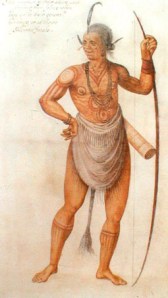
Because in the chapter I discuss tasseled yarn belts and sashes, this image was captioned: “A North American Indian wearing a tasseled sash, ca. 1590, from a painting by John White.” I would certainly not have captioned this particular image in this particular way. The apron worn in this image is relatively anomalous for the dress of the region and for Native North America in general. It appears to be tied in the back and what we see hanging in the back (between the man’s legs) seems to be the apron ties (of animal hide?) presented in a unusual but decorative way. The closest thing to this in the documentary record or present-day practice, are the animal tails worn by some men when playing “match game” (stickball), as among the Oklahoma Muscogee (Creek) and Oklahoma Seminole today (and the Choctaw historically). In the Mississippian engraved shell images, the historic-period paintings, and today, yarn sashes with tassels are worn so that the tassels fall from one or both hips (or are tied at one hip). This can be seen in the painting of a Seminole man by Charles Bird King that was also published in the article and in the shell images and contemporary photographs that I suggested but that were not used. I did suggest the use of this early Virginia image, but only because I had devoted considerable space to discussing the total Virginia corpus as a source of information on dress and adornment in the contact era. I had asked that it be paired with an image of a woman from the same time and place so as to insure gender balance across all of the images. As published online, there are no women’s objects shown or images of women wearing native dress. I apologize for this unanticipated and regrettable outcome.

The copy editing introduced various infelicities that didn’t need to be there and that degraded the work. Here are a couple to illustrate:

My sentence: “The Yuchi have a different colonial-era history and continue, into the twenty-first century, to speak their own unique language—a language isolate unrelated to other known tongues.” in which I used the technical term “language isolate” but then preceded to explain the meaning of this terminology became: “…unique language—a language isolated and unrelated to other known tongues.” This just does not mean anything sensible and it is the typical kind of “improvement” that a copy editor wanting to enhance the accessibility of an work would make in the absence of any specialist knowledge. I do not mind this as one step in the process, but it never works in an context in which the scholarly author lacks the ability to catch problems introduced by the process.

Similarly, describing Mississippian period body adornment, I mention “gorgets.” The copy editor sought to help general readers make sense of this perhaps unfamiliar term and introduced “(neck coverings)” after the word. This is a particularly interesting problem (if sad) for a work on the history of dress and body adornment in general, from a worldwide perspective. Historical period gorgets in the Southeast were mainly trade objects. Look up “Gorget” in Wikipedia (as of today) and you can see a painting of Colonel George Washington (later to become the first U.S. President) wearing exactly the same kind of silver gorget that the Seminole John Hicks is wearing in the King portrait included with my article. This crescent-shaped metal plate worn as a necklace is derived historically from European armor, as the wikepedian’s kindly tell us:

A gorget originally was a steel or leather collar designed to protect the throat. It was a feature of older types of armour and intended to protect against swords  and other non-projectile weapons. Later, particularly from the 18th century onwards, the gorget became primarily ornamental, serving only as a symbolic accessory on military uniforms.

Because, in the historic period, this elaborate necklace-strung item of adornment–a large curved object worn suspended on the upper chest–was known in English as a gorget, scholars of the region like me (perhaps too sloppily) have extended the terminology back to refer to large shell decorations worn similarly. Those obviously do not derive from European armor and they two kinds of adornment provide an illustration of the kind of convergence of European forms and Native styles that I was trying to discuss in the essay. In any event, the copy editor was seeking to help readers by introducing a definition of gorget, but the definition is anachronistic in that Southeastern people did not wear armor-like neck coverings. I would have been very happy to have helped fix this mistake if I could have.

The published version includes a list of references but the citations that had been provided in the manuscript linking particular statements to particular works were removed in conformity with the style of the volume. I am sorry about this. Thankfully the reference list itself was preserved. If a work appears there, it was used with direct citation in the original manuscript.

I wish that I had a way to share the original manuscript but this was a project that I was recruited to participate in before I had given up engaging with commercial publishers all together. Maybe someday I will have a chance to try to address the topic again in a different and more open venue.

Although I am disappointed with this sort of outcome, I do not want to sound overly bitter. I appreciate the work that the publishers and editors have created and nothing about this experience is particularly out of the ordinary for the commercial encyclopedia publishing space.  For those who can get access to it, some good information, I hope, can still be found in my contribution. The kinds of frustrations that accompany, or are generated in, projects like this motivate my enthusiasm for doing scholarly publishing in new, better, and more open ways that are less impacted by the ramifications of hard business decisions made in a dysfunctional marketplace.

Opening Three More Established Folklore Studies Journals

More excellent news from the effort to make more of the scholarly literature in (and beyond) folklore studies freely available. This account comes from Simon Bronner (re-posted from his H-FOLK announcement), who led the effort to open up the three important titles discussed here. This effort was done in collaboration with the IUScholarWorks project in the context of broader efforts undertaken with the American Folklore Society. (More about these soon.)

The only point I would add to Simon’s account is that the content will not cease being available in Hathi Trust when it also becomes accessible via Google Books. This is reassuring and useful in a number of ways, including the fact that Hathi Trust is a major digital library managed in the public interest by a large and growing consortium of libraries and universities. Indiana University is a leading partner in it. Thus this content (and so much else from the digitization of the important IU Folklore Collection) is not solely being stewarded–and made useful and accessible online–by a corporation whose time horizons and motivations are understandably different from scholarly ones. That said, Google has been an invaluable partner by providing the digitization (or digital creation) of these resources and it will be very useful to be able to search and use such content in two contexts, each with different sets of digital tools and built for different purposes. Thanks go to Simon and the relevant scholarly organizations/communities for the years of effort that went into these titles and for the work of making them available to the world. Folklore studies is stronger for these efforts.

Penn State Harrisburg, which features a doctoral program in American Studies with a folk cultural area of study, in cooperation with Indiana University ScholarWorks and Google is happy to report the availability online of back issues for three important journals in folklore studies: Folklore Historian, Jewish Folklore and Ethnology Review, and Keystone Folklore. The material is available at no cost in HathiTrust Digital Library at the moment until it migrates to Google Books (where it will still be available gratis). All the material is viewable as full-text with the exception of some issues of Keystone Folklore Quarterly, which are at present have limited search functionality.

The URLs are:

Keystone Folklore:
http://catalog.hathitrust.org/Record/000496431

Keystone Folklore Quarterly:
http://catalog.hathitrust.org/Record/006090454

(Keystone Folklore was the publication of the Pennsylvania Folklore Society and featured important early works in folklife and material culture, public folklore, and ethnic-urban folklore, many produced by students at the folklore and folklife program at the University of Pennsylvania).

Jewish Folklore and Ethnology Review:
http://catalog.hathitrust.org/Record/006931628

Jewish Folklore and Ethnology Newsletter:
http://catalog.hathitrust.org/Record/006929769

(Jewish Folklore and Ethnology Review was the publication of the Jewish Folklore and Ethnology section of the American Folklore Society, before the establishment of the Jewish Cultural Studies series published by Littman. It featured many special-themed issues, including Yiddish folklore, material culture, folk dance, foodways, pilgrimage, Israeli ethnography, folk literature, and Jews in the Heartland).

Folklore Historian:
http://catalog.hathitrust.org/Record/006811508

(Folklore Historian is the still active publication of the History and Folklore Section of the American Folklore Society. Back issues feature essays on the history of folklore studies globally as well as studies incorporating or reflecting on historical methodologies; special issues include “Theorizing Folklore,” “Symposium on the Contributions of Francis James Child to Folklore Studies,” “Martha Beckwith: The First American Chair of Folklore Studies.”

Sincerely,

Simon Bronner

Other folklore, ethnology, and ethnomusicology titles that have been made available through the work of the IUScholarWorks project include:  the Folklore Forum backfiles (see new content here), New Directions in Folklore, and the Folklore and Folk Music Archivist. In addition, IUScholarWorks Journals publishes (with its partners) the titles Museum Anthropology Review, Anthropology of East Europe Review, and the Inter-American Journal of Education for Democracy.

University of Prince Edward Island Unplugs Web of Science

Official news here that the University of Prince Edward Island is giving up on licensing Web of Science in the face of a 120% subscription increase. Better yet, they are taking the forward-looking step of building a consortium to develop a free and open alternative to it. Congratulations and thank you UPEI.

Web of Science is a product sold by Thompson Reuters. Part of its bundle of services is the proprietary system of citation indexes and impact factor rankings that has gummed up much of the legacy journal system.

Google Books Meets Stith Thompson

Craig Fehrman has published an essay in Nuvo: Indy’s Alternative Voice that looks at the state of the Google Books project through the lens of the Indiana University Library’s wonderful and legendary Folklore Collection. (Much of) the Folklore Collection has been digitized in partnership with the Google Book project. Its greatness as a collection stems from the efforts of long-serving Distinguished Service Professor Stith Thompson (1885-1976), the founder of what is today the Department of Folklore and Ethnomusicology. Fehrman uses the story to make a case for copyright reform and is particularly disturbed by the way that vernacular culture becomes enclosed through publication.

Plateau Peoples Web Portal

Check out the informational website for the new Plateau Peoples Web Portal project being undertaken at Washington State University by my friend and collaborator Kimberly Christen. It is an awesome new project that builds on the work that she and colleagues have been doing developing open source community cultural archive tools. Learn more about the broader effort on her website, on the site for the Mukurtu project, and at the new Plateau Peoples Web Portal project site. Congratuations to the whole project team.