Skip to content

Posts from the ‘Anthropology’ Category

Kim Fortun Reflects on the Open Folklore Project

Anthropologist and science studies scholar Kim Fortun has written an essay discussing the Open Folklore project for Anthropology News. Her piece is currently accessible (toll free) via the AAA website. Kim is the outgoing co-editor of  Cultural Anthropology and a thoughtful advocate for rethinking scholarly communication work in anthropology.

Time to Apply: Summer Institute in Museum Anthropology #SIMA

Summer Institute in Museum Anthropology (SIMA)
Supported by the Smithsonian Institution and the National Science Foundation
June 27 – July 22, 2011
Application deadline: MARCH 1

SIMA is a graduate student training program in museum research methods offered through the Department of Anthropology at the Smithsonian Institution’s National Museum of Natural History.  During four weeks of intensive training in seminars and hands-on workshops at the museum and at an off-site collections facility, students are introduced to the scope of collections and their potential as data.  Students become acquainted with strategies for navigating museum systems, learn to select methods to examine and analyze museum specimens, and consider a range of theoretical issues that collections-based research may address.  In consultation with faculty, each student carries out preliminary data collection on a topic of their own choice and develops (and continually refines) a prospectus for research to be implemented upon return to their home university.

Application Information

Who should apply?

Graduate students preparing for research careers in cultural anthropology who are interested in using museum collections as a data source. The program is not designed to serve students seeking careers in museum management. Students at both the masters and doctoral level will be considered for acceptance. Students in related interdisciplinary programs (Indigenous Studies, Folklore, etc.) are welcome to apply if the proposed project is anthropological in nature. All U.S. students are eligible for acceptance, even if studying abroad, as are international students enrolled in universities in the U.S.A. NOTE: First Nations people of Canada are eligible.

Costs

The program covers students’ tuition and housing, which is provided at a local university. A small stipend will be provided to assist with the cost of food and other local expenses. Participants are individually responsible for the cost of travel to and from Washington, DC.

Application deadline – MARCH 1, 2011

SIMA dates for 2011: June 27 – July 22

For more information and to apply, please visit http://anthropology.si.edu/summerinstitute/
Additional questions? Email SIMA@si.edu

Kellie Hogue on Lakota Kinship and Myth

Congratulations to IU Doctoral Student Kellie Hogue on the publication of her new article: “A Myth of Kinship? Reinterpreting Lakota Conceptualization of Kin Relationships vis-à-vis 19th and 20th Century Historical Narratives.” in the Journal de la Société des Américanistes find an abstract and citation information here: http://jsa.revues.org/index11529.html

Lorenz Khazaleh on Public Anthropology

A valuable commentary on strategies for fostering a more public anthropology by Lorenz Khazaleh.

This Post is a Reply to #AAAfail as PR Meltdown

I respect Strong when he comments that the AAA is fine.  I certainly agree that anthropology is fine.  The AAA may or may not be fine. At an empirical level that is an open question about which there is evidence-based disagreement among thoughtful people. Rather than offer another long-winded plea for our association to rethink its most basic assumptions, here is a simpler observation and a open/positive proposal for the AAA leadership to consider.

The AAA website suggests that the home office staff hovers around 15-17 people at any one time.  At any one time, only a small number of these folks are likely to have some background in anthropology. If they do have such background, it will likely have been at the B.A. or maybe M.A. level and this experience will have been seen as a “added” strength that augments a core competency in accounting, public relations, publishing, grant writing, etc. Its just not the case that a person with an extended set of career experiences in applied anthropology, college or university anthropology teaching, or anthropological research is going to wind up working in the association business office.

What does this mean in an instance such as this one? While the AAA staff can get on the phone with the (certainly very busy) AAA elected leadership, there is probably not an experienced anthropologist in the building on a day to day basis.  (If I am guessing wrongly about this, I hope that a AAA staff member will correct me.)  This means that there is no in-house expertise about anthropology to turn to when the professional staff needs greater understanding of the intellectual, conceptual, methodological, interpersonal, historical, etc. background of the field.

How might this absence be addressed short of hiring another expensive staff member whose day to day responsibilities would, under present conditions, remain nebulous?

Under the kind of conditions that Rex has described (and that have been illustrated in the case of the phenomena now known as #AAAfail), I suggest that the association as a whole would be strengthened if (following the lead of the NSF and its program of augmenting its program officer staff with shorter term appointments of faculty on leave from home institutions) there could be established something like an “Anthropologist in Residence Program” in the AAA home office. With four or six month terms tied to academic semesters, the Anthropologist in Residence would be selected from a group of applicants. There would always be one in the office and they would be given a modest work office in Arlington (desk, internet, etc.).  Much of the time, they would be free to pursue their own work–writing or doing research in the DC area–but they would also have modest obligations in the home office.  They would do professional development activities (informal teaching) with the AAA staff, the aim of which would be to strengthen the staff’s knowledge of the field. They would also be available to (and would be chosen in part because of their capacity to) assist the staff leadership in such areas as lobbying on behalf of anthropology and representing the field in wider discussions that take place in Washington.

As importantly, they would be informally accessible as a consultant and sounding board to the staff as a whole.  They would also be chosen with an eye towards those who are prepared to, and are willing to, help the staff connect better with the rapid and mediated conversations that are now a constant background presence and, as in this case, sometimes a very precarious foreground matter.  This would not just be blog (etc.) posting, it would also be a matter of listening and translating and explaining.

This description frames the matter mainly in terms of translating the field for the benefit of the staff, but the matter would work in the other direction too–fostering understanding of the staff and its work by the membership.  To have a series of Anthropologists in Residence would contribute to the kind of ethnographic analysis of the field and its institutions that Rex has urged while, at a simple level, the staff would come to have a growing number of better-informed interlocutors and perhaps advocates in the membership at large.  Whether the Anthropologist in Residence were a primatologist, a discourse analyst, a social network specialist, an Egyptologist, or whatever, they could all contribute to strengthening the association and its self-understanding.

If this role were mainly filled by people granted the luxury of a sabbatical (and I know that this institution is under greater pressure for those who even still have access to it), the costs associated with this scheme would not be the same as the “full salary and benefits” costs attached to an actual staff member.  Washington, DC is a really wonderful place for anthropologists to be and I think that it would be an appealing challenge and an appealing opportunity for mid-career and senior scholars in our field to be at a key nexus in the field where they could be making a major difference.  Selfishly, they would have an opportunity to connect in depth, for instance, with many of the key elected leaders in our field, most of whom are also key intellectual leaders in our field.

Were such a scheme to become institutionalized, Anthropologists in Residence could be recruited to help advance particular strategic goals, such as outreach to archaeologists or preparing for a major grant initiative (such as the RACE exhibition) or consulting with the publication staff on implementing a significant change. In other words, expertise of a diverse sort could be recruited for strategic and tactical purposes.

There are people in our field who have experience setting up visiting fellowship programs and similar kinds of arrangements who could be called upon to use past experience elsewhere to help properly plan such an initiative, including calculating its costs realistically.  It might be possible to set up such an arrangement in partnership with relevant units of the Smithsonian and/or local Departments of Anthropology.  That could be good and could help distribute the real costs.  It would just be important not to loose sight of the key “in Residence” dimension.

Previous to the so-called #AAAfail event, I had written about the kind of PR problems that open discussion of AAA policy on the web was fostering. It was claimed to me after I had posted “Ignored” that most of the AAA elected leadership was actually reading postings like it and the regular AAA-related discussions at Savage Minds and elsewhere (and just not commenting).  I am not sure if that is actually true. (I am doubtful.)  If anyone in a policy-considering role within the AAA elected leadership reads this post, feel free to sign the guest book (so to speak) or to send me an email.
Wenner-Gren Foundation Takes Major Step for Open Access

Anthropologists have reason to cheer with news from the Wenner-Gren Foundation for Anthropological Research that the biannual symposium proceedings published by the Foundation as an extension of the journal Current Anthropology will now be made available in open access form. Wenner-Gren Foundation President Leslie Aiello describes the move and the rationale behind it in a [toll wall protected] contribution to the latest issue of Current Anthropology [volume 51, page 727, December 2010] See: DOI: 10.1086/657920.

The two supplements published in 2010 are freely available via the journal’s page at the University of Chicago Press.  Formatted like the journal, these are book-sized edited collections organized thematically. Discussing the history of the Foundation’s Symposium efforts, Aiello writes:

The first Wenner-Gren Symposium was in 1952, and since then, more than 170 symposia and workshops have been sponsored by the foundation. Many of these have resulted in landmark edited volumes that have made significant contributions to the development of our field (see http://www.wennergren.org/history). In today’s electronic age, the foundation wants to ensure that its symposia continue to have a significant impact and reach the broadest possible international audience. We believe that open-access publication in Current Anthropology is the best way to achieve this goal.

This is wonderful news and a real advancement. One more reason to say thank you to Wenner-Gren for its dedication to the discipline of anthropology. Wenner-Gren joins other scholarly foundations working to advance the cause of a more just, rational, and effective system of scholarly communication.

Note:  While there is not a press-release on the Foundation website regarding this shift, there is a discussion of the move to publishing the symposium in connection with the journal (rather than as edited books). This announcement also discusses several recent symposium volumes.

Daniel Swan on Osage Uses of the North American Lotus

Ethnobotany Research and Applications is an important gold open access journal in the field of ethnobotany. It is now in the midst of publishing its 8th volume. I am pleased to note that my friend and collaborator Daniel C. Swan has just published a paper in this journal. “The North American Lotus (Nelumbo lutea Willd Pers.) – Sacred Food of the Osage People” draws upon his long-term research with Osage people in present-day Oklahoma and grows out of his studies of both Osage cultural performance and expressive culture and his interest in plant use in Native North America. The paper also reflects Dan’s commitment to open access publishing. It has been a good month for him in this connection, as earlier this month another paper of his appeared in Museum Anthropology Review, this one on the decorated boxes made and used by members of the Native American Church.

Congratulations Dan!  Congratulations too to all those countless folks who would like to read such papers but who usually cannot afford to access them.

Fall Conference #4: The Legacy of Claude Lévi-Strauss’ Work

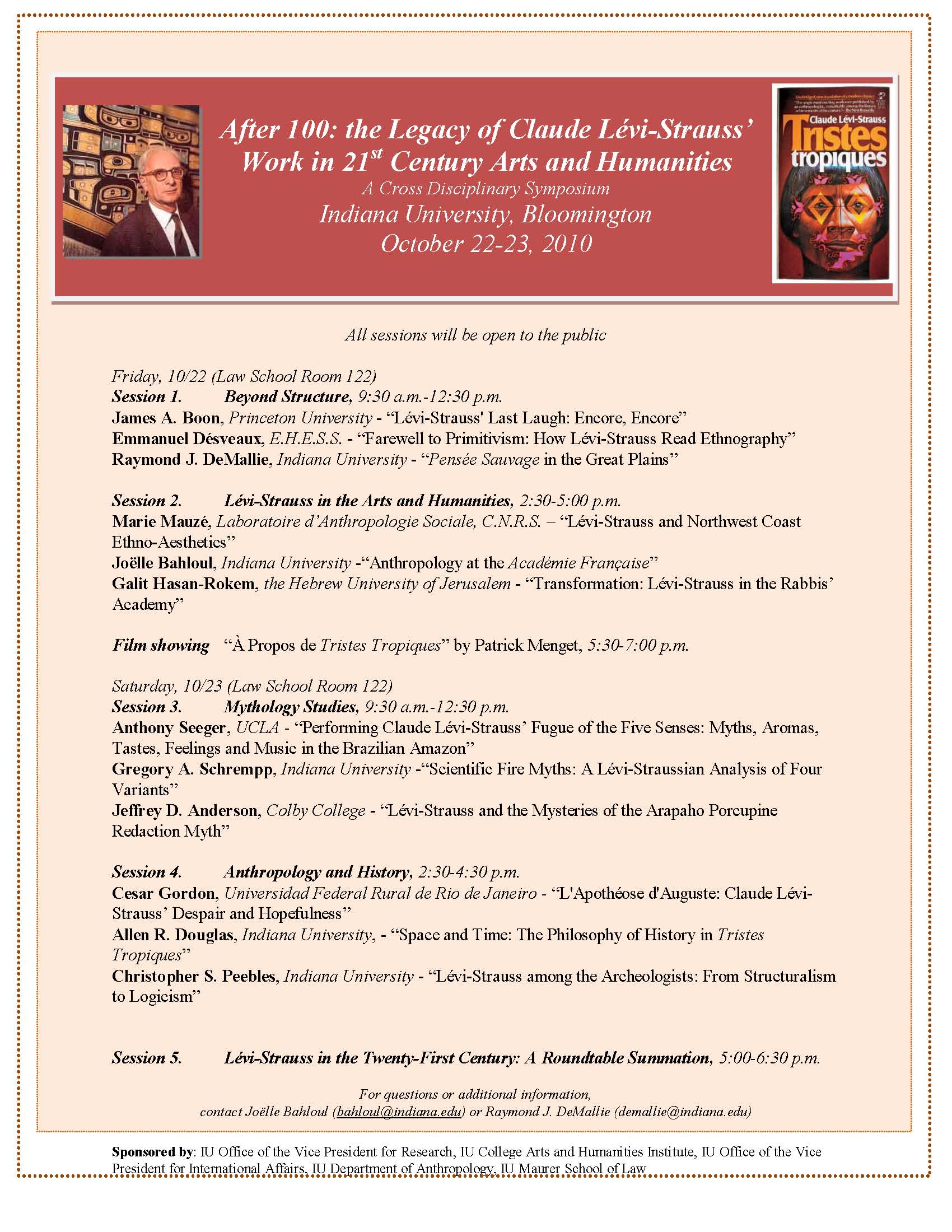
Soon after returning from the AFS meeting, I was fortunate to be a participant in an conference at IU organized by Joëlle Bahloul and Raymond J. DeMallie. The symposium was called After 100: The Legacy of Claude Lévi-Strauss’ Work in 21st Century Arts and Humanities and it brought a large and diverse group of scholars to our campus to talk about the ramifications of Claude Lévi-Strauss’ scholarship. I enjoyed meeting some colleagues for the first time and reconnecting with some others. I also enjoyed returning to interests that I have had throughout the career. I appreciated being included and having the chance to host one of the panels. My thanks go to the organizers and all of the participants.

New Book: Die Konstituierung von Cultural Property: Forschungsperspektiven

The Göttingen Interdisciplinary Research Group on Cultural Property is happy to announce the publication of an edited volume on the constitution of cultural property:

Regina Bendix, Kilian Bizer, Stefan Groth (Hg.)
Die Konstituierung von Cultural Property: Forschungsperspektiven.
Göttinger Studien zu Cultural Property, Band 1. Göttingen: Universitätsverlag Göttingen 2010, 320 Seiten, Softcover, 30,00 EUR
ISBN 978-3-941875-61-6

Kann Eigentum an Kultur sinnvoll sein? Das Interesse, Cultural Property dem Markt zuzuführen oder dies zu verhindern und hierdurch kollektiven oder individuellen, ideologischen oder ökonomischen Gewinn zu schaffen, gestaltet sich unter den stark divergierenden Bedingungen, die Akteure in einer postkolonialen, spätmodernen Welt vorfinden.

Die interdisziplinäre DFG-Forschergruppe zur Konstituierung von Cultural Property beleuchtet diese seit einigen Jahren in der Öffentlichkeit mit wachsender Brisanz verhandelte Frage. Die Forschergruppe fragt nach der Konstituierung von Cultural Property im Spannungsfeld von kulturellen, wirtschaftlichen, juristischen und hiermit auch gesellschaftspolitischen Diskursen. Dies bedingt auch die in dieser fokussierten Form neue Zusammenarbeit von Fachwissenschaftler/innen aus Kultur- und Sozialwissenschaften sowie Rechts- und Wirtschaftswissenschaften. Die Unterschiedlichkeit des disziplinären Zugriffs auf einen Forschungsbereich zeigt sich in den in diesem Band vermittelten ersten Ergebnissen aus der laufenden Forschung genauso deutlich wie die Notwendigkeit, disziplinäre Standpunkte in gemeinsamer Arbeit zusammenzuführen, um den Konstituierungsprozess von Cultural Property zu verstehen.

Der erste Teil versammelt Beiträge, die den Zusammenhang zwischen Heritage Praxen und der Formierung von Interessen an Cultural Property anhand von Fallstudien aus Indonesien, Kambodscha und Deutschland  beleuchten. Im zweiten Teil werden existierende Parameter des Schutzes von Cultural Property aus der Sicht von Völkerrecht, Verfüungsrecht und visueller Anthropologie untersucht. Der dritte Teil widmet sich Erkenntnissen aus internationalen Verhandlungsprozessen und ein vierter Abschnitt zeigt unterschiedliche Forschungsperspektiven auf Cultural Property.

Der Band kann auf den Seiten des Göttinger Universitätsverlages bestellt werden und ist zudem unter einer Creative-Commons-Lizenz als PDF verfügbar:
http://bit.ly/gscp01
Read more

The Cost of Applying for that Academic [Anthropology or Folklore] Job on the Final Day

This note encodes a particular observation on the academic job search process that I have witnessed on several occasions as a faculty member involved in, or witnessing, a number of faculty searches in anthropology and folklore studies. There is plenty of good advice out there on the academic job search but I do not recall anyone ever making the following observation.

This note applies to searches that are not of the “wide open” variety. That is, I am speaking about cases where a department wants a particular set of specialties.

Anthropology job searchers play close attention to the job ads in their field. A sometimes puzzling development is when a department runs their ad again with a new, later due date. It may be obvious that this happens when the search committee is not happy with the size or qualities of the applicant pool. What is not so obvious is the effect that last minute applications have on this process. I am talking to you last minute applicants!

As the due date for applications approaches, those managing the search have to make an assessment. Is the pool large enough to pass muster with college or university HR officials? In many institutions, the powers that be will not allow a search to move forward to the screen and interview stage if there are too few applicants.  Too few applicants is a sign that something has not gone right.  In some institutions, the human resources authorities want to see that the pool has attracted an appropriately diverse pool in terms of gender and other demographic variables. For multiple practical reasons, the assessment of the pool typically has to happen before the original due date is reached. If the due date is reached without being extended and the pool turns out to be inadequate, the search might be declared “busted.” Particularly under current economic conditions, faculty searches are very prized occurrences and no one wants to risk seeing the plug being pulled from above.

So, in a hypothetic search for a specialized colleague, it is almost due date time and there are too few applicants. Rather than risk a range of problems, the department extends its deadline. Then, minutes before the original deadline, a wave of applications arrive. Arriving on the last day are just enough solid applications to cause the original pool to be viable after all.  If those late appliers had applied earlier, the original deadline would have stuck and they would have been part of a small but viable pool. For any one of them, their chances would have been better had this happened. Now, in this example instance, they have to wait around a month or more to see what happens. Their chances are harmed because delay=risk. (A Dean can close an in-process search for all kinds of reasons.) They are also harmed because the pool, with additional time, will attract additional candidates. Additional candidates=additional competition.  This scenario happens in the real world and the N number of applicants who turn their stuff in on the last day are the cause.  They mess things up for themselves and they mess things up for the hiring department. Applying at the last minute is, of course, better than not applying at all, but if you are an applicant, it is not in your self-interest.

If you are applying for an anthropology or folklore (or etc.) job with a narrow area or historical focus or in a specialized or emergent research area or for a job with a complicated mandate or in an off-the-beaten-path location, paying attention to this potential dynamic is very much in your interest. It is simply better to be an excellent candidate in a small but viable pool in a search that is unfolding quickly and early in the annual hiring season.