Skip to content

Archive for

Teri Klassen Reviews “A Cherokee Woman’s America”

Congratulations to Teri Klassen on the publication of her review of the book A Cherokee Woman’s America: Memoirs of Narcissa Owen, 1831-1907. Her review appears in the latest issue of the (print only, but not-for-profit) journal Material Culture*. Well done.

*Volume 41, No. 1, Pp. 92-96.

New M.A. Program at Texas A&M

Copied from a H-Folk posting by Harris Berger:

The Department of Performance Studies at Texas A&M University announces a new Master of Arts degree in Performance Studies. This interdisciplinary program emphasizes the ethnographic study of vernacular culture. The Department of Performance Studies has strengths in Africana studies, dance and ritual studies, ethnomusicology, folklore, performance ethnography, popular music studies, religious studies, theatre and media studies, and women’s studies. Application deadline for Fall, 2010 is January 15, 2010. Assistantships are available.

New Exhibits!

I am late posting on them, but I want to celebrate two new exhibitions at the Mathers Museum that were curated by IU doctoral students, both of whom are minoring in Folklore. Jim Seaver (an alum of my Curatorship and Theories of Material Culture courses and a history doctoral student) curated “A World of His Own: The Uncommon Artisty of Chester Cornett.” The exhibition looks at the work of a Kentucky chairmaker whose life and art were originaly documented in the dissertation and later books produced by folklorist Michael Owen Jones. The Mathers staff really outdid itself in helping Jim realize his vision. The exhibition includes a number of innovate custom display elements, incuding a shotgun house with a front poarch on which to display Cornett’s chairs.

The second new exhibition is “Clothes, Collections and Culture… What is a Curator? Undertaken by Lori Hall-Araujo, a doctoral student in the Department of Communication and Cuture, the exhibition utilizes the Royce Collection of Isthmus Zapotec Textiles and Clothing to examine the behind the scenes work of museum curators.

Both exhibitions are visiually and intellectually compelling and both were vigorously celebrated at a joint exhibition openning last Friday evening. Congratulations to Lori and to Jim and to the entire Mathers Museum staff. Wonderful!  Learn more here and here.
Anthropological Linguist Mary Linn Named DaVinci Fellow

I am so pleased to note that my friend and collaborator Mary Linn (Associate Curator of Native American Languages at the Sam Noble Oklahoma Museum of Natural History) has been named as one of five 2009 DaVinci Fellows by the DaVinci Institute. Mary is the founding curator of the museum’s Native American Languages program and has done amazing outreach work with American Indian communities across Oklahoma and the whole of the United States. Among the innovative efforts that she has stewarded is the museum’s annual Native American Youth Language Fair, which, each spring, attracts close to 1,000 American Indian students to the museum for two days of programs in which they make public presentations in the languages of their home communities.

Thanks to Indian Country Today for getting out the news of this well-deserved award. Find their story here. Congratulations Mary! An honor well bestowed.

Latrinalia Revisited

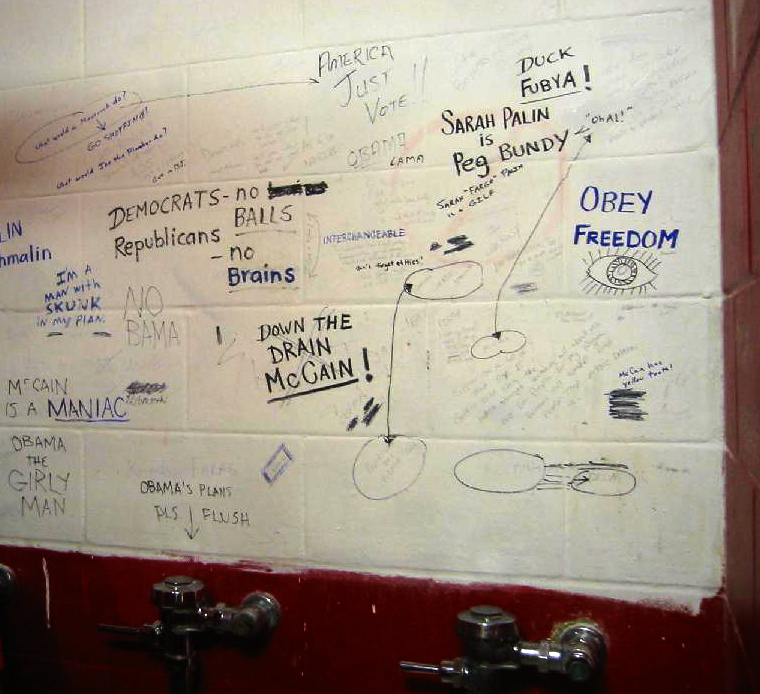
My IU folklore colleague John McDowell was featured prominently in a recent April Fools Day news feature on NPR affiliate WFIU exploring the nature of latrinalia, more commonly known as bathroom graffiti.  John did a great job as a consultant to the station’s news staff.  If you missed it, you can see, hear, and read the story online here:

http://www.newsmatters.org/the-writing-on-the-bathroom-wall/

3403918775_a86a5398ae_o

Christen and Hennessy on Issues in Digital Ethnography

The new (April 2009) issue of Anthropology News features an exceptionally large amount of interesting material. I have not digested it all, but I want to point to the first two articles. Leading the issue is a piece by Kimblery Christen titled “Access and Accountability: The Ecology of Information Sharing in the Digital Age. It is a great short and accessible summary of her key arguements about possibility and responsibility in collaborative ethnographic work. It builds on the remarkable range of practical, technical and theoretical projects that she has been pursuing for a number of years.  (These have been a regular topic on this site and her own website provides a rich introduction.)

The second paper–a wonderful companion to the first–is “Virtual Repatriation and Digital Cultural Heritage” by Kate Hennessy. I builds on collaborative media projects that she and Amber Ridington have been pursuing with a Canadian First Nations community.  This piece is a powerful complement to the  Dane Wajich site and other projects that they have pursued because it offers a glimpse behind the scenes at the kinds of challenges these efforts can entail.

I recommend both of these contributions highly.  They showed up in my mailbox on Monday and I was teaching with them on Tuesday. Kim and Kate (and their project partners) are doing amazing work.

Neely and Palmer on Kiowa Language Ideology

I am happy to note the publication of a book chapter by my friends Amber A. Neely and Gus Palmer, Jr. Titled “Which Way Is the Kiowa Way? Orthography Choices, Ideologies, and Language Renewal,” their paper appears in the new volume  Native American Language Ideologies: Beliefs, Practices, and Struggles in Indian Country edited by Paul V. Kroskrity and Margaret C. Field  (Tucson: The University of Arizona Press, 2009). I was lucky enough to read the paper in manuscript and can report that it is a valuable and insightful account of language revitalization efforts among the Kiowa people of Oklahoma undertaken in light of contemporary work on language ideology and language politics in Indigenous communities.