Skip to content

Oklahoma’s Drinking Water Problems, Then and Now

This is not a good news post. Last year I experimented with Connexions publishing a collection of essays by Frank G. Speck on life in Indian Territory and Oklahoma Territory (=Oklahoma before statehood). Among these essays was a piece titled “Observations in Oklahoma and Indian Territory.” Like me, I think Speck loved Oklahoma but also understood that the state’s problems, both their causes and their potential solutions, would need to be spoken of honestly. Describing the region at a time in which almost no Americans knew anything about it, he spoke about the problem of clean drinking water. He wrote:

In most parts of the territories a fairly healthy atmosphere prevails, except in the timbered and swampy tracts. Noxious insects are everywhere more abundant than welcome, and venomous snakes are not unknown. The chief hygienic drawbacks are, however, the poor water and the lack of town drainage. It is a fact, although hotly disputed by those who have interests at stake, that the water of at least three-fourths of the entire region is totally unfit for human consumption. Most of it is offensive to both nose and mouth, the physical attestation of which fact is the appearance of those who use it. As to town drainage, I will only state that in the western section of Indian Territory the shallowness of the surface soil makes it impossible to have refuse pits of sufficient depth for decency, and even where this does not hold true the consistency of the turf impedes the drainage of fluids to such an extent that in places a pit will hold water about as well as a vessel. The difficulty is increased by the levelness of the land. See: http://cnx.org/content/m22434/latest/

I was reminded of Speck’s observation when reading the following news report from today (September 7, 2010). This report describes the health consequences of drinking the water in exactly the same part of the state (the Cross-Timbers region) about which Speck was writing in particular. Here are two excerpts from the whole story. Such stories have long been common news items in Oklahoma.

Nearly 140 public water supplies are operating in consistent violation of state and federal drinking water codes, pumping water containing chemicals linked to cancer, infant illness, and damage to the liver and nervous system.
Arthur Platt with Logan County Rural Water District No. 2 said he knew something had to change when his customers started coming to the water district office for bottled water. “The things in the water weren’t good for you,” said Platt, who’s worked for the water district since 1986. The district pumps water to areas in and around Cashion and Crescent. Platt said the water started testing high for nitrates in 2001. The compound is naturally occurring and leaches into the water supply from manures and fertilizers. “They can hurt pre-born babies, older people, and result in blue babies,” Platt said. “So we had to start giving people bottled water if they wanted it.” Blue baby syndrome is the result of a baby’s blood not being able to carry enough oxygen. Excessive nitrates in drinking water can even kill infants. Read the full story here: http://www.newsok.com/many-oklahoma-water-providers-told-to-clean-up-their-supply/article/3492219#ixzz0yqYSTrgO
Oklahoma is a beautiful place. While its history is more tragic than it should have been, it is a place rich in cultural heritage and cultural diversity. People there deserve for life to be better than it is. There are many great people working to make the state a better place, but deep problems persist, in part, because some of the state’s leaders would rather deny the existence of long-term structural problems rather than acknowledge and address them. The state’s congressional delegation and senators exemplify the problem, but it is characteristic of all levels of government, as well as in civil society.

DIY OA Superstar Laura Gibbs Making Stuff Happen for Lovers of Latin and Classical Folklore

And now for something else completely positive.

I got to know many nice and wonderful people during the time that I was on the faculty of the University of Oklahoma. One of them is Dr. Laura Gibbs. Laura is a classicist and a folklorist with an interest in new approaches to both university-level teaching and scholarly communications. Among the many things that illustrate how cool she is, I would point out that she is the most passionate language teacher I have ever seen. And the language that she is passionate about teaching is Latin.  How cool is that?  She goes all out for her students (and everyone is a potential student) whether or not those students happen to be enrolled in one of her classes.  When we were both actually on the OU campus, I would usually see her doing language tutorials with students in a campus coffee shop or someplace similar. (I am not at OU anymore and she mainly teaches online now.)

She is probably most famous for her new translation of Aesop’s Fables published by Oxford University Press, but I want to point to one of her newer book projects, a cool DIY OA book worth checking out even if (like me) you know nothing about Latin.

In a best of times, worst of times (for scholarly publishing) email discussion, she mentioned this project, telling me:

This summer I experimented with self-publishing a book at Lulu.com AND giving it away in PDF format. It’s the most fun I have ever had doing a book: Mille Fabulae et Una: 1001 Aesop’s Fables in Latin. The book is intended for Latin students and teachers; it’s a Latin language manual rather than a scholarly study, but it is based on a really serious survey of the whole scholarly and literary Latin Aesopic tradition, from ancient Rome up through the 19th century (including LOTS of Renaissance fables otherwise unavailable in any modern edition). It has worked out wonderfully, just as I had hoped. Some teachers have bought printed copies for themselves, but the main thing is this: thanks to teachers recommending the book as a free download for their students, there have been over 1600 downloads in just a few weeks. In the weird little world of post-classical Latin, that is a seriously large number. I am really happy! Plus, the fables look GREAT on handheld screens, so offering it as a PDF with the expectation that people might read the book on their iPhone or Android is something new and exciting for me.

The book itself is a celebration of public domain materials–basically me harvesting from GoogleBooks and other digital libraries–and now I am using my blog to link up the Latin texts to the hundreds of public domain images I have found at Internet Archive where the scans are good enough to justify reproducing the images for their own sake.

You can learn more about this project and see and get the book itself on her project website at http://millefabulae.blogspot.com/

When I asked Laura if I could share the story of her project, she replied enthusiastically and commented:

I love telling people about what I am doing because this is a time when people who love stories and music and art can learn and connect and share in ways that just were not easy to do even a few years ago. Now if somebody has a project they want to pursue, all they need is time and enthusiasm – that to me is why open access is important as a principle; if we can remove the access barriers, real education will take place, at last.

What more needs to be said?

In addition to the cool book and website, Laura has leveraged everyday blog features and other software to allow people to do such things as put a Latin fable of the day on their own blogs.  There is no end to what she has already created and tried to share with you (or at least with the vast world of budding classicists). Check out not only the 1001 Aesop’s Fable in Latin site, but also her main site where there are piles of stuff made just for you (and everybody else).

My elementary-age daughter and I have been systematically reading all of Andrew Lang’s so-called colored fairy books, thus I have to point to one more of Laura’s projects.  She has created a one-stop shop where you can go and not only get basic information on this series, but download (free) copies of all of the books in a very easy way.  Check that out at:  http://www.mythfolklore.net/andrewlang/

Thank you Laura for teaching in more ways than one! And thanks also to the folks at the University of Oklahoma who have supported Laura’s unusual and productive work as a teacher, technologist, and scholar.

Utah State University Press = Win

Take a break from grouchy discussions of scholarly communication, scholarly societies, and the destruction of the university press system and feast your eyes on a big pile of good newsUtah State University Press is not only not going away (as it might have, as reported in IHE here) but it is moving on to great things as part of the USU Library. Its even better than I had hoped.  There will be more great news in the future, I think, but for now check this out.  Like old fashioned books?  They will sell them to you. Like e-books?  They will sell them to you? Like free PDFs of books? They will just give you some! How great is that?

For my folklore colleagues especially, check it out.  Among the OA offerings are:

Books from across USUP’s lists are available OA in the DigitalCommons@USU system. History and literature of the North American West, Mormon history, and works on teaching writing are other areas of strength in addition to folklore studies.

Three cheers for Utah State University Press. When other small university presses are dead or headed in the wrong direction, here is one that is finding a path to new accomplishment.  Thank you Utah State University administrators!

42 Cents? Really?

When Scott Jaschik of Inside Higher Education published an article about Museum Anthropology Review (MAR) on February 28, 2008 he cited roughly the same costs comparison that Alex (Rex) Golub has  noted in his September 2, 2010 Savage Minds post. At least a few commentators on the IHE story in 2008 questioned the validity of the ridiculous figure that was being attributed to (and by) me as the (then) cost of publishing MAR.  I should have explained it then but Golub has given me a second chance. (thanks!)  Here goes as quickly as I am able.

As I noted in discussing Bill Davis’ recent post, most journals edited by employed scholars benefit from some kind of subsidies. Usually a rich and diverse array of subsidies. As with my earlier editing of Museum Anthropology, Museum Anthropology Review has benefited in a variety of ways from my being employed at Indiana University Bloomington. As things stand in 2010, the most important subsidy for the journal is the remarkable-super-awesome support provided to the journal by the Indiana University Blooming Libraries (and Librarians!) through the IUScholarWorks program.  The IUB Libraries are now MAR‘s publisher. They make this possible with the use of an amazing open source software program called Open Journal Systems (it does editorial work flow and publishing) and, very importantly, significant (but not insane) amounts of technical (and librarian-skills) support.  Set this wonderful background aside because it is not relevant to the source of the 42 cent thing.

It was the launch of the OJS-based, IUB Libraries-published instance of MAR that the IHE story was profiling/discussing. In other words, that story was about the version of MAR that exists today. In the IHE story I was quoted (accurately) as saying I spent “about $20” last year to publish a journal reaching many more people [than were being reached by Museum Anthropology].  What this meant literally, was that I spent about $20 out of my own pocket in 2007 to publish the content issued during 2007. This was the first year of a thing in the world called Museum Anthropology Review. What were the these costs?  I would have to take more time than I have now to figure out what went into the $20 figure, but I think that it was only a single expense (getting an ISSN is free, btw).  It was to purchase the domain name http://museumanthropology.net and to map it onto the free WordPress.com site that was used to get MAR up and running on the cheap.

That was it.  All other costs came were Indiana University Bloomington supports (thanks IU!).  For doubts and grouchiness as well as a fruitful discussion from IHE commentators on the economics of open access see most of the 19 comments that appeared in the wake of the IHE story. All I want to say about these comments now is that I never tried to suggest that the total cost of publishing a gold OA journal was $20 per year. I think that I have been completely obsessive about endlessly flagging for notice the important subsidies that host institutions provide to the publishing processes as hosts to academic editors. I discussed this issue in AAA editors meetings and I have spoken and written of them often. It is why I try to say thank you to the IUB Library staff at least once a week. (thank you!)  Put most simply in the MAR case, for the period from 2007 to 2010, those (library, department, college) subsidies (combined with a free blogging platform in 2007 and an open source software program in 2008-2010) were (together with the generous help of an authorial and peer-review community and a great editorial board) all that was required to publish MAR. It is likely that MAR‘s subsidy model will change and new partners will be hopefully be recruited in consortial fashion to help extend and expand the work we are doing, but what we have now is very stable and (I think) very successful. The IUScholarWorks team and I have plans to do a careful cost analysis of how much it costs to make MAR happen but it is undeniable that the costs are many orders of magnitude less than any current AAA publication. And they are being willingly taken up by the best research library in the United States. Why? Because the system we have known is broken and the librarians at IU want to be part of the solution rather than part of the problem.

Oh yeah. And the journal is freely available to rich and poor.

To finish this up.  Golub is citing, for his MAR cost information, not the IHE story but the paper that I gave at a conference on circulation (ie. The Form of Value in Globalized Traditions) at the Ohio State University that was organized by Dorothy Noyes and Charles Briggs (thanks go to my hosts). This paper [Our Circulatory System (or Folklore Studies Publishing in the Era of Open Access, Corporate Enclosure and the Transformation of Scholarly Societies] was circulated via my website. The per page cost figure ($202) that I cited there for Museum Anthropology were my own estimates of the per page costs during the time of the publishing contract with the University of California Press. (Insert expression of deep appreciation to the nice people at UC Press Journals here.) Those figures were available to me as editor and were not covered by a confidentiality agreement (as my time as a Wiley editor is). At the time from which they come, everyone in the AAA was doing everything possible to make sense of the costs associated with AAA journal publishing because these costs were being paid directly by individual publishing sections.  The Council for Museum Anthropology had charged me with figuring out how to make Museum Anthropology work or to prepare for what to do when it died a financial death.

The paragraph in which I cite the $202 per page cost and the loss figure of $79 per page for Museum Anthropology was followed by the paragraph where I mention the 42 cents per article cost for Museum Anthropology Review. Unlike now, MAR did not (in its 2007 WordPress guise) have pages. It just had digital “entries” or (blog posts). This cost was (roughly, if memory serves) calculated by dividing the $20 out of pocket cost by the number of items (versus pages)  published that year at the time I made these calculations.  The more one published, the lower the per item cost would be.  I acknowledge that this has a rhetorical dimension, but that does not change the facts of the matter.  MAR reached and reaches a vast number of people and costs very little.  While MAR matured from its WordPress format (see the legacy site here) to the use of grown up, full-functioned Open Journal Systems, the WordPress version of MAR inspired Trickster Press (for instance) to shift publication of Folklore Forum to a similar WordPress arrangement.  This costs nothing and allows for the publication of color images, video, audio, conference posters, etc.–lots of good stuff.  Like MAR version 1.0 Folklore Forum content is preserved reliably in library approved ways in IUScholarWorks Repository (which uses DSpace and is fully compatible with Google Scholar).

This post is not intended as a complete unpacking of the history of Museum Anthropology Review.  That can come later.  I hope that it does explain the cost structure of the journal and contextualize the $20 or 42 cent business.

For those following the AAA story line, I will say one more thing.  Museum Anthropology Review is many things.  One of these is a purposeful experiment designed to generate reliable research findings on the viability of gold open access publishing in anthropology and neighboring fields.  It is not rocket science to see that it is structured to provide a very easy to grasp comparison with Museum Anthropology. (I did all that I could to succeed with Museum Anthropology and I am doing all that I can to succeed with MAR. The natural experiment aspect was highlighted in the IHE story.) MAR was founded with the blessing of the Council for Museum Anthropology as a possible successor to Museum Anthropology had that journal died during the section/cost crisis that preceded the Wiley partnership.

The deal with Wiley meant that Museum Anthropology would not end and, for the time being, it would continue as it had been. As a person who gave a vast amount to save that journal, I am glad that it still exists. My happiness in this is greatly reduced though knowing what I sacrificed to my Dean and others in order to gather additional subsidies aimed at balancing its books AND by my bitterness (yes, it is bitterness) at having these subsidies (and self-sacrifices of a significant professional sort) enclosed by Wiley and the AAA Executive Board without my having any voice in the matter.

So.  Museum Anthropology Review is, as Golub has sought to argue, a (modest and fallible) demonstration that another world is possible.  I cannot speak for them, but every sign suggests that the Indiana University Bloomington Libraries would have been happy to publish Museum Anthropology just as it now publishes Museum Anthropology Review.  Had such an alternative future been realized, Museum Anthropology might have generated no revenues, but it also might have generated no costs.  And, its content would have been freely available to everyone with the capacity to get online.

Neither MAR nor Museum Anthropology are flagship journals with impact factor rankings (yet).  It is easy to imagine that the American Ethnologist (for instance) somehow just has to be different, more complicated, more expensive.  But if it were published using Open Journal Systems in a AAA+Library partnership in an open access format available to all of the world, it would not loose its status as a premier journal with an impressive impact factor ranking.  It would not have to stop publishing four issues a year. The best authors and peer-reviewers and editors would still, presumably, want to be involved with it.  There would be additional costs, but they would be totally addressable with dues money and other subsidies. (For example, AE does and MAR does not yet use DOI numbers. This is a cost and benefit that MAR needs to start taking on soon.)

Anyone who has read this far belongs to the choir and I will stop preaching now. My thanks go to everyone who is working to solve the massive problems that the scholarly communication system and the scholarly society system and the research library system are facing.

[On] Free [AAA] Journal Access as a Public Issue

A discussion of the future of scholarly publishing within the American Anthropological Association is underway in a small way on the AAA’s blog, where an editorial by AAA Executive Director Bill Davis (“Free Journal Access as a Public Issue”) has been posted. I have made a couple of comments there but do not want to overwhelm the conversation that might (I hope) happen there with an additional long comment post. For anyone who might be interested, here is a comment that can be spliced in after the first note offered there by AAA Director of Publishing Oona Schmid.

Bill Davis begins with a discussion of green OA deposit mandates and then transitions pretty quickly to a discussion of gold OA journal publishing. The literature on varieties of OA makes clear that these are rather different matters and readers of this discussion may (as often happens) conflate them. Advocates of green OA deposit frameworks outside anthropology have noted that the AAA author agreement has been, for several years now, a fully green one (in SHERPA/RoMEO terms) and thus the AAA is fully ready, in legal terms, to enable AAA authors to easily comply with any of the kinds of (funder and institutional) mandates that have been discussed or implemented.

Green OA generally involves making pre-prints or post-prints (these are terms of art that can be unpacked at the SHERPA website) freely available online, not final publisher versions. Very few AAA authors are exercising their deposit rights at present and, when the do, they are typically doing so in less than ideal ways–that is, they are placing the final published PDF online (the author agreement does not allow for this) and (generally) they are not using reliable institutional repositories, opting instead for personal websites. (That the AAA is not policing author misappropriations of the value-added published PDFs just increases confusion about what is and is not legal, thereby stymying better understanding of the important issues that the AAA and its publishing system  faces and producing more low level lawlessness.)

The concerns that Bill Davis is evoking do not actually stem from government mandated gold open access (there is no such thing, even as a proposal) but from a hypothetical future situation in which actual use of green OA deposit (if mandated) becomes sufficiently ubiquitous that people stop needing or wanting toll access, value-added publisher versions. I think that such matters are worthy of thinking about, but they are not happening right here right now and it does not help us to think about these matters to evoke a more direct linkage than actually exists.  There is not an open access lobby working hard to push through U.S. law aimed at forcing the AAA or anyone else to give away value-added publications in a gold OA framework (i.e. free online journals). The national legal and policy questions are about open accessibility of manuscript versions of federally funded research articles. Davis’ own essay provides evidence showing that 2/3 of AA authors would not be affected by such U.S. mandates. Low use of the pre-print deposit options provided by the AAA author agreement suggests that there is no immediate danger stemming from voluntary author-by-author pursuit of green OA deposit.

Lobbying for OA (both green and gold) among anthropologists, by anthropologists is a different matter altogether. It is not about federal mandates, it is about (discussing, at least) larger matters relating to the ethics, technology, and political economy of scholarly communications and engaging with the future life of scholarly societies, including the AAA. This is a point that Chris Kelty has made over and over again and that was the focus of the article that he and others (I was one) published in Cultural Anthropology. That paper had much positive effect on the discussion in other societies but apparently no impact of any kind within the AAA ($4000-$6000 wasted, I guess). [Impact here is being measured not in terms of shaping ideas and actions, but much less impressively in terms of anyone involved in AAA governance acknowledging that something had been said.]

Oona Schmid reports that the AAA does not produce any surplus revenue from the publishing program.  That is a straight forward answer to a complicated question. Engaging with the details at issue is difficult even for those AAA leaders who have access to a lot of lines of data.  Separate from that important and difficult work, it is possible to observe that our publishing partner would not be our publishing partner if we were not a source of surplus revenue for it. It reported 2009 revenues of over 1.6 trillion dollars and net income of 128 million dollars.  The many subsidies that Oona and I have discussed above (i.e. in earlier comments on the Davis post) contribute, across all disciplines and fields, to enhancing this profit position. Institutional subsidies, along with the free labor of anthropologists, their consultants, (and other scholars), along with our dues money, along with the investments of research funders and the students whose tuition dollars pay the bills at college and university libraries enhance the earnings picture in an industry that has seen very steady rises in revenue and income growth. As an association, we made a decision to more fully join this part of the system. We did so for particular reasons in a particular moment in association and world history.

Doing so opened some opportunities and foreclosed on some others. I think that we will discover that the benefits of doing so accrued at the beginning of this current period and that the hidden costs will come further down the line. Kim Fortun has written of such themes more eloquently that I can. She is hardly alone in trying over the past several years to participate in a conversation aimed at formulating “a strategy to sustain AAA’s traditional journal publishing role as we engage with a world that expects scholarly content to be “free.”” No past efforts along these lines have ever been acknowledged, or even condemned as completely wrongheaded by the AAA leadership. The more elaborate and engaged the intervention, the greater the official silence it generates. Maybe this new invitation to dialogue and the work that CFPEP and the Board did at the May meeting can stand as a turning point.

This comment was written (and sat on overnight) before the second comment by Barbara and the first comment by Chris Kelty.

Depressing: My Contribution to the Berg Encyclopedia of World Dress and Fashion

Update: Today (9-13-2010) I received my author copy of the book version of this project. I am happy to report that the two images that I provided showing contemporary dress (including that worn by women) are included in it. As discussed below, they do not appear in the online/database version.

Last night I saw one of two published versions of my contribution to the monumental (10 volume) Berg Encyclopedia of World Dress and Fashion (New York: Berg, 2010). It is the chapter titled “The Southeast” and it is one of a series of long, regionally focused essays on the dress and body adornment practices characteristic (past and present) of Native North American Indian societies. (My contribution is about 9000 words.)

As often happens with encyclopedias and other works of this type, I did not get a chance to review page proofs or the final copy edited manuscript. This has resulted is some less that ideal outcomes. I may eventually have the patience to write a full erratum to the piece, but here are some items that I want to apologize for.

I have only seen the version appearing in the Berg Fashion Library database. The print version may be different in some ways of which I am as yet unaware. The following comments are based on the Berg Fashion Library version.

The publisher was provided with a number of images illustrating contemporary Native American people wearing the kinds of clothing discussed in the essay. None of these were put to use and (if those that I had provided were not suitable) I was not engaged to find alternatives. Only two historic paintings by non-native artists and one object image of museum artifacts are used. This omission unfortunately fosters the general misconception that Native American lifeways are a thing of the past and that they are only preserved (via ethnographic documentation) by and for non-natives. I hope that my text (as published) sufficiently counters this widespread tendency. I have no idea why it had to be this way.

The publisher provided a caption to one of the images that was used that is misleading. From among the images that I suggested, they chose to publish the image of a native man from (what would be) Virginia associated with the artist John White.
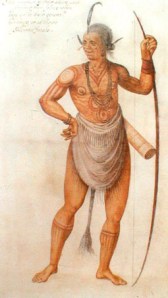
Because in the chapter I discuss tasseled yarn belts and sashes, this image was captioned: “A North American Indian wearing a tasseled sash, ca. 1590, from a painting by John White.” I would certainly not have captioned this particular image in this particular way. The apron worn in this image is relatively anomalous for the dress of the region and for Native North America in general. It appears to be tied in the back and what we see hanging in the back (between the man’s legs) seems to be the apron ties (of animal hide?) presented in a unusual but decorative way. The closest thing to this in the documentary record or present-day practice, are the animal tails worn by some men when playing “match game” (stickball), as among the Oklahoma Muscogee (Creek) and Oklahoma Seminole today (and the Choctaw historically). In the Mississippian engraved shell images, the historic-period paintings, and today, yarn sashes with tassels are worn so that the tassels fall from one or both hips (or are tied at one hip). This can be seen in the painting of a Seminole man by Charles Bird King that was also published in the article and in the shell images and contemporary photographs that I suggested but that were not used. I did suggest the use of this early Virginia image, but only because I had devoted considerable space to discussing the total Virginia corpus as a source of information on dress and adornment in the contact era. I had asked that it be paired with an image of a woman from the same time and place so as to insure gender balance across all of the images. As published online, there are no women’s objects shown or images of women wearing native dress. I apologize for this unanticipated and regrettable outcome.

The copy editing introduced various infelicities that didn’t need to be there and that degraded the work. Here are a couple to illustrate:

My sentence: “The Yuchi have a different colonial-era history and continue, into the twenty-first century, to speak their own unique language—a language isolate unrelated to other known tongues.” in which I used the technical term “language isolate” but then preceded to explain the meaning of this terminology became: “…unique language—a language isolated and unrelated to other known tongues.” This just does not mean anything sensible and it is the typical kind of “improvement” that a copy editor wanting to enhance the accessibility of an work would make in the absence of any specialist knowledge. I do not mind this as one step in the process, but it never works in an context in which the scholarly author lacks the ability to catch problems introduced by the process.

Similarly, describing Mississippian period body adornment, I mention “gorgets.” The copy editor sought to help general readers make sense of this perhaps unfamiliar term and introduced “(neck coverings)” after the word. This is a particularly interesting problem (if sad) for a work on the history of dress and body adornment in general, from a worldwide perspective. Historical period gorgets in the Southeast were mainly trade objects. Look up “Gorget” in Wikipedia (as of today) and you can see a painting of Colonel George Washington (later to become the first U.S. President) wearing exactly the same kind of silver gorget that the Seminole John Hicks is wearing in the King portrait included with my article. This crescent-shaped metal plate worn as a necklace is derived historically from European armor, as the wikepedian’s kindly tell us:

A gorget originally was a steel or leather collar designed to protect the throat. It was a feature of older types of armour and intended to protect against swords  and other non-projectile weapons. Later, particularly from the 18th century onwards, the gorget became primarily ornamental, serving only as a symbolic accessory on military uniforms.

Because, in the historic period, this elaborate necklace-strung item of adornment–a large curved object worn suspended on the upper chest–was known in English as a gorget, scholars of the region like me (perhaps too sloppily) have extended the terminology back to refer to large shell decorations worn similarly. Those obviously do not derive from European armor and they two kinds of adornment provide an illustration of the kind of convergence of European forms and Native styles that I was trying to discuss in the essay. In any event, the copy editor was seeking to help readers by introducing a definition of gorget, but the definition is anachronistic in that Southeastern people did not wear armor-like neck coverings. I would have been very happy to have helped fix this mistake if I could have.

The published version includes a list of references but the citations that had been provided in the manuscript linking particular statements to particular works were removed in conformity with the style of the volume. I am sorry about this. Thankfully the reference list itself was preserved. If a work appears there, it was used with direct citation in the original manuscript.

I wish that I had a way to share the original manuscript but this was a project that I was recruited to participate in before I had given up engaging with commercial publishers all together. Maybe someday I will have a chance to try to address the topic again in a different and more open venue.

Although I am disappointed with this sort of outcome, I do not want to sound overly bitter. I appreciate the work that the publishers and editors have created and nothing about this experience is particularly out of the ordinary for the commercial encyclopedia publishing space.  For those who can get access to it, some good information, I hope, can still be found in my contribution. The kinds of frustrations that accompany, or are generated in, projects like this motivate my enthusiasm for doing scholarly publishing in new, better, and more open ways that are less impacted by the ramifications of hard business decisions made in a dysfunctional marketplace.

Noyes on the Oversimplications of Cultural Property and Heritage Policy

An important working paper by my friend Dorry Noyes presenting alternatives to the conceptual oversimplifications common in cultural property and cultural heritage policy has just been circulated by the Interdisciplinary Research Group on Cultural Property at the University of Göttingen. Help make the argument even stronger with your comments and feedback here: http://www.cultural-property.org/2010/cp-101-how-traditional-culture-works

Lots to think with and work on.

Library Babel Fish on Open Folklore and Neighboring Discussions

Barbara Fister in her regular column on library and scholarly communications issues for Inside Higher Education (Library Babel Fish) has focused today on Open Folklore and a cluster of neighboring discussions, projects, articles, and memos relating to scholarly communications in folklore studies, anthropology, media studies, and in general. In addition to commenting on Open Folklore, she connects to (among other things) my IUB colleague (1) Ted Striphas’ article on scholarly communications in media studies [discussed here and oa here], (2) discussion of these issues at Savage Minds, (3) Kim Fortun’s memo on these matters within the American Anthropological Association, and (4) my essay on scholarly communications in folklore studies. That she could make these connections without having discussed the linkages with me (we have not communicated previously except for my comment on her post last week) is a testimony to the power of scholarly communications in a open and networked environment.

Her essay is titled Open to Change: How Open Access Can Work. It can be found here: http://www.insidehighered.com/blogs/library_babel_fish/open_to_change_how_open_access_can_work

Thanks to Barbara for highlighting these projects and discussions so prominently.

Folklore Studies Assistant Professorship Open at George Mason University

The following important notice is being circulated on behalf of the folklore faculty at George Mason University:

The Department of English in the College of Humanities and Social Sciences at George Mason University announce a tenure-track assistant professor position in Folklore beginning Fall 2011. Read more

Play and Folklore: Another Fully OA Folklore Journal to Note

In the wake of the Open Folklore announcement, I was pleased to learn that the journal Play and Folklore published by Museum Victoria in Australia is fully available online.  Published since 1981, the full run up to the current issue is available online at http://museumvictoria.com.au/about/books-and-journals/journals/play-and-folklore/. How great is that!