Skip to content

Wenner-Gren Foundation Takes Major Step for Open Access

Anthropologists have reason to cheer with news from the Wenner-Gren Foundation for Anthropological Research that the biannual symposium proceedings published by the Foundation as an extension of the journal Current Anthropology will now be made available in open access form. Wenner-Gren Foundation President Leslie Aiello describes the move and the rationale behind it in a [toll wall protected] contribution to the latest issue of Current Anthropology [volume 51, page 727, December 2010] See: DOI: 10.1086/657920.

The two supplements published in 2010 are freely available via the journal’s page at the University of Chicago Press.  Formatted like the journal, these are book-sized edited collections organized thematically. Discussing the history of the Foundation’s Symposium efforts, Aiello writes:

The first Wenner-Gren Symposium was in 1952, and since then, more than 170 symposia and workshops have been sponsored by the foundation. Many of these have resulted in landmark edited volumes that have made significant contributions to the development of our field (see http://www.wennergren.org/history). In today’s electronic age, the foundation wants to ensure that its symposia continue to have a significant impact and reach the broadest possible international audience. We believe that open-access publication in Current Anthropology is the best way to achieve this goal.

This is wonderful news and a real advancement. One more reason to say thank you to Wenner-Gren for its dedication to the discipline of anthropology. Wenner-Gren joins other scholarly foundations working to advance the cause of a more just, rational, and effective system of scholarly communication.

Note:  While there is not a press-release on the Foundation website regarding this shift, there is a discussion of the move to publishing the symposium in connection with the journal (rather than as edited books). This announcement also discusses several recent symposium volumes.
UC Press Hires New Director Saturated with Corporate Scholarly Publishing Experience

A recent press release conveys the announcement of Alison Mudditt’s appointment to the Directorship of the University of California Press. It describes her vision and accounts for her experience at Blackwell (now Wiley-Blackwell), Taylor and Francis, and Sage.

Presentation Formats

I am happy to be part of a circle that is thinking a lot lately about new formats for communicating ideas–in person, not just in formal scholarly communication modes. The recent seven minute presentation format experiment at the AFS meetings is part of this. My iTunesU/Academix experience was also an experiment in this zone.. This post by John Laudun is part of the same conversation.:

http://johnlaudun.org/20101201-whiteboard-animations/

Checkout Paleobot.org

Open access folks in anthropology, folklore, and museums/archives who do not follow paleobotany should still check out the start of paleobot.org.

CFP: Making Sense of Visual Culture

From a circulated call for papers and participation…

Call for Participation

“Making Sense of Visual Culture”
An interdisciplinary conference sponsored by the Graduate Program in 
Visual and Cultural Studies at the University of Rochester
April 1st-3rd, 2011, Rochester, New York

Sound, taste, touch and smell. The institutionalization of the field of Visual Culture has coincided with a proliferation of methods to investigate a range of sensory experience.  More than conceiving of Visual Studies as an historical intervention into disciplinary art history, we seek to explore its ongoing development as a clearing house for investigation of what the visual does, and doesn’t do. With these concerns in mind, the Graduate Program in Visual and Cultural Studies at the University of Rochester invites scholars from across disciplines to discuss the evolving institutional and methodological contours of our field.  From April 1st-3rd, 2011, “Making Sense of Visual Culture” will address large-scale disciplinary questions as well the development of new approaches to an expanded range of sensory objects, phenomena, and practices.

In order to create a space for new voices on these topics, we have decided to eschew the standard figure of the keynote speaker and its implied authority.  Instead, we invite innovative work by graduate students and non-tenured faculty for a series of round-tables, workshops, and panels that will address the two major, interlinked concerns of the conference: sensory experience and the future of the field.

To this end, we envision this CFP functioning not just as a traditional call for papers, but also as a call for participation.  There are many ways to participate in this discussion, even if you cannot join us in April.

1. We are circulating a questionnaire. All responses will be posted to an open access website to create a broad dialogue. We are asking all scholars with an investment in the future study of visual culture to respond.  Select respondents will be invited to participate in a roundtable discussion at the conference.

2. We solicit 300-word abstracts for 20-minute paper presentations on work that exemplifies, challenges and expands the field of visual studies. Possible topics include, but are not limited, to:

– multi-sensory approaches to material culture and memory
– the “hegemony of the visual”
– the practice of visual culture as method, discipline or sensibility
– visualizing sensory experience
– cultural difference and the senses
– epistemology of the senses
– histories of perception
– lending form to affect
– synesthetia
– the interface of vision and touch
– changing practices of visualizing information
– the present and future of medium specificity (in both artistic and scholarly practices)
– the role of technologies in sensory perception

Please include a brief CV with your submissions.  Deadline: January 15, 2011.  Please email these documents to submissions@makingsenseconference.com

Daniel Swan on Osage Uses of the North American Lotus

Ethnobotany Research and Applications is an important gold open access journal in the field of ethnobotany. It is now in the midst of publishing its 8th volume. I am pleased to note that my friend and collaborator Daniel C. Swan has just published a paper in this journal. “The North American Lotus (Nelumbo lutea Willd Pers.) – Sacred Food of the Osage People” draws upon his long-term research with Osage people in present-day Oklahoma and grows out of his studies of both Osage cultural performance and expressive culture and his interest in plant use in Native North America. The paper also reflects Dan’s commitment to open access publishing. It has been a good month for him in this connection, as earlier this month another paper of his appeared in Museum Anthropology Review, this one on the decorated boxes made and used by members of the Native American Church.

Congratulations Dan!  Congratulations too to all those countless folks who would like to read such papers but who usually cannot afford to access them.

Read Frank Speck’s Oklahoma Essays on your Phone, Free (Connexions)

The Connexions project headquartered at Rice University is great. I tried it out as a book publishing platform last year by editing into existence a book composed of Frank G. Speck’s essays on Oklahoma and Indian Territories originally published in The Southern Workman. Speck was a anthropologist and folklorist who visited the twin territories just before statehood.  The essays are really interesting for a lot of reasons that I try to describe in my introduction to the volume.  Today I am just noting that Connexions has added EPUB format to the range of ways that you can freely read and use (and remix) Connexions content.  This means that the little Speck book can be read using a e-reader on fancy phones and other mobile devices.  Connexions also serves up content in free PDF files and free dynamic webpages.  Any work can be purchased as a print on demand book too. If you do not know about Connexions, you really should check it out.

Fall Conference #5: SIMA Board Meeting and the AAA Annual Meeting #AAA2010

Last week I went quickly to New Orleans. I had not planned to go to the American Anthropological Association meetings this year, but my friend Candace Greene called a meeting of the Advisory Board for the Smithsonian Institution Summer Institute on Museum Anthropology. Candace direct’s this important NSF-funded summer training program (more about it soon) and I have been involved in its development since its formative stage. This coming summer will be the program’s third year of providing a month-long intensive training program in the use of systematic museum collections for advanced research in cultural anthropology and neighboring fields. The program attracts graduate students from across the United States and really fills an important need.

I arrived in New Orleans in time for an all-afternoon SIMA advisory panel meeting.  The program is preparing plans for its next three year cycle and our conversations focused on assessing what has been accomplished and building out for the future.  The meeting ended in time to catch up with fellow Oklahoma-ists Dan Swan, Michael Jordan, Jessica Walker and John Lukavic.. After dinner, I was able to attend one of many solid museum anthropology and material culture studies panels on the conference program.  John was a presenter on this panel (Making Meaning with Objects: Community Processes and Museum Practices) and presented a talk titled “Circulating Property and Knowledge: Intellectual Property and Cultural Knowledge Systems of the Southern Cheyenne.” John’s paper was one of many fine contributions to this panel.

The next day, before heading home, I was able fit in several meetings and a couple more excellent panels.  Two of my meetings were with journal editors eager to trade notes on the changing world of scholarly communication, including the practical possibilities of shifting to open access strategies.  The paper panel was “Museum Ethnography in Theory and Practice” organized by Jennifer Shannon and Christina Kreps.  I was not able to hear all the papers, but all that I did hear were excellent, as was the commentary provided by Eric Gable and Ann McMullen.  I also went quickly to see the poser session organized by Dan Swan–“Applying New Theories to Old Things: Museum Research Today.” The posters (and the projects that they represent) were all great.

Getting caught up in open access talk, I had to race to catch my plane with a real sense of anxiety.  I took the most impressive cab ride of my life.  The driver had no choice but to take me into some terrible rush hour traffic on I-10 going to the airport.  He used so many tricks to get there fast that it was mind boggling.  On many occasions, he bypassed long stretches of gridlock by exiting and then creatively cutting from off-ramps to on-ramps thereby getting back onto the interstate ahead of big blocks of stopped and slowed cars.  Had I been a driver in the vicinity I would have been out of my mind with irritation at his antics, but as a passenger worried about missing a flight, I was full of admiration.  It really was movie-quality cab driving.  It took an hour to get there and I know that he saved me 30 or more minutes.  NOLA has flat rates from downtown to the airport and this instance was the first time in which I thought that a taxi rate seemed way too low for the work done.  Needless to say, I was a generous tipper.  This cab ride may be the thing I remember most about the trip.

I left way early in the meeting and missed tons of promising panels and missed seeing scores of friends and colleagues.  Perhaps I can make a longer trip of it next year.

Fall Conference #4: The Legacy of Claude Lévi-Strauss’ Work

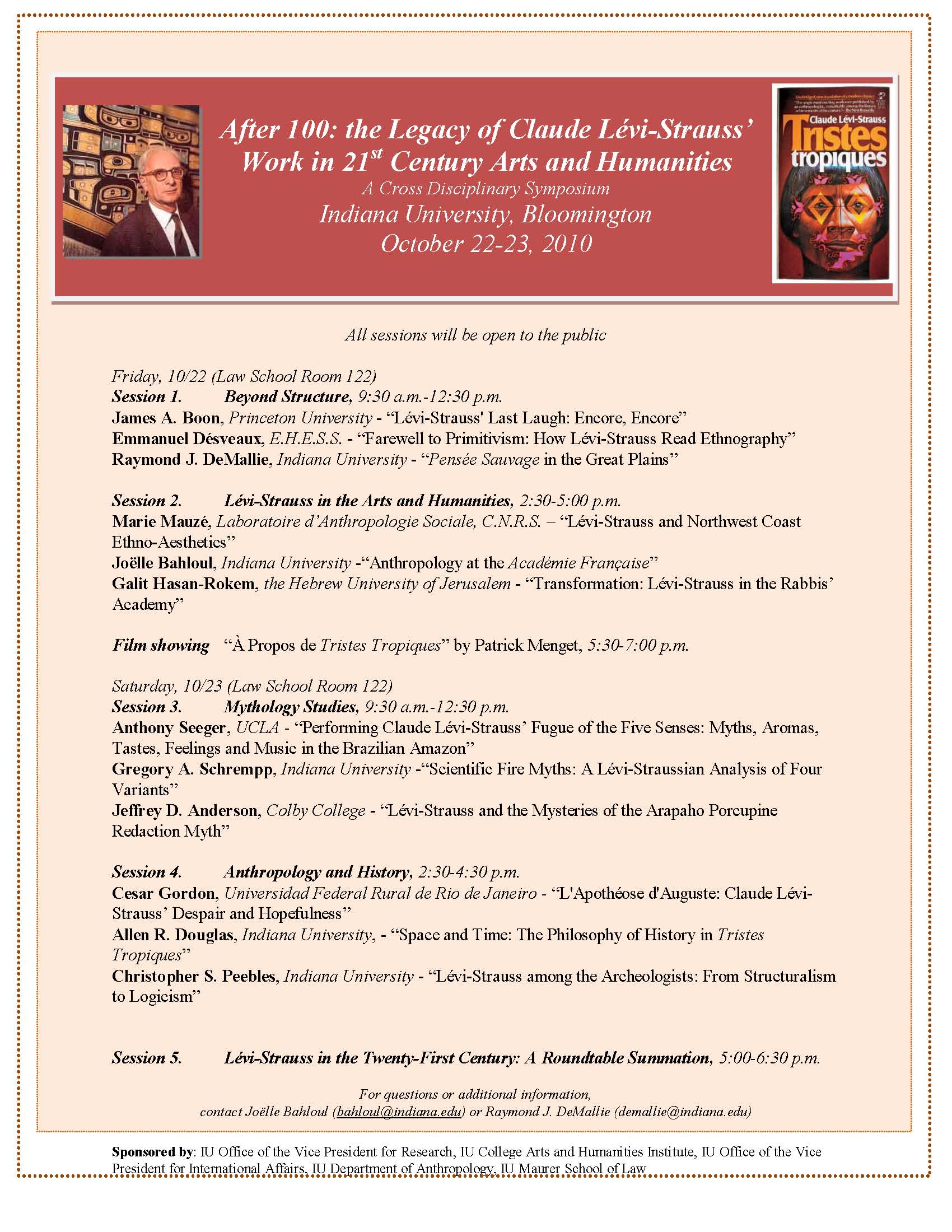
Soon after returning from the AFS meeting, I was fortunate to be a participant in an conference at IU organized by Joëlle Bahloul and Raymond J. DeMallie. The symposium was called After 100: The Legacy of Claude Lévi-Strauss’ Work in 21st Century Arts and Humanities and it brought a large and diverse group of scholars to our campus to talk about the ramifications of Claude Lévi-Strauss’ scholarship. I enjoyed meeting some colleagues for the first time and reconnecting with some others. I also enjoyed returning to interests that I have had throughout the career. I appreciated being included and having the chance to host one of the panels. My thanks go to the organizers and all of the participants.

Fall Conference #3: American Folklore Society

A couple of days after returning from Oklahoma, I turned around and headed out again to the Annual Meeting of the American Folklore Society.  Three main tasks filled my time during these meetings.  As was the case when I went to the American Anthropological Association meetings as a society editor, my AFS meetings are now mainly composed of business meetings taking place within the time and space of the scholarly meeting.  I saw very few scholarly presentations and I ate all of my lunches out of boxes inside the conference hotel, but the meeting was really productive from a work point of view.  The domains of my activity were focused on:  (1) the AFS Executive Board (of which I am a member), (2) the Teagle Foundation funded “Big Questions and the Disciplines” project on improving undergraduate instruction in folklore studies and (3) the launch of the Open Folklore portal site.

It is a honor to represent the AFS membership as a member of the society’s board. The crux of the story from my perspective as a board member is that the society and thus the board are in the midst of a very very busy and very positive time.  The broader context of our work as scholars in North America and in the United States is troubling, but our society has never been stronger. At the meetings, we heard an abundance of good news from the field, recognized many excellent people and projects with well deserved awards, and pushed forward on a number of initiatives. The Teagle grant project is one of these and Open Folklore is another, but great progress is being made on many fronts. I am thankful for all of the people who are helping the society thrive.

As a participant in the Teagle project, I had the pleasure of participating in a lively and rich panel discussion and then a working lunch meeting in which we reviewed our work of the past year and planned for further efforts in the year ahead. I am learning from all of the project’s participants and am especially grateful to Dorothy Noyes and Tim Lloyd for leading our efforts.

I have discussed the Open Folklore project and the portal launch in previous posts. I’ll just note again here how exciting I think that this project is and how appreciative I am for the chance to participate in it.  I had planned on discussing the Southeastern Native American Collections Project as part of an experimental panel in which colleagues and I were trying out a seven minute-twenty-one slide speed format panel. As the conference approached, I proposed a change in which I would present on Open Folklore instead.  The slides are available here and I hope to work up an audio slidecast very soon.  The experimental panel was a big success and we are planning to include the format in the 2011 AFS meetings in Bloomington.

Thanks to everyone who worked to make the Nashville meetings a success.