Skip to content

Two Euchee (Yuchi) Baskets in the Collections of the Philbrook Museum of Art

The basketry traditions of the Native South have experienced divergent histories from a common regional tradition of work basketry. Among the North Carolina Cherokee, for instance, the indigenous river cane basketry tradition was augmented with the adoption of an old European white oak splint basketry practice and a more modern vine runner basketry practice using Japanese honeysuckle. The two older traditions are focused on workbasket forms, even as these have increasingly become works of art and heritage appreciated as aesthetically compelling collectables rather than tools of labor. The vine runner basketry made in honeysuckle added graceful forms intended by their makers to be visually appreciated more than used for rough labor. The richness of Cherokee basket making, up to the present, has been facilitated through an arts and crafts market fostered by the location of the Eastern Cherokee community in a key tourism destination at the eastern gateway to the Great Smoky Mountain National Park. While workbaskets were, for a time during the early 20th century, presented for sale to outsiders among the Florida Seminole, Florida Seminole basketry shifted in that century to decorative craft baskets made from coiled sweet grass. As in Cherokee, North Carolina, these baskets were crafted with non-Seminole tourist-collectors in mind.

Not all Southern Native communities reside in locales where tourism and tourist craft markets could foster (and reshape) local basketry practice. In many native communities, local baskets were used less and less for work—replaced by commercial containers—and thereby they became less and less common, as did knowledge of their construction and use. In some contemporary Native communities, a commitment to revitalize tribal cultures has more recently led to a renewal of basketry practices, not so much for external consumption but as heritage endeavors celebratory of local traditions. This dynamic is found among the Catawba (ex: “Catawba Indian basket maker revives almost-lost ancient tradition”) and among numerous groups—such as the Chickasaw—who have begun regularly organizing basketry classes (ex: “Chickasaw Nation to host basket weaving class”).

While revivals of the sort that numerous communities are pursuing can be initiated in the near or distant future, there are some communities in which basketry has quietly fallen into obsolescence. As with heritage languages, we might describe basketry in such communities as “sleeping”—especially when extant baskets are present in museums and some ethnographic documentation of basket making or use has been made. As with “sleeping languages,” sleeping basketry traditions are capable of being revitalized, especially when knowledge can be gained from basket makers among neighboring peoples sharing similar practices.

While they are an extraordinarily vital community in many other ways, sleeping describes the present state of basketry among the Euchee (Yuchi) people now residing in Tulsa, Creek, and Okmulgee Counties in (present-day) Oklahoma. (For the remainder of this note, I will just use the “Euchee” spelling.) To my knowledge, eight Euchee baskets are curated in museum collections. Then a Ph.D. student in anthropology, Frank G. Speck collected five Euchee baskets in the Sand Creek tribal town near Bristow, Indian Territory in 1904. These were purchased with funds from the American Museum of Natural History and are preserved in its collections. They can be studied in the AMNH’s online database and were discussed in Speck’s Ethnology of the Yuchi Indians, a book-length study that is now freely accessible via the HathiTrust Digital Library and the Internet Archive (see pages 31-34). [If consulting the AMNH database, see numbers 50 / 5368, 50 / 5369, 50 / 5370, 50 / 5371, and 50 / 5372]

One Euchee basket is cared for by the Columbus Museum in Columbus, Georgia. (I hope to report on it later.)

Of interest here are two baskets close to the present-day Euchee community, at the Philbrook Museum of Art in Tulsa, Oklahoma. These two baskets (I believe, the only ones in Oklahoma museum collections) are significant in a number of ways that I will narrate here.

They are, to my knowledge, the most recently collected baskets from among the Euchee. Some Euchee families preserve heirloom objects from the past, but I have not been shown or told about old workbaskets in the possession of the Euchee families that I know. There is a chance that these two were among the last in Euchee hands.

They were collected by famed basketry collector Clark Field. One can learn more about Field and his collection in the volume Woven Worlds: Basketry from the Clark Field Collection edited by Lydia L. Wyckoff and published by the Philbrook Musuem of Art. Field collected these two baskets from Johnson Tiger, then living in Kellyville, Oklahoma. [Kellyville is a municipality in the territory of the Yuchi Tribal Town known as Polecat (after nearby Polecat Creek)].

Tiger indicated for Field that the first of the baskets (catalog number 1963.13.2) was made by his grandfather George Fulsom and dated to 1875. George Fulsom was age 57 at the time of the 1910 census and thus he was born around 1853. If the basket was actually crafted in 1875, this would have been when George Fulsom was about 22 years of age. Field paid Tiger $27.50 for the basket in 1962, which would be about $218 in 2016 dollars. (As noted below, it may be that this amount was the price paid for both baskets.)
IMG_5425

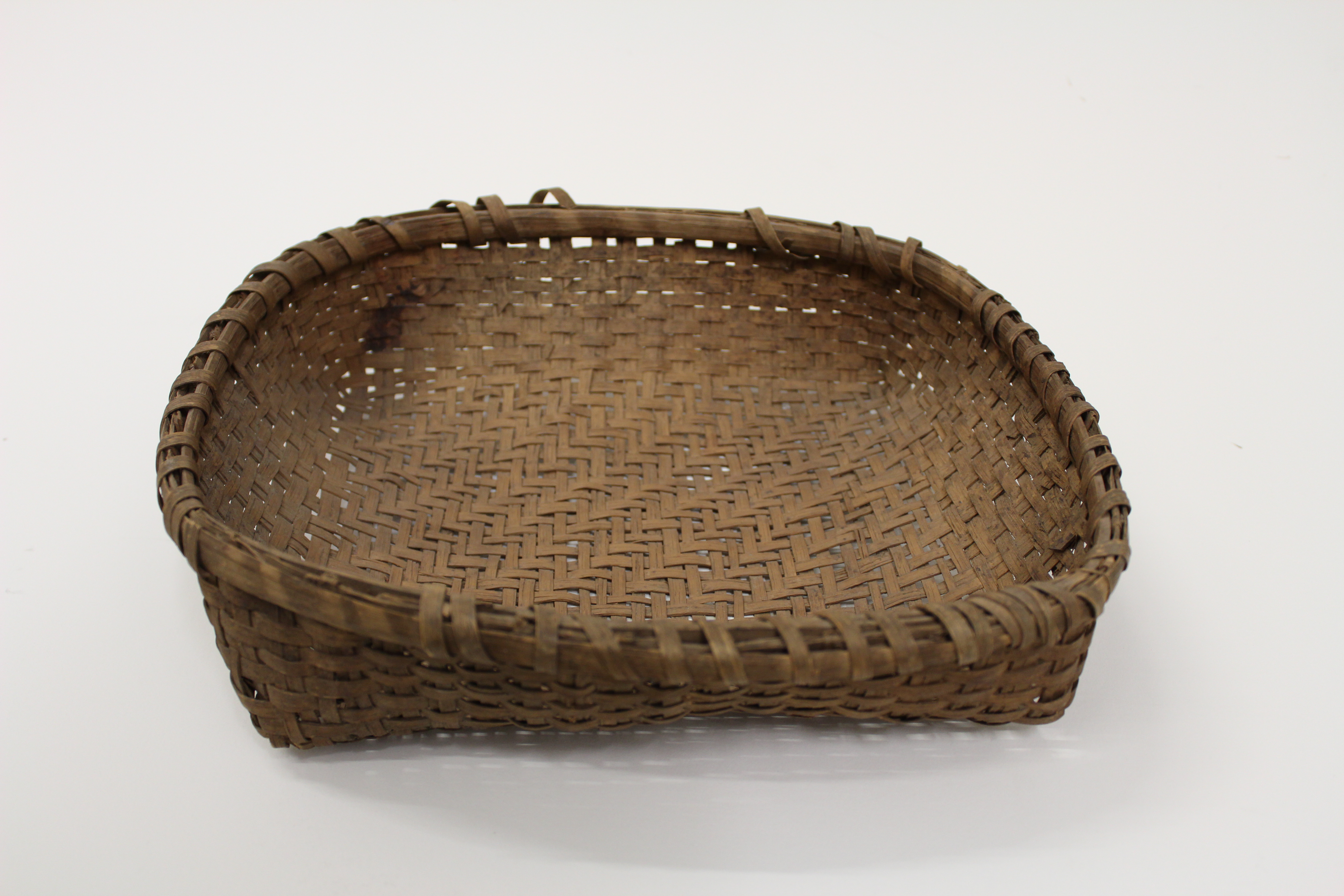
Euchee tray or fanner basket of river cane. Collected from Johnson Tiger in 1962 and attributed to his grandfather George Fulsom. Late 19th century. Polecat Tribal Town. Philbrook Musuem of Art #1963.13.2. Used with permission of the Philbrook Museum of Art.

This plaited basket is made of river cane, the primary material out of which baskets were historically made in the Native South, but a plant that was and is increasingly rare generally and that is particularly rare on the western edge of its range in Oklahoma. Like most of the known Euchee baskets, this example was one of two fundamental tools used in processing corn for food. (It could be used, of course, for other activities, including other food processing ones.) With a solid bottom, this kind of basket was used to both catch grain falling through a sifter (sieve) basket and for fanning grain that has been pounded (or ground) so as to separate the grain from the chaff.

As J. Marshall Gettys has noted, this basket is interesting because it is made of rivercane (the region’s old material) but it has a reinforced rim assembled in a style more common in European American basketry styles. In river cane trays or sifters in the South, a braided rim (as found in the second basket, below) would be more common (Gettys 2001:182).

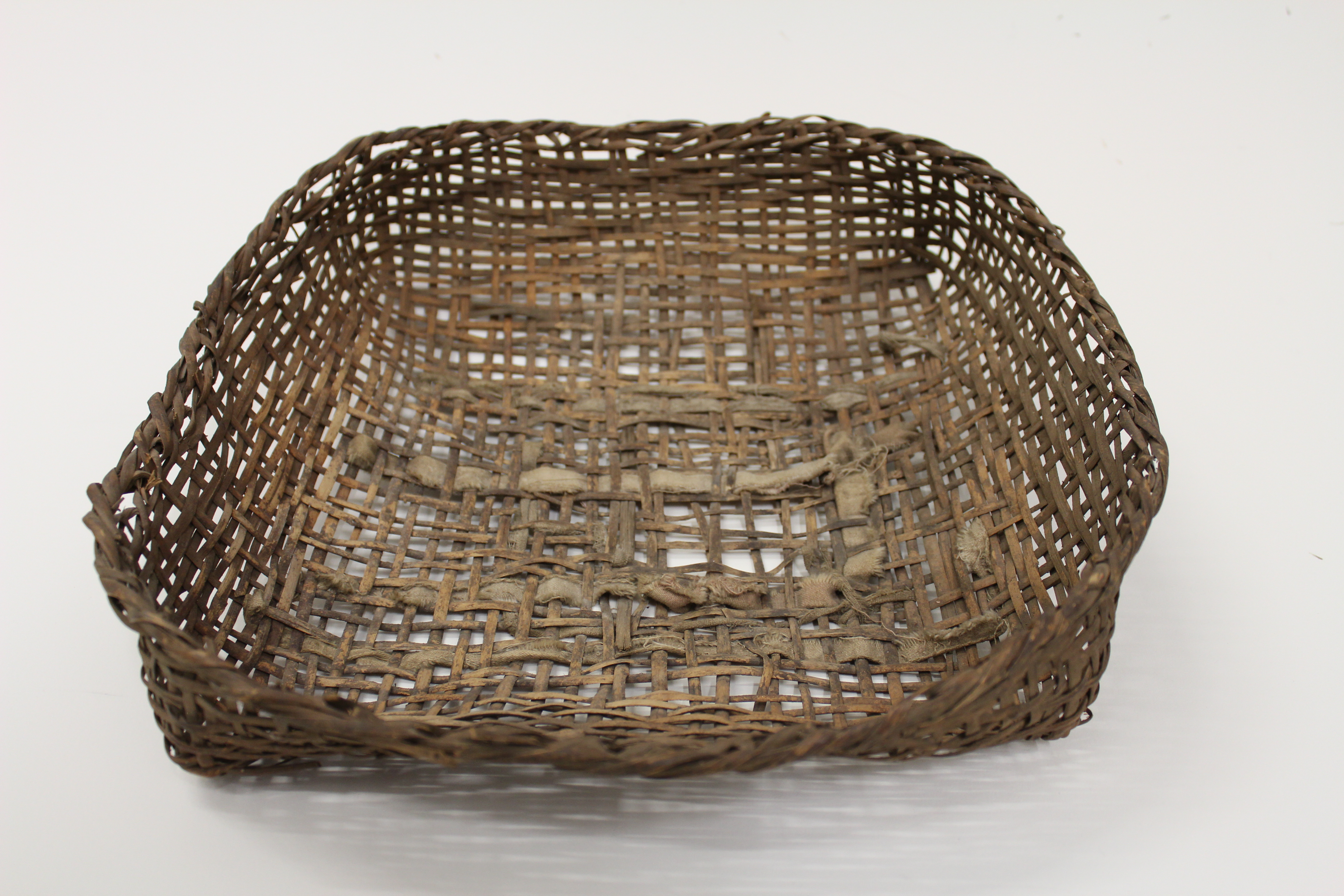
The second basket was likely long used as a pair with the first one. It (catalog number 1963.13.3) is a sifter basket or sieve. Johnson Tiger told Field that Fannie Fulsom, his grandmother and the wife of George Fulsom, made this basket. As with the first basket, he dated it to 1875. According to the 1910 census, Fannie Fulsom was 45 in 1910, indicating that she was born around 1865. If this is correct and if the basket were made in 1875, then she would have been age ten at the time of its manufacture. While it is possible a ten-year-old made it, my intuition is that it was either made at a later (but still probably nineteenth century) date or by a different maker. Like all of the other Euchee baskets in museum collections, this (and the other Philbrook basket) shows extensive wear from practical use. Especially noteworthy is the way that the basket was patched with cloth strips. Because they are woven with evenly sized openings in their bases (bottoms), sifter baskets are more fragile than fully woven trays, such as the other Philbrook basket.
IMG_5454

Euchee sifter basket or sieve in river cane style but made with hardwood splints, probably hickory. Collected from Johnson Tiger in 1962 and attributed to his grandmother Fannie Fulsom. Late 19th century. Polecat Tribal Town. Philbrook Musuem of Art #1963.13.3. Used with permission of the Philbrook Museum of Art.

The Philbrook records do not preserve a purchase price for the second basket. It is possible, but unproven, that the price recorded for the first basket was a price for both baskets.

While this basket has a braided rim in the region’s aboriginal style, it is made not of river cane but of narrow splints of hardwood (probably hickory). My interpretation of this material is that it represents an Indian Territory (/Oklahoma) adaptation in a setting in which river cane was difficult to obtain. To my knowledge, it is only in Oklahoma that we find Southern river cane-based forms produced in materials other than river cane. Elsewhere in the South, newer materials were utilized in altered, adopted, or innovated forms.

Euchee basket making may continue to sleep. If it does, that should not be taken to mean that Euchee people lack appreciation for the baskets, basket making, and the basket-using of their ancestors. Elders I have known, from the 1990s to the present, have often recalled memories of how baskets such as these were used. These stories were never simply for my benefit. They are regularly shared with audiences of younger Euchee people. The tellers of such stories are eager to preserve a memory of past Euchee ways of life. The moral of such stories often center on how hard older Euchee people worked to care for their families and communities and how they possessed and use specialized cultural knowledge to sustain a rich and self-sufficient social life in the face of hardships and limited financial resources. In the late 1990s, I worked with cultural leaders from the Euchee community to organize an exhibition at Tulsa’s Gilcrease Museum. For this exhibition, two of the AMNH baskets were lent and displayed. Euchee elders noted how well-worn these baskets were. This prompted not only an appreciation for their industry of their ancestors, but also laughter at the thought that the baskets unnamed Euchee owners turned a nice profit selling end-of-life, totally worn out, baskets to an earnest young scholar from the East. They also appreciated the fact that some Euchee work baskets still existed in the world and would thus be available for future generations to see and appreciate. These thoughts apply, I think, to the two baskets that Johnson Tiger sold to Clark Field in 1962.

Thank you to my friend Christina Burke, Curator of Native American and Non-Western Art at the Philbrook Museum of Art for letting me spend time with these two baskets, not once but twice. Thanks also to the Euchee elders who have shared their people’s past and present with me.
An Interview with Rachel Tavaras, Indiana University Graduate and Collections Manager at the Museum of Miniature Houses in Carmel, Indiana

Rachel Tavaras grew up in the Chicago area and earned undergraduate degrees in History and Anthropology, both in the College of Arts and Sciences at Indiana University (IU), where she was inducted into Phi Beta Kappa. At IU, museum work was a special focus for her and she undertook internships and practicum at the Mathers Museum of World Cultures, the Wylie House Museum, the Monroe County History Center, the Hinkle-Garton Farmstead, and the LaPorte County History Museum. After graduation in 2015, she joined the Historical Administration M.A. program at Eastern Illinois University (EIU). This highly regarded program is built around an on-campus year of coursework and hands-on training followed by a six-month supervised internship or job in a relevant museum or historical institution. While at EIU she was a graduate assistant at the Tarble Arts Center. Eager to catch-up with an outstanding undergraduate alumna who made a big difference during her time at Indiana University, I was pleased that Rachel agreed to an interview with me. In it we discuss her first job hunt, the Museum of Miniature Houses in Carmel, Indiana, where she now serves as Collections Manager, and her experience studying at Indiana and Eastern Illinois.

JJ: Thank you Rachel for being willing to do this interview.

Folk wisdom holds—and I think that it is often true—that one’s first full time job is often the hardest to find. We will come to your current work in a moment, but first could you tell us a bit about how you first got connected with the Museum of Miniature Houses?

RT: The initial job hunting process was quite daunting! My graduate program at Eastern Illinois University requires that we complete a six-month internship after coursework, unless we find a job. While I would not have had an issue with taking an internship, I sought something more permanent. When I saw an opening for the Collections Manager position at the Museum of Miniature Houses and Other Collections through the Association of Indiana Museums (AIM), I did not hesitate to apply.

Miniatures have always fascinated me, and, while I did not have a background in miniatures explicitly, I felt that my prior experiences with other types of collections could apply. From working with jewelry from the Middle East at Mathers, to working with Midwestern folk art dioramas at the Tarble Arts Center, I felt confident in my ability to work with a collection of objects made by less “formally trained” artisans. My theoretical training, both in class and in the museum field, also helped when it came to landing the job. I have been trained in methods of material culture, decorative arts, understanding folklife, and more. Such training is essential to understanding miniatures, whether it be a representation of an American Rococo living room or a Japanese farm house from Osaka.

IMG_1798[4]Rachel Tavaras shows off the “Yellow Georgian,” an assemblage of objects in the collections of the Museum of Miniature Houses in Carmel, Indiana.

JJ: Did you have any personal contacts with the museum beforehand or were you applying in response to the AIM advertisement? What did you learn from the application and selection process?

I did not have any personal contacts from the museum beforehand—I applied merely because of the online advertisement. Because I did not know anyone at the museum personally, every chance to leave an impression with the hiring committee was especially precious.

Because of this, through the hiring process I came to better understand the importance of the interview. I think that many recent graduates focus heavily on their resume and cover letter—and rightfully so. These are the first items that a potential employers looks over, and they will ultimately determine the applicant’s chance at an interview. For the interview, I was fully prepared and had anticipated many of the questions that the hiring committee asked. I had also researched the institution and miniatures in general beforehand, giving me the opportunity to explicitly express how my skills and experiences would make me a great asset. My efforts were worthwhile. Since being hired, I have been told that I “nailed” the interview. While my application materials got me the interview, it was my interview that go me the job.

I have since had to opportunity to be on the other end of the hiring process. Looking for a part-time Collections Assistant was an intimidating task, especially being so new to my own position. While sifting through applicants, I was reminded of the importance of first impressions. Many applicants sent vague and brief application materials. It was clear that they did not read the job description. On the other hand, one applicant both emailed and physically mailed me copies of her application. She was a high contender.

JJ: The name alone suggests that the Museum of Miniature Houses is a rather interesting institution. I won’t be alone in wanting to know more about it. Is the part-time Collections Assistant your only staff colleague or is the staff bigger than these two roles? Do volunteers play a big part in your museum? What can you tell us about the history of the museum and its current status? Who is the museum’s governance authority? Read more

Basketmaker Viki Graber on The Weekly Special

Last year, the Mathers Museum of World Cultures presented the exhibition Willow Work: Viki Graber, Basketmaker to great success. Happily we are staying connected with Viki in many ways, including her participation in the Indiana Folk Arts: 200 Years of Tradition and Innovation exhibition and associated Traditional Arts Indiana programs around the state. The public television station here at Indiana University, WTIU has just posted a beautiful video, from their show The Weekly Special, in which Viki Graber talks about and demonstrates her work. Check it out here.

Weekly Special


June Events and Exhibitions, Including Arts in the Park at McCormick’s Creek

Check out some MMWC events and exhibitions this month. In particular, this Saturday (June 11, 2016) a great group of artists will join the Traditional Arts Indiana team at McCormick’s Creek State Park for Arts in the Park. Learn more about that event here.

MMWCEcalJune2016

May at the MMWC

It has been a whirlwind of activity at the Mathers Museum of World Cultures this semester. The spring semester is ending and many students are leaving campus, but there are still great things to come at the MMWC this May. Please stop by for an event or anytime.

Unknown

Theories of Material Culture: Two Highlights

I am now concluding my graduate course Theories of Material Culture. I have taught this course several times previously and I always enjoy it. This year, the students who gathered with me were more diverse than usual. Beyond the normal folklorists and cultural anthropologists, there were practicing artists, a learning scientist, a fashion scholar, and an ethnomusicologist. In comparison to past instances, this made the course simultaneously more interesting and a more challenging exercise in translation. I am thankful for the chance to work with students whose interests intersect with mine in such stimulating ways. Interacting with these students was a big highlight of my distractingly busy semester.

k10581
Intentionally, I have made the Theories of Material Culture a weird course. In response to students who rightfully complained about constantly noting how key book-length works were often mentioned* in our courses but not assigned, the only readings in the course are books. Many books. Experience shows that, as part of a more diverse reading diet, this course pattern helps students in noticeable ways later–during qualifying exams, research planning, and dissertation writing. Some works have reappeared in different versions of the course, but some are always new to the course and occasionally some are new to me. This semester, I added two titles that, while I had not yet read them because they were brand new, seemed like sure bets. And they were. The were most beloved by the students and they provoked particularly rich discussions. These were Pravina Shukla’s Costume: Performing Identities Through Dress (Bloomington: Indiana University Press, 2015) and Anna Lowenhaupt Tsing’s The Mushroom at the End of the World: On the Possibility of Life in Capitalist Ruins (Princeton: Princeton University Press, 2015).

9780253015778_lrg
I cannot spare the time now to comment properly on these two excellent books, but I note here that they were highlights for me and for the students. I eagerly recommend them to you. Of reviews of Costume, I like the one written by Brandon Barker for JFRR. For The Mushroom at the End of the World, I note Eugene N. Anderson’s review in Ethnobiology Letters. (These two journals are both wonderful open access publications, by the way.)


* Particularly unnerving to students is the faculty habit of mentioning canonical books as if everyone in the room had not only heard of them previously but had read them and long ago assimilated their lessons. (I know I to am guilty of this tic too.) Books do of course get assigned in our classes, but usually a smaller number are balanced with a mixture of works in other genres. This normal pattern is true of my other courses too.

Indiana Folk Arts: 200 Years of Tradition and Innovation

Unknown.jpeg

Please come out to the Mathers Museum of World Cultures this Sunday afternoon to celebrate the vernacular arts of Indiana and to help launch our state bicentennial exhibition. Root beer floats! Bluegrass music from Hamilton Creek! Artists demonstrations! The new exhibition, plus the students, staff, faculty, and artists who made it. We hope to see you this weekend.

The Digital Future of Research in the Humanities and Social Sciences

What follows is an open letter of invitation written by Mike Fortun in connection with an upcoming meeting of the Digital Practices in History and Ethnography Interest Group of the Research Data Alliance. All interested parties are invited to engage with the RDA and the DPHE IG.

Dear colleagues,

We hope you can join us in a discussion about the digital future of research in the humanities and social sciences (HASS), particularly history, anthropology, folklore, and related fields in which researchers generate and interpret qualitative data to understand historical, social, and cultural phenomena.   The conversation is being led by the Digital Practices in History and Ethnography Interest Group (DPHE-IG), part the Research Data Alliance (RDA), an international alliance working to making research data more open and accessible, which will host its 7th plenary meeting in Tokyo 1-3 March.  Our DPHE-IG session is scheduled for Wednesday, 2 March from 11:00-12:30 in Conference Room 3 at Hitotsubashi Hall (National Center of Sciences Building).

Together, we will assess the current state and challenges of these fields, in different national and cultural contexts, and how enhanced digital research infrastructure can vitalize them in coming years.  Among the topics on our agenda are:

  • How can digital infrastructure animate the work of HASS researchers in coming years?
  • What are the opportunities and challenges for HASS researchers in different national and cultural contexts?
  • Strategies for increasing access to basic tools and infrastructure for sharing primary data, for collaborative analysis, and for collaborative publishing (especially in an experimental vein).
  • Developing digital infrastructure to support greatly enhanced collaboration between HASS researchers, both locally and internationally, and between HASS researchers and researchers in the physical sciences, engineering, medicine and other professions.
  • Reconfiguring or extending digital infrastructure to support the particular needs of HASS researchers (consent forms and human subjects committees, metadata standards, well-designed research and exhibition platforms, citizen science and community involvement, collaboration governance processes, repositories and data nets, etc.)

You are welcome to join the RDA at this link, where you can then join our interest group and learn about our past and planned activities. If you would like more information about attending the session, or are unable to attend the session but would like to learn more about our work, please [be in touch] and we will be happy to continue the conversation. And please feel free to forward [share] this [post with] anyone else you think might be interested in this.

We hope you’ll consider joining the discussion!

Best regards,

Mike Fortun (Rensselaer Polytechnic Institute)
Jason Baird Jackson (Indiana University)
Kim Fortun (RPI)

Co-chairs, RDA Digital Practices in History and Ethnography Interest Group

Value, Ownership, and Cultural Goods: Regina F. Bendix to Deliver 2016 Richard M. Dorson Memorial Lecture

This is the season’s big lecture. With many heritage studies projects underway, it is a perfect time to welcome Regina back to Bloomington. Here are the details:

2016 Richard M. Dorson Memorial Folklore Lecture
Join us for the 6th Annual Richard M. Dorson Memorial Folklore Lecture.

“Value, Ownership, and Cultural Goods”

Regina F. Bendix, University of Gottingen, Germany

Monday, March 21, 2016
6:00-8:00 pm
800 N Indiana Ave

A reception will follow the lecture.

Abstract:

Since the mid-1990s, scholarship on heritage has blossomed – some might say boomed – and brought forth a plethora of new journals and studies in many languages, not least due to the vigorous work and impact of UNESCO’s heritage programs. UNESCO’s work on behalf of “cultural goods” reaches back roughly sixty years and has yielded many policy suggestions, conventions and programs. UNESCO’s activities in turn mobilized other international agencies concerned less with safeguarding valuables and more with ownership and group rights. They point toward ways in which different groups of actors harness the notions of tradition, folklore, culture or heritage to improve their lot on this earth. In their efforts, such groups are likely assisted more by experts in international law and economics than by students of culture.

For scholars in folklore and related fields, at least two tasks present themselves. One entails a continuation of a by now “traditional” task: understanding how excerpts from cultural scholarship, in their transfer and implementation in the public sphere transform, the practices, people and places we tend to study. A second task builds on this first one: we need to find avenues to communicate better with disciplines and practitioners engaged in establishing the legal norms and the economic projections concerning the fate of culture turned resource.

Funding for Collections Research at Indiana University

This wonderful program of the Indiana University Institute for Advanced Study provides support for researchers–including community-based scholars–to study collections held at Indiana University. The Mathers Museum of World Cultures is one of the eligible repositories. Details are available in the request for proposals, which is copied below:

Announcement for distribution:

The Indiana University Institute for Advanced Study is now accepting applications for its 2016 Summer Repository Research Fellowship. In partnership with repositories on the IU Bloomington campus and supported by the Office of the Vice Provost for Research, the program funds a short-term fellowship for a faculty member or community scholar to conduct in-depth research in the collections of one or more of our partner repositories. Applicants from Minority Serving Institutions, community colleges, and source communities are welcome. Preference will be given to applicants who are collaborating with Indiana University Bloomington faculty members.

This initiative is intended to support research in the rich collections of the IU Bloomington campus and to build partnerships between scholars at and beyond IUB.  The fellowship provides funding for travel costs, accommodation, per diem, and a two-week stipend.  Please note: This fellowship is intended to support research in IU Bloomington’s unique collections; the application should focus on materials that cannot be accessed elsewhere.

Summer 2016 partner repositories include the Archives of African American Music and Culture, the Archives of Traditional Music, the Black Film Center/Archive, the Glenn A. Black Laboratory of Archaeology, The IU Art Museum, the IU Herbarium, the IU Libraries, the IU Paleontology Collection, the Jerome Hall Law Library, the Mathers Museum of World Cultures, and the Sinor Research Institute for Inner Asian Studies Central Asian Archives. Applications are due by March 21, 2016. For application materials and additional information, please visit our website at http://ias.indiana.edu/fellows/summer-research-fellowship/ .