Skip to content

An Interview with Rachel Tavaras, Indiana University Graduate and Collections Manager at the Museum of Miniature Houses in Carmel, Indiana

Rachel Tavaras grew up in the Chicago area and earned undergraduate degrees in History and Anthropology, both in the College of Arts and Sciences at Indiana University (IU), where she was inducted into Phi Beta Kappa. At IU, museum work was a special focus for her and she undertook internships and practicum at the Mathers Museum of World Cultures, the Wylie House Museum, the Monroe County History Center, the Hinkle-Garton Farmstead, and the LaPorte County History Museum. After graduation in 2015, she joined the Historical Administration M.A. program at Eastern Illinois University (EIU). This highly regarded program is built around an on-campus year of coursework and hands-on training followed by a six-month supervised internship or job in a relevant museum or historical institution. While at EIU she was a graduate assistant at the Tarble Arts Center. Eager to catch-up with an outstanding undergraduate alumna who made a big difference during her time at Indiana University, I was pleased that Rachel agreed to an interview with me. In it we discuss her first job hunt, the Museum of Miniature Houses in Carmel, Indiana, where she now serves as Collections Manager, and her experience studying at Indiana and Eastern Illinois.

JJ: Thank you Rachel for being willing to do this interview.

Folk wisdom holds—and I think that it is often true—that one’s first full time job is often the hardest to find. We will come to your current work in a moment, but first could you tell us a bit about how you first got connected with the Museum of Miniature Houses?

RT: The initial job hunting process was quite daunting! My graduate program at Eastern Illinois University requires that we complete a six-month internship after coursework, unless we find a job. While I would not have had an issue with taking an internship, I sought something more permanent. When I saw an opening for the Collections Manager position at the Museum of Miniature Houses and Other Collections through the Association of Indiana Museums (AIM), I did not hesitate to apply.

Miniatures have always fascinated me, and, while I did not have a background in miniatures explicitly, I felt that my prior experiences with other types of collections could apply. From working with jewelry from the Middle East at Mathers, to working with Midwestern folk art dioramas at the Tarble Arts Center, I felt confident in my ability to work with a collection of objects made by less “formally trained” artisans. My theoretical training, both in class and in the museum field, also helped when it came to landing the job. I have been trained in methods of material culture, decorative arts, understanding folklife, and more. Such training is essential to understanding miniatures, whether it be a representation of an American Rococo living room or a Japanese farm house from Osaka.

IMG_1798[4]Rachel Tavaras shows off the “Yellow Georgian,” an assemblage of objects in the collections of the Museum of Miniature Houses in Carmel, Indiana.

JJ: Did you have any personal contacts with the museum beforehand or were you applying in response to the AIM advertisement? What did you learn from the application and selection process?

I did not have any personal contacts from the museum beforehand—I applied merely because of the online advertisement. Because I did not know anyone at the museum personally, every chance to leave an impression with the hiring committee was especially precious.

Because of this, through the hiring process I came to better understand the importance of the interview. I think that many recent graduates focus heavily on their resume and cover letter—and rightfully so. These are the first items that a potential employers looks over, and they will ultimately determine the applicant’s chance at an interview. For the interview, I was fully prepared and had anticipated many of the questions that the hiring committee asked. I had also researched the institution and miniatures in general beforehand, giving me the opportunity to explicitly express how my skills and experiences would make me a great asset. My efforts were worthwhile. Since being hired, I have been told that I “nailed” the interview. While my application materials got me the interview, it was my interview that go me the job.

I have since had to opportunity to be on the other end of the hiring process. Looking for a part-time Collections Assistant was an intimidating task, especially being so new to my own position. While sifting through applicants, I was reminded of the importance of first impressions. Many applicants sent vague and brief application materials. It was clear that they did not read the job description. On the other hand, one applicant both emailed and physically mailed me copies of her application. She was a high contender.

JJ: The name alone suggests that the Museum of Miniature Houses is a rather interesting institution. I won’t be alone in wanting to know more about it. Is the part-time Collections Assistant your only staff colleague or is the staff bigger than these two roles? Do volunteers play a big part in your museum? What can you tell us about the history of the museum and its current status? Who is the museum’s governance authority? Read more

Basketmaker Viki Graber on The Weekly Special

Last year, the Mathers Museum of World Cultures presented the exhibition Willow Work: Viki Graber, Basketmaker to great success. Happily we are staying connected with Viki in many ways, including her participation in the Indiana Folk Arts: 200 Years of Tradition and Innovation exhibition and associated Traditional Arts Indiana programs around the state. The public television station here at Indiana University, WTIU has just posted a beautiful video, from their show The Weekly Special, in which Viki Graber talks about and demonstrates her work. Check it out here.

Weekly Special


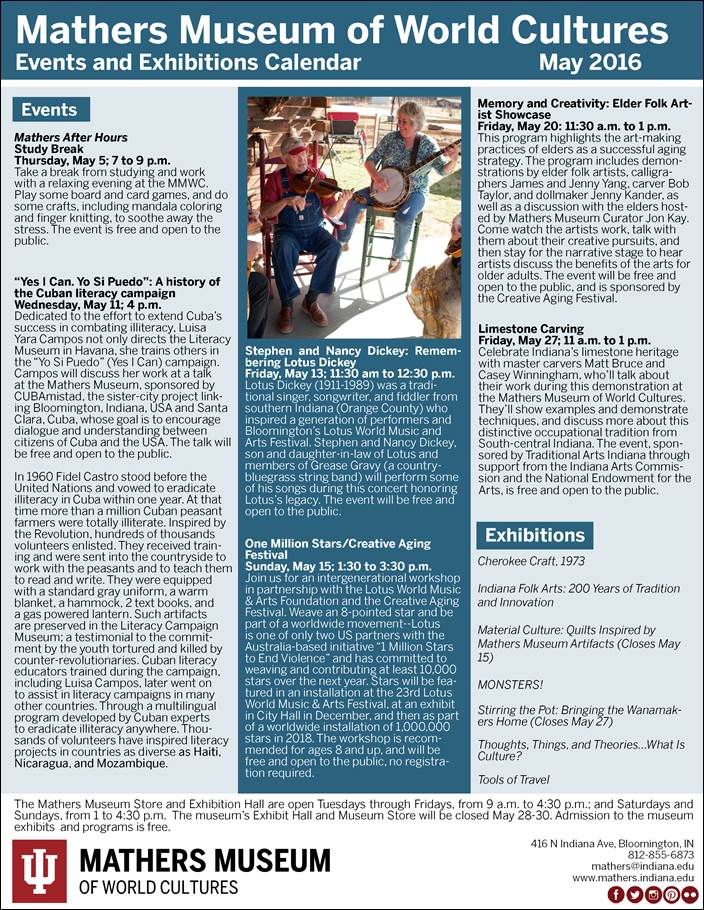
June Events and Exhibitions, Including Arts in the Park at McCormick’s Creek

Check out some MMWC events and exhibitions this month. In particular, this Saturday (June 11, 2016) a great group of artists will join the Traditional Arts Indiana team at McCormick’s Creek State Park for Arts in the Park. Learn more about that event here.

MMWCEcalJune2016

May at the MMWC

It has been a whirlwind of activity at the Mathers Museum of World Cultures this semester. The spring semester is ending and many students are leaving campus, but there are still great things to come at the MMWC this May. Please stop by for an event or anytime.

Unknown

Theories of Material Culture: Two Highlights

I am now concluding my graduate course Theories of Material Culture. I have taught this course several times previously and I always enjoy it. This year, the students who gathered with me were more diverse than usual. Beyond the normal folklorists and cultural anthropologists, there were practicing artists, a learning scientist, a fashion scholar, and an ethnomusicologist. In comparison to past instances, this made the course simultaneously more interesting and a more challenging exercise in translation. I am thankful for the chance to work with students whose interests intersect with mine in such stimulating ways. Interacting with these students was a big highlight of my distractingly busy semester.

k10581
Intentionally, I have made the Theories of Material Culture a weird course. In response to students who rightfully complained about constantly noting how key book-length works were often mentioned* in our courses but not assigned, the only readings in the course are books. Many books. Experience shows that, as part of a more diverse reading diet, this course pattern helps students in noticeable ways later–during qualifying exams, research planning, and dissertation writing. Some works have reappeared in different versions of the course, but some are always new to the course and occasionally some are new to me. This semester, I added two titles that, while I had not yet read them because they were brand new, seemed like sure bets. And they were. The were most beloved by the students and they provoked particularly rich discussions. These were Pravina Shukla’s Costume: Performing Identities Through Dress (Bloomington: Indiana University Press, 2015) and Anna Lowenhaupt Tsing’s The Mushroom at the End of the World: On the Possibility of Life in Capitalist Ruins (Princeton: Princeton University Press, 2015).

9780253015778_lrg
I cannot spare the time now to comment properly on these two excellent books, but I note here that they were highlights for me and for the students. I eagerly recommend them to you. Of reviews of Costume, I like the one written by Brandon Barker for JFRR. For The Mushroom at the End of the World, I note Eugene N. Anderson’s review in Ethnobiology Letters. (These two journals are both wonderful open access publications, by the way.)


* Particularly unnerving to students is the faculty habit of mentioning canonical books as if everyone in the room had not only heard of them previously but had read them and long ago assimilated their lessons. (I know I to am guilty of this tic too.) Books do of course get assigned in our classes, but usually a smaller number are balanced with a mixture of works in other genres. This normal pattern is true of my other courses too.

Indiana Folk Arts: 200 Years of Tradition and Innovation

Unknown.jpeg

Please come out to the Mathers Museum of World Cultures this Sunday afternoon to celebrate the vernacular arts of Indiana and to help launch our state bicentennial exhibition. Root beer floats! Bluegrass music from Hamilton Creek! Artists demonstrations! The new exhibition, plus the students, staff, faculty, and artists who made it. We hope to see you this weekend.

The Digital Future of Research in the Humanities and Social Sciences

What follows is an open letter of invitation written by Mike Fortun in connection with an upcoming meeting of the Digital Practices in History and Ethnography Interest Group of the Research Data Alliance. All interested parties are invited to engage with the RDA and the DPHE IG.

Dear colleagues,

We hope you can join us in a discussion about the digital future of research in the humanities and social sciences (HASS), particularly history, anthropology, folklore, and related fields in which researchers generate and interpret qualitative data to understand historical, social, and cultural phenomena.   The conversation is being led by the Digital Practices in History and Ethnography Interest Group (DPHE-IG), part the Research Data Alliance (RDA), an international alliance working to making research data more open and accessible, which will host its 7th plenary meeting in Tokyo 1-3 March.  Our DPHE-IG session is scheduled for Wednesday, 2 March from 11:00-12:30 in Conference Room 3 at Hitotsubashi Hall (National Center of Sciences Building).

Together, we will assess the current state and challenges of these fields, in different national and cultural contexts, and how enhanced digital research infrastructure can vitalize them in coming years.  Among the topics on our agenda are:

  • How can digital infrastructure animate the work of HASS researchers in coming years?
  • What are the opportunities and challenges for HASS researchers in different national and cultural contexts?
  • Strategies for increasing access to basic tools and infrastructure for sharing primary data, for collaborative analysis, and for collaborative publishing (especially in an experimental vein).
  • Developing digital infrastructure to support greatly enhanced collaboration between HASS researchers, both locally and internationally, and between HASS researchers and researchers in the physical sciences, engineering, medicine and other professions.
  • Reconfiguring or extending digital infrastructure to support the particular needs of HASS researchers (consent forms and human subjects committees, metadata standards, well-designed research and exhibition platforms, citizen science and community involvement, collaboration governance processes, repositories and data nets, etc.)

You are welcome to join the RDA at this link, where you can then join our interest group and learn about our past and planned activities. If you would like more information about attending the session, or are unable to attend the session but would like to learn more about our work, please [be in touch] and we will be happy to continue the conversation. And please feel free to forward [share] this [post with] anyone else you think might be interested in this.

We hope you’ll consider joining the discussion!

Best regards,

Mike Fortun (Rensselaer Polytechnic Institute)
Jason Baird Jackson (Indiana University)
Kim Fortun (RPI)

Co-chairs, RDA Digital Practices in History and Ethnography Interest Group

Value, Ownership, and Cultural Goods: Regina F. Bendix to Deliver 2016 Richard M. Dorson Memorial Lecture

This is the season’s big lecture. With many heritage studies projects underway, it is a perfect time to welcome Regina back to Bloomington. Here are the details:

2016 Richard M. Dorson Memorial Folklore Lecture
Join us for the 6th Annual Richard M. Dorson Memorial Folklore Lecture.

“Value, Ownership, and Cultural Goods”

Regina F. Bendix, University of Gottingen, Germany

Monday, March 21, 2016
6:00-8:00 pm
800 N Indiana Ave

A reception will follow the lecture.

Abstract:

Since the mid-1990s, scholarship on heritage has blossomed – some might say boomed – and brought forth a plethora of new journals and studies in many languages, not least due to the vigorous work and impact of UNESCO’s heritage programs. UNESCO’s work on behalf of “cultural goods” reaches back roughly sixty years and has yielded many policy suggestions, conventions and programs. UNESCO’s activities in turn mobilized other international agencies concerned less with safeguarding valuables and more with ownership and group rights. They point toward ways in which different groups of actors harness the notions of tradition, folklore, culture or heritage to improve their lot on this earth. In their efforts, such groups are likely assisted more by experts in international law and economics than by students of culture.

For scholars in folklore and related fields, at least two tasks present themselves. One entails a continuation of a by now “traditional” task: understanding how excerpts from cultural scholarship, in their transfer and implementation in the public sphere transform, the practices, people and places we tend to study. A second task builds on this first one: we need to find avenues to communicate better with disciplines and practitioners engaged in establishing the legal norms and the economic projections concerning the fate of culture turned resource.

Funding for Collections Research at Indiana University

This wonderful program of the Indiana University Institute for Advanced Study provides support for researchers–including community-based scholars–to study collections held at Indiana University. The Mathers Museum of World Cultures is one of the eligible repositories. Details are available in the request for proposals, which is copied below:

Announcement for distribution:

The Indiana University Institute for Advanced Study is now accepting applications for its 2016 Summer Repository Research Fellowship. In partnership with repositories on the IU Bloomington campus and supported by the Office of the Vice Provost for Research, the program funds a short-term fellowship for a faculty member or community scholar to conduct in-depth research in the collections of one or more of our partner repositories. Applicants from Minority Serving Institutions, community colleges, and source communities are welcome. Preference will be given to applicants who are collaborating with Indiana University Bloomington faculty members.

This initiative is intended to support research in the rich collections of the IU Bloomington campus and to build partnerships between scholars at and beyond IUB.  The fellowship provides funding for travel costs, accommodation, per diem, and a two-week stipend.  Please note: This fellowship is intended to support research in IU Bloomington’s unique collections; the application should focus on materials that cannot be accessed elsewhere.

Summer 2016 partner repositories include the Archives of African American Music and Culture, the Archives of Traditional Music, the Black Film Center/Archive, the Glenn A. Black Laboratory of Archaeology, The IU Art Museum, the IU Herbarium, the IU Libraries, the IU Paleontology Collection, the Jerome Hall Law Library, the Mathers Museum of World Cultures, and the Sinor Research Institute for Inner Asian Studies Central Asian Archives. Applications are due by March 21, 2016. For application materials and additional information, please visit our website at http://ias.indiana.edu/fellows/summer-research-fellowship/ .

CFP: Unfinished Stories: Folklife and Folk Narrative at the Gateway to the Future

Unfinished Stories: Folklife and Folk Narrative at the Gateway to the Future

The 2016 Joint Meeting of the American Folklore Society and the International Society for Folk Narrative Research

October 19-22, 2016

Hyatt Regency Miami, Miami, Florida, USA

The joint meeting of the American Folklore Society (AFS) and the International Society for Folk Narrative Research (ISFNR) will bring together more than 800 US and international specialists in folklore and folklife, folk narrative, popular literature, and related fields to exchange work and ideas and to create and strengthen friendships and working relationships.

The meeting will feature a number of plenary lectures as well as panel and forum presentations of work by folklorists and their allies in 14-17 concurrent sessions for four days. In addition, participants may register for workshops and tours that will offer an introduction to some of Miami’s cultures and communities.

Prospective participants may submit proposals for papers, panels, forums, films, and diamond presentations or propose new presentation formats. Proposal submission begins February 1 and ends March 31. Presentations on the theme are encouraged but not required.

Proposals will be reviewed by a committee of ISFNR members and of folklorists who live in the region hosting the meeting. AFS will send notification of acceptance or rejection for the meeting program in early June and post an online preliminary program schedule by July 1.

You can find more information about the meeting, including instructions for submitting proposals, beginning February 1, 2016, at http://www.afsnet.org/?2016AM.

Theme: Unfinished Stories: Folklife and Folk Narrative at the Gateway to the Future

Throughout its history, Florida has served as a sustained point of cultural convergence and exchange. Its tropical climate, burgeoning economy, and geographic proximity to the Caribbean and Latin America have influenced its cultural identity. South Florida was shaped by early migration from the United States and Caribbean Islands, as well as influxes of political refugees during the second half of the 20th century. Miami, known as the “Gateway of the Americas,” is now perceived as one of the largest and most significant Latin American and Caribbean cities. As Miami continues to evolve through cultural synthesis, it serves as a leader in terms of its transnational identity and experiences.

In addition to being termed a “Gateway,” Miami has also been described as a “City of the Future.” As such, it offers inspiration for multiple perspectives on the future development of folk narrative and folklife, both within the region and in larger contexts. Relevant topics include transnational communities, cultural synthesis and creolization, the impact of the digital revolution on folk culture, narratives about land and place, traditional responses to climate change, and much more. Conference participants may reflect on these unfinished stories as they appeared in the past and also consider the future of our fields, including emergent theories, methodologies, and ethics.

The organizing committee invites participants to explore the narrative dimensions of their work, regardless of topic.

Contact info:

Lorraine Walsh Cashman
American Folklore Society
Eigenmann Hall, Indiana University
1900 East Tenth Street
Bloomington, IN 47406
812-856-2422; fax: 812-856-2483
www.afsnet.org
lcashman@indiana.edu

Joanna Ella
Secretary
International Society for Folk Narrative Research
www.isfnr.org
jella@gwdg.de