Skip to content

Posts from the ‘Scholars to Know’ Category

Museum Anthropologists are Award Winners

I am presently batting my email box. One of the small rewards in this situation is discovering great news emails that slipped by. From the excellent news rediscovered department, I am happy to note two recent awards bestowed on friends from the museum anthropology community.

Dr. Nancy Parezo was awarded the 2011-2012 Graduate College Graduate and Professional Education Teaching and Mentoring Award at her home institution, the University of Arizona. Nancy is a member of the Department of American Indian Studies at UA and is a lead faculty member for the Summer Institute in Museum Anthropology held each year at the National Museum of Natural History, Smithsonian Institution. (I will be joining Nancy for part of this year’s SIMA).

The Association of Tribal Archives, Libraries, and Museums (ATALM) recently bestowed its 2012 Guardians of Culture and Lifeways International Awards. Winning for “Outstanding Project” was the
Plateau Peoples’ Web Portal, “an interactive, online digital archive that provides access to Plateau peoples’ cultural materials at Washington State University through tribal curation. The Portal provides a way for tribal communities to include their own knowledge and memories of digital materials for various collections.  This project is an inspiring model of how university repositories can successfully collaborate with tribal communities to curate and enhance collections with tribal voices and histories.” The project director for this effort is my friend and collaborator Kimberly Christen of Washington State University.

Belated congratulations to Nancy, Kim, and to the Plateau Peoples’ Web Portal team on these well deserved awards.

People Make Collections: Anthropologist Michael Davis (1942-2012)

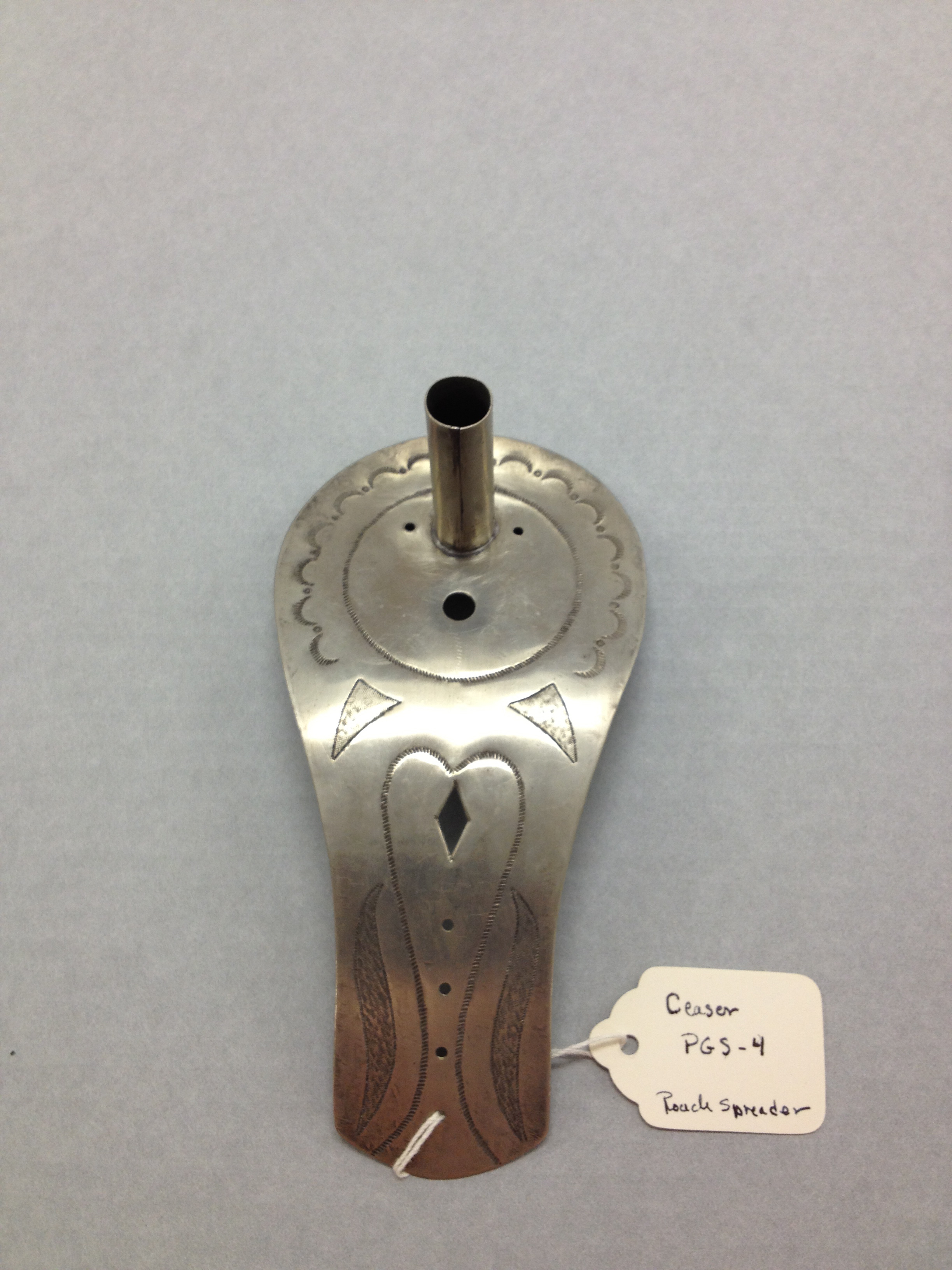
Museum collections are made by people who gather together the things that other people make. Earlier this week I was looking at a group of objects in the William C. Sturtevant Collection that were gathered together and documented by then-University of Oklahoma doctoral student Michael Davis. This is an exceptional collection of German silver jewelry made in the 1960s by an impressive number of Native American artists working on the Southern Plains.

After his OU studies, Michael Davis went on to become a Professor of Anthropology at Truman State University in Kirksville, Missouri. I wanted to congratulate him on the quality of the collection that he made and the exceptional way in which he documented it. Thinking about getting in touch, I discovered sadly that he passed away a few months ago. An obituary appears in the Kirksville Daily Express and is available online.

One reason that we make museum collections is to preserve something of the past for the sake of the future. I hope that Professor Davis, as well as the artists whom he documented, would be pleased to know that their work is being appreciated by those who have come along after them.

A German silver roach spreader by Pawnee smith Julius Ceasar (1910-1982) collected for the National Museum of Natural History by Michael Davis (1942-2012) and found as part of the William C. Sturtevant Collection, Department of Anthropology, National Museum of Natural History.

On the Study of Shreds and Patches

Yesterday my work with the William C. Sturtevant collection focused on the material culture side of his efforts to document the history, practice, and significance of the unique Florida Seminole art form known as “patchwork.” Basically, I organized and quickly looked at a couple of hundred patchwork samples such as those arrayed in the image presented here.

I have done little work yet with documents, but a large folder of notes associated with Dr. Sturtevant’s patchwork studies were handy and I took a quick peak. There is a lot there. I hold off on talking about that and describe a single note that is very relevant to this website.

For its early years, this website was just associated with my name. A while back though, it started to seem clear (to me, at least) that it needed a more blog-like name. The name the I chose was Shreds and Patches. I should have explained the source of this name at the time, but didn’t. It was a soft re-launch, I guess. Anyway, the first thing that my eye fell on when peaking into Dr. Sturtevant’s patchwork notes folder was a single slip of paper that explains the source of my name.

It is a medium sized slip of paper in his own hand and it is a quotation–the very quotation from which the title of this blog comes. The source is a famous, oft debated passage from the conclusion of a book by Robert Lowie. I have not gone back to the source to check Sturtevant’s note, but here it is as he has it.

“Nor are the facts of culture history without bearing on the judgement of our own future. To that planless hodgepodge, that thing of shreds and patches called civilization, its historian can no longer yield superstitious reverence. He will realize better than others the obstacles to infusing design into the amorphous product; but in thought at least he will not grovel before it in fatalistic acquiescence but dream of a rational scheme to supplant the chaotic jumble.”–p 441 (concluding paragraph of Lowie’s Primitive Society (1947, N.Y., Liveright; 1st ed. 1920; on pp ix-x of the new preface to the ’47 ed, RHL [Lowie] complains that this famous passage has been misinterpreted)

Lowie was one of Bill Sturtevant’s undergraduate teachers at Berkeley. I can talk some other time about the significance and history of this passage from Lowie. Here it is interesting to think what it is doing in Bill’s patchwork notes. Two possibilities have occurred to me.

If he meant it to be there, it was clever because it suggested that he was going to draw upon anthropology’s most famous theoretical discussion of “patches” in his empirical project on patches (of the Seminole sort). Alternatively, and amusingly, it could have been filed in this place by someone else because a quick scan of the text could suggest that because it is about patches it needed to go with the patchwork notes. I’ll get to the bottom of it someday, perhaps. In any case, it provides the answer to the question of why I named the blog as I did. (Lowie was not the original source of the phrase Shreds and Patches, just the one who gave it anthropological resonance in theorizing the nature of culture and so-called “civilization.”

Note.  The patchwork samples shown above are not yet numbered, but they are part of the William C. Sturtevant Collection at the National Museum of Natural History, Smithsonian Institution.

Matthew Guterl on The Future of the Library/Libraries

A fellow faculty participant in the November 2, 2011 “Faculty Discussion on the Future of University Libraries” held at Indiana University under the sponsorship of the Dean of Libraries and the Provost was my Department of American Studies colleague Matthew Guterl. Matt is Rudy Professor of American Studies and History and the Chair of the the Department of American Studies. A historian of race and race-relations in the Americas, he is the author of numerous key works in American Studies, including The Color of Race in America, 1900-1940 (Harvard University Press, 2001) and American Mediterranean: Southern Slaveholders in the Age of Emancipation (Harvard University Press, 2008). This site does not have a flashy title like The Edge of the American West, Crooked Timber, or Savage Minds but it is fun to welcome such a talented guest contributor to the blog part of my website. Rather than see them filed away unread, here are Matt’s thoughtful reflections on the future of libraries at IU and everywhere.

“The Future of the Library/Libraries”

Matthew Pratt Guterl

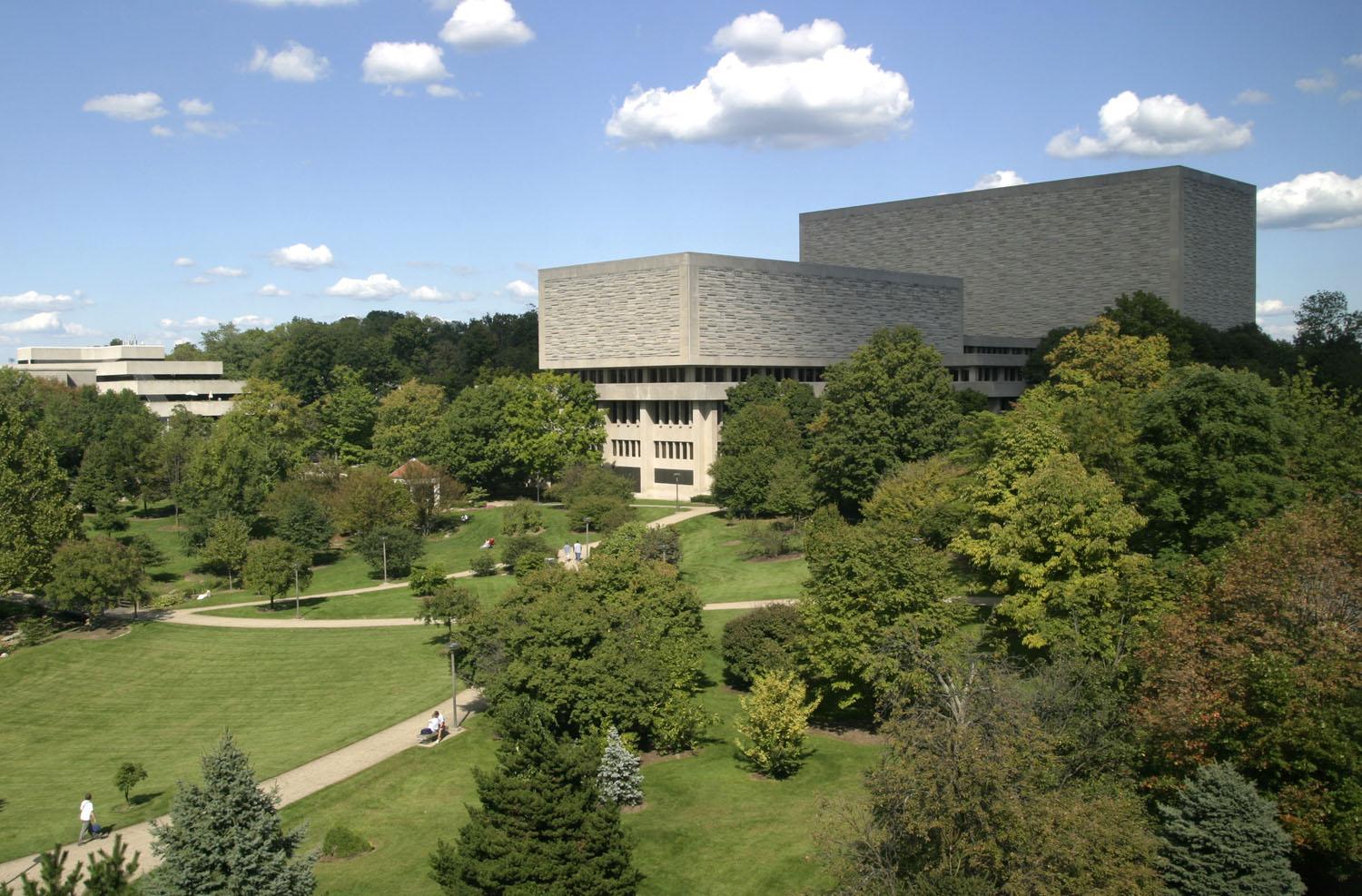
I haven’t been to the big limestone box on Jordan in over a year, but I use the library every day.

Once I needed to use the Reader’s Guide to Periodical Literature; now I use Google.  I used to check the stacks; now I just search by keyword on Project Muse, or wait for a Google Scholar alert to arrive in my inbox.  I used to store my handwritten notes and copies in fireproof boxes or plastic crates; now I have digital reproductions of the entire archive of my current project stored on my phone.

The last time I was there, in the Wells Library, it was for coffee and donuts.

Maybe the future of the library is not the same thing as the future of that building.

Wells Library, Bloomington, Indiana. Courtesy of Indiana University.

After all, even if I’ve been absent physically, I’ve clicked on the IU Libraries link more times than I can count, and trolled through its rich databases with great delight.  I have more need of the library-in-the-abstract than ever before.

The big limestone box – and all that it includes – is still important.  But ours is not the Fitchburg State library, and IU isn’t a second tier, branch campus.  When I wonder about the short-term future of “real” academic libraries with walls and windows and floors, my thoughts race to Rutgers-Newark, to IU-East, or Washington State-Tri-Cities, or Lincoln University, the places most likely to be first erased by budget cutting and spatial reallocation.  I think about small town libraries in places less well off than Bloomington.  I think about corporate libraries and law firm libraries and museum libraries.  I think about the impending extinction of the bookshelf at the old ski lodge, or the hotel lobby, where the accidental discovery of some old Faulkner text, or some Philip K. Dick collection, encourages a new thought. Our research library – the Wells Library – may be safe, for now.  These other, less secure sites, are not.

I worry, after thinking about all of this, about the right now, and about short term access for the less fortunate, confronted with the boxing up of the local library stacks, however meager, or the end of the hard copy, however scarce, and about the corresponding absence of laptops and ipads and wifi, which we imagine as open substitutes, available to anyone, in this age of receding material reality.

Yes, the Wells Library will survive for some time, much like the 42nd Street Branch of the New York Public Library, or the Library Company in Philadelphia.  The scale of the architecture ensures that, as does the vastness of the collections and the professionalism of the research faculty.  Such places, awe-inspiring and beautiful, still generate new knowledge, even while they also encourage new and necessarily generous donations, and serve as delightful backdrops for critical fundraising campaigns.  But eventually, perhaps inevitably, as the library becomes ever more disembodied, even these historic buildings may become repurposed reliquaries, like old Masonic temples turned into state office buildings, or old movie theatres turned into restaurants, or old plantations turned into museums and beds and breakfasts.  Or, like abandoned factories, they will simply be emptied of content and left to fall apart, or turned into loft apartments.

Of course, for those of us caught up in the past, it is easy to get nostalgic about what is lost in this transition.  I remember the smell of my first public library, nestled in a retrofitted old fire station next to my childhood home.  I remember reading Santayana on the steps of the New York Public Library, waiting for the doors to open, and excited about what might be revealed within.  I remember the pleasure of waiting for something to arrive, for my call number to light up, or of finding something unexpected, and of the pervasive smell of glue and paper and ink.   I remember discovering a letter, misfiled under the wrong name, proving what I thought to be a powerful point.   In my most troubled moments, I grow concerned that all of this – this set of possibilities, this travail – will be lost.

Nostalgia, though, is the conservative reflex of those confronted by rapid change.  And so I push back against it.  I imagine what is possible in our future.  And I think, instead, of how cool it will be when the poorest person in the world can press a button – even if the button is worn, and the screen is dingy – and call up the complete works of Toni Morrison, linked to every video interview she’s ever given, and joined with her correspondence, archived in public and for free.  As a public university now more indebted than ever to a bigger, more global “public,” we have a big role in making this future possible.

I’m not sure that this utopic vision includes the bricks-and-mortar of the Wells Library, though it surely includes research librarians.  In many ways, it is the antithesis of this place, which has more in common with the Royal Library at Alexandria than it does with Google books.  And I remember that when the College’s Strategic Planning Committee met a few years ago, we half-joked about creating a rooftop biergarten, with crystal slides to the ground floor.  But this vision most certainly includes the library as a liberal ideal, with a social function worth expanding, a political mission worth protecting, and a research agenda that deserves better articulation.
Remembering Kara Bayless (1982-2010)

The wonderful memorial statements authored by American Folklore Society members and read publicly at the opening ceremonies of the 2011 AFS meetings are now online on the AFS website. Among them is a beautifully written statement about Kara Bayless an amazing Oklahoman, folklorist, and doctoral student in my home department. A star student, Kara was enrolled in my seminar at the time of her tragic passing last year during the 2010 AFS meetings. She is so missed by her many friends and colleagues.

Also remembered at the meetings, with statements now on the website were three distinguished elders in the field. Stetson Kennedy (1916-2011), Roger E. Mitchell (1925-2011) and Kathryn Tucker Windham (1918-2011).

Learn about their lives and work here: http://www.afsnet.org/?InMemorium

Why Michael Wesch’s “Blogging” Should Count

In his essay “Blogging for Promotion: An Immodest Proposal” anthropologist Greg Downey outlines a clear set of actionable proposals for reform at the intersection of scholarly communications practices and academic tenure and promotion practices. I commend his essay, which was published today (10/20/11) on Neuroanthropology, a compelling and influential PLoS (Public Library of Science) weblog that he runs with Daniel Linde. Rather than discussing this important contribution here in depth, I am going to try enacting one of its proposals. (For reference, see especially the discussion that follows Downey’s section heading “An immodest proposal (not an indecent proposition)”.)

First the set up. I am working extensively right now preparing a new course for spring 2011. This course was devised as part of my participation in a two year think-tank funded by the Teagle Foundation (a funder supporting projects designed to foster innovation in undergraduate teaching and learning) and organized by the American Folklore Society. The AFS project was built around the theme “What is the relationship between lay and expert knowledge in a complex society?” Colleagues teaching in a range of institutions, from community colleges and private liberal arts colleges to large research institutions gathered to explore the frontiers of research-based teaching, changing curriculum practices, and the wider contexts of our work in a small border discipline bridging the humanities and the social sciences, as well as the academy and the public sphere. As part of our work, we developed plans for new courses and teaching resources. Part of my work focused on working out plans for the course that I will initially teach next spring (it opens for enrollment today).

I have mentioned the course here previously. In a nutshell it uses the toolkit of folkloristics (and by extension my other field–cultural anthropology) to consider human responses–including aesthetic, expressive, customary, and communal responses–to a range of recently emergent and highly contested human social problems. Called “The New Social Problems: Communal and Expressive Responses” the new problem domains to be considered include such things as the digital divide, genetic engineering, intellectual property contests, and nanotechnologies. I am sure that I will be discussing the course further as it moves forward. The important point in this context is noting the influence that one colleague–whom I do not know and whom I have not yet met–has had on the shaping of my plans for this experimental course.

Michael Wesch, on his website/weblog Digital Ethnography (which is a key node in the digital infrastructure of his undergraduate-based research group), has regularly and effectively documented the pedagogical experiments and research work that he has been pursuing (over many years) with many successive groups of Kansas State University students. Wesch has been appropriately recognized and celebrated for the innovative work that he and his students have been doing. What I want to highlight here is that the manner in which he has documented and explained this work has made it richly available for the wider scholarly community. Because he has used http://mediatedcultures.net as a venue for reporting on his work, his strategies and experiences are openly and immediately accessible to me (and to my students) as well as to everyone else able to surmount the digital divide. Essays like “Our Class on How We Run Our Class” in which Wesch and his students describe (and enact) the technical and intellectual strategies through which a standard U.S. undergraduate course is turned into a deeply meaningful research collaboratory for social scientific investigation are just not available in the conventional published literature in our field. It is on the basis of the inspiration provided and the information conveyed by Wesch and his students that I am able to imagine a very different kind of course to pursue with my own students in January.

Michael Wesch’s Digital Ethnography efforts represent the kinds of “blogging” work that deserves to count as a substantive scholarly contribution (bridging teaching, research, and service) in such areas as annual review and tenure and promotion considerations.

Sukkot=Time to Check Out Gabrielle Berlinger’s Beautiful Photographs of People, Buildings, and Food

It is Sukkot time again and I urge everyone to check out Gabrielle Berlinger’s beautiful photographs. She is at the end of her current fieldwork period in Tel Aviv where she has been studying many interlocking topics, with Sukkot at the center of things. Her reporting and her photographs are beautiful. Don’t miss out.

Gabrielle Berlinger Reports on the Latest Housing Protests in Israel

While, after inexcusable delay, the U.S. media finally start covering the Wall Street protests here in the United States, my colleague and IU doctoral researcher Gabrielle Berlinger continues to be one of the few people positioned to report in English on the continuing housing protests in Israel. As the protests connect directly with the community in which she is living and working and because they relate closely to her research, her reporting is rich in ways that journalistic accounts never could be. Her latest account, of a protest outside the home of the Minister of Housing in Jerusalem, is here.

Barbara Kirshenblatt-Gimblett and the Museum of the History of Polish Jews

Barbara Kirshenblatt-Gimblett and the Museum of the History of Polish Jews [A discussion of her current museum project in the online journal Habitus.]

Florida Folklorist Stetson Kennedy (1916-2011)

I wish to note the passing of fellow Floridian and folklorist Stetson Kennedy. I did not know him, but I admire his work and his remarkable career. As the detailed obituary published Tuesday in the New York Times will suggest, he is very much a person worth knowing about. To have hung out with Woody Guthrie and Zora Neale Hurston, married seven times, and crippled the Ku Klux Klan via a Superman radio show and lived to 94–that’s a life. Rest in Peace.