Skip to content

Posts from the ‘Scholarly Societies’ Category

Native American and First Nations Studies in the Work of the American Folklore Society During the 1910s

Here we go again, this time looking at the 1910s. This post is the eighth in a series considering the absence and presence of Native North American and First Nations studies work (and individuals) within the life of the American Folklore Society (AFS). For a summary of the previous posts, check out the opening passages in the seventh post. As with that post, I will be combining a survey of the annual meetings for the 1910s with a review of articles and notes published in the Journal of American Folklore (JAF) for the same decade. For the present-day United States, the AFS is the main organization for the discipline of folklore studies.

As in other early decades, knowledge of what happened at the annual meetings of the AFS, including the titles and speakers for presentations given, is derived from annual reports of the society published in JAF. These can be consulted in JAF today and they have also been made available in an open access way by the AFS in IUScholarWorks. While the AFS annual reports do not seem strikingly different between the two decades, comparison of meeting presentations of the 1910s and the 1920s reveals a key pattern. In the 1910s, presentations on non-Native topics (N=45) outnumbered presentations on Native North American studies topics (N=27), as is shown in the table below (compare with the first table in the preceding post). For the 1920s, this pattern was reversed, with fewer papers on non-Native North American topics (N=28) than for Native North American studies topics (N=40).

YearPresentations on Non-Native American TopicsPresentations on Native American TopicsPercentage on Native American Topics
19108111%
19116333%
1912500%
19136650%
19144343%
19154233%
19163563%
19175550%
1918000%
19194233%
Totals452738%
Presentations on Non-Native North American- and Native North American-Related Topics at the Annual Meetings of the American Folklore Society During the 1910s

When considering this, keep in mind that the nature of the presentations on non-Native North American topics is heterogeneous. That group usually includes literary folklorists working on topics such as ballads and tales from European settler, Black, “Hispanic” (Latinx), etc. communities in the US and the Americas, but also anthropological folklore studies works related to peoples outside the settler states of the United States and Canada. Finally, this grouping sometimes includes work of a theoretical or comparative character that by scholars who were otherwise deeply involved in Native North American studies.

We still need to get back to 1888, but from the vantage point of the meetings of the 1910s, it would appear that Native American studies work within folklore studies, as represented by meeting participation, is working towards a peak that is still to come in the 1920s. (As discussed in the earlier post on the meetings of the 1930s, that decade presents a muddled picture, but it seems clear that the 1920s were the high water mark for Native North American studies work within the society’s meetings as distinct undertakings. In the 1910s, like the 1920s, but not like the muddled 1930s, there was generally a distinct AFS meeting program, even though the society was meeting in partnership with the American Anthropological Association (AAA), the American Association for the Advancement of Science (AAAS), and other organizations. This fact helps this inquiry greatly.

Unlike the 1920s, there is no recorded moment of participation in the meetings of the 1910s by a Native North American/First Nations scholars. If I am mistaken about this, please alert me.

What about the view from JAF? The table below reflects my quick coding of articles and notes in JAF during the 1910s. As in later decades, the journal presents a more moderate picture than the meetings relative to balance. Things said about the journal in the 1920s and 1930s generally hold true for the 1910s. These decades fall into the long period of (first) Franz Boas’ and then (second) Ruth Benedict’s editorships. The stability of norms and practices in this period is very noteworthy. Throughout, there was a significant group of associate editors mapping onto the major interest groups within the society and published content reflected these interests and their constituencies.

For anyone who was very committed to Native North American and First Nations studies (particularly studies of verbal art/narrative), JAF would have been essential reading in the 1910s. For such a scholar, there would be people to talk to if one made it to the annual meetings, but it is clear that one could be active in the AFS via the journal and an associated state and local society “branches” and never make it to one of the anthropology-inflected national meetings (often held in association with the AAA and related organizations). An elite of literary folklorists working on non-Native American materials found their way to the meetings in order to engage with and shape the organization, but such scholars really shone in the pages of JAF, where their works constituted a majority of what was published in the 1910s. Consider folk song scholar Phillips Barry, for whom the Phillips Barry Lecture*, given each year at the AFS meetings is named. There are stretches in the 1910s where he seems to be present in every issue of JAF, sometimes more than once in the same issue.

(*Wasn’t Dom Flemons an incredible Phillips Barry presenter at this year’s [2020] meeting!)

Below the table, I offer a few more observations, but for Native North American studies in folklore, I want to record here that the 1910s saw JAF publish two papers by William Jones (Sauk). I cannot do justice to Jones’ amazing story here, but I note that the two papers from the 1910s were published posthumously after his tragic murder in the Philippines. Many others have written of the terrible, sad story of his death while doing fieldwork in Luzon. It is likely that Jones, if one were to do the archival work carefully, would turn out to be the first Native North American member of the AFS. I may discover new things when I look at the remainder of the meeting reports and journal issues, but for now, this is a reasonable proposition. (I will make a correction here if I discover something different. Having published many books and articles while still young and having earned one of the first PhDs in anthropology (the first Native American do to so), it is overwhelming to think what he might have accomplished had he not died so young (at age 38). (See his “Ojibwa Tales from the North Shore of Lake Superior in JAF #113 (1916) and his “Notes on the Fox Indians” in JAF #92 (1911).

YearPublished Papers and Notes on Non-Native American TopicsPublished Papers and Notes on Native American TopicsPercentage on Native American Topics
191013941%
191112529%
191220829%
191316936%
191419932%
191519932%
191613424%
191722929%
191827516%
191922621%
Total1837329%
JAF Publications on Non-Native North American- and Native North American-Related Topics at During the 1910s

While Native North American studies were not dominant in the journal, it was (like the 1920s and 1930s) an era in which Boas’ students published often in the journal on both Native North American and theoretical topics. A few dissertations were published as long articles and there were many text collections from both anthropological folklorists and literary folklorists concerned with non-Native North American peoples, particularly from the western hemisphere. Boas’ editorial system of making sure that every volume, for the most part, included materials related to English-speaking European settler, Spanish-speaking settler, French-speaking settler, Black diaspora, and Native American/First Nations (here including the Indigenous peoples of the Americas as a whole) was evident as was his efforts to balance short items with the very long ones that he also was keen to publish.

Native American and First Nations Studies in the Work of the American Folklore Society During the 1920s

This is a seventh post in a series on the presence and absence of Native American and First Nations studies within the life of the American Folklore Society (AFS). So far, the series is as follows.

First, a post considered the presence and absence of Native American and First Nations studies within the AFS conference programs of the 1950s.

Second, I moved back a to the AFS conference reports for the 1940s.

Third, I considered the distribution of interest and work among the original group of AFS Fellows at the moment of the Fellows beginning in 1960, a moment that represented a kind of capstone for the state of things at the end of the 1950s.

Fourth, I moved forward to consider the annual meetings of the 1960s.

Fifth, I went back and assessed Native American and First Nations Studies at the American Folklore Society Meetings During the 1930s

Sixth, I dug deeper for the 1930s, looking at the content of the Journal of American Folklore (JAF) for that decade.

Here in a combined post, I look at Annual Meetings and the JAF for the 1920s.

While the published AFS Annual Reports for the 1920s have the same format and style as those crated and published in the 1930s, for the 1920s there is, for each year, an accounting of the papers presented at the Society’s annual meeting. There are indicators that the AFS was then meeting with the AAA and other organizations, but the picture in the 1920s is one of autonomy and in each instance there are is a small but clear and substantive group of papers presented at the annual meeting. The data on these presentations is given below. For the tracking of presentations relative to Native North American and First Nations topics, 1924 will look a anomalous, especially in the context of the decade. In addition to two papers presented on other topics, there was that year a round table event on European tales taken up by Native North American peoples. Below the table I touch on a highlight and assess the data.

YearPresentations on Non-Native American TopicsPresentations on Native American TopicsPercentage on Native American Topics
19201686%
19211686%
19226225%
19232467%
192420* (Roundtable)0%
19254450%
19264969%
19272360%
19285229%
19291480%
Total284059%
Presentations on Non-Native American- and Native American-Related Topics at the Annual Meetings of the American Folklore Society During the 1920s

For me the highlight is seeing, in the program for the 1926 meeting held at the University of Pennsylvania, Gladys Tantaquidgeon (Mohegan). Born in 1899, she would have been 27 years old at the time of the AFS meetings. The annual reporting tells us that her presentation was “Notes on Mohegan Folklore.” Based on my knowledge of the people involved, she was the only Native North American person presenting during the 1920s. If you know me to be in error on this point, please correct me.

Before turning to the JAF in the 1920s, I can say that the picture that the 1920s presents is pretty consistent. Editorial matters are a dominant concern of the society. To achieve its publishing goals, financial and membership issues were very prominent. Franz Boas was a very active presence in the life of the society in the 1920s and his students were central to its work, but well-known literary folklorists maintain their place in the society and Stith Thompson in particular can be seen rising through the ranks throughout the 1920s. The other key leaders among the non-anthropologists included Louise Pound, Phillips Barry, Frank Doby, Aurelio Espinosa. I tend not to enumerate them, but nearly everyone in ethnology/anthropological folklore studies generally associated with Franz Boas is present among the anthropological folklorists of AFS, with Ruth Benedict, Gladys A. Reichard, and Ruth L. Bunzel consistently playing key roles. I should have mentioned this previously, but throughout the 1920s and 1930s, Elsie Clews Parsons (herself a student of Native American topics) really was the patron saint of the AFS, consistently providing major donations to advance large projects and to patch holes in the society’s finances during difficult moments.

The meetings were small but those who gathered at them and served as officers, including as councilors, were major figures in the field. As I discuss below, the picture from JAF is much larger. Here is the basic count for the 1920s.

YearPublished Papers and Notes on Non-Native American TopicsPublished Papers and Notes on Native American TopicsPercentage on Native American Topics
19202214%
1921211032%
19221317%
1923151448%
19242250%
192511945%
192611842%
1927900%
192891155%
192914318%
Total1275931%
JAF Publications on Non-Native North American- and Native North American-Related Topics at During the 1920s

As in the 1930s, review of the content published in the JAF during the 1920s presents a more balanced perspective on the field, both in terms of literary vis-a-vis anthropological folklore studies and in terms of Native North American and First Nations studies vis-a-vis the study of other peoples and traditions.

Key to contextualizing the JAF data is remembering, as in the 1930s, that the journal regularly published huge text collections from various peoples of the world (particularly of the Western hemisphere). While these were sometimes collections related to Native North American and First Nations peoples, there were also frequently devoted to other groups that were prominent in the concerns of the broader membership–European American settler populations in rural North America, European immigrant populations in cities, African American populations in the U.S. and elsewhere in the Americas, French Canadian groups. As in the 1930s, a there is non-trivial amounts of work published related to Africa and Asia (particularly Chinese) and a significant amount of material related to both Indigenous groups and settler populations in the Spanish-speaking Americas. (A lot of work on the Spanish-speaking Americas is present in JAF during the 1920s. Put another way, the diversity of the field is much clearer in the pages of JAF than it is in the meeting halls where AFS leaders gathered for a business meeting and a small group of papers.

[Before moving on, a comment here on the studies of the Spanish-speaking Americas. Many people contributed to this work, including even Boas himself. But the central figure is Aurelio Macedonio Espinosa, Sr. He is clearly the star figure in this corner of the field and it is evident that he was greatly respected overall. He served as AFS President in 1924 and was reelected for 1925. His role, and that of other folklorists who might be identified as Latinx today is important in its own terms, but it is also important to keep this other thread in mind as we search the annals of the society for Indigenous and Black scholars.]

As noted previously, an assessment by pages published rather than by itemized articles and notes would generate a different picture. While very large articles are devoted to all groups (and the 1920s saw a huge amount of text material published on Puerto Rico), a page approach would shift perceptions of Native American studies in the AFS. As in the 1930s, JAF as a key location for the publication of Native North American text collections. 1929, for instance, looks different on the table above than it does on the tables of contents in JAF. Among the three Native North America-related publications for that year is a huge Hopi text collection.

Noting Gladys Tantaquidgeon, above, at the 1926 meeting was a relief in the face of the absence of Indigenous scholars at the decades and decades of meetings already surveyed. As noted in an earlier post, the 1920s also feature a paper in the JAF by Ella Deloria (Yankton Dakota), her “The Sun Dance of the Oglala Sioux” published in number 166 in 1929. (She was age 40 at the time.) While both Tantaquidgeon and Deloria did research with other Indigenous peoples it is perhaps relevant to note that their 1920s AFS contributions were reflections on studies undertaken among their own peoples.

What provisional patterns stick out from the 1920s survey, here combining JAF and the annual meeting in one post? If a scholar were interested in Native American expressive culture, particularly verbal art, in the 1920s, JAF would be essential reading. If such a scholar had the means and ability to travel to the (usually Northeast US) cities where the AFS met during this decade, they would find fellow scholars with which to converse and from which to learn. But the AFS was not at all reducible to the annual meeting. The journal represented and presented a bigger and more complicated scholarly world. Separate from Native North American studies concerns, it is strange to note that the difference between the 1920s and the 2020 on this point is basically an inversion. In 1920, the JAF involved more people and a more diverse set of concerns. In 2019 and even in virtual COVID-19 reshaped 2020, the annual meetings are simply bigger and more diverse than the content of the JAF. It has been thus for a long time. JAF is great, but it is a a very partial slice of the AFS today, whereas in 1920, the annual meeting was a tiny slice of the membership and of the journal as a community.

It is painful to contemplate that the 1920s might have been more inclusive than many later decades in terms of the involvement of women scholars and also of BIPOC scholars. I am not combing through this data just for kicks, although it is good to learn more about my fields. I am trying to get a better handle on just such painful questions as this one. I have not surveyed all of the data yet. There are later decades (ex: 1970s, 1980s, etc.) to consider as well as earlier ones (ex: 1900s, 1910s, etc.) to look at. But the patterns are starting to emerge more sharply.

The 1930s from the Perspective of the Journal of American Folklore

This is the sixth post in the series looking at the presence and absence of Native North American and First Nations scholars and scholarship from the work and life of the American Folklore Society (AFS). To get a recent recap of the series, look at the start of the post preceding this one.

If the annual meetings of the 1930s presented a picture of anthropological hegemony within the American Folklore Society, the published issues of the Journal of American Folklore (JAF) present a somewhat less stark picture. As the focus of this series is on the presence and absence of Native (North) American and First Nations studies within the work of the AFS as a community of scholars, the notes and articles published within the JAF, as the journal of the AFS, present a more harmonious picture with studies of diverse peoples of the Americas and of the wider world appearing in its pages. JAF also represents a less-skewed disciplinary balance between anthropological folklorists (working not only in Native North American but around the world and with other non-Native peoples of North America) and of non-anthropological (primarily literary) folklorists

As the question of Native American and First Nations scholars active within the American Folklore Society community is not disconnected from the openness of the society to BIPOC scholars in general, I note that the 1930s is the decade in which Zora Hurston published her two JAF papers. (“Dance Songs and Tales from the Bahamas” in 1930 and “Hoodoo in America in 1931”. (Writing from Honduras in 1947, she would later publish one of the most awesomely vehement negative reviews that I have ever read. You should go find it in JAF #238).

As noted previously, Gladys Tantaquidgeon (Mohegan) published two articles in JAF, the first appearing in 1932 (“Notes on the Origins and Uses of Plants of the Lake St. John Montagnais”) and a second one to appear later, in 1941.

I am going to share the raw counts for JAF publications dealing with non-Native and Native topics, but a few points should be kept in mind. This count combines shorter notes with full articles. I do not think that the two genres were used equally across these two areas of interests, which skews the overall count in a way that increases the proportion of non-Native North American content. The counts also do not take into account page counts. During this period, articles could be very brief or they could be huge text collections that occupy full numbers. Thus an assessment by page count might lead to very different results. While the Boasian scholars (in this period still working under Boas’ leadership) used the JAF in this way actively, text collections for varied peoples produced by scholars with different orientations did so also. More likely imballanced though in this period (and earlier) was the publication of full theses as articles in JAF. This is another kind of long-form work that impacted distribution of topics vis-a-vis page counts. Anthropological folklorists in the Boasian circle were more likely to see their theses and dissertations published in this way. This is no small matter, as in this era, publication of the dissertation was a requirement for the bestowal of the degree. The rise later of University Microfilms as a means of publication aimed to solve the problem that scholars of this earlier era faced around dissertation publication. Boas and his students used JAF towards this end in cases where the topics could make sense within its pages within an anthropological definition of folklore studies.

YearPublished Papers and Notes on Non-Native American TopicsPublished Papers and Notes on Native American TopicsPercentage on Native American Topics
193012529%
193118728%
19326440%
193314526%
19342614%
193515421%
19369640%
19373350%
193814318%
193914422%
Totals1314224%
JAF Publications on Non-Native North American- and Native North American-Related Topics at During the 1930s

To illustrate the way that page counts rather than presence/absence can offer a richer view, consider 1934, as presented above. This could seems like a bad year for a partisan whose interests were solely in anthropological folklore studies work related to Native North America. But the single item shown there, accounting for the 4% figure, is Diamond Jenness’ “Myths of the Carrier Indians of British Columbia” in JAF #184-185. At 160 pages, it represents 40% of the total pages published in JAF in 1934.

What is the take away? Native North American and First Nations studies was a vital part of the work of the American Folklore Society during the 1930s. The previous post suggested that the topic was a dominant factor when it came to AFS meetings and this one shows that the area of concern was prominent, but not hegemonic from the perspective of the society’s journal during this decade.

A very large group of scholars published on Native North American and First Nations topics in JAF during the 1930s. At least one of them–Gladys Tantaquidgeon–was member of a Native North American society that had then, or would later have, government-to-government relations with the United States. If readers know of other Native North American scholars present in JAF during the 1930s, please point this out to me.

Reblog: AFS Rebooks Tulsa Annual Meeting for 2022 but Continues to Plan for a Smaller Fall Meeting

Here I am sharing this important announcement from the American Folklore Society. I will continue to be involved in work towards the 2020 and 2022 AFS Annual Meetings, both with Tulsa ties. Those who have been involved in the running of scholarly societies will know what a financial and governance triumph this news is. Many scholarly organizations face catastrophic loss at the intersection of conference hotel contracts and COVID-19 consequences. I am so happy for AFS and thank its leaders. –Jason

AFS Rebooks Tulsa Annual Meeting for 2022 but Continues to Plan for a Smaller Fall Meeting

Like you, we at AFS are still faced with more questions than answers about how to plan for the coming year, but one thing has become clear: the current pandemic and its economic fallout will have a serious impact on our October meeting.

Because we want the opportunity to deliver fully on the plans and promises that we have already developed for our Tulsa meeting, we have taken one definite step at this time: we have renegotiated our contract with the Tulsa Hyatt to minimize our financial obligations to the hotel for this year, while rebooking to return to Tulsa October 12-15, 2022. This gives us the opportunity to continue planning several options for our Fall 2020 meeting while also planning to return to Tulsa in full in 2022.

This contract rebooking buys us more time to explore what we CAN do to convene in 2020, so our message remains the same: we are proceeding with our plans for a 2020 meeting in some form, as we investigate our options to best serve our members and attendees, perhaps including a smaller regional meeting, some virtual offerings, or a combination of both. We will continue our current work with partner organizations in Oklahoma to produce meaningful collaborative programming this year, and we hope to deepen those relationships through our return in 2022.

The AFS 2020 Local Arrangements Committee supports these difficult decisions and are thankful to the executive office and the Hyatt’s exceptional staff for finding a compromise with a larger vision for engaging folklore in Oklahoma. LAC co-chairs, Terri Jordan and Sarah Milligan see the benefit of returning to Tulsa in 2022, “This outcome allows us to continue to build flexible and innovative partnerships with both AFS members and our regional collaborators in light of the uncertainties caused by the COVID-19 pandemic. By extending our Tulsa meeting commitment to 2022 the LAC has an unprecedented opportunity for a deeper, more prolonged period of relationship building between our Oklahoma partners and the AFS community. Not only are we beyond grateful for the time and commitment from our LAC members in preparing for the 2020 meeting, we are excited to continue developing and nurturing these exchanges in 2020 and leading up to 2022.”

AFS Executive Director Jessica A. Turner says the Hyatt’s willingness to amend the meeting contract gives AFS the flexibility it needs to serve its members. “Moving our contract to 2022 removes a financial hurdle and allows us to have the successful full meeting in Tulsa we have been planning with extraordinary Oklahoma partners. It also allows us to be creative in adapting our plans to keep us connected as a field.”

Catherine McKemie, our partner with ConferenceDirect, emphasized that “Collaboration is key during a crisis and I was honored to help all parties involved reach a successful outcome. It is during tough times that true partners rise up to help each other and we were fortunate to work with Hyatt Hotels and American Folklore Society to deliver a favorable outcome.”

AFS thanks the Hyatt Regency Tulsa for its partnership in creating a plan that works flexibly with financial and travel uncertainties during the COVID-19 pandemic.  “We are proud to work with the American Folklore Society in rebooking its meeting to 2022 so that their plans for a Tulsa meeting see their full potential,” said Denise Davis, Director of Events for Hyatt Corporation.

In the meantime, the Review Committee is currently at work reading proposals, keeping calm and carrying on with the annual business of reviewing the research and concerns that are shaping our field right now and for the future. Many thanks to them for laying this foundation as we look for both customary and new ways of connecting our members and supporting their important work as circumstances evolve.

We have not changed our standards for proposal review: each submission will be considered on its own merits as a contribution to the full convening of the American Folklore Society. If you submitted a proposal, you’ll hear from us in the coming weeks about the Review Committee’s decisions. Though we can’t yet commit to what kind of platform we will provide if your proposal is accepted, you can rest assured that if it isn’t acceptable to you or you can’t present for other reasons, you may defer your presentation until 2021 or withdraw with a full refund. In the meantime, if your own plans to participate significantly change, please let us know as soon as possible, so we can respond and scale our plans accordingly. We will be reaching out for your input in the coming weeks as we work out a plan that serves most members.

On behalf of the AFS Executive Board, AFS President Norma E. Cantú said, “We thank everyone who has grappled with the changing situation and found solutions to our predicament so we can honor our bylaws and hold our annual meeting as scheduled in some form or another.  We send our deepest sympathy to any members who have been touched by the tragic events of the pandemic and send best wishes to everyone as we go forward.”

In summary:
• We are reducing our meeting with Tulsa and will plan for a smaller in-person meeting; all are welcome should your feel safe and able to travel
• We are exploring virtual meeting options and will make some decisions about scale and format in the coming weeks
• We will return to Tulsa for our 2022 Annual Meeting
• Wait a few weeks more before making or changing your travel plans for October until our program and your own ability to participate become clearer

Count on us to communicate directly with you as soon as we have more information to share; we will email all members and registered attendees, post updates to the 2020 Annual Meeting page, the AFS Review and our social media channels as our plans take shape. As always, we are here to respond to questions or concerns.

We remain hopeful that our efforts to meet in Tulsa will be realized, perhaps through an even stronger and more intentional meeting. Woody Guthrie wrote, “The note of hope is the only note that can keep us from falling to the bottom of the heap of evolution. Because, largely, about all a human being is anyway is just a hoping machine.” To that end, we reached out to a few of our members to ask them to share what they are hopeful for, creating some video in the new Zoom aesthetic.

Jessica A. Turner
AFS Executive Director


The Seventh Forum on China-US Folklore and Intangible Cultural Heritage: Collaborative Work in Museum Folklore and Heritage Studies

The following is a report on The Seventh Forum on China-US Folklore and Intangible Cultural Heritage: Collaborative Work in Museum Folklore and Heritage Studies (第七届中美民俗学与非物质文化遗产论坛: 博物馆民俗与遗产研究的协作工作). The version of record appears on the website of the American Folklore Society. This version adds more images. You can find a copy of the conference program here. –Jason Baird Jackson (杰森. 拜尔德. 杰克逊)

During three beautiful spring days in Beijing, a group of Chinese and American scholars and cultural workers gathered to discuss practices of collaboration in folklore studies and intangible cultural heritage work, with a focus on collaborations between ethnographic museums and between such museums and other groups in society. Held on May 19-22, 2019, this was the Seventh Forum on China-US Folklore and Intangible Cultural Heritage, one of a long-running series of conferences organized cooperatively by the China Folklore Society (CFS) and the American Folklore Society (AFS), as part of a broader binational collaboration begun in 2007. These forums have explored various aspects of cultural heritage policy, practice, and theory, giving US and Chinese participants an opportunity to learn about the state of the field as pursued in the national context that is not their own (Lloyd 2017).

This Seventh Forum, focusing on Collaborative Work in Museum Folklore and Heritage Studies, was held at the Indiana University China Gateway office in Beijing. Meeting under the auspices of the CFS and the AFS, the conference’s program was organized by the Mathers Museum of World Cultures and the Anthropology Museum of Guangxi (Guangxi Museum of Nationalities), with extensive logistical and practical support provided by the two societies and the gateway office staff. Generous financial support was provided by the Henry Luce Foundation and the Office of the Vice President for International Affairs at Indiana University.

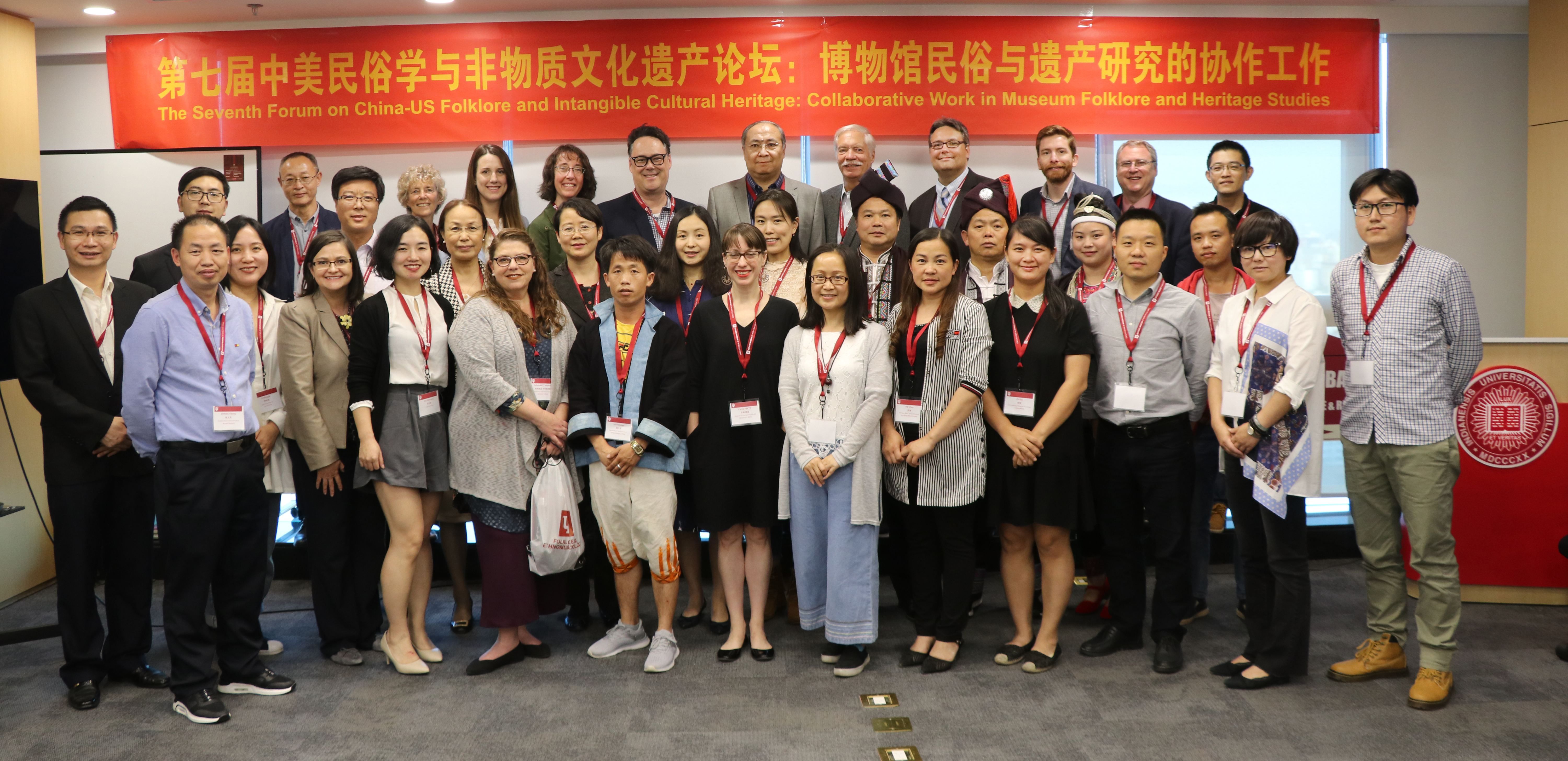
Delegates to the forum came from a diversity of American and Chinese museums and universities. Chinese institutions represented included the Chinese Academy of Social Sciences, Sun Yat-sen University, the Anthropology Museum of Guangxi, the Nandan Baiku Yao Ecomuseum, Beijing Normal University, the Sanjiang Dong Ecomuseum, East China Normal University, Fudan University, the Guizhou Nationalities Museum, Minzu University of China, Shandong University, and the Yunnan Nationalities Museum. American institutions represented included the Michigan State University Museum, the Museum of International Folk Art, Texas Tech University, the Mathers Museum of World Cultures (Indiana University), History Miami, the Sam Noble Oklahoma Museum of Natural History (University of Oklahoma), and the American Folklore Society (Figure 1).
IMG_2160 copy_ed

Figure 1. Delegates to the Seventh Forum on China-US Folklore and Intangible Cultural Heritage held at the Indiana University Gateway Office in Beijing, May 19, 2019. Shu Caiqian (Guizhou Nationalities Museum), Zhang Yibing (Guizhou Nationalities Museum, Zhu Gang (Chinese Academy of Social Sciences), Li Mingjie (East China Normal University), Wang Wei (Shandong University), Jessica Anderson Turner (American Folklore Society), An Deming (Chinese Academy of Social Sciences), Luo Wenhong (Fudan University), Marsha MacDowell (Michigan State University Museum), Surna (Minzu University of China), Kristin Otto (Mathers Museum of World Cultures), Felicia Katz-Harris (Museum of International Folk Art), Sarah Hatcher (Mathers Museum of World Cultures), Yang Lihui (Beijing Normal University), Lu Chaoming (Nandan Baiku Yao Ecomuseum), Jason Baird Jackson (Mathers Museum of World Cultures), Chen Xi (Sun Yet-sen University), Carrie Hertz (Museum of International Folk Art), Chao Gejin (Chinese Academy of Social Sciences), Wuerxiya (Mathers Museum of World Cultures), Fan Miaomiao (Anthropology Museum of Guangxi), C. Kurt Dewhurst (Michigan State University Museum), Yang Quanzhong (Sanjang Dong Ecomuseum), He Chun (Nandan Baiku Yao Ecomuseum), Michael Paul Jordan (Texas Tech University), Wu Dawei (Sanjang Dong Ecomuseum), Ou Bo (Anthropology Museum of Guangxi), Michael Knoll (History Miami), Lan Yuanyuan (Sanjang Dong Ecomuseum), Gong Shiyang (Anthropology Museum of Guangxi), Jon Kay (Mathers Museum of World Cultures), Luo Yong (Nandan Baiku Yao Ecomuseum), Mai Xi (Anthropology Museum of Guangxi), Zhao Fei (Yunnan Nationalities Museum), Wang Yucheng (Anthropology Museum of Guangxi).

On the afternoon of May 19, the conference began with warm words of welcome from AFS Executive Director Jessica Turner and CFS Past President Chao Gajin (Chinese Academy of Social Sciences), standing in for current CFS President Ye Tao (Chinese Academy of Social Sciences) who was unable to attend (Figure 2). Also offering brief opening remarks on behalf of the program committee were Jason Baird Jackson (Mathers Museum of World Cultures) and Gong Shiyang (Anthropology Museum of Guangxi) (Figure 3). These remarks preceded the forum’s keynote address by C. Kurt Dewhurst (Michigan State University Museum). Extending an earlier discussion of principles for museum collaboration (Dewhurt and MacDowell 2015), Dewhurt reflected on a range of museum collaborations in which he and the MSU Museum have participated. Among the collaborations that Dewhurst addressed were earlier phases of the AFS-CFS partnership, which has included two museum sub-projects (2013-2016; 2017-2019). The first of these encompassed the Fifth and Sixth forum events, the traveling exhibition and bilingual catalogue Quilts of Southwest China (MacDowell and Zhang 2015), and numerous other elements (Lloyd 2017). In this phase, three Chinese museums and three US museums partnered together (Dewhurst and Lloyd 2019). In the more recent phase, collaborators from the three U.S. museums have joined with the Anthropology Museum of Guangxi for a program of joint research focused on textiles and intangible cultural heritage policy in two northern counties of the Guangxi Zhuang Autonomous Region. Central to this new phase of work are the Nandan Baiku Yao Ecomuseum and the Sanjiang Dong Ecomuseum. Thus, while Dewhurst’s keynote was a general reflection on museum collaboration, his presentation also served to orient conferees to the specific joint AFS-CFS supported projects that gave the forum its organizational context.

The keynote address was followed by a panel discussion in which representatives from the Sanjiang Dong Ecomuseum and Nandan Baiku Yao Ecomuseum described their work and the community and organizational collaborations in which they participate (Figure 4). American participants appreciated this opportunity to learn about the innovative work of these ecomuseums first-hand and drew comparisons to various kind of community-based museums in the US. While Chinese delegates were more knowledgeable about the form that ecomuseums take in China, they also appreciated the chance to engage with the ecomuseum leaders directly in a comparative scholarly context.

It was an honor that many Beijing-based leaders in the CFS and in Chinese folklore studies overall could attend these opening events, which also included a welcoming banquet generously hosted by the CFS. This gathering was enlivened further when the leaders of the Sanjiang Dong Ecomuseum introduced both Dong flute music and toasting songs to the group. For many American delegates, this was a memorable first experience with the richness of Chinese banquet customs and the beauty of Dong music (Figure 5).

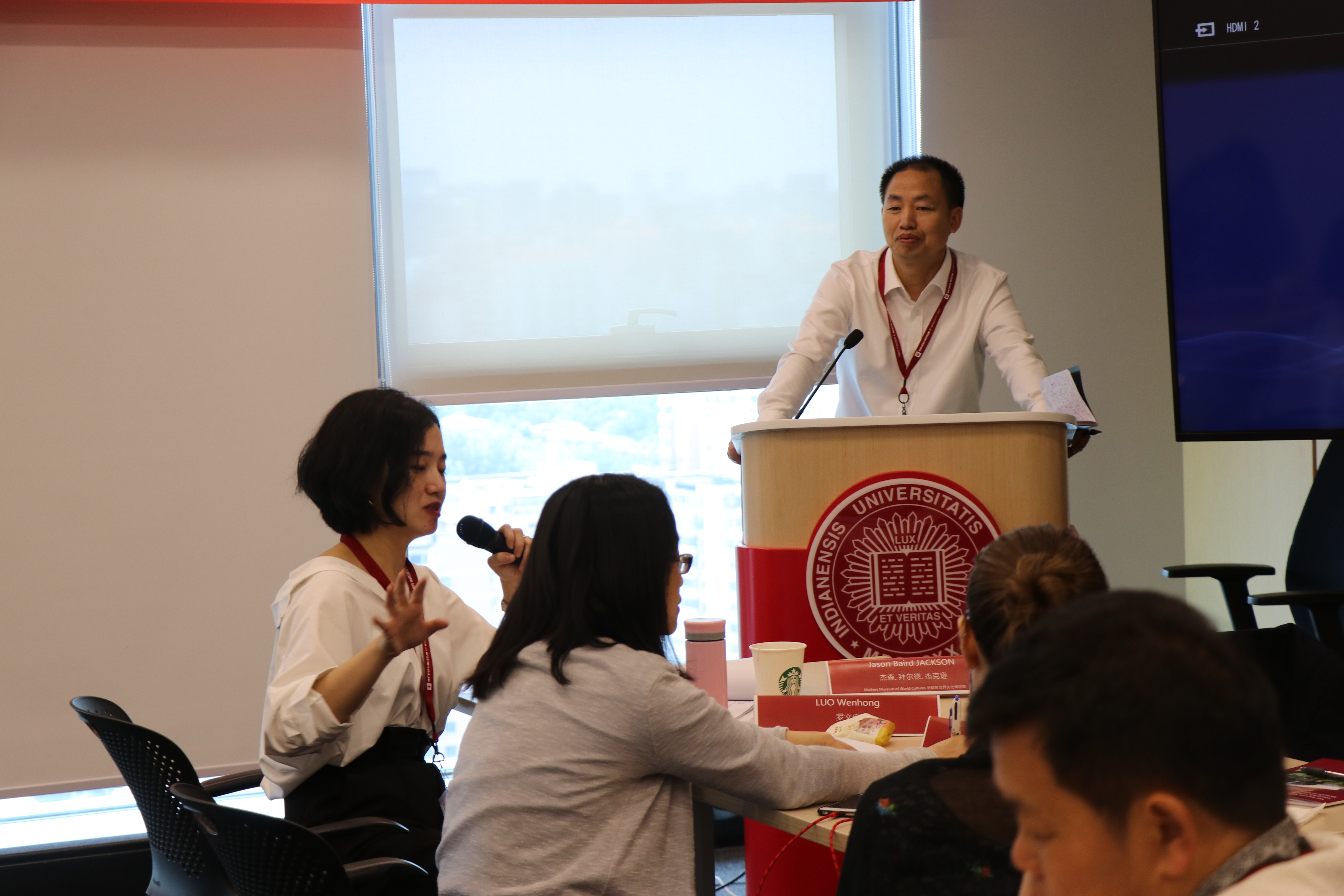
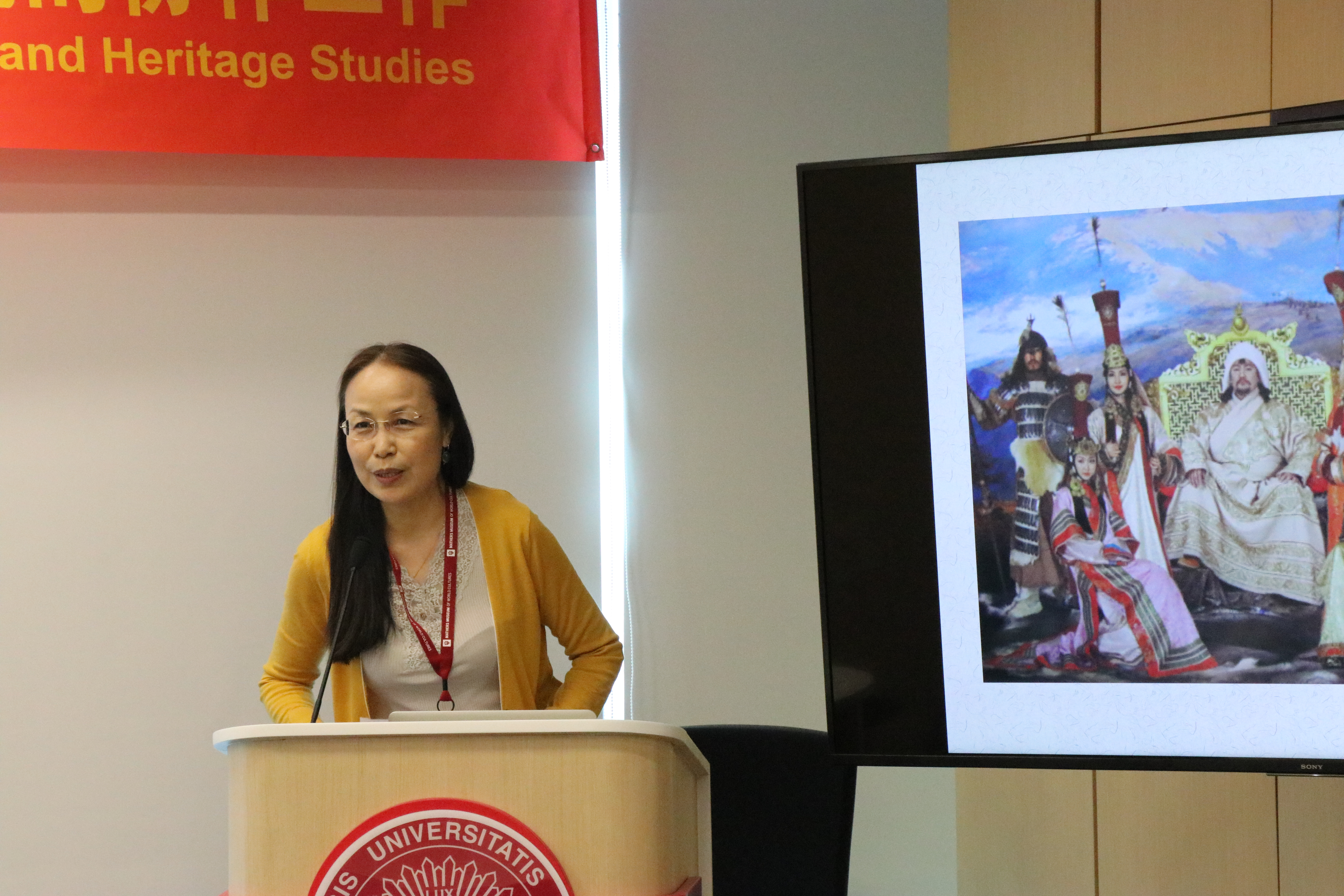
The second day of the conference was a full day featuring presentations from Chinese and American delegates. In line with the goals of the forum, the presenters described specific museum collaboration projects, using them as the basis for broader reflections on the work of museum ethnography and heritage studies today. Translation for most conference presentations was very ably done by Chen Xi (Sun Yat-sen University) and Luo Wenhong (Fudan University) (Figure 6). A number of themes emerged through the juxtaposition of presentations throughout the conference. These included: (1) the nature of museum-based ethnographic and exhibition projects in urban contexts, (2) the dynamics unique to heritage-oriented fieldwork pursued across differences of language, culture, and institutional context, (3) the place of objects and material culture studies within museum collaborations, (4) the use of exhibitions as catalysts for broader collaborations and relationship building, (5) the value of older museum collections for contemporary communities and craftspeople, (6) the place of documentary video in museum ethnography, and (7) the special importance that attaches to national folk costume in diverse museum and local cultural contexts in the current era (Figure 7).

The conference’s third day featured a morning of additional presentations followed by a special outing in which conferees visited Beijing’s Shichahai historic area to learn about cultural preservation and heritage tourism activities centered there (Figures 8-9). Participants enjoyed a hutong tour and a visit to the Drum Towner of Beijing (Gulou). While she could not attend the forum, this outing was curated by Zhang Lijun (George Mason University) and drew upon her folklore research interpreting the narrative performances of hutong tour guides (Zhang 2016, 2019). The conference concluded with a banquet, hosted by AFS and featuring Yunnan cuisine. Highpoints of this concluding gathering were many individual expressions of friendship and goodwill as well as a vigorous singing competition staged between the binational groups gathered around two large banquet tables. Heartfelt singing in Dong, Yao, Mandarin, Mongolian and English brought the seventh forum to a joyful close.

References Cited

Dewhurst, C. Kurt, and Timothy Lloyd. 2019. “The American Folklore Society-China Folklore Society Folklore and Intangible Cultural Heritage Project, 2013-2016.” Museum Anthropology Review 13 (1): 59-68. https://doi.org/10.14434/mar.v13i1.25405

Dewhurst, C. Kurt, and Marsha MacDowell. 2015. “Strategies for Creating and Sustaining Museum-Based International Collaborative Partnerships.” Practicing Anthropology 37 (3): 54–55. https://doi.org/10.17730/0888-4552-37.3.54

Lloyd, Tim. 2017 “The Inside Story of the AFS China-US Project.” https://www.afsnet.org/news/349609/The-Inside-Story-of-the-AFS-China-US-Project.htm, accessed June 12, 2019.

MacDowell, Marsha, and Lijun Zhang, eds. 2016. 中国西南拼布 | Quilts of Southwest China. Nanning: Guangxi Museum of Nationalities. [Distributed in the United States by Indiana University Press.]

Zhang, Lijun. 2016. “Performing Locality and Identity: Rickshaw Driver, Narratives, and Tourism.” Cambridge Journal of China Studies 11 (1): 88-104. https://www.repository.cam.ac.uk/handle/1810/260292

Zhang, Lijun. 2019. “A Brief Guide to Shichahai.” Video Presentation Prepared for The Seventh Forum on China-US Folklore and Intangible Cultural Heritage: Collaborative Work in Museum Folklore and Heritage Studies, Beijing, China.

IMG_1984

Figure 2. Figure 2. Chao Gajin welcomes delegates to the Seventh Forum on China-US Folklore and Intangible Cultural Heritage: Collaborative Work in Museum Folklore and Heritage Studies. May 19, 2019. Photograph by Jon Kay.

IMG_2001

Figure 3. Figure 3. Gong Shiyang addresses delegates to the Seventh Forum on China-US Folklore and Intangible Cultural Heritage. May 19, 2019. Photograph by Jon Kay.

IMG_2072 copy

Figure 4. Wu Dawei offers remarks on the work of the Sanjang Dong Ecomuseum during the ecomuseum panel discussion. Left to Right: Lu Chaoming, He Chun, Lan Yuanyuan, Yang Quanzhong, Wu Dawei, Luo Wenhong (translating), Jason Baird Jackson. May 19, 2019. Photograph by Jon Kay.

IMG_2434

Figure 5. Wu Dawei performs Dong flute music at the opening banquet. May 19, 2019. Photograph by C. Kurt Dewhurst.
IMG_2297

Figure 6. Zhang Yibing discusses the work of the Guizhou Nationalities Museum with Luo Wenhong providing English translation.. May 20, 2019. Photograph by Jon Kay.

IMG_2320

Figure 7. Carrie Hertz discusses research related to the exhibition Dressing with Purpose. May 20, 2019. Photograph by Jon Kay.
IMG_2475

Figure 8. Surna discusses her research on Mongol national dress. May 21, 2019. Photograph by Jon Kay.

IMG_7434

Figure 9. Lan Yuanyuan and He Chun begin a rickshaw tour of the Shichahai neighborhood in Beijing. May 21, 2019. Photography by Jason Baird Jackson.

Looking Ahead: University Anthropology Museums Matter

With notices going out from the Program Committee this week, the American Anthropological Association’s annual meeting (November 29-December 3, 2017) is coming into focus. Notes that I am seeing on Facebook and Twitter suggest that the program will feature a lot to like. I am pleased to note that a Executive Session that colleagues and I have organized has been accepted and scheduled. If you are interested in museum anthropology or the future of university museums, I invite you to hold the day and time. We would love to see you there. Here are the details.

Looking Ahead: University Anthropology Museums Matter
Friday, December 1, 2017
8:00 AM – 9:45 AM

Session Abstract: University-based museums of anthropology, including campus museums of natural history, history, and art with anthropological programs, play a vital role not just as hubs for the work of museum anthropology but for the research, teaching, professional training, and public outreach agendas of the field as a whole. While the historical contributions of university-based museum anthropology are decisive and worthy of continued investigation, this panel aims to characterize present work viewed in institutional terms and to anticipate new developments and emerging needs in the field more broadly. Numerous campus anthropology museums have experienced leadership changes in recent years. This collective shift, as well as dramatic changes happening in the publics with which campus museums engage, suggests that now is a particularly good moment to undertake an environmental scan and in which to consider a collective agenda that is cognizant of the vexing challenges—from anthropogenic climate change to rising inequality; from resurgent xenophobia to the transformation of higher education—that anthropology museums are positioned to address. As the leaders of six key university anthropology museums, the speakers will characterize the present work and emerging goals of their institutions. Considering the changing contexts—intellectual, economic, political, technological, educational, ethical—within which museum anthropology, and anthropology more generally, is being pursued, they will also propose topics and tactics for collective work in the period ahead. While rooting their reflections in the work of their institutions, the presenters will directly address the conference theme Anthropology Matters from the distinctive vantage point of campus anthropology museums in the United States, Canada, and the United Kingdom.

Thanks go to all who supported or endorsed the session proposal, including our sponsor, the Council for Museum Anthropology. See you in Washington.

cma-logo

CFP: Museum Anthropology Futures

On behalf of the Council for Museum Anthropology, I am happy to pass along the call for proposals for the Museum Anthropology Futures conference in Montreal this May. Find details below. (Quoted material follows, contact the organizers with questions or concerns.)

Call for Session Proposals: “Museum Anthropology Futures” Conference (due March 1)
Council for Museum Anthropology Inaugural Conference

May 25-27, 2017 at Concordia University, Montreal, Quebec, Canada

The Council for Museum Anthropology is seeking submissions for its inaugural conference taking place in Montreal from May 25-27, 2017. This will not be your traditional conference experience! “Museum Anthropology Futures” seeks to spark critical reflection and discussion on (1) the state of museum anthropology as an academic discipline; (2) innovative methods for the use of collections; (3) exhibition experiments that engage with anthropological research; and (4) museums as significant sites for grappling with pressing social concerns such as immigration, inequality, racism, colonial legacies, heritage preservation, cultural identities, representation, and creativity as productive responses to these.

The conference will have several sessions each day that all participants will attend, as well as one period each day with breakout sessions like workshops and formats that would benefit from a more intimate setting for dialogue and collaboration.
We are seeking session proposals that are different than the usual call for papers – see session descriptions below. Feel free to email us with questions at museumfutures2017@gmail.com.

Updates available at our Facebook page, https://www.facebook.com/MuseumFutures/

Email your session proposal to museumfutures2017@gmail.com by March 1, 2017

Please provide the following information in your email text, no attachment:

1) Your name, title, home institution (if applicable), and email address
2) Your proposed session format (see below)
3) The title of your session
4) Additional session participants if a group submission (title and email address)
5) A description of your session (max 150 words) Specific requirements for each format below.
6) What you hope to achieve in presenting/participating in this session (1-3 sentences)
7) What you believe this session can contribute to museum futures (1-3 sentences)
***Please note: Some Workshops and Pre-circulated Paper sessions will be by registration only due to limited capacity. All other sessions are open to all conference participants. For example, Roundtable or PechaKucha sessions will have several presenters who discuss their work, and the audience attending the session is invited to listen and ask questions or give feedback.***

SESSION FORMATS
Read more

CFP: Unfinished Stories: Folklife and Folk Narrative at the Gateway to the Future

Unfinished Stories: Folklife and Folk Narrative at the Gateway to the Future

The 2016 Joint Meeting of the American Folklore Society and the International Society for Folk Narrative Research

October 19-22, 2016

Hyatt Regency Miami, Miami, Florida, USA

The joint meeting of the American Folklore Society (AFS) and the International Society for Folk Narrative Research (ISFNR) will bring together more than 800 US and international specialists in folklore and folklife, folk narrative, popular literature, and related fields to exchange work and ideas and to create and strengthen friendships and working relationships.

The meeting will feature a number of plenary lectures as well as panel and forum presentations of work by folklorists and their allies in 14-17 concurrent sessions for four days. In addition, participants may register for workshops and tours that will offer an introduction to some of Miami’s cultures and communities.

Prospective participants may submit proposals for papers, panels, forums, films, and diamond presentations or propose new presentation formats. Proposal submission begins February 1 and ends March 31. Presentations on the theme are encouraged but not required.

Proposals will be reviewed by a committee of ISFNR members and of folklorists who live in the region hosting the meeting. AFS will send notification of acceptance or rejection for the meeting program in early June and post an online preliminary program schedule by July 1.

You can find more information about the meeting, including instructions for submitting proposals, beginning February 1, 2016, at http://www.afsnet.org/?2016AM.

Theme: Unfinished Stories: Folklife and Folk Narrative at the Gateway to the Future

Throughout its history, Florida has served as a sustained point of cultural convergence and exchange. Its tropical climate, burgeoning economy, and geographic proximity to the Caribbean and Latin America have influenced its cultural identity. South Florida was shaped by early migration from the United States and Caribbean Islands, as well as influxes of political refugees during the second half of the 20th century. Miami, known as the “Gateway of the Americas,” is now perceived as one of the largest and most significant Latin American and Caribbean cities. As Miami continues to evolve through cultural synthesis, it serves as a leader in terms of its transnational identity and experiences.

In addition to being termed a “Gateway,” Miami has also been described as a “City of the Future.” As such, it offers inspiration for multiple perspectives on the future development of folk narrative and folklife, both within the region and in larger contexts. Relevant topics include transnational communities, cultural synthesis and creolization, the impact of the digital revolution on folk culture, narratives about land and place, traditional responses to climate change, and much more. Conference participants may reflect on these unfinished stories as they appeared in the past and also consider the future of our fields, including emergent theories, methodologies, and ethics.

The organizing committee invites participants to explore the narrative dimensions of their work, regardless of topic.

Contact info:

Lorraine Walsh Cashman
American Folklore Society
Eigenmann Hall, Indiana University
1900 East Tenth Street
Bloomington, IN 47406
812-856-2422; fax: 812-856-2483
www.afsnet.org
lcashman@indiana.edu

Joanna Ella
Secretary
International Society for Folk Narrative Research
www.isfnr.org
jella@gwdg.de

AFS “Folklore and Museums Section” Founded, AFS Members (and Non-Members too) are Welcome to Join

I am happy to note here that the Executive Board of the American Folklore Society has endorsed a proposal put forward by the Folklore and Museum Policy and Practice Working Group to establish a Folklore and Museums section within the society. The section came into existence as of the Executive Board’s November 2014 meeting in Santa Fe. I am very pleased to serve as the new section’s first convener and to invite everyone with an interest in the intersection of museum practice and folklore (/folklife/ethnology) to join the new section.

As noted in the call for members on the AFS website:

the Folklore and Museums Section exists to foster communication and cooperation among museum-oriented folklorists, to advance the contribution of folklore studies scholarship and practice in museum settings, and to articulate museum-oriented folklorists with other colleagues, institutions, and organizations in the museum sector. The section aims, whenever possible, to cooperate with other sections of the American Folklore Society and with peer-organizations in the field.

The public web home for the new section can be found online here: http://www.afsnet.org/?page=MuseumSection and the member’s group space is accessible to members who are logged into the AFS website.

While I am very eager for all interested colleagues to join AFS, I want to note that the AFS has a free “Section Only” membership category by which non-AFS members can sign-up with sections such as the new Folklore and Museums section. This might be of particular value to non-folklorists who wish to keep up with the section’s work. Information on the Sections Only “membership” is available on the Membership Categories page of the AFS website. There is no cost to join the Folklore and Museums section.

The Santa Fe meetings were a great gathering for museum-minded folklorists. I am optimistic that the new section can help make the 2015 meetings even richer for our corner of the field. Thanks to all who have contributed to the momentum behind the new section and to the growth of folklore and museums work.

Sky Above New Mexico Museum of Art

Sky Above New Mexico Museum of Art, November 2014

Check Out the New Anthropod Podcast on Open Access

I really enjoyed listening to the new Anthropod podcast on open access in anthropology. Focusing on the move of Cultural Anthropology to an open access model, hosts Bascom Guffin and Jonah S Rubin have done a great job with the podcast. I urge everyone to check out their well produced conversations with Sean Dowdy (of Hau), Alex Golub (of Savage Minds and many OA discussions), Brad Weiss (past SCA President), and Timothy Elfenbein (Cultural Anthropology Managing Editor).

Find it in context here: http://www.culanth.org/fieldsights/492-8-can-scholarship-be-free-to-read-cultural-anthropology-goes-open-access