It would take a book to itemize and admire all of the vital tasks and key accomplishments that Amy Skillman realized during her year as American Folklore Society President-Elect (2023) and her two years as AFS President (2024, 2025). I know that I speak on behalf of the whole AFS membership when I note here my profound thanks for all that Amy has done to support and advance AFS, the field of folklore studies, and the quality of cultural life experienced in the communities–both grassroots and academic–that folklorists aspire to serve. I am appreciative of all that she has done leading the society and I am grateful that she will continue to contribute as board member and Past-President in the year ahead. May 2026 be a great year for Amy and for all who help AFS thrive.
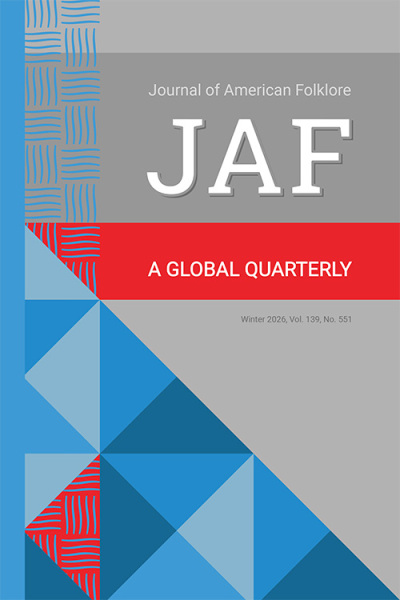
Even before 2026 began, many American Folklore Society (AFS) members were already getting a first glimpse of Journal of American Folklore (JAF) 139 (551), the Winter 2026 issue. I have started reading it via Project Muse, but JAF readers experience the journal in a variety of formats, including print. If you have not seen it yet, I am sure that you will be checking it out soon. There is much to consider and think about in the issue. I am tempted to start writing here about contributions of special interest—many very timely and important—but I instead wish to use this space to acknowledge and thank two groups of colleagues.
George Mason University folklore studies faculty members Lisa Gilman (Editor-in-Chief), along with Ben Gatling, Debra Lattanzi Shutika and Lijun Zhang (Co-Associate Editors) worked with a range of colleagues across the field, within AFS, and at the University of Illinois Press, to steward and advance the journal over several years (2020-2025). Their term of service concluded at the end of 2025, with the new issue being the first led by the new editorial collective. Thus, 2025 was—as suggested by the new issue just out—a fruitful year of collaboration and overlap between the outgoing editors and the incoming ones. My first order of business is to join the new editors (Cantú et al. 2026) to thank Lisa, Ben, Debra, and Lijun for their exemplary service stewarding and advancing JAF throughout their term as the JAF editorial team. Editing almost any journal is a challenge and editing a global English flagship journal with four issues a year, in this time and place, is a particularly daunting task. AFS and the whole global folklore studies community is fortunate to have benefitted from their leadership across many endeavors and we were fortunate that they chose to take up the work of editing JAF at a crucial time. Helping them were many peer-reviewers, editorial assistants, University of Illinois Press colleagues, freelance publishing professionals, and others. It takes a village to publish a journal.
A crucial bridge between the outgoing and incoming editorial teams is JAF’s Senior Managing Editor Lorraine Walsh Cashman, whom I thank here in the liminal space within this post!
Which brings me to the new editorial collective. I here want to express appreciation for colleagues Norma E. Cantú (Trinity University), Coppélie Cocq (Umeå University), Tim Frandy (University of British Columbia), Lisa Gabbert, (Utah State University) and Shelley Ingram (University of Louisiana at Lafayette) for their willingness to take on our most important AFS publication and to pioneer a new distributed editorial team model. As reflected in the new issue of JAF, they have already been hard at work since early in 2025 and it is exciting to now see and read the first fruits of their labors.
With their diverse talents, backgrounds, and interests, and Lorraine’s experience linking the journal’s excellent past work to their promising present efforts, JAF is well positioned to thrive in the year, and the years, ahead, despite the many challenges that our field, our society, and our wider calling as humanists and interpretive social scientists will face in the period ahead. My thanks go not only to the new editorial team, but also to Lorraine and the various student assistants, peer-reviewers, deans, departmental staffers, University of Illinois Press colleagues, and others who have already helped the team to succeed and who will do so in the years ahead.
Please do not flood their email boxes but do look for opportunities in the year ahead to thank both sets of editors for their valuable service on behalf of the American Folklore Society and all those whom we serve and support.
Reference Cited
Cantú, Norma E., Coppélie Cocq, Tim Frandy, Lisa Gabbert, and Shelley Ingram. 2026. “From the Editors.” Journal of American Folklore 139 (551): 3–4.
All, or almost all of the ACLS Scholarly Societies are in mutual aid relationships with university-based scholarly publishers (=university presses). In the case of folklore studies and the American Folklore Society (AFS), the most obviously relevant of these presses are (1) University of Illinois Press (which publishes the Journal of American Folklore (JAF) on behalf of AFS), (2) Indiana University Press (based at Indiana University Bloomington, where AFS is also based), (3) University Presses of Mississippi, (4) Wayne State University Press, (5) University of Wisconsin Press, and (6) Utah State University Press (now an imprint of the University Press of Colorado). Numerous other university presses in the United States are important to folklorists for various (often, but not only, area studies) reasons, but these six are particularly impactful through their (strong, specifically) folklore studies lists. They are also, like their peer presses strong in other fields, always working to innovate and take advantage of new affordances arising in our own time. Like our societies, they are not perfect but they are invaluable.
I have had a lot to say previously about university presses and scholarly communications more generally. Beyond talk, I have tried to do what I can. where I can to help. Here I just want to record again that university presses are themselves a crucial part of the ecosystems within which scholarly societies work generally, and in which folklorists and the AFS works, specifically. There are many threads woven together here and I will not unravel them at this point. Key at present is that those six presses of special concern to AFS members (call them the six most likely to send editors and books to the AFS meetings year after year) are all based at public universities. Things are more and more challenging at public universities like the ones that host these presses, especially anything seen from above to be part and parcel of the humanities, the social sciences, or the liberal arts tradition generally. The contexts in which the presses and some of us as individuals work are getting more difficult and administrators in varied locations are less and less willing to listen and learn learn about the important ways that university presses serve the universities that host them as part of a larger ecology of actors advancing research, teaching and service in the public interest.
So, when we do environmental scans of the state of our field, or when we pursue such things as a so-called SWOT analysis (Strengths, Weaknesses, Opportunities, Threats), we must keep the state of “our” university presses in mind. They have done, and are doing, important work with and for folklorists every day. In doing that work, they are also helping students and the various local audiences, publics, communities, and and collaborators with whom we engage. Given that all of the nodes in our network are experiencing new stresses, it is important that none of us in that network take any other node for granted. We must keep a lot of different things in view, including university press publishing.
My run of posts on scholarly societies in general, and my scholarly societies in particular, has, I know, been heavy on facing unhappy developments and low, so far, on positive prospects. Here is a post to where I highlight what is for me a welcome trend.
I live and work in a community that still centers a really rich and generative and extended form of in-person graduate education, but my colleagues and I have long been confronted by the question of how to support those who cannot take up the project of moving across the United States, or the globe, to join us in the multi-year study of folklore (or, in my other field and department, anthropology). This question predated the internet. It predated Zoom, YouTube, and similar platforms. It once took the form of letters seeking reading recommendations and these still come to us by email. In my former department, the Department of Anthropology at the University of Oklahoma, we then still ran a paper- and postage-based correspondence course in folklore studies when I arrived on the faculty in 2000. The old summer institute-based form of the Folklore Institute associated with Indiana University and the leadership of Stith Thompson (1885-1976)—like it’s still thriving peer, the Linguistic Institutes run by the Linguistic Society of America since 1928—was another analog solution to the problem of low residency, high impact, advanced study in folkloristics. For the bestowal of a full and formal master’s degree, the Master of Arts in Cultural Sustainability (M.A.C.S.) today offered by folklorists and allies at Goucher College is a now proven low-residency option. I commend all of those, past and present, who have worked to build up the Goucher program. They identified, and have found ways to meet, an obvious need.
To my fellow folklorists, I say that we need more experiments and more approaches to the problem of higher-level, but still introductory, educational opportunities in folklore studies. It is in this context that I have been inspired by some specific developments that I wish to flag. For those who are not yet aware of them, I point here to some in-person and online initiatives that have broader implications. If you can get access to the Chronicle of Higher Education, I direct your attention to a survey article: “Making Space for the Humanities Off Campus: Night School Bar and the Brooklyn Institute for Social Research offer alternatives to traditional academe.” by Ariannah Kubli (2024). Finish out your introduction, if you can, by consulting an older (but still post-COVID) account of the Brooklyn Institute for Social Research (BISR) in the New York Times: “Where Can You Go to Grad School Without Going to Grad School?” by Cat Zhang (2023).
Given the number of folklorists in New York City and the lack of folklore courses there, it would be easy and fruitful to imagine a sophisticated folklore studies course in-person at the BISR, but pitching such a direct thing is not my point here. What I am trying to evoke is the idea that we can find win-win ways to give more adults access to sophisticated learning in folklore studies outside the extant US/North American/world graduate programs.
While the articles cited above evoke the convivial nature of in person, non-degree adult education, it is important to highlight here that many of the BISR courses (to stick with a flagship example) are taught online and are thus available to those who cannot physically get to Brooklyn, New York. I urge the curious to check out the current BISR course offerings not because I am urging you to take one of their courses, but because I am hoping that you will give thought to the possibilities. It is within the capacity of, I believe, organizations such as the American Folklore Society to organize and platform such a thing as a four-week (twelve-contact hour) introduction to folklore studies. Who might take such a course? Probably a mixed group with diverse purposes, but one audience that I hope would take such a course would be those colleagues who have entered the realm of public folklore practice without having a background in folklore studies. Such colleagues increasingly staff folk and traditional arts programs in state-level arts and humanities agencies and thus are our colleagues, but they are colleagues who sometimes struggle to join in the discussions that we have had been advancing since 1888 or earlier. Another potential audience might be those pondering whether formal graduate training in folklore studies is actually what they want.
Of course, the examples of Night School Bar and the BISR are just variations on older practices, including a wide range of proven community education frameworks that we can be revisiting and perhaps revising for present purposes. The first folklore studies course that I ever taught was a multi-session course for adults on “Jewish Folklore and Ethnology” shared in Tulsa, Oklahoma as part of the dryly named, but richly experienced, “Adult Institute” co-managed by Jewish community organizations in the city that I once lived in so intensively. I was too young and inexperienced when I did that, but I know of no harms caused and I met lifelong friends in the doing.
I will wrap this reflection up, but I note that trends in continuing and adult education are intersectional with the rise of microcredentials in general and the practical ability for organizations to issue semi-formal credentials on platforms like LinkedIn in particular. When I complete, for instance, university- required training on various regulations governing my work as a scholar, these completed trainings can now be sent to display on my LinkedIn page. We are now more than a decade into discussions of digital badges and a raft of related practices that are separate from the university degree and its associated transcript. There is a large literature on microcredentials and continuing education in various domains, and the issues are complex, but the shallow end of the pool is accessible to us and in the AFS, we have a strong, time-tested brand. We at least have opportunities, as always, to experiment with even one-time trials. In this, we have the recent experience of the such key recent projects as the Folk Arts Partnership Professional Development Institute, the Veterans Oral History Workshops, and the institutes held in connection with the China-US Folklore and ICH Project. All of these have been partnered and impactful programs in teaching and learning staged outside formal university educational contexts.
PS: To anyone who has reads this post with hope that it would offer a top ten list of ways to study folklore without going to graduate school, I am sorry that my colleagues are not yet in a place to answer the title question in that way. For a glimpse of how the field works in the United States, see Lloyd (2021). For a glimpse how folklorists write and think, consider reading any of the titles recognized with the Chicago Folklore Prize. And think about attending a American Folklore Society annual meeting.
Miami tradition bearer and Allen County Resident Dani Tipman (center) being recognized by Jon Kay (left) and Scott Willard, NAGPRA Program Director for the Miami Tribe of Oklahoma. In addition to being an Indiana Heritage Fellow (2021), Dani was recently recognized with a national Taproot Fellowship.
On Friday evening on the Indiana University Bloomington campus in Maxwell Hall, Traditional Arts Indiana hosted a moving and inspiring celebration of the state’s grassroots arts and cultures. Specifically, the event celebrated the work of an impressive roster of masters and apprentice teams carrying forward a rich array of art, craft, and performance forms. At the same time, a wonderful cohort of Indiana Heritage Fellowship Awardees were acknowledged and given the spotlight. These days I am more likely to cry tears of grief when on my own campus, but this was an evening that, by the time it reached its zenith, had my tearing up with tears of thanksgiving. What I know is that scenes just like this take place around the United States year-round (but not often enough) and that this happens because academic folklore studies departments and programs like mine train students to do the good work to make such programs happen and that all of us are supported in this work by the American Folklore Society.
The event in Maxwell Hall was overflowing. I arrived a bit late and worried that I would have to stand for a few hours—as some wound up doing—but I (as is so often the case) was lucky and the amazing Jenny Yang, a fellow Bloomington resident and herself a marvel and a multi-tradition bearer, flagged me over to an empty seat next to her. Not having visited with her since the end of the Mathers Museum and the onset of COVID, it was such a treat to chat with her before the formal program began. Along with her late husband James, Jenny has been a stalwart supporter of, and participant in, the programs of TAI. They were valued supporters and friends of the MMWC too, featured in exhibitions and programs at the museum.
While Jenny and I visited and traded stories and I asked her questions about mahjong, the edges of the room bustled with craftspeople and artisans demonstrating and discussing their work. To the left at the front of the room, a who’s who of Indiana musicians, together with some of their apprentices, were seated in an oval, jamming and filling the room with beautiful music played on fiddles, guitars, banjos and mandolins.
At the appointed hour, Jon Kay (Director of Traditional Arts Indiana) went to the podium to begin the formal program. I won’t do justice to it all here, but I want to identify the honorees, as the diversity and excellence that they represent speak to what is best about the state of Indiana, and by extension, life in the United States.
While it may be open for a bit longer for logistical reasons, Friday was the official finale for the exhibition A Culture Carried: Chin Basketry in Central Indiana (also presented by TAI in Maxwell Hall). This exhibition was simply excellent—rich, detailed, beautiful, well-informed, surprising to the uninitiated. In this context, the program began with special recognition of the Chin tradition bearers in the room. The delegation from Chindianapolis included weavers and weaving learners from the Winding Wednesdays group, as well as the two basket makers featured in the A Culture Carried exhibition, Pu Ngai Chum and Reverend Ceu Hlei, with members of their families. (To get background on the exhibition and its contexts, see my earlier post where I pose five questions to Jon about it.)
For most of the individuals recognized, displays and demonstrations happening before the awards ceremony itself served to showcase them and their disciplines, but for the musicians recognized, there were brief opportunities to hear and see performances during the awards ceremony itself.
The 2023 and 2024 Apprentices and masters recognized were:
Sam Bartlett (of Monroe County) and his apprentice Patrick Blackstone, supported in the transmission of mandolin playing (they sounded great!) [2023]
Tony Dickerson (of Marion County) and her apprentice Verna Moore, supported in the transmission of quilting [2023]
Emily Guerrero (from Allen County) and her apprentice Avery Guerrero, supported for the transmission of ofrenda making [2023]
Pi Hniang Ki (from Marion County) and her apprentice Anna Biak, supported for the transmission of Chin weaving traditions [2023]
Natalie Kravchuk (from Monroe County) and her apprentice Gabriela Coolidge, supported in the transmission of Ukranian American pysanka making [2023]
Denzil McMim (from Harrison County) and his apprentice Rebekah Carrol, supported in the transmission of wood chain carving [2023]
Joe Rice (from Tipton County) and his apprentice Matt Kenyon, supported in the transmission of Indiana glass arts [2023]
Peggy Taylor (from Posey County) and her apprentice Taylor Burden, supported in the transmission of Indiana loom weaving practices [2023]
Jannie Wyatt (from Allen County) and her apprentice Dee Chambers, supported in the transmission of quilting [2023]
Marlene Gaither (from Floyd County) and her apprentice Danny Gaither, supported in the transmission of rag rug weaving [2024]
Larry Haycraft (from Pike County) and his apprentice Cameron Burkhart, supported in the transmission of net making [2024]
Kwan Hui (from Hamilton County) and his apprentices Kevin Quang and Quan Nguyen, supported in the transmission of Lion Dance performance [2024]
Shaomin Qian (from Hamilton County) and his apprentices Shaojuan Jia, Jin Lu, Sen Li and Yijun Wang, supported in the transmission of Chinese seal (stamp) carving [2024]
Jim Smoak (from Washington County) and his apprentice Graham Houchin, supported in the transmission of banjo playing (they sounded great!) [2024]
Becky Sprinkle (from Laurence County) and her apprentice Brittany Campbell, supported in the transmission of local music jam organizing (they sounded great!) [2024]
Pi Nah Sung (from Marion County) and her apprentice Awi Nung, supported in the transmission of Chin weaving traditions [2024]
Jena Visel (Spencer County) and her apprentice Donna House, supported in the transmission of Eastern Orthodox-tyle icon painting [2024]
Recognition of these masters and their apprentices was so moving and inspiring for me and for, I think, almost everyone in attendance. They represent the pursuit of excellence. They remind us that knowledge and value exist everywhere, not just on university campuses, big city galleries, and in corporate headquarters. Together with the Heritage Fellows to whom I turn next, they represent the true diversity and strength of my adopted home state and the United States as a whole.
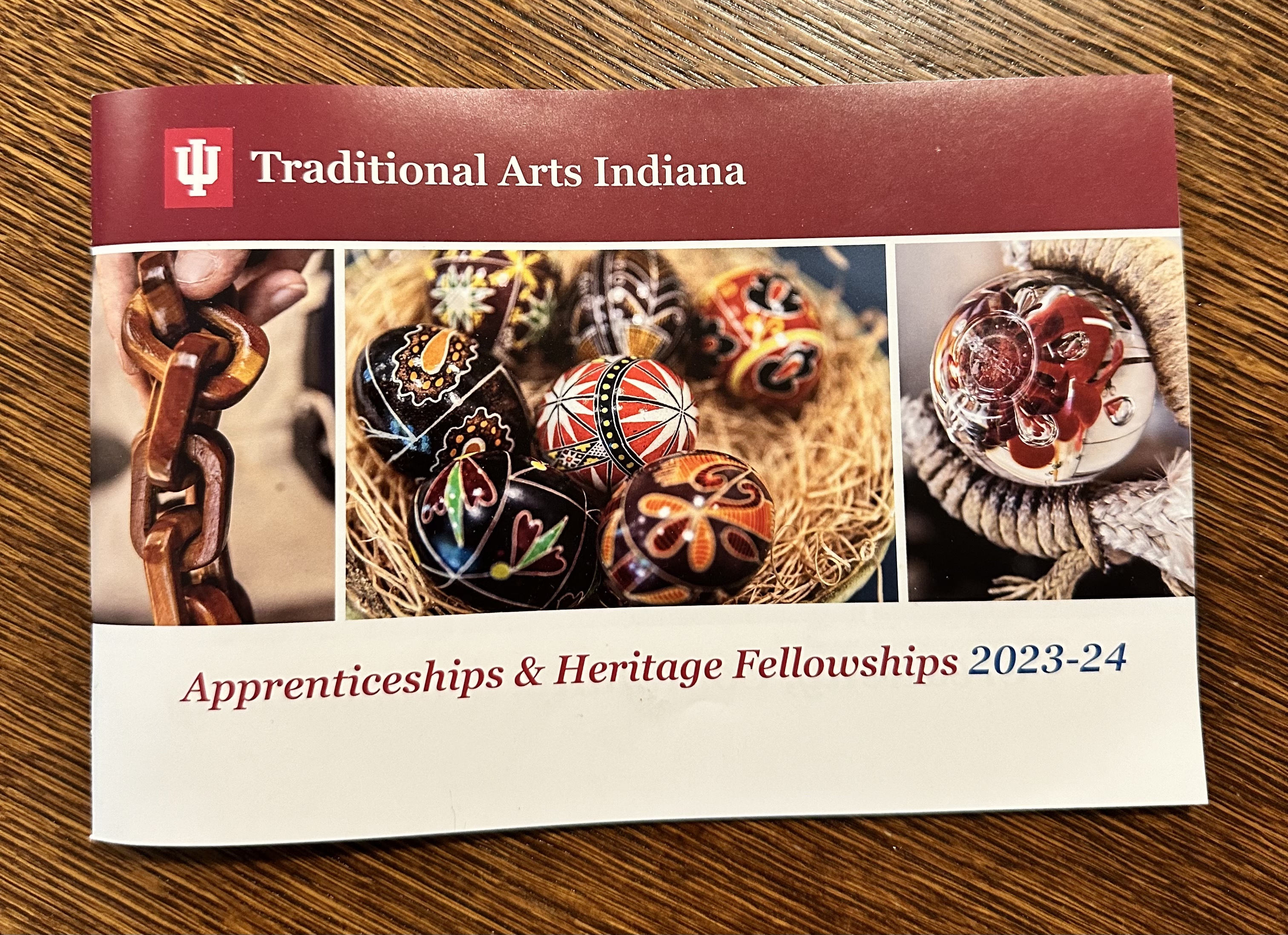
An image of the published book featuring the Indiana Heritage Fellowship recipients and Apprenticeship Teams for 2023 and 2024.
The 2023 and 2024 Indiana Heritage Fellows were recognized next, by Jon Kay, here with the help of Indiana Arts Commission Executive Director Miah Frazer Michaelsen. They honored the following Hoosiers:
Stephen and Nancy Dickey (from Orange County), in recognition of their excellence as fiddle and banjo musicians (This TAI event took place on Friday evening of the Lotus World Art and Music Festival, named after Stephen Dickey’s father Lotus Dickey.) [2023]
Helen Kiesel (from Vanderburg County), in recognition of her excellence as an accordion musician [2023]
Dick Lehman (from Elkhard County), in recognition of his excellence as a potter and for his role in building up Michiana pottery as a regional pottery tradition [2023]
Larry Haycraft (from Pike County), in recognition of his excellence as a net maker [2024]
Kwai Hui (from Marion County), in recognition for his excellence in lion dance and his role as a tradition bearer in the Central Indiana Chinese American and Asian American communities [2024]
A high point of the evening was when Jon announced that 2021 Indiana Heritage Fellow Dani Tippmann, who carries forward the traditional plant knowledge, and associated craft practices, of the Miami Nation was recently announced as a 2024 Taproot Fellow. This program—the Taproot Artists and Communities Trust is “dedicated to honoring and uplifting accomplished US-based traditional artists who serve as community leaders and catalysts for social change in the United States. This initiative is funded by the Mellon Foundation. It is a new national program of the Alliance for California Traditional Arts.” It provides $50,000 fellowships accompanied by $10,000 community project grants for tradition bearers such as Dani.
If you do not see the pattern here, let me call it out directly. Modest state-level master-apprentice programs such as those undertaken by TAI and its peers around the country not only help strengthen artistic and cultural life in local communities, they are also a small investment that pays dividends in the lives of both older and younger adults who are committed to their communities and to the cultural heritages that make those communities livable. Some of those involved will be further recognized in programs like the Indiana Heritage Fellowship program. That recognition, which means a tremendous amount for those so recognized, can also be a springboard for national awards, recognitions, and investments, as is the case with Dani Tippmann’s Taproot Fellowship or with those who go from being recognized on a state level to being recognized as National Heritage Fellows by the National Endowment for the Arts.
Per capita, Indiana and its state peers around the US invest microscopic amounts in the folk and traditional arts, but those investments, and especially the still tiny investments made at the state level by the National Endowment for the Arts, do an extraordinary amount of good. These investments help make life meaningful, make life bearable, in rural places, suburban places, and urban places around the U.S. They recognize and strengthen life in Indigenous communities and in the lives of diverse other communities—Latinx, African American, European American, Asian American, refugee, old settler, immigrant, etc. As reflected in the county shout-outs above, there is no corner of the state of Indiana that Traditional Arts Indiana (meaning just one half-time director and two half-time graduate assistants and some hourly and intern helpers) are not positively impacting.
The infrastructure and mutual support networks that make this possible have never been strong enough, but they are presently being weakened concurrently on many fronts. And they face still greater threats on the horizon. Organizations and activities that get rural good ole boys and refugee weavers, African American matrons and Mexican American kids in the same room and on the same page are getting fewer and fewer. In a society returning to bad habits of political violence and renormalizing xenophobia and other pathologies, joyful, plural spaces such as Maxwell Hall last Friday night are precious and all who see the value in them need to rally to defend them, and the academic programs, scholarly societies, funding agencies, and public humanities organizations that underpin them.
Helen Kiesel, pictured standing and playing an accordion, was recognized as a Indiana Heritage Fellow for 2023. Fellow Heritage Fellow Stephen Dickey can be seen joining her performance on fiddle. Helen Kiesel is from Vanderburgh County in far southwest Indiana and Stephen Dickey is Orange County in the center of far southern Indiana.
There was much to move me, but it was Stephen Dickey asking if he could join in on fiddle with Helen Kiesel’s accordion demonstration that brought tears to me. I knew they’d be great together, but I also knew what awaited me outside Maxwell Hall on my walk home—rock classics blasting from fraternity houses where the front-lawn beer pong* was going to be, and was, well underway. For a moment, Jon Kay and his students and the amazing people they support gave me the world I want rather than the world that, most of the time, I have.
*Yes, I know that beer pong is folklore and folklife too.
Chin weavers and weaving students being recognized during the awards ceremony hosted by Traditional Arts Indiana, October 4, 2024.
Unbury the Lede: Here I reflect on the ways that the crises of the current moment make the older Whac-A-Mole problem something more and more risky for scholarly societies and those they serve. No moles are harmed in this post.
Wikipedia has a solid entry on Whac-A-Mole and how the arcade game became a colloquial expression “to refer to a situation characterized by a series of futile, Sisyphean tasks, where the successful completion of one just yields another popping up elsewhere.” Almost everyone I know lives, at times at least, in this Whac-A-Mole state of being. I do not propose to diagnose or assess that. In a more focused way, I want to reflect on the ways that elected leaders and professional staff in scholarly societies are today particularly stressed by Whac-A-Mole dynamics and evoke the consequences in the particular time and place that we are in (at least in my neighborhood of the North American scholarly, public humanities, and applied social science world). As in the previous two posts, my frame of reference is primarily the American Folklore Society (AFS), secondarily the American Anthropological Association (AAA), and tertiarily all of the scholarly societies of the American Council for Learned Societies (ACLS). These levels relate to my degree of direct experience, with my knowledge of scholarly societies in general being informed most heavily by the situation of the AFS.
I do not want to suggest that society leaders never faced the Whac-A-Mole dynamic in the past. Surely, they did. I do not want to suggest that others in the world or in academia, the public humanities, and the applied social sciences do not also face real challenges of the sort that I am evoking. Clearly, they do. But the focus of these reflections are the societies that I know, the AFS in particular. Some of what I reflect upon here is, I think, more generally applicable.
What scholarly society leaders—lay and professional alike—generally wish to do is to have a sound strategic plan and to work it. Even in good times, this is a challenge. There is always too much to do, and resources are almost always scarce. Money is the resource that gets discussed most often, but time and attention may be the most valuable resources of all. Whether a work week is forty hours or fifty hours or more hours, there are only so many hours to devote to the work. Elected (and appointed) leaders have “day jobs” (usually quite demanding ones) and can only devote a part of their work effort to the governance, or just basic service, tasks associated with their professional society. If a scholarly society is large and organized enough to have a professional staff (as both AFS and AAA do), the staff members will have many day-to-day duties to fulfill. Even if no unexpected problems were to ever arise, they would face challenging decisions related to the balance of work between tending to immediate tasks relative to advancing longer term goals arrived at in discussion between the elected leadership and the Executive Director. Sorting this out is a basic aspect of everyday leadership.
But in practice, matters are usually still harder than this. And I argue that they are harder today (much harder today) than they were fourteen years ago when I was elected to the AFS Executive Board or nineteen years ago when I was (as editor) an ex-officio member of the Council for Museum Anthropology Board (and thereby attending with special focus on AAA governance issues). Whac-A-Mole is the vernacular expression for the problem that is now, I believe, severe.
As a matter of planning, how much time should a paid or elected society leader set aside each week to deal with unexpected, but inescapable, problems that will arise unlooked for? How does a professional or elected society leader do triage in real-time when the day-today and longer-term-work still needs to be done, but the unexpected problems keep popping up? And what about when those pop-up problems are less “regular” and more existential? Even the conscious choice not to deal with a pop-up challenge can, and often is, time and attention consuming. And choosing not to tackle a pop-up challenge, while perhaps justified in context or on principle, can often generate still more pop-up challenges.
This dynamic has some reoccurring elements that can be isolated and described. Even in non-dumpster fire times, there is the problem of asymmetry. Membership organizations are comprised of numerous members and a small number of elected leaders and usually a still smaller group of professional staff. At any one time, there is only one Executive Director and only one elected President. This is an inherent design feature of these organizations, and I would certainly not wish to change this, but it means that many voices can be (and usually are) trying to be heard by a very small number of ears. Devoted to serving the membership that has entrusted them with leadership roles, society Presidents and Executive Directors are going to do everything they can do to respond to all who seek to engage with them, but as most professionals in my world experience, email (for instance) is also asymmetric. It is very easy to send a question or to state a demand or to make a suggestion via email, but it is almost always a bigger task for the recipient to reply and an even bigger task to do what the email sender wants or to address substantively the concern or suggestion being raised. As many of my colleagues who worked before and after widespread email can report, email is, in part, a means by which strangers (and friends) have direct access with which to write things on someone’s to do list. Some among us can ignore (or have no other choice, given time limits, but to ignore) email (and other communications channels), but a society President or Executive Director really cannot do this. Writing a letter on a typewriter and mailing it was once a laborious barrier to entry in this communicative economy, but despite efforts such as the slow email movement, expectations for immediate replies and easy communication, have intensified the Whac-A-Mole problem considerably.
That was true without dumpster fires (another contemporary idiom explained by Wikipedia), but now we are living in a time of near constant, and usually overlapping, crises and are doing so in crisis-saturated social environments. A scholarly society (AFS for instance) might set a strategic goal of working with members to establish new graduate programs in its field. In an AFS context, this is a perfectly reasonable goal to consider pursuing. I know individuals in folklore studies who would like to do just this thing and who work in contexts in which such an endeavor is reasonable and do-able. But in the world of Whac-A-Mole and of interconnected and endemic crises, there can be a difficult calculus. If a particular already extant graduate program in a field is in trouble and members (understandably) call upon their scholarly society to help make the case to, for instance, local university administrators, that is pressing work, and it very well may displace giving attention to the project of supporting the creation of new graduate programs. And under conditions in which crises are arising constantly and society members are expecting their society to respond, constantly, strategic goals—even strategical goals aimed at preventing crises from arising in the first place—can be forced, by the unfolding of human events in real-time, to the back-burner.
Even if everyone—all members of a society, for instance—had abundant knowledge and clear insights into the state of various matters, and of the world as a whole, this dynamic would be hard, but it is harder still because such perfect knowledge is not how things are. Different people know, or think that they know, different things. And regardless of what they know and don’t know and think that they know, they have different priorities. An Executive Board, for instance, can assess and rank priorities, but some possible goals can be simply incompatible with other goals. And very few Executive Boards devote time (or have time to devote) to setting general priorities for addressing specific crises that emerge unlooked for. What tends to happen in most organizations, is that leaders fall back on what they understand to be shared values and historical precedents for dealing improvisationally with emergent challenges in their field.
(For an example that is actually unfolding now…) If a AAA member is understood by a significant number of AAA members to being treated unfairly by their home institution, the general value of supporting members and the historical lessons of earlier instances of AAA interventions in support of other AAA members under threat kicks in. I am not saying that it should not be thus. What I am flagging is the general problem that some elected leaders of a scholarly society and some professional staff of a society in this situation will wind up devoting time to the emergent problem and in doing do, other work will be hindered. Pursuit of strategic goals are part of what gets hindered in the world of Whac-A-Mole.
The basic problem relates to the fact that almost no organizations in which we work and few individuals working within them, budget “slack time” for addressing unexpected crises. I see this in my own College at my own University in which my Executive Dean is working almost around the clock to address profound structural problems, but each day he is handed a raft of pop-up problems, the addressing of which is unavoidable but the addressing of which will not solve or ameliorate the structural problems that are on his agenda. I have writing group colleagues who set aside a few hours each week for pop-up problems, but the pop-up problems of an individual faculty member and those of a whole scholarly society and field (or College) are of a different order of magnitude.
Returning to the different priorities of individual members and constituent groups within societies, they can not only have different priorities and hopes and needs, but they can also have different levels of expectations of both norms and of service. For instance, one of the hardest problems for societies right now is that senior members often expect the maintenance of, or enhancement of, both quality and coverage of services and activities. (Doing fewer things, doing things less well, etc. is a choice that very few individuals are willing to openly endorse, but older members (a group I am in) especially bring “historical perspective” to the matter.) Senior members also often expect—as experienced members who have served their societies in various ways over extended periods—to have gained from this (1) direct and regular access to current leaders and (2) that their expectations for what the society is attending to will be given due weight. This would just be a familiar social dynamic under less crisis-filled conditions, but it makes hard problems harder under present ones, when demands for change, demands for stasis, and vigorous demands for active responses to crises—some contradictory, irresolvable, or lose-lose in character—are constantly being called for. This is just one more part of the Whac-A-Mole calculus. One could offer a companion analysis of the parallel special demands of younger members and the ways that they get expressed through other channels. Similarly, the contribution of an ever-changing digital social media landscape to Whac-A-Mole could be discussed. The problem comes from all sides through many channels.
Will Whac-A-Mole get worse? I cannot see how it will not get worse, at least in the short term. If one society member is being subjected to a doxing campaign today (a real example on my mind today), chances are pretty good that two or three will be so threatened sometime soon. While such new, sometimes completely unprecedented, crises emerge and have to be addressed by society professional staff and elected leaders, the endless stream of less dramatic but still insistent emails and text messages will also continue. Society leaders don’t stop fielding calls for more online meetings and fewer online meetings, the restoration of print conference programs and the elimination of print conference programs, the restoration of more rigorous screening practices for conference participation and the lowering of barriers to entry to the conference program, etc. In such circumstances, my response has been to try to cultivate empathy for those who take up the work of scholarly societies, even when they are pursuing policies that I do not favor, or not taking up the tasks and challenges that I would myself prioritize as urgent. We are contemplating the lives and work of human beings who are trying, usually trying their best, to serve others.
Empathy can help, but it is also not enough to get societies through the multiple and intersectional crises that they and the fields that they serve are now facing. Members have, I think, to more actively give society leaders a break and grant them some time (which means perhaps letting some things slip for a while) to sort out and prioritize not just strategic goals and tactical plans, but also to sort out day-to-day workflows and—this is most difficult—the mission and values-based frameworks by which (and this hurts) they will decide on our behalf what not to do and not just what they will (with us as members) do. As my posts on the potential banning of public funds for scholarly societies and on the impacts of forced change in general education were trying to suggest, giving society leaders some space to learn about emerging risks is one of the things that we collectively can be doing. The way that we would do this would include individually learning more about what our societies (and fields) and their leaders are up against and, also, engaging in a bit of triage ourselves. Do I need to send this email? If I need to send it, do I need a reply and if I do not need a reply, can I tell my recipient this and then not feel bad if they take me up on my offer of not replying? You get the idea.
I am very pleased to share news of a new publication. It is an article appearing now in the Journal of American Folklore:
Jackson, Jason Baird. “Collaborative Work in Museum Folklore and Heritage Studies: An Initiative of the American Folklore Society and Its Partners in China and the United States.” Journal of American Folklore 136, no. 539 (2023): 48-74. muse.jhu.edu/article/877843.
The paper’s abstract is:
Since 2007, the American Folklore Society has pursued a partnership project with the China Folklore Society. Diverse in activities and extensively participated in, the endeavor is known as the China-US Folklore and Intangible Cultural Heritage Project. In this peer-reviewed report, one sub-project within this umbrella effort is reviewed. The Collaborative Work in Museum Folklore and Heritage Studies sub-project continued the project’s established exchange practices and added a program of material culture and heritage studies research.
Thanks to the generous terms of the American Folklore Society’s author agreement, a version of the article is now available in the Indiana University open access repository. Find that version online here: https://iu.tind.io/record/3333
If you are an academic author or aspire to be one, I hope that you will check out the series organized by Ilana Gershon and published on the Anthropology News site of the American Anthropological Association. As the AAA sets it up: “Ilana Gershon asked eight anthropologists for their approaches to the many daunting tasks of publishing an article in a journal, based on questions generated by Sandhya Narayanan.” It was fun to be one of those respondents and interesting to see what the whole panel had to say. Here are the items published to date. I will add to the list if it grows further. Special thanks to Ilana for producing the series and for including me.
This is another post in a series devoted to better understanding the place of Native North American and First Nations studies within the field of folklore studies as represented in the present-day United States by the work of the American Folklore Society (AFS). In a post published here, I itemize the posts in the series so far.
From at least one perspective, 1900-1909 was a kind of high water mark for Native North American work within the American Folklore Society. In the early 20th century, the AFS had a lot of members (in my view), although its leaders constantly stressed the smallness of the membership and stressed the need to grow both members and the number of state and local chapters within which, in those days, most members engaged with the field. There was a relatively small elite of members, both literary and anthropological in orientation, that attended annual meetings and that published substantive articles in the pages of the Journal of American Folklore (JAF). During the 1900-1909 decade, two such elite members were Native North American men–William Jones (Sauk) and Frances La Flesche (Omaha).
Jones was the first Native American to earn a PhD in Anthropology and one of the first to earn this degree at all in the United States. He undertook extensive research among his own people–the Sauk and closely related Meskwaki (Fox)–but also other groups speaking related Central Algonquian languages. He published widely and during his lifetime he published two papers in the JAF. Two additional JAF papers were published posthumously. His first JAF paper is “Episodes in the Culture-Hero Muth of the Sauks and Foxes in JAF #55 (1901). His second paper, “The Algonkin Manitou” appeared in JAF #70 in 1905. He also published reviews in JAF during his lifetime. Sadly, in an episode that has been widely considered in the history of anthropology, he was killed in 1908 while conducting research as a Field Museum curator among the Ilongot people in the Philippines. An unsigned obituary, likely written by his mentor Franz Boas, appears at the end of the decade in JAF #84 (1909). Despite the racism of his day, I do not have any difficulty imagining William Jones having been the President of the American Folklore Society. Many of Boas’ former students, both male and female, came in time to fill this role. Among them Jones was particularly engaged in folk narrative research and he was widely admired. His death remains a vividly felt loss. When I position Jones as an leading member of the AFS in this decade, I include the fact that he was one of a very small number of members to actually present a paper at an annual meeting during this period. He delivered a paper titled “Customs and Rites Concerning the Dean Among the Sauks and Foxes” at the 1901 (13th) annual meeting in Chicago, one of sixteen given at that meeting.
Similarly prominent in this time as a working anthropologist and folklorist, although trained formally in law, is Francis La Flesche. Like Jones, he also undertook ethnographic field work among his own people (the Omaha) and among closely related peoples (the Osage and other peoples speaking Degihan langauges). The JAF volume for 1905 featured Jones’ Manitou paper and, in the next issue, La Flesche’s “Who was the Medicine Man?”. With his research collaborator (and soon-to-be AFS’s first female president) Alice C. Fletcher, he also presented a paper on “Military Insignia of the Omaha” at the 14th Annual Meeting of the AFS, held jointly with the American Anthropological Association and the anthropological section of the American Association for the Advancement of Science (AAAS) in Washington, DC at the end of 2002 and the beginning days of 2003. While La Flesche did not become an AFS officer, he clearly could have as reflected in his Presidency of the Anthropological Society of Washington (1922-1923) and his 1922 election to National Academy of Sciences (a high honor then, as now).
A reoccurring theme in these posts, I will address the tiny group of prominent Native North American folklorists in a separate concluding post. Here, I just wish to underline that the 1900s (111 to 120 years ago was the apparent peak moment for such involvement in the society, as represented by the participation in both meetings and the JAF of both Jones and La Flesche during the decade. Ella Deloria (Dakota) would publish in JAF in the 1920s and Gladys Tantaquidgeon (Mohegan) would present at the meetings once in that decade, but as measured by total involvement including three full JAF articles published by La Flesche during his career and four full JAF articles published during (and after) his lifetime by Jones, they, and this decade, really stand out. I hope it is clear that I admire them and that I am frustrating that the best moment in terms of Native American scholars being near the center of the field would be in the first decade of the 20th century. As in previous posts when I touched on the question of Native American participation in the society, I welcome information on Native scholars involved in AFS that I many not be recognizing.
During the 1900s decade, meetings remained small and centered mostly in the Northeastern US. It was common, not just for the AFS, but for scholarly societies in general, to systematically meet in what one annual report refers to as a convocation, in which a significant number of scholarly societies are jointly hosted by a university. The AFS met in such situations multiple times in the 1900s decade. Such meetings often included an overarching welcome by the host university president, break-out meetings for the participating societies, and keynote lectures and receptions held again jointly.
It is important to recall that the AFS was founded fourteen years prior to the founding of the American Anthropological Association (AAA). Prior to the founding of the AAA, the Anthropological Society of Washington (ASW) (of which La Flesche would eventually be President) and the anthropology section within the AAAS were the key anthropology organizations. AFS met regularly with the ASW and with AAAS throughout its early history and after the AAA formed, it was added to this mix of regular meeting partners. Once the AAA was in the mix, it became common for there to be an AFS focused day within a multi-day meeting. This would have probably been adaptive for the non-anthropologists who may have wished to take in the AFS portion of the meeting but perhaps not the AAA (etc.) parts. I am guessing about this. With respect to the balance between scholars of Native North American and non-Native North American topics–a distinction that in this decade does map rather closely onto the anthropology/literature distinction–Native American-focused presentations at the annual meetings across the decade were somewhat dominant, but as shown in the first table, there was much variability. The most imbalanced meeting, in 1907, was one of those held jointly with the AAA and AAAS. It was held in Chicago (an emerging hub for anthropology due to the Field Museum), a new development that may have made the meeting more difficult for the New England-centric literary folklorists and appealing to the anthropologists who were in this time increasingly fanning out across the country. The meeting in 1904, where only a small number of papers were given and where the Native studies percentage is at its lowest for the decade, was in Philadelphia during one of the joint meetings that included the still new AAA and AAAS. It is likely that AFS members appeared on the AAA’s program in this context, impacting the figures. How AFS papers are reported in the annual report varies year to year in response to different meeting configurations and other factors.
The 1900s decade is when Boas’ students (both formal and informal) begin to show up in growing numbers and assume leadership roles. Jones has been mentioned here and in previous posts. In the previous decade A. L. Kroeber was present as a student, now he is present as an established figure. He is not only a presenter at meetings and a regular JAF author, but he and colleagues begin the California chapter in this time and it becomes a force within the field. In this period, there is often a dedicated section of the journal presenting papers and notes under this California branch’s auspices. Kroeber followed Alice Fletcher as AFS President, serving in 1906. John Swanton, active starting in this decade, would serve as President in 1909. Other Boas students such as Frank Speck, Robert Lowie, and Edward Sapir–all scholars of Native American topics–entered into the life of the AFS and rose to prominence in it, eventually service as Presidents.
As noted previously, the membership size and the number of presentations at AFS annual meetings are very different things. Most members articulated with the society as journal readers and as members of local branches, not via the annual meetings. There continued in this period to be elite AFS participants from both the anthropology community (ex: Alice Fletcher, James Mooney, Franz Boas and others) and the literary and historical side (inclusive of such topics as ballad studies, Black vernacular culture, children’s folklore, etc) (ex: George Lyman Kittredge, Alcée Fortier, Phillips Barry and others) as reflected in meeting attendance and service as an officer of the society. The politics of the AFS seems to have mainly taken place at the annual meetings, thus centering leadership and decision making among a small group (nearly all white, mostly men, weighted towards the northeast, but less exclusively so) able to both attend annual meetings and engage in the work on a national basis. The Annual Meeting table follows.
Year
Presentations on Non-Native American Topics
Presentations on Native American Topics
Percentage on Native American Topics
1900
4
10
71%
1901
6
10
63%
1902
3
10
77%
1903
6
4
40%
1904
3
1
25%
1905
4
2
33%
1906
6
5
45%
1907
1
6
86%
1908
6
5
45%
1909
2
4
67%
Totals
41
57
58%
Presentations on Non-Native North American- and Native North American-Related Topics at the Annual Meetings of the American Folklore Society During the 1900s.
As in earlier decades, the JAF picture is distorted by my initial choice (probably a mistaken one) to code notes and articles rather than limiting attention just to full articles. In this period, the JAF often (but not always) published notes that ranged from substantive contributions with a byline to very short items (as short as a couple sentences). As I have noted elsewhere, my inclusion of notes serves to supress the percentages for Native North American topical works, because the smaller notes are weighted towards items related to Non-Native North American folklore topics. I am just guessing, but it seems likely that in the decade of the 1900s, the ratio for sunstantive Native and Non-Native North American content in the journal might have been about 50/50 rather than the decade-based 39% presented in the table below.
Year
Published Papers and Notes on Non-Native American Topics
Published Papers and Notes on Native American Topics
Percentage on Native American Topics
1900
21
17
45%
1901
32
18
36%
1902
45
15
25%
1903
43
18
30%
1904
18
17
49%
1905
17
16
48%
1906
30
16
35%
1907
24
18
43%
1908
16
18
53%
1909
16
18
53%
Totals
262
171
39%
JAF Publications on Non-Native North American and Native North American-Related Topics During 1900s.
Early volumes of the JAF are available without a paywall from JSTOR, thus I end by suggesting that anyone who has made it this far read the brief obituary published for William Jones in #84. Find it here. It is unsigned but his mentor Franz Boas was the editor of JAF at the time and knew him well, suggesting to me that he is the likely author of the obituary.
The posts on the presence and absence of Native North American and First Nations studies within the work of the AFS were done in a non-sequential way. Several more chunks remain to be done, but here is a historically sequenced listing of the posts completed as of November 2, 2020.




 Shreds and Patches