The Council for Museum Anthropology (CMA) invites applications for the next Co-editor of the section’s peer reviewed academic journal, Museum Anthropology. The three-year term runs from January 2026 through December 2028. Please contact journal co-editor Johanna Zetterstrom- Sharp (j.zetterstrom-sharp@ucl.ac.uk) or CMA President Christina J. Hodge (christina_hodge@brown.edu) to discuss this opportunity. Please submit a letter of interest indicating your experience and ideas for the journal, along with a recent CV, to Hodge by 31 December 2025. [RFP continues after the image]
The Journal: Over its 50-year history, Museum Anthropology (MA) has become a leading voice for scholarly research on the collection, interpretation, and representation of the material world and global cultures. Through critical articles, provocative commentaries, thoughtful book and exhibit reviews, and new publishing formats, this peer reviewed journal reflects the diverse, vibrant, global, and transdisciplinary work of museums. Situated at the intersection of practice and theory, MA advances our knowledge of the ways in which material objects are intertwined with living histories of cultural display, economics, socio-politics, law, memory, ethics, colonialism, heritage, conservation, and education.
MA is published by Wiley-Blackwell through the end of 2027. CMA is actively negotiating for a new press and contract, which will start in 2028.
The Role: MA editors have independent editorial responsibility for the journal. MA is produced by two co-editors with staggered three-year terms, ensuring continuity of knowledge and production and shared responsibilities. MA is supported by an editorial board of six international scholars in museum anthropology and allied disciplines.
The incoming MA Co-editor will contribute to the publication of a journal that enriches and diversifies scholarly and professional museum settings by: (1) soliciting and evaluating high-quality manuscripts and peer-reviews from a diversity of experts in relevant fields; (2) maintaining academically rigorous and ethical standards of publication, as well as timely management of review, submission, and publication processes; (3) constructively working with AAA and press staff, as well as the MA editorial board and CMA leadership.
The Co-editors serve as non-voting members of the CMA Board, participate in quarterly Board Meetings, and provide annual reports to CMA’s members at its annual Business Meeting (held at the AAA annual meeting). Co-editor is not a paid position, but financial support typically includes some travel expenses to the AAA meeting and some copyediting services.
All, or almost all of the ACLS Scholarly Societies are in mutual aid relationships with university-based scholarly publishers (=university presses). In the case of folklore studies and the American Folklore Society (AFS), the most obviously relevant of these presses are (1) University of Illinois Press (which publishes the Journal of American Folklore (JAF) on behalf of AFS), (2) Indiana University Press (based at Indiana University Bloomington, where AFS is also based), (3) University Presses of Mississippi, (4) Wayne State University Press, (5) University of Wisconsin Press, and (6) Utah State University Press (now an imprint of the University Press of Colorado). Numerous other university presses in the United States are important to folklorists for various (often, but not only, area studies) reasons, but these six are particularly impactful through their (strong, specifically) folklore studies lists. They are also, like their peer presses strong in other fields, always working to innovate and take advantage of new affordances arising in our own time. Like our societies, they are not perfect but they are invaluable.
I have had a lot to say previously about university presses and scholarly communications more generally. Beyond talk, I have tried to do what I can. where I can to help. Here I just want to record again that university presses are themselves a crucial part of the ecosystems within which scholarly societies work generally, and in which folklorists and the AFS works, specifically. There are many threads woven together here and I will not unravel them at this point. Key at present is that those six presses of special concern to AFS members (call them the six most likely to send editors and books to the AFS meetings year after year) are all based at public universities. Things are more and more challenging at public universities like the ones that host these presses, especially anything seen from above to be part and parcel of the humanities, the social sciences, or the liberal arts tradition generally. The contexts in which the presses and some of us as individuals work are getting more difficult and administrators in varied locations are less and less willing to listen and learn learn about the important ways that university presses serve the universities that host them as part of a larger ecology of actors advancing research, teaching and service in the public interest.
So, when we do environmental scans of the state of our field, or when we pursue such things as a so-called SWOT analysis (Strengths, Weaknesses, Opportunities, Threats), we must keep the state of “our” university presses in mind. They have done, and are doing, important work with and for folklorists every day. In doing that work, they are also helping students and the various local audiences, publics, communities, and and collaborators with whom we engage. Given that all of the nodes in our network are experiencing new stresses, it is important that none of us in that network take any other node for granted. We must keep a lot of different things in view, including university press publishing.
My run of posts on scholarly societies in general, and my scholarly societies in particular, has, I know, been heavy on facing unhappy developments and low, so far, on positive prospects. Here is a post to where I highlight what is for me a welcome trend.
I live and work in a community that still centers a really rich and generative and extended form of in-person graduate education, but my colleagues and I have long been confronted by the question of how to support those who cannot take up the project of moving across the United States, or the globe, to join us in the multi-year study of folklore (or, in my other field and department, anthropology). This question predated the internet. It predated Zoom, YouTube, and similar platforms. It once took the form of letters seeking reading recommendations and these still come to us by email. In my former department, the Department of Anthropology at the University of Oklahoma, we then still ran a paper- and postage-based correspondence course in folklore studies when I arrived on the faculty in 2000. The old summer institute-based form of the Folklore Institute associated with Indiana University and the leadership of Stith Thompson (1885-1976)—like it’s still thriving peer, the Linguistic Institutes run by the Linguistic Society of America since 1928—was another analog solution to the problem of low residency, high impact, advanced study in folkloristics. For the bestowal of a full and formal master’s degree, the Master of Arts in Cultural Sustainability (M.A.C.S.) today offered by folklorists and allies at Goucher College is a now proven low-residency option. I commend all of those, past and present, who have worked to build up the Goucher program. They identified, and have found ways to meet, an obvious need.
To my fellow folklorists, I say that we need more experiments and more approaches to the problem of higher-level, but still introductory, educational opportunities in folklore studies. It is in this context that I have been inspired by some specific developments that I wish to flag. For those who are not yet aware of them, I point here to some in-person and online initiatives that have broader implications. If you can get access to the Chronicle of Higher Education, I direct your attention to a survey article: “Making Space for the Humanities Off Campus: Night School Bar and the Brooklyn Institute for Social Research offer alternatives to traditional academe.” by Ariannah Kubli (2024). Finish out your introduction, if you can, by consulting an older (but still post-COVID) account of the Brooklyn Institute for Social Research (BISR) in the New York Times: “Where Can You Go to Grad School Without Going to Grad School?” by Cat Zhang (2023).
Given the number of folklorists in New York City and the lack of folklore courses there, it would be easy and fruitful to imagine a sophisticated folklore studies course in-person at the BISR, but pitching such a direct thing is not my point here. What I am trying to evoke is the idea that we can find win-win ways to give more adults access to sophisticated learning in folklore studies outside the extant US/North American/world graduate programs.
While the articles cited above evoke the convivial nature of in person, non-degree adult education, it is important to highlight here that many of the BISR courses (to stick with a flagship example) are taught online and are thus available to those who cannot physically get to Brooklyn, New York. I urge the curious to check out the current BISR course offerings not because I am urging you to take one of their courses, but because I am hoping that you will give thought to the possibilities. It is within the capacity of, I believe, organizations such as the American Folklore Society to organize and platform such a thing as a four-week (twelve-contact hour) introduction to folklore studies. Who might take such a course? Probably a mixed group with diverse purposes, but one audience that I hope would take such a course would be those colleagues who have entered the realm of public folklore practice without having a background in folklore studies. Such colleagues increasingly staff folk and traditional arts programs in state-level arts and humanities agencies and thus are our colleagues, but they are colleagues who sometimes struggle to join in the discussions that we have had been advancing since 1888 or earlier. Another potential audience might be those pondering whether formal graduate training in folklore studies is actually what they want.
Of course, the examples of Night School Bar and the BISR are just variations on older practices, including a wide range of proven community education frameworks that we can be revisiting and perhaps revising for present purposes. The first folklore studies course that I ever taught was a multi-session course for adults on “Jewish Folklore and Ethnology” shared in Tulsa, Oklahoma as part of the dryly named, but richly experienced, “Adult Institute” co-managed by Jewish community organizations in the city that I once lived in so intensively. I was too young and inexperienced when I did that, but I know of no harms caused and I met lifelong friends in the doing.
I will wrap this reflection up, but I note that trends in continuing and adult education are intersectional with the rise of microcredentials in general and the practical ability for organizations to issue semi-formal credentials on platforms like LinkedIn in particular. When I complete, for instance, university- required training on various regulations governing my work as a scholar, these completed trainings can now be sent to display on my LinkedIn page. We are now more than a decade into discussions of digital badges and a raft of related practices that are separate from the university degree and its associated transcript. There is a large literature on microcredentials and continuing education in various domains, and the issues are complex, but the shallow end of the pool is accessible to us and in the AFS, we have a strong, time-tested brand. We at least have opportunities, as always, to experiment with even one-time trials. In this, we have the recent experience of the such key recent projects as the Folk Arts Partnership Professional Development Institute, the Veterans Oral History Workshops, and the institutes held in connection with the China-US Folklore and ICH Project. All of these have been partnered and impactful programs in teaching and learning staged outside formal university educational contexts.
PS: To anyone who has reads this post with hope that it would offer a top ten list of ways to study folklore without going to graduate school, I am sorry that my colleagues are not yet in a place to answer the title question in that way. For a glimpse of how the field works in the United States, see Lloyd (2021). For a glimpse how folklorists write and think, consider reading any of the titles recognized with the Chicago Folklore Prize. And think about attending a American Folklore Society annual meeting.
Today I published my final editorial as founding editor ofMuseum Anthropology Review. It may be that Museum Anthropology Review thus concludes with volume 17(1-2), now just published. Perhaps instead it will be revived someday by a new editorial team in partnership with the wonderful folks at the Indiana University Press and the IUScholarWorks Program at the IU Libraries. As of now, the search for a new editor or editorial team can be considered concluded unsuccessfully and the journal is either ceasing or pausing publication. I do not need to write a new version of the editorial here. I invite everyone interested in the journal and the fields that it serves to read it (always open access!) for a contextualized back story.
Here I just want to reiterate my thanks to all who contributed to, supported, and encouraged the journal as a project and who supported me as its editor. I also want to reiterate my thanks to the Indiana University Press for supporting my fields—folklore studies and cultural anthropology, including material culture studies—so well. Even though the journal—by design—was not a money making endeavor, the press stood by it and invested in its improvement and its success. Equal thanks go to the extraordinary IUScholarWorks program (now broadened as Open Scholarship) that helped launch the journal and supported it vigorously for its full run.
I am very pleased to share news of a new publication. It is an article appearing now in the Journal of American Folklore:
Jackson, Jason Baird. “Collaborative Work in Museum Folklore and Heritage Studies: An Initiative of the American Folklore Society and Its Partners in China and the United States.” Journal of American Folklore 136, no. 539 (2023): 48-74. muse.jhu.edu/article/877843.
The paper’s abstract is:
Since 2007, the American Folklore Society has pursued a partnership project with the China Folklore Society. Diverse in activities and extensively participated in, the endeavor is known as the China-US Folklore and Intangible Cultural Heritage Project. In this peer-reviewed report, one sub-project within this umbrella effort is reviewed. The Collaborative Work in Museum Folklore and Heritage Studies sub-project continued the project’s established exchange practices and added a program of material culture and heritage studies research.
Thanks to the generous terms of the American Folklore Society’s author agreement, a version of the article is now available in the Indiana University open access repository. Find that version online here: https://iu.tind.io/record/3333
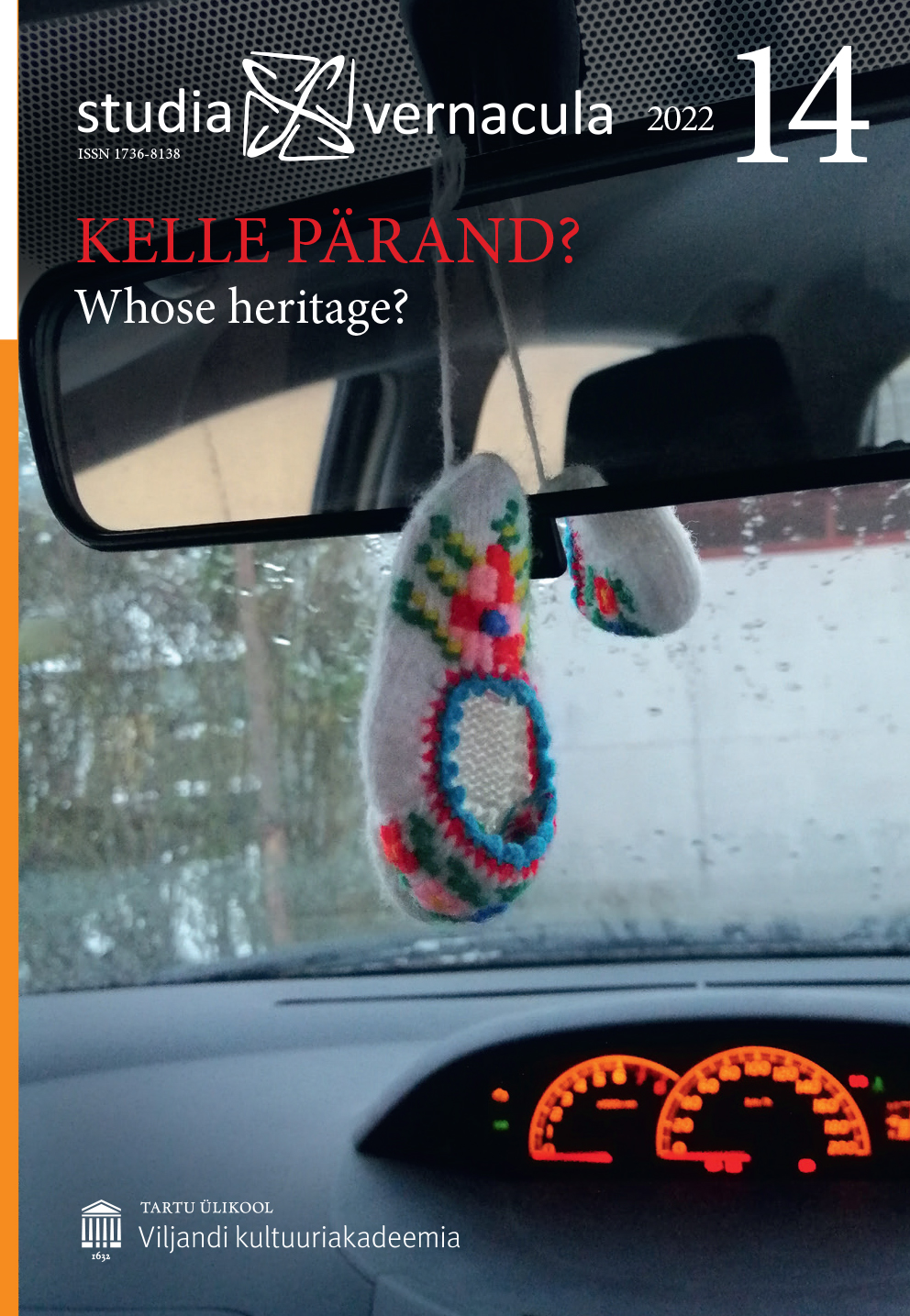
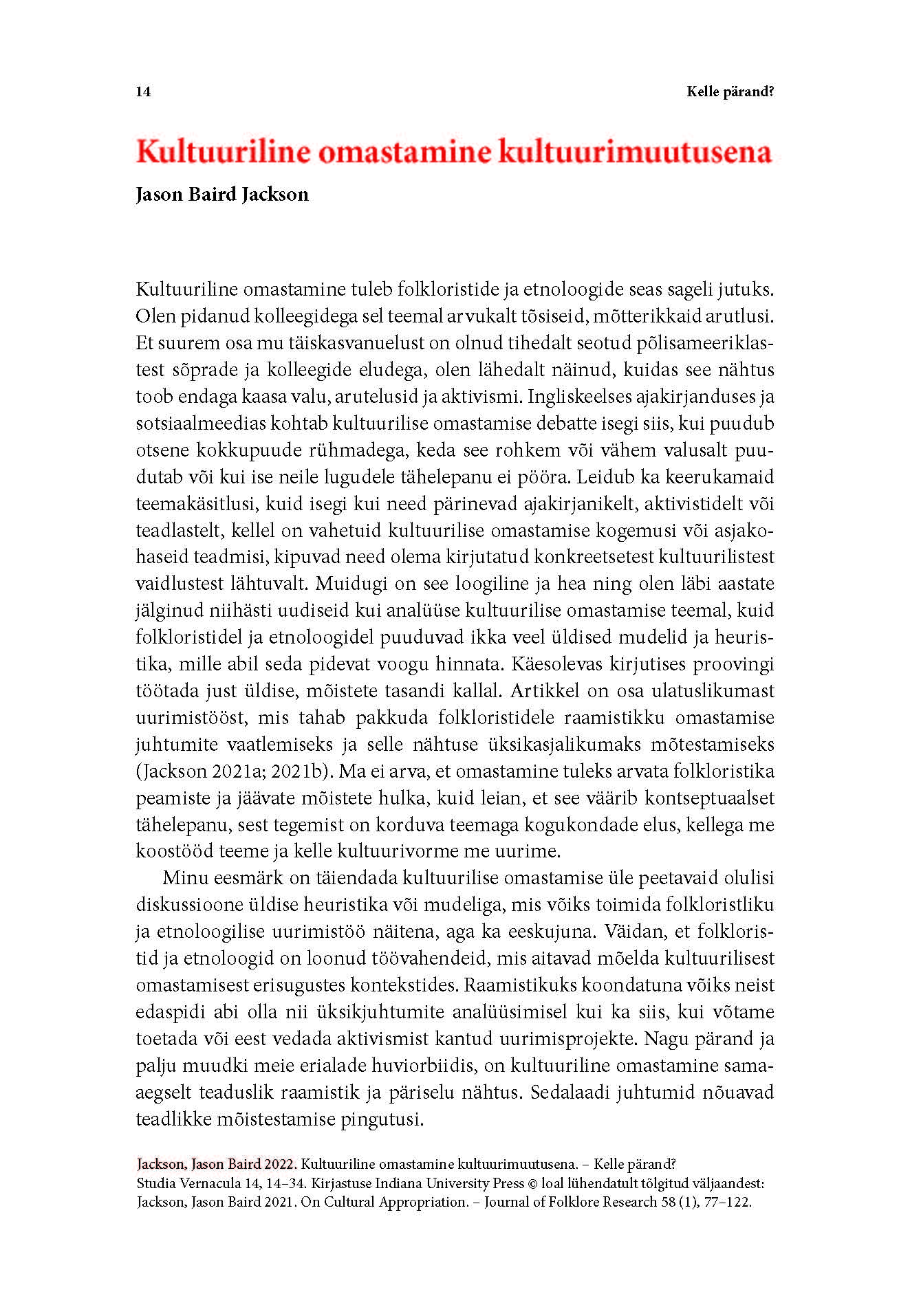
More good news in terms of publication work. I am pleased to share that my article “Kultuuriline omastamine kultuurimuutusena” is now published in Estonian in the wonderful journal Studia Vernacula (see volume 14). This is a translation (minus the case studies) of my earlier paper “On Cultural Appropriation,” which appeared in English in the Journal of Folklore Research (volume 51, number 1 in 2021). Special thanks go to Elo-Hanna Seljamma for work translating the paper, to Kristi Jõeste for inviting me to contribute the paper, and to Madis Arukask for discussing my contribution in an editorial appearing in the new issue. Studia Vernacula is a wonderful open access journal beautifully produced in digital and print form. Even if you do not read Estonian, I urge you check it out with the help of Google Translate or a similar service. So much wonderful material culture studies work appears therein year after year.
I am very happy to note a new co-authored article titled “A Survey of Contemporary Bai Craft Practices in the Dali Bai Autonomous Prefecture, Yunnan, China.” It was jointly written with Wuerxiya (first author), C. Kurt Dewhurst (third author) and Cuixia Zhang (fourth author) and it appears in Museum Anthropology Review volume 16, numbers 1-2. This is the special double issue published in honor of Daniel C. Swan, as noted in an earlier post on Shreds and Patches. The article is based on work undertaken by a much larger bi-national team within the “Collaborative Work in Museum Folklore and Heritage Studies” sub-project of the broader “China-US Folklore and Intangible Cultural Heritage Project,” a collaboration (2007-present) of the American Folklore Society and the China Folklore Society. In particular, it describes work undertaken through the auspices of, and in partnership with, The Institute of National Culture Research at Dali University. Special thanks go to the Institute and its leadership.
Presented as an image is the first page of the journal article “A Survey of Contemporary Bai Craft Practices in the Dali Bai Autonomous Prefecture, Yunnan, China.”
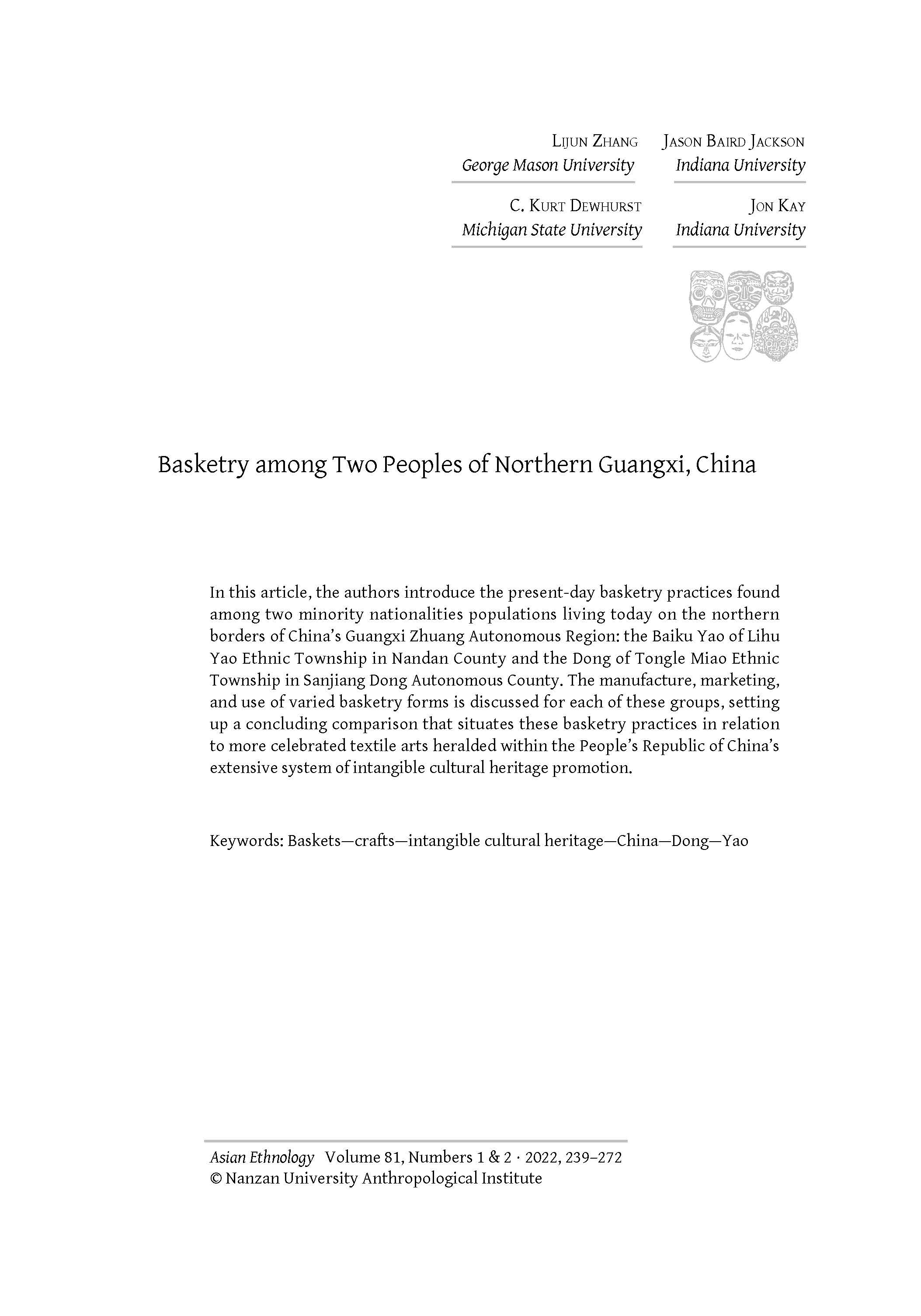
I am very happy to note the publication of “Basketry among Two Peoples of Northern Guangxi, China” in the latest double issue of Asian Ethnology. This article is one that I co-wrote with my friends and collaborators Lijun Zhang (first author), C. Kurt Dewhurst (third author), and Jon Kay (fourth author) and it is based on work undertaken by a much larger bi-national team within the “Collaborative Work in Museum Folklore and Heritage Studies” sub-project of the broader “China-US Folklore and Intangible Cultural Heritage Project,” a collaboration (2007-present) of the American Folklore Society and the China Folklore Society.
I am a huge fan of Asian Ethnology, a wonderful open access journal now in its 81st year. Check out the huge volume that our paper is a part of, Find Asian Ethnology online here: https://asianethnology.org/ and also in JSTOR
A image of page one of the typeset version of the scholarly article “Basketry among Tow Peoples of Northern Guangxi, China” published in Asian Ethnology.
Page one of the article “Towards Wider Framings” as typeset for the Journal of Ethnology and Folkloristics.
I am happy to report that my article “Towards Wider Framings: World-Systems Analysis and Folklore Studies” was published in the Journal of Ethnology and Folkloristics earlier this year. Readers will have the judge the article for itself, but I can’t say enough good things about JEF. Its a wonderful open access journal doing wonderful work in, and at the intersection of, my two fields. Thanks to everyone at the Estonian Literary Museum, the Estonian National Museum, and the University of Tartu who work to make the journal a success.
If you are an academic author or aspire to be one, I hope that you will check out the series organized by Ilana Gershon and published on the Anthropology News site of the American Anthropological Association. As the AAA sets it up: “Ilana Gershon asked eight anthropologists for their approaches to the many daunting tasks of publishing an article in a journal, based on questions generated by Sandhya Narayanan.” It was fun to be one of those respondents and interesting to see what the whole panel had to say. Here are the items published to date. I will add to the list if it grows further. Special thanks to Ilana for producing the series and for including me.