Don’t Miss Kim Christen’s Account of Returning to Tennant Creek
Don’t miss Kim Christen’s account of returning to Tennant Creek. Its a beautiful account of an important moment. Find it on her website here.
Jul 20
Don’t miss Kim Christen’s account of returning to Tennant Creek. Its a beautiful account of an important moment. Find it on her website here.
Jun 13
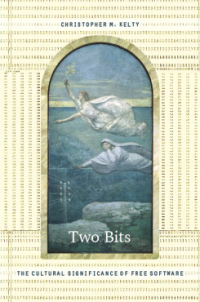 A few days ago I finished reading Chris Kelty‘s wonderful book Two Bits: The Cultural Significance of Free Software (Duke University Press, 2008). During the academic year, I could not get to it but it was a treat to read it at a time in which it could be the only big thing that I was reading (as opposed to reading it alongside course readings). While I would have benefited greatly from reading it last year (when my involvement in the issues that it treats really began to expand), it will do me much good in the days ahead, as it relates very centrally to the work that I am now doing on scholarly communications issues. It provides invaluable context on the emergence and present-day life of open source software, but it also offers a range of valuable theoretical, interpretive and methodological tools that are portable to other contexts. The book also examines, in a very sophisticated way, the manner in which the processes and ideas and values of free and open source software have been extended into projects like Connexions (about which my department held a really fruitful meetup recently) and the Creative Commons license system. All of this work is done very artfully and in ways that we can all learn from.
This post is no surogate for a careful review, but I want to flag the book’s importance to me and to suggest that it is going to be touchstone work for many of the projects that I am increasingly involved in. More ambitiously, I want to plead with my friends and colleagues to read it so that we can talk about it and draw upon it in our efforts together and in our conversations. It is a great work of ethnography, history, and theory. It is also an experiment that modulates the very processes that it describes, as is evident on the excellent and innovative website that Chris has built to extend the book. One can purchase the book the conventional way, but it is also available to freely read and remix in a variety for formats via the website. Some of the background for this is also provided in the “Anthropology of/in Circulation” project that Chris led and that I particupated in. Find the article version of that project here in IUScholarWorks Repository.
Thank you Chris.
A new volume (=issue) of Cultural Analysis, volume 7, has just been published. It has a special focus on “Memory.” Find the new issue as well as the entire back content, plus information on the journal at http://socrates.berkeley.edu/~caforum. CA is an open access journal that publishes peer-reviewed articles and assorted editorially reviewed genres in PDF and HTML formats.
The editors also announce a call for papers for a special issue (volume 9). The CFP follows:
CALLS FOR PAPERS:
1. Call for Papers for Special Issue Volume 9: Here, There, and In-Between: Virtual and Actual Social Space
Cultural Analysis is currently seeking submissions for an upcoming special volume on the virtual. Folklore’s power to constitute collectivities has made it a frequent site of shared virtual spaces. As scholars increasingly engage with the effects of digital media on culture, it is useful to reflect on the historical virtualities of folklore as well as the newly emerging folklore of the digital virtual.
The editors welcome submissions from a variety of disciplines and perspectives that touch on the production, transmission, performance or reception of virtual social spaces. Possible subject areas could include the digital virtual (The cultural geography of digital spaces, online social memory sites, etc), other forms of virtual presence (“real but not actual” social spaces) or connections between virtual and actual spaces.
2. General Submissions
In addition to submissions for our special volume, we always welcome submissions for our general issues. These submissions should critically interrogate some aspect of folklore or popular culture, but can approach these topics from a range of disciplinary perspectives. Cultural Analysis encourages submissions from a variety of theoretical standpoints and from different disciplines including anthropology, cultural studies, folklore, media studies, popular culture, psychology, and sociology. As the mission of Cultural Analysis is to promote interdisciplinary dialogue on the topics of folklore and popular culture, pieces that engage with multiple methodologies are especially welcome. For a representative sample of our publications, previous volumes can be viewed on our website.
Read more
I am happy to note the publication of a book chapter by my friends Amber A. Neely and Gus Palmer, Jr. Titled “Which Way Is the Kiowa Way? Orthography Choices, Ideologies, and Language Renewal,” their paper appears in the new volume Native American Language Ideologies: Beliefs, Practices, and Struggles in Indian Country edited by Paul V. Kroskrity and Margaret C. Field (Tucson: The University of Arizona Press, 2009). I was lucky enough to read the paper in manuscript and can report that it is a valuable and insightful account of language revitalization efforts among the Kiowa people of Oklahoma undertaken in light of contemporary work on language ideology and language politics in Indigenous communities.
Not long after the publication of Linguistic Diversity in the South: Changing Codes, Practices, and Ideology, I was asked by an anthropology journal to review the book. The subject interested me greatly and I was acquainted with the work of the editor and several of the volume’s contributors. In a relatively timely fashion, I submitted the brief review that follows here. At the time, the journal’s editors asked that I expand the review to focus on the contents of the volume in greater detail, thereby bulking what amounts to a book note up to the scale of a full scholarly review. I fully intended to give this a try, but in the constant flow of new tasks, the matter was delayed so long that it was lost sight of. Rediscovering the review today, in the course of organizing my writing-related files, I experienced regret that I did not follow through and see the review through to publication. Rather that attempt to expand it at this stage and secure journal publication for it, I offer it here for those who know my interest in Southern cultural studies and linguistic anthropology and for those web searching researchers whose queries may lead them to the book or my comments on it. I apologize to the volume’s editor, contributors, and publisher for my lack of follow through. Thanks go to all involved for assembling a valuable contribution to the literatures in these fields. The actual review follows.
Linguistic Diversity in the South: Changing Codes, Practices, and Ideology. Southern Anthropological Society Proceedings, No. 37. MARGARET BENDER, editor. Athens: University of Georgia Press, 2004. Pp. 141. $19.95 (paper).
Reviewed by Jason Baird Jackson, Indiana University
Linguistic Diversity in the South is comprised of eight fine essays and a solid introduction contextualizing the volume’s contents and its place in contemporary sociolinguistics and linguistic anthropology. The papers gathered in the volume were originally delivered at the Southern Anthropological Society’s 2002 keynote symposium, which was organized by the volume’s editor, Margaret Bender. Contributors range from enterprising graduate student researchers to distinguished senior scholars. All offer brief, nuanced ethnographic or sociolinguistic treatments of language use in the southern United States.
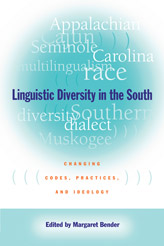 A great strength of the volume is the manner in which it, without attempting to be a comprehensive survey, offers a rich sampling of Southern speech-communities, ways of speaking, and language ideologies. The papers explore language in Native American [Lumbee (Walt Wolfram), Muscogee/Creek (Pamela Innes), Seminole (Susan E. Stans and Louise Gopher)], Mulungeon (Anita Puckett), Scotch Irish (Puckett), Cajun (Shana Walton), Appalachian (Kirk Hazen and Ellen Fluharty), Outer Banks (Wolfram), and North Carolina African American communities (Christine Mallinson). Blair Rudes contributes a paper historically surveying multilingualism, linguistic complexity and change in the Carolinas since contact. Bender’s introduction reflects experiences gained in her own work among the North Carolina Cherokee and links the volume’s contributions to contemporary theoretical concerns in linguistic anthropology, especially research on discourse, contact, maintenance, shift, and ideology.
It is exciting that the volume provides evidence that a critical mass of contextual research on language use in the Southern United States has been reached. Because of the conference proceedings format shared by all Southern Anthropological Society volumes, the papers contained within Linguistic Diversity in the South represent short, accessible samplings of broader, more detailed research programs. In this instance, this is a virtue, as, for instance, scholars consulting the book for its studies of language in Native American communities, easily also gain concise accounts of other Southern peoples and varieties. While many interesting and important communities are not treated in the volume, as Bender is quick to note, it does offer a clear picture of how linguistically and cultural complex the contemporary South is. The book thus counters conventional assumptions of Southern linguistic homogeneity at the same time that it proves to the fields of linguistics and linguistic anthropology that key general issues can be very productively examined from the perspective of the region’s ethnography.
 I am happy to report that Kimberly Christen’s new book Aboriginal Business: Alliances in a Remote Australian Town has just been released by The School for Advanced Research Press. Rather than go on and on, I’ll just say that it is really, really great and that you can get the details on Kim’s super website/weblog Long Road. For the long haul, find it in Open World Cat (and your local library) here. Congratulations Kim!
[Kim and I work together on Museum Anthropology Review, for which she is the Associate Editor. She is also an Assistant Professor of Comparative Ethnic Studies at Washington State University.]
Congratulations to Ray Cashman, who has just published an article in the Journal of Folklore Research (JFR) interpreting the verbal and visual culture of Northern Ireland. JFR is as toll access journal, but I can pass on the abstract and encourage everyone to track the article down in print or behind the pay wall.
Murals, graffiti, flags, and annual commemorative parades are common in urban Northern Ireland where Irish Catholic nationalists and British Protestant unionists use these vernacular forms of custom and material culture to reiterate their differential identities in terms of ethnicity, denomination, and politics. Rural areas, on the other hand, present a very different visual scene with far fewer public visual displays broadcasting political messages and affiliations. Nevertheless, this lack does not necessarily signify that rural dwellers are somehow less politically minded or more peacefully integrated in comparison to their urban counterparts. Moving beyond the visual scene alone, we must pay attention to how rural dwellers contextualize their seemingly unmarked environment through oral legendary and personal narrative. In particular, the oral traditions of one rural, majority-nationalist community in County Tyrone demonstrate significant differences between urban and rural ways of imagining and internalizing the Irish Catholic nationalist cause. Many urban murals, for example, focus outward, gesturing to a secular, cosmopolitan, and international consciousness, while the Tyrone landscape—as contextualized by oral tradition—focuses inward on the local, autochthonous, and sacred. Despite advances in an on-going peace process, this rural, radically emplaced vision of the Irish nationalist cause may well have significant staying power.
Ray Cashman (2008 ) “Visions of Irish Nationalism.” Journal of Folklore Research: An International Journal of Folklore and Ethnomusicology. 45(3):361-381.
I am pleased to note that One Hundred Summers: A Kiowa Calendar Record, a book by my friend Candace S. Greene, has just been released by the University of Nebraska Press. Candace’s study is an important outcome of a project that I initiated while serving as Assistant Curator of Ethnology at the Sam Noble Oklahoma Museum of Natural History. Through text and color images, the book presents and interprets a remarkable pictoral calendar by the Kiowa artist Silver Horn. Covering 100 years of Kiowa tribal history, the calendar was donated to the museum during my tenure at SNOMNH. With IMLS funding, teaching materials have been prepared to faciliate use of the calendar in K-12 contexts. In addition, my friend Daniel Swan, the current SNOMNH curator of ethnology is preparing an exhibition focused on the calendar. In the period since the project began, the fragile calendar has been completely conserved and stabilized with funding provided by the Save America’s Treasures program. My friend Victoria Book, SNOMNH’s conservator supervised this effort working with paper conservation specialist Ellen Livesay-Holligan.
The University of Nebraska Press has done an exceptional job in designing the book. It is really beautiful. Check it out and help spread the word.

Congratulations to Teri Klassen on the publication of her new paper “How Depression-Era Quiltmakers Constructed Domestic Space: An Interracial Processual Study” in the journal Midwestern Folklore (Klassen 2008). This fine peer-reviewed paper draws upon research reported in her M.A. thesis (Klassen 2007) exploring neglected aspects of the wider social history of quilting in the United States.
Klassen, Teresa Christine
2007 Historical Ethnographies of Quiltmaking. M.A. Thesis, Department of Folklore and Ethnomusicology, Indiana University.
Klassen, Teri
2008 How Depression-Era Quiltmakers Constructed Domestic Space: An Interracial Processual Study. Midwestern Folklore. 34(2):17-47.
Congratulations to Flory Gingging who has attracted attention from antropologi.info for her paper on headhunting heritage in Sabah, Malaysia. Her paper was published in Cultural Analysis and Lorenz has provided an engaging description and discussion of it on the antropologi.info weblog. Check it out.


 Shreds and Patches