Skip to content

Posts from the ‘Publications’ Category

Preprint: The Story of Colonialism, or Rethinking the Ox-hide Purchase in Native North America and Beyond

It will be more than a year and a half before my paper on the ox-hide purchase story is published in the Journal of American Folklore. Since my revisions are now complete, I am happy to temporarily post a preprint here. I am a big advocate for institutional repositories such as IUScholarWorks Repository and my fellow repository boosters may wonder why I have not (as I so often preach) placed the preprint there. In this case, the American Folklore Society is transitioning to a new author agreement that will, when the time comes, allow me to post the final published version to IUSW. For that reason, I am making the preprint available in a way that will be easy to take down once the paper is published.

This is a paper that many great people helped me work on over many years. To all of them, thank you!

Hacking the Academy, Revisited [ #hackacad ]

I am honored to have learned that my post “Getting Yourself Out of the Business in Five Easy Steps” will be included in the edited book version of Hacking the Academy. The essay focuses on resistance to commercial enclosure in scholarly publishing. Thanks to everyone involved in the ongoing effort.

Tipi: Heritage of the Great Plains

I am very pleased to note the publication of the exhibition catalog Tipi: Heritage of the Great Plains. This book has been published by the Brooklyn Museum in cooperation with the University of Washington Press on the occasion of an exhibition of the same name that has been organized by the Brooklyn Museum and that will travel to the Autry National Center for the American West in LA and the Minnesota History Center in St. Paul. It is a beautiful book on a topic that long been of scholarly and general interest. The project has been organized by and the catalog edited by Nancy B. Rosoff and Suzan Zeller of the Brooklyn Museum. I am taking special notice of the book here because it includes contributions from three of my close friends and collaborators.  Daniel C. Swan and Michael P. Jordan (Sam Noble Oklahoma Museum of Natural History) have published a chapter titled “Tipis and the Warrior Tradition,” which focused on their collaborative work with Kiowa people and organizations and Christina E. Burke (Philbrook Museum) has published a chapter on “Growing Up on the Plains,” which explores child raising and associated material culture among the Native peoples of the Plains in the context of the tipi as vernacular architecture.

Read Frank Speck’s Oklahoma Essays on your Phone, Free (Connexions)

The Connexions project headquartered at Rice University is great. I tried it out as a book publishing platform last year by editing into existence a book composed of Frank G. Speck’s essays on Oklahoma and Indian Territories originally published in The Southern Workman. Speck was a anthropologist and folklorist who visited the twin territories just before statehood.  The essays are really interesting for a lot of reasons that I try to describe in my introduction to the volume.  Today I am just noting that Connexions has added EPUB format to the range of ways that you can freely read and use (and remix) Connexions content.  This means that the little Speck book can be read using a e-reader on fancy phones and other mobile devices.  Connexions also serves up content in free PDF files and free dynamic webpages.  Any work can be purchased as a print on demand book too. If you do not know about Connexions, you really should check it out.

[New, Open Access] Culture Archives and the State: Between Nationalism, Socialism, and the Global Market

From a CFS News Release:

The Center for Folklore Studies at the Ohio State University is delighted to announce the online publication of

Culture Archives and the State: Between Nationalism, Socialism, and the Global Market

Proceedings of an international conference held May 3-5, 2007, at the Mershon Center for International Security Studies, The Ohio State University, Columbus. Ohio.

Columbus: The OSU Knowledge Bank, 2010. https://kb.osu.edu/dspace/handle/1811/46896

The papers address the political uses of ethnographic archives from the late nineteenth century to the present. Archives keep tabs on populations, define and discipline national identities, shape and censor public memories, but also shelter discredited alternative accounts for future recovery. Today their contents and uses are tensely negotiated between states, scholars, and citizens as folklore archives become key resources for the reconstruction of lifeworlds in transition.

Case studies and reports come from China, India (Bengal), Afghanistan, Spain, Finland, Estonia, Romania, Croatia, the US, and the German-speaking lands.

In a keynote address, Regina Bendix provides a general account of “property and propriety” in archival practice.

What can the Open Folklore project help me do now? [3] (The Community Arts Network Edition)

This post is the third in a series [1] [2] discussing what the efforts bundled as the Open Folklore project can do for the community now, before the portal site that will live at http://www.openfolklore.org/ is finalized.

A part of the Open Folklore effort that has not been discussed here previously concerns the plan to durably archive content-rich websites of relevance to scholars and practitioners in the field of folklore studies. Recently a need arose to put these plans to a quick test. The Community Arts Network (CAN), a not-for-profit service organization that had built up a large and widely used website found itself needing to cease operation of its elaborate site. On August 31, Debora Kodish of the Philadelphia Folklore Project contacted the Open Folklore team at Indiana about the possibility that the project might be able to assist in the preservation of the CAN assets.  Discussions and investigations quickly followed and the IU Libraries decided to pursue archiving the site. This work was complete before the time of the scheduled shut down on Labor Day.  It all worked and now we can see what a website archived in the manner that we anticipate using looks and feels like.  The words of appreciation that have been offered from the community arts and public folklore communities have been most appreciated and are a major source of encouragement for what we are trying to get going with Open Folklore.

To help explicate a bit further, this is a re-posting of an announcement being circulated by the Community Arts Network (CAN). It was crafted with input from the librarians at Indiana who are central to the current early-phase work on the Open Folklore project. Thanks go to everyone who has been involved in these efforts.  (See the CAN Facebook page for additional discussion.)

The Community Arts Network (CAN), Indiana University Bloomington Libraries, and the American Folklore Society are pleased to announce that the CAN Web site has been archived as part of the Open Folklore project (http://www.openfolklore.org/). Open Folklore is intended to be an online portal to open-access digital folklore content and plans to launch a prototype in October at the American Folklore Society meeting in Nashville, Tenn.

After CAN announced it would be forced to immediately shut down its Web site due to lack of funds, the IU Bloomington Libraries offered to capture the CAN Web site using Archive-It, a subscription service from the Internet Archive that allows institutions to build and preserve collections of born-digital content. The Internet Archive is a 501(c)(3) non-profit that was founded in 1996 to build an “Internet library” with the purpose of offering permanent access for researchers, historians, and scholars to collections that exist in digital format. Because CAN is a content-rich Web site that is of great interest to folklorists, the IU Bloomington Libraries made use of their subscription to Archive-It to preserve the site without charge.

The archived CAN is static, but is fully text searchable, though some external links and some internal scripted functions may no longer work. It is, however, a unique and permanent record of the site as it existed at the time. Users may visit the archived site at http://wayback.archive-it.org/2077/20100906194747/http://www.communityarts.net/. The full text of the site may be searched at the Archive-It home site, http://www.archiveit.org/.

Art in the Public Interest, CAN’s non-profit, will continue to seek funding to develop the CAN materials into a sophisticated archive library.

Debora Kodish, founder of the Philadelphia Folklore Project first suggested that Open Folklore might have a role to play in preserving CAN, and this suggestion was enthusiastically and swiftly adopted. IU Bloomington Libraries Dean Brenda Johnson described this sequence of events as an excellent proof of concept for Open Folklore and for the value of collaboration between a research library and the scholarly community it serves. “This is a sterling example of why digital preservation efforts are so important. Without the active collaboration of the folklore community, and without IUB Libraries participation in Archive-It, a unique and valuable online resource would have vanished.”

I invite you to check out the archived CAN site.

Athabasca University Press!

Check out Athabasca University Press.

In keeping with Athabasca University’s mission of overcoming barriers to education, AU Press is committed to the open access dissemination of scholarship. “Open-access literature is digital, online, free of charge, and free of most copyright and licensing restrictions” (Suber, 2007). While AU Press publications are freely readable on our website, print versions are also available for sale.

From an academic author’s point of view, open access publication is compatible with traditional scholarly publication. It includes peer review, print, preservation, impact, and career advancement, and does not preclude material gain. AU Press books will be sold to libraries through electronic aggregators, who do pay royalties. Putting a scholar’s book on the web to be read for free increases both sales and citation impact. As well, many AU Press books are accompanied on our website by “podcast” interviews with their authors or editors—an innovative promotional tool.

Editors at AU Press work with emerging writers and researchers to promote success in scholarly publishing for traditionally underrepresented populations.

Scholars are invited to submit prospectuses to AU Press, c/o Walter Hildebrandt, Director. *

Thanks to everyone behind Athabasca University Press not only for publishing a pile of OA monographs, but for showing that this can be done and for helping the Public Knowledge Project develop Open Monograph Press, a tool that will help others follow this path.

DIY OA Superstar Laura Gibbs Making Stuff Happen for Lovers of Latin and Classical Folklore

And now for something else completely positive.

I got to know many nice and wonderful people during the time that I was on the faculty of the University of Oklahoma. One of them is Dr. Laura Gibbs. Laura is a classicist and a folklorist with an interest in new approaches to both university-level teaching and scholarly communications. Among the many things that illustrate how cool she is, I would point out that she is the most passionate language teacher I have ever seen. And the language that she is passionate about teaching is Latin.  How cool is that?  She goes all out for her students (and everyone is a potential student) whether or not those students happen to be enrolled in one of her classes.  When we were both actually on the OU campus, I would usually see her doing language tutorials with students in a campus coffee shop or someplace similar. (I am not at OU anymore and she mainly teaches online now.)

She is probably most famous for her new translation of Aesop’s Fables published by Oxford University Press, but I want to point to one of her newer book projects, a cool DIY OA book worth checking out even if (like me) you know nothing about Latin.

In a best of times, worst of times (for scholarly publishing) email discussion, she mentioned this project, telling me:

This summer I experimented with self-publishing a book at Lulu.com AND giving it away in PDF format. It’s the most fun I have ever had doing a book: Mille Fabulae et Una: 1001 Aesop’s Fables in Latin. The book is intended for Latin students and teachers; it’s a Latin language manual rather than a scholarly study, but it is based on a really serious survey of the whole scholarly and literary Latin Aesopic tradition, from ancient Rome up through the 19th century (including LOTS of Renaissance fables otherwise unavailable in any modern edition). It has worked out wonderfully, just as I had hoped. Some teachers have bought printed copies for themselves, but the main thing is this: thanks to teachers recommending the book as a free download for their students, there have been over 1600 downloads in just a few weeks. In the weird little world of post-classical Latin, that is a seriously large number. I am really happy! Plus, the fables look GREAT on handheld screens, so offering it as a PDF with the expectation that people might read the book on their iPhone or Android is something new and exciting for me.

The book itself is a celebration of public domain materials–basically me harvesting from GoogleBooks and other digital libraries–and now I am using my blog to link up the Latin texts to the hundreds of public domain images I have found at Internet Archive where the scans are good enough to justify reproducing the images for their own sake.

You can learn more about this project and see and get the book itself on her project website at http://millefabulae.blogspot.com/

When I asked Laura if I could share the story of her project, she replied enthusiastically and commented:

I love telling people about what I am doing because this is a time when people who love stories and music and art can learn and connect and share in ways that just were not easy to do even a few years ago. Now if somebody has a project they want to pursue, all they need is time and enthusiasm – that to me is why open access is important as a principle; if we can remove the access barriers, real education will take place, at last.

What more needs to be said?

In addition to the cool book and website, Laura has leveraged everyday blog features and other software to allow people to do such things as put a Latin fable of the day on their own blogs.  There is no end to what she has already created and tried to share with you (or at least with the vast world of budding classicists). Check out not only the 1001 Aesop’s Fable in Latin site, but also her main site where there are piles of stuff made just for you (and everybody else).

My elementary-age daughter and I have been systematically reading all of Andrew Lang’s so-called colored fairy books, thus I have to point to one more of Laura’s projects.  She has created a one-stop shop where you can go and not only get basic information on this series, but download (free) copies of all of the books in a very easy way.  Check that out at:  http://www.mythfolklore.net/andrewlang/

Thank you Laura for teaching in more ways than one! And thanks also to the folks at the University of Oklahoma who have supported Laura’s unusual and productive work as a teacher, technologist, and scholar.

Utah State University Press = Win

Take a break from grouchy discussions of scholarly communication, scholarly societies, and the destruction of the university press system and feast your eyes on a big pile of good newsUtah State University Press is not only not going away (as it might have, as reported in IHE here) but it is moving on to great things as part of the USU Library. Its even better than I had hoped.  There will be more great news in the future, I think, but for now check this out.  Like old fashioned books?  They will sell them to you. Like e-books?  They will sell them to you? Like free PDFs of books? They will just give you some! How great is that?

For my folklore colleagues especially, check it out.  Among the OA offerings are:

Books from across USUP’s lists are available OA in the DigitalCommons@USU system. History and literature of the North American West, Mormon history, and works on teaching writing are other areas of strength in addition to folklore studies.

Three cheers for Utah State University Press. When other small university presses are dead or headed in the wrong direction, here is one that is finding a path to new accomplishment.  Thank you Utah State University administrators!

Depressing: My Contribution to the Berg Encyclopedia of World Dress and Fashion

Update: Today (9-13-2010) I received my author copy of the book version of this project. I am happy to report that the two images that I provided showing contemporary dress (including that worn by women) are included in it. As discussed below, they do not appear in the online/database version.

Last night I saw one of two published versions of my contribution to the monumental (10 volume) Berg Encyclopedia of World Dress and Fashion (New York: Berg, 2010). It is the chapter titled “The Southeast” and it is one of a series of long, regionally focused essays on the dress and body adornment practices characteristic (past and present) of Native North American Indian societies. (My contribution is about 9000 words.)

As often happens with encyclopedias and other works of this type, I did not get a chance to review page proofs or the final copy edited manuscript. This has resulted is some less that ideal outcomes. I may eventually have the patience to write a full erratum to the piece, but here are some items that I want to apologize for.

I have only seen the version appearing in the Berg Fashion Library database. The print version may be different in some ways of which I am as yet unaware. The following comments are based on the Berg Fashion Library version.

The publisher was provided with a number of images illustrating contemporary Native American people wearing the kinds of clothing discussed in the essay. None of these were put to use and (if those that I had provided were not suitable) I was not engaged to find alternatives. Only two historic paintings by non-native artists and one object image of museum artifacts are used. This omission unfortunately fosters the general misconception that Native American lifeways are a thing of the past and that they are only preserved (via ethnographic documentation) by and for non-natives. I hope that my text (as published) sufficiently counters this widespread tendency. I have no idea why it had to be this way.

The publisher provided a caption to one of the images that was used that is misleading. From among the images that I suggested, they chose to publish the image of a native man from (what would be) Virginia associated with the artist John White.
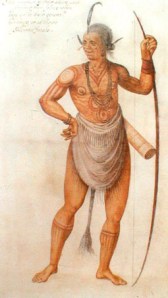
Because in the chapter I discuss tasseled yarn belts and sashes, this image was captioned: “A North American Indian wearing a tasseled sash, ca. 1590, from a painting by John White.” I would certainly not have captioned this particular image in this particular way. The apron worn in this image is relatively anomalous for the dress of the region and for Native North America in general. It appears to be tied in the back and what we see hanging in the back (between the man’s legs) seems to be the apron ties (of animal hide?) presented in a unusual but decorative way. The closest thing to this in the documentary record or present-day practice, are the animal tails worn by some men when playing “match game” (stickball), as among the Oklahoma Muscogee (Creek) and Oklahoma Seminole today (and the Choctaw historically). In the Mississippian engraved shell images, the historic-period paintings, and today, yarn sashes with tassels are worn so that the tassels fall from one or both hips (or are tied at one hip). This can be seen in the painting of a Seminole man by Charles Bird King that was also published in the article and in the shell images and contemporary photographs that I suggested but that were not used. I did suggest the use of this early Virginia image, but only because I had devoted considerable space to discussing the total Virginia corpus as a source of information on dress and adornment in the contact era. I had asked that it be paired with an image of a woman from the same time and place so as to insure gender balance across all of the images. As published online, there are no women’s objects shown or images of women wearing native dress. I apologize for this unanticipated and regrettable outcome.

The copy editing introduced various infelicities that didn’t need to be there and that degraded the work. Here are a couple to illustrate:

My sentence: “The Yuchi have a different colonial-era history and continue, into the twenty-first century, to speak their own unique language—a language isolate unrelated to other known tongues.” in which I used the technical term “language isolate” but then preceded to explain the meaning of this terminology became: “…unique language—a language isolated and unrelated to other known tongues.” This just does not mean anything sensible and it is the typical kind of “improvement” that a copy editor wanting to enhance the accessibility of an work would make in the absence of any specialist knowledge. I do not mind this as one step in the process, but it never works in an context in which the scholarly author lacks the ability to catch problems introduced by the process.

Similarly, describing Mississippian period body adornment, I mention “gorgets.” The copy editor sought to help general readers make sense of this perhaps unfamiliar term and introduced “(neck coverings)” after the word. This is a particularly interesting problem (if sad) for a work on the history of dress and body adornment in general, from a worldwide perspective. Historical period gorgets in the Southeast were mainly trade objects. Look up “Gorget” in Wikipedia (as of today) and you can see a painting of Colonel George Washington (later to become the first U.S. President) wearing exactly the same kind of silver gorget that the Seminole John Hicks is wearing in the King portrait included with my article. This crescent-shaped metal plate worn as a necklace is derived historically from European armor, as the wikepedian’s kindly tell us:

A gorget originally was a steel or leather collar designed to protect the throat. It was a feature of older types of armour and intended to protect against swords  and other non-projectile weapons. Later, particularly from the 18th century onwards, the gorget became primarily ornamental, serving only as a symbolic accessory on military uniforms.

Because, in the historic period, this elaborate necklace-strung item of adornment–a large curved object worn suspended on the upper chest–was known in English as a gorget, scholars of the region like me (perhaps too sloppily) have extended the terminology back to refer to large shell decorations worn similarly. Those obviously do not derive from European armor and they two kinds of adornment provide an illustration of the kind of convergence of European forms and Native styles that I was trying to discuss in the essay. In any event, the copy editor was seeking to help readers by introducing a definition of gorget, but the definition is anachronistic in that Southeastern people did not wear armor-like neck coverings. I would have been very happy to have helped fix this mistake if I could have.

The published version includes a list of references but the citations that had been provided in the manuscript linking particular statements to particular works were removed in conformity with the style of the volume. I am sorry about this. Thankfully the reference list itself was preserved. If a work appears there, it was used with direct citation in the original manuscript.

I wish that I had a way to share the original manuscript but this was a project that I was recruited to participate in before I had given up engaging with commercial publishers all together. Maybe someday I will have a chance to try to address the topic again in a different and more open venue.

Although I am disappointed with this sort of outcome, I do not want to sound overly bitter. I appreciate the work that the publishers and editors have created and nothing about this experience is particularly out of the ordinary for the commercial encyclopedia publishing space.  For those who can get access to it, some good information, I hope, can still be found in my contribution. The kinds of frustrations that accompany, or are generated in, projects like this motivate my enthusiasm for doing scholarly publishing in new, better, and more open ways that are less impacted by the ramifications of hard business decisions made in a dysfunctional marketplace.