Skip to content

Posts from the ‘Publications’ Category

Council for Museum Anthropology Call for Co-editor: Museum Anthropology

The Council for Museum Anthropology (CMA) invites applications for the next Co-editor of the section’s peer reviewed academic journal, Museum Anthropology. The three-year term runs from January 2026 through December 2028. Please contact journal co-editor Johanna Zetterstrom- Sharp (j.zetterstrom-sharp@ucl.ac.uk) or CMA President Christina J. Hodge (christina_hodge@brown.edu) to discuss this opportunity. Please submit a letter of interest indicating your experience and ideas for the journal, along with a recent CV, to Hodge by 31 December 2025. [RFP continues after the image]

The Journal: Over its 50-year history, Museum Anthropology (MA) has become a leading voice for scholarly research on the collection, interpretation, and representation of the material world and global cultures. Through critical articles, provocative commentaries, thoughtful book and exhibit reviews, and new publishing formats, this peer reviewed journal reflects the diverse, vibrant, global, and transdisciplinary work of museums. Situated at the intersection of practice and theory, MA advances our knowledge of the ways in which material objects are intertwined with living histories of cultural display, economics, socio-politics, law, memory, ethics, colonialism, heritage, conservation, and education.

MA is published by Wiley-Blackwell through the end of 2027. CMA is actively negotiating for a new press and contract, which will start in 2028.

The Role: MA editors have independent editorial responsibility for the journal. MA is produced by two co-editors with staggered three-year terms, ensuring continuity of knowledge and production and shared responsibilities. MA is supported by an editorial board of six international scholars in museum anthropology and allied disciplines.

The incoming MA Co-editor will contribute to the publication of a journal that enriches and diversifies scholarly and professional museum settings by: (1) soliciting and evaluating high-quality manuscripts and peer-reviews from a diversity of experts in relevant fields; (2) maintaining academically rigorous and ethical standards of publication, as well as timely management of review, submission, and publication processes; (3) constructively working with AAA and press staff, as well as the MA editorial board and CMA leadership.

The Co-editors serve as non-voting members of the CMA Board, participate in quarterly Board Meetings, and provide annual reports to CMA’s members at its annual Business Meeting (held at the AAA annual meeting). Co-editor is not a paid position, but financial support typically includes some travel expenses to the AAA meeting and some copyediting services.

Full responsibilities of the Editors are outlined in the CMA’s By-Laws: https://museumanthropology.org/about/cma-bylaws/. More about the journal can be found here: https://museumanthropology.org/journal/.

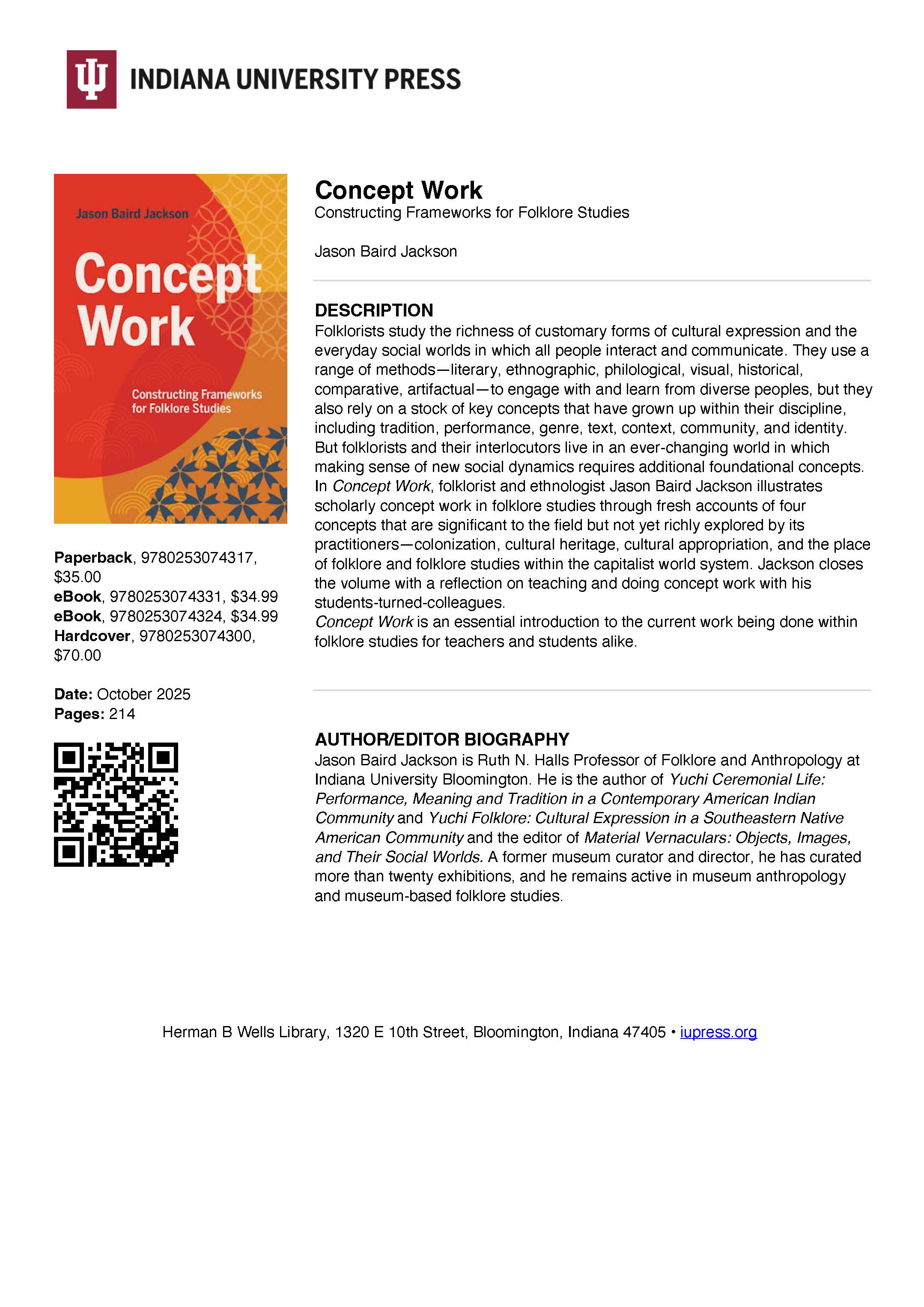
Concept Work: Constructing Frameworks for Folklore Studies Due October 2025 from IU Press.

I am happy to note that my book Concept Work: Constructing Frameworks for Folklore Studies is in press with Indiana University University. Look for it in October and learn more about it on the press website here: https://iupress.org/9780253074317/concept-work/ . The flyer is below.

And Another Thing: University Presses

This image shows a human hand holding a ebook reader showing a generic abook. It is in in graphic art style and is use to evoke the topic of book publishing.

All, or almost all of the ACLS Scholarly Societies are in mutual aid relationships with university-based scholarly publishers (=university presses). In the case of folklore studies and the American Folklore Society (AFS), the most obviously relevant of these presses are (1) University of Illinois Press (which publishes the Journal of American Folklore (JAF) on behalf of AFS), (2) Indiana University Press (based at Indiana University Bloomington, where AFS is also based), (3) University Presses of Mississippi, (4) Wayne State University Press, (5) University of Wisconsin Press, and (6) Utah State University Press (now an imprint of the University Press of Colorado). Numerous other university presses in the United States are important to folklorists for various (often, but not only, area studies) reasons, but these six are particularly impactful through their (strong, specifically) folklore studies lists. They are also, like their peer presses strong in other fields, always working to innovate and take advantage of new affordances arising in our own time. Like our societies, they are not perfect but they are invaluable.

I have had a lot to say previously about university presses and scholarly communications more generally. Beyond talk, I have tried to do what I can. where I can to help. Here I just want to record again that university presses are themselves a crucial part of the ecosystems within which scholarly societies work generally, and in which folklorists and the AFS works, specifically. There are many threads woven together here and I will not unravel them at this point. Key at present is that those six presses of special concern to AFS members (call them the six most likely to send editors and books to the AFS meetings year after year) are all based at public universities. Things are more and more challenging at public universities like the ones that host these presses, especially anything seen from above to be part and parcel of the humanities, the social sciences, or the liberal arts tradition generally. The contexts in which the presses and some of us as individuals work are getting more difficult and administrators in varied locations are less and less willing to listen and learn learn about the important ways that university presses serve the universities that host them as part of a larger ecology of actors advancing research, teaching and service in the public interest.

So, when we do environmental scans of the state of our field, or when we pursue such things as a so-called SWOT analysis (Strengths, Weaknesses, Opportunities, Threats), we must keep the state of “our” university presses in mind. They have done, and are doing, important work with and for folklorists every day. In doing that work, they are also helping students and the various local audiences, publics, communities, and and collaborators with whom we engage. Given that all of the nodes in our network are experiencing new stresses, it is important that none of us in that network take any other node for granted. We must keep a lot of different things in view, including university press publishing.

PS: While I will not unpack the varied specifics here, the fate of university presses is linked to themes raised earlier in this series, including the discussion of AI, the reflection on Whac-A-Mole and, especially, the post on blocking scholarly societies from receiving public funds. Many other themes have not yet been raised in this series but could be.

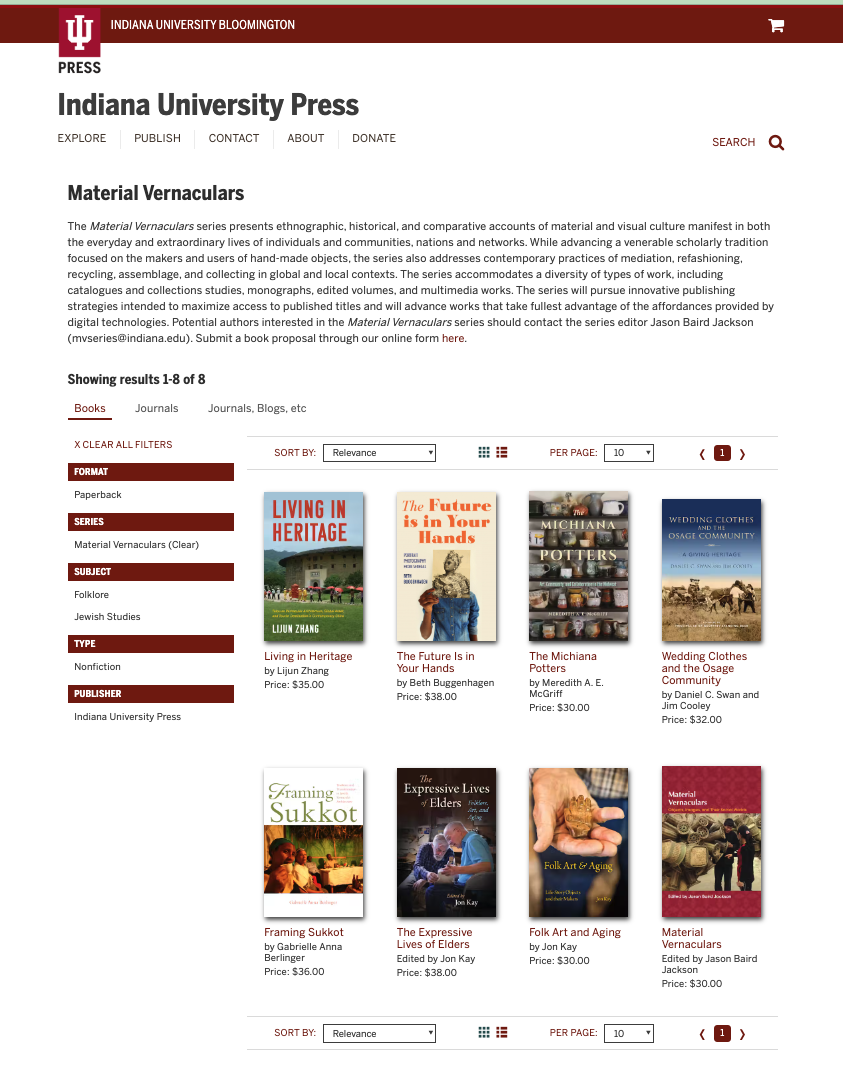
Now Published: Living in Heritage: Tulou as Vernacular Architecture, Global Asset, and Tourist Destination in Contemporary China by Lijun Zhang

Good news is scarce in my world right now, but I am really very pleased to share that Lijun Zhang’s latest book Living in Heritage: Tulou as Vernacular Architecture, Global Asset, and Tourist Destination in Contemporary China has now been published by Indiana University Press in the Material Vernaculars series. It has to be auspicious that Lijun’s important book was officially published on September 17, 2024, which this year was the Mid-Autumn Festival or Moon Festival (did you see that moon?!?). I may share more about the book later, but for today, here is the description and the link to its page at IU Press.

Yongding County in southeast China is famous for its large, multistory communal vernacular buildings known as tulou, translated “rammed earth building.” These structures were designated a UNESCO World Heritage Site in 2008. Living in Heritage introduces readers outside of China to this classic example of local Chinese architecture in the context of contemporary heritage preservation and tourism.

Focusing on the Yongding Hakka Tulou Folk Culture Village, which is part of Hongkeng Village, author Lijun Zhang examines the on-the-ground processes and effects of heritage-making, UNESCO-inspired tourism, and how locals negotiate the dramatic transformation of their daily, social, and economic lives. Within an age of cultural change beginning at the start of the 21st century, Living in Heritage explores how the tulou phenomenon as heritage has and continues to be transformed into cultural, economic, or political capital. Through her careful study, Zhang reveals how the blurring of formerly distinct domains—private and public, local and global—gives rise to a living museum that now relies on insiders and outsiders to preserve their way of life.

Living in Heritage offers an in-depth ethnographic account of the people dwelling and working within traditional tulou architecture in the 21st century.

Lijun Zhang is Assistant Professor of Folklore at George Mason University. She is author of Chinese Folk Art and Crafts and editor (with Marsha MacDowell) of Quilts of Southwest China and (with Ziying You) of Chinese Folklore Studies Today: Discourse and Practice.

Please consider purchasing a copy from IU Press here https://iupress.org/9780253070975/living-in-heritage/ (or wherever you get your books). Doing so supports not only the press in general but the free-to-readers versions of Material Vernacular titles. (More on that when the free version becomes available.)

Museum Anthropology Review

“But at the laste, as every thing hath ende…”

Today I published my final editorial as founding editor of Museum Anthropology Review. It may be that Museum Anthropology Review thus concludes with volume 17(1-2), now just published. Perhaps instead it will be revived someday by a new editorial team in partnership with the wonderful folks at the Indiana University Press and the IUScholarWorks Program at the IU Libraries. As of now, the search for a new editor or editorial team can be considered concluded unsuccessfully and the journal is either ceasing or pausing publication. I do not need to write a new version of the editorial here. I invite everyone interested in the journal and the fields that it serves to read it (always open access!) for a contextualized back story.

Here I just want to reiterate my thanks to all who contributed to, supported, and encouraged the journal as a project and who supported me as its editor. I also want to reiterate my thanks to the Indiana University Press for supporting my fields—folklore studies and cultural anthropology, including material culture studies—so well. Even though the journal—by design—was not a money making endeavor, the press stood by it and invested in its improvement and its success. Equal thanks go to the extraordinary IUScholarWorks program (now broadened as Open Scholarship) that helped launch the journal and supported it vigorously for its full run.

This image file shows two of the published editorial "On Museum Anthropology Review (2007-2023). That editorial discusses the history and conclusion of the journal.
Page 2 of MAR 17 (1-2).

Article: Collaborative Work in Museum Folklore and Heritage Studies: An Initiative of the American Folklore Society and Its Partners in China and the United States

I am very pleased to share news of a new publication. It is an article appearing now in the Journal of American Folklore:

Jackson, Jason Baird. “Collaborative Work in Museum Folklore and Heritage Studies: An Initiative of the American Folklore Society and Its Partners in China and the United States.” Journal of American Folklore 136, no. 539 (2023): 48-74. muse.jhu.edu/article/877843.

The paper’s abstract is:

Since 2007, the American Folklore Society has pursued a partnership project with the China Folklore Society. Diverse in activities and extensively participated in, the endeavor is known as the China-US Folklore and Intangible Cultural Heritage Project. In this peer-reviewed report, one sub-project within this umbrella effort is reviewed. The Collaborative Work in Museum Folklore and Heritage Studies sub-project continued the project’s established exchange practices and added a program of material culture and heritage studies research.

Thanks to the generous terms of the American Folklore Society’s author agreement, a version of the article is now available in the Indiana University open access repository. Find that version online here:  https://iu.tind.io/record/3333

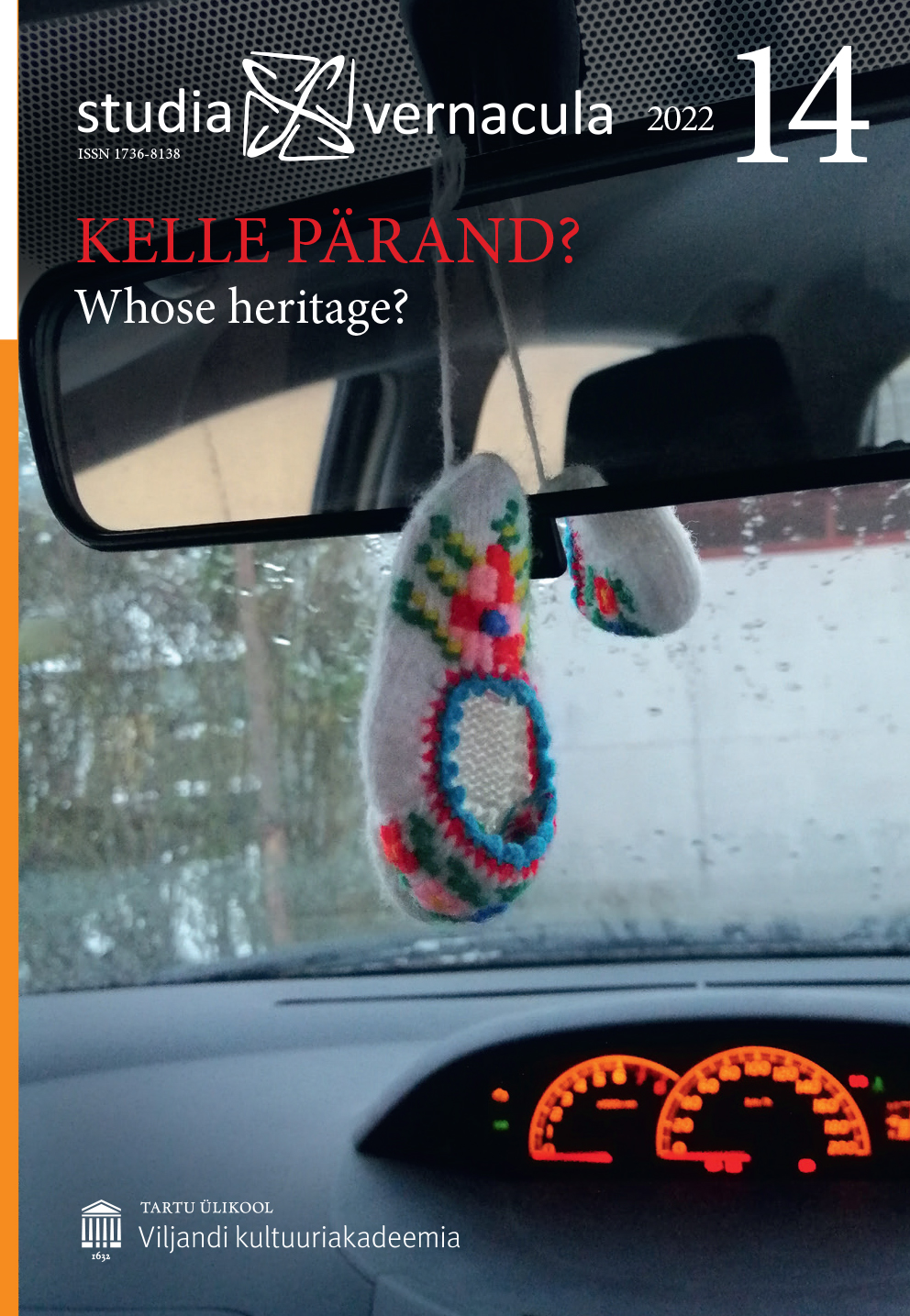
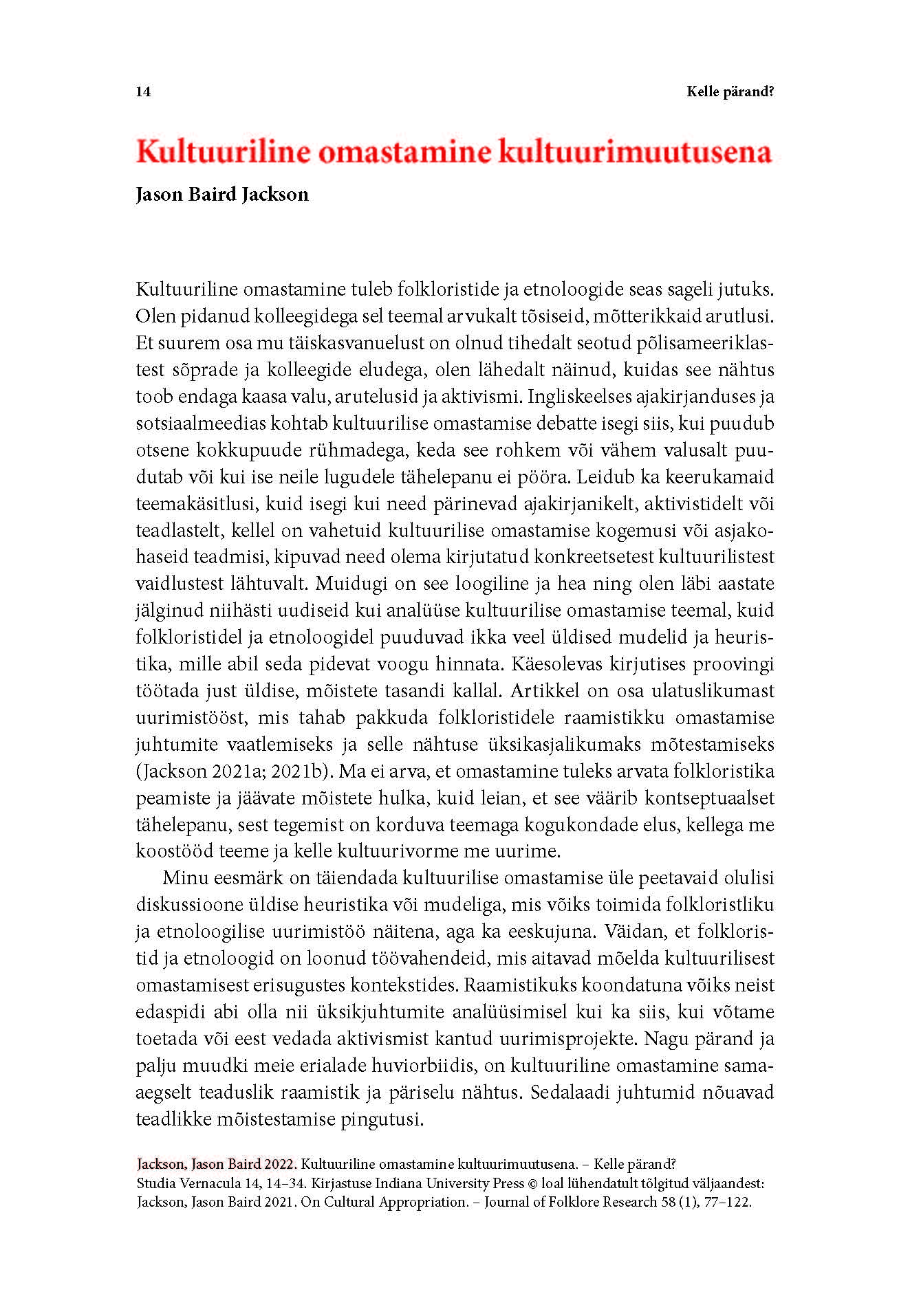
Article: “Kultuuriline omastamine kultuurimuutusena” in Studia Vernacula 14

More good news in terms of publication work. I am pleased to share that my article “Kultuuriline omastamine kultuurimuutusena” is now published in Estonian in the wonderful journal Studia Vernacula (see volume 14). This is a translation (minus the case studies) of my earlier paper “On Cultural Appropriation,” which appeared in English in the Journal of Folklore Research (volume 51, number 1 in 2021). Special thanks go to Elo-Hanna Seljamma for work translating the paper, to Kristi Jõeste for inviting me to contribute the paper, and to Madis Arukask for discussing my contribution in an editorial appearing in the new issue. Studia Vernacula is a wonderful open access journal beautifully produced in digital and print form. Even if you do not read Estonian, I urge you check it out with the help of Google Translate or a similar service. So much wonderful material culture studies work appears therein year after year.

Article: “A Survey of Contemporary Bai Craft Practices in the Dali Bai Autonomous Prefecture, Yunnan, China” in Museum Anthropology Review 16(1-2)

I am very happy to note a new co-authored article titled “A Survey of Contemporary Bai Craft Practices in the Dali Bai Autonomous Prefecture, Yunnan, China.” It was jointly written with Wuerxiya (first author), C. Kurt Dewhurst (third author) and Cuixia Zhang (fourth author) and it appears in Museum Anthropology Review volume 16, numbers 1-2. This is the special double issue published in honor of Daniel C. Swan, as noted in an earlier post on Shreds and Patches. The article is based on work undertaken by a much larger bi-national team within the “Collaborative Work in Museum Folklore and Heritage Studies” sub-project of the broader “China-US Folklore and Intangible Cultural Heritage Project,” a collaboration (2007-present) of the American Folklore Society and the China Folklore Society. In particular, it describes work undertaken through the auspices of, and in partnership with, The Institute of National Culture Research at Dali University. Special thanks go to the Institute and its leadership.

Find the article online at Museum Anthropology Review: https://scholarworks.iu.edu/journals/index.php/mar/article/view/34101

In this image is the first page of a journal article as typeset. The article pictured is "A Survey of Contemporary Bai Craft Practices in the Dali Bai Autonomous Prefecture, Yunnan, China." Visible are the names of the authors, the abstract, the key words and the first paragraph of text.
Presented as an image is the first page of the journal article “A Survey of Contemporary Bai Craft Practices in the Dali Bai Autonomous Prefecture, Yunnan, China.”

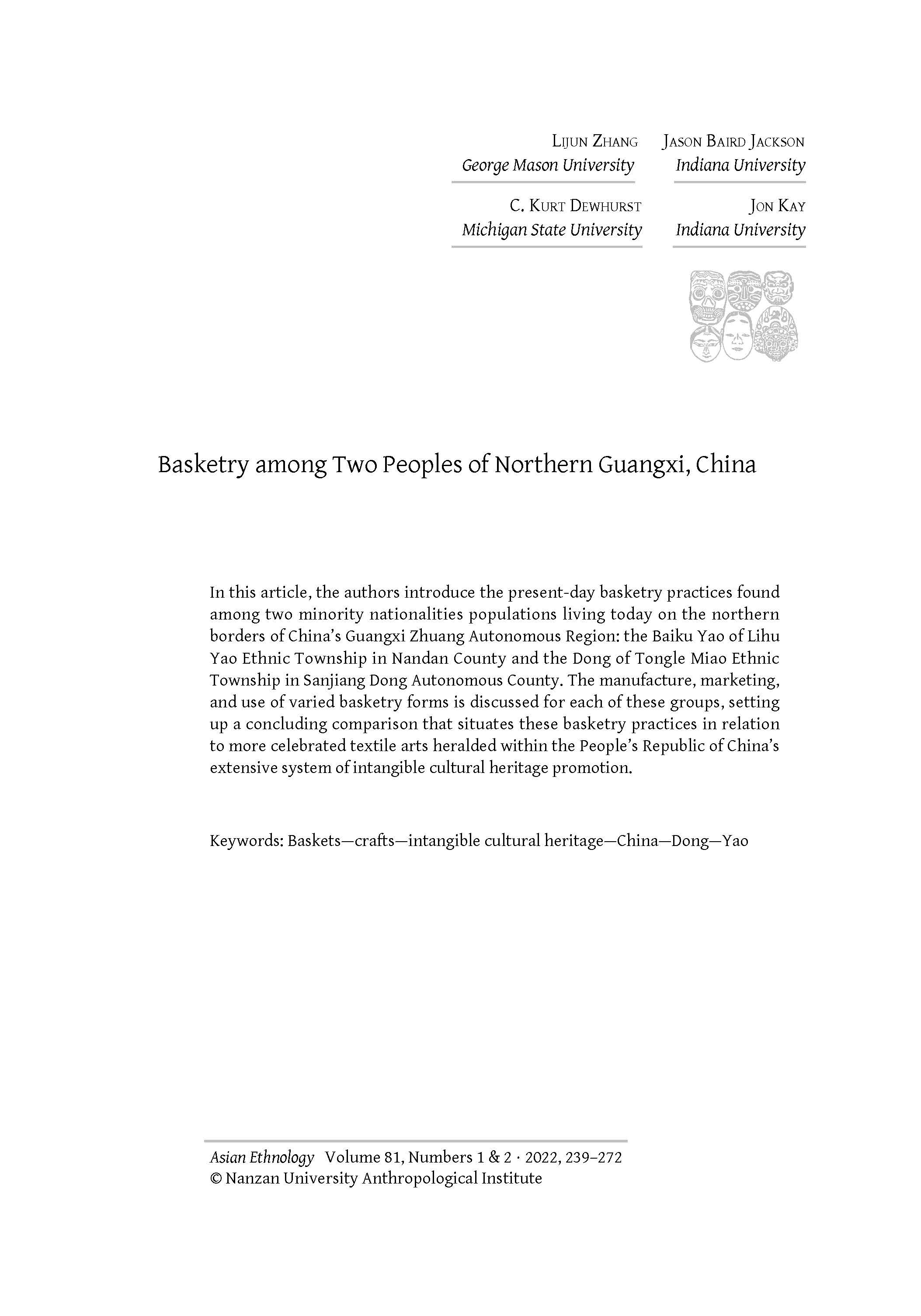
Article: “Basketry among Two Peoples of Northern Guangxi, China” in Asian Ethnology 81(1-2)

I am very happy to note the publication of “Basketry among Two Peoples of Northern Guangxi, China” in the latest double issue of Asian Ethnology. This article is one that I co-wrote with my friends and collaborators Lijun Zhang (first author), C. Kurt Dewhurst (third author), and Jon Kay (fourth author) and it is based on work undertaken by a much larger bi-national team within the “Collaborative Work in Museum Folklore and Heritage Studies” sub-project of the broader “China-US Folklore and Intangible Cultural Heritage Project,” a collaboration (2007-present) of the American Folklore Society and the China Folklore Society.

I am a huge fan of Asian Ethnology, a wonderful open access journal now in its 81st year. Check out the huge volume that our paper is a part of, Find Asian Ethnology online here: https://asianethnology.org/ and also in JSTOR

Find our article here: https://asianethnology.org/articles/2386

Find Jon Kay’s companion article here: https://asianethnology.org/articles/2387

His project is distinct from ours, but find William Nitzky’s article (also) on the Baiku Yao people today here: https://asianethnology.org/articles/2384

This is a image of page one of the published journal article "Basketry among Two Peoples of Northern Guangxi, China. It shows the author's names, the article title, an abstract and the keywords along with the journal's logo, which are a group of line drawn masks from Asian traditions.
A image of page one of the typeset version of the scholarly article “Basketry among Tow Peoples of Northern Guangxi, China” published in Asian Ethnology.

Article: “Towards Wider Framings: World-Systems Analysis and Folklore Studies” in Journal of Ethnology and Folkloristics 16(1)

Page one of the article “Towards Wider Framings” as typeset for the Journal of Ethnology and Folkloristics.

I am happy to report that my article “Towards Wider Framings: World-Systems Analysis and Folklore Studies” was published in the Journal of Ethnology and Folkloristics earlier this year. Readers will have the judge the article for itself, but I can’t say enough good things about JEF. Its a wonderful open access journal doing wonderful work in, and at the intersection of, my two fields. Thanks to everyone at the Estonian Literary Museum, the Estonian National Museum, and the University of Tartu who work to make the journal a success.

Find the article in two places online. In Sciendo here: https://sciendo.com/article/10.2478/jef-2022-0002 and in the JEF OJS instance here: https://www.jef.ee/index.php/journal.