An Endeavor Worth Explaining, Uplifting, Strengthening, and Defending

My three most recent posts are probably dispiriting for those who have taken the time to read them (on the AEI-led attack on scholarly societies, on implications of the dismantling of general education, on the internal governance challenges the societies face in a time of polycrisis). I want to balance that coverage with a local-to-me glimpse of why such things matter so much. I want to balance that coverage with good news and positive vibes, albeit tempered by the moment.
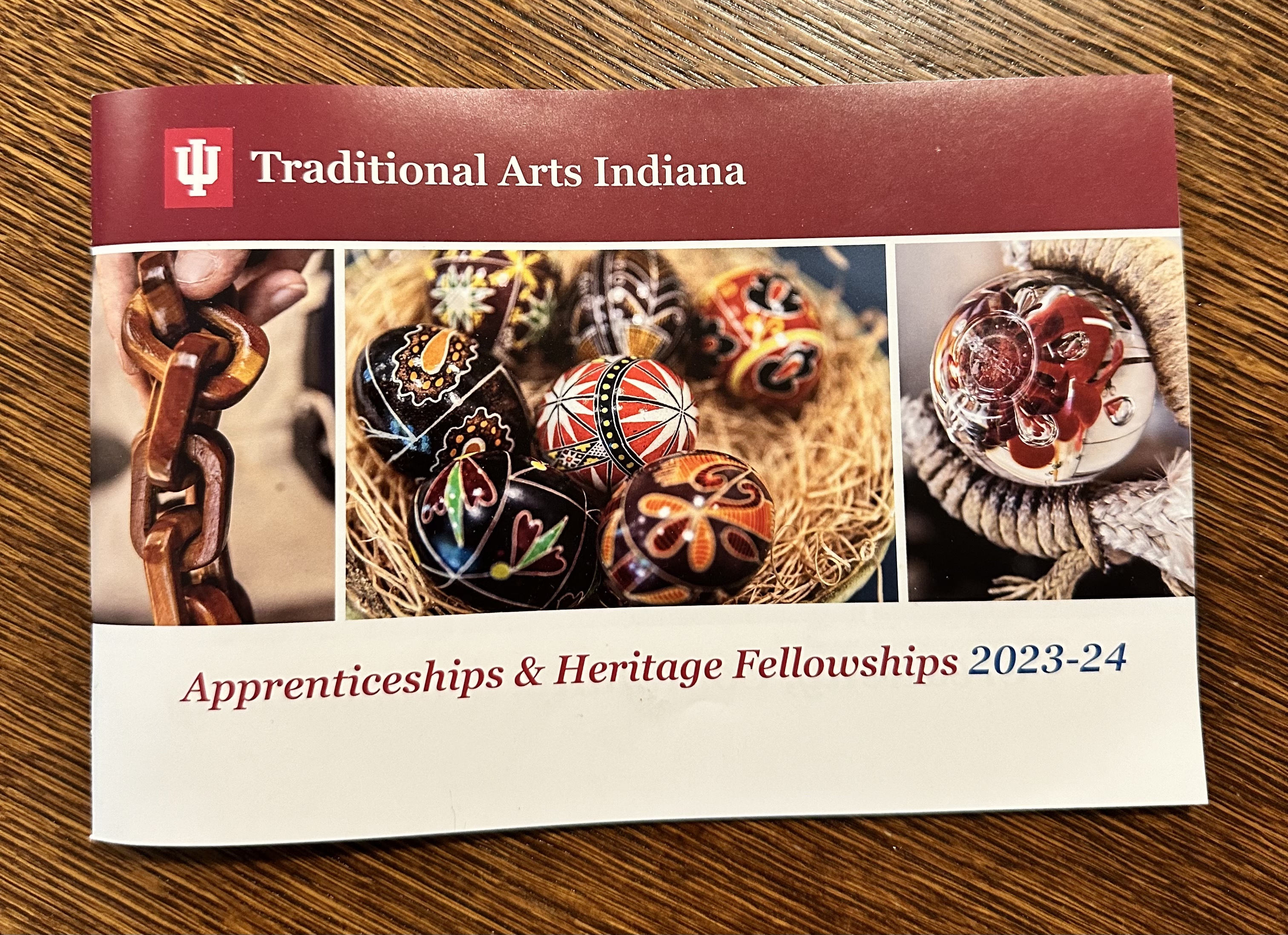
On Friday evening on the Indiana University Bloomington campus in Maxwell Hall, Traditional Arts Indiana hosted a moving and inspiring celebration of the state’s grassroots arts and cultures. Specifically, the event celebrated the work of an impressive roster of masters and apprentice teams carrying forward a rich array of art, craft, and performance forms. At the same time, a wonderful cohort of Indiana Heritage Fellowship Awardees were acknowledged and given the spotlight. These days I am more likely to cry tears of grief when on my own campus, but this was an evening that, by the time it reached its zenith, had my tearing up with tears of thanksgiving. What I know is that scenes just like this take place around the United States year-round (but not often enough) and that this happens because academic folklore studies departments and programs like mine train students to do the good work to make such programs happen and that all of us are supported in this work by the American Folklore Society.
The event in Maxwell Hall was overflowing. I arrived a bit late and worried that I would have to stand for a few hours—as some wound up doing—but I (as is so often the case) was lucky and the amazing Jenny Yang, a fellow Bloomington resident and herself a marvel and a multi-tradition bearer, flagged me over to an empty seat next to her. Not having visited with her since the end of the Mathers Museum and the onset of COVID, it was such a treat to chat with her before the formal program began. Along with her late husband James, Jenny has been a stalwart supporter of, and participant in, the programs of TAI. They were valued supporters and friends of the MMWC too, featured in exhibitions and programs at the museum.
While Jenny and I visited and traded stories and I asked her questions about mahjong, the edges of the room bustled with craftspeople and artisans demonstrating and discussing their work. To the left at the front of the room, a who’s who of Indiana musicians, together with some of their apprentices, were seated in an oval, jamming and filling the room with beautiful music played on fiddles, guitars, banjos and mandolins.
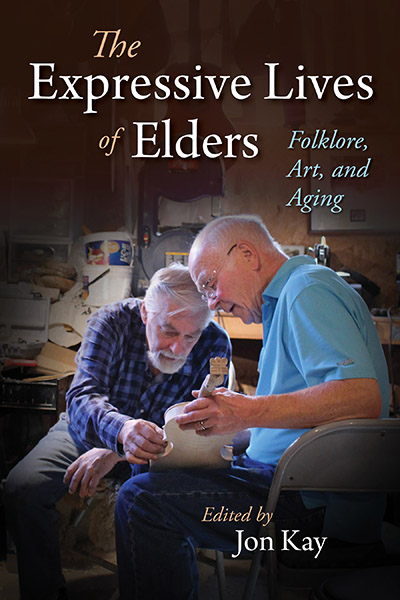
At the appointed hour, Jon Kay (Director of Traditional Arts Indiana) went to the podium to begin the formal program. I won’t do justice to it all here, but I want to identify the honorees, as the diversity and excellence that they represent speak to what is best about the state of Indiana, and by extension, life in the United States.
While it may be open for a bit longer for logistical reasons, Friday was the official finale for the exhibition A Culture Carried: Chin Basketry in Central Indiana (also presented by TAI in Maxwell Hall). This exhibition was simply excellent—rich, detailed, beautiful, well-informed, surprising to the uninitiated. In this context, the program began with special recognition of the Chin tradition bearers in the room. The delegation from Chindianapolis included weavers and weaving learners from the Winding Wednesdays group, as well as the two basket makers featured in the A Culture Carried exhibition, Pu Ngai Chum and Reverend Ceu Hlei, with members of their families. (To get background on the exhibition and its contexts, see my earlier post where I pose five questions to Jon about it.)
For most of the individuals recognized, displays and demonstrations happening before the awards ceremony itself served to showcase them and their disciplines, but for the musicians recognized, there were brief opportunities to hear and see performances during the awards ceremony itself.
The 2023 and 2024 Apprentices and masters recognized were:
- Sam Bartlett (of Monroe County) and his apprentice Patrick Blackstone, supported in the transmission of mandolin playing (they sounded great!) [2023]
- Tony Dickerson (of Marion County) and her apprentice Verna Moore, supported in the transmission of quilting [2023]
- Emily Guerrero (from Allen County) and her apprentice Avery Guerrero, supported for the transmission of ofrenda making [2023]
- Pi Hniang Ki (from Marion County) and her apprentice Anna Biak, supported for the transmission of Chin weaving traditions [2023]
- Natalie Kravchuk (from Monroe County) and her apprentice Gabriela Coolidge, supported in the transmission of Ukranian American pysanka making [2023]
- Denzil McMim (from Harrison County) and his apprentice Rebekah Carrol, supported in the transmission of wood chain carving [2023]
- Joe Rice (from Tipton County) and his apprentice Matt Kenyon, supported in the transmission of Indiana glass arts [2023]
- Peggy Taylor (from Posey County) and her apprentice Taylor Burden, supported in the transmission of Indiana loom weaving practices [2023]
- Jannie Wyatt (from Allen County) and her apprentice Dee Chambers, supported in the transmission of quilting [2023]
- Marlene Gaither (from Floyd County) and her apprentice Danny Gaither, supported in the transmission of rag rug weaving [2024]
- Larry Haycraft (from Pike County) and his apprentice Cameron Burkhart, supported in the transmission of net making [2024]
- Kwan Hui (from Hamilton County) and his apprentices Kevin Quang and Quan Nguyen, supported in the transmission of Lion Dance performance [2024]
- Shaomin Qian (from Hamilton County) and his apprentices Shaojuan Jia, Jin Lu, Sen Li and Yijun Wang, supported in the transmission of Chinese seal (stamp) carving [2024]
- Jim Smoak (from Washington County) and his apprentice Graham Houchin, supported in the transmission of banjo playing (they sounded great!) [2024]
- Becky Sprinkle (from Laurence County) and her apprentice Brittany Campbell, supported in the transmission of local music jam organizing (they sounded great!) [2024]
- Pi Nah Sung (from Marion County) and her apprentice Awi Nung, supported in the transmission of Chin weaving traditions [2024]
- Jena Visel (Spencer County) and her apprentice Donna House, supported in the transmission of Eastern Orthodox-tyle icon painting [2024]
Recognition of these masters and their apprentices was so moving and inspiring for me and for, I think, almost everyone in attendance. They represent the pursuit of excellence. They remind us that knowledge and value exist everywhere, not just on university campuses, big city galleries, and in corporate headquarters. Together with the Heritage Fellows to whom I turn next, they represent the true diversity and strength of my adopted home state and the United States as a whole.
The 2023 and 2024 Indiana Heritage Fellows were recognized next, by Jon Kay, here with the help of Indiana Arts Commission Executive Director Miah Frazer Michaelsen. They honored the following Hoosiers:
- Stephen and Nancy Dickey (from Orange County), in recognition of their excellence as fiddle and banjo musicians (This TAI event took place on Friday evening of the Lotus World Art and Music Festival, named after Stephen Dickey’s father Lotus Dickey.) [2023]
- Helen Kiesel (from Vanderburg County), in recognition of her excellence as an accordion musician [2023]
- Dick Lehman (from Elkhard County), in recognition of his excellence as a potter and for his role in building up Michiana pottery as a regional pottery tradition [2023]
- Larry Haycraft (from Pike County), in recognition of his excellence as a net maker [2024]
- Kwai Hui (from Marion County), in recognition for his excellence in lion dance and his role as a tradition bearer in the Central Indiana Chinese American and Asian American communities [2024]
A high point of the evening was when Jon announced that 2021 Indiana Heritage Fellow Dani Tippmann, who carries forward the traditional plant knowledge, and associated craft practices, of the Miami Nation was recently announced as a 2024 Taproot Fellow. This program—the Taproot Artists and Communities Trust is “dedicated to honoring and uplifting accomplished US-based traditional artists who serve as community leaders and catalysts for social change in the United States. This initiative is funded by the Mellon Foundation. It is a new national program of the Alliance for California Traditional Arts.” It provides $50,000 fellowships accompanied by $10,000 community project grants for tradition bearers such as Dani.
If you do not see the pattern here, let me call it out directly. Modest state-level master-apprentice programs such as those undertaken by TAI and its peers around the country not only help strengthen artistic and cultural life in local communities, they are also a small investment that pays dividends in the lives of both older and younger adults who are committed to their communities and to the cultural heritages that make those communities livable. Some of those involved will be further recognized in programs like the Indiana Heritage Fellowship program. That recognition, which means a tremendous amount for those so recognized, can also be a springboard for national awards, recognitions, and investments, as is the case with Dani Tippmann’s Taproot Fellowship or with those who go from being recognized on a state level to being recognized as National Heritage Fellows by the National Endowment for the Arts.
Per capita, Indiana and its state peers around the US invest microscopic amounts in the folk and traditional arts, but those investments, and especially the still tiny investments made at the state level by the National Endowment for the Arts, do an extraordinary amount of good. These investments help make life meaningful, make life bearable, in rural places, suburban places, and urban places around the U.S. They recognize and strengthen life in Indigenous communities and in the lives of diverse other communities—Latinx, African American, European American, Asian American, refugee, old settler, immigrant, etc. As reflected in the county shout-outs above, there is no corner of the state of Indiana that Traditional Arts Indiana (meaning just one half-time director and two half-time graduate assistants and some hourly and intern helpers) are not positively impacting.
The infrastructure and mutual support networks that make this possible have never been strong enough, but they are presently being weakened concurrently on many fronts. And they face still greater threats on the horizon. Organizations and activities that get rural good ole boys and refugee weavers, African American matrons and Mexican American kids in the same room and on the same page are getting fewer and fewer. In a society returning to bad habits of political violence and renormalizing xenophobia and other pathologies, joyful, plural spaces such as Maxwell Hall last Friday night are precious and all who see the value in them need to rally to defend them, and the academic programs, scholarly societies, funding agencies, and public humanities organizations that underpin them.

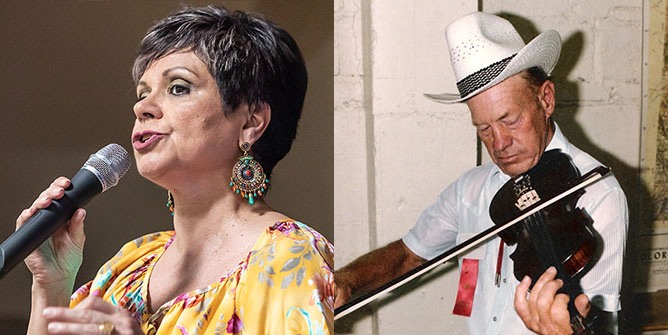
There was much to move me, but it was Stephen Dickey asking if he could join in on fiddle with Helen Kiesel’s accordion demonstration that brought tears to me. I knew they’d be great together, but I also knew what awaited me outside Maxwell Hall on my walk home—rock classics blasting from fraternity houses where the front-lawn beer pong* was going to be, and was, well underway. For a moment, Jon Kay and his students and the amazing people they support gave me the world I want rather than the world that, most of the time, I have.
*Yes, I know that beer pong is folklore and folklife too.










 Shreds and Patches