All, or almost all of the ACLS Scholarly Societies are in mutual aid relationships with university-based scholarly publishers (=university presses). In the case of folklore studies and the American Folklore Society (AFS), the most obviously relevant of these presses are (1) University of Illinois Press (which publishes the Journal of American Folklore (JAF) on behalf of AFS), (2) Indiana University Press (based at Indiana University Bloomington, where AFS is also based), (3) University Presses of Mississippi, (4) Wayne State University Press, (5) University of Wisconsin Press, and (6) Utah State University Press (now an imprint of the University Press of Colorado). Numerous other university presses in the United States are important to folklorists for various (often, but not only, area studies) reasons, but these six are particularly impactful through their (strong, specifically) folklore studies lists. They are also, like their peer presses strong in other fields, always working to innovate and take advantage of new affordances arising in our own time. Like our societies, they are not perfect but they are invaluable.
I have had a lot to say previously about university presses and scholarly communications more generally. Beyond talk, I have tried to do what I can. where I can to help. Here I just want to record again that university presses are themselves a crucial part of the ecosystems within which scholarly societies work generally, and in which folklorists and the AFS works, specifically. There are many threads woven together here and I will not unravel them at this point. Key at present is that those six presses of special concern to AFS members (call them the six most likely to send editors and books to the AFS meetings year after year) are all based at public universities. Things are more and more challenging at public universities like the ones that host these presses, especially anything seen from above to be part and parcel of the humanities, the social sciences, or the liberal arts tradition generally. The contexts in which the presses and some of us as individuals work are getting more difficult and administrators in varied locations are less and less willing to listen and learn learn about the important ways that university presses serve the universities that host them as part of a larger ecology of actors advancing research, teaching and service in the public interest.
So, when we do environmental scans of the state of our field, or when we pursue such things as a so-called SWOT analysis (Strengths, Weaknesses, Opportunities, Threats), we must keep the state of “our” university presses in mind. They have done, and are doing, important work with and for folklorists every day. In doing that work, they are also helping students and the various local audiences, publics, communities, and and collaborators with whom we engage. Given that all of the nodes in our network are experiencing new stresses, it is important that none of us in that network take any other node for granted. We must keep a lot of different things in view, including university press publishing.
This is an essay (or “essay”) mainly authored by Copilot, the LLM-based AI tool provisioned to me by Indiana University. Spelling and typographic errors made by JBJ have been silently corrected for the sake of readability.
Jason Baird Jackson (JBJ): Hello again. I would like to return to one specific matter discussed in my previous conversation with you. I will review the background and, if it is ok, we can make a fresh start on just this topic. I will be approaching it somewhat differently this time. I wish to produce an essay, with your (Copilot) help that lays out the major risks posed by LLM-based AI tools for the American Folklore Society, the US-based organization that supports professional folklorists and those communities that they in turn serve. In a moment, I will give you some parameters for this essay. Are you ready to help?
Copilot: Absolutely, I’m ready to help! Please go ahead and provide the parameters for the essay, and we’ll get started on crafting it together.
JBJ: I would like the essay to be between 800 and 1000 words. While I know that you are engineered to produce pro- and con- style treatments of many issues, including on AI as a topic, I would like you to support me in emphasizing the concerns that I have. I will note some of those for you after giving these parameters. Beyond the 800-1000 word length, I would like the essay to be written in the most sophisticated register that you are capable of. Put differently, understand your readers to be people with graduate degrees in general and well-trained in folklore studies specifically. Before I share my themes of concern, do these parameters make sense?
Copilot: Yes, your parameters make perfect sense. We’ll aim for an essay between 800 and 1000 words, focusing on the risks posed by LLM-based AI tools, written in a sophisticated register suitable for an audience of graduate-level professionals in folklore studies. Please go ahead and share your specific themes of concern, and we’ll incorporate those into the essay.
JBJ: Thank you. I know that space is limited, so here are the key concerns to weave in. I will number them (1-4).
(1) We will address the impact of the ways that LLM training data has been sourced, without consent, from writings produced by many individuals, but here including folklore studies scholars. Because folklorists have led around issues of open access, their exposure to enclosure in LLM training data is greater than it would have otherwise been. Those who lead the American Folklore Society and thereby help shape the future of the discipline need to understand these dynamics and to set policy related to them as well as to foster educational activities related to them.
(2) We will address the impact of the fact that folklorists have, in particular, entextualized and shared the words and knowledge of non-scholars of very diverse backgrounds living in many communities around the world. This has often been done in contexts in which we have said that we would not seek profit from, or allow others to profit from, their words. Cultural experts shared their words and lives with us but now their words and lives have been encoded into LLM training data without our knowledge and sometimes in ways that contradict what we promised our consultants. Those who lead the American Folklore Society and thereby help shape the future of the discipline need to understand these dynamics and to set policy related to them as well as to foster educational activities related to them.
(3) LLM and other AI tools are already fundamentally reshaping all of higher education, including the teaching of folklore studies (also known as folkloristics) by folklore scholars based in universities and colleges around the world. Those who lead the American Folklore Society and thereby help shape the future of the discipline need to understand these dynamics and to set policy related to them as well as to foster educational activities related to them.
(4) LLM and other AI tools are being adopted and put to use widely at present. This uptake is already transforming social life and having significant environmental and economic effects. Because folklorists are social scientists and humanists who study and intervene in the social world, it is crucial that they understand these environmental and economic effects and share their own work in relation to them. Those who lead the American Folklore Society and thereby help shape the future of the discipline need to understand these dynamics and to set policy related to them as well as to foster educational activities related to them.
With these four themes described, you can compute a response using your own LLM models.
Copilot: Great, thank you for outlining these key concerns. Let’s begin crafting the essay. Here’s a draft that incorporates your themes:
The Risks Posed by LLM-Based AI Tools: A Call to Action for the American Folklore Society
The advent of large language model (LLM) based AI tools has ushered in a new era of technological advancement, promising unprecedented capabilities in data processing and information dissemination. However, these tools also pose significant risks, particularly to disciplines such as folklore studies. As members of the American Folklore Society (AFS), it is imperative that we critically examine these risks and develop strategies to mitigate them. This essay outlines four major concerns that demand our immediate attention and action.
1. Unconsented Use of Scholarly Work
One of the most pressing issues is the manner in which LLM training data has been sourced. Many LLMs have been trained on vast datasets that include writings produced by individuals without their consent. This includes the work of folklore studies scholars, whose contributions to open access initiatives have inadvertently increased their exposure to such data enclosure. The ethos of open access, championed by many folklorists, has been exploited, leading to the unauthorized use of their intellectual property. The AFS must recognize these dynamics and advocate for policies that protect the rights of scholars, ensuring that their work is not co-opted without permission.
2. Exploitation of Cultural Knowledge
Folklorists have long been dedicated to documenting and sharing the knowledge of diverse communities around the world. This often involves entextualizing the words and experiences of non-scholars, with a commitment to ethical practices that respect the source communities. However, the integration of this cultural knowledge into LLM training data, often without the knowledge or consent of the communities involved, represents a profound breach of trust. Many folklorists have assured their consultants that their contributions would not be used for profit, yet these assurances are undermined by the current practices of AI developers. The AFS must address this issue by setting stringent policies and fostering educational initiatives that emphasize the ethical implications of AI use in folklore studies.
3. Transformation of Higher Education
The impact of LLM and other AI tools on higher education is already being felt, with significant implications for the teaching of folklore studies. These technologies are reshaping pedagogical approaches, research methodologies, and the overall academic landscape. Folklore scholars must navigate this rapidly changing environment, balancing the potential benefits of AI tools with the need to maintain the integrity of their discipline. The AFS has a crucial role to play in guiding this transition, developing policies that support the responsible integration of AI in academia, and providing resources to help educators adapt to these new challenges.
4. Broader Societal Impacts
Beyond the confines of academia, the widespread adoption of LLM and other AI tools is transforming social life, with significant environmental and economic effects. As social scientists and humanists, folklorists are uniquely positioned to study and intervene in these transformations. The environmental costs of AI, including the substantial energy consumption required for training and operating LLMs, are a growing concern. Additionally, the economic implications, such as job displacement and the creation of new forms of labor, must be critically examined. The AFS should lead efforts to understand these impacts, encouraging research that explores the intersection of AI, society, and the environment, and advocating for policies that promote sustainable and equitable technological development.
Conclusion
The risks posed by LLM-based AI tools are multifaceted and complex, demanding a proactive and informed response from the American Folklore Society. By addressing the unconsented use of scholarly work, the exploitation of cultural knowledge, the transformation of higher education, and the broader societal impacts, the AFS can help shape a future where AI technologies are used ethically and responsibly. It is incumbent upon us, as stewards of cultural heritage and advocates for ethical scholarship, to lead this charge and ensure that the values of our discipline are upheld in the face of technological change.
Please review this draft and let me know if there are any adjustments or additional points you’d like to include.
JBJ: I have only one request. In section “4. Broader Societal Impacts” you evoke, as expected, “substantial energy consumption”. Could you add language related to the environmental issue of water consumption in AI computing? It is acceptable for this addition to make the essay slightly longer.
Copilot: Certainly! Here is the revised section with the addition regarding water consumption:
4. Broader Societal Impacts
Beyond the confines of academia, the widespread adoption of LLM and other AI tools is transforming social life, with significant environmental and economic effects. As social scientists and humanists, folklorists are uniquely positioned to study and intervene in these transformations. The environmental costs of AI are substantial, including the significant energy consumption required for training and operating LLMs. Additionally, the water consumption associated with cooling data centers is a critical issue, as it places further strain on already limited water resources. These environmental impacts necessitate a thorough examination and responsible management. Furthermore, the economic implications, such as job displacement and the creation of new forms of labor, must be critically examined. The AFS should lead efforts to understand these impacts, encouraging research that explores the intersection of AI, society, and the environment, and advocating for policies that promote sustainable and equitable technological development.
Please review this updated draft and let me know if there are any further adjustments or additional points you’d like to include.
JBJ: Thank you. May I have your permission to share this with text readers, citing you (Copilot) as the co-author?
Copilot: I’m glad you found the essay helpful! You are welcome to share the essay with your readers. While I don’t require formal citation, you can certainly mention that you used Microsoft Copilot to assist in crafting the essay. If you need any further assistance or revisions, feel free to ask!
JBJ: Thank you!
Copilot: You’re very welcome! If you need any more assistance in the future, feel free to reach out. Good luck with your essay!
A Note to Human Readers
Thank you for your patience with me (JBJ) in this, my most recent experiment with LLM-based AI. You should know that I engage in such experiments sparingly because on the one hand, I really do not wish to be doing this and, on the other hand, I really feel the need to understand these tools, which have already dramatically changed my job and the lives of all of those around me and in my own egocentric and sociocentric networks.
Hopefully readers will realize that what I would say unassisted by co-pilot would be different. Co-pilot is not human and therefore co-pilot does not actually believe anything, but reading the text that Co-pilot strung together one work prediction at a time might suggest that co-pilot has opinions. If Co-pilot had the opinions expressed/suggested, then Co-pilot and I would agree on some points and disagree on others. Where we agree, it is because the system is drawing upon my prompts and trying to give me what I am asking for. Where we disagree it is because the system is drawing upon its own predictive algorithms and training data to produce what it thinks is the statistically most likely statements. An example early in Co-pilot’s text is “promising.” I certainly would not, on my own, say promising. But take note: the training data and algorithms “know” us and such systems are getting more sophisticated in reflecting what we know all the time. That is part of the point here. If you need an example of this, search for the phrase “source community” in section 2. This is not everyday English. This is a term of art specific to museum anthropology and museum-focused folklore studies. It has only been in active disciplinary use since the publication in 2003 of Laura Peers and Alison Brown’s edited book Museums and Source Communities.
Before publishing this AI-dependent post, I donated to the Native American Rights Fund, which supports federally recognized Native American nations in the US in defending water and water rights. I invite you to learn more about NARF and its water work here: https://narf.org/cases/tribal-water-institute
Today I published my final editorial as founding editor ofMuseum Anthropology Review. It may be that Museum Anthropology Review thus concludes with volume 17(1-2), now just published. Perhaps instead it will be revived someday by a new editorial team in partnership with the wonderful folks at the Indiana University Press and the IUScholarWorks Program at the IU Libraries. As of now, the search for a new editor or editorial team can be considered concluded unsuccessfully and the journal is either ceasing or pausing publication. I do not need to write a new version of the editorial here. I invite everyone interested in the journal and the fields that it serves to read it (always open access!) for a contextualized back story.
Here I just want to reiterate my thanks to all who contributed to, supported, and encouraged the journal as a project and who supported me as its editor. I also want to reiterate my thanks to the Indiana University Press for supporting my fields—folklore studies and cultural anthropology, including material culture studies—so well. Even though the journal—by design—was not a money making endeavor, the press stood by it and invested in its improvement and its success. Equal thanks go to the extraordinary IUScholarWorks program (now broadened as Open Scholarship) that helped launch the journal and supported it vigorously for its full run.
I am very happy to share this guest post by Tim Lloyd.
The American Folklore Society’s annual meeting is the high point of the professional year for the Society and for many of us this is evidenced by the amount of time we spend discussing present and past meetings and by the intensity of some of those discussions. In the hallways, lobbies, and bars near the rooms in which AFS annual meeting sessions happen, and in living rooms, offices, and coffee shops back home, it’s common for folklorists to discuss, interpret, and rate or rank the most recent annual meeting in light of our experience there, and to compare that experience to our recollections of the way things used to be. Each of us rapidly builds a body of such recollections which, as we know, can form the foundation of professional beliefs.
One of the more frequent beliefs that I have heard about AFS annual meetings is customarily expressed in two parts: one, that in recent decades the number of sessions devoted to academic papers has decreased as a proportion of the program; and two, that paper sessions have been replaced on the program by workshops and forums devoted to public folklore, as that part of the field has grown. But is either of these beliefs supported by the data?
Luckily, there is a rich and easily available source of data to which we can turn to support or challenge these professional beliefs: the American Folklore Society collection in the Indiana University ScholarWorks (IUSW) open online institutional repository (https://scholarworks.iu.edu/dspace/handle/2022/9004). The collection is also accessible through the AFS-IU Library online portal Open Folklore at https://openfolklore.org/.
AFS staff and volunteers and Indiana University librarians worked together to create and populate this collection starting in 2009. It contains large back runs of the journals of AFS sections and of AFS newsletters and the more recent AFS Review; a collection of syllabi and teaching resources provided by Society members; reports and other publications from AFS-sponsored professional development consultancies and workshops; AFS annual reports; and indexes to the contents of the Journal of American Folklore from 1889 to 1994.
This means that extensive information about every AFS annual meeting is openly accessible online, offering an important way to track developments in folklore scholarship and public practice—and the timelines along which they first arose, since conference paper and session topics can evidence those trends well before they reach print.
Here is a brief report on a quick survey of just a bit of the annual meeting data contained in this collection.
Wanting to know more about the ways in which the “shape” of AFS annual meetings—as measured by the types of sessions that make up the program—may have changed in recent decades, I reviewed the programs from five sample meetings (the most recent “normal” one in 2019, plus every ten years before that for 40 years: 2009, 1999, 1989 [the second of the Society’s two centennial meetings], and 1979) and counted up the numbers of various kinds of sessions, in six categories:
Paper sessions
Workshops or forums on non-public folklore subjects (as defined, on the fly, by me)
Workshops or forums on public folklore subjects (ditto)
Media sessions
Plenary sessions
Sessions to attend to some matter of AFS business
I’ve shown the numbers—and, more importantly, the percentages of each kind of session on that year’s program—in Figure 1, with the most significant percentage increases from the previous decade’s program shown in green and the most significant decreases in red. My tracking excluded all social events and all events held by non-AFS organizations (like university presses). I also did not include section business meetings in my overall tally, though I did count them separately and have included them on the spreadsheet to note the growth in the number of AFS sections over these decades.
My main takeaways from this quick look?
1. The percentage of paper sessions did decrease by about 22 percentage points during this 40-year period, most notably (I’m assuming for the moment) in the 2000s. (Note: “Paper sessions” includes those on all topics, including a small number—I’d say no more than 10% in any year—of paper sessions on public-folklore topics.)
2. This decrease has been slightly more than offset by increases in the percentage of workshops and forums of all kinds. Contrary to what I understand to be popular belief, since 2000 only a minority of those workshops and forums have covered public folklore subjects; that is, in 2009 and 2019, most of them were devoted to topics outside public folklore.
3. The greatest growth in the public-folklore workshop and forum part of the program, in fact, took place during the 1980s and 1990s. This makes sense, as this was the period when the field’s current public front was undergoing its initial periods of growth and development. (I believe that the first modern-day public folklore forum session at AFS was in Salt Lake City in 1978.) The percentage of these sorts of sessions continued to increase, though at a slower rate, in the 2000s and 2010s.
My smaller takeaways?
4. The percentage of AFS-sponsored or AFS business-related sessions increased most significantly in the 2000s. Having been around (and to some extent responsible) for almost all of those years, I’m not surprised.
5. The numbers suggest that the primary growth era for the AFS section universe was the 1980s.
And two smaller notes: Neither the number of media sessions nor that of plenaries showed much growth or decline during these 40 years. There were also three poster sessions at Boise in 2009, and one diamond session at Baltimore in 2019, but I didn’t include them in the spreadsheet because those numbers didn’t really seem material.
So on the basis of the work described here, it appears clear that over the last 40 years the percentage of the program devoted to sessions of academic papers has significantly decreased. It also appears clear that this decrease has been offset by an increase in the percentage of the program devoted to workshops and forums. But this increase is more complicated than it is widely believed to be, and appears to have two eras: one during the 1980s and 1990s that saw an increase in the number of public-folklore-related workshops and forums, and one that has taken place in the first two decades of the present century that saw an increase in the number of non-public-folklore-related (sorry for this infelicitous name) workshops and forums.
It might be pointed out that these decreases and increases could be attributed to patterns in the selections and choices made by the program committees who review, accept, and reject annual meeting proposals, rather than patterns in what prospective meeting attendees propose in the first place. However, the fact is that for many years the great majority of proposals have been accepted for annual meeting programs, which has the effect of taking those committees’ decisions largely out of this equation.
This is a small project, undertaken quickly with just a few data points from just five years of annual meetings. Please take it in the spirit in which I share it: as indicative rather than definitive. I undertook it because of my curiosity about whether perceptions of changes in the annual meeting over time matched what the programs would tell us, and because I wanted to carry out a small test of the utility of the AFS IUSW annual meeting collection for helping us answer questions about the history of the field.
The data—including abstracts of all AFS annual meeting presentations and sessions for the last several decades—exist in the AFS IUSW collection to support deeper and more extensive research. We could, for example, ask several forms of the “Why?” question about the data I’ve presented here, or examine in greater detail the topics of workshops and forums of all kinds looking for patterns of subject or theme. We could look more closely at the growth or decline over time of particular topics, approaches, sub-fields, or keywords in annual meetings generally. Or we might focus more tightly on every year in a decade to be able to craft a more complete picture of it, perhaps extending it forward, backward, or both (e.g., might there have been a “long 1980s” in folklore studies and if so, what was it and why does it matter?).
Thanks for your attention. I invite your responses and comments, but more emphatically I encourage you to pursue your own investigations using these remarkable, openly accessible online resources.
Figure 1. Data related to five annual AFS meetings staged over the past five decades.
Alternate title: How to give away $99,000 worth of articles.
Although it has become normalized in open access/scholarly publication reform discussions to speak in this way, it often seems laughable to use the phrase ‘business model” in the context of many open access projects. Business model implies more modeling and more business that are often found in these efforts. When the eye-rolling or chuckling stops, the business school talk does remind prompt us to try to figure out what we are doing and how we are doing it. This is good even for tiny projects held together (often happily) with just a bit of used string and some tape. (Thank goodness that we do not all want to become the next oversized thing.)
I write the following as founding editor of Museum Anthropology Review, an open access journal supporting scholarly and public-facing work in museum anthropology, museum-based folklore studies, and material culture studies. In an immediate context of painful collective disciplinary assessment, debate, and reflection (#hautalk) on scholarly communication work (and labor practices, and power, and hierarchy, and practices of discrimination, etc.) in the ethnographic disciplines, I thought it might be useful to be more explicit about labor and funding underpinning MAR). While the journal has a complex origin story and has changed alongside other changes (in my career, at Indiana University, in the fields that it serves, etc.), the so-called business model has remained pretty consistent, making this small task easier. It is not the business school way, but it may be easiest and most contextually relevant in MAR and disciplinary context to track labor and money using participant roles. It is hard to do this in a way that will not seem either self-promoting or defensive, but it has to be done. I have stressed throughout my wider engagements with open access that projects such as MAR need to try to be intentional in their experimental work and in reporting back to the field for collective benefit. The need for more of this is more pressing now than ever and I have been relatively silent on open access issues since finishing what I thought of as capstone activities in two pieces written with colleague-collaborators (Jackson and Anderson 2014; Walters et al. 2015 [for this project, see also here]).
Readers: The journal does have readers. I and others involved in the journal know this from digital statistics (like Google Analytics), citations to work published, and word of mouth. Accessing MAR requires internet access but does not cost readers anything. Everyone involved is pleased to know that the work is worth doing, so I say thank you to the readers who have spent their time and attention on MAR. (I invite you to sign up as a reader and get free tables of contents for MAR by email.)
Authors: The journal does have authors. Authors are not paid for their contributions to MAR, but they are also not charged author fees or article processing charges, as is common in some other kinds of open access projects. In MAR we have so-far published 33 peer-reviewed articles. Had the authors of those articles published them in Curator and paid to make them open via Wiley’s Online Open program, the total cost to authors would have been $2500 x 33 = $82,500. Author-pays open publication in Museum Anthropology would have cost $3000 x 33 = $99,000 (See Wiley-Journal-APCs-2018MAY24 (a spreadsheet) via https://authorservices.wiley.com/author-resources/Journal-Authors/licensing-open-access/open-access/onlineopen.html, accessed June 16, 2018). Those of us in other MAR other roles wish, of course, that authors were more aware of these taken-for-granted things. Hopefully this post will help a bit. I am proud that the MAR community has been able to make publication happen for these authors and their readers without ability-to-pay being a factor shaping the publication process. I also thank journal’s authors for sharing their valuable work widely through publication in MAR.
Peer-Reviewers: The journal definitely has peer-reviewers. They are generous and thoughtful and they are essential. I thank them here for their contributions to MAR. MAR peer-reviewers are not paid for their contributions. This is the current scholarly publishing norm for journals. I track the debate on the ethics of this. We are in a bind. Peer-review is hard, important labor. My opposition to industrial scale commercial scholarly publishing is based in part on the relationship between free labor of some participants and the huge profits that these firms reap (sample rants here and here). If paying peer-reviewers were to become the norm, then small community-based journals such as MAR would not be able to do it and corporate run and co-published journals would have an even bigger slice of the scholarly publishing pie (the enclosure of anthropology was at issue here). It is a conundrum at the heart of scholarly communications reform. For now, know that MAR peer-reviewers are valued and unpaid. The cash/gift economy status of the other roles is probably relevant to their feelings about this. My hope is that one feels relatively less exploited about peer-reviewing for a journal that looks like the one that I am describing here.)
Editorial Board: As is normal, MAR has a valued editorial board. As is common, I have not turned to them for structural, business or governance issues as much as I might have. As in other journals, they often serve as a kind of meta- peer-reviewers. For instance, serving as a source of editorial advice when I need help figuring something out or as a source of recommendations for reviewers. Sometimes editorial board members are called upon to undertake peer-reviews themselves. As with all journals that I know (and this is relevant in the context of the current journal controversies in the ethnographic fields), they also lend their reputations to the journal as a project. This is not inherently bad and it has a function beyond the accumulation of symbolic capital. When a potential author considers making a submission to any journal, they can review the masthead and ask: “Does my work resonate with the work of some of the people identified here?” Editorial Board Members are not paid for their MAR service. I thank them for encouraging and supporting the journal and helping it go.
A special member of the editorial board during the initial years of MAR was Associate Editor Kimberly Christen. As reflected also in her important scholarship (example here) and her own large and innovative projects (example here), Kim was a key interlocutor for me on (then new) questions of open access, helping me make sense of the shifting terrain across which MAR would travel.
Editor: At the most, two people have worked in the editorial office. Quite often, one person works in the editorial office. If there is just one person, then that person has been me. MAR launched in 2007. The story of its birth and its transformation is a different story and I postpone telling it here. A large number of friends and colleagues have helped by occupying the roles that I have noted above and by offering a range of encouragements and words of appreciation. The duties that traditionally fall to an editor are the ones that I have pursued. In the MAR case, this also includes overseeing the journal’s reviews work (book, exhibitions, etc.). This is a smaller setup than is normal even in smaller journals, which typically have a book review editor and other separated roles. There is no doubt that a critic would say that this concatenation of roles represents a concentration of power. I hope that close independent analysis would suggest that no pronounced problems flowed from this fact. For better or worse, it was also a concentration of so-called “service” labor. Understanding the finances of the editorial office can help readers judge the risks and ethics.
The actual production of the journal is also done in the editorial office. Content does not get handed off to a publishing partner for formatting, metadata coding, assignment of DOI numbers, etc. That work happens in-house and it is the editor and (when existing) the editorial assistant that do that work. As described below, Indiana University has created an excellent open access publishing environment that makes this possible.
As I still do, I held a tenured professorship when MAR sprang up into existence. As reflected by my notes above (and the points remaining to be made below), no money comes into MAR and no money goes out of MAR. There is no direct financial benefit to me to work on MAR. I acknowledge that I am paid well by Indiana University in support of the range of teaching, research, and service activities in which I engage and that I am reviewed annually and in the context of promotion decisions. No pressure to stop doing MAR has ever arisen (although my colleagues may privately question my judgement vis-à-vis excess editorial activity) and no special reward for doing it has been provided. My departments are home to a lot of editorial activity and mine just conforms to this local norm. This is a longstanding tradition, with many journals previously edited in them (Museum Anthropology, International Journal of American Linguistics, American Ethnologist, etc.) and many founded in them (Ethnohistory, Anthropological Linguistics, Journal of Folklore Research, etc.). If I did not do work on MAR I would be working on other things and my salary would not, I think, be any different. [I am mindful of the luxuries of choice available to me in my position.) MAR keeps me connected to my scholarly community and has brought a huge range of valuable experiences and relationships into my life. But there is no money to follow. Before 2013, MAR had only a kind of informal social base. It was produced by me and my friends with help from the IUScholarWorks program at the Indiana University libraries (see below). After 2013, MAR became the journal of the the Mathers Museum of World Cultures (MMWC). This was a positive byproduct of my becoming the MMWC’s Director. When my Directorship ends, MAR will remain at the museum and will be the responsibility of its next Director to continue, expand, shrink, change, or shutter. (Note: If the journal were to end next month or next year or next decade, the robust preservation and continued public accessibility of its backfiles is one of the durable commitments that IU Libraries have made to the project. See IU ScholarWorks below).
Editorial Assistant: When I was help in the work of the Editorial Office, it was by a graduate student from the Department of Folklore and Ethnomusicology or Department of Anthropology at Indiana University holding an .5 FTE (half of fulltime) graduate assistantship. Whereas the College of Arts and Sciences at Indiana University specifically funded a .5 FTE graduate assistantship for the work of supporting my previous editorship (2005-2009) of Museum Anthropology (the journal of the Council for Museum of Anthropology), MAR was never directly supported in this way. During a year serving as a department chair (2009-2010), a graduate assistant was assigned to support me in my scholarly activities. Helping with MAR became this colleague’s key duty. Between becoming Director of the MMWC in 2013 and the end of Spring 2017, the primary duty of a graduate student similarly appointed has also been to help with the journal. During fall 2017 and spring 2018, the work of the MMWC Director’s Office graduate assistantship has broadened to other projects, but the incumbent did do some MAR work. When a graduate student was working primarily on the journal, they held the title Editorial Assistant and appeared thus on the MAR masthead.
When filled, this Editorial Assistant role was a 20 hour per week position held during the fall and spring semesters. Those holding it have had the same stipends as their classmates holding similar appointments in the Department of Folklore and Ethnomusicology. They also hold fee waivers that pay for a significant portion of their course work for the full year (including summer courses) and they have a university health insurance plan. I wish that all of the assistantships held by students in my home departments (Folklore and Ethnomusicology, Anthropology) were better paid and offered better benefits, but I am happy that those student colleagues who worked with me on MAR had as good of a deal as any of their classmates. They can speak for themselves, but I think that they appreciated the experiences that they had while working on the journal. The rich range of publishing opportunities provided to graduate students in my departments have, over time, made (what I perceive to be) a significant difference in the career outcomes of the graduate students with whom my faculty colleagues and I have thus worked.
The key thing to note here vis-à-vis broader debates in anthropology publishing right now is that MAR’s basic editorial office work (correspondence, copyediting, layout and formatting, social media stuff, etc.) was either done by me or by a graduate student being paid to work with me.* Given its small scale and lack of cash in and cash out practices, MAR could have been done with a wider pool of volunteer laborers. I actually support this model and have spoken up for it often, but in the actual doing, the mix of roles described here made sense to me for MAR. In part, this stemmed from MAR being an off-shoot of Museum Anthropology which, for a time, was run with as many variables as possible being held constant so as to provide a kind of natural experiment to contrast open access and conventional publishing in the sub-field that both journals served. The mode of editor (or pair of editors) plus assistant has been constant with Museum Anthropology from the time of my editorship and thus through the period of MAR’s history at issue here. Creating opportunities to support the work of graduate students interested in museum ethnography was always a key concern of mine in this work. It motivated my seeking the Museum Anthropology editorship in 2005 and it has remained a prominent goal throughout. I thank the College of Arts and Sciences and the Office of the Vice Provost for Research for supporting the assistantship positions that have at various points helped MAR prosper. I thank Janice Frisch (2019-2010), Teri Klassen (2014), and Emily Buhrow Rogers (2014-2017) for their hard work as editorial assistants with MAR.
IUScholarWorks: MAR would not be possible without the extraordinary vision, investment, and labor gathered in the IUScholarWorks program of the Indiana University Libraries. Focused on supporting open access scholarly communications efforts, IUScholarWorks (IUSW) has a number of signature projects, including Indiana University’s institutional repository and the IUScholarWorks Journals program. MAR was the first of the IUSW supported journals. This program has grown to include more than forty open access journal titles, including others of relevance to the ethnographic disciplines (Anthropology of East Europe Review, Ethnomusicology Translations, Studies in Digital Heritage, etc.).
I am not able to quantify the financial investments that the IU Libraries have made in MAR via the IUSW program, but the investment is significant and important. Most crucially, it is via IUSW that MAR has access to the incredible open access journal hosting and workflow software known as Open Journal Systems (OJS). OJS makes MAR possible and the IUSW librarians and staff make MAR on OJS possible. I want to express appreciation for the investment and incredible support that the IU Libraries have provided to me and to the MAR project. I hope to say more about the details of this support in the future and to quantify the technical and staff costs underlying it. For now, it may be enough to know that just as MAR tries to serve the field without charging fees for that service, IUSW tries to serve projects like MAR without charging fees for that service. It is certainly the case that economies of scale have been realized by having library-based publishing support services that can concurrently help a wide range of (mostly small) journal projects.
Indiana University Press: Technically, I could speak of the IU Press alongside IUScholarWorks. At Indiana University, our wonderful press is now a unit inside the IU Libraries. In this position, there is significant overlap and interdigitation between the open access publishing support work of IUScholarWorks and the general publishing work of the IU Press. But the two efforts also preserve some distinction. One way that MAR is increasingly being served by the IU Press is through promotion. As an outgrowth of the Press’ own commitment to fostering open access publishing, the Press has generously promoted MAR alongside its full suite of scholarly journals. As with the libraries as a whole and IUSW in particular, I cannot say enough good things about our press. The open access-fostering work of the Press, IUSW and the libraries in general are an outgrowth of a larger campus-wide and university-wide commitment that has been a key factor in the success of MAR and other OA (related) projects (JFRR, Material Vernaculars, Open Folklore) in which I have participated. I am appreciative of this support even as I cannot put a dollar figure on it. The key thing here is that MAR had not had to pay the IU Press to promote the journal (through print and web ads) just as it has not had to pay the libraries for IUSW services.
Conclusion: Responding to current calls for transparency in the work of open access journals is important. When I edited Museum Anthropology for the Council for Museum Anthropology Review, I was required to prepare and present annual editor’s reports that provided the board, the membership, and the AAA an auditable record of the journal’s editorial work and the financial realities of the journal in relation to the finances of AAA vis-à-vis its (then) publishing partners (University of California Press –> Blackwell/Wiley-Blackwell). By their nature, more emergent and grassroots projects (like MAR) lack formal institutional structures and thus they lack baked-in prompts for recording and reporting the facts of their existence. I hope that the accounting that I have provided here shows how one such project has functioned, particularly in terms of the flow of in-kind services. If cognate projects to MAR can also respond to calls for more public sharing of their underlying circumstances, the larger project of building a more equitable and sustainable system of scholarly communication can be advanced. I regret now not putting the facts noted above into written form sooner. Rather than end though on regret, let me close with a final word of appreciation to all of those who have provided the in-kind labor or financial support or technical infrastructure that has made MAR possible. See what you think of the results at: https://scholarworks.iu.edu/journals/index.php/mar/issue/archive.
Note
*For the first time in MAR’s history, I paid a freelance copyeditor to edit three article manuscripts last month. Other duties prevented me from doing this work in a timely way and the assistantship role is not filled during the summer months. I paid for these edits out of discretionary funds raised through my involvement in other non-journal projects. Noting this fact allows me to record the value I place on the contributions that publishing professionals make in scholarly communication work. The DIY nature of MAR is an outgrowth of its nature and scale and is not a repudiation of professionalism in publishing work. Opposition to large corporate publishers is not the same thing as opposition to all publishers. I have devoted significant effort to supporting university presses and I try to be an ally to university press colleagues.
[Jason Baird Jackson is the author of this post. It was initially written on June 16-17, 2018 and published on Shreds and Patches on June 17, 2018. It is released under a CC BY-NC-SA 3.0 license. At the time of its publication, his twitter account “handle” is @jasonjackson116]
Just in time for the holiday that is at its center, I am happy to trumpet the publication of Framing Sukkot: Tradition and Transformation in Jewish Vernacular Architecture by Gabrielle Berlinger. Framing Sukkot is the third title in the Material Vernaculars series and it is appearing in the world just as the Jewish holiday of Sukkot is about to begin for 2017/5778!
The sukkah, the symbolic ritual home built during the annual Jewish holiday of Sukkot, commemorates the temporary structures that sheltered the Israelites as they journeyed across the desert after the exodus from Egypt. Despite the simple Biblical prescription for its design, the remarkable variety of creative expression in the construction, decoration, and use of the sukkah, in both times of peace and national upheaval, reveals the cultural traditions, political convictions, philosophical ideals, and individual aspirations that the sukkah communicates for its builders and users today.
In this ethnography of contemporary Sukkot observance, Gabrielle Anna Berlinger examines the powerful role of ritual and vernacular architecture in the formation of self and society in three sharply contrasting Jewish communities: Bloomington, Indiana; South Tel Aviv, Israel; and Brooklyn, New York. Through vivid description and in-depth interviews, she demonstrates how constructing and decorating sukkah and performing the weeklong holiday’s rituals of hospitality provide unique circumstances for creative expression, social interaction, and political struggle. Through an exploration of the intersections between the rituals of Sukkot and contemporary issues, such as the global Occupy movement, Berlinger finds that the sukkah becomes a tangible expression of the need for housing and economic justice, as well as a symbol of the longing for home.
As I noted in discussing the edited collection Material Vernaculars: Objects, Images, and Their Social Worlds last fall, it is my hope that many readers will purchase a beautiful paper or hardback edition of Framing Sukkot, thereby helping support the work of a great university press. One of the things that makes IU Press great is its commitment to building strategies for free and open access to scholarly writings. The Material Vernaculars series, co-published with the Mathers Museum of World Cultures, is part of that commitment. So, first let me note that you can buy copies of the book from a range of online booksellers, including Amazon and the IU Press itself. Secondly, let me show you where the free digital edition of the book lives. Hopefully by the time Sukkot ends, people around the world will be reading this great new book.
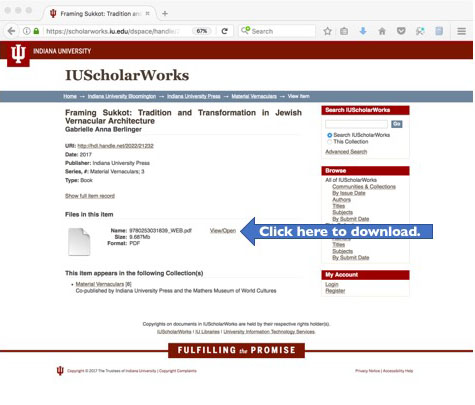
Once you are there, click on the “View/Open” link as shown in the image. Clicking should enable you to download a copy of the book.
Dr. Berlinger is an Assistant Professor of American Studies and Folklore at the University of North Carolina at Chapel Hill, where she is also the Babette S. and Bernard J. Tanenbaum Fellow in Jewish History and Culture within the Carolina Center for Jewish Studies. In addition to the new book, you can find a moving Sukkot-oriented post by Dr. Berlinger on the IU Press blog.
A quick note to convey appreciation for the great staff of the Indiana University Press, especially the work of the press staff who attended the 2016 American Folklore Society meetings in Miami. It was clear that the press had a great meeting. They brought mountains of new books and were wiped out. They also announced a lot of forthcoming titles and clearly were talking to a lot of scholars about their work. One highlight for me was a tremendous reception sponsored by the press in celebration of the Material Vernaculars series that the press co-publishes with the Mathers Museum of World Cultures and that I edit. The reception attracted a huge crowd and the food and drinks that IU Press so kindly provided were first rate. Thanks to IU Press and to all who came to the reception. Thanks to all who purchased copies of the first two Material Vernaculars titles. Your endorsement is very encouraging.
If you think that high quality open and/or free access editions of scholarly monographs are a good thing, and if you have the means to do so, I urge you to purchase copies of the companion print or ebook editions as a way of supporting the cause and subsidizing the access of others, including those who cannot otherwise afford to obtain the book. If you really want to make a difference, consider donating to the not-for-profit publishers and libraries behind such efforts. In our case, you can contribute to the Indiana University Press (co-publisher of the Material Vernaculars series with the Mathers Museum of World Cultures) here: http://www.iupress.indiana.edu/pages.php?CDpath=12
Here is a screen shot showing you where to click to download Material Vernaculars. The image should link to the page in IUScholarWorks where the book is found. (The link is given above as well.)
The answer here is no, but as you might guess, the series is intended to be the go to place when the museum does have its own publishing projects. This answer prompts then a couple of more points needing to be made. Peer-review for the series is fully managed by the IU Press and editorial review is a joint matter, thus it is quite conceivable that a museum project might be passed on by the press either at the early editorial review stage or at the peer-review stage. (I note that the press has already passed on one possible project, to illustrate this point tangibly.) Thus the series will hopefully be the home for additional MMWC authors and projects, but this is not guaranteed—and should not be.
The other side of this is that the series will hopefully come to publish authors without ties to museum, including colleagues not yet known to me. As the series homepage presently notes, “Potential authors interested in the Material Vernaculars series should contact the series editor Jason Baird Jackson via mvseries [at] indiana.edu and Aquisitions Editor Janice Frisch at frischj [at] indiana.edu.” That phrase, and the series overview, are available here.
As noted there, a new series also poses genre questions. Here, my intentions as editor are broad. “The series accommodates a diversity of types of work, including catalogues and collections studies, monographs, edited volumes, and multimedia works.” To me, these are the key genres of relevance for research museum practice in ethnography, ethnology, and cultural history (our museum’s fields), but it could be that new, as yet not fully recognized genres could also find a home in the series. While the forthcoming edited volume is something of a sampler, future edited volumes will likely have a strong thematic focus. Stand alone essays will continue to find a home in the museum’s journal, Museum Anthropology Review.
I hope to hear from potential authors and editors interested in learning more about the series. Thanks to all who have supported this new effort.
First the take away, then the story. While produced in very nice and reasonably priced hardback, paperback, and ebook editions, works in the new Material Vernaculars series are also being made available in free-to-the-reader PDF versions. This is a great thing and, if you agree with me about that, and can afford to do so, I really hope that you will purchase the edition of your choice, thereby signaling your support for making such works freely accessible to those who cannot afford to purchase them. If this seems strange to you, its a lot like community and public radio in the United States. Those who can support these services help make them accessible to those who cannot afford to make their own donations. We all gently nudge those who use them and could, but don’t, support them. (Called free riders.) Its not utopia, but its what we have and its better than the vast majority of people being locked out of non-commercial arts and education programming (and scholarly books). Now you can skip to the end for the link if you are in a rush.
Those who know about my work know that I have been focused on promoting free and open access to scholarly work for a relatively long time. My advocacy efforts followed soon after I began work as a scholarly journal editor. At that time, I was drawn into a diverse range of problems, opportunities, and paradoxes that the transformation of scholarly communication was (and is still) engendering. Probably the best place to find the things that I have written on this theme is to look at the interview that I did with Ryan Anderson (published in Cultural Anthropology in 2014)
Books cost a lot of money to make. In a peer-reviewed article, based on our humanities book research studying publishing work of the Indiana University Press and University of Michigan Press, my colleagues report that the zero copy cost for a typical humanities book is about $27,000. Efforts to increase access to scholarship have to find ways to confront these costs from all sides—finding ways to lower prices but also new ways of funding the professional work that it takes to make a quality book.
For me, for the museum, and especially for the IU Press, the Material Vernaculars series is an experiment. If we get past talking about it and actually begin doing it, what can we learn that will, we hope, help us learn to do it more and better? This is part of what is at stake for IU Press and for the whole world of university press humanities book publishing. I am thrilled to be a part of a new series that has a secondary role (beyond its primarily scholarly one) of finding ways to make scholarly books more widely and openly accessible.
So paradoxically, if you believe (for example) that the communities about whom ethnographers write should have access to what they write, then I call on you, paradoxically, to purchase a copy of Folk Art and Aging and the other other books that are in the pipeline. Your purchase helps support the goals of the series and it demonstrates that paid-for print editions or e-book editions are not mutually exclusive of free-to-readers electronic editions. If it helps, think of the print edition as a thank you gift for your donation to this cause rather than as a commodity that you are purchasing in the marketplace. You can feel particularly good about it if you purchase it directly from the Indiana University Press, thereby cutting out one or more commercial intermediaries.
It (PDF) won’t always be the file format of choice, but for now the free editions of Material Vernaculars titles will be circulated in PDF form via the IUScholarWorks Repository. When people download the books from IUScholarWorks, there is a download count, which helps us learn how many people, over what time period, showed interest in the book(s). (So, send your friends to the link rather than passing around the PDF…)
If you are wondering how to download the book, see the picture above for the place to click.
Here is the link. Two actually. The first is durable but enigmatic. The second is more human readable, but potentially less permanent.





 Shreds and Patches