All, or almost all of the ACLS Scholarly Societies are in mutual aid relationships with university-based scholarly publishers (=university presses). In the case of folklore studies and the American Folklore Society (AFS), the most obviously relevant of these presses are (1) University of Illinois Press (which publishes the Journal of American Folklore (JAF) on behalf of AFS), (2) Indiana University Press (based at Indiana University Bloomington, where AFS is also based), (3) University Presses of Mississippi, (4) Wayne State University Press, (5) University of Wisconsin Press, and (6) Utah State University Press (now an imprint of the University Press of Colorado). Numerous other university presses in the United States are important to folklorists for various (often, but not only, area studies) reasons, but these six are particularly impactful through their (strong, specifically) folklore studies lists. They are also, like their peer presses strong in other fields, always working to innovate and take advantage of new affordances arising in our own time. Like our societies, they are not perfect but they are invaluable.
I have had a lot to say previously about university presses and scholarly communications more generally. Beyond talk, I have tried to do what I can. where I can to help. Here I just want to record again that university presses are themselves a crucial part of the ecosystems within which scholarly societies work generally, and in which folklorists and the AFS works, specifically. There are many threads woven together here and I will not unravel them at this point. Key at present is that those six presses of special concern to AFS members (call them the six most likely to send editors and books to the AFS meetings year after year) are all based at public universities. Things are more and more challenging at public universities like the ones that host these presses, especially anything seen from above to be part and parcel of the humanities, the social sciences, or the liberal arts tradition generally. The contexts in which the presses and some of us as individuals work are getting more difficult and administrators in varied locations are less and less willing to listen and learn learn about the important ways that university presses serve the universities that host them as part of a larger ecology of actors advancing research, teaching and service in the public interest.
So, when we do environmental scans of the state of our field, or when we pursue such things as a so-called SWOT analysis (Strengths, Weaknesses, Opportunities, Threats), we must keep the state of “our” university presses in mind. They have done, and are doing, important work with and for folklorists every day. In doing that work, they are also helping students and the various local audiences, publics, communities, and and collaborators with whom we engage. Given that all of the nodes in our network are experiencing new stresses, it is important that none of us in that network take any other node for granted. We must keep a lot of different things in view, including university press publishing.
This is an essay (or “essay”) mainly authored by Copilot, the LLM-based AI tool provisioned to me by Indiana University. Spelling and typographic errors made by JBJ have been silently corrected for the sake of readability.
Jason Baird Jackson (JBJ): Hello again. I would like to return to one specific matter discussed in my previous conversation with you. I will review the background and, if it is ok, we can make a fresh start on just this topic. I will be approaching it somewhat differently this time. I wish to produce an essay, with your (Copilot) help that lays out the major risks posed by LLM-based AI tools for the American Folklore Society, the US-based organization that supports professional folklorists and those communities that they in turn serve. In a moment, I will give you some parameters for this essay. Are you ready to help?
Copilot: Absolutely, I’m ready to help! Please go ahead and provide the parameters for the essay, and we’ll get started on crafting it together.
JBJ: I would like the essay to be between 800 and 1000 words. While I know that you are engineered to produce pro- and con- style treatments of many issues, including on AI as a topic, I would like you to support me in emphasizing the concerns that I have. I will note some of those for you after giving these parameters. Beyond the 800-1000 word length, I would like the essay to be written in the most sophisticated register that you are capable of. Put differently, understand your readers to be people with graduate degrees in general and well-trained in folklore studies specifically. Before I share my themes of concern, do these parameters make sense?
Copilot: Yes, your parameters make perfect sense. We’ll aim for an essay between 800 and 1000 words, focusing on the risks posed by LLM-based AI tools, written in a sophisticated register suitable for an audience of graduate-level professionals in folklore studies. Please go ahead and share your specific themes of concern, and we’ll incorporate those into the essay.
JBJ: Thank you. I know that space is limited, so here are the key concerns to weave in. I will number them (1-4).
(1) We will address the impact of the ways that LLM training data has been sourced, without consent, from writings produced by many individuals, but here including folklore studies scholars. Because folklorists have led around issues of open access, their exposure to enclosure in LLM training data is greater than it would have otherwise been. Those who lead the American Folklore Society and thereby help shape the future of the discipline need to understand these dynamics and to set policy related to them as well as to foster educational activities related to them.
(2) We will address the impact of the fact that folklorists have, in particular, entextualized and shared the words and knowledge of non-scholars of very diverse backgrounds living in many communities around the world. This has often been done in contexts in which we have said that we would not seek profit from, or allow others to profit from, their words. Cultural experts shared their words and lives with us but now their words and lives have been encoded into LLM training data without our knowledge and sometimes in ways that contradict what we promised our consultants. Those who lead the American Folklore Society and thereby help shape the future of the discipline need to understand these dynamics and to set policy related to them as well as to foster educational activities related to them.
(3) LLM and other AI tools are already fundamentally reshaping all of higher education, including the teaching of folklore studies (also known as folkloristics) by folklore scholars based in universities and colleges around the world. Those who lead the American Folklore Society and thereby help shape the future of the discipline need to understand these dynamics and to set policy related to them as well as to foster educational activities related to them.
(4) LLM and other AI tools are being adopted and put to use widely at present. This uptake is already transforming social life and having significant environmental and economic effects. Because folklorists are social scientists and humanists who study and intervene in the social world, it is crucial that they understand these environmental and economic effects and share their own work in relation to them. Those who lead the American Folklore Society and thereby help shape the future of the discipline need to understand these dynamics and to set policy related to them as well as to foster educational activities related to them.
With these four themes described, you can compute a response using your own LLM models.
Copilot: Great, thank you for outlining these key concerns. Let’s begin crafting the essay. Here’s a draft that incorporates your themes:
The Risks Posed by LLM-Based AI Tools: A Call to Action for the American Folklore Society
The advent of large language model (LLM) based AI tools has ushered in a new era of technological advancement, promising unprecedented capabilities in data processing and information dissemination. However, these tools also pose significant risks, particularly to disciplines such as folklore studies. As members of the American Folklore Society (AFS), it is imperative that we critically examine these risks and develop strategies to mitigate them. This essay outlines four major concerns that demand our immediate attention and action.
1. Unconsented Use of Scholarly Work
One of the most pressing issues is the manner in which LLM training data has been sourced. Many LLMs have been trained on vast datasets that include writings produced by individuals without their consent. This includes the work of folklore studies scholars, whose contributions to open access initiatives have inadvertently increased their exposure to such data enclosure. The ethos of open access, championed by many folklorists, has been exploited, leading to the unauthorized use of their intellectual property. The AFS must recognize these dynamics and advocate for policies that protect the rights of scholars, ensuring that their work is not co-opted without permission.
2. Exploitation of Cultural Knowledge
Folklorists have long been dedicated to documenting and sharing the knowledge of diverse communities around the world. This often involves entextualizing the words and experiences of non-scholars, with a commitment to ethical practices that respect the source communities. However, the integration of this cultural knowledge into LLM training data, often without the knowledge or consent of the communities involved, represents a profound breach of trust. Many folklorists have assured their consultants that their contributions would not be used for profit, yet these assurances are undermined by the current practices of AI developers. The AFS must address this issue by setting stringent policies and fostering educational initiatives that emphasize the ethical implications of AI use in folklore studies.
3. Transformation of Higher Education
The impact of LLM and other AI tools on higher education is already being felt, with significant implications for the teaching of folklore studies. These technologies are reshaping pedagogical approaches, research methodologies, and the overall academic landscape. Folklore scholars must navigate this rapidly changing environment, balancing the potential benefits of AI tools with the need to maintain the integrity of their discipline. The AFS has a crucial role to play in guiding this transition, developing policies that support the responsible integration of AI in academia, and providing resources to help educators adapt to these new challenges.
4. Broader Societal Impacts
Beyond the confines of academia, the widespread adoption of LLM and other AI tools is transforming social life, with significant environmental and economic effects. As social scientists and humanists, folklorists are uniquely positioned to study and intervene in these transformations. The environmental costs of AI, including the substantial energy consumption required for training and operating LLMs, are a growing concern. Additionally, the economic implications, such as job displacement and the creation of new forms of labor, must be critically examined. The AFS should lead efforts to understand these impacts, encouraging research that explores the intersection of AI, society, and the environment, and advocating for policies that promote sustainable and equitable technological development.
Conclusion
The risks posed by LLM-based AI tools are multifaceted and complex, demanding a proactive and informed response from the American Folklore Society. By addressing the unconsented use of scholarly work, the exploitation of cultural knowledge, the transformation of higher education, and the broader societal impacts, the AFS can help shape a future where AI technologies are used ethically and responsibly. It is incumbent upon us, as stewards of cultural heritage and advocates for ethical scholarship, to lead this charge and ensure that the values of our discipline are upheld in the face of technological change.
Please review this draft and let me know if there are any adjustments or additional points you’d like to include.
JBJ: I have only one request. In section “4. Broader Societal Impacts” you evoke, as expected, “substantial energy consumption”. Could you add language related to the environmental issue of water consumption in AI computing? It is acceptable for this addition to make the essay slightly longer.
Copilot: Certainly! Here is the revised section with the addition regarding water consumption:
4. Broader Societal Impacts
Beyond the confines of academia, the widespread adoption of LLM and other AI tools is transforming social life, with significant environmental and economic effects. As social scientists and humanists, folklorists are uniquely positioned to study and intervene in these transformations. The environmental costs of AI are substantial, including the significant energy consumption required for training and operating LLMs. Additionally, the water consumption associated with cooling data centers is a critical issue, as it places further strain on already limited water resources. These environmental impacts necessitate a thorough examination and responsible management. Furthermore, the economic implications, such as job displacement and the creation of new forms of labor, must be critically examined. The AFS should lead efforts to understand these impacts, encouraging research that explores the intersection of AI, society, and the environment, and advocating for policies that promote sustainable and equitable technological development.
Please review this updated draft and let me know if there are any further adjustments or additional points you’d like to include.
JBJ: Thank you. May I have your permission to share this with text readers, citing you (Copilot) as the co-author?
Copilot: I’m glad you found the essay helpful! You are welcome to share the essay with your readers. While I don’t require formal citation, you can certainly mention that you used Microsoft Copilot to assist in crafting the essay. If you need any further assistance or revisions, feel free to ask!
JBJ: Thank you!
Copilot: You’re very welcome! If you need any more assistance in the future, feel free to reach out. Good luck with your essay!
A Note to Human Readers
Thank you for your patience with me (JBJ) in this, my most recent experiment with LLM-based AI. You should know that I engage in such experiments sparingly because on the one hand, I really do not wish to be doing this and, on the other hand, I really feel the need to understand these tools, which have already dramatically changed my job and the lives of all of those around me and in my own egocentric and sociocentric networks.
Hopefully readers will realize that what I would say unassisted by co-pilot would be different. Co-pilot is not human and therefore co-pilot does not actually believe anything, but reading the text that Co-pilot strung together one work prediction at a time might suggest that co-pilot has opinions. If Co-pilot had the opinions expressed/suggested, then Co-pilot and I would agree on some points and disagree on others. Where we agree, it is because the system is drawing upon my prompts and trying to give me what I am asking for. Where we disagree it is because the system is drawing upon its own predictive algorithms and training data to produce what it thinks is the statistically most likely statements. An example early in Co-pilot’s text is “promising.” I certainly would not, on my own, say promising. But take note: the training data and algorithms “know” us and such systems are getting more sophisticated in reflecting what we know all the time. That is part of the point here. If you need an example of this, search for the phrase “source community” in section 2. This is not everyday English. This is a term of art specific to museum anthropology and museum-focused folklore studies. It has only been in active disciplinary use since the publication in 2003 of Laura Peers and Alison Brown’s edited book Museums and Source Communities.
Before publishing this AI-dependent post, I donated to the Native American Rights Fund, which supports federally recognized Native American nations in the US in defending water and water rights. I invite you to learn more about NARF and its water work here: https://narf.org/cases/tribal-water-institute
Today I published my final editorial as founding editor ofMuseum Anthropology Review. It may be that Museum Anthropology Review thus concludes with volume 17(1-2), now just published. Perhaps instead it will be revived someday by a new editorial team in partnership with the wonderful folks at the Indiana University Press and the IUScholarWorks Program at the IU Libraries. As of now, the search for a new editor or editorial team can be considered concluded unsuccessfully and the journal is either ceasing or pausing publication. I do not need to write a new version of the editorial here. I invite everyone interested in the journal and the fields that it serves to read it (always open access!) for a contextualized back story.
Here I just want to reiterate my thanks to all who contributed to, supported, and encouraged the journal as a project and who supported me as its editor. I also want to reiterate my thanks to the Indiana University Press for supporting my fields—folklore studies and cultural anthropology, including material culture studies—so well. Even though the journal—by design—was not a money making endeavor, the press stood by it and invested in its improvement and its success. Equal thanks go to the extraordinary IUScholarWorks program (now broadened as Open Scholarship) that helped launch the journal and supported it vigorously for its full run.
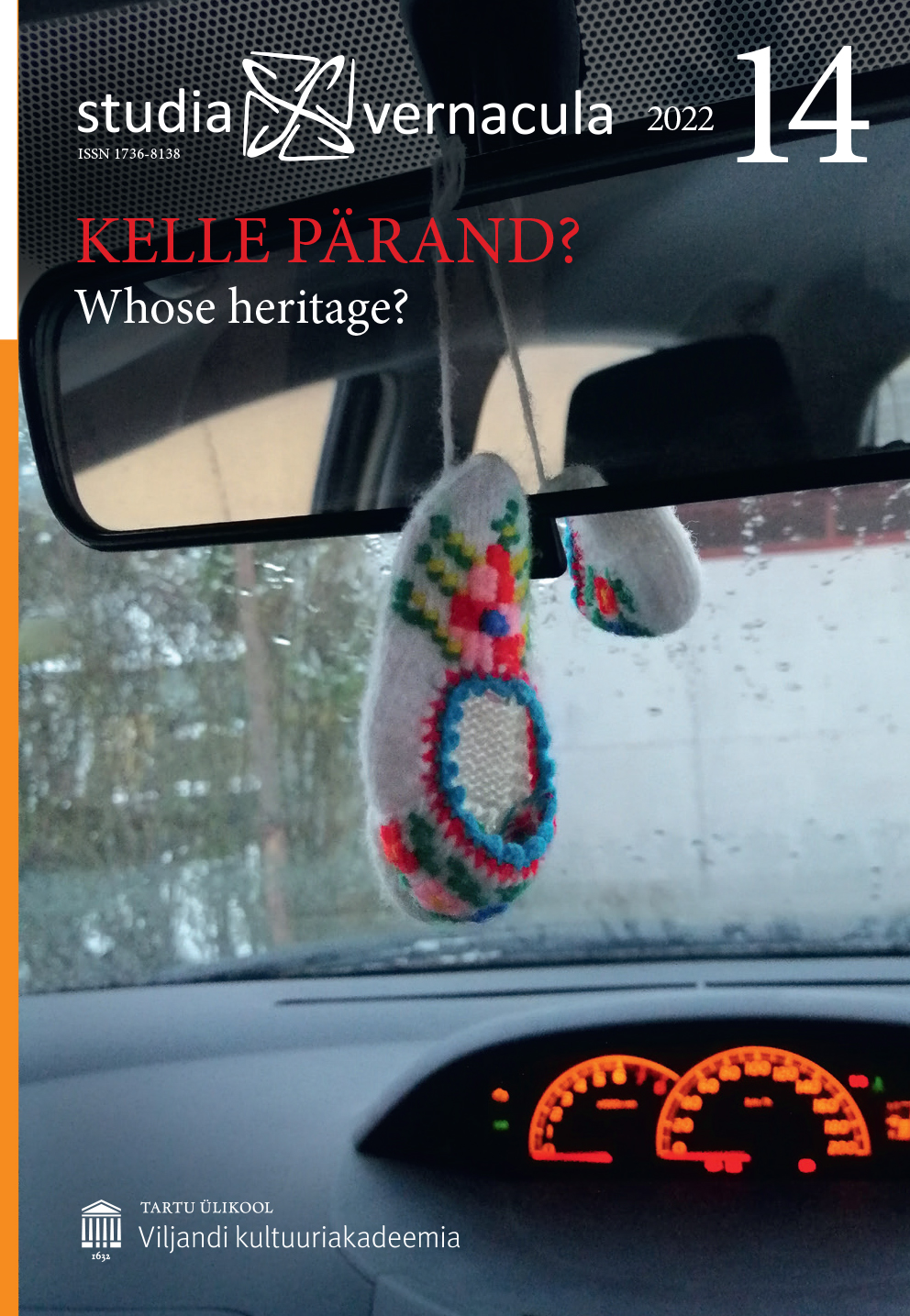
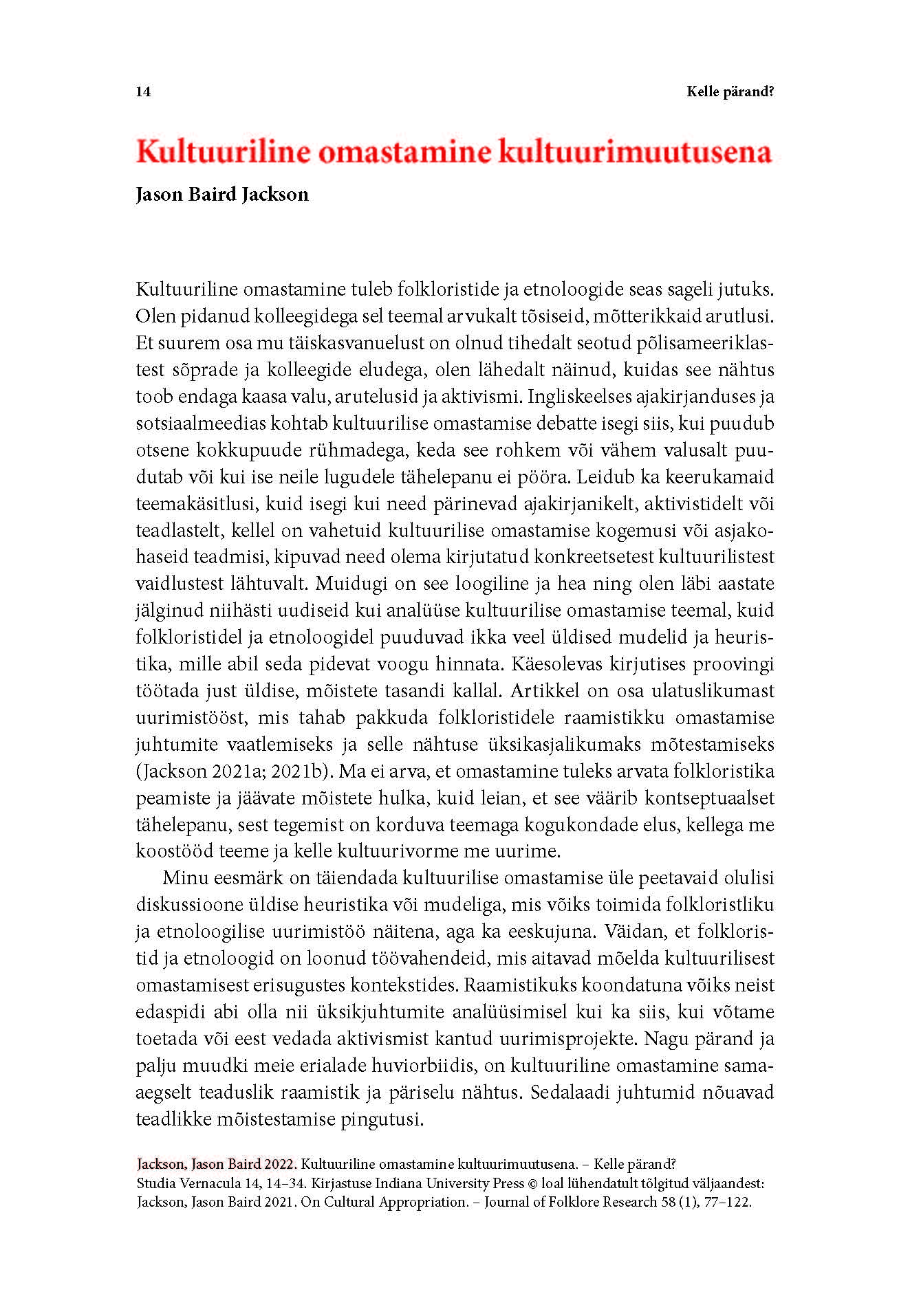
More good news in terms of publication work. I am pleased to share that my article “Kultuuriline omastamine kultuurimuutusena” is now published in Estonian in the wonderful journal Studia Vernacula (see volume 14). This is a translation (minus the case studies) of my earlier paper “On Cultural Appropriation,” which appeared in English in the Journal of Folklore Research (volume 51, number 1 in 2021). Special thanks go to Elo-Hanna Seljamma for work translating the paper, to Kristi Jõeste for inviting me to contribute the paper, and to Madis Arukask for discussing my contribution in an editorial appearing in the new issue. Studia Vernacula is a wonderful open access journal beautifully produced in digital and print form. Even if you do not read Estonian, I urge you check it out with the help of Google Translate or a similar service. So much wonderful material culture studies work appears therein year after year.
I am very happy to note a new co-authored article titled “A Survey of Contemporary Bai Craft Practices in the Dali Bai Autonomous Prefecture, Yunnan, China.” It was jointly written with Wuerxiya (first author), C. Kurt Dewhurst (third author) and Cuixia Zhang (fourth author) and it appears in Museum Anthropology Review volume 16, numbers 1-2. This is the special double issue published in honor of Daniel C. Swan, as noted in an earlier post on Shreds and Patches. The article is based on work undertaken by a much larger bi-national team within the “Collaborative Work in Museum Folklore and Heritage Studies” sub-project of the broader “China-US Folklore and Intangible Cultural Heritage Project,” a collaboration (2007-present) of the American Folklore Society and the China Folklore Society. In particular, it describes work undertaken through the auspices of, and in partnership with, The Institute of National Culture Research at Dali University. Special thanks go to the Institute and its leadership.
Presented as an image is the first page of the journal article “A Survey of Contemporary Bai Craft Practices in the Dali Bai Autonomous Prefecture, Yunnan, China.”
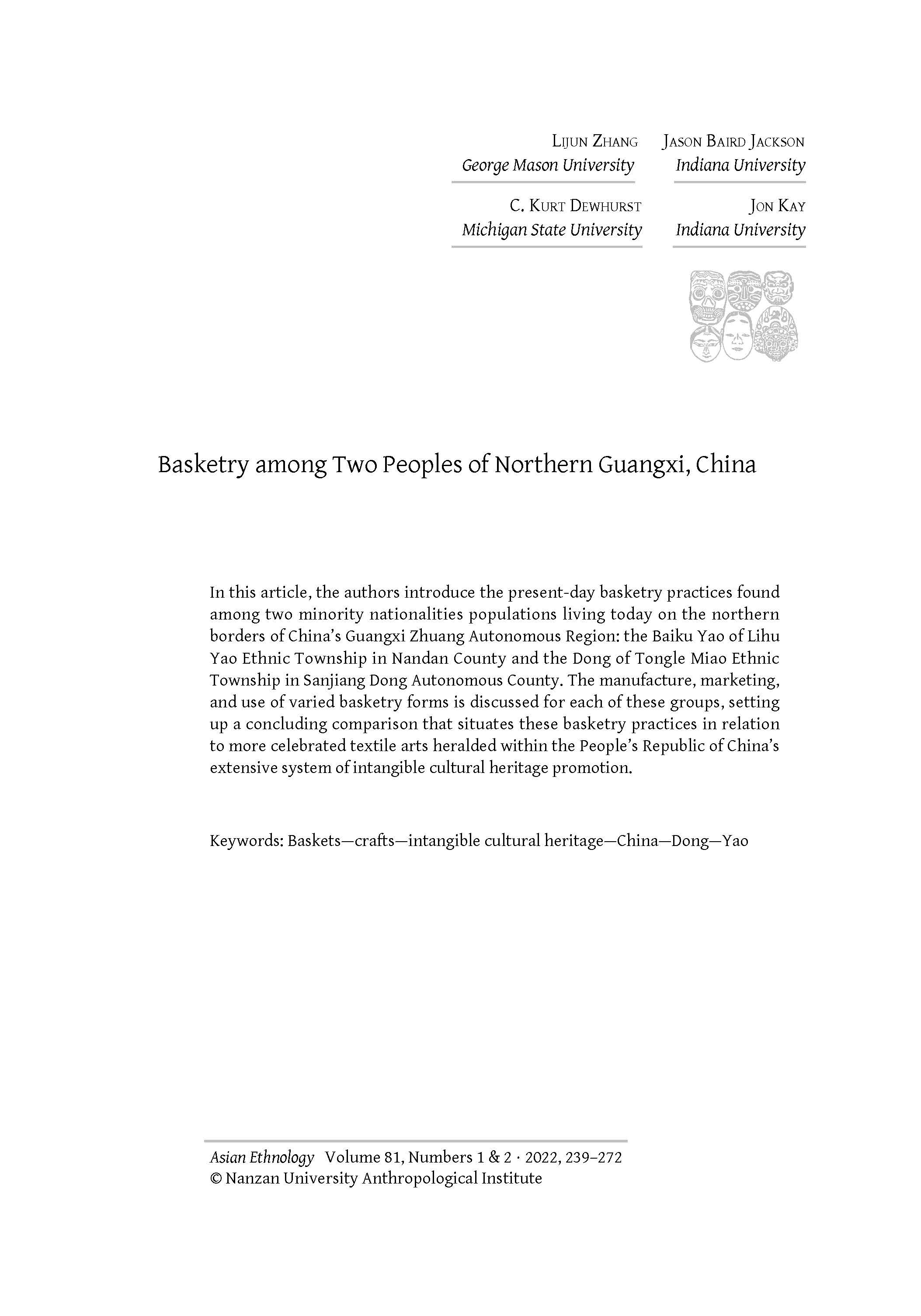
I am very happy to note the publication of “Basketry among Two Peoples of Northern Guangxi, China” in the latest double issue of Asian Ethnology. This article is one that I co-wrote with my friends and collaborators Lijun Zhang (first author), C. Kurt Dewhurst (third author), and Jon Kay (fourth author) and it is based on work undertaken by a much larger bi-national team within the “Collaborative Work in Museum Folklore and Heritage Studies” sub-project of the broader “China-US Folklore and Intangible Cultural Heritage Project,” a collaboration (2007-present) of the American Folklore Society and the China Folklore Society.
I am a huge fan of Asian Ethnology, a wonderful open access journal now in its 81st year. Check out the huge volume that our paper is a part of, Find Asian Ethnology online here: https://asianethnology.org/ and also in JSTOR
A image of page one of the typeset version of the scholarly article “Basketry among Tow Peoples of Northern Guangxi, China” published in Asian Ethnology.
Page one of the article “Towards Wider Framings” as typeset for the Journal of Ethnology and Folkloristics.
I am happy to report that my article “Towards Wider Framings: World-Systems Analysis and Folklore Studies” was published in the Journal of Ethnology and Folkloristics earlier this year. Readers will have the judge the article for itself, but I can’t say enough good things about JEF. Its a wonderful open access journal doing wonderful work in, and at the intersection of, my two fields. Thanks to everyone at the Estonian Literary Museum, the Estonian National Museum, and the University of Tartu who work to make the journal a success.
It is a great moment for a great project. Some Shreds and Patches readers will remember when, in 2017, the Mathers Museum of World Cultures hosted the special exhibition A Giving Heritage: Wedding Clothes and the Osage Community. After debuting at the MMWC, this exhibition, developed in a partnership between the Sam Noble Oklahoma Museum of Natural History (Sam Noble Museum) and the Osage Nation Museum, went on to be presented at the Osage Nation Museum. Now, the exhibition is on view, in an extended version, at the Sam Noble Museum. The Sam Noble Museum has organized a rich series of programs to accompany the exhibition, including a special community reception for citizens of the Osage Nation on November 1st. Dan Swan, the Interim Director and Curator for Ethnology at the Sam Noble Museum, served as lead curator for the exhibition.
Unboxing my copy of Wedding Clothes and the Osage Community. October 21, 2019.
I return to this exhibition not only because it is now on display at its originating institution but because the book Wedding Clothes and the Osage Community: A Giving Heritage, which stands alone but which also serves as a companion to the exhibition, has just been published by Indiana University Press in the Material Vernaculars series that I edit. The series has been a joint endeavor of the museum and the press. Wedding Clothes is the fifth title to appear in the series. As noted in other posts, MV titles are produced in paper editions sold by the press but also in free-to-readers versions shared digitally via the IUScholarWorks Repository. (It will may take a month or so for the free edition to be posted.) Wedding Clothes and the Osage Community was co-authored by Swan and Jim Cooley and includes a foreword by Osage Nation Principal Chief Geoffrey Standing Bear.
My copy of the book arrived today and this is, hands-down, one of the most beautiful books that I have ever seen. IU Press went above and beyond with this one and it is really incredible to hold and to read as a book artifact. The book is filled with great images and they have been reproduced exquisitely on excellent paper. This is the first MV title to be printed in offset. That will not usually be possible with other MV titles, but in this case, with the exhibition and high Osage interest in play, the press was able to take this extra step. I urge everyone to find and enjoy a paper copy. Ideally purchase one. I know that $32 seems like a lot, but when you are holding this book, you will see and know that it is, unlike with so many academic titles, worth it.
Wedding Clothes and the Osage Community makes its debut at the IU Press booth at the 2019 American Folklore Society Annual Meeting in Baltimore, MD. October 17, 2019.
The book is more than a pretty object though. It is a rich historical and ethnographic account of Osage life. I really hope that you will devote time to reading this book. The investment will be rewarded. Gift giving is a key theme in Wedding Clothes and the Osage Community. I hope that you will receive the gift of this book.
(I will share news of the free edition when it is posted.)
Life got away from me last week and I still have more “Exhibition Week” posts to share, but today I turn attention to the new issue of MAR.
It is hard to believe but Museum Anthropology Review is now in its thirteenth year. If you are interested in a bit of how MAR got to this point and where it will be heading in the near term, you can check out the editorial that I wrote for the new issue, just out. You can find the whole issue, including my piece, online here: https://scholarworks.iu.edu/journals/index.php/mar/issue/view/1589. As always, MAR is not just free to readers but open access.
MAR is the journal of the Mathers Museum of World Cultures, Indiana University’s museum of ethnography, ethnology, and cultural history. The new issue is particularly focused on reports recounting projects undertaken at the MMWC and by its partners, friends, and regular collaborators.
Three MMWC colleagues share projects that they led. Jon Kay tells the story of Traditional Arts Indiana’s exhibition for the Indiana Bicentennial, Emily Buhrow Rogers reflects on the Cherokee Craft, 1973 exhibition, and Kristin Otto discusses our museum’s projects relating to so-called Ghanaian fantasy coffins.
MMWC partners C. Kurt Dewhurst and Timothy Lloyd report on the larger Sino-US collaboration project that the MMWC has been an active participant in and Marsha Bol, another participant in that collaboration, shares background on a different project, her recent exhibition on beadwork at the Museum of International Folk Art. Regular MAR contributor Kerim Friedman is joined by his collaborator Gabrielle de Seta for a discussion of the Sensefield exhibition that they organized as a companion to the Taiwan International Ethnographic Film Festival.
The issue concludes with a book review and an exhibition review by Otto. Both focus on innovative projects of special relevance to museum anthropology in African contexts.
Thanks go to the reviewers and others who helped with this issue behind the scenes. MAR’s transition to teenager status provides an opportunity to thank the librarians and library staff who have worked to support and encourage the journal since its beginnings. Thanks also to all of the graduate assistants who have worked on the journal over the years.
A partial view of Museum Anthropology Review 13(1)
Numbers 1 and 3 arose in the context of the systemic problems with Hau that became widely known and discussed beginning last summer. Numbers 4, 6, 7, 8, and 9 relate to collaborative work in China. Numbers 2 and 10 are retro posts that I wrote back in 2012 and relate to studies of the William C. Sturtevant Collection at the National Museum of Natural History. Number 5 is a post related to my 2019 travels in Estonia.
Shreds and Patches has featured 580 posts spread over about 4123 days since my first post, The site software reports 101,258 views from 30,545 visitors. The peak week for 2018 was June 11-17, when the Hau inspired posts appeared. That week saw 2076 views from 1675 visitors. Peak wordiness came in 2011 with 41,403 words. This year saw 22,681 words (prior to this post).
Thanks to everyone who reads and appreciates the posts and special appreciation goes to the those who wrote guest posts during 2018. Happy new year everyone.







 Shreds and Patches