Skip to content

Posts from the ‘OA Books’ Category

Open Access Book: Indiana Folk Arts

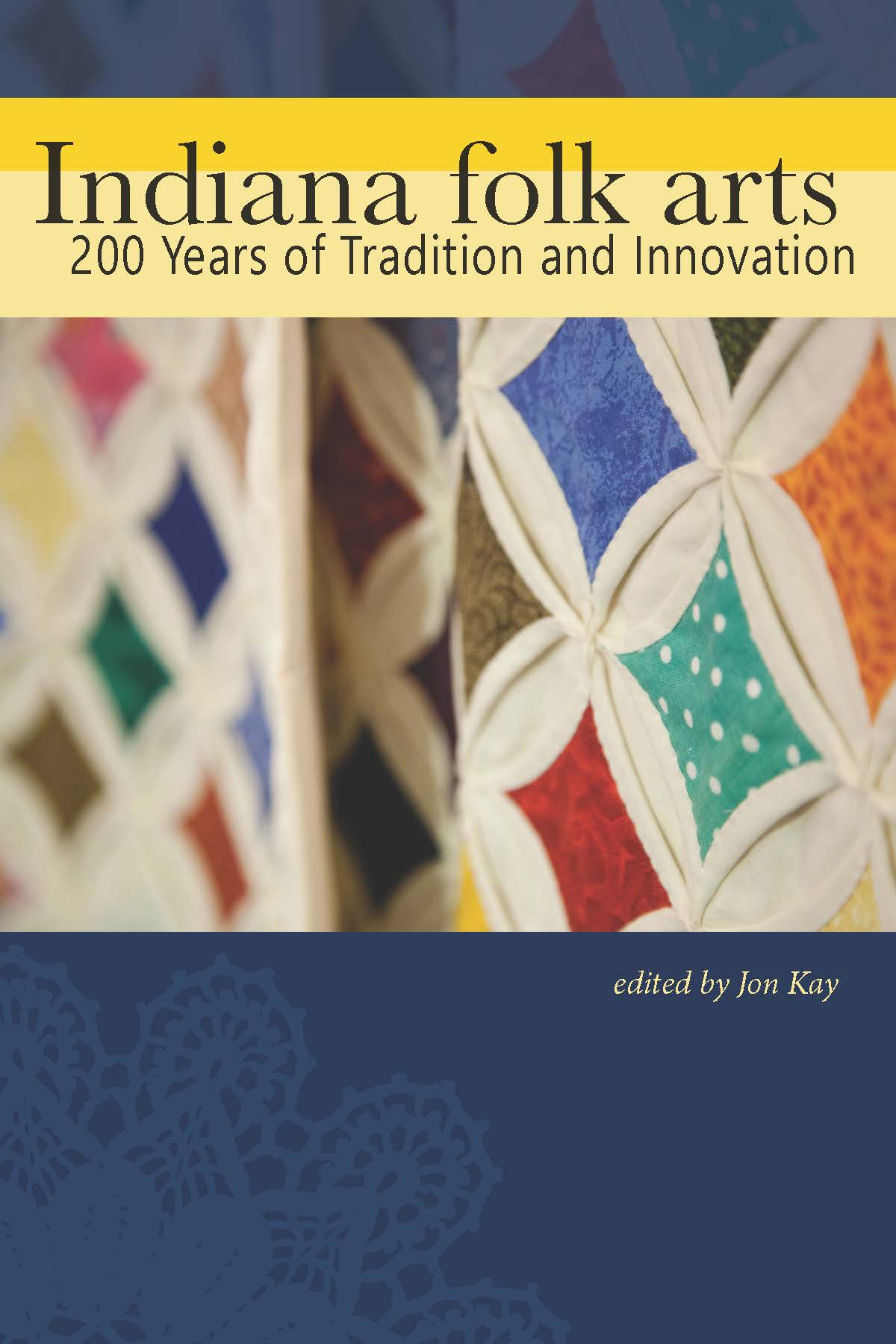
IFA CoverThis year is a big year for the Mathers Museum of World Cultures in a number of respects. Two of these weave together. Its the state bicentennial for Indiana and we are engaging with it in a big way through the exhibition Indiana Folk Arts: 200 Years of Tradition and Innovation. That exhibition is now traveling across Indiana along with with a deep roster of presenting artists and craftspeople. The exhibition and associated in-person demonstrations are happening at state parks and festivals around Indiana and the exhibition will also be presented at the Indiana State Fair, later this summer. The exhibition brings together more than a decade of research by Traditional Arts Indiana and was also an project worked on by the Laboratory in Public Folklore graduate course taught in the IU College of Arts and Sciences’ Department of Folklore and Ethnomusicology. Working with TAI Director and MMWC Curator of Folklife and Cultural Heritage Jon Kay, a large number of students have been involved in all aspects of the exhibition and associated programs, products, and events.

2016 is also slated to be a big year for book publishing at MMWC. We have a number of books in the cue for fall. The first to become available is the catalogue for Indiana Folk Arts. Edited by Jon Kay with chapters authored by a large and talented group of graduate students, the volume enriches the exhibition while also standing alone as a contribution to scholarship on Indiana craft and art. At exhibition events and here at the MMWC, the book is being distributed for free in a beautiful full-color print edition. In keeping with our institutional commitment to increased and open access to scholarship, the volume is also available electronically and permanently via the IUScholarWorks Respository. Licensed under a CC-BY license, it can be found online here: https://scholarworks.iu.edu/dspace/handle/2022/20893. Its the first MMWC publication for which we obtained an ISBN number (two actually, one for the print edition and one for the PDF edition), which is also pretty neat.IFA Front Page

Congratulations to Jon Kay, the volume’s editor, to all of its contributors, and to the talented artists, craftspeople, and tradition bearers featured in the book. Welcome readers–72 beautiful pages await you, wherever in the world you live. If you like the book and support the work behind it, spread it widely. Tell your friends and colleagues so that they can enjoy it too.

Scholarly Communication Postdoctoral Fellowship at UC Davis

Circulated on behalf of a colleague…

A new UC Davis initiative on “Innovating the Communication in Scholarship” (http://icis.ucdavis.edu/) is hiring a 2 year postdoctoral fellow, starting July 1, 2014. This is a cross-disciplinary project to study the future of academic publishing, involving faculty from the Center for Science and Innovation Studies, the Library, the Genome Center, and the School of Law (with additional collaborators in Computer Science, English, Philosophy, and the Graduate School of Management). Research topics include open access models, peer review, new forms of quality metrics, data publication, use of social media, and new forms of academic misconduct.

The successful candidate will conduct research, collaborate on or lead organization of conferences, workshops, participate in pedagogical activities, and assist in grant writing. A Ph.D. or equivalent degree is required in Science and Technology Studies, Library and Information Sciences, Communication, Law, Science, or Literature. Other disciplines will be considered depending on the specific focus of the candidate’s research and other experience. Qualified applicants will have experience working successfully in teams and managing multi-year projects. He or she will possess excellent written and oral communication and administrative skills.

We encourage applicants from historically under-represented groups, as well as individuals who can contribute to the diversity and excellence of the academic community through their research, teaching, and/or service.

Salary is based on experience and qualifications according to UC Davis guidelines.

To apply: E-mail a PDF file containing your CV, short description of your research experience relevant to this position, and contact details for three references to Mario Biagioli (mbiagioli@ucdavis.edu), MacKenzie Smith (macsmith@ucdavis.edu), Jonathan Eisen (jaeisen@ucdavis.edu).

Applications are due by April 15, 2014.

Last but Not Least: Hacking the Academy–the Print and Ebook Editions

I am pleased to note that the University of Michigan Press has now published the print and ebook editions of Hacking the Academy: New Approaches to Scholarship and Teaching from Digital Humanities. This volume was organized and edited by Daniel J. Cohen and Tom Scheinfeldt and is part of the press’ Digital Humanities series.

Followers of the project will know that this is just the latest iteration of a multimodal effort. The history of the project is narrated in numerous places, including in the preface to the free open web version (made available earlier by the Press’s Digital Culture Books unit). Very instructive is the more primordial version (inclusive of much content not in the book) at http://hackingtheacademy.org/

I was trilled to participate in the project with an abridged version of a blog post that first appeared here (still a best seller after several years). That original post was called “Getting Yourself Out of the Business in Five East Steps” and it promotes resisting the increasing enclosure of scholarly publishing by large multinational firms. (In the new book, it appears on pages 13-14.)

Everyone reasonably wonders about the point of a print edition of a “book” born out of twitter links and weblogs posts. Here is how the editors address this point.

Finally, the reader may legitimately ask: Doesn’t the existence of Hacking the Academy as a book undermine its argument? Why put this supposedly firebrand work into a traditional form? The answer is that we wanted this project to have maximal impact and especially to reach those for whom RSS and Twitter are alien creatures. Moreover, one of the main themes of this volume—and of digital technology—is that scholarly and educational content can exist in multiple forms for multiple audiences.

A review of the book edition, but someone new to the effort (who missed the earlier instances), has been published on the Education Technology and Change (ETC) blog.

Thanks to all of the editors, contributors, readers, and publishers involved in this experimental work.

Two Reasons to Love the University of Nebraska Press @UnivNebPress

Visitors to this site will know that I am involved in a range of projects relating to reform in the scholarly communication system. University presses are a key part of that system. They bring to the current moment a lot of durable skills, values, and useful practices and they have the potential to play a key role in innovating the future.

In this note, I want to put on my author hat and celebrate two modest practices–one a tradition and the other an innovation–in the work of the University of Nebraska Press, the press that I have historically worked most closely with.

Part One: Some Things Never Go Out of Style

As an editor of a small scholarly journal with a reviews program, I spend a lot of time with what used to be called (and sometimes still are called) tear sheets. The term’s origins are in commercial advertising, but it extends logically to journal-based publishing of things like book reviews. When a publisher sends a new book to a journal in the hopes that it will be reviewed, it asks (among other things) that a journal that actually does publish a review send a copy of the final published review to the press’ attention. In the older days (and, in some cases, still today) the obligation was to send two (sometimes more) paper copies of the review to the press’ attention. These days, this task is most often accomplished electronically by sending a PDF of the published review to the attention of the relevant press’ marketing staff. The old name tear sheet refers to actual sheets of paper (with advertisements to send to buyers or reviews to send to publishers) torn from the relevant print edition so that they could then be mailed. (BTW: Shame on those journals who do not live up to their end of this bargain.)

When the reviews get to the press, there are a number of things that can be done with them. It is common for them to be harvested for favorable quotes that get added to a book’s page on the press’ website. In more elaborate operations, such quotes get pushed out to sites like Amazon. A acquisitions editor can use the incoming reviews to guide the development of their “list.” In aggregate, reviews tell editors what kinds of works (and which authors) are being well received. Such intellectual indicators complement quantitative measures as sales numbers.

At the University of Nebraska Press a tradition that many other presses have abandoned is also maintained. It is one that promotes tremendous goodwill with authors and, by extension, furthers the press’ reputation among potential authors. Judging by my experience (I have never discussed the practice with UNP staff.), the UNP marketing staff forwards incoming reviews to authors for their interest and use. Even in an era of such things as Google Alerts, this is a tremendous help to authors. In the wake of the publication of Yuchi Ceremonial Life, copies of these reviews–neatly annotated by press staff with date and place of publication–were mailed to me as they came in. Today, via email, I got from the press a PDF copy of the Chronicle of Higher Education book note appearing in the wake of Yuchi Indian Histories Before the Removal Era. This is such a wonderful courtesy. If the new (edited) book is reviewed, I will really appreciate learning of this from the press. Even today, not all journals are richly woven into the digital infrastructure and thus the press will sometimes know of a review before I will. When I mention that UNP does this for authors, all my colleagues are jealous, as few of them have experienced such attention from the presses with which they work. This service is especially valuable to pre-tenure scholars for whom reviews are a crucial resource in route to their tenure cases.

In a time in which academic author have new choices, old courtesies like this can go a long way in maintaining strong relationships with authors.

Part Two: New Things Done the Right Way

Increasingly, university presses aim to promote awareness of their titles by making sample chapters available for free via their websites. This is an inevitable outgrowth of broader practices, such as the views inside books available on sites like Amazon. Typically university presses simply (and it is not exactly simple, of course) make this material available as a PDF download from inside the press’ website on the book’s page. This is a logical thing to do, but it is also a very temporary thing to do, as press websites (like most websites) are very unstable and ephemeral things. They are breeding grounds for link rot and they just do not measure up as preservation environments.

If a press is going to let a sample chapter loose into the digital world, it should do this in a way that advances all of the goals of scholarly communication. This means that if content is going to be freely available, it should be made freely available according to professional best practices. This means curated carefully in a digital environment with attention directed to preservation, metadata, stable URLs, etc.

Kudos and thanks, in this context, to the University of Nebraska Press for working with DigitalCommons @ University of Nebraska-Lincoln (the university’s institutional repository) to make such samples permanently and properly available (with a great cover sheet and good metadata) for the long haul.. I was happy to learn about this effort when I found the introduction to Yuchi Indian History Before the Removal Era deposited there. As such samples clearly generate sales, these practices are self-interested as well as in the interest of the public good.

In a word, thanks to everyone at the University of Nebraska Press for your work to preserve what is good about university presses while we discover new paths forward.
Open Research and Learning: Collaboration, Connections, and Communities

I am very happy to be again visiting the University of Minnesota in the Twin Cities. Over the weekend, I participated in a wonderful conference on the “Anthropology of Performance” organized by the industrious undergraduate students in the Department of Anthropology here. The conference included work in all four of anthropology’s four sub-fields, plus folklore studies and social psychology. The student presentations were outstanding. The number of soon to finish students reporting on nearly complete senior theses was amazing and the quality of their research and presentations was very impressive. Congratulations to the students and to the faculty and advisers who are supporting them.

Today I get to reconnect with my friends at the library here. I will be participating in a very promising event on “Open Research and Learning: Collaboration, Connections, and Communities.” The event includes an amazing group of people. David Ernst, Director of Academic Technology in the UM College of Education and Human Development will discuss open textbooks. Astronomer Lucy Fortson will discuss open data, and University of Minnesota Press Director Doug Armato will discuss open publishing projects at the press. Copyright librarian Nancy Sims–whom you should certainly be following on Twitter (@CopyrightLibn)–will be the moderator. I will be talking about the ways that open access projects foster richer forms of scholarly collaboration. I am really looking forward to it and I am thankful that the kind invitation from the anthropology students has allowed me to reconnect with the scholarly communications community at Minnesota. Thank you to all of the faculty and researchers who have signed up for today’s event. Information on the event is online here.

Open Access Interview Part Two @savageminds

Thanks again to Ryan Anderson for working with me on an interview exploring the basic issues relating to open access in anthropology and folklore. The second part of three has now been published on Savage Minds. As always I appreciate Savage Minds for hosting such considerations of these issues.

Interview on Open Access @savageminds

Thank you very much to anthropologist Ryan Anderson for inviting me to do an interview on open access issues in anthropology. He has begun publishing it on Savage Minds and re-broadcasting it on his weblog ethnografix. Ryan is also one of the organizers of the online anthropology magazine anthropologies. The current issue focuses on Appalachia and includes essays by Britteny M. Howell, Ann Kingsolver, Tammy L. Clemons, Shaunna L. Scott, Amanda Fickey and Lynne Rieske-Kinney, and Sarah Raskin. Check it out.

Follow Ryan on Twitter at @ethnografix

AFS Releases Lay and Expert Knowledge Project Reports #oaweek

In time for Open Access Week, the American Folklore Society and the Center for Folklore Studies at The Ohio State University have just made available a collection of reports and working papers derived from the Society’s project on Lay and Expert Knowledge in a Complex Society. This two-year project was funded by the Teagle Foundation as part of its “Big Questions and the Disciplines” program and focused examined undergraduate teaching of folklore in the contemporary world.

These materials are available now as volume 2 of the series Working Papers of the Center for Folklore Studies under the editorship of PIs Dorothy Noyes and Timothy Lloyd. This working paper series is made available through the OSU KnowledgeBank (the OSU institutional repository) and are harvested for search (OAI-PMH interoperability!) through the Open Folklore portal.

It has been an honor to participate in this project and I am super happy that first rate open access strategies are being used to make the work more accessible.

On the Harvesting of Low Hanging Fruit #oaweek

In disciplinary contexts, community discussions of open access and related issues in scholarly communications often get bogged down and then stall out. The reasons for this seem to me to be many. For example, participants rooted in their own particular discipline often guess about the meanings attached to key terms rather than finding, and then working from, common definitions established outside their own fields. Similarly, they often approach the various issues as if their subject area was the first, or only, field confronting these issues. In this spirit, considerable effort is then devoted to reinventing the wheel. Beyond the simple fact that the issues are really complicated and can be approached from a large number of perspectives, another problem stems from an all or nothing sensibility. The largest or most intractable problem is often quickly put on the table for consideration and proceeds to becomes a conversation stopper.

Its this last dynamic that I would like to briefly address. Put simply, we do not have to solve the most difficult problems first. Instead, we can search out and harvest the low hanging fruit. Low hanging fruit is easy and inexpensive to gather. Gathering it, we learn and gain experiences (and buy time) that will allow us, eventually, to tackle bigger challenges on the basis of experience gained and lessons learned. When we spend little or no time/money pursuing the smaller, easier prospects, we put less at risk and we can afford to learn from our mistakes. A single fall out of the top of a tree can be catastrophic. Standing on the ground, we can usually stumble and fall countless times without doing ourselves any great harm.

It is in the spirit of making progress in the harvesting of low hanging fruit–wherein significant good can be done in an easy and inexpensive way–that I recently suggested a way in which the conference programs and abstracts of the American Anthropological Association could be made freely available online to all interested users as part of the HathiTrust Digital Library. My recent suggestion of this strategy was offered as small part of an important discussion of the future of the AAA publishing program that was begun on the AAA weblog. It can be found there attached to the first of two posts by Michael F. Brown. The first (on which I commented) can be found here and a second post, dealing with the expense picture for the total AAA publishing program, is here.

Starting with the easier and less risky tasks is also the strategy underpinning the American Folklore Society/Indiana University Bloomington Libraries’ joint project called Open Folklore. Now entering its second year, most of the progress that the project has made so far could be understood as gathering low hanging fruit. What is exciting is that if enough such modest efforts are pursued concurrently, they add up to results that are definitely not a small matter.

Readers interested in looking at the basket into which a large amount of low hanging fruit has been gathered, can consult the project reports of the Open Folklore project. Over the course of three narrative accounts–the first offered at launch, the second offered at the six month mark, and the most recent at the twelve month point–a large diversity of open access accomplishments are described. In and of themselves, each represents a relatively modest resource and a readily accomplished task. Taken together, they represent significant progress towards the goal of making folklore studies a more accessible discipline. No make-or-break revenue streams were harmed in the making of the Open Folklore portal and the work that has been accomplished is as robustly and professionally preserved as is possible in the year 2011.

Like all scholarly societies confronting these questions, the AFS faces giant uncertainties in the years and decades ahead. There are many questions that will eventually need to be faced. For instance, will it ever be possible to make The Journal of American Folklore accessible in a gold OA fashion? Probably, but the pathway to getting there is hardly clear and, for the present, solving the riddles of revenue, expense and organizational sustainability in that context is too big a task. My argument is that there are other ways to make steady progress that do not require us to take on excessive risk or to immediately untie the tightest, most complicated knots.

I encourage interested anthropologists to join the conversation that Michael F. Brown is hosting at the AAA weblog. Folklorists with thoughts on the future of scholarly communications in our field are invited to comment here or to write to me privately.

This post reflects my own thinking on the questions that it addresses and should not be read as an official statement by any of the organizations or projects with which I am associated.

Open Access Week + Occupy Scholarly Communications #occupyscholcomm #oaweek

My job is eating my lunch at present so I have not yet had time to engage properly with open access week, which began today (well, yesterday since it just passed midnight where I am). Learn more from the Open Access Week website here ( http://www.openaccessweek.org/ ) and by searching “Open Access Week” on the open web and by looking for “open access week” and “#oaweek” on Twitter. Thankfully many good folks are working hard to get the word out.

If you think that the Occupy Wall Street (etc.) folks have anything like a point in their concerns about the unsustainable nature of the status quo or the need to acknowledge the influence that a small number of large corporations have in our lives and work, then the open access movement, together with the critique of, and efforts to reform, the scholarly communications system are for you. Above and beyond discussions of open access, a taste of the Occupy Scholarly Communications conversation can be found in Heather Morrison’s October 23, 2011 post “High Profits for Commercial Publishers-or Jobs for Academics Let’s #occupyscholcomm”

Next year, when open access week comes again, lets hope that some of the most vocal, articulate, and visible scholars working on questions of income inequality and corporate power will not have published their sophisticated accounts of emergent phenomena such as the Occupy movement with publishers like Polity (people Polity effectively = Wiley) and Palgrave-Macmillian or in journals owned wholly by Sage or Taylor and Francis. Our doing this occasionally is ironic and even kind of funny, but its starting to suggest that we actually do not get it, even when we get it.