Skip to content

Posts from the ‘New Publications’ Category

New Issue of Museum Anthropology Focuses on NAGPRA

Congratulations to the contributors to, and editors of, the new issue of Museum Anthropology, which has just appeared online in Wiley Online Library. The issue focuses specifically on the Native American Graves Protection and Repatriation Act of 1990 (NAGPRA).

DIY OA Superstar Laura Gibbs Making Stuff Happen for Lovers of Latin and Classical Folklore

And now for something else completely positive.

I got to know many nice and wonderful people during the time that I was on the faculty of the University of Oklahoma. One of them is Dr. Laura Gibbs. Laura is a classicist and a folklorist with an interest in new approaches to both university-level teaching and scholarly communications. Among the many things that illustrate how cool she is, I would point out that she is the most passionate language teacher I have ever seen. And the language that she is passionate about teaching is Latin.  How cool is that?  She goes all out for her students (and everyone is a potential student) whether or not those students happen to be enrolled in one of her classes.  When we were both actually on the OU campus, I would usually see her doing language tutorials with students in a campus coffee shop or someplace similar. (I am not at OU anymore and she mainly teaches online now.)

She is probably most famous for her new translation of Aesop’s Fables published by Oxford University Press, but I want to point to one of her newer book projects, a cool DIY OA book worth checking out even if (like me) you know nothing about Latin.

In a best of times, worst of times (for scholarly publishing) email discussion, she mentioned this project, telling me:

This summer I experimented with self-publishing a book at Lulu.com AND giving it away in PDF format. It’s the most fun I have ever had doing a book: Mille Fabulae et Una: 1001 Aesop’s Fables in Latin. The book is intended for Latin students and teachers; it’s a Latin language manual rather than a scholarly study, but it is based on a really serious survey of the whole scholarly and literary Latin Aesopic tradition, from ancient Rome up through the 19th century (including LOTS of Renaissance fables otherwise unavailable in any modern edition). It has worked out wonderfully, just as I had hoped. Some teachers have bought printed copies for themselves, but the main thing is this: thanks to teachers recommending the book as a free download for their students, there have been over 1600 downloads in just a few weeks. In the weird little world of post-classical Latin, that is a seriously large number. I am really happy! Plus, the fables look GREAT on handheld screens, so offering it as a PDF with the expectation that people might read the book on their iPhone or Android is something new and exciting for me.

The book itself is a celebration of public domain materials–basically me harvesting from GoogleBooks and other digital libraries–and now I am using my blog to link up the Latin texts to the hundreds of public domain images I have found at Internet Archive where the scans are good enough to justify reproducing the images for their own sake.

You can learn more about this project and see and get the book itself on her project website at http://millefabulae.blogspot.com/

When I asked Laura if I could share the story of her project, she replied enthusiastically and commented:

I love telling people about what I am doing because this is a time when people who love stories and music and art can learn and connect and share in ways that just were not easy to do even a few years ago. Now if somebody has a project they want to pursue, all they need is time and enthusiasm – that to me is why open access is important as a principle; if we can remove the access barriers, real education will take place, at last.

What more needs to be said?

In addition to the cool book and website, Laura has leveraged everyday blog features and other software to allow people to do such things as put a Latin fable of the day on their own blogs.  There is no end to what she has already created and tried to share with you (or at least with the vast world of budding classicists). Check out not only the 1001 Aesop’s Fable in Latin site, but also her main site where there are piles of stuff made just for you (and everybody else).

My elementary-age daughter and I have been systematically reading all of Andrew Lang’s so-called colored fairy books, thus I have to point to one more of Laura’s projects.  She has created a one-stop shop where you can go and not only get basic information on this series, but download (free) copies of all of the books in a very easy way.  Check that out at:  http://www.mythfolklore.net/andrewlang/

Thank you Laura for teaching in more ways than one! And thanks also to the folks at the University of Oklahoma who have supported Laura’s unusual and productive work as a teacher, technologist, and scholar.

Depressing: My Contribution to the Berg Encyclopedia of World Dress and Fashion

Update: Today (9-13-2010) I received my author copy of the book version of this project. I am happy to report that the two images that I provided showing contemporary dress (including that worn by women) are included in it. As discussed below, they do not appear in the online/database version.

Last night I saw one of two published versions of my contribution to the monumental (10 volume) Berg Encyclopedia of World Dress and Fashion (New York: Berg, 2010). It is the chapter titled “The Southeast” and it is one of a series of long, regionally focused essays on the dress and body adornment practices characteristic (past and present) of Native North American Indian societies. (My contribution is about 9000 words.)

As often happens with encyclopedias and other works of this type, I did not get a chance to review page proofs or the final copy edited manuscript. This has resulted is some less that ideal outcomes. I may eventually have the patience to write a full erratum to the piece, but here are some items that I want to apologize for.

I have only seen the version appearing in the Berg Fashion Library database. The print version may be different in some ways of which I am as yet unaware. The following comments are based on the Berg Fashion Library version.

The publisher was provided with a number of images illustrating contemporary Native American people wearing the kinds of clothing discussed in the essay. None of these were put to use and (if those that I had provided were not suitable) I was not engaged to find alternatives. Only two historic paintings by non-native artists and one object image of museum artifacts are used. This omission unfortunately fosters the general misconception that Native American lifeways are a thing of the past and that they are only preserved (via ethnographic documentation) by and for non-natives. I hope that my text (as published) sufficiently counters this widespread tendency. I have no idea why it had to be this way.

The publisher provided a caption to one of the images that was used that is misleading. From among the images that I suggested, they chose to publish the image of a native man from (what would be) Virginia associated with the artist John White.
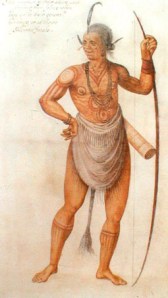
Because in the chapter I discuss tasseled yarn belts and sashes, this image was captioned: “A North American Indian wearing a tasseled sash, ca. 1590, from a painting by John White.” I would certainly not have captioned this particular image in this particular way. The apron worn in this image is relatively anomalous for the dress of the region and for Native North America in general. It appears to be tied in the back and what we see hanging in the back (between the man’s legs) seems to be the apron ties (of animal hide?) presented in a unusual but decorative way. The closest thing to this in the documentary record or present-day practice, are the animal tails worn by some men when playing “match game” (stickball), as among the Oklahoma Muscogee (Creek) and Oklahoma Seminole today (and the Choctaw historically). In the Mississippian engraved shell images, the historic-period paintings, and today, yarn sashes with tassels are worn so that the tassels fall from one or both hips (or are tied at one hip). This can be seen in the painting of a Seminole man by Charles Bird King that was also published in the article and in the shell images and contemporary photographs that I suggested but that were not used. I did suggest the use of this early Virginia image, but only because I had devoted considerable space to discussing the total Virginia corpus as a source of information on dress and adornment in the contact era. I had asked that it be paired with an image of a woman from the same time and place so as to insure gender balance across all of the images. As published online, there are no women’s objects shown or images of women wearing native dress. I apologize for this unanticipated and regrettable outcome.

The copy editing introduced various infelicities that didn’t need to be there and that degraded the work. Here are a couple to illustrate:

My sentence: “The Yuchi have a different colonial-era history and continue, into the twenty-first century, to speak their own unique language—a language isolate unrelated to other known tongues.” in which I used the technical term “language isolate” but then preceded to explain the meaning of this terminology became: “…unique language—a language isolated and unrelated to other known tongues.” This just does not mean anything sensible and it is the typical kind of “improvement” that a copy editor wanting to enhance the accessibility of an work would make in the absence of any specialist knowledge. I do not mind this as one step in the process, but it never works in an context in which the scholarly author lacks the ability to catch problems introduced by the process.

Similarly, describing Mississippian period body adornment, I mention “gorgets.” The copy editor sought to help general readers make sense of this perhaps unfamiliar term and introduced “(neck coverings)” after the word. This is a particularly interesting problem (if sad) for a work on the history of dress and body adornment in general, from a worldwide perspective. Historical period gorgets in the Southeast were mainly trade objects. Look up “Gorget” in Wikipedia (as of today) and you can see a painting of Colonel George Washington (later to become the first U.S. President) wearing exactly the same kind of silver gorget that the Seminole John Hicks is wearing in the King portrait included with my article. This crescent-shaped metal plate worn as a necklace is derived historically from European armor, as the wikepedian’s kindly tell us:

A gorget originally was a steel or leather collar designed to protect the throat. It was a feature of older types of armour and intended to protect against swords  and other non-projectile weapons. Later, particularly from the 18th century onwards, the gorget became primarily ornamental, serving only as a symbolic accessory on military uniforms.

Because, in the historic period, this elaborate necklace-strung item of adornment–a large curved object worn suspended on the upper chest–was known in English as a gorget, scholars of the region like me (perhaps too sloppily) have extended the terminology back to refer to large shell decorations worn similarly. Those obviously do not derive from European armor and they two kinds of adornment provide an illustration of the kind of convergence of European forms and Native styles that I was trying to discuss in the essay. In any event, the copy editor was seeking to help readers by introducing a definition of gorget, but the definition is anachronistic in that Southeastern people did not wear armor-like neck coverings. I would have been very happy to have helped fix this mistake if I could have.

The published version includes a list of references but the citations that had been provided in the manuscript linking particular statements to particular works were removed in conformity with the style of the volume. I am sorry about this. Thankfully the reference list itself was preserved. If a work appears there, it was used with direct citation in the original manuscript.

I wish that I had a way to share the original manuscript but this was a project that I was recruited to participate in before I had given up engaging with commercial publishers all together. Maybe someday I will have a chance to try to address the topic again in a different and more open venue.

Although I am disappointed with this sort of outcome, I do not want to sound overly bitter. I appreciate the work that the publishers and editors have created and nothing about this experience is particularly out of the ordinary for the commercial encyclopedia publishing space.  For those who can get access to it, some good information, I hope, can still be found in my contribution. The kinds of frustrations that accompany, or are generated in, projects like this motivate my enthusiasm for doing scholarly publishing in new, better, and more open ways that are less impacted by the ramifications of hard business decisions made in a dysfunctional marketplace.

Folktales and Fairy Tales: OA Book Published in ScholarSpace at University of Hawaii at Manoa

A folklore essay collection has just been published in an open access institutional repository. The collection is Folktales and Fairy Tales: Translation, Colonialism, and Cinema edited by ku‘ualoha ho‘omanawanui, Noenoe Silva, Vilsoni Hereniko, and Cristina Bacchilega. It is available in ScholarSpace at University of Hawaii at Manoa at the following stable URL: http://scholarspace.manoa.hawaii.edu/handle/10125/15609

In their Preface, the editors write:

We chose ScholarSpace as a publishing venue because it allows for wide accessibility to scholars across disciplines and because its reduced production timeline enables us to make the collection available in a more timely manner. We thank UHM librarian Beth Tillighast for her support.

Congratulations to the folklore minded editors, authors, and librarians involved in this significant project.

Smith on the Launch of (the) Journal of Anthropology

Archaeologist and advocate for open access strategies in archaeology (and anthropology) Michael Smith offers a skeptical review of the announcement that Hindawi plans to publish a general journal of anthropology to be called Journal of Anthropology. I was going to let this news just slip by with no comment, but I am pleased that Michael has weighed in and I recommend taking a look at his post.

Author-side fees is just one aspect of Michael’s commentary. I’ll elaborate on one aspect of this. I have nothing in particular against Hindawi and for those who work and publish in other science fields, its $425 article processing charge may seem reasonable. For folks in those fields who wonder about anthropology’s take on this, keep in mind that old fashioned page charges are extremely rare in our own ancestral publishing system. I have paid page charges twice in my career. Both times it was when publishing in Economic Botany–a journal on the edge of anthropology with biology norms and customs. Page charges and other author-side fees are outside the experience of most anthropologist and many would be faced with actual difficulties if asked to pay them. (Not all anthropology research is funded research and in many workplaces, there is no money available for such purposes.) Because author-side fees are so often brought up as a reason to reject (gold) open access in anthropology, it is important to note that there are numerous (gold) open access anthropology journals now in existence that do require submission charges, author fees, or page charges.

I recommend Michael’s post for a wider discussion of this particular development. I share some of his reservations.

Berlinger’s Chapter in the Collection-Jews at Home

Congratulations to Gabrielle A. Berlinger on the publication of her article “770 Eastern Parkway: The Rebbe’s Home as Icon” in Jews at Home: The Domestication of Identity, volume two in the Jewish Cultural Studies series edited by Simon J. Bronner and published by Littman. The book is beautifully made and carefully edited. Gabi’s article is a fine study of Jewish architecture in a complex context. Find the book on the publisher’s website here.

Cultural Subjects and Objects: The Legacy of Franz Boas and Its Futures in Anthropology, Academe, and Human Rights

In April 2008, I had the honor of participating in a symposium organized for the spring meeting of the American Philosophical Society held at the APS’s campus in Philadelphia. The APS Library holds many archival collections of great relevance to my research and its Phillips Fund has been a crucial source of support for my work and for that of students with whom I work. The symposium was titled: “Cultural Subjects and Objects: The Legacy of Franz Boas and Its Futures in Anthropology, Academe, and Human Rights” and it was organized on behalf of the membership by Carol Greenhouse and timed to commemorate the sesquicentennial of Franz Boas’ birth. Boas’ papers are curated by the APS and they are absolutely crucial sources for the history of anthropology and American intellectual and political life more broadly. The APS thus has a long history of engagement with Boas’ work.

Professor Greenhouse generously recruited me to the symposium relatively late in the planning process, after a previously committed (and much more senior and distinguished) scholar needed to withdraw from participation for personal reasons. This was a wonderful opportunity for me. I was eager to reflect upon the contemporary salience of Boas’ work for my own and attendance at an APS meeting is a once in a lifetime opportunity. I was able to share my reflections with an audience that included not only distinguished anthropologists such as Ward Goodenough and Regna Darnell but also the leaders of intellectual life in the United States more broadly. It was simply amazing to be listened to respectfully by a hall full of APS members and to be asked questions by scholars of such breadth and sophistication. Howard Gardner was among those who posed questions after my talk and, because I was speaking of a legal questions, Judith Resnik and Judge David S. Tatel were among the jurists who kindly invited me to join them for lunch to struggle with making sense of cultural property issues and to discuss cases in American Indian law. As a speaker at the conference, I was a guest of the society and was able to enjoy other presentations on the program. I heard amazing presentations on a staggering range of topics. The most memorable was by Bonnie L. Bassler, a molecular biologist whose presentation on cell to cell communication in bacteria was a revelation and a demonstration of how good an effective teacher can be. (She went on to make a similar presentation as a TED Talk in February 2009.)

The Boas Symposium included a moving introduction by Professor Greenhouse and four presentations. Lee Baker spoke on “Franz Boas and His “Conspiracy” to Destroy the White Race.” James A. Boon presented “On Alternating Boasians: Generational Connections.” Nicholas B. Dirks offered “Reflections on Fieldwork in University Administration: The Liberal Arts in Global Perspective.” My own presentation was titled “Boasian Ethnography and Contemporary Intellectual Property Debates.”

I am recalling all of this history now because I am happy to report that the symposium has now been published in the Proceedings of the American Philosophical Society. It appears in the April 2010 issue, which is volume 154, number 1. While the Proceedings eventually appear in JSTOR, they are available freely and immediately online from the APS website. The APS publication staff does a wonderful job editing the Proceedings and they are beautifully produced. Articles are provided to the world (open access!) in PDF format. (The titles of Professors Baker and Dirks presentations are somewhat changed in publication.)

My thanks go to the members and officers of the APS, as well as to Professor Greenhouse, for including me in these efforts. If anyone is interested in my own paper, it can be found here (pdf). It is my first real attempt at discussing intellectual property issues in light of my Oklahoma ethnography and Boasian work on “incorporeal property.”

The Museum Anthropology Weblog 2.0

Early in my time editing Musuem Anthropology, I started a weblog to support the work that we were doing with the journal. That journal’s new editors–Chip Colwell-Chanthaphonh and Stephen E. Nash–have updated the blog and are continuing with it in a very good way. I recommend it to everyone interested in the fields of museum and material culture studies. I am taking this opportunity to especially thank them for noting the publication of the past couple issues of Museum Anthropology Review.

I am happy to return the favor by noting that their first issue as c0-editors has also recently appeared in print and online. It is a great issue and it is the debut of the journal’s long-needed redesign. The new issue thus combines great style with great substance.

What’s New in Museum Anthropology Review?

I am very pleased to announce the publication of Museum Anthropology Review 4(1). This is the spring 2010 issue and there are a number of things to say about it.  First, a huge expression of  thanks go to everyone who worked to bring it into the world. Managing editor Janice Frisch in particular deserves special credit for working hard to bring several new features online.

First things first, the issue contains a lot of wonderful content. Measured in old-fashioned pages, the issue serves up 143 pages brought to the world by twenty-two generous and smart authors. Thanks to all.

The issue is also the first in which we have published a contribution in a language other than English. Christian Bromberger’s valuable essay “From Race To Culture To Esthetics: A Museographic Journey into French Ethnology” is published here in both French and English versions. My Indiana University colleagues Raymond J. DeMallie and Noemie Waldhubel assisted in the preparation of Professor Bromberger’s bilingual essay for publication. Where possible, we hope to publish additional content in languages other than English thereby contributing to the further internationalization of museum and material culture studies.

MAR 4(1) is the first for which we are offering contributions in both PDF and a new HTML format designed to match the new journal style that was developed last year. While several early issues of the journal featured content in a very rough and ready HTML format, we are now using a relatively sophisticated (CSS) style sheet and we hope that we have really improved reader’s experiences with the journal. If you encounter problems, please let us know.

As always, MAR is a fully open access journal that is available to all interested readers at no cost. This is possible because of the wonderful support provided by the very talented librarians behind Indiana University Bloomington’s IUScholarWorks project. They are heroes in the work of building a better and more ethical system of scholarly communication.

Please consider signing up as a “Reader” at the journal’s website. Its free and it helps us measure support for the journal. You’ll also get table of contents sent twice per year by email. Museum Anthropology Review is also on Facebook.

Help Ted Striphas Make an OA Audiobook of The Late Age of Print

Help Ted Striphas make an open access audiobook version of The Late Age of Print: Everyday Book Culture from Consumerism to Control.

My IUB colleague Ted Striphas published The Late Age of Print: Everyday Book Culture from Consumerism to Control in 2009 with Columbia University Press. Coincident with the release of the copyrighted physical volume last year, Columbia released a free, CC-licensed PDF of the book. The goal of Ted’s next effort is to produce a text-to-speech (T-T-S) version of the book, which will be released freely online under a Creative Commons 3.0 BY-NC-SA license.  Kudos to Columbia University Press for supporting these progressive projects, including the new audiobook making effort.

Describing his project and seeking community help on it, Ted writes:

“Producing a T-T-S version of the book will require a great deal of textual cleanup — more than I can muster given my professional commitments, plus a newborn in my life.  Consequently, I’ve set up a wiki site — http//www.thelateageofprint.org/wiki — in the hopes that I might be able to crowdsource some help.”

“Why do I want to create a Late Age of Print audiobook?  First, I’m trying to promote both the idea and practice of free, open-source scholarly work — an issue that I address at length in an essay just out in the journal Communication and Critical/Cultural Studies, on the politics of academic journal publishing.  Second, it seems profoundly unfair to me that people with vision impairments cannot access many scholarly titles, since few ever get transformed into audiobooks.  I’m hoping that my wiki might become a model for similar projects.  Admittedly, the project will serve to promote the book as well.”

If you are interested in helping on this worthy project and, along the way, demonstrating your support for open access scholarly publishing, everything you need to know should be findable on the website for The Late Age of Print.

(PS:  I cannot get the block quote function to work for me today, hence the old fashioned formatting.)