Skip to content

Posts from the ‘Museums’ Category

Smithsonian Thanks

I have recently returned from my research work at the Museum Support Center of the National Museum of Natural History, Smithsonian Institution. My work with William C. Sturtevant collection was very fruitful and I want to thank he many people who helped make it happen.

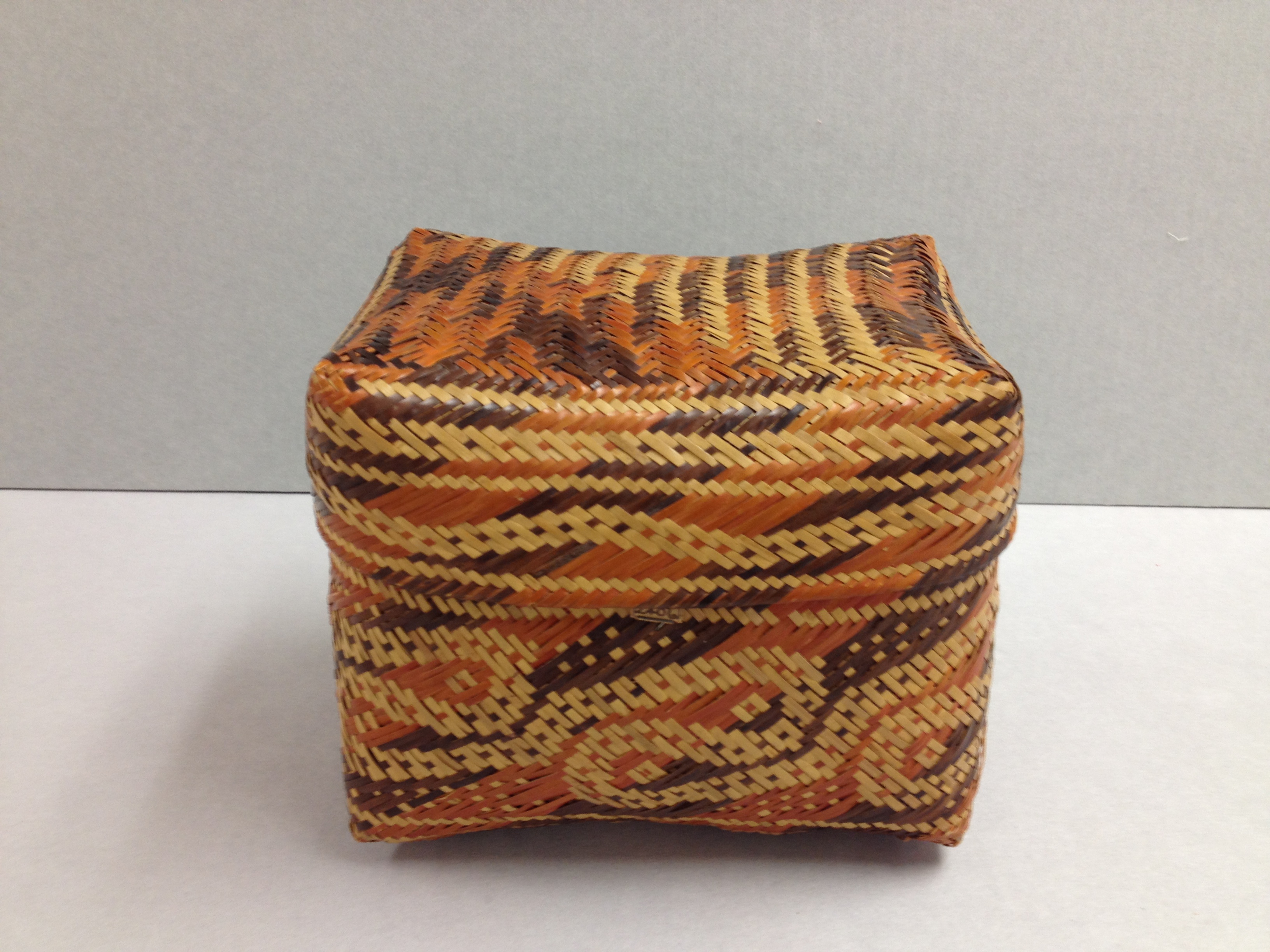
A Chitimacha Basket

Here is an image of a double woven river cane basket with lid from the Chitimacha people of Louisiana. It was purchased at auction in 1972 by William C. Sturtevant and is now in the collections of the Department of Anthropology, National Museum of Natural History, Smithsonian Institution (T070).

Baskets from Choctaw Fair, 1961

William C. Sturtevant’s collection includes a group of baskets purchased in 1961 at the Choctaw Indian Fair near Philadelphia, Mississippi. This example (above) is part of this group. It is number 580 and I have not yet learned who the artist who made it is. This basket is made from rivercane, a plant related to bamboo that is indigenous to the Southeast of North America.

To gain a sense of native basket making in the South as a dynamic cultural activity, check out these photographs from the 1st Gathering of Southeastern Indian Basketweavers in 2002. This was an event organized by the Louisiana Regional Folklife Program and the Williamson Museum.

Here is another basket from this group. A rivercane tray, it is number 576. Both are in the collections of the Department of Anthropology, National Museum of Natural History, Smithsonian Institution.

Tweezers!

I encountered a large number of objects in my work with the William C. Sturtevant Collection today. An important sub-set of the objects that I looked at today was a collection of “German silver” (a.k.a. nickel silver) jewelry made by a diversity of native silversmiths from central and western Oklahoma. These works were made during the 1960s and sold a trading posts in western Oklahoma.

Alongside earrings, finger rings, bracelets, broaches, buttons, stickpins, scarf slides and other items worn for adornment are nice two examples of an interesting–but not-widely known form–men’s tweezers, used for plucking hair from one’s beard. These stamped German silver tweezers from Western Oklahoma are beautiful. Older native men that I have known in Eastern Oklahoma would use tight commercial springs to achieve the same goal.

Much more can and needs to be said about the objects, the artists, the materials, the contexts of use, the contexts of sale, collecting, etc., but here is a glimpse at these two tweezers. (I still have a lot of data organizing to do before tomorrow.)

The first example (below) was made by the Kiowa smith Murray Tonepahote. It is WCS 599 in the National Museum of Natural History, Smithsonian Institution. (All photographs by me.)

Tweezers by Murray Tonepahote (Kiowa)

Tweezers by Murray Tonepahote (Kiowa)

A side view will help make sense of the object for those who have not seen such tweezers previously.

Side View of Tweezers by Murray Tonepahote (Kiowa)

Side View of Tweezers by Murray Tonepahote (Kiowa)

(BTW: Murray Tonepahote’s work as an artist is a subject taken up in the scholarship of his granddaughter, Dr. Jenny Tone-Pah-Hote, an assistant professor at the University of North Carolina.)

A second example (below) of such tweezers in the Sturtevant collection is by a Cheyenne (?) artist named Bushyhead. I will see fuller documentation for these objects tomorrow and can learn then which member of the Bushyhead family was the maker of this object–my guess is that it was made by Henry Bushyhead. This object is WCS T343, PGS-1.

Bushyhead Tweezer

Tweezers by Bushhead

As noted above (for contingent reasons) I have not yet seen the documentation that accompanies these objects. Needless to say there is much more to say about these two objects. If I have made any errors here, I will correct them a.s.a.p.

Pot Holders, Or William C. Sturtevant Collections Research, Day 1

I am in Washington at the start of a period of research studying the collection of objects gathered over much of the career of Smithsonian anthropologist William C. Sturtevant (1927-2007). (For background on W.C.S., see this biographical sketch that I posted to the Museum Anthropology weblog and this Washington Post obituary by WP staff writer Louie Estrada.)

While Dr. Sturtevant was long associated with the Smithsonian, his individual research collection grew and grew over the course of his career and was not accessioned into the holdings of the National Museum of Natural History until after his death in 2007. My work with the objects is an extension of the Southeastern Native American Collections Project (SNACP), but it also aims to assist the museum in the work of organizing and cataloging the Sturtevant Collection.

Today was mainly a get organized day, but I can share a glimpse of the objects that was looking at.

Dr. Sturteveant worked throughout his career on issues in Florida Seminole ethnography, linguistics, ethnology, and ethnohistory. He was always particularly interested in material culture and he went to considerable lengths to document the rich visual and material culture of the Seminole people living in my home state. (I first met Dr. Sturtevant while still an undergraduate when he attended a conference on Seminole folk art not far from my family home.)

It will take a very long time to sort out the details, but I began (metaphorically) unraveling the threads of his collection and its history with initial study of eight relatively simple objects–patchwork decorated pot holders made for sale to non-Seminole tourists by Seminole women during in the 1980s. In addition to their aesthetic richness and visual interest, such objects speak to the complex ways that the Seminole people have adapted to life in one of the most complex corners of North America. The Seminole engagement with tourism began in the early 20th century, it continued through the period represented by these pot holders, and it continues up to the present-era, in which the Seminole Tribe of Florida is the force behind a myriad of tourist destinations, including the global Hard Rock cafe and casino enterprise.

For four of the eight pot holders that I looked at today, I already know the name of the artist. A few of the as-yet artist-unidentified objects are pictured below. All objects are from the collections of the Department of Anthropology, National Museum of Natural History. I especially thank the department’s staff for hosting my research visit. Photographs shown here are my own quick and simple iPhone snapshots. (Better photographs can come later.)
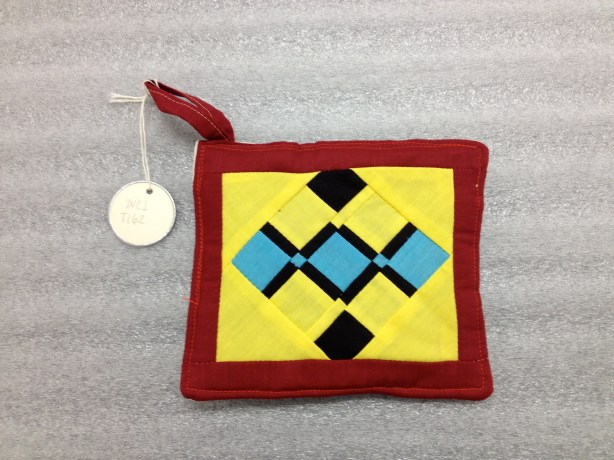
Sturtevant Collection T162

Patchwork Pot Holder, Florida Seminole

(Above) Patchwork Pot Holder, Florida Seminole, Sturtevant Collection T162, Department of Anthropology, National Musuem of Natural History, Smithsonian Institution. Photograph by Jason Baird Jackson

Patchwork Pot Holder, Florida Seminole

Patchwork Pot Holder, Florida Seminole

(Above) Patchwork Pot Holder, Florida Seminole, Sturtevant Collection T111A, Department of Anthropology, National Musuem of Natural History, Smithsonian Institution. Photograph by Jason Baird Jackson
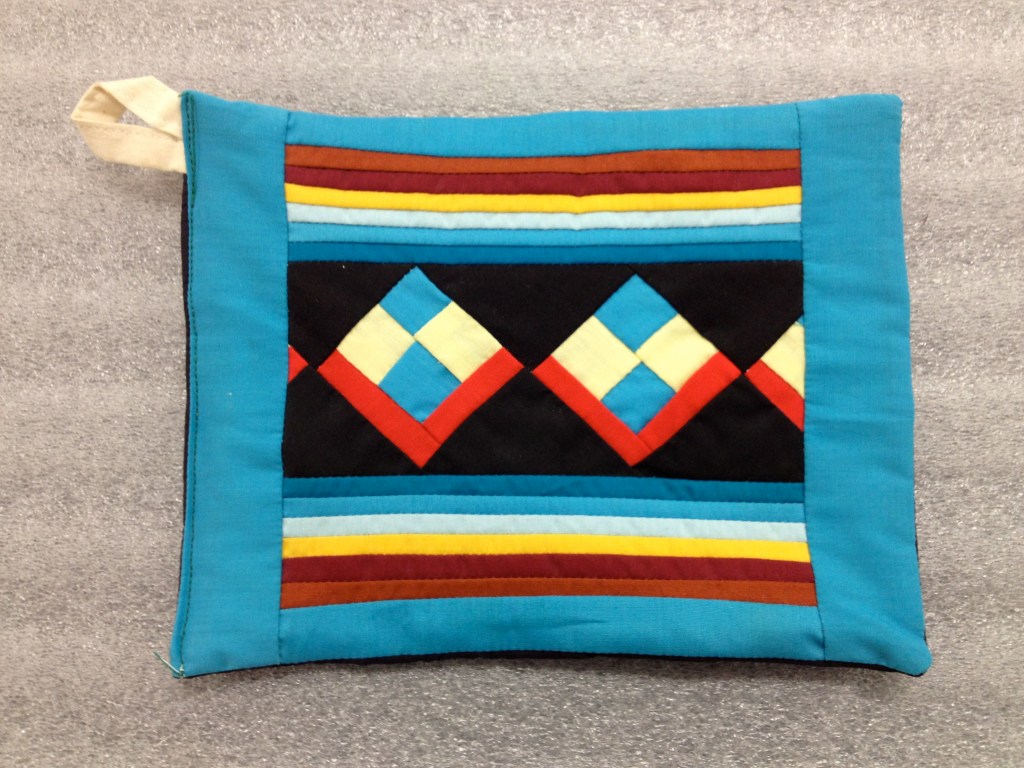
Patchwork Pot Holder, Florida Seminole

Patchwork Pot Holder, Florida Seminole

(Above) Patchwork Pot Holder, Florida Seminole, Sturtevant Collection T111B, Department of Anthropology, National Musuem of Natural History, Smithsonian Institution. Photograph by Jason Baird Jackson

Patchwork Pot Holder, Florida Seminole

Patchwork Pot Holder, Florida Seminole

(Above) Patchwork Pot Holder, Florida Seminole, Sturtevant Collection T111C, Department of Anthropology, National Musuem of Natural History, Smithsonian Institution. Photograph by Jason Baird Jackson

I have a lot of data management work to accomplish before tomorrow, but I could not resist sharing this glimpse.
Time to Apply to Participate in the Summer Institute in Museum Anthropology

Happy New Year! With the new year comes the season in which thoughts turn towards summer plans. A great summer program for graduate students interested in material culture studies is the Summer Institute in Museum Anthropology (SIMA). Held at the Smithsonian Institution’s National Museum of Natural History and funded by the [U.S.] National Science Foundation, this is a month-long intensive course focused on promoting “broader and more effective use of museum collections in anthropological research by providing a supplement to university training.”

“Working intensively each summer with 12-14 students interested in museum research, the institute: [1] introduces students to the scope of collections and their potential as data, [2] provides training in appropriate methods to collect and analyze museum data, [3] makes participants aware of a range of theoretical issues relating to collections, [and 4] positions students to apply their knowledge within their home university.”

Graduate students in anthropology and neighboring fields (including folklore studies) can find full information and application instructions on the SIMA website. As noted there: “The program covers students’ room, board, and tuition. Housing is provided at a local university and a small stipend will be provided for food and other local expenses. Participants are individually responsible for the cost of travel to and from Washington, DC. This is an intensive residential program and the participants are expected to devote full time to the training. Preparatory readings are assigned to ensure that students arrive with comparable background knowledge.”

This is a great program and a great opportunity. Please consider applying.

Wanted: Anthropology Minded Museum Directors

There are a number of museum directorships of relevance to anthropology and folklore studies open right now. The University Museum of Archaeology and Anthropology at the University of Pennsylvania, the Haffenreffer Museum of Anthropology at Brown University and the Museum of Anthropology at Northern Illinois University are among them.  Most relevant to me, because the museum is so central to my graduate teaching and my collections research, is the Mathers Museum of World Cultures at Indiana University. I especially hope that a large group of strong candidates apply for the Mathers Museum position. It will be exciting to see where each of these institutions head when they welcome their new leaders.

Sam Noble Oklahoma Museum of Natural History Openning: Curator of Archaeology

Job Opening: University of Oklahoma – Assistant/Associate Curator of Archaeology AND Assistant/Associate Professor of Archaeology.

@Mukurtu Project Wins Major IMLS Grant

Congratulations to Kim Christen and everyone working on the Mukurtu project on news that the effort has received a major grant from the (U.S.) Institute for Museum and Library Services (announced here). This is a major development for a major project.

As noted on the Mukurtu project site, Mukurtu is “A free and open source community content management system that provides international standards-based tools adaptable to the local cultural protocols and intellectual property systems of Indigenous communities, libraries, archives, and museums.” It is “a flexible archival tool that allows users to protect, preserve and share digital cultural heritage through Mukurtu Core steps and unique Traditional Knowledge licenses.”

Recovering Voices Program Manager

Recovering Voices Program Manager (IS-301-12, $74,872)
Department of Anthropology, National Museum of Natural History, Smithsonian Institution

We are seeking a program manager for Recovering Voices, an interdisciplinary Smithsonian program that is working with communities to document and sustain endangered languages and knowledge. Read more