Skip to content

Posts from the ‘Museums’ Category

Reblogged: “Thoughts on How to Get a Museum Job” by Robert Connolly

For those seeking museum jobs or who are training and mentoring junior colleagues for such work, check out Robert Connolly’s recent post “Thoughts on How to Get a Museum Job.”

Find it here: http://rcnnolly.wordpress.com/2013/09/02/thoughts-on-how-to-get-a-museum-job/

My older list of Web Resources for Museum Job Seekers can be found here: https://jasonbairdjackson.com/2012/12/04/web-resources-for-museum-job-seekers/

The Textile Museum | Out of Southeast Asia: Art that Sustains

While in Washington, I had a chance to visit The Textile Museum in its historical location amid the city’s embassies. I say historical because the museum is now preparing to move to the George Washington University campus.* I had not been to the museum previously (although I follow its work at a distance) and was eager to see it as it has been before it becomes what it will be next. The logic of the move is apparent, but the “old” museum had many charms. It is obvious that the museum’s building–a beautiful and stately old home–has been taken as far as it can be taken as a museum site. It was warm (in the good sense) and comfortable and attractive, but it is surely a challenge to use as a site for research, collections care, and public programs and exhibitions. That said, the facility seemed optimized within the scope of its limitations and I am certain that longtime visitors will miss the old site, as it really was comfortable and nice for small groups of visitors coming and going on a weekend morning. (With the preparations for the move, only the first floor is being used for public visitation, so I cannot comment on the upstairs areas.)

A main first floor exhibition gallery was renovated at some point to make it into a typical art museum gallery, disguising its presence in a large historic home. This space hosted the last temporary exhibition to be staged at the old location–Out of Southeast Asia: Art that Sustains.

Also accessible on the first floor was a welcoming desk and a truly remarkable gift shop where a pair of very kind museum staff members were stationed. Further back on the first floor was a “family room” space where guests were treated to cookies and lemonade. This room led to the back garden–a beautiful green space from which one can see glimpses of the embassies surrounding the museum. (Returning to the subject of the shop, it is a real model of the genre–well stocked, beautifully arranged, well staffed. Sourced globally, the shop offered beautiful and diverse textiles and textile-related objects, along with books at many different price levels. Even a hardened museum professional with little interest in textiles would be impressed by the shop.)

The exhibition focused on Southeast Asian textile traditions as inspiration for contemporary textile design and construction in the work of batik artist Vernal Bogren Swift (whose work draws upon the example of Javanese batiks), weaver Carol Cassidy (whose work draws upon her engagements with Lao weavers and weaving), and a husband and wife team working in batik–Agus Ismoyo and Nia Fliam. Contemporary work by these artists were exhibited alongside historical pieces from the museum’s collection and private collectors.

The work was impressive and the interpretation sound, but I focused my attention on the display strategies used for the display of these attractive works. Textiles are challenging to exhibit and The Textile Museum clearly has cultivated skills needed for first rate display. I filled several pages of my notebook trying to record the techniques used in impressive, conservation-friendly, presentations of these often delicate textiles. Hopefully we can draw upon these inspirations in future textile projects at the MMWC.

The exhibition was accompanied by a gallery guide, which is available online. A family guide was also available, as is a general educational room with adult-level books on world textiles and a range of hands on displays explaining weaving and other textile-related topics to children.

I am glad that I was able to visit the museum in its old location. The current exhibition and the museum as a whole were impressive. This is what I expected on the basis of the museum’s past projects and publications.

*See The Textile Museum’s press release for details on the move and a recent Inside Higher Education story by Kevin Kiley on the subject of U.S. museums being incorporated into colleges and universities.
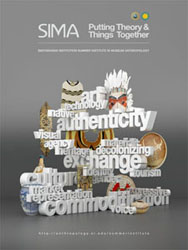
Excellent Symposium Concludes 2013 Summer Institute in Museum Anthropology

Many things have been happening lately–so many that keeping up with them here has been difficult. Many good things have gone unreported and some bad current events (global and national, not personal) have gone un-commented upon. I am pleased though to celebrate the conclusion of the 2013 Summer Institute in Museum Anthropology. I was invited to join the institute for its last week and a half and to participate in its concluding symposium at the National Museum of Natural History (NMNH) on the Mall in Washington. In the symposium, SIMA’s twelve graduate student participants presented the initial findings of their four-week research projects utilizing the (amazing) collections–both objects and archival materials–of the NMNH Department of Anthropology. The students came to SIMA from many different graduate programs and backgrounds and possessed a diversity of historical, ethnographic, topical, and theoretical interests. They did wonderful work and I learned a lot from their studies and from their careful and compelling reporting. While they have further to go, of course, with their projects, I think that it is pretty exciting to hear the results of four intensive weeks of research as the concluding act of that same four week process. Quite remarkable.

I am very appreciative of my continued association with this wonderful program. I am glad that I have been able to help it continue moving along so well.

SIMA will happen again next summer. Details will be posted here on the SIMA website in the months ahead.

2013 Cultural Heritage Informatics (CHI) Fieldschool

Sharing below information on the 2013 Cultural Heritage Informatics Fieldschool.

The 2013 Cultural Heritage Informatics (CHI) Fieldschool introduces students to the tools and methods required to creatively apply information and computing technologies to cultural heritage materials and questions.

The CHl Fieldschool is a unique experience in which students come together for 5 weeks to collaboratively work on cultural heritage informatics projects. In the process they learn to envision and build applications and digital user experiences for cultural heritage – exploring skills such as programming, web design & development, user experience design, project management, digital storytelling, etc.

Build soundly on the principle of “building as a way of knowing,” the CHI Fieldschool embraces the idea that students develop a better understanding of cultural heritage informatics by actually building tools, applications, and digital user experiences.

2013 Fieldschool Theme: Each year, the CHI Fieldschool has a theme which guides and informs all work and projects undertaken by students. This year’s theme is “Visualization: Time, Space, and Data.”

The CHI Fieldschool is offered through the MSU Department of Anthropology as ANP491 (6 Credits)

DIRECTOR & CONTACT:  ETHAN WATRALL (WATRALL@MSU.EDU)
INFO & APPLY:  CHI.ANTHROPOLOGY.MSU.EDU/FIELDSCHOOL
DATES:  MAY 27-JULY 3

Note:  Interested graduate students from CIC Schools (Big 10 + Chicago) may wish to investigate participating through the CIC Traveling Scholars Program, which lets graduate students enroll on their home CIC campus while participating in a class on another CIC campus. For information, see: http://www.cic.net/projects/shared-courses/traveling-scholar-program/introduction

The Woody Guthrie Center Seeks Executive Director, Educator

The emergent Woodie Guthrie Center in Tulsa, Oklahoma (one of my favorite places) is seeking to fill two key positions: (1) Executive Director/Chief Curator and (2) Educator and Public Programs Manager. These are great opportunities in an exciting new venture to be built around the Woody Guthrie Archives . Find out about both the Director and Educator jobs on the Oklahoma Museum Association website.

New Beginnings: Mathers Museum of World Cultures

Today I had the privilege of beginning work as Director of the Mathers Museum of World Cultures. I will surely write about the work of the museum extensively in the months ahead. Here I just want to thank the museum’s staff for welcoming me and thank the Indiana University administration for giving me this exceptional opportunity to do the  work that I love.

I could single out countless museum objects, collections, colleagues, goals, or aspirations to write about here, but I will use this post to acknowledge the long and important service of my predecessor Geoffrey W. Conrad. The Mathers Museum celebrates its 50th anniversary this year, and Geoff led the museum for nearly 30 of those years. The museum accomplished a tremendous amount over those three decades and it is exciting to have a chance to collaborate in building upon the solid foundation that Geoff and the staff built over the span of his long and distinguished career leading the museum.

Web Resources for Museum Job Seekers

I am again (Spring 2018; Spring 2020) teaching Curatorship and have again checked and updated the job links below. General purpose sites such as Indeed and LinkedIn are places where museum jobs are posted. I have not taken account of the general job posting site phenomena here, but I do note that social media and other technologies have shifted the ways that news of job opening circulate. The social sharing of openings makes clear how important it is to find the most relevant networks in one’s part of the field.

For many years I have maintained a handout in which I list online venues of interest to those searching for museum positions. Every few years I check and update the links, usually in connection with my Curatorship course. I will be teaching that course again next spring and I am working with a number of students preparing for museum job searches. This motivated the latest update, which I am posting online here. Additions and corrections are welcome. Please use the comments section.

Updated most recently on 4/25/18 12/3/19.


Candace Greene Wins Ames Prize; Summer Institute in Museum Anthropology Recognized

I learned great news today. My friend, colleague and collaborator Candace Greene (National Museum of Natural History) has been selected as this year’s recipient of the Michael M. Ames Prize for Innovative Museum Anthropology, awarded by the Council for Museum Anthropology.

In a letter sent to Candace and quoted from in an announcement making the rounds, Alex Barker, CMA President, wrote: “The award recognizes your groundbreaking work in developing and implementing the Smithsonian Institution Summer Institute in Museum Anthropology, and particularly the transformational potential of the program. Museums are more than just collections of things, after all. They’re also collections of people, and the SIMA program provides crucial training and educational opportunities, enriching the discipline of museum anthropology and embodying the innovative spirit the award recognizes.”

I am not attending the American Anthropological Association meetings and will unfortunately miss it, but there will be a formal announcement and presentation during the current AAA meetings during the Council for Museum Anthropology’s reception on Saturday, November 17 in the San Francisco Hilton’s room Imperial A. The reception runs from 6:30 – 8:30 p.m.

I am super pleased with this wonderful news of recognition well-deserved. Candace has been a great leader in the museum anthropology community and her vision for the creation of SIMA, together with her hard work to make it a success, have been amazing. This is an important award, well-bestowed. Congratulations to Candace and to everyone involved in making SIMA a thriving endeavor.

Director, Smithsonian Center for Folklife and Cultural Heritage

Having been asked to do so, I am happy to share news that the Smithsonian Institution is seeking applications for the position of Director of the Center for Folklife and Cultural Heritage. This is an important and exciting post. See the details below:

The Center for Folklife and Cultural Heritage, Smithsonian Institution, is accepting applications and nominations for a Director. The Center for Folklife and Cultural Heritage is responsible for planning, developing, and managing programs which have as their major objectives the research, documentation, presentation and conservation of living traditional and grassroots folk cultures of the United States and of other countries. The director is responsible for the administrative direction and management of all Center program activities including the Smithsonian Folklife Festival, Smithsonian Folkways Recordings, Ralph Rinzler Folklife Archives and Collections, exhibitions, symposia, scholarly research, cultural heritage policy, educational projects and all media, as well as the participation of other Smithsonian museums and programs in national celebration events and National Mall events. The Director represents, at national and international levels, Smithsonian concerns relating to the understanding of the cultural representation of living heritage, as well as public sector folklore, and policies related to them. The Director will have a proven track record of leadership, management and fundraising skills to run a unique multi-disciplinary cultural organization. The successful applicant must have a degree in a relevant field, management level experience in public programming, and have earned a presence in the scholarly and/or cultural community. The Smithsonian offers a competitive salary commensurate with experience and a comprehensive benefit plan including a lucrative, fully vested retirement program with TIAA- CREF. For detailed information on the position, qualifications and application instructions, go to http://www.sihr.si.edu/jobs.cfm and scroll to position announcement EX-13-01. We are only accepting online applications for this position. For questions or additional information, contact Tom Lawrence, 202-633-6319 or lawrencet@si.edu. The Smithsonian Institution is an Equal Opportunity Employer.

A First Rate Podcast: Artisan Ancestors Visits the Summer Institute in Museum Anthropology

A perfect example of how scholarly research in folklore and anthropology can be made accessible and interesting for a wider audience is the Artisan Ancestors podcast produced and hosted by my friend and colleague Jon Kay. (Jon is, among other roles, the Director of Traditional Arts Indiana.) If you have not yet encountered the Artisan Ancestors show, I urge you to check it out. As Jon describes it, the focus of the show is on strategies for “researching creative lives and handmade things.” Jon does interviews with people involved in such work with the goals of encouraging and guiding newcomers to such studies and of expanding the horizons of those already deeply involved. Long adept in the skills of the public folklorist, Jon has mastered the podcast genre. He is a great interviewer and he knows how to do in interview with the needs of his audience and the requirements of the medium in mind. The production values are high but it is clear that he has worked out a system that gets good results without endless, expensive work.

In his newest episode (#26) Jon interviews Dr. Candace Greene, another friend and the Director of the Summer Institute in Museum Anthropology (SIMA). The interview explores the purposes and goals of SIMA in a way that not only introduces this training program (for which I was a faculty member this past summer) but also encourages deeper understanding of the broader value of museum collections for research in social and cultural history. It is a great interview and listening to it will illustrate not only the value of the SIMA effort but also suggest the value of podcasting initiatives such as Artisan Ancestors. Kudos to Jon and Candace for their great job with this episode.