Skip to content

Posts from the ‘Museums’ Category

Announcement: Dress to Express Museum Modules

An announcement posted here on behalf of Local Learning:

DRESS TO EXPRESS MUSEUM MODULES

In conjunction with Volume 1 of the Journal of Folklore and Education, “Dress to Express: Exploring Culture and Identity,” Local Learning proudly announces the launch of three museum modules that extend this theme in our new online Discovery Studio found at www.locallearningnetwork.org. Because dress and adornment carry such deep, complex meaning, they present exciting opportunities for learning across disciplines and age groups and in various settings. Dress and adornment create accessible portals to culture and community as well as to historical and contemporary identity.

The images and lesson plans made available by our museum partners connect to literacy, art, and social studies learning and make diverse collections accessible online. These modules offer new ways to think about history, identity, art, and culture as well as encourage close observation and interpretation. Activities suitable for grades 4-12, university, museum, and community settings accompany the images.

Exploring Dress, Culture, and Identity in Asian Art

by Joanna Pecore, Asian Arts & Culture Center, Towson University, Towson, Maryland

What do art objects from distant times and places express about the identity of the people and the cultures depicted in them?

Exploring Dress, Culture and Identity in American Indian Dress and Objects

by Lisa Falk, Arizona State Museum, University of Arizona, Tucson

How would you feel if someone (outside your identity group) used your identity design references in a clothing line? What might change how you feel about this use?

Lau Hala Weaving and Hawai’ian Cultural Identity

by Marsha MacDowell, Michigan State University Museum, East Lansing

How are the weaving and wearing of lau hala papale (hats) connected to Hawai’ian history, identity, natural resources, and culture?


Find the Dress to Express Museum Modules in the Discovery Studio of the Local Learning website. Explore more activities and context on this theme in Volume 1 of the Journal of Folklore and Education. This work is funded in part by the National Endowment for the Arts. Please publicize these free resources among your colleagues and networks.

Contact:

Paddy Bowman, Director, pbbowman@gmail.com

Lisa Rathje, Assistant Director, rathje.lisa@gmail.com

Local Learning: The National Network for Folk Arts in Education www.locallearningnetwork.org

###

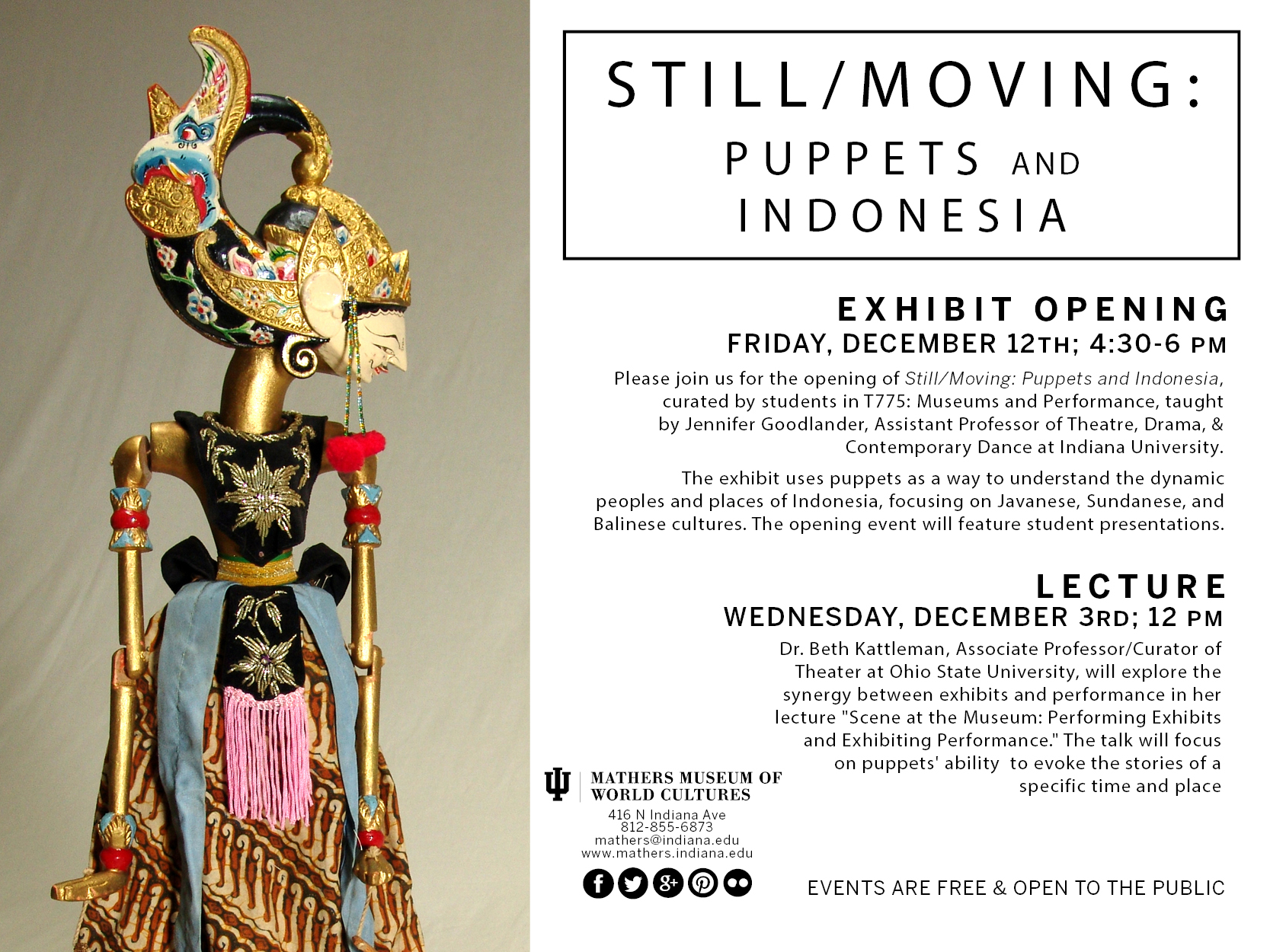
Still/Moving: Puppets and Indonesia Lecture and Exhibition Opening

Still/Moving Lecture & Exhibition Invite

AFS “Folklore and Museums Section” Founded, AFS Members (and Non-Members too) are Welcome to Join

I am happy to note here that the Executive Board of the American Folklore Society has endorsed a proposal put forward by the Folklore and Museum Policy and Practice Working Group to establish a Folklore and Museums section within the society. The section came into existence as of the Executive Board’s November 2014 meeting in Santa Fe. I am very pleased to serve as the new section’s first convener and to invite everyone with an interest in the intersection of museum practice and folklore (/folklife/ethnology) to join the new section.

As noted in the call for members on the AFS website:

the Folklore and Museums Section exists to foster communication and cooperation among museum-oriented folklorists, to advance the contribution of folklore studies scholarship and practice in museum settings, and to articulate museum-oriented folklorists with other colleagues, institutions, and organizations in the museum sector. The section aims, whenever possible, to cooperate with other sections of the American Folklore Society and with peer-organizations in the field.

The public web home for the new section can be found online here: http://www.afsnet.org/?page=MuseumSection and the member’s group space is accessible to members who are logged into the AFS website.

While I am very eager for all interested colleagues to join AFS, I want to note that the AFS has a free “Section Only” membership category by which non-AFS members can sign-up with sections such as the new Folklore and Museums section. This might be of particular value to non-folklorists who wish to keep up with the section’s work. Information on the Sections Only “membership” is available on the Membership Categories page of the AFS website. There is no cost to join the Folklore and Museums section.

The Santa Fe meetings were a great gathering for museum-minded folklorists. I am optimistic that the new section can help make the 2015 meetings even richer for our corner of the field. Thanks to all who have contributed to the momentum behind the new section and to the growth of folklore and museums work.

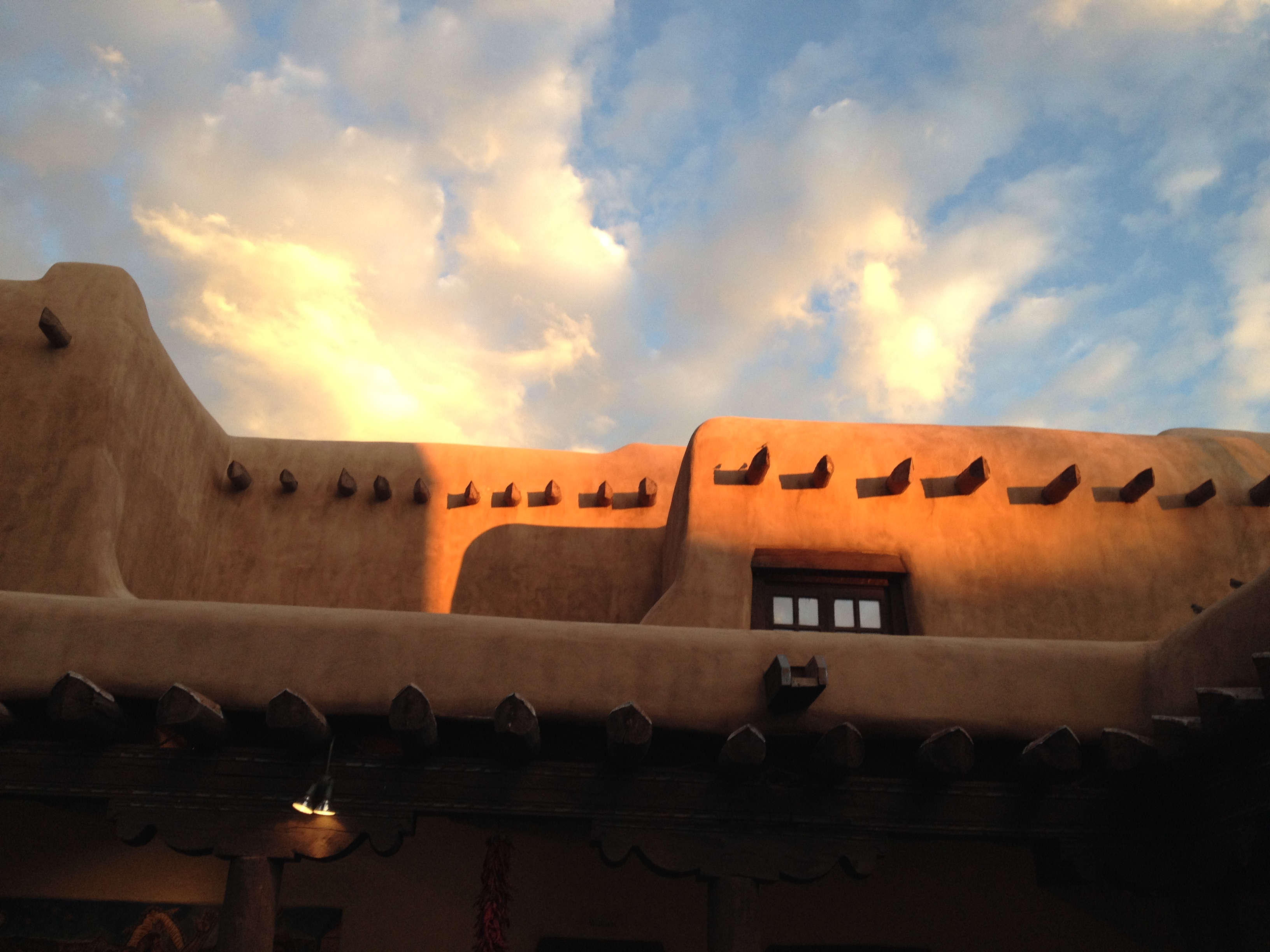
Sky Above New Mexico Museum of Art

Sky Above New Mexico Museum of Art, November 2014

Seeking Applicants | Museums at the Crossroads: Local Knowledge, Global Encounters

Call for Applications (Deadline Nov. 15)

Museums at the Crossroads:  Local Knowledge, Global Encounters

A Summer Institute of the Mathers Museum of World Cultures and the School of Global and International Studies, Indiana University

Bloomington, Indiana, USA
May 14-21, 2015

The Indiana University Mathers Museum of World Cultures and School of Global and International Studies invite applications for up to eight Museum Partners who will take part in an innovative international workshop on the future of museums of culture and history.

Museums at the Crossroads, scheduled for May 14-21, 2015, in the beautiful college town of Bloomington, Indiana, combines keynote addresses, tours, charrettes, and social interactions. We seek applications from museum practitioners and theorists who wish to partner in conversation and creative practice with a group of invited keynote speakers and international museum fellows in a small, informal workshop setting.  Successful applicants will receive eight nights of on-campus lodging and per diem support of $45 for eight days.

About Museums at the Crossroads

Museums at the Crossroads connects theory and practice, bridging institutional, regional, and national museum contexts in order to advance the global conversation around museums and generate a range of practical outcomes for its participants.

Workshop participants will include:

•    4 international fellows from innovative museums around the globe
•    8 museum partners drawn from museums and other institutions in the United States and abroad
•    12 Indiana University faculty, staff, and graduate students
•    4 keynote speakers, each addressing a broader social and cultural theme that we wish to explore in depth in museum contexts.

Our keynote speakers are:

•    Steven Lubar, Brown University (keynote on Today’s Museum:  Innovation, Change, and Challenge)
•    Michael F. Brown, School for Advanced Research (keynote on Cultural Crossroads:  World Cultures in Transition)
•    Stephan Fuchs, University of Virginia (keynote on Disciplinary Crossroads:  The Evolving Sociology of Knowledge)
•    Haidy Geismar, University College London (keynote on Artifactual Crossroads:  Real Meets Virtual)

Museum Partners will be responsible for their own travel arrangements to and from Bloomington, Indiana, and are expected to participate actively in the full workshop and in associated follow-on activities. Prior to attending, each shall develop an institutional profile that includes an account of challenges your museum faces relative to the three “crossroads” (Cultural, Disciplinary, Artifactual) being explored in the workshop. Partners without a museum affiliation will be asked to prepare a comparable position paper on the themes.

How to Apply

To apply for a position as Museum Partner, please send a resume or curriculum vitae, as well as a cover letter expressing your interest, as a PDF email attachment to:

Sarah Hatcher, c/o mxrd@indiana.edu.

Review of applications will begin November 15, 2014, with applicants receiving notifications by December 15, 2014.

Further Information

For additional detail on the scope and nature of Museums at the Crossroads, see the workshop précis, which is accessible online at: http://www.mathers.indiana.edu/crossroads.html.

Additional information about Indiana University Bloomington can be found at: http://iub.edu/.

Information on the Mathers Museum of World Cultures is available at: http://mathers.indiana.edu/.

Questions about the workshop can be addressed to the organizers at: mxrd@indiana.edu.

A Museum-Minded Guide to the 2014 American Folklore Society Meetings

Cross-posted from AFS News.

Folklorists with an interest in museums are feeling quite excited about the upcoming American Folklore Society annual meeting in Santa Fe, New Mexico (November 5-8, 2014). The home to many world-class museums, Santa Fe is always a favorite with museum lovers, whether they are enthusiastic avocational visitors or veteran museum workers. This year, Santa Fe’s wonderful museums compete for our attention with an AFS meeting program that is unusually broad and deep in its engagement with museums as rich sites for collaboration, education, and community empowerment as well as for ethnographic, historical, and comparative research. If your plans are not yet finalized, please consider joining us in Santa Fe.

For those with museum interests, there are too many wonderful panels and presentations to enumerate all of them here. Many material culture panels—covering everything from food ways to architecture—appear throughout the program and will certainly attract the attention of museum-minded folklorists. The same can be said for public folklore programming and other themes of perennial concern. Here I highlight a selection of promising events of likely interest to those eager to learn more about the intersection of folklore studies and museum practices. This account though is just a selection drawn from the larger program and I know that much wonderful work of museum-interest is not flagged here. The Santa Fe program will provide a near infinite number of options for all of us.

Before the meetings even officially open, an abundance of museum-relevant offerings on Wednesday will get us in the mood for a jam-packed program. While the rich set of tour choices have understandably attracted many in the museums crowd, some museum folklorists have understandably been drawn to the “Experiments in Exhibition Workshop” that has been organized by Carrie Hertz and Suzanne Seriff at the Museum of International Folk Art. This innovative hands-on gathering has been sponsored by the Museum of International Folk Art, the AFS Folklore and Museum Policy and Practice Working Group, the Folklore and Education Section, and Local Learning: The National Network for Folk Arts in Education.

The Experiments in Exhibition Workshop is only one of a number of special events connected to our hosts at the Museum of International Folk Art. Kicking off the meeting’s panel sessions on Thursday morning, is a double session on “Pottery of the US South” that will offer a diversity of viewpoints on a topic that is the focus of the museum’s special exhibition of the same name. Those attending the exhibition’s opening later on Thursday may wish to attend one or both of these companion panels [01-01, 02-01].

Also in the first time slot on Thursday is Dress, Culture, and Identity: Museum Collections and Outreach, which has been sponsored by the Folklore and Education Section [01-04]. For those with museum interests, difficult choices or shuttling between rooms will be a welcome challenge throughout the meetings.

Running alongside the second pottery panel in the second slot on Thursday is the first of a series of museum-focused panels organized by the Folklore and Museum Policy and Practice Working Group. Leading off the working group’s series is a forum in which group members will update the membership on its work and solicit questions, concerns, and contributions from the field in anticipation of a final working group white paper and a range of spin off publications—all of which will aim to strengthen understanding of, and opportunities in, museum-based folklore studies [02-04]. The series of panels organized by the working group all aim to facilitate the sharing of innovative case studies and hard won experience throughout, and beyond, the field. Please join the conversation.

After lunch on Thursday, a second working group event will be held—a diamond session on “Current Digital Projects in Ethnographic Museum Contexts” [03-04]. This panel runs concurrently with “Folk Art, Folk Craft I”, which also includes presentations of special relevance to those with museum interests [03-17].

A highpoint of the conference will happen on Thursday evening, from 5:00 to 7:30 p.m. This is when the “Open House on Museum Hill” will be held. All of the Museum of International Folk Art and Museum of Indian Arts and Culture galleries and gift shops will be open and attendees will have the unique opportunity of seeing a performance by the Cibecue Creek Apache Crown Dancers. Check your program for details on other musical and exhibition offerings, as well as shuttle information. There are many great choices lined up and we will also be able to indulge in diverse fare with food trucks providing local and international foods for purchase.

Among the many museum scholars attending AFS for the first time is Aaron Glass of the Bard Graduate Center. On Thursday evening, following the events on Museum Hill, Glass will be screening “In the Land of the Head Hunters: A Newly Restored Version of Edward S. Curtis’s 1914 Silent Film Made with the Kwakwaka’wakw (Kwakiutl) of British Columbia.” This special event should have wide appeal to all who have heard of Curtis’ famous work or who have interests in archives, Native American culture, community collaboration, or visual methods and productions.

Museum-focused panels begin again on Friday with “Movement Creates Museum: Activist Beginnings of Historic Sites of Conscience” [04-01], which runs concurrently with “Archives, Museums, Collections I” [04-08]. These two panels are followed by another museums working group event: “At the Crossroads of Museums and the Marketplace” [05-03].

After lunch on Friday, hard choices continue with “Archives, Museums, and Collections II” [06-03] running concurrently with another panel with much museum content—the diamond session “People and Things: Material Culture Research at the Crossroads” [06-05].

A further museums working group event kicks off Saturday morning: “At the Crossroads of Museums and Communities” [07-01]. This event is followed by “At the Crossroads of Folklore and Museum Education” [08-05], which has been sponsored by the Folklore and Education Section.

In the conference’s final time slot for presentations, museum-relevant papers appear in “The Crossroads Are Owned: Folklore Institutions and the Negotiation of Public and Personal Tradition” [09-07], which runs concurrently with the final event of the museums working group series. It is: “Museums and Intangible Heritage: Connecting the Tangible with the Intangible” [09-16] as well as a panel discussion grounded in the work of the Museum of International Folk Art’s Gallery of Conscience initiative: “Community Crossroads: Integrating Folk Art, Media, and Youth to Impact HIV/AIDS Advocacy” [09-03].

Among the special features of the Santa Fe meetings will be the presence of many first-time attendees who are museum colleagues from China and the United States. Their attendance follows from the work of the joint China Folklore Society-American Folklore Society project focused on folklore and intangible cultural heritage (ICH). The current, second phase of this Luce Foundation-funded effort is focused on museums and ICH policies in both countries. For those interested in learning more about the current “Intangible Cultural Heritage and Ethnographic Museum Practice” project as well as the broader “China-US Folklore and Intangible Cultural Heritage Project” can find details on the AFS website.

As suggested above, this year’s museums-rich program has also attracted first-time attendees and guests from neighboring fields sharing our museum interests, including cultural anthropology and Native American studies. I would like to encourage all AFS regulars to welcome and connect with these many new AFS meeting participants. As always, AFS will also attract many students. This year will provide them with an unusually rich opportunity to learn about museum-based folklore practice and to engage with colleagues, projects, institutions, and ideas in the wider museum field.

Thanks to all who have worked hard to assemble such a rich set of events and scholarly presentations for the Santa Fe meetings.
Notes on an Eastern Cherokee Gathering Basket

For me, new light was just cast on a basket in the William C. Sturtevant Collection in the Department of Anthropology, National Museum of Natural History, Smithsonian Institution. In the mail, I just received a slew of basketry books. This is a topic on which I need to get caught up for a number of interconnected purposes, including for the analysis and publication of the Mathers Museum of World Cultures basketry collections (especially the Eastern Cherokee baskets, which will be the focus of an exhibition that I will co-curate).

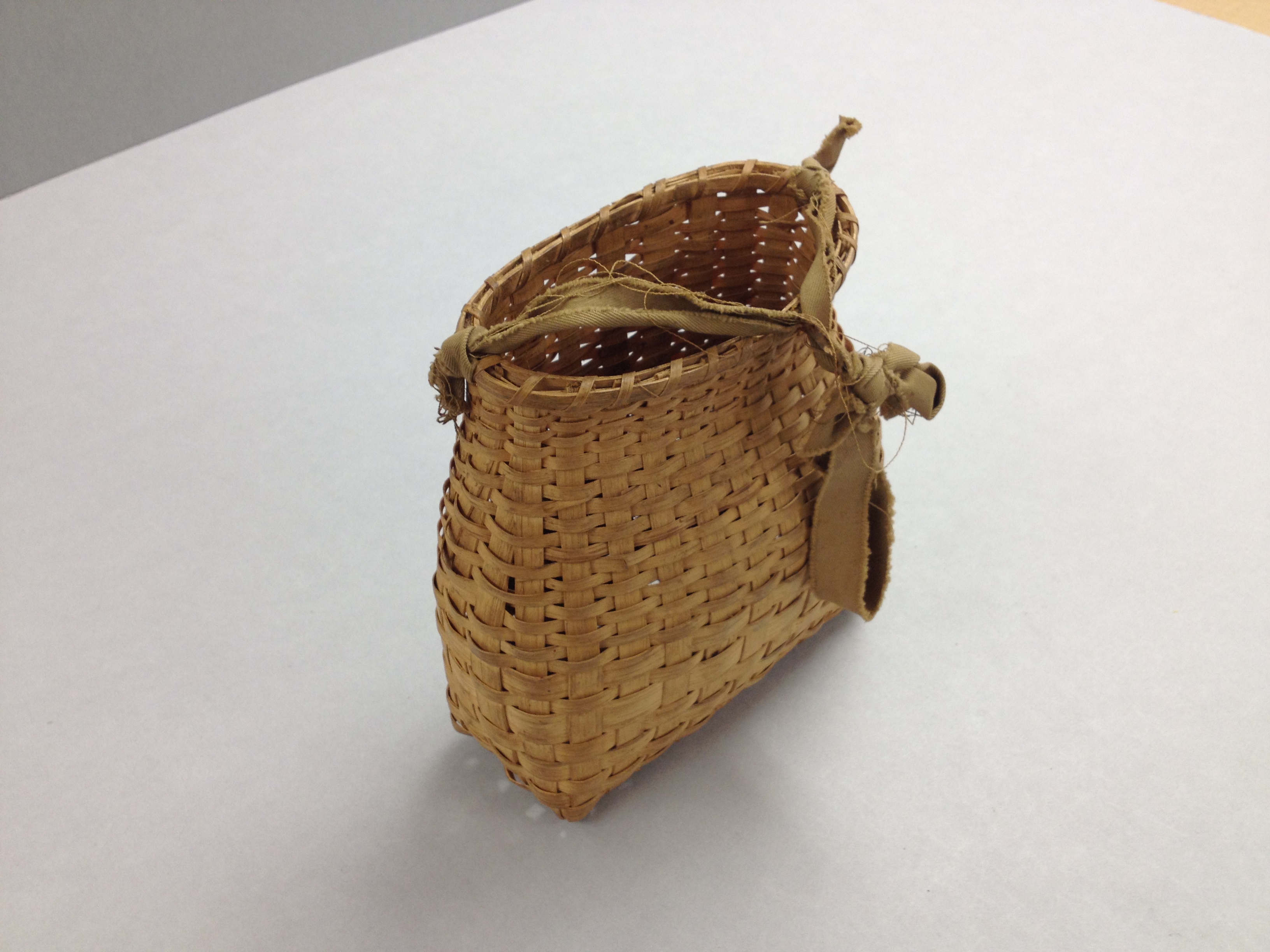
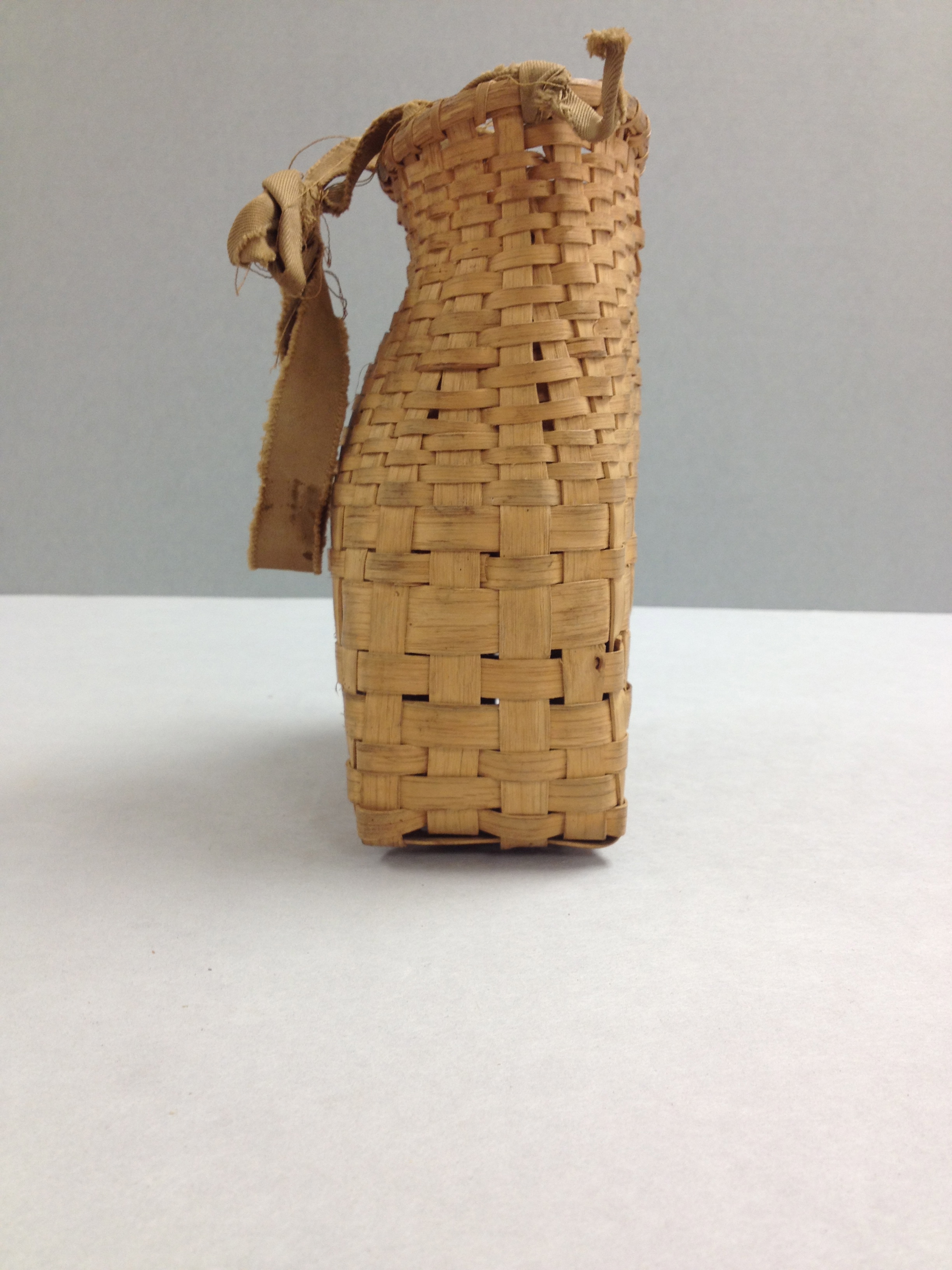
Among the used books that I just received is Baskets and Basket Makers in Southern Appalachia by John Rice Irwin (Exton, PA: Schiffer Publishing, 1982). In a chapter devoted to “The Indian Influence on Southern Appalachian Mountain Baskets” the author describes a relatively unfamiliar (to me, at this stage, at least) basket form on the basis of an example believed (to the author, at least) to be Cherokee and collected in Buncombe County, NC (p. 157). The basket discussed by Irwin is similarly shaped and similarly sized to a basket that I studied a few summers ago in the Sturtevant collection at NMNH. The splint basket that Sturtevant collected among the Eastern Cherokee is pictured here:

Eastern Cherokee Basket

Eastern Cherokee Basket, NMNH, Temporary Number WCS 322

Eastern Cherokee Gathering Basket

Eastern Cherokee Basket, NMNH, Temporary Number WCS 322

IMG_4760

Eastern Cherokee Basket, NMNH, Temporary Number WCS 322

It shares the same, flat on one side, curved on the other, shape as the basket pictured by Irwin. In a photo on p. 157, Irwin photographed a older boy holding the basket under his right arm, thereby illustrating how the shape of both baskets facilitates the collecting of berries, nuts, etc. with both hands. Prior to getting direct information from a Cherokee consultant who has made or used such a basket, this (that is, Irwin’s) is a much better account of this shape and its use that I had been speculating about.


On the New Volume of Museum Anthropology Review

Museum Anthropology Review (MAR) has just published a new double issue—its first themed collection. Volume 7, number 1-2 of MAR collects papers originally presented at a January 2012 workshop titled “After the Return: Digital Repatriation and the Circulation of Indigenous Knowledge.” Hosted by the National Museum of Natural History, Smithsonian Institution and funded by the (U.S.) National Science Foundation and the Understanding the American Experience and World Cultures Consortia of the Smithsonian Institution, the workshop was organized by Kimberly Christen (Washington State University), Joshua Bell (Smithsonian Institution), and Mark Turin (Yale University). The workshop brought together scholars from indigenous communities, cultural anthropology, folklore studies, ethnomusicology, linguistics, and collecting institutions to document best practices and case studies of digital repatriation in order to theorize the broad impacts of such processes in relation to: linguistic revitalization of endangered languages, cultural revitalization of traditional practices, and the creation of new knowledge stemming from the return of digitized material culture. Like the workshop itself, the peer-reviewed and revised papers collected in MAR ask how, and if, marginalized communities can reinvigorate their local knowledge practices, languages, and cultural products through the reuse of digitally repatriated materials and distributed technologies. The authors of the collected papers all have expertise in applied digital repatriation projects and share theoretical concerns that locate knowledge creation within both culturally specific dynamics and technological applications.

Find this special issue of MAR online at: http://scholarworks.iu.edu/journals/index.php/mar/issue/view/233

As it has always been, MAR is an open access, peer-reviewed journal free to all readers. With volume 8, to be published in 2014, MAR is becoming the journal of the Mathers Museum of World Cultures. It will continue to be published in partnership with the Indiana University Libraries with assistance from the IU Department of Folklore and Ethnomusicology and other partners.

2014 will bring new enhancements to MAR. To keep up with the journal, please sign up as a reader, follow it on Twitter @museanthrev, and/or like it on Facebook.

Museums of Ethnography and Cultural History Celebrate Fiftieth Anniversaries and Welcome New Directors

I will say more detailed things about the Mathers Museum of World Cultures during 2013 in later posts. Here I just want to flag a few happy curiosities.

Today is the last day of 2013 and 2013 marked the 50th anniversary of the Mathers Museum of World Cultures. This fact made it an extra wonderful year to begin service as the museum’s Director. The exhibition Treasures of the Mathers Museum was the centerpiece of our celebratory activities and a new strategic plan was the fruit of our reflections on the past and our goal setting for the future. We have made good progress on our goals for the second half century, but that is for a future post.

We were not alone among museums of ethnography, cultural history, and world cultures celebrating golden anniversaries in 2013. Joining us in such celebrations were the Fowler Museum at UCLA, the Wake Forest Museum of Anthropology, and the Cherokee Heritage Center. (2013 saw other notable 50th anniversaries in the broader museum world, including the 50th anniversary of the University of Wisconsin Milwaukee/Milwaukee Public Museum museum studies program.) Congratulations to all of the half century celebrants, especially to these museums in our corner of the field.

2013 was also a year for new directors among such museums. I am happy to be among them. My friend Candessa Tehee and I shared the experience of becoming directors during a 50th anniversary. Candessa is the new Executive Director of the Cherokee Heritage Center. Robert Preucel was named the new Director of the Haffenreffer Museum of Anthropology at Brown University and Patrick Lyons was named the new Director of the Arizona State Museum at the University of Arizona. The Cherokee Heritage Center was not the only Cherokee museum to get a new director, The Museum of the Cherokee Indian named James “Bo” Taylor as Executive Director. I am sure that I missed someone (please add them in the comments), but I want to wish all of these new directors well. It is an exciting time for our field and I look forward to seeing where we all collectively go during 2014.

Exhibition Opening: Operation AB – Katyn–The Destruction of the Polish Elite at the Beginning of WWII

Thank you to all everyone who traveled, from near and far, to attend last night’s exhibition opening of “Operation AB – Katyn: The Destruction of the Polish Elite at the Beginning of WWII,” at the Mathers Museum of World Cultures. The exhibition, organized by, and circulated to the MMWC by, the Institute of National Remembrance, Poland is an important effort to report on a tragic, important, and poorly understood phase in WWII-era European history, particularly the terrible Katyn massacre. It is an honor to host this important historical exhibition and it was an honor to welcome so many guests to the museum for the opening.

Among the special visitors attending the exhibition opening was Dr. Łukasz Andrzej Kamiński, the President of the Institute of National Remembrance. It was a great experience to welcome Dr. Kaminski and his colleagues to the museum and to Indiana University.

The IU Polish Studies Center, led by Padraic Kenney, was the leader of this local effort and the MMWC is thankful for the opportunity to pursue this partnership.

IU and MMWC in Ghana

IU President McRobbie’s recent trip to South Africa, Kenya, and Ghana has proven incredibly timely for projects coming to fruition at the Mathers Museum of World Cultures. The IU delegation began its trip with extensive consultations in South Africa and this linked up nicely with the Margaret Bourke-White exhibition that we opened today. In one of his many compelling stories from the trip, Ryan Piurek recounted the deep history of positive university involvement in South African partnerships and projects, concluding his story with reflections on the Bourke-White exhibition as a current collaboration, one that will see the exhibition travel to two South African venues.

House Painting in Ghana

The President’s trip is concluding with a visit to another African nation where IU has deep ties and a long history of collaboration–Ghana. At MMWC, we are very excited that the museum is also connecting with audiences, communities, collaborators, and research opportunities in Ghana. While the museum’s ties to Ghana and scholars of the nation are multiple, the story right now centers on the work of IU art history graduate student, and MMWC collaborator, Brittany Sheldon. With MMWC help, Brittany has developed an exhibition based on her research on traditional decoratively painted houses. The exhibition State of an Art: Contemporary Ghanaian Bambɔlse will be presented this fall at the Ghana Museums and Monuments Board. The exhibition features Sheldon’s photographs documenting the red, black, and white designs (bambɔlse) that adorn the earthen walls of houses in the Upper East Region in Ghana.

Brittany is in Ghana now and is documenting her continued studies on her blog. For details on the exhibition that she has worked with the MMWC to develop, see the museum’s website.

Congratulations to Brittany on her exhibition and good luck to her in her continued studies with Ghanaian artists and tradition bearers.