Skip to content

Posts from the ‘Museum Anthropology’ Category

People Make Collections: Anthropologist Michael Davis (1942-2012)

Museum collections are made by people who gather together the things that other people make. Earlier this week I was looking at a group of objects in the William C. Sturtevant Collection that were gathered together and documented by then-University of Oklahoma doctoral student Michael Davis. This is an exceptional collection of German silver jewelry made in the 1960s by an impressive number of Native American artists working on the Southern Plains.

After his OU studies, Michael Davis went on to become a Professor of Anthropology at Truman State University in Kirksville, Missouri. I wanted to congratulate him on the quality of the collection that he made and the exceptional way in which he documented it. Thinking about getting in touch, I discovered sadly that he passed away a few months ago. An obituary appears in the Kirksville Daily Express and is available online.

One reason that we make museum collections is to preserve something of the past for the sake of the future. I hope that Professor Davis, as well as the artists whom he documented, would be pleased to know that their work is being appreciated by those who have come along after them.
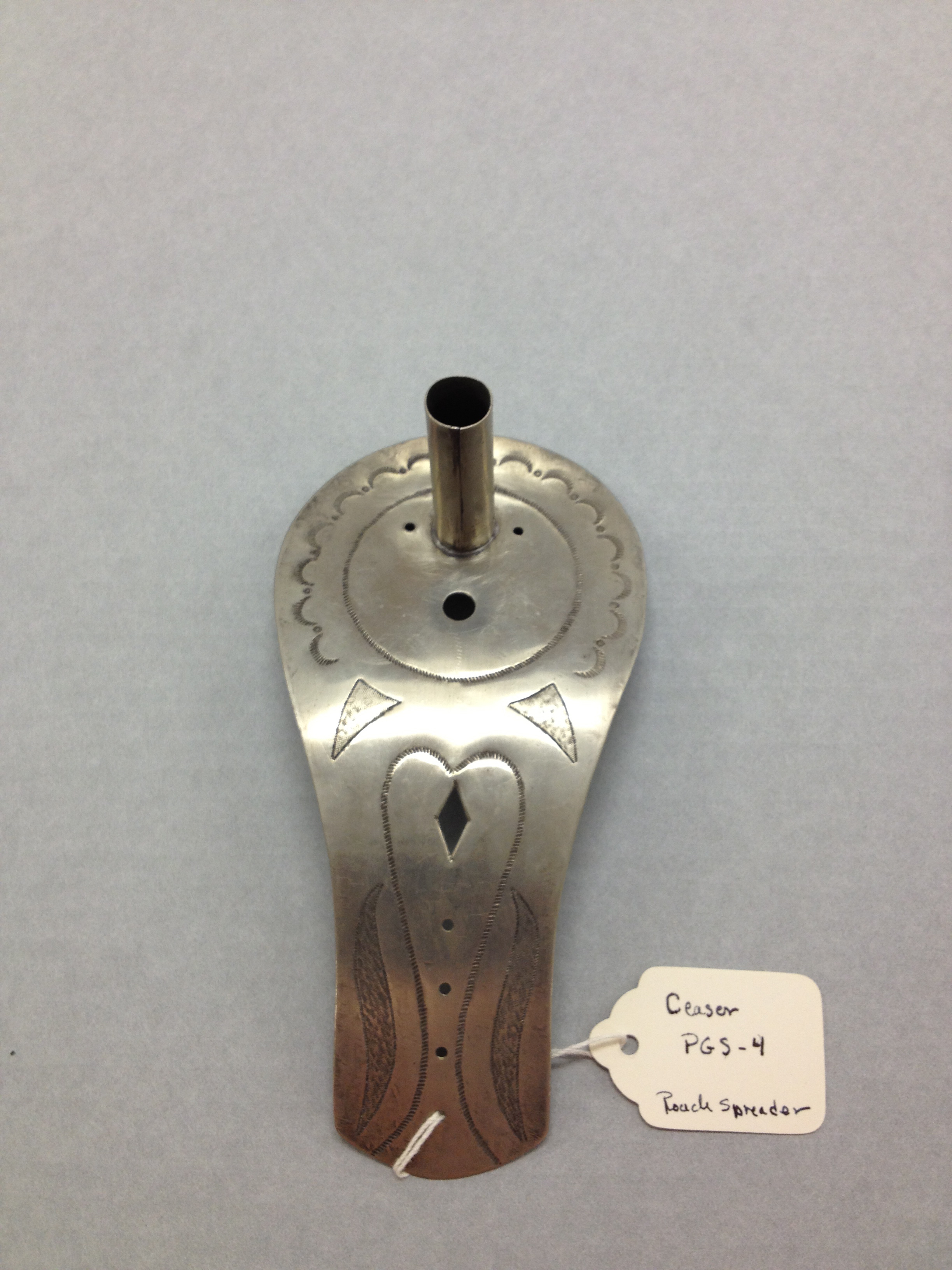
A German silver roach spreader by Pawnee smith Julius Ceasar (1910-1982) collected for the National Museum of Natural History by Michael Davis (1942-2012) and found as part of the William C. Sturtevant Collection, Department of Anthropology, National Museum of Natural History.

Time to Apply to Participate in the Summer Institute in Museum Anthropology

Happy New Year! With the new year comes the season in which thoughts turn towards summer plans. A great summer program for graduate students interested in material culture studies is the Summer Institute in Museum Anthropology (SIMA). Held at the Smithsonian Institution’s National Museum of Natural History and funded by the [U.S.] National Science Foundation, this is a month-long intensive course focused on promoting “broader and more effective use of museum collections in anthropological research by providing a supplement to university training.”

“Working intensively each summer with 12-14 students interested in museum research, the institute: [1] introduces students to the scope of collections and their potential as data, [2] provides training in appropriate methods to collect and analyze museum data, [3] makes participants aware of a range of theoretical issues relating to collections, [and 4] positions students to apply their knowledge within their home university.”

Graduate students in anthropology and neighboring fields (including folklore studies) can find full information and application instructions on the SIMA website. As noted there: “The program covers students’ room, board, and tuition. Housing is provided at a local university and a small stipend will be provided for food and other local expenses. Participants are individually responsible for the cost of travel to and from Washington, DC. This is an intensive residential program and the participants are expected to devote full time to the training. Preparatory readings are assigned to ensure that students arrive with comparable background knowledge.”

This is a great program and a great opportunity. Please consider applying.