Skip to content

Posts from the ‘Museum Anthropology’ Category

Get Oriented to Themester 2016: Beauty

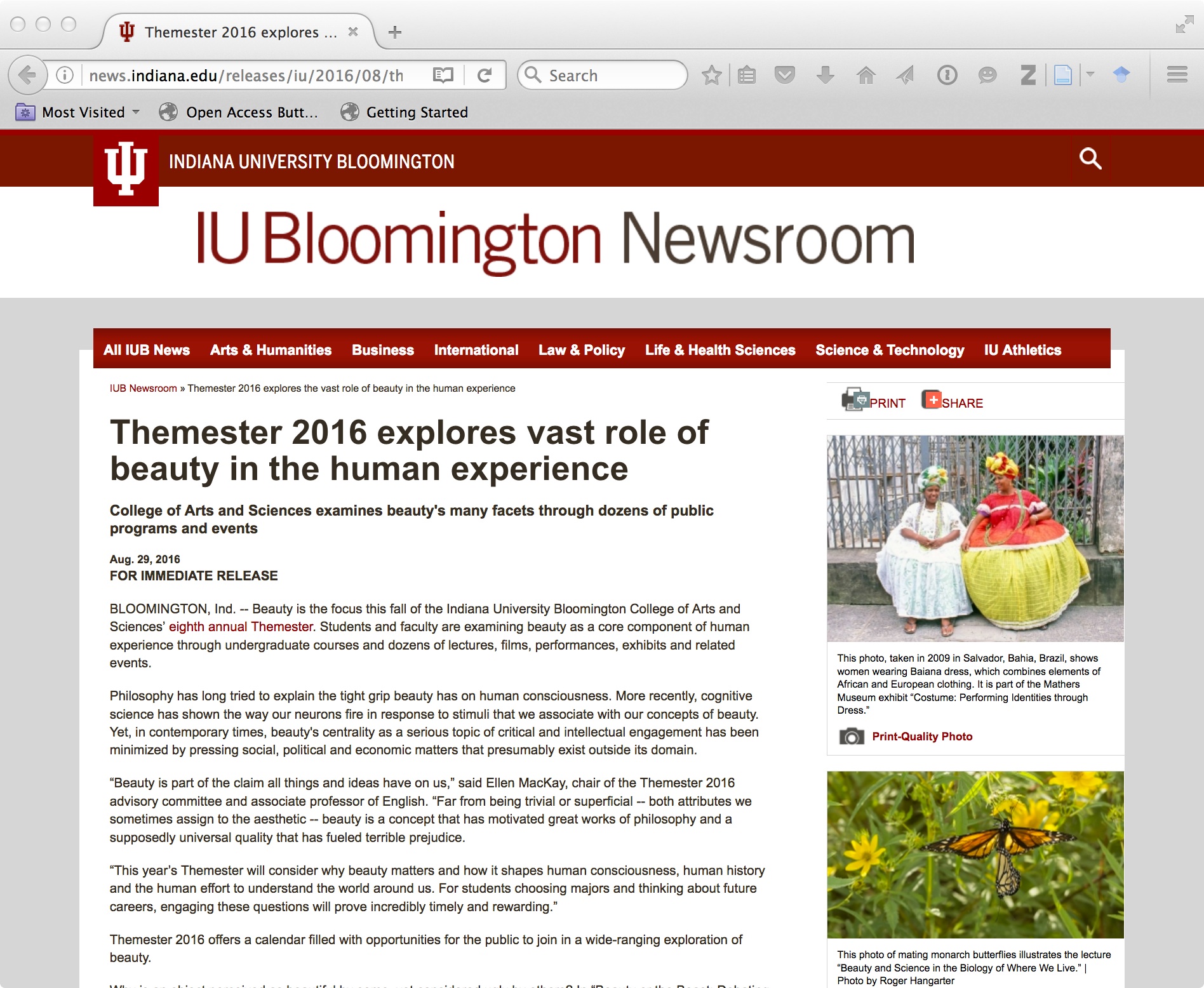
Reviewing the Mathers Museum of World Cultures events and exhibitions pages is probably the only way to get a full sense of all that we are doing for 2016 Themester, but for an overview of Themester as a whole and its focus on Beauty, I recommend checking out yesterday’s kickoff press release (Figure 1). In addition to the MMWC pages, it would also be great to see the Themester website. For MMWC, Themester boils down to three great classes [A400, E460, F360] taught at the museum, three great beauty-focused exhibitions [Costume, Hózhó, Siyazama], plus a lot of programming, including folk artists residencies throughout the semester, as well as films, lectures, and hands-on activities. Check out the full list here. Thanks go to the College of Arts and Sciences for including the museum in an impressive roster of Themester activities. Thanks too go to the students who are helping us organize our Themester activities and to the artists and tradition bearers whose work we are highlighting. Please join it this remarkable exploration of beauty around the world.

Themester.jpg
Figure 1: The Themester 2016 press release, which leads off with a photography b MMWC Consulting Curator Pravina Shukla, from her exhibition Costume.

Siyazama: Traditional Arts, Education, and AIDS in South Africa

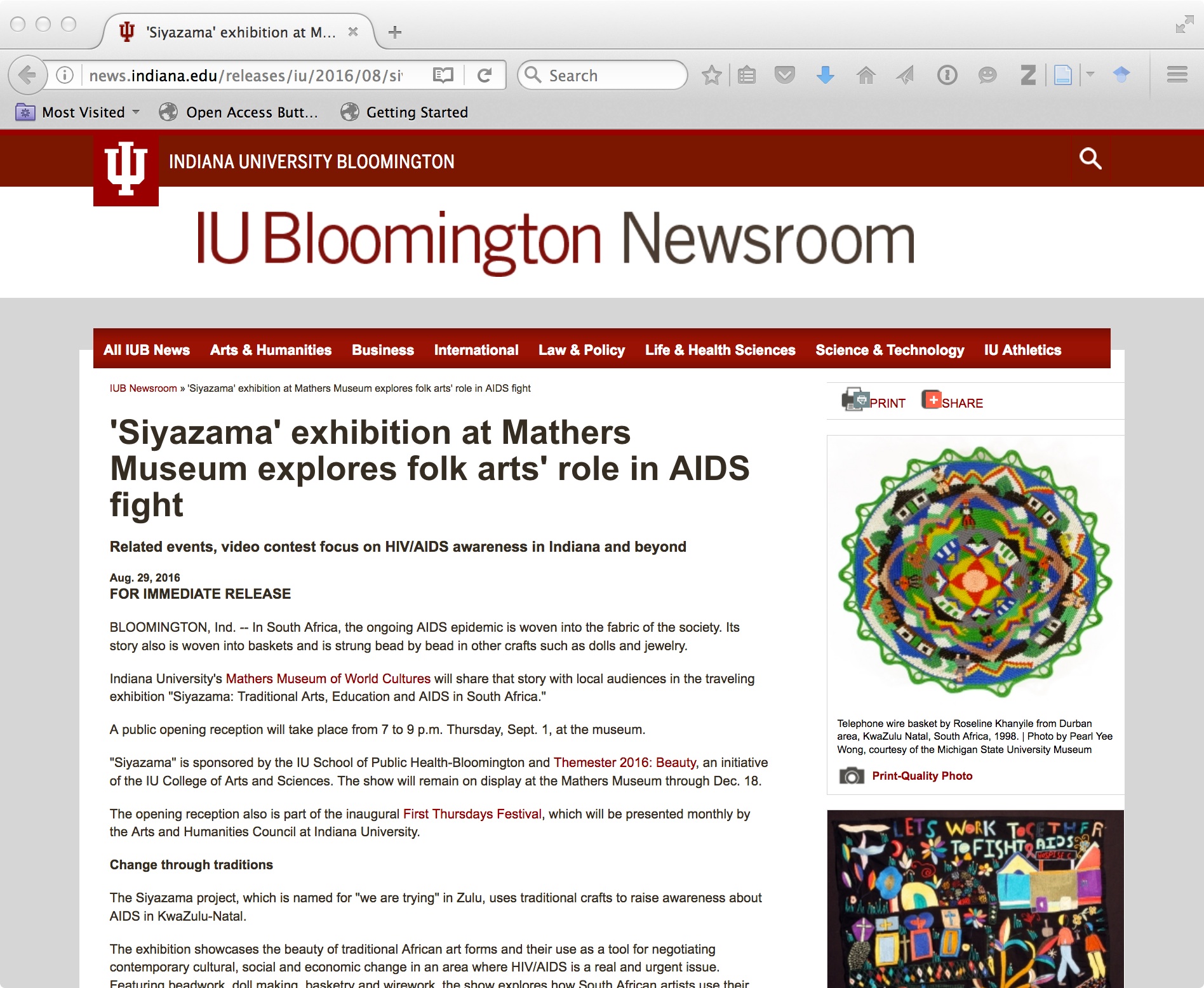
Get all the details by checking out the new press release announcing the Mathers Museum of World Cultures’ programs and activities in support of the exhibition Siyazama: Traditional Arts, Education, and AIDS in South Africa. This wonderful exhibition is part of a great fall at the museum, now underway. I hope to see everyone at the opening at the museum right after the First Thursdays Festival. Thanks to Themester 2016 and the School of Public Health for supporting this exhibition and its programs and to the Michigan State University Museum for curating it.

Siyazama Release

Material Vernaculars: Institutional Role, Review, Authors, and Genres

The new Material Vernaculars series is co-published by the Mathers Museum of World Cultures with a huge amount of heavy lifting from our partner, the Indiana University Press. The first two volumes in the series are Folk Art and Aging by Jon Kay and the eponymous edited volume Material Vernaculars: Objects, Images, and Their Social Worlds. Jon Kay is the author of the first of these and I am the editor of the second. Jon and I are both on the IU faculty (in the Department of Folklore and Ethnomusicology) and in the MMWC, where Jon is Director of Traditional Arts Indiana and Curator of Folklife and Cultural Heritage and I am the museum’s director. As the new series becomes known, it is reasonable to ask—is it just a publishing venue for the museum and its associates and partners?

MW Website

The answer here is no, but as you might guess, the series is intended to be the go to place when the museum does have its own publishing projects. This answer prompts then a couple of more points needing to be made. Peer-review for the series is fully managed by the IU Press and editorial review is a joint matter, thus it is quite conceivable that a museum project might be passed on by the press either at the early editorial review stage or at the peer-review stage. (I note that the press has already passed on one possible project, to illustrate this point tangibly.) Thus the series will hopefully be the home for additional MMWC authors and projects, but this is not guaranteed—and should not be.

The other side of this is that the series will hopefully come to publish authors without ties to museum, including colleagues not yet known to me. As the series homepage presently notes, “Potential authors interested in the Material Vernaculars series should contact the series editor Jason Baird Jackson via mvseries [at] indiana.edu and Aquisitions Editor Janice Frisch at frischj [at] indiana.edu.” That phrase, and the series overview, are available here.

As noted there, a new series also poses genre questions. Here, my intentions as editor are broad. “The series accommodates a diversity of types of work, including catalogues and collections studies, monographs, edited volumes, and multimedia works.” To me, these are the key genres of relevance for research museum practice in ethnography, ethnology, and cultural history (our museum’s fields), but it could be that new, as yet not fully recognized genres could also find a home in the series. While the forthcoming edited volume is something of a sampler, future edited volumes will likely have a strong thematic focus. Stand alone essays will continue to find a home in the museum’s journal, Museum Anthropology Review.

I hope to hear from potential authors and editors interested in learning more about the series. Thanks to all who have supported this new effort.


Material Vernaculars Series Launches with Jon Kay’s Folk Art and Aging

This fall I will be talking a lot about the new book series that the Indiana University Press and the Mathers Museum of World Cultures are jointly publishing. I am the series’ editor and my friend and colleague Jon Kay is its first author. I will frame the series here, before I conclude this post, but I do not want to bury the lead, which is that there is a great new book in the world and you should buy and learn from it.

Jon Kay is Director of Traditional Arts Indiana, Curator of Folklife and Cultural Heritage at the Mathers Museum of World Cultures, and Professor of Practice in the Department of Folklore and Ethnomusicology, Indiana University. His book is Folk Art and Aging: Life-Story Objects and Their Makers. (Jon’s content rich book website is here.) It is the fruit of many years of work exploring the creative lives of older adults in Indiana and in other parts of the United States. Jon has much to say about the ways that material culture and narrative come together in social encounters and in unfolding lives, as well as about about the ways that more attentive scholarship on the verbal and material life, as well as the memory, work, of elders can shape more humane and sensible approaches to what is increasingly referred to as creative aging, as well as to social gerontology more generally. The book is a folklorist’s book, but it also speaks very generatively to a range of neighboring disciplines. Written in a very clear and engaging style, it is the kind of book that lots of people (not just scholars) can read and both enjoy and learn from. At its center are profiles of five incredibly interesting creators of objects, stories, and lives. Jon helps share their stories and their creations in a really engaging way. The book has many beautiful color images and at 133 pages, it never gets bogged down.

9780253022165_lrg

The hardback, paperback, and ebook editions are beautiful and they can be purchased from the Indiana University Press, from Amazon, from Google, and from many other retailers. I’ll tell you next time where to get the free PDF edition, but here I want to urge everyone who can to purchase one of the paper or ebook editions. Why? Paradoxically, because I believe in open access. If those who can do so purchase the modestly priced print or e-book editions, the IU Press will secure the revenue that it needs to produce more books such as Folk Art and Aging and to make them freely available to those who otherwise could not afford to purchase them. More on such questions next time.

Having introduced Folk Art and Aging to you, let me introduce the series quickly. The series précis reads:

The Material Vernaculars series presents ethnographic, historical, and comparative accounts of material and visual culture manifest in both the everyday and extraordinary lives of individuals and communities, nations and networks. While advancing a venerable scholarly tradition focused on the makers and users of hand-made objects, the series also addresses contemporary practices of mediation, refashioning, recycling, assemblage, and collecting in global and local contexts. Indiana University Press publishes the Material Vernaculars series in partnership with the Mathers Museum of World Cultures at Indiana University. The series accommodates a diversity of types of work, including catalogues and collections studies, monographs, edited volumes, and multimedia works. The series will pursue innovative publishing strategies intended to maximize access to published titles and will advance works that take fullest advantage of the affordances provided by digital technologies.

The series second title is an eponymous edited volume—Material Vernaculars: Objects, Images, and Their Social Worlds. That collection is due out in a few days (September 5, 2016). In its introduction, I characterize in more detail the goals of the series as well as situate its disciplinary (cultural anthropology, folklore studies, ethnology, culture history) engagements as well as its place in the larger research work of the MMWC. I look forward to sharing it with you.

Congratulations to Jon Kay on his second book of the summer (see Indiana Folk Art) and to all of our friends at the Indiana University Press.

Active Collections: A Brown Bag Talk with Rainey Tisdale

tisflyer.final[3]

Call for Applications: Summer Institute in Museum Anthropology

SIMAHere is a call for applications for next year’s Summer Institute in Museum Anthropology, which will be held again at the National Museum of Natural History, Smithsonian Institution, in Washington, DC. I post it here on behalf of SIMA Director Candance Greene. This is a wonderful program that has made a big difference for the training of graduate students for collections research. Note that the program now includes Faculty Fellows as well as graduate student participants.

Dear Colleagues,

We are now recruiting prospective graduate student participants, as well as Faculty Fellows, for the 2016 Summer Institute in Museum Anthropology (SIMA). We hope you will forward this announcement to interested students and colleagues and re-post to relevant lists. SIMA is a graduate student summer training program in museum research methods offered through the Department of Anthropology at the Smithsonian Institution’s National Museum of Natural History with major funding from the Cultural Anthropology Program of the National Science Foundation. Summer 2016 dates are June 27-July 22. Student applications are not due until March 1, 2016, but now is the time for students to investigate the program and begin to formulate a research project to propose. Decisions on Faculty Fellows will be made in December.

During four weeks of intensive training in seminars and hands-on workshops in the research collections, students are introduced to the scope of collections and their potential as data. Students become acquainted with strategies for navigating museum systems, learn to select methods to examine and analyze museum specimens, and consider a range of theoretical issues that collections-based research may address. In consultation with faculty, each student carries out preliminary data collection on a topic of their own choice and develops a prospectus for research to be implemented upon return to their home university. Instruction will be provided by Dr. Joshua A. Bell, Dr. Candace Greene and other Smithsonian scholars, plus a series of visiting faculty.

Who should apply?: Graduate students preparing for research careers in cultural anthropology who are interested in using museum collections as a data source. The program is not designed to serve students seeking careers in museum management. Students at both the masters and doctoral level will be considered for acceptance. Students in related interdisciplinary programs (Indigenous Studies, Folklore, etc.) are welcome to apply if the proposed project is anthropological in nature. All U.S. students are eligible for acceptance, even if studying abroad. International students can be considered only if they are enrolled in a university in the U.S. Members of Canadian First Nations are eligible under treaty agreements.

Costs: The program covers students’ tuition and shared housing in local furnished apartments. A stipend will be provided to assist with the cost of food and other local expenses. Participants are individually responsible for the cost of travel to and from Washington, DC.

SIMA dates for 2016: June 27 – July 22
Application deadline – March 1, 2016

NEW opportunity for faculty: We are now also offering fellowships for faculty to develop courses in museum anthropology. Interested faculty members should see the information included on the SIMA website.

I will be at the AAA meetings in Denver from November 18-22 and would be glad to discuss and answer any questions about the program. Email me at greenec@si.edu if you would like to schedule time to meet.

Want to discuss a project proposal? We’d love to hear from you. Email SIMA@si.edu
For more information and to apply, please visit http://anthropology.si.edu/summerinstitute/

Regards,

Candace Greene

Summer 2015 Roundup

Sherds and Patches has been neglected. My summers are always busy, but this year has been really busy. As the fall semester is about to begin, I feel like I should at least take stock of where I have been. A surprising number of folks visit this site and seemingly find something that they are looking for. In hopes of leading online visitors to some of the exhibitions, projects, etc. that I have been involved in this summer, I offer this roundup with relevant links. Packing a summer into one post, please excuse the length (about 1600 words). Skimmers welcome.

When the spring semester ended, my Mathers Museum of World Cultures colleagues and I, together with MMWC Policy Committee Chair Eric Sandweiss, poured our energies into hosting Museums at the Crossroads: Local Encounters, Global Knowledge. Held at the museum between May 14 and 21, the workshop was supported by the IU School of Global and International Studies and the College of Arts and Sciences. It gathered museum professionals and other scholars from numerous institutions and various countries for generative discussions and activities aimed at considering the state of museums in changing social contexts around the world. I am thankful for all who journeyed to Bloomington to join the discussion. Thanks too go to the MMWC staff members who helped organize the gathering and to the School and College for their generous support. Learn a bit more about Museums at the Crossroads from this IU press release. SGIS published a wrap-up story about Crossroads.

Before and after Museums at the Crossroads, I worked as a lead investigator on a Andrew W. Mellon Foundation-funded research/planning project considering the viability of alternative, sustainable financial models for university press monograph publishing in the humanities and interpretive social sciences. This is a project being pursued concurrently on the University of Michigan and Indiana University campuses. I am the researcher for the IU component of the project. A glimpse of the project is available in this IU press release (where our project is the second of two being discussed). A story last summer in the Chronicle of Higher Education provides additional context for the models that I have been discussing with IU faculty and administrators as well as with our UM/IU, research team.

Another big project that came to fruition in the days after Museums at the Crossroads is the Mathers Museum of World Cultures exhibition Cherokee Craft, 1973. This is an exhibition that I have looked forward to doing since the early 1990s. As I student, I first studied the museum’s collections made among the Eastern Cherokee. I knew then that they would make a great exhibition. That moment came this summer. Originally, I was going to curate the exhibition with help from graduate students Emily Buhrow Rogers and Kelley Totten but by the time we finished, it was Kelly and I helping Emily with her exhibition. What Kelly and Emily came up with is infinitely better than the simple exhibition that I had originally imagined. Cherokee Craft, 1973 opened June 16. Here is how we have described the exhibition in promotional materials.

Cherokee Craft, 1973 offers a snapshot of craft production among the Eastern Band Cherokee at a key moment in both an ongoing Appalachian craft revival and the specific cultural and economic life of the Cherokee people in western North Carolina. The exhibition showcases woodcarvings, masks, ceramics, finger woven textiles, basketry, and dolls. The works presented are all rooted in Cherokee cultural tradition but all also bear the imprint of the specific individuals who crafted them and the particular circumstances in which these craftspeople made and circulated their handwork.

What that description does not explain is that the presentation for the exhibition creatively evokes the Qualla Arts and Crafts Mutual, Inc. gallery (ca. 1973), from which the museum obtained its collection. Come by and see the exhibition at MMWC and find the real co-op as it is today on its website.

After a quick but wonderful visit to Oklahoma for Green Corn, I headed off to the Smithsonian Institution to again serve as a visiting faculty member at the Summer Institute in Museum Anthropology, which is led by Candace Greene and funded by the National Science Foundation. I have discussed SIMA previously. It is a great program and this was a another great year. If you are new to SIMA, check out the SIMA information page. On top of the great SIMA stuff, I even had a bit of time to see the Chinese basketry in the NMNH collections!
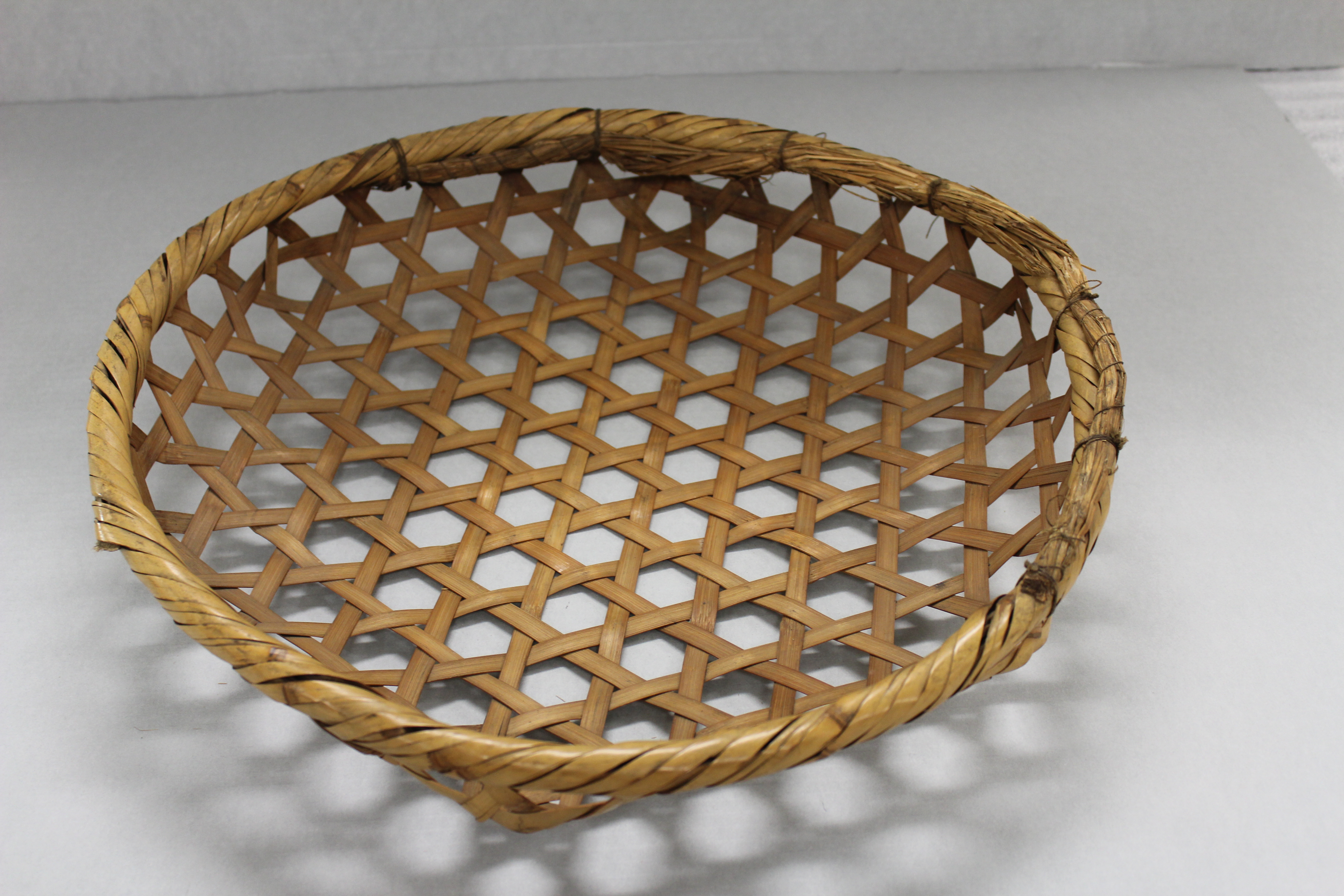
A basket cataloged as Chinese in the collections of the National Museum of Natural History, Smithsonian Institution. ET08510

A basket cataloged as Chinese in the collections of the National Museum of Natural History, Smithsonian Institution. ET08510

SIMA was followed by a quick family trip to Santa Fe, where I got to attend the International Folk Art Market (which was great as always) and see the exhibition “The Red that Colored the World” at the Museum of International Folk Art. The “Red” exhibition is a tour de force. Simply amazing. I hope that many many more people get to see it in Santa Fe or on the tour to come. You can read about the Red exhibition in many places, including this NEH story by Peter BG Shoemaker in Humanities magazine.

While in Santa Fe, I purchased (at the market) two willow baskets by Blaise Cayol, a remarkable French basket maker. Learn about his basketry on his website Celui qui Tresse.

I collected Blaise Cayol’s baskets for a lot of reasons, including wanting them to help expand on the story that the Mathers Museum of World Cultures is telling in the exhibition Willow Work: Viki Graber, Basketmaker, which opens tomorrow. It is a great exhibition focused on the work of a great basket maker. Quoting from our exhibition announcement:

Willow Work: Viki Graber, Basketmaker presents a weaver of willow baskets from the Mennonite community of Goshen, Indiana, where she has lived for 25 years. Graber learned willow basket weaving at the age of twelve from her father, who was recognized by the National Endowment for the Arts as a 2009 National Heritage Fellow. Where once her family plied their talents to make utilitarian workbaskets, today she works full-time weaving baskets for collectors and to sell at art shows and galleries. While using the same tools and methods as her great-grandfather, Graber’s keen sense of color and innovative designs have elevated her family’s craft to a new aesthetic level.

Jon Kay curated Willow Work, drawing upon work done for Traditional Arts Indiana. Get details on the exhibition on the MMWC website. Learn more about Viki’s basketry on her website, Confluence of Willows.

Willow Work: Viki Graber, Basketmaker is one of three exhibitions that we (MMWC) are organizing for Themester. I will post (I hope) about the two that are still to come, but I note here that a second one has been curated by Jon Kay. Here is the description. Working Wood opens on September 8.

Working Wood: Oak-Rod Baskets in Indiana presents the work of the Hovis and Bohall families of Brown County, Indiana, who made distinctive white-oak baskets for their neighbors to carry everyday items and to gather corn. However, by the 1930s, the interest of urban tourists transformed these sturdy workbaskets into desirable souvenirs and art objects. In recent years, these baskets have come to be called “Brown County” and “Bohall” baskets, perhaps because of the great number of baskets made by the Bohall family in Brown county during the 1920s and 1930s. Nevertheless, the history of this craft is more complex these names reveal. Using artifacts and historic photographs, this exhibit explores the shifts in the uses and meanings of these baskets as they changed from obsolete, agricultural implements, into a tourist commodity. Using the lens of work, this exhibition tells the story of these oak-rod baskets and the people who made and used them, and how local makers strived to find a new audience for their old craft, and how ultimately the lure of steady work in the city contributed to the end of this tradition.

Between now and then, we will be working to finalize an third basketry exhibition that I have co-curated with Lijun Zhang of the Guangxi Museum of Nationalities. Opening September 1, It focuses on work baskets in Southwestern China. We describe it in this way.

Putting Baskets to Work in Southwestern China explores the contemporary the use of basketry in urban and rural labor in contemporary China drawing upon a newly acquired representative collection of bamboo baskets documented as active tools of labor in the region around Dali, in Yunnan province, and in Guizhou and Guangxi provinces. The collection was acquired and documented by Jason Baird Jackson, Director of the Mathers Museum of World Cultures, who will co-curate the exhibit with Lijun Zhang, Research Curator at the Guangxi Museum of Nationalities in Guangxi, China.

All three of these work-related basketry exhibitions have been organized for the Fall 2015 Themester, which is themed “@Work: The Nature of Labor on a Changing Planet.” Our museum programs are organized under the rubric “@Work with Basketry on a Changing Planet.” The College of Arts and Sciences at IU has contributed to these projects and the public programs that will accompany them. Learn more about Themester 2015 on the Themester website. Learn more about the exhibitions and programs on the MMWC website.

In the background, Emily Buhrow Rogers and I have been finalizing a double issue of Museum Anthropology Review. We look forward to sharing it in the next couple of weeks. See some of its content online in preview mode at the journal website.

In the midst of all of this, I have—with the support of numerous friends and colleagues—been preparing my faculty promotion case. Time will tell how that turns out.

This is just some of the high points. Its been a busy summer. Whether relaxing or busy, I hope that your summer was excellent.
Instruments of Prayer: Musical Instruments in the Expressive Cultures of the Native American Church

Flyer promoting a lecture by Daniel Swan at the Mathers Museum of World Cultures.

Time to Apply to the Summer Institute in Museum Anthropology

simaposter_medIts application season again for the Summer Institute in Museum Anthropology.

As noted recently on the American Folklore Society website:

“The Summer Institute in Museum Anthropology (SIMA), supported by the Smithsonian Institution and the National Science Foundation, is accepting applications for its 2015 program in Washington, DC to be held June 22-July 17. SIMA is an intensive museum research methods training program for graduate students, offered in residence at the Department of Anthropology in the Smithsonian Institution’s National Museum of Natural History. Graduate students at the masters or doctoral level who are preparing for research careers and are interested in using museum collections as a data source should apply. Although primarily oriented to cultural anthropology, students in related programs (Indigenous Studies, Folklore, etc.) are welcome to apply if the proposed project is anthropological in nature.”

Learn a lot more about SIMA on the program website: http://anthropology.si.edu/summerinstitute/

I am excited to be returning to SIMA 2015 as a visiting faculty member.

Thanks to the National Science Foundation and the Smithsonian Institution for its great support of the Institute.

Osage Weddings Project Website Launched

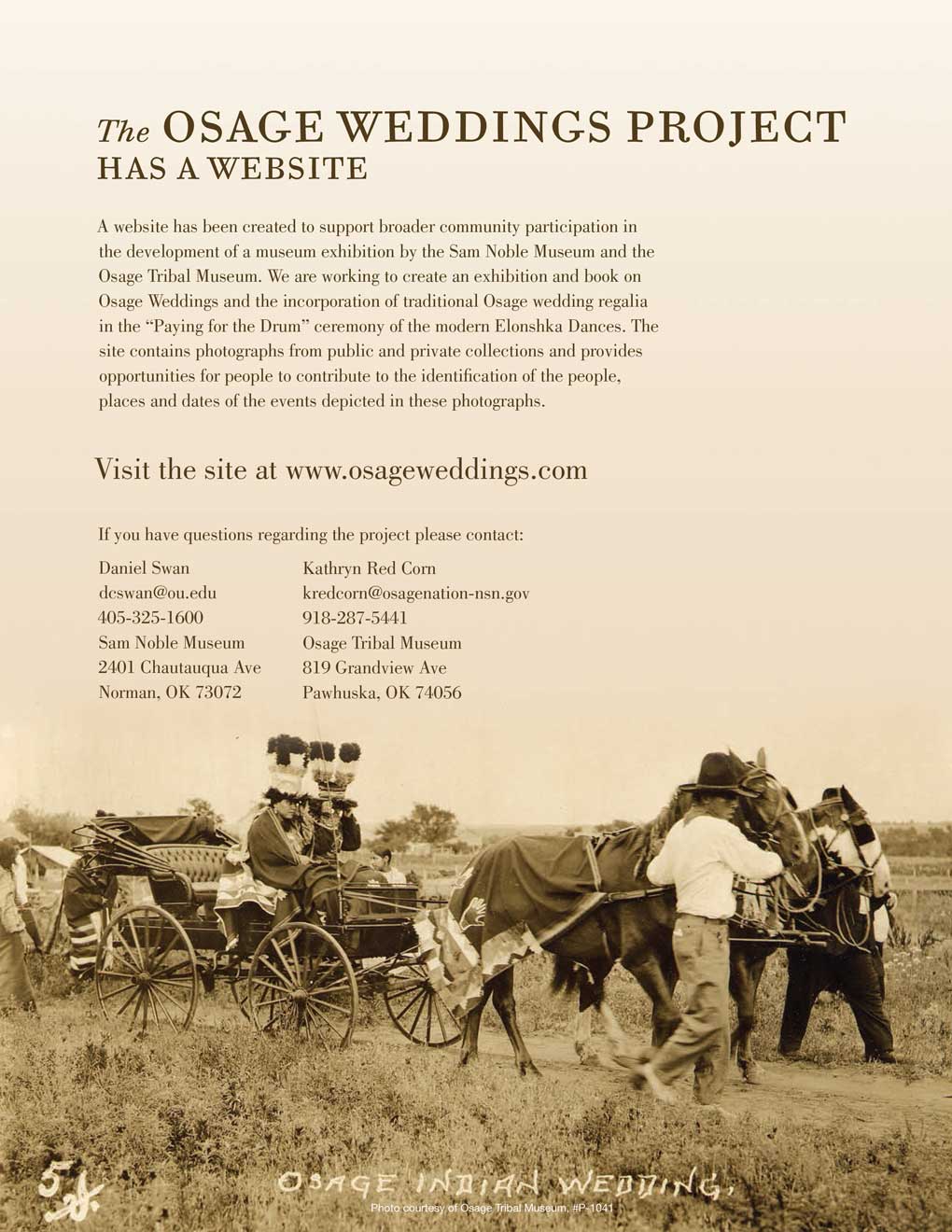
EDU15_OsageFlierhttp://osageweddings.com/

Update: Archived here: https://web.archive.org/web/20181125013857/https://osageweddings.com/