Skip to content

Posts from the ‘Mathers Museum’ Category

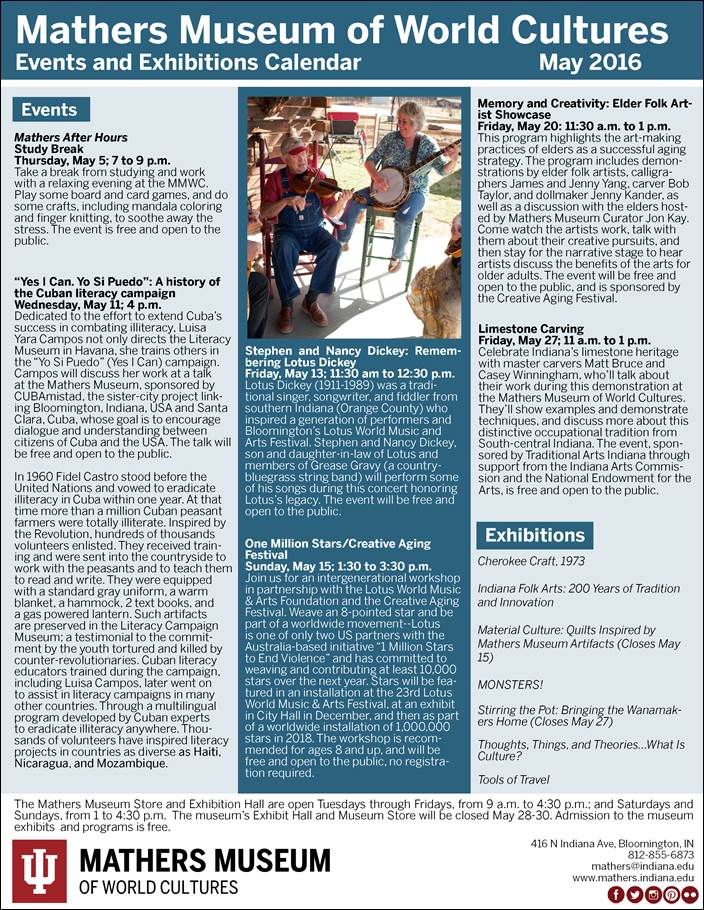
May at the MMWC

It has been a whirlwind of activity at the Mathers Museum of World Cultures this semester. The spring semester is ending and many students are leaving campus, but there are still great things to come at the MMWC this May. Please stop by for an event or anytime.

Unknown

Indiana Folk Arts: 200 Years of Tradition and Innovation

Unknown.jpeg

Please come out to the Mathers Museum of World Cultures this Sunday afternoon to celebrate the vernacular arts of Indiana and to help launch our state bicentennial exhibition. Root beer floats! Bluegrass music from Hamilton Creek! Artists demonstrations! The new exhibition, plus the students, staff, faculty, and artists who made it. We hope to see you this weekend.

Funding for Collections Research at Indiana University

This wonderful program of the Indiana University Institute for Advanced Study provides support for researchers–including community-based scholars–to study collections held at Indiana University. The Mathers Museum of World Cultures is one of the eligible repositories. Details are available in the request for proposals, which is copied below:

Announcement for distribution:

The Indiana University Institute for Advanced Study is now accepting applications for its 2016 Summer Repository Research Fellowship. In partnership with repositories on the IU Bloomington campus and supported by the Office of the Vice Provost for Research, the program funds a short-term fellowship for a faculty member or community scholar to conduct in-depth research in the collections of one or more of our partner repositories. Applicants from Minority Serving Institutions, community colleges, and source communities are welcome. Preference will be given to applicants who are collaborating with Indiana University Bloomington faculty members.

This initiative is intended to support research in the rich collections of the IU Bloomington campus and to build partnerships between scholars at and beyond IUB.  The fellowship provides funding for travel costs, accommodation, per diem, and a two-week stipend.  Please note: This fellowship is intended to support research in IU Bloomington’s unique collections; the application should focus on materials that cannot be accessed elsewhere.

Summer 2016 partner repositories include the Archives of African American Music and Culture, the Archives of Traditional Music, the Black Film Center/Archive, the Glenn A. Black Laboratory of Archaeology, The IU Art Museum, the IU Herbarium, the IU Libraries, the IU Paleontology Collection, the Jerome Hall Law Library, the Mathers Museum of World Cultures, and the Sinor Research Institute for Inner Asian Studies Central Asian Archives. Applications are due by March 21, 2016. For application materials and additional information, please visit our website at http://ias.indiana.edu/fellows/summer-research-fellowship/ .

Active Collections: A Brown Bag Talk with Rainey Tisdale

tisflyer.final[3]

Working Wood: Oak-Rod Baskets in Indiana [Exhibition, Presentation @ MMWC]

The final exhibition of the three basketry exhibitions that the Mathers Museum of World Cultures (MMWC) is presenting as part of Themester opened this week. Like the first of the three to open (Willow Work: Viki Graber, Basketmaker), this one was also curated by MMWC Curator of Folklife and Cultural Heritage Jon Kay as an outgrowth of his research on Indiana folklife pursued as the Director of Traditional Arts Indiana. Later in this post, I will share information on a great upcoming event connected with the exhibition, but first a description:

Working Wood: Oak-Rod Baskets in Indiana presents the work of the Hovis and Bohall families of Brown County, Indiana, who made distinctive white-oak baskets for their neighbors to carry everyday items and to gather corn. However, by the 1930s, the interest of urban tourists transformed these sturdy workbaskets into desirable souvenirs and art objects. In recent years, these baskets have come to be called “Brown County” and “Bohall” baskets, perhaps because of the great number of baskets made by the Bohall family in Brown county during the 1920s and 1930s. Nevertheless, the history of this craft is more complex these names reveal. Using artifacts and historic photographs, this exhibit explores the shifts in the uses and meanings of these baskets as they changed from obsolete, agricultural implements, into a tourist commodity. Using the lens of work, this exhibition tells the story of these oak-rod baskets and the people who made and used them, and how local makers strived to find a new audience for their old craft, and how ultimately the lure of steady work in the city contributed to the end of this tradition. Sponsored by Fall 2015 Themester @Work: The Nature of Labor on a Changing Planet, the exhibit will be on display at the museum through February 7, 2016.

It is great to now see all three basketry exhibitions open and staged in adjacent galleries. (Putting Baskets to Work in Southwestern China is the other one–I curated it with Lijun Zhang, Curator of Folklife and Cultural Heritage at the Guangxi Museum of Nationalities). Together they are one outgrowth of a broader focus at present on basketry research at MMWC. I’ll discuss some other aspects of this work in later posts. (Our Themester series echos the College’s theme. Our work is together grouped as @Work with Basketry on a Changing Planet).

A chance to learn more about the work of the basketmakers explored in Working Wood: Oak-Rod Baskets in Indiana is upcoming this Friday at the MMWC. Jon will present a talk titled “The Last Basketmaker: Indiana’s Oak-Rod Baskets and Their Makers” (Friday, September 11; 4 to 5 p.m.). Here is our description of the event:

The Bohall and Hovis families of Brown County made oak-rod baskets for their neighbors to gather produce and carry everyday items. While these workbaskets were essential for subsistence farming, industrialization and changes in agricultural practices threatened the continuation of this craft. and by the 1980s, the weaving of oak-rod baskets had ended in Indiana. In a lecture filled with historic photographs, Jon Kay, Director of Traditional Arts Indiana and Curator of Folklife and Cultural Heritage at the MMWC, unravels the story of these baskets and explores the global forces that brought this distinctive Indiana tradition to an end. The lecture, sponsored by Fall 2015 Themester @Work: The Nature of Labor on a Changing Planet, is free and open to the public.

Friday afternoon will be a great time to see the exhibitions and then hear and see Jon’s talk. I hope that you can make it.

The front of the At Work with Basketry on a Changing Planet postcard.

The front of the At Work with Basketry on a Changing Planet postcard.

Vernacular Culture in Hands and Minds (The New Basketry Video)

The best places to preserve worthwhile vernacular cultural knowledge is in the hands and minds of talented and engaged people who carry it forward, making it their own and handing it on to still more people. Viki Graber of Goshen, Indiana comes from a long line of willow basketmakers. She has not only preserved the traditions of her family, she has built upon them in ways that curator Jon Kay has explored in the MMWC exhibition Willow Work: Viki Graber, Basketmaker. With Viki, Jon made a short documentary film showing steps that Viki uses in the production of a bail-handled work basket. Check it out on YouTube.

This basket is of the basic workbasket type that Viki learned from her father. If you visit the exhibition, you will see the great diversity of complex forms that Viki now creates.

Hopefully the film will inspire you to see the exhibition (through December 20, 2015) at the Mathers Museum of World Cultures, to learn more about Viki’s basketwork, and to carry on or document the cultural practices of your family, community, or heritage. If you share a passion for vernacular culture—follow the Mathers Museum of World Cultures and Traditional Arts Indiana on social media or sign up for the museum’s email list.

Don’t Miss Viki Graber’s Artist in Residence Visit to the Mathers Museum of World Cultures, Exhibition Opening

It will be a great semester at the Mathers Museum of World Cultures. The first of our three At Work with Basketry on a Changing Planet exhibitions has already opened. Willow Work: Viki Graber, Basketmaker opened on August 18, but it is just getting started. This coming week will feature Viki Graber visiting the museum and demonstrating her work as Artist in Residence. Come meet her and see her work 11 am-2 pm on Wednesday (26th), Thursday (27th) or Friday (28th). On Wednesday the 26th at 4:30, we’ll formally open the exhibition with a reception. Everyone is welcome!!!!!

See the whole fall lineup below. The front and back of our postcard here are jpg files. If you have difficulty reading them, full details are on the museum website. Learn more about Viki Graber’s work on her website and Facebook page.

Putting Baskets to Work in Southwest China will open September 1st. Working Wood: Oak Rod Baskets in Indiana will open on September 8. (The photograph on the postcard, showing Bruce Hovis making an oak rod basket, relates to this final exhibition of the three part series.)

The exhibitions and associated programs have been supported by the 2015 Themester program of the College of Arts and Sciences, Indiana University. (The Themester theme for this year is @Work: The Nature of Labor on a Changing Planet.)

The front of the At Work with Basketry on a Changing Planet postcard.

The front of the At Work with Basketry on a Changing Planet postcard.

The back of the At Work with Basketry on a Changing Planet postcard.

The back of the At Work with Basketry on a Changing Planet postcard.

Summer 2015 Roundup

Sherds and Patches has been neglected. My summers are always busy, but this year has been really busy. As the fall semester is about to begin, I feel like I should at least take stock of where I have been. A surprising number of folks visit this site and seemingly find something that they are looking for. In hopes of leading online visitors to some of the exhibitions, projects, etc. that I have been involved in this summer, I offer this roundup with relevant links. Packing a summer into one post, please excuse the length (about 1600 words). Skimmers welcome.

When the spring semester ended, my Mathers Museum of World Cultures colleagues and I, together with MMWC Policy Committee Chair Eric Sandweiss, poured our energies into hosting Museums at the Crossroads: Local Encounters, Global Knowledge. Held at the museum between May 14 and 21, the workshop was supported by the IU School of Global and International Studies and the College of Arts and Sciences. It gathered museum professionals and other scholars from numerous institutions and various countries for generative discussions and activities aimed at considering the state of museums in changing social contexts around the world. I am thankful for all who journeyed to Bloomington to join the discussion. Thanks too go to the MMWC staff members who helped organize the gathering and to the School and College for their generous support. Learn a bit more about Museums at the Crossroads from this IU press release. SGIS published a wrap-up story about Crossroads.

Before and after Museums at the Crossroads, I worked as a lead investigator on a Andrew W. Mellon Foundation-funded research/planning project considering the viability of alternative, sustainable financial models for university press monograph publishing in the humanities and interpretive social sciences. This is a project being pursued concurrently on the University of Michigan and Indiana University campuses. I am the researcher for the IU component of the project. A glimpse of the project is available in this IU press release (where our project is the second of two being discussed). A story last summer in the Chronicle of Higher Education provides additional context for the models that I have been discussing with IU faculty and administrators as well as with our UM/IU, research team.

Another big project that came to fruition in the days after Museums at the Crossroads is the Mathers Museum of World Cultures exhibition Cherokee Craft, 1973. This is an exhibition that I have looked forward to doing since the early 1990s. As I student, I first studied the museum’s collections made among the Eastern Cherokee. I knew then that they would make a great exhibition. That moment came this summer. Originally, I was going to curate the exhibition with help from graduate students Emily Buhrow Rogers and Kelley Totten but by the time we finished, it was Kelly and I helping Emily with her exhibition. What Kelly and Emily came up with is infinitely better than the simple exhibition that I had originally imagined. Cherokee Craft, 1973 opened June 16. Here is how we have described the exhibition in promotional materials.

Cherokee Craft, 1973 offers a snapshot of craft production among the Eastern Band Cherokee at a key moment in both an ongoing Appalachian craft revival and the specific cultural and economic life of the Cherokee people in western North Carolina. The exhibition showcases woodcarvings, masks, ceramics, finger woven textiles, basketry, and dolls. The works presented are all rooted in Cherokee cultural tradition but all also bear the imprint of the specific individuals who crafted them and the particular circumstances in which these craftspeople made and circulated their handwork.

What that description does not explain is that the presentation for the exhibition creatively evokes the Qualla Arts and Crafts Mutual, Inc. gallery (ca. 1973), from which the museum obtained its collection. Come by and see the exhibition at MMWC and find the real co-op as it is today on its website.

After a quick but wonderful visit to Oklahoma for Green Corn, I headed off to the Smithsonian Institution to again serve as a visiting faculty member at the Summer Institute in Museum Anthropology, which is led by Candace Greene and funded by the National Science Foundation. I have discussed SIMA previously. It is a great program and this was a another great year. If you are new to SIMA, check out the SIMA information page. On top of the great SIMA stuff, I even had a bit of time to see the Chinese basketry in the NMNH collections!
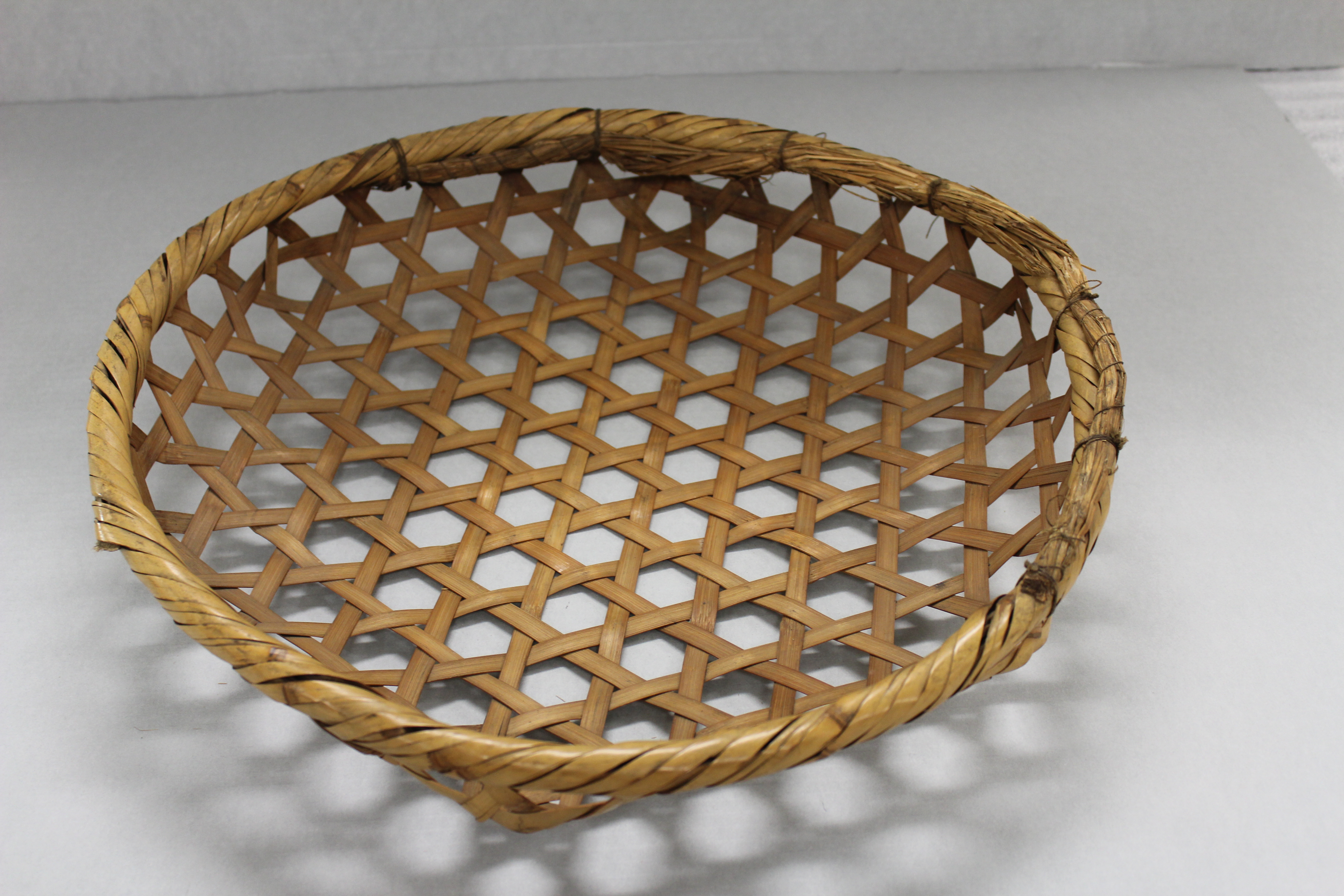
A basket cataloged as Chinese in the collections of the National Museum of Natural History, Smithsonian Institution. ET08510

A basket cataloged as Chinese in the collections of the National Museum of Natural History, Smithsonian Institution. ET08510

SIMA was followed by a quick family trip to Santa Fe, where I got to attend the International Folk Art Market (which was great as always) and see the exhibition “The Red that Colored the World” at the Museum of International Folk Art. The “Red” exhibition is a tour de force. Simply amazing. I hope that many many more people get to see it in Santa Fe or on the tour to come. You can read about the Red exhibition in many places, including this NEH story by Peter BG Shoemaker in Humanities magazine.

While in Santa Fe, I purchased (at the market) two willow baskets by Blaise Cayol, a remarkable French basket maker. Learn about his basketry on his website Celui qui Tresse.

I collected Blaise Cayol’s baskets for a lot of reasons, including wanting them to help expand on the story that the Mathers Museum of World Cultures is telling in the exhibition Willow Work: Viki Graber, Basketmaker, which opens tomorrow. It is a great exhibition focused on the work of a great basket maker. Quoting from our exhibition announcement:

Willow Work: Viki Graber, Basketmaker presents a weaver of willow baskets from the Mennonite community of Goshen, Indiana, where she has lived for 25 years. Graber learned willow basket weaving at the age of twelve from her father, who was recognized by the National Endowment for the Arts as a 2009 National Heritage Fellow. Where once her family plied their talents to make utilitarian workbaskets, today she works full-time weaving baskets for collectors and to sell at art shows and galleries. While using the same tools and methods as her great-grandfather, Graber’s keen sense of color and innovative designs have elevated her family’s craft to a new aesthetic level.

Jon Kay curated Willow Work, drawing upon work done for Traditional Arts Indiana. Get details on the exhibition on the MMWC website. Learn more about Viki’s basketry on her website, Confluence of Willows.

Willow Work: Viki Graber, Basketmaker is one of three exhibitions that we (MMWC) are organizing for Themester. I will post (I hope) about the two that are still to come, but I note here that a second one has been curated by Jon Kay. Here is the description. Working Wood opens on September 8.

Working Wood: Oak-Rod Baskets in Indiana presents the work of the Hovis and Bohall families of Brown County, Indiana, who made distinctive white-oak baskets for their neighbors to carry everyday items and to gather corn. However, by the 1930s, the interest of urban tourists transformed these sturdy workbaskets into desirable souvenirs and art objects. In recent years, these baskets have come to be called “Brown County” and “Bohall” baskets, perhaps because of the great number of baskets made by the Bohall family in Brown county during the 1920s and 1930s. Nevertheless, the history of this craft is more complex these names reveal. Using artifacts and historic photographs, this exhibit explores the shifts in the uses and meanings of these baskets as they changed from obsolete, agricultural implements, into a tourist commodity. Using the lens of work, this exhibition tells the story of these oak-rod baskets and the people who made and used them, and how local makers strived to find a new audience for their old craft, and how ultimately the lure of steady work in the city contributed to the end of this tradition.

Between now and then, we will be working to finalize an third basketry exhibition that I have co-curated with Lijun Zhang of the Guangxi Museum of Nationalities. Opening September 1, It focuses on work baskets in Southwestern China. We describe it in this way.

Putting Baskets to Work in Southwestern China explores the contemporary the use of basketry in urban and rural labor in contemporary China drawing upon a newly acquired representative collection of bamboo baskets documented as active tools of labor in the region around Dali, in Yunnan province, and in Guizhou and Guangxi provinces. The collection was acquired and documented by Jason Baird Jackson, Director of the Mathers Museum of World Cultures, who will co-curate the exhibit with Lijun Zhang, Research Curator at the Guangxi Museum of Nationalities in Guangxi, China.

All three of these work-related basketry exhibitions have been organized for the Fall 2015 Themester, which is themed “@Work: The Nature of Labor on a Changing Planet.” Our museum programs are organized under the rubric “@Work with Basketry on a Changing Planet.” The College of Arts and Sciences at IU has contributed to these projects and the public programs that will accompany them. Learn more about Themester 2015 on the Themester website. Learn more about the exhibitions and programs on the MMWC website.

In the background, Emily Buhrow Rogers and I have been finalizing a double issue of Museum Anthropology Review. We look forward to sharing it in the next couple of weeks. See some of its content online in preview mode at the journal website.

In the midst of all of this, I have—with the support of numerous friends and colleagues—been preparing my faculty promotion case. Time will tell how that turns out.

This is just some of the high points. Its been a busy summer. Whether relaxing or busy, I hope that your summer was excellent.
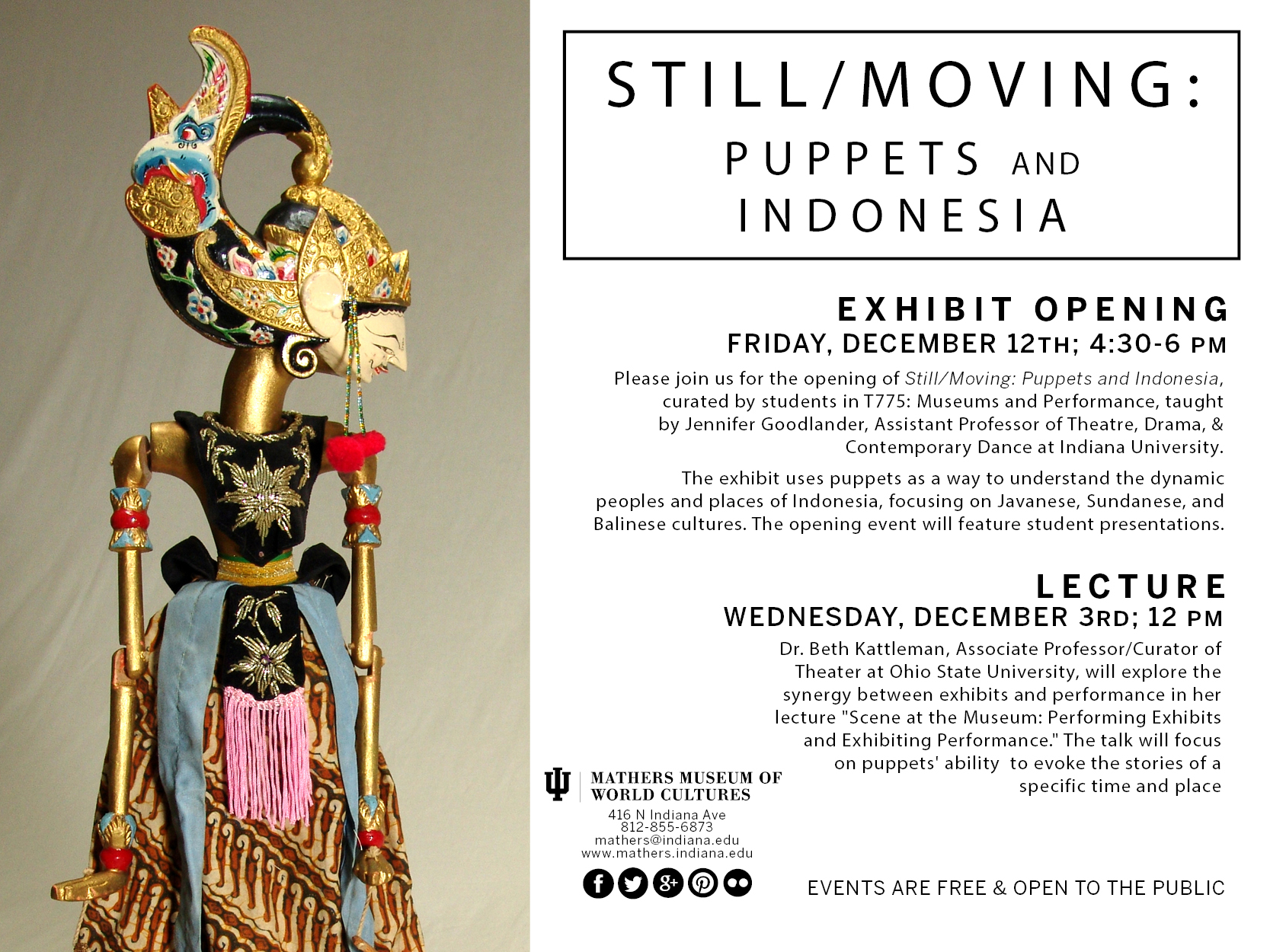
Still/Moving: Puppets and Indonesia Lecture and Exhibition Opening

Still/Moving Lecture & Exhibition Invite

Seeking Applicants | Museums at the Crossroads: Local Knowledge, Global Encounters

Call for Applications (Deadline Nov. 15)

Museums at the Crossroads:  Local Knowledge, Global Encounters

A Summer Institute of the Mathers Museum of World Cultures and the School of Global and International Studies, Indiana University

Bloomington, Indiana, USA
May 14-21, 2015

The Indiana University Mathers Museum of World Cultures and School of Global and International Studies invite applications for up to eight Museum Partners who will take part in an innovative international workshop on the future of museums of culture and history.

Museums at the Crossroads, scheduled for May 14-21, 2015, in the beautiful college town of Bloomington, Indiana, combines keynote addresses, tours, charrettes, and social interactions. We seek applications from museum practitioners and theorists who wish to partner in conversation and creative practice with a group of invited keynote speakers and international museum fellows in a small, informal workshop setting.  Successful applicants will receive eight nights of on-campus lodging and per diem support of $45 for eight days.

About Museums at the Crossroads

Museums at the Crossroads connects theory and practice, bridging institutional, regional, and national museum contexts in order to advance the global conversation around museums and generate a range of practical outcomes for its participants.

Workshop participants will include:

•    4 international fellows from innovative museums around the globe
•    8 museum partners drawn from museums and other institutions in the United States and abroad
•    12 Indiana University faculty, staff, and graduate students
•    4 keynote speakers, each addressing a broader social and cultural theme that we wish to explore in depth in museum contexts.

Our keynote speakers are:

•    Steven Lubar, Brown University (keynote on Today’s Museum:  Innovation, Change, and Challenge)
•    Michael F. Brown, School for Advanced Research (keynote on Cultural Crossroads:  World Cultures in Transition)
•    Stephan Fuchs, University of Virginia (keynote on Disciplinary Crossroads:  The Evolving Sociology of Knowledge)
•    Haidy Geismar, University College London (keynote on Artifactual Crossroads:  Real Meets Virtual)

Museum Partners will be responsible for their own travel arrangements to and from Bloomington, Indiana, and are expected to participate actively in the full workshop and in associated follow-on activities. Prior to attending, each shall develop an institutional profile that includes an account of challenges your museum faces relative to the three “crossroads” (Cultural, Disciplinary, Artifactual) being explored in the workshop. Partners without a museum affiliation will be asked to prepare a comparable position paper on the themes.

How to Apply

To apply for a position as Museum Partner, please send a resume or curriculum vitae, as well as a cover letter expressing your interest, as a PDF email attachment to:

Sarah Hatcher, c/o mxrd@indiana.edu.

Review of applications will begin November 15, 2014, with applicants receiving notifications by December 15, 2014.

Further Information

For additional detail on the scope and nature of Museums at the Crossroads, see the workshop précis, which is accessible online at: http://www.mathers.indiana.edu/crossroads.html.

Additional information about Indiana University Bloomington can be found at: http://iub.edu/.

Information on the Mathers Museum of World Cultures is available at: http://mathers.indiana.edu/.

Questions about the workshop can be addressed to the organizers at: mxrd@indiana.edu.