Skip to content

Posts from the ‘Mathers Museum’ Category

Improving Access to Scholarship: Material Vernaculars as Milestone and Experiment

First the take away, then the story. While produced in very nice and reasonably priced hardback, paperback, and ebook editions, works in the new Material Vernaculars series are also being made available in free-to-the-reader PDF versions. This is a great thing and, if you agree with me about that, and can afford to do so, I really hope that you will purchase the edition of your choice, thereby signaling your support for making such works freely accessible to those who cannot afford to purchase them. If this seems strange to you, its a lot like community and public radio in the United States. Those who can support these services help make them accessible to those who cannot afford to make their own donations. We all gently nudge those who use them and could, but don’t, support them. (Called free riders.) Its not utopia, but its what we have and its better than the vast majority of people being locked out of non-commercial arts and education programming (and scholarly books). Now you can skip to the end for the link if you are in a rush.

Slide1

Those who know about my work know that I have been focused on promoting free and open access to scholarly work for a relatively long time. My advocacy efforts followed soon after I began work as a scholarly journal editor. At that time, I was drawn into a diverse range of problems, opportunities, and paradoxes that the transformation of scholarly communication was (and is still) engendering. Probably the best place to find the things that I have written on this theme is to look at the interview that I did with Ryan Anderson (published in Cultural Anthropology in 2014)

In 2015, my focus in this work shifted to books when I was a participant in a project funded by the Mellon Foundation. The results of that project were reported in: A Study of Direct Author Subvention for Publishing Humanities Books at Two Universities: A Report to the Andrew W. Mellon Foundation by Indiana University and University of Michigan.

Concurrent with such advocacy work, I have tried to build real-world projects that could advance scholarship while testing strategies for increasing public access to research. Now in its tenth year, Museum Anthropology Review (now the journal of the Mathers Museum of World Cultures) is the best example of this. On the book side, there is now the Material Vernaculars series co-published by the museum and the Indiana University Press. In my previous post, I highlighted the series first title—Folk Art and Aging: Life-Story Objects and their Makers by Jon Kay and the series’ scholarly mandate. Here I am flagging the series’ relationship to free and open access movements.

Books cost a lot of money to make. In a peer-reviewed article, based on our humanities book research studying publishing work of the Indiana University Press and University of Michigan Press, my colleagues report that the zero copy cost for a typical humanities book is about $27,000. Efforts to increase access to scholarship have to find ways to confront these costs from all sides—finding ways to lower prices but also new ways of funding the professional work that it takes to make a quality book.

For me, for the museum, and especially for the IU Press, the Material Vernaculars series is an experiment. If we get past talking about it and actually begin doing it, what can we learn that will, we hope, help us learn to do it more and better? This is part of what is at stake for IU Press and for the whole world of university press humanities book publishing. I am thrilled to be a part of a new series that has a secondary role (beyond its primarily scholarly one) of finding ways to make scholarly books more widely and openly accessible.

So paradoxically, if you believe (for example) that the communities about whom ethnographers write should have access to what they write, then I call on you, paradoxically, to purchase a copy of Folk Art and Aging and the other other books that are in the pipeline. Your purchase helps support the goals of the series and it demonstrates that paid-for print editions or e-book editions are not mutually exclusive of free-to-readers electronic editions. If it helps, think of the print edition as a thank you gift for your donation to this cause rather than as a commodity that you are purchasing in the marketplace. You can feel particularly good about it if you purchase it directly from the Indiana University Press, thereby cutting out one or more commercial intermediaries.

It (PDF) won’t always be the file format of choice, but for now the free editions of Material Vernaculars titles will be circulated in PDF form via the IUScholarWorks Repository. When people download the books from IUScholarWorks, there is a download count, which helps us learn how many people, over what time period, showed interest in the book(s). (So, send your friends to the link rather than passing around the PDF…)

If you are wondering how to download the book, see the picture above for the place to click.

Here is the link. Two actually. The first is durable but enigmatic. The second is more human readable, but potentially less permanent.

http://hdl.handle.net/2022/20906
https://scholarworks.iu.edu/dspace/handle/2022/20906

Happy reading.

Material Vernaculars Series Launches with Jon Kay’s Folk Art and Aging

This fall I will be talking a lot about the new book series that the Indiana University Press and the Mathers Museum of World Cultures are jointly publishing. I am the series’ editor and my friend and colleague Jon Kay is its first author. I will frame the series here, before I conclude this post, but I do not want to bury the lead, which is that there is a great new book in the world and you should buy and learn from it.

Jon Kay is Director of Traditional Arts Indiana, Curator of Folklife and Cultural Heritage at the Mathers Museum of World Cultures, and Professor of Practice in the Department of Folklore and Ethnomusicology, Indiana University. His book is Folk Art and Aging: Life-Story Objects and Their Makers. (Jon’s content rich book website is here.) It is the fruit of many years of work exploring the creative lives of older adults in Indiana and in other parts of the United States. Jon has much to say about the ways that material culture and narrative come together in social encounters and in unfolding lives, as well as about about the ways that more attentive scholarship on the verbal and material life, as well as the memory, work, of elders can shape more humane and sensible approaches to what is increasingly referred to as creative aging, as well as to social gerontology more generally. The book is a folklorist’s book, but it also speaks very generatively to a range of neighboring disciplines. Written in a very clear and engaging style, it is the kind of book that lots of people (not just scholars) can read and both enjoy and learn from. At its center are profiles of five incredibly interesting creators of objects, stories, and lives. Jon helps share their stories and their creations in a really engaging way. The book has many beautiful color images and at 133 pages, it never gets bogged down.

9780253022165_lrg

The hardback, paperback, and ebook editions are beautiful and they can be purchased from the Indiana University Press, from Amazon, from Google, and from many other retailers. I’ll tell you next time where to get the free PDF edition, but here I want to urge everyone who can to purchase one of the paper or ebook editions. Why? Paradoxically, because I believe in open access. If those who can do so purchase the modestly priced print or e-book editions, the IU Press will secure the revenue that it needs to produce more books such as Folk Art and Aging and to make them freely available to those who otherwise could not afford to purchase them. More on such questions next time.

Having introduced Folk Art and Aging to you, let me introduce the series quickly. The series précis reads:

The Material Vernaculars series presents ethnographic, historical, and comparative accounts of material and visual culture manifest in both the everyday and extraordinary lives of individuals and communities, nations and networks. While advancing a venerable scholarly tradition focused on the makers and users of hand-made objects, the series also addresses contemporary practices of mediation, refashioning, recycling, assemblage, and collecting in global and local contexts. Indiana University Press publishes the Material Vernaculars series in partnership with the Mathers Museum of World Cultures at Indiana University. The series accommodates a diversity of types of work, including catalogues and collections studies, monographs, edited volumes, and multimedia works. The series will pursue innovative publishing strategies intended to maximize access to published titles and will advance works that take fullest advantage of the affordances provided by digital technologies.

The series second title is an eponymous edited volume—Material Vernaculars: Objects, Images, and Their Social Worlds. That collection is due out in a few days (September 5, 2016). In its introduction, I characterize in more detail the goals of the series as well as situate its disciplinary (cultural anthropology, folklore studies, ethnology, culture history) engagements as well as its place in the larger research work of the MMWC. I look forward to sharing it with you.

Congratulations to Jon Kay on his second book of the summer (see Indiana Folk Art) and to all of our friends at the Indiana University Press.

An Interview with Curator and American Music Specialist Levon Williams

Levon Williams will return to Indiana University in the fall of 2016 to pursue a MA degree in Non-Profit Management in the School of Public and Environmental Affairs. He holds a BA in Interpersonal Communications from Purdue University and studied Library and Information Science at IU. He has previously worked as Curator of Collections and Registrar at the STAX Museum of American Soul Music in Memphis and as Curator of the National Museum of African American Music in Nashville.

Jason Jackson (JJ): Thank you Levon for taking time for this interview. You are looking ahead to your new graduate program, but I am sure that you have also been reflecting on your recent years working as a curator and interpreter of American musical culture. What have been some highlights of your work as a museum professional so far?

Levon Williams (LW):  Well there have been many, but here are two that really standout. During my time at the Stax Museum, I had the opportunity to work collaboratively with the non-profit organization Facing History and Ourselves (FHAO). Facing History and Ourselves’ work focuses on empowering young people to be “upstanders” (as opposed to bystanders) by strengthening their capacity for empathy and understanding. Our goal was to create an educational curriculum for middle school and high school aged students centered around the development and music of Stax Records as well as the history of the Civil Rights movement of the 1960s and 1970s.

The opportunity to use the history of Stax Records as a lens through which to explore broader concepts such as Civil Rights history in this manner spoke directly to both my professional and personal goals. Using music as an entry point, we were able to help students frame their own history and related it directly to the lives they live everyday. FHAO were absolutely wonderful to work with on this project and I am very proud of the result. This curriculum includes text, images, as well as several audio/visual elements. It can be viewed here: Sounds of Change.

A second major highlight, was the opportunity to work collaboratively with the Curatorial Team at the National Museum of African American Music (NMAAM) to create what will become the interpretive program for the museums galleries. The NMAAM set open in Nashville, TN in 2018 will house 5 main galleries, a changing gallery and a large area for shared visitor experiences called Rivers of Rhythm. It is shaping up to be something that will be extremely engaging for visitors from various interests and walks of life.

It is not often that one has the opportunity to have input on how a story of this magnitude (the history of American music) will be told on this scale (roughly 1600 sq ft.)  Learning about the process of undertaking such a task, as well as working collaboratively to contribute to how the history and music will be contextualized in the story the museum will tell has definitely been another professional highlight.

JJ: Those are incredible experiences. In the case of the FHAO project, an exciting museum effort is closely aligned with positive social change. In the NMAAM, the creation of a new museum is itself a huge change, one that will surely create an important platform for doing good on a national level. How did your previous work in the field and your studies at Purdue and Indiana prepare you to contribute to those endeavors?

LW: I’d definitely suggest that in a way all of your previous experiences contribute to how you approach any given project in one way or another. However, specifically in regards to my undergraduate and graduate experiences, I would lean heavily on my graduate experience having a significantly strong impact.

Over my two years at Indiana University, I worked, volunteered and/or interned at Wells Library, Monroe County Public Library, IU GLBT Library, Kinsey Library and Special Collections, Archives of African American Music and Culture, Archives of Traditional Music, Mathers Museum of World Cultures and the Monroe County History Center. My understanding of how libraries, archives and museums worked increased exponentially. My association with these different organizations offered a wealth of opportunity to gain experience in all three disciplines, and was immeasurable in terms of exposing me to the inner workings of different organizations. I’d definitely say it did much to prepare me for my first steps into professional life. The opportunity to gain a deeper understanding of departments were set up, how workflows were managed as well as the seemingly inescapable politics of work were just a peak into what what I would encounter in the field, but I am beyond grateful for those opportunities.

I was also able to utilize these positions as a platform to build a strong professional network. I established relationships with several people I would come to call mentors. It has been tremendously helpful to be able to call on them during my time in the field. I am eternally grateful to all of them for the support they’ve offered over the years. Their collective impact on my career path cannot be understated.

JJ: I like how you stress the ways that skills development and networking are both part of the practicum/internship/volunteering experience. I also note that you treated libraries, archives, and museums as a diverse but unified sector—what, with the inclusion of galleries, we sometimes call the GLAM (galleries, libraries, archives, and museums) fields. You have finished up your work at NMAAM and are soon to return to IU as a student. What will you be studying and what are your goals for your program?

This fall I am returning to IU to pursue a Master of Public Affairs degree in the of the School of Public and Environmental Affairs. My focus will be Nonprofit Management. After spending close to 5 years in the field I felt this area might be one where I could make an impact of significance. I am a strong believer in the importance of a strong and supportive organizational culture. I feel that strong support and sustained investment (financial and otherwise) in creating and empowering strong leaders is especially pronounced in the Nonprofit sphere as organizations are often understaffed and may not have salaries that reflect the impact of the work they do. I feel an environment that is energizing and offers the potential for professional and personal growth goes a long way to keep staff passionate about the mission they serve.

On a personal note, my hope is to broaden my Administrative skill set and to return to the field with a strong foundation in best practices for operating healthy Nonprofit organizations as well as some practical experience as well. The SPEA Nonprofit Management program stands to significantly deepen my understanding of many of the Administrative elements of leadership in Nonprofit organization such as budgets and philanthropy in general. I strongly believe a better understanding of how these concepts all work together will prove invaluable as I continue my career. The program also offers a Capstone project that I am very excited about, as it will afford me the opportunity to apply the concepts I will be learning in class to real world scenarios. I look forward to possibly returning to museums or working with other organizations in the Nonprofit sphere once I have completed my degree.

JJ: The leadership needs that you’ve identified for the non-profit sector are certainly pressing. I am excited for you that you have this new opportunity to return to SPEA and secure this additional training. I look forward to keeping up with your work, both in the nonprofit management program and throughout your career. Thank you for sharing your experiences with me. Good luck with your new round of studies.

An Interview with Dorothy J. Berry, Metadata Specialist and Project Manager for Umbra, an Initiative of the Givens Collection of African American Literature, University of Minnesota Libraries

While a graduate student at Indiana University, Dorothy J. Berry concurrently earned an MA degree in ethnomusicology from the Department of Folklore and Ethnomusicology and a MLS degree from the Department of Information and Library Science. She undertook several projects at the Mathers Museum of World Cultures, including work co-curating the 2014 exhibition Ojibwe Public Art, Ostrom Private Lives. Her masters research focused on African American musical theater in the Gilded Age and Progressive Era and she has broad interests in the curation and presentation of historical and cultural materials. She has just begun work as Metadata Specialist and Project Manager for Umbra, “a free digital platform and widget that brings together content documenting African American history and culture.” The Umbra project is an initiative of the University of Minnesota Libraries.

Jason Jackson (JJ): Its great to catchup with you Dorothy! Congratulations on your new post at Minnesota. As you know, I am a huge fan of the work being done at the University of Minnesota Libraries, thus I am really eager to catchup with you and your efforts there. Umbra sounds very ambitious in terms of its technical work, its institutional partnerships, and its culture-changing goals. What is it all about and how are you beginning to contribute?

Dorothy Berry (DB): Umbra is ambitious in scope, indeed! In clear technical jargon, Umbra is an African American digital archives aggregate. It will provide an accessible interface for researchers at various experience levels to explore African American archival materials from across a wide variety of repositories, from huge institutions like the Smithsonian to smaller, but still vital cultural heritage sites like the Jacob Fontaine Religious Museum. Umbra works as a gathering place for African American collections, placing far flung digitized holdings within the broader context of African American history.

Up until now, Umbra has primarily worked with its over 500 contributing institutions to get their already digitized holdings accessible through the site. My position as Metadata Specialist and Project Manager is part of a Council on Library and Information Resources funded grant to digitize over half a million holdings from over 70 collections across the University of Minnesota Libraries system. U of M library staff and faculty have already gone through their wealth of collections looking for hidden records related to African American history—collections which on their face may not be directly related to Black history but have turned out to have breadcrumb trails leading to newly contextualized rich resources. At this point, we are in the digitization and metadata augmentation stage. There is a fantastic cadre of student workers doing large batch scanning and quality control. My position involves supervising their work, as well as using my research background in African American history to add to the metadata for these recontextualized items, making them more easily findable to future scholars studying Black history both in Umbra and in U of M’s Online Finding Aids and UMedia. Not to mention, of course, documenting the process along the way so that other major institutions can potentially implement a similar hidden holdings digitization plan for marginalized histories within their own collections.

In spite, or perhaps because, of the broad scope of the project Umbra has very clear pathways from both the front and back ends. My fellow Umbra team members with more forward facing positions are really masterful at organizing with stakeholders from all levels of participation and creating an aesthetically engaging and community engaged portal, and this massive addition from the University of Minnesota Libraries will go even further in making Umbra a research destination.
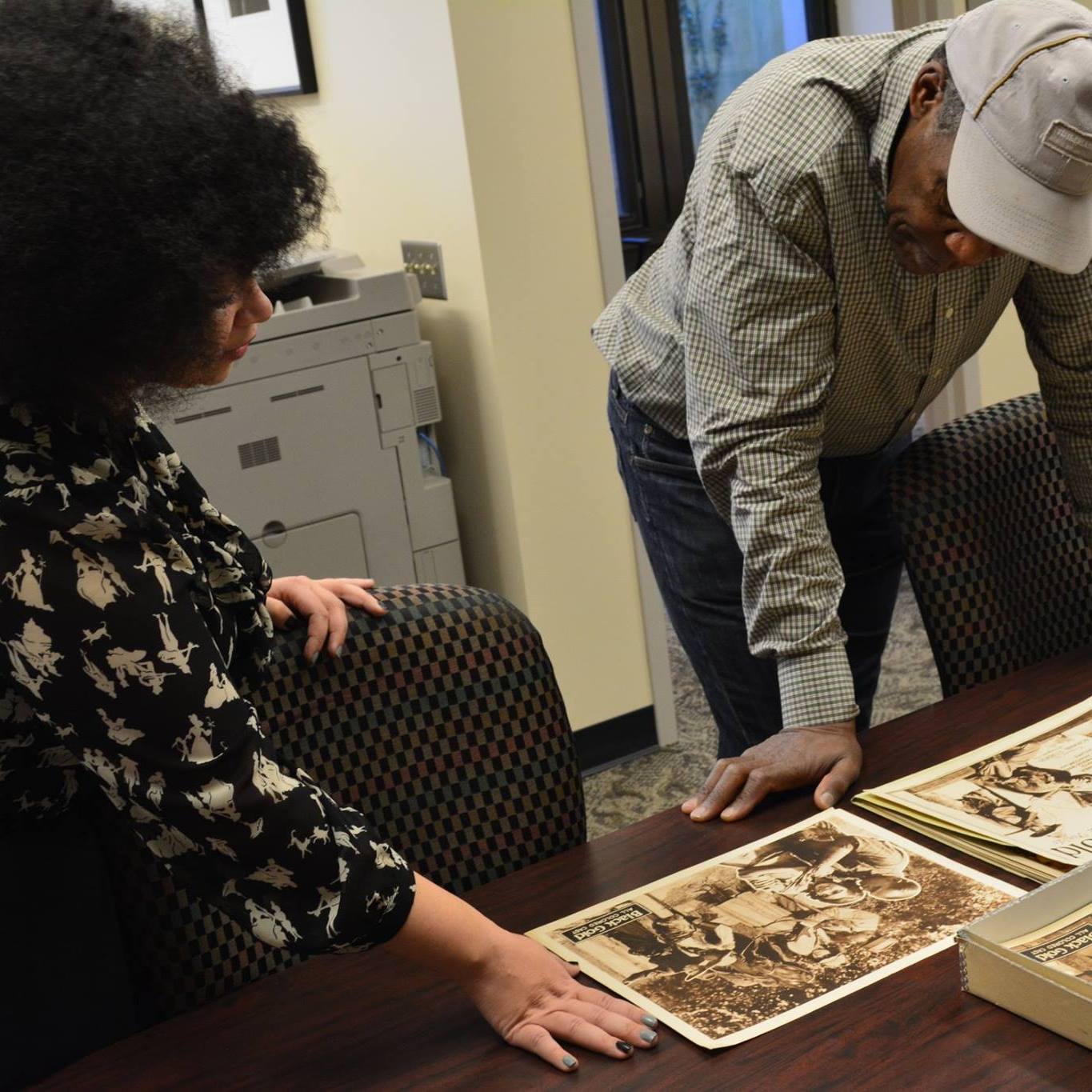
Unknown
Dorothy J. Berry shares historic film photographs with Danny Glover, star of stage and screen.

JJ: That sounds awesome. I look forward to using it in my own work and teaching! In my experiences visiting there and talking with librarians and campus leaders, I came to see that Minnesota has long been a leader in special collections development and has advocated an approach to access that is mindful of broad and diverse community needs. It seems that your work there is a part and parcel to a wider embrace of open access values and practices. There is also the context of the Big Ten Academic Alliance—what we until recently called the Committee on Institutional Cooperation or CIC. Minnesota is part of a community of universities and libraries committed to working on such things in an innovative way. Indiana University is part of that environment too. How have your graduate studies and the hands-on work that you did at IU prepared you for the work that you are now doing?

DB: I think the wealth of hand’s on opportunities available at Indiana University are what have most prepared me for professional life. While a graduate student I had a two year assistantship at the Archives of African American Music and Culture, one year at the Black Film Center/Archive, a year’s practicum at the Mathers Museum of World Cultures, and a semester practicum in the Film Archive. Librarianship in particular is a field that expects its emerging professionals to already have a wealth of experiences before getting that first full time job—I don’t believe I’ve ever really seen a job listing that didn’t ask for at least two years experience, unless it was a specific “recent graduates” oriented position (few and far between!). Having the opportunity to work at a variety of cultural heritage repositories in both front and back of house positions, exhibitions and cataloging, really set me up to have a set of skills and experiences that demonstrate competency, even from a very recent graduate.

On the academic side, I think the pursuit of a dual masters is really key for reaching new levels of accomplishment in archives and museums, especially when it comes to dealing with marginalized people’s collections. My job involves adding value to pre-existing metadata—something that requires technical archival skills, but also a focused research background. Every archivist I’ve known has great research abilities and can quickly become an expert in the collection they’re currently dealing with, but I think specific experience with rigorous research in a specific area leads to richer and more diverse finding aids and exhibits. Studying ethnomusicology was particularly of use as it established a research praxis that values discrete cultural intent, which is useful when working with marginalized people’s collections, but also with historical collections as well. My focus has always been on historical ethnomusicology, and I’m a proponent of the idea of research-based historic ethnography. I believe that work in understanding historic lived experiences from the perspective of the day is integral in fairly representing archival collections, which is increasingly important in the more widely accessible world of digital archives.

JJ: That is a great expression of the value of both hands-on work and interdisciplinary or multi-disciplinary academic training. You also stress something that I also care about, the continued importance of historical work in ethnographic fields that have often become very present-centered. In your concern for the historical experiences of marginalized groups, I hear you rightly stressing the need to understand and represent such peoples in their own historical contexts. This is part of the Umbra mission, as I read it. But this initiative clearly is also doing important social or political work in the present. Umbra’s name reminds us, for instance, of “a renegade group of Black writers and poets who helped create the Black Arts Movement in the 1960s.” I cannot stop thinking about all that is happening right now in our tragic, shared American present. What are some of the roles that you emphasize when you think about the work of the archivist and curator of African American cultural materials in the present?

DB: What’s most important to me as an African American archivist/Archivist of African American materials is to use the past to inform the present that Black history has always been filled with a gradient of experiences, emotions, activism, and suffering. Because African American history is taught at a very surface level, usually beginning vaguely before the Civil War, people of all colors often come away with a historical timeline along the lines of “Antebellum slaves-Civil War-Maybe Harlem Renaissance-Civil Rights Movement-People had Afros-Hip Hop in the 90s.” Archivists have the ability to show materials from the hands of African Americans and people of African descent from the earliest periods of North American colonization, showing not only that Black people have always been here, but that those Black people were not tropes pushing forward a linear narrative of American history. Primary documents have the ability to humanize in a way that even the best written non-fiction book cannot, and Archivists are the gatekeepers for this information.

I think we are in a time of extreme hunger for this sort of history, in the face of racism that says Black life is one-note and useless. Letters, publications, notes, films, photos—they force people to see that Black life has always been an integral sinew in the American corpus, and that Black people are human. That phrase “that Black people are human,” should be trite but we live in a segmented society that has long seemed to view African Americans as symbols, as stand-ins for cultural and social issues. Fleshing out human experience is an incredibly important role for all cultural heritage workers, but I think archivists have a really unique ability to share things that can completely turn a worldview on it’s head.

I love African American musical theater of the turn of the 20th century, and people usually get a chuckle out of how obscure that topic sounds. At the end of the day though, it was not an obscure topic at the time—we are talking about celebrities amongst Blacks and Whites, who staged financially and culturally successful performances and were well-known enough to have invitations for private performances from the Rothschilds and the British Royal Family. When the average person thinks of turn of the century Black life, they might think share-croppers, Great Migration, Jim Crow. Those are all realities, but so are popular entertainers and more frivolous things—because Black life has always been diverse and complex (something always assumed of White American populations, but rarely of Black ones).

At the same time, I think it’s important for people who work in historical contexts to not get so comfortable in the past that they ignore the present. When I am speaking on archival objects from the past, I do so to inform and complicate understandings of the present. One of the best recent examples of addressing contemporary understandings while exploring a historical document can be seen in Musical Passage: A Voyage to 1688 Jamaica. This project explores some of the earliest transcriptions of African diasporic music in the Americas using two pages from a 17th century book called Voyage to the Islands of Madera, Barbados, Nieves, S. Christophers and Jamaica. Decisions like referring to the planter class as “…people involved in colonizing Jamaica and enslaving Africans in pursuit of profit” might seem trivial, but is a powerful step in discussing archival history without traditional deference to a presumed white readership.

The other role I find incredibly important, personally, is that of someone who is a vocal trained expert who is not easily cowed. This is a role of personal importance because I do not think it is necessarily required of every archivist of color or person working with marginalized people’s collections, but it is one that I try to fulfill as someone with the disposition and positionality to feel comfortable doing so. I have found that many White scholars in a variety of fields assume that people of color who work with materials from their own ethnic/racial/cultural groups are not true scholars—that their expertise comes solely from lived experience and personal opinion. Lived experiences and personal opinions are not without value, of course, but it is important for me to stop those fellow scholars and say “Oh, I hear that you are devaluing my expertise, but we are actually going to talk about this right now.”

I was recently talking to two very intelligent medievalists and said in passing that “race is made up.” They both know me as someone with multiple degrees and professional experience working with archival materials, but one of them immediately scoffed and brought up the dreaded specter of “internet social justice warriors.” I could tell this was something I was supposed to let slide, but instead began a discussion on the undefined “white person” of the 1790 Naturalization Act and the various court-cases and social movements that followed in attempts to create meaning for “white person.” This type of intellectual and emotional labor is, in brief, a pain. I personally find it remarkably important, however, to use my role as a researcher and archivist to plant Black history firmly in the minds of fellow scholars who might, consciously or not, attempt to ignore the historical and archival record solely because they don’t understand or like the 21st century discourse around race.

JJ: Given that talking such issues through over and over again for the larger social good is, as you note, a pain—even as it is also remarkably important—I am very thankful that you were willing to speak to them so eloquently here in the context of your work. In further shaping your understandings of them and in the professional practice that you pursue around them, did you find mentors and allies here at IU during your studies? My hopeful self hopes so, but my worried self worries “not-so-much.”

DB: I don’t know that I’d say I found mentors but that is mainly because my personality doesn’t really seek out that sort of individual one-on-one relationship, for better or for worse. I found many, many people who provided intellectual, professional, and sometimes even emotional support, however. Within the department of Folklore and Ethnomusicology, Fernando Orejuela has always been a great champion and someone with whom I could discus navigating the racial and social problematics of academic life. My time working at the Mathers was fairly instrumental as well, because I had the opportunity to talk with people working with collections, exhibitions, curation. I found everyone there very supportive of professional intentions/potential and was given a lot of opportunity to discus processes and learn. In the other degree side, I spent a lot of time working with Andy Uhrich and Brian Graney, of the University Film Archives and Black Film Center/Archives respectively. They were very much super-allies of the Dorothy-cause, providing again that combination of education and professional freedom that I think is really valuable for graduate students. Graduate students need to learn huge amounts, obviously, but without hands-on projects the job market outside of academia doesn’t really care how many papers you’ve read. There are other professors, Judah Cohen in the Jacobs School [of Music], Terri Francis in the Media School, who really encouraged and challenged me intellectually.

I think there are definitely people at IU who presented serious problems for me, but that is to be expected in life! It is an effort to find and pursue the people that can add to your experiences, but for me it was certainly worth it.

JJ: I am obviously glad that the MMWC provided some of the useful opportunities that you drew upon and took advantage of. I am also glad that you took the Curatorship course and then followed up with hands-on projects at the museum. Engaging a diversity of people and organizations seems to be one key lesson that I read out of your experience. I know that the museum and I benefit from the diversity of students and other stakeholders with whom we engage.

In your new role, you are encountering many different collecting organizations, collections, and collection items. Is there one—at any of these levels—that has really struck a chord with you and that you would like to narrate? (This is the “favorite object” question reworked in an archival context, of course.)

DB: I’m so fresh into the position I haven’t had too much to explore, but in my first week I came across some really interesting holdings in the Social Welfare History Collection. I was pulling files and enriching metadata from a large collection called the Verne Weed Collection for Progressive Social Work, that holds the papers for a variety of activist social workers. That collection contains the Jack Kamaiko Papers, and a subsection of those papers were marked as relevant. The files all had titles along the lines of “USS New Orleans Segregation,” so I originally thought, “Hmm maybe this is someone who was fighting against segregation in the Navy? Maybe a lawyer, maybe someone who was discriminated against themselves?” When I looked through the first file, however, it was all correspondences dealing the the purchase of the Senator Hotel in New Orleans. I had no idea what that could possibly have to do with anything. I tried Googling, and came up with maybe two relevant results that all hinted at the real story.

In the 1940s, the United Seamen’s Service, a non-profit that works for the welfare of seafarers by providing services and local information, attempted to purchase the Senator Hotel to provide recreation and temporary housing for both African American and White seamen. Though the housing would be separated into two segregated wings, with separate entrances, local forces in the French Quarter railed against the close proximity. Jack Kamaiko, who would later go on to become a well respected professor at Hunter College’s School of Social Work, was employed by the United Seamen’s Service and kept letters, telegrams, and ephemera detailing the eventually unsuccessful purchase. These kinds of materials are exciting because while they are accessible at this point to scholars who know where to look, once they are digitized and added to Umbra Search they will be easily discoverable for anyone simply searching for “Segregation in New Orleans.” That kind of fleshing out of the historical record, showing the ongoing fights for fair treatment, provide the “vindicating evidence” that Arturo Schomburg described as his intellectual pursuit. Evidence that Black history is now and has always been, American history.

JJ: That’s an interesting collection and a great point to close on. Thank you so much for sharing your work with me.

An Interview with Hannah Davis, Regional Folklife Survey and Program Development Consultant for the New York Folklore Society and the New York State Council on the Arts

Hannah Davis earned her MA in Folk Studies from Western Kentucky University and a BA in Folklore and Ethnomusicology from Indiana University. While at Indiana, she served for four years as a Program Coordinator with Traditional Arts Indiana, Indiana’s statewide folk and traditional arts agency—now a constituent program of the Mathers Museum of World Cultures. Throughout her MA training at WKU, she worked as a Graduate Assistant for the Kentucky Folklife Program. In June 2016, she began work in a public folklore position based within the New York Folklore Society with funding from the New York State Council on the Arts. While a student, she gained additional internship experience working with the Smithsonian Institution’s Center for Folklife and Cultural Heritage and the American Folklore Society.

Jason Jackson (JJ): Hannah—I am so happy to be doing this interview with you, especially just as you are getting settled into your new role as a public folklorist in upstate New York. Could you describe your new position?

Hannah Davis (HD): Since June 1, I’ve been working as a contractor for the New York Folklore Society and New York State Council on the Arts. I’ve been tasked with doing a folklife survey of nine counties (six in the Finger Lakes and three in the southwestern corner of the state). I’m also responsible for coordinating a few public programs with smaller regional arts organizations and acting as a consultant in the planning of future folklife-based programming. The state of New York is unique in that it has an organized network of folklorists working in many different capacities. This position was created as a way to serve counties that are not otherwise served by folklorists.

JJ: For those who are reading about such work for the first time, what goes into doing a multi-county folklife survey? How will your findings translate into further research and eventually presentations, publications,  or other outcomes?

HD:  Surveys involve, in many ways, all the fun parts of working as a folklorist. Between now and the end of my contract, I will have conducted dozens of interviews with all kinds of artists, musicians, and other informants, and crisscrossed the state documenting fairs and festivals. I’ll record, photograph, and film as much as possible.

Especially when a survey includes so many unique communities, it’s important to stay organized and keep your eyes on the big picture. There’s only one of me, and so many hours in a day. This is not intended to be a comprehensive survey of all the traditional arts and culture that one may find in each of my nine counties. Rather, my goal is to be able to paint a picture for our partner organizations of the kinds of traditions that exist in their service areas, and the ways in which they may continue to do folklife programming in the future.

It’s important to me to respond directly to the needs of these organizations. The Auburn Public Theater, for example, is interested in doing a narrative stage, during which informants will engage in a conversation with each other about a specific topic, and their audience will be able to interact and ask questions. As I’m conducting fieldwork in their service area, then, I will make note of informants who seem to particularly enjoy discussing their life and work. Towards the end of my contract, I’ll work on organizing photos and recordings, transferring files to others, and drafting my programming recommendations. It’s possible that parts of this project will turn into more long-term work for NYFS. I’ll also publish a few articles discussing my work in NYFS’s journal, Voices: The Journal of New York Folklore.

JJ: It does sound like it will be a lot of fun. You know you will meet great people but you do not yet know who they all are or what they are passionate about. How did your work in Indiana and Kentucky prepare you for your new work in New York state?

HD: Exactly! A big part of my job at TAI [Traditional Arts Indiana] was transcribing, logging, and organizing materials collected by fieldworkers. I’m grateful to Jon Kay, the organization’s director, for introducing me to basic ethnographic methods through this kind of work, and allowing me to participate (even as a college freshman!) in collaborative projects like the one I’m tackling now. Certainly, entering my grad program already comfortable with convening meetings, drafting grant applications, and planning public programs allowed me to work more independently at the Kentucky Folklife Program. My time in Indiana and Kentucky really equipped me to take a “big picture” approach to my work here in New York—I didn’t just learn how to do fieldwork, I learned what to do with fieldwork.

JJ: That is good. As we continue working with students in TAI and at the museum as a whole, your experience will be a source of encouragement. On the flip side, what kinds of experiences do you wish you could have had while at IU and WKU? What are you surprised by as you get going in New York?

HD: I certainly wish I had been able to take some [undergraduate] public folklore classes to complement my work at TAI. I didn’t really understand the origins of the field I was working in until I began graduate-level classes at Western. Once I got to Western, though, I really missed being able to take advantage of the diverse programs offered at IU. Pursuing my interests in digital media, for example, became a lot more difficult. There’s only so much you can study and prepare for, though! There’s a lot to be said for just diving in.

This might be a silly answer, but honestly, I’ve been most surprised by how smoothly things have gone. I don’t mean this to be self-congratulatory at all—the people here have just been so kind, and so happy to share their work with me. When you’re learning how to do fieldwork, you hear a lot of horror stories. I don’t have any yet!

JJ: Building up undergraduate course opportunities for public and applied folklore work is on the agenda at IU, as are opportunities for public humanities involvements more generally. Your reflection contributes to the making of the case for such efforts. I am glad that you have no horror stories and I hope that things continue in that vein.

HD: That’s great to hear.

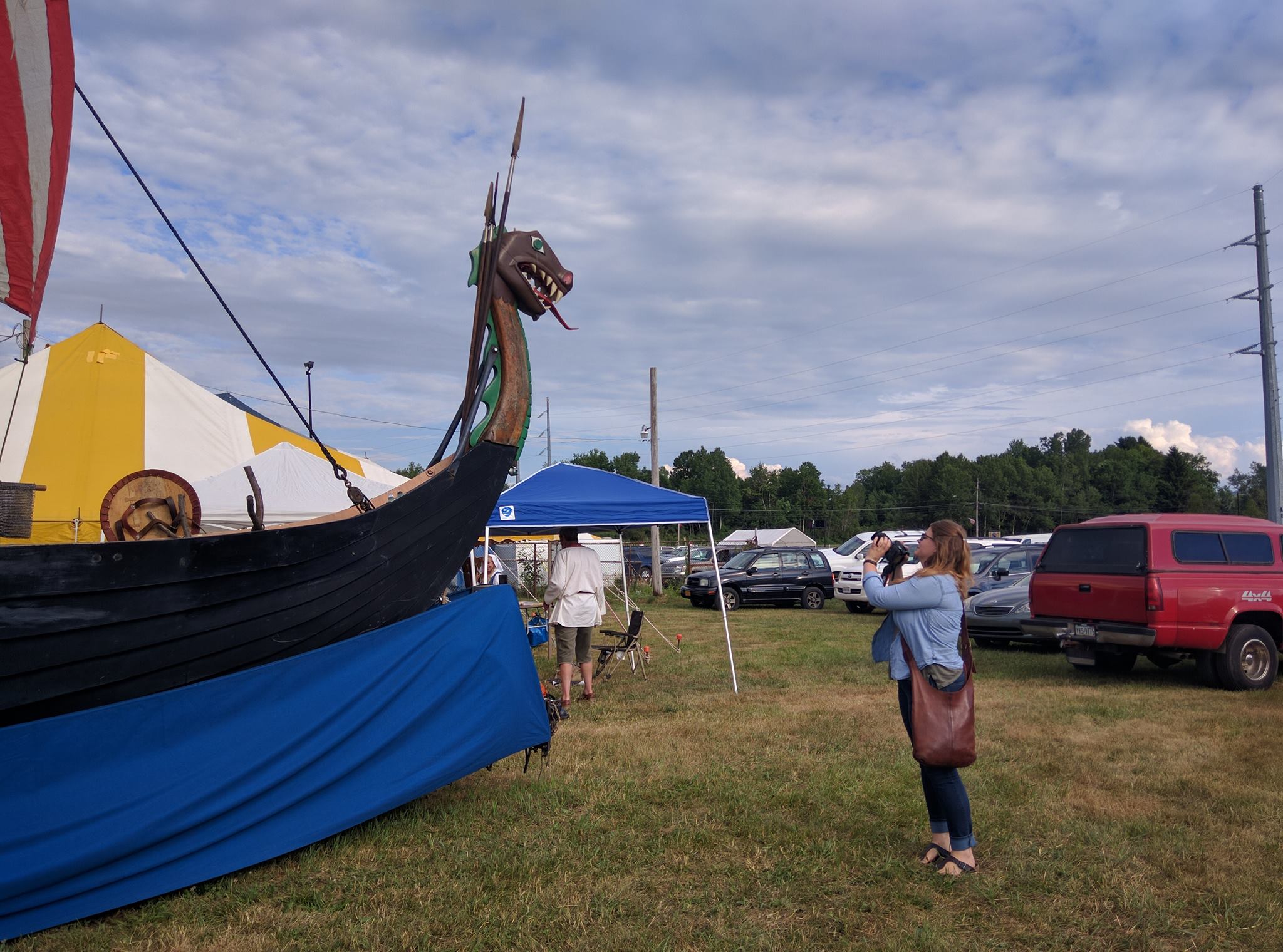
vikingship
Hannah photographs a recreation of a Viking ship at the Scandinavian Folk Festival in Jamestown, NY.

JJ: What are you learning about public folklore infrastructure in New York state? Things seem really strong there and this seems to be a longstanding pattern

HD: The infrastructure here is part of the reason I was so excited to take the job. There are capable and accomplished folklorists, including a few IU students and grads, working across the state. Many are within arts organizations, some work more independently, but they are all part of a collaborative network loosely bound together by Ellen McHale at NYFS and Robert Baron at NYSCA, who both work hard to support what we do (financially and otherwise). Their leadership has been crucial to the longstanding pattern you’ve noticed.

JJ: What is one cool cultural discovery that you have already made as you begin to learn your way around your part of the state?

HD: Word on the street is that there’s a game called “roque” played in the western part of the state. I hadn’t heard of it until a few days ago! An annual tournament is held in Angelica, a village in Allegany County, during the community’s Heritage Day celebration. It resembles croquet, but has entirely different rules. Readers might be interested in this 2010 ESPN article.

JJ: I knew you’d have something great to share and just like that you serve up roque. Hopefully we’ll all be playing it soon, or at least watching your documentary!

Here’s two to go out on. If you could share a word of counsel with an IU sophomore with an interest in a humanities career, what would you say? As an alumna, what would you share in conversation with our Provost or President about your training at IU.

It’s scary to think about how recently I was an IU sophomore. Feels like it’s been ages! Here’s what I’d say: “It will be okay. There are jobs.” Sincere commitment to an interest goes a long way at IU, especially in the Department of Folklore and Ethnomusicology. I knew as a freshman that I wanted to graduate as a folklore major, and it was entirely because of a pep talk from a grad student who saw some potential in me and sent me to talk to Jon [Kay]. With the guidance of wonderful professors like you, Jason, and some very honest graduate students, I became a success story. And there are so many others. I’m proud to be an IU alumna, and to be part of the community that the department has fostered. A degree in the humanities is not a death wish.

To the provost and president, I’d say this: “My training at IU made me the professional that I am today.” I’ve been thinking a lot about my time at IU since yesterday’s announcement about the department’s move to the Classroom Office Building. I met some of my nearest and dearest friends and mentors in the TAI office. Our buildings were run-down. They were not accessible to members of the community with different physical capabilities. That’s a terrible thing. But they were home, and I’m sad that I won’t be able to go back there. The department is a whole lot more than a cluster of neglected brick buildings, though. It’s an incubator, it’s a community, and it’s a wonderful thing to be a part of. I couldn’t have learned the things I learned there anywhere else.*

JJ: Thank you Hannah for sharing your experiences with me and with our readers. Keep us posted on your adventures and come back soon and teach your Bloomington friends how to play roque!

*In her closing remarks, Hannah is referring to the offices of the IU Department of Folklore and Ethnomusicology from which she earned her BA and in which I serve as a Professor. The department’s offices and seminar rooms in a cluster of four historic brick houses located adjacent to one another on N. Fess Ave. and N. Park Ave in Bloomington have, for alumni, staff, and faculty, become icons of the department over the course of many decades. In July 2016 it was announced that the Department would be moved to new more modern and accessible quarters in a university building known as the Classroom Office Building on 3rd Street, across from the campus’ historic “Old Crescent” area. The department looks forward to showing off its new home to returning alumni very soon. (JJ)

An Interview with Sterling Jenson of the March Field Air Museum

20160704_133838[4]

Sterling Jenson is the Collections Manager at the March Field Air Museum in Riverside, California. He earned a B.A. degree in folklore and an M.A. degree in arts administration at Indiana University. While at IU, he was graduate assistant in the registration department at the Mathers Museum of World Cultures (MMWC) and a volunteer in its education department. He was also an intern at Traditional Arts Indiana, which is now a department of the MMWC.

Jason Baird Jackson (JJ): Thank you Sterling for your willingness to talk to me about your work as a museum professional and Indiana University alumnus. We’ll go back in time shortly, but could you tell me a bit about the March Field Air Museum and your work as its Collections Manager?

Sterling Jenson (SJ): The March Field Air Museum celebrates the history of aviation with a focus on one of the historical military airfields of the United States, the March Air Reserve Base. March Field was founded in 1918 and since that time has been an important part of the history of the [U.S.] Air Force and the Air Force Reserves, which means that the museum has an important legacy to present to the public. The museum has on display over seventy aircraft, including one of the two A-9s in existence, a SR-71 Blackbird, and, a PT-6 biplane trainer from 1930. The collections range in size from a B-52 on our flight line to ribbons awarded to airmen for their service. In order to house these objects, the museum has two hangars, an exhibit hall, and a library.

As Collections Manager, I am in charge of the processing of the objects, loan paperwork, and ensuring that the collections are organized. Currently, I am building upon my predecessor’s work in order to make the collections more accessible. Prior to my arrival, the museum was using an [Microsoft] Access database to keep track of the objects and the books in our library. In order to better serve the museum, I am migrating the database from Access to CollectiveAccess in the case of objects and to Koha for the library books. Both programs are open source software that we will be able to upload to the museum’s website in order to make the collections more accessible. I am also in the process of overseeing an inventory and standardizing the disposition system, both of which I learned from my time working as a Graduate Assistant at the MMWC.

JJ: A B-52! I know that you did not get experience in caring for a 132-ton bomber during your time at the MMWC! How did your experience as a student at IU prepare you for the challenging museum work that you are doing now?

SJ: At Indiana University, I studied folklore as an undergraduate and then went back to get my Masters of Arts in arts administration. Due to my studies in folklore, I love collecting information that describes the context of the object, especially personal narratives or biographies. While I never know if these stories will ever be utilized in the exhibits, trying to collect them when the objects arrive is the best time to get this kind of documentation. For one donation, the son emailed me a document he created for his father’s funeral, which helps explain the history of the man who wore the uniform.

My studies in arts administration have helped me immensely because the program focused on both the practical components as well as the theoretical ones. I have been working on preparing grant proposals in order to better manage the objects within the collections. The course [MMWC Assistant Director] Judy Kirk taught on Museum Management will be helpful in the near future as I go through and update the collections policies, plans, and procedures. During my graduate studies, I worked at MMWC in the Registrar’s office as the Graduate Assistant. I loved my time there because [Registrar] Terry Harley-Wilson gave me hands-on projects, including working with loan agreements and working with an inventory.

At my current position, I am try to emulate Terry by giving my interns and volunteers important tasks and seeking their opinions to better improve the department. As many of our aircraft are on loan from the National Museum of the United States Air Force, including the B-52, I am using what I learned at MMWC regarding loans frequently. I am grateful we have a Restoration Department to deal with repairs to the aircraft, so my focus can be on the smaller objects within the collection. In short, my experience dealing with loans and other institutions at MMWC has been valuable in this position.

JJ: I am a big advocate for the combination of disciplinary training in folklore studies and professional training in arts administration, thus it is great for me to hear how you bring them together everyday in your current role. I am, of course, also thrilled that your work with MMWC Registrar Terry Harley-Wilson has proved to be so valuable in your current efforts. Courses like Judy Kirk’s combined with hands-on experiences at the museum are a big part of our mission. Is there something about your current role that has surprised you or that you initially felt less prepared to address? We are all, of course, constantly learning new things on the job.

SJ: One of the areas that I feel less prepared for is needing to explain why all of my projects in my department need to be so thorough and why they take so long. As you know, the standards in the museum world have been set high because of past mistakes in the field. In order to achieve these standards takes work, care, and persistence. I hope that I am slowly making progress in explaining the importance of collections care.

JJ: I have been there with you, for sure. Unfortunately we live in an impatient moment in which time is money, talent is money, attention is money, and money is money. We are expected to be good stewards of all of them but it is often hard to explain to those not working alongside us why being careful the first time is so crucial. We cannot un-break an ancient Greek vase or recover an un-digitized analog oral history recording destroyed in a fire or flood or misplaced and discarded through careless handling. As you note so well, past mistakes haunt us and we want and need to get it right the first time.

In closing, can you tell me about your favorite item or collection at the March Field Air Museum?

SJ: My favorite items are part of the Collection relating to Orla Bridges and as you can see in the photograph (Figure 1), the curator decided that these items were important enough to put right into the cases. Wagoner Orla Bridges’ uniform and Victory in Europe Medal from the Great War for Civilization were donated to our museum within the last year. Mr. Bridges was stationed at March Field about the time when it opened in 1918 and his family owned the farm across the street from the front gates of the base. He is a great example of someone who has ties to both local history as well as international history.

JJ: Well said. That is a great example of what we do—connecting the little and the big, the local and the global. Thank you so much for taking the time to talk with me about your work and your career. Good luck with all that you and your March Field Air Museum colleagues are pursuing.

BridgesFigure 1. A uniform coat and military medal from the collection of Wagoner Orla Bridges, now in the collections of the March Field Air Museum.
An Interview with Dr. Lori Hall-Araujo, Curator and Assistant Professor at Stephens College

In fall 2016, Lori Hall-Araujo will begin a position as Assistant Professor and Curator in the School of Design and the Costume Museum at Stephens College in Columbia, Missouri. She recently concluded a year as Anawalt Postdoctoral Fellow in the Center for the Study of Regional Dress at UCLA’s Fowler Museum in Los Angeles, California. She holds the Ph.D. in Communication and Culture from Indiana University as well as an M.A. in the History of Religions from the University of Chicago, and a B.A. in Philosophy from Michigan State University. She has extensive experience as a museum professional and, during her time in Bloomington, she curated the exhibition Clothes, Collections, and Culture . . . What is a Curator? for the Mathers Museum of World Cultures. Learn more about her work at http://www.lorihallaraujo.com/.

Jason Baird Jackson (JJ): Thank you so much for agreeing to this interview. I know I will want to ask about the varied things that you have been doing in the museum world since you left Bloomington, but I have to begin with a big CONGRATULATIONS on the news of your tenure-track position at Stephens College. As you look ahead to moving to Missouri and getting started there, can you describe your new position?

Lori Hall-Araujo (LH-A): Thanks so much for the well wishes. I’m absolutely thrilled about embarking on this next phase of my career and feel very fortunate. The Atlantic recently published an article about how colleges and universities are offering buyouts to senior faculty and staff to encourage retirement and save on spending. While Oberlin, the story’s featured college, is promising not to replace its tenured faculty with part-time instructors and non-tenure-track faculty, that’s the direction many colleges and universities are heading. Most academic jobs now are either part-time or non-tenure track so I feel extraordinarily lucky to have been on the job market just as the Stephens position opened up.

My role at Stephens College calls on me to wear two hats, one as professor in the fashion program and the other as curator for the Costume Museum and Research Library (CMRL). Stephens’ fashion program emphasizes practice within a liberal arts environment. The classes I teach will tend towards the academic side. This year I teach writing intensive courses on dress history that situate changing modes of dress within their cultural and sociopolitical contexts. For my course on 20th century dress I plan to use the Costume Museum’s collections in my teaching.

The Costume Museum and Research Library at Stephens has over 13,000 objects from the mid-18th century to the present and includes designer and everyday attire. As curator I am responsible for mounting two exhibitions each academic year though my ambitions for the CMRL go well beyond that. This fall I will work with staff to conduct an overall assessment of the facilities and collections to determine ways we can improve storage and increase access for students, faculty, and outside researchers. Finding ways to incorporate the collections into the curriculum is a top priority. The fashion program recently earned an affiliation with the Council of Fashion Designers of America (CFDA). This is a highly coveted and prestigious affiliation as it provides students with scholarships as well as industry opportunities. The CFDA tapped Stephens to participate in its scholarship competition based on the strength of student portfolios and the Costume Museum’s collections so the work I do as curator has real potential to resonate in our students’ futures.

JJ: That sounds great on every front. I love my dual museum-faculty role and I feel confident that you will really thrive in that environment too. Before we get to what you have been doing most recently, can you reflect a bit about the ways that your studies at Indiana contributed to the work that you are being called to do at Stephens? This matters not only in a MMWC context, where we are always seeking to be more impactful in the careers of museum professionals-in-training, but also in the context of Indiana University’s new School of Art and Design, where students and faculty share so many interests in common with you. You came to IU with a lot of museum background. What did IU add to the equation?

LH-A: I had been Collection Manager for Costume and Textiles at the Chicago History Museum before enrolling in my IU doctoral program. One of the reasons I chose IU was for its museums. I wanted to dip my feet into curatorial waters and the Mathers Museum gave me that opportunity. Working closely with [MMWC Chief Curator] Ellen Sieber and other Mathers staff, I was able to experience first hand how a well run university museum operates. The Mathers offers credit-granting practica for students, which are a great way to learn about the collections and to gain hands-on supervised museum experience. At Stephens the Costume Museum offers work-study positions in its collections. In the future I’d like to see us offer museum practica along the lines of the year-long cataloging and curating project I worked on at the Mathers.

JJ: You came to IU as a doctoral student in the Department of Communication and Culture. As a Ph.D. student you thus had a research agenda that you hoped to establish and then carry forward into your career. Do you feel that you were able to integrate your training as a researcher and your museum interests? One of your foci is dress in Latin American contexts. How did this interest mature at IU and how has it carried forward through your work at the Fowler Museum and up to the present?

LH-A: While there was no museum studies track in my department per se, I was able to get the support I needed. Before his retirement, Dick Bauman was my advisor and he really pointed me in the right direction as far as coursework and training went. Beverly Stoeltje in Folklore was my earliest advocate for writing a dissertation that incorporated my interests in dress theory, film, performance studies, and museum studies. I took a short exploratory visit to Rio de Janeiro, Brazil in my second year at IU and it was Beverly who urged me to check out the Carmen Miranda Museum there. From that kernel of an idea my research and dissertation bloomed.

Dick encouraged me to do a practicum at the Mathers, which I did thanks to the faculty sponsorship of Pravina Shukla. Several years before enrolling at IU I had spent some time in Oaxaca, Mexico making art and learning about indigenous textiles. When I met with Ellen Sieber I expressed my interest in Latin American textiles and she suggested I work with one of two sizable collections. I chose to work with the Royce Collection as it includes Zapotec clothing and objects from Juchitán, Oaxaca. My work on that project was incredibly rewarding in terms of the intellectual and creative freedom it provided. My exhibition was highly reflexive and examined how the meaning of objects changes depending on context–art, wearable garment, museum object, and so on.

The themes I addressed for the Mathers practicum have informed my research at the Fowler Museum where I have been studying two significant collections of objects collected in Mesoamerica throughout the 20th century. I ask questions such as, “Why does the collector collect what she collects? What does it mean for outsiders to come into indigenous Mesoamerican communities and buy clothing? What happens when the collector’s cultural biases cause her to misinterpret or misrepresent other cultures?” These are difficult and sensitive topics but I think there’s a way for productive dialogue to emerge from this project. Ideally these issues would be addressed not just between academics but also in a more public way such as a museum exhibition.

JJ: Needless to say, hearing you recount your experience at IU is very gratifying. We can’t let your Carmen Miranda research go unexplored, but you have just referred to your Mesoamerican clothing research, including your earlier visits to Oaxaca, your work with Chancellor’s Professor Anya Royce’s collection at the MMWC, and your more recent work on such collections at the Fowler Museum. In my corner of the field, the Fowler Museum has a strong reputation as a leading university museum of world cultures. When administrators here ask me to identify aspirational peers for the MMWC, it is always on my list. How did you secure a postdoctoral fellowship there? What was it like to work there? What’s next for you Mesoamerican research?

LH-A: From 2014 to 2015 I worked on the Hollywood Costume exhibition organized by the Victoria and Albert Museum and hosted in Los Angeles by the Academy of Motion Picture Arts and Sciences. Just prior to the exhibition’s closing, the curator, Deborah Nadoolman Landis (professor in UCLA’s Theater, Film and Television Department and founding director and chair of the David C. Copley Center for Costume Design), invited the Fowler staff to come check out the exhibition. That was when I first met the Fowler director, Marla Berns, who suggested I stay in touch. After Hollywood Costume closed I visited the Fowler and got to see their many treasures in storage. Marla told me they were planning to offer their first ever post doc fellowship and invited me to apply. Happily they offered me the fellowship and in September I hit the ground running.

During my time at the Fowler I’ve been impressed by how much they accomplish with such a small staff. They have an incredibly full exhibition schedule for their own galleries and of course have any number of objects out on loan at any given time. The first six months were magical when I got to throw myself fully into research. Then from March to June I had the opportunity to teach an undergraduate class for the World Arts and Cultures Department, “Collecting Indigenous Mesoamerican Dress.” The class was essentially the research I’d been working on in the preceding six months. Every week we looked at objects from the collections and addressed issues of collecting practices, interpretation, and different theme-driven exhibitions. My students were amazing. Their final projects asked them to conduct original research in the Fowler archives and to discuss the objects. The questions they raised and the discoveries they made have been so helpful to me as I write about my own research.

This past January I had the opportunity to look at pieces in the Fowler collections with the Oaxaca Textile Museum‘s founder, Alejandro de Ávila Blomberg. He’s been an ideal colleague, so generous. He’s invited me to attend a textile conference in Oaxaca this October so I’ll be there and plan to do a little exploratory research while in Mexico.

JJ: That is great to hear. I hope that you can continue your work with Oaxacan textiles while based at Stephens. People are understandably passionate about them and they both raise and help address so many key questions, as your comments reflect. Selfishly, we would love for you to weave our collections into your ongoing work. Happily, I can report that Professor Royce is continuing to add new works to our collections on the basis of her still active research and her strong relationships with friends in Oaxaca.

While many of your projects are getting short changed here, we can’t conclude without giving your dissertation research and its famous subject—Carmen Miranda—its due. Brazil is about to host the world for the 2016 Summer Olympics. I recently heard an interview with vocalist Carla Hassett. She was discussing Carmen Miranda on NPR and cited Brazilian composer “Caetano Veloso [whom she said] said, [she] is the original tropicalista, meaning she was really the first artist to leave Brazil and influence and bring the culture to outside of Brazil. She was really our pioneer of that.” Hearing that interview, I immediately thought of your work and how you have tried to understand the role of dress in how the world made sense of Carmen Miranda and, by extension, all of Brazil. As Brazil is now a focus of much global attention for so many reasons, what does your research tell us about Carmen Miranda’s legacy?

LH-A: What can I say?  I could fill a book addressing your question and am in the midst of doing so!

As far as Carmen Miranda being the original tropicalista goes, I can say this. The tropicalistas of the late 1960s and early 1970s inherited a Brazilian tradition of “cultural cannibalism.” Brazilians have long understood that their land and people have been acted upon whether via slavery or environmental or cultural exploitation. Yet rather than allow themselves to simply be the passive subjects of external fantasies and oppression, they have taken those external fantasies and turned them on their heads. Carmen was European born but she fully embraced the Brazilian feijoada and considered herself a Brazilian. When Caetano Veloso called her the original tropicalista he was saying that she wasn’t a sell-out to Hollywood as some suggested but instead was consuming Hollywood versions of Brazilians and regurgitating them in unique and distinctly Brazilian ways to create a kind of cultural chaos for global audiences. I’ve no doubt Brazil and its culture will surprise and confuse Olympics tourists this summer.

JJ: That is good food for thought as we all gather around screens to consume the spectacle in Brazil this summer. We can watch and look forward to your book. You will face the challenge of moving to Missouri and getting situated in your new post while also taking notes on those themes in the Brazil context. I can hardly imagine that the costumes worn in the opening and closing ceremonies won’t be ringing these bells and playing again off the tradition of cultural cannibalism you note.
 
I want to thank you so much for sharing these glimpses of some of your work in progress. Good luck with your new position and with your exciting research. We hope you are able to get back to the MMWC very soon.

Open Access Book: Indiana Folk Arts

IFA CoverThis year is a big year for the Mathers Museum of World Cultures in a number of respects. Two of these weave together. Its the state bicentennial for Indiana and we are engaging with it in a big way through the exhibition Indiana Folk Arts: 200 Years of Tradition and Innovation. That exhibition is now traveling across Indiana along with with a deep roster of presenting artists and craftspeople. The exhibition and associated in-person demonstrations are happening at state parks and festivals around Indiana and the exhibition will also be presented at the Indiana State Fair, later this summer. The exhibition brings together more than a decade of research by Traditional Arts Indiana and was also an project worked on by the Laboratory in Public Folklore graduate course taught in the IU College of Arts and Sciences’ Department of Folklore and Ethnomusicology. Working with TAI Director and MMWC Curator of Folklife and Cultural Heritage Jon Kay, a large number of students have been involved in all aspects of the exhibition and associated programs, products, and events.

2016 is also slated to be a big year for book publishing at MMWC. We have a number of books in the cue for fall. The first to become available is the catalogue for Indiana Folk Arts. Edited by Jon Kay with chapters authored by a large and talented group of graduate students, the volume enriches the exhibition while also standing alone as a contribution to scholarship on Indiana craft and art. At exhibition events and here at the MMWC, the book is being distributed for free in a beautiful full-color print edition. In keeping with our institutional commitment to increased and open access to scholarship, the volume is also available electronically and permanently via the IUScholarWorks Respository. Licensed under a CC-BY license, it can be found online here: https://scholarworks.iu.edu/dspace/handle/2022/20893. Its the first MMWC publication for which we obtained an ISBN number (two actually, one for the print edition and one for the PDF edition), which is also pretty neat.IFA Front Page

Congratulations to Jon Kay, the volume’s editor, to all of its contributors, and to the talented artists, craftspeople, and tradition bearers featured in the book. Welcome readers–72 beautiful pages await you, wherever in the world you live. If you like the book and support the work behind it, spread it widely. Tell your friends and colleagues so that they can enjoy it too.

Basketmaker Viki Graber on The Weekly Special

Last year, the Mathers Museum of World Cultures presented the exhibition Willow Work: Viki Graber, Basketmaker to great success. Happily we are staying connected with Viki in many ways, including her participation in the Indiana Folk Arts: 200 Years of Tradition and Innovation exhibition and associated Traditional Arts Indiana programs around the state. The public television station here at Indiana University, WTIU has just posted a beautiful video, from their show The Weekly Special, in which Viki Graber talks about and demonstrates her work. Check it out here.

Weekly Special


June Events and Exhibitions, Including Arts in the Park at McCormick’s Creek

Check out some MMWC events and exhibitions this month. In particular, this Saturday (June 11, 2016) a great group of artists will join the Traditional Arts Indiana team at McCormick’s Creek State Park for Arts in the Park. Learn more about that event here.

MMWCEcalJune2016