Skip to content

Posts from the ‘Material Culture’ Category

Two Short Courses in Tartu

#fulbrightspecialist #fulbright #exchangeourworld

In an earlier post, I expressed my appreciation for the opportunity to visit the University of Tartu as a Fulbright Specialist. Among my tasks while there was to teach two short courses. Here I want share the story of those courses and reflect upon how they fit into my visit and into my fall of sabbatical leave.

IMG_5455

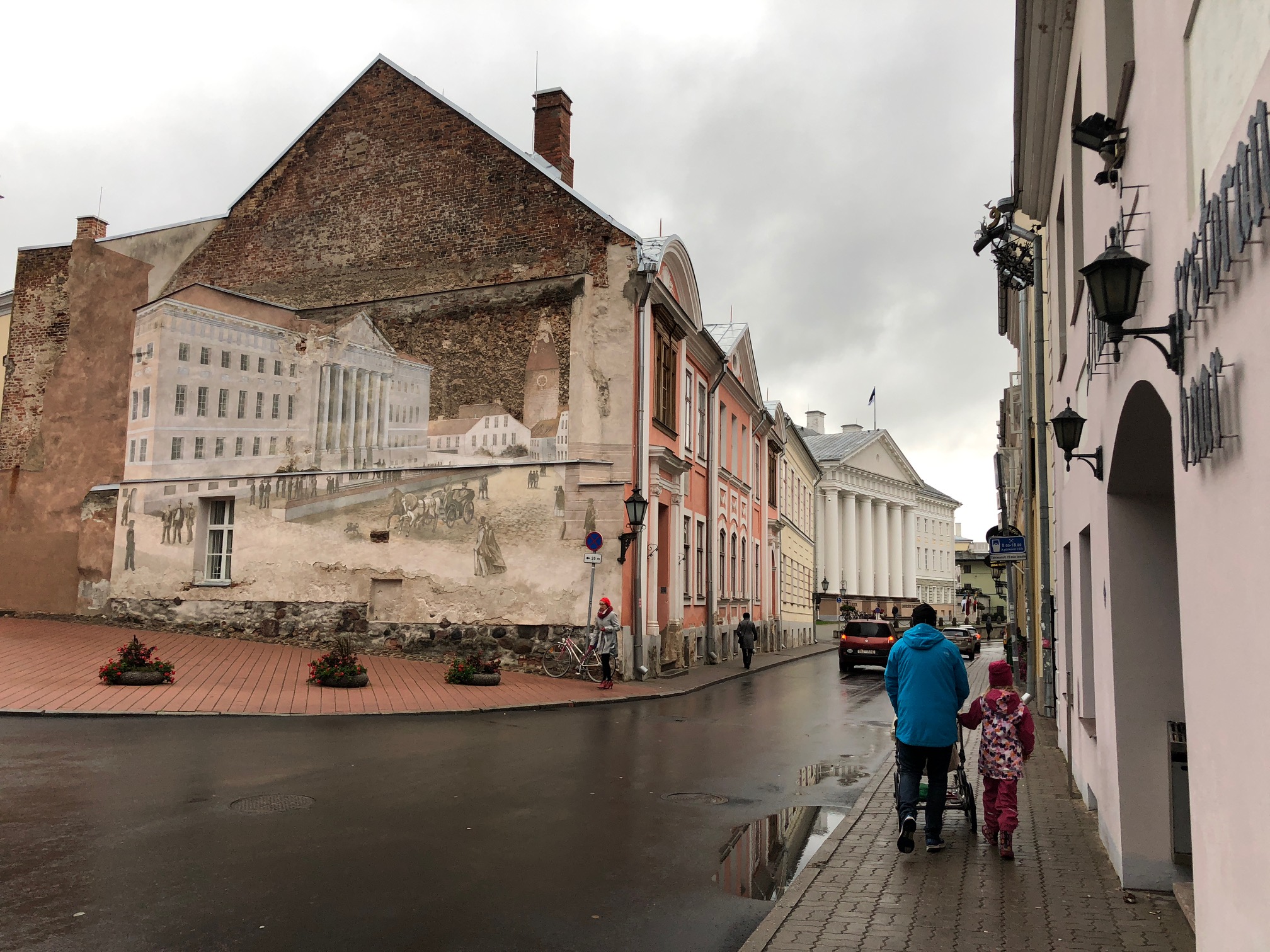
The Departments of Ethnology and of Estonian and Comparative Folklore are not only headquartered in the beautiful building on the left, but they are located across from the wonderful, legendary cafe Werner on the right. The cafe itself justifies a trip to Tartu.

As I noted earlier, the University of Tartu has well-established and distinguished degree programs in (1) folklore studies, (2) ethnology, and (3) Estonian craft. My visit was in part prompted by the addition of an English-language MA program in folkloristics and applied heritage studies. This new program is being offered by the three departments in partnership. Given the focus of the new program and the interests of its students, there was a desire in the core faculty to offer an enhanced opportunity related to museums and material culture. That is where I fit it, as I regularly teach graduate courses in museum curatorship and in material culture studies for students of both folkloristics and in ethnology (≈ cultural anthropology). I suspect that my experience working in both museums and academe is also relevant here.

For my Fulbright visit, I was asked to contribute to a course called “Material Culture and the Museum.” Wonderful Tartu colleagues Kirsti Jõesalu, Elo-Hanna Seljamaa, and Ene Kõresaar organized and kicked off the course prior to my arrival and carefully managed its mechanics during and after my visit. I offered four course lectures and then participated with the students in the International Committee for Museums and Collections of Ethnography Conference held during my final week in Estonia at the Estonian National Museum (more on the conference later). The descriptions for my course talks were:

Museum Ethnology and Material Culture Studies: An Introduction

In the first of four sessions, the core concerns of museum-based folkloristics, cultural anthropology, and ethnology (= museum ethnology, hereafter) will be introduced. Material culture studies within these fields is an intertwined but independent endeavor. Concerned especially with the areas in which museum ethnology and the study of objects and built environments intersect, material culture studies as an research area in ethnology will also be introduced.

Theories of Material Culture

In the second of four sessions, the focus will be a survey of theoretical perspectives relevant to the study of material culture within the ethnographically-oriented disciplines. As a prelude to later investigations by course participants, a wide range of perspectives will be introduced briefly. The session will conclude with a somewhat more elaborated account of the primary approach to material culture studies now active in North American folkloristics. This dormant perspective reflects the communication or performance focus characteristic of North American folkloristics more generally.

Practices in Museum Ethnology

The third of the four sessions will characterize the practice of museum ethnology by scholars who are both based in museums and those who, while employed in other kinds of institutions, take museums and their collections as a special focus. What does a museum anthropologist, a museum-minded folklorist, or a museum ethnologist do? Why do they do what they do? What are the broader implications of this kind of work? How do such museum scholars contribute to the larger work of their field(s)? These questions will animate this session.

Contemporary Developments in Museum Ethnology and Material Culture Studies

In the final of the four sessions, the focus will be on emergent trends at the intersection of museum ethnology and material culture studies. These trends will be situated within a broader revitalization of work within these endeavors. Among the developments to be discussed are: (1) the changing role of museums in society, (2) reconfigured relationships with originating or source communities, (3) the impact of new digital technologies, and (4) the rise of new or reconfigured heritage and property regimes. We will also reflect on the relationship between museum/collections-based material culture studies and the now much larger and more diverse realm of material culture studies as a whole.

I was honored and a bit surprised that so many colleagues from around Estonia came to sit in on these four course meetings. There was a large and talented group of students participating in the course from the English-language MA and from other degree programs, but there were also faculty, researchers, and museum curators from around Estonia attending as well. It was exciting to engage with this diverse and interested audience. I am sorry that the size of the group prevented me from connecting personally with everyone.

I am on sabbatical leave this fall. Did I really have any business teaching? Yes. I will not be the first to observe how valuable teaching can be for the advancement of one’s own thinking and research. My Material Culture course at IU has been taught several times already, as has my Curatorship course. They need fresh thinking. Together, these two courses occupy 30 weeks of graduate seminar (75 contact hours). While in a small group, American-style seminar, I might have conversed my way across the topics outlined above, the large audience and tight time window necessitated coming at the material in a new way. Thinking about how to present the big picture in these two intersecting domains in a brief series of lectures was extremely productive for my own thinking. As I re-engage with my own museum-related material culture research, this fresh look is really valuable. One other thing that I can say about it was that–in the doing–I really drew inspiration from the recent work of younger scholars, including the IU graduate students with whom I get to work. The whole undertaking was generative and I appreciate the opportunity to pursue it. Special thanks to my colleagues for organizing it and for all who attended the course meetings.

My other short course was titled “Getting the Most Out of Peer-Review.” One of the advantages of a university with smaller course modules is that there is room for focused courses like this. This is the course that previously mentioned was partially supported by the European Union. It drew students from beyond folkloristics and ethnology and the participants were mostly PhD rather than MA students. It was at a high level from the first moment because a majority of the students came to the course with publishing experience. Most had already published one or more peer-reviewed articles, which meant that our discussions did not focus on the mechanics of submission and publication but focused specifically on peer-review. In this, we explored two phases. How to (1) engage with peer-reviews as an author receiving them and (2) how to be a good citizen and effective as a peer-reviewer. My kind hosts Kirsti Jõesalu and Elo-Hanna Seljamaa handled the kick-off and follow-up and mechanics of this course also and I hosted and led two seminars (one short, one long-but-with excellent snacks!) in which we discussed the broad domain. Unlike the lecture-hall material culture course, the peer-review course could be handled in seminar style and I thus had an increased chance to learn from the participants. I note here my thanks to all of the participants and to my hosts.

I won’t elaborate the peer-review course content further here, but I will note one related issue of particular interest to me.

The students in this course are advanced in their research and advanced in their publishing careers. This is normal for their institutional and disciplinary contexts in Europe and it also articulates with how most of them will meet their dissertation requirement for the PhD. As is true in the hard sciences in the United States but rare in cultural anthropology or folklore studies (or history, art history, etc.) here, these students dissertations will be assembled around a suite of peer-reviewed articles rather than a long-form, book-like manuscript. I hope to write more about this difference in the future, but if you are curious about what such a dissertation looks like, consider the case of Anastasiya Astapova’s dissertation titled Negotiating Belarusianness: Political Folklore Betwixt and Between. I choose this example because it is highly regarded and connects to my own home department.

As you will see if you consult the dissertation online here: https://dspace.ut.ee/handle/10062/49509, this dissertation combines a 69 page contextualizing and framing essay with presentation of five peer-reviewed articles and chapters. The first of these appeared in the journal Humor, the second appeared in the Journal of Folklore Research (published the IU Department of Folklore and Ethnomusicology and IU Press), the third appeared in Ethnologia Europaea, the fourth appeared in the Journal of American Folklore, and the fifth appeared in an edited book titled Contesting Authority: Vernacular Knowledge and Alternative Beliefs. This is a stellar set of high profile publications in leading venues.

If you look at the dissertation online, you will find all of the framing and wrapper material, but not the five articles/chapters themselves. Professor Ülo Valk kindly gave me a paperback edition of the dissertation and it includes reproductions of the five published or then-forthcoming contributions. (All of the current Tartu dissertations are beautifully produced as book-like objects.) I suspect that the University of Tartu withholds these in the open access version for copyright reasons.

IMG_5454

While I mention Anastasiya Astapova’s dissertation in my post, there are plenty to attract our attention. Here is the cover of Jinseok Seo’s dissertation on Korean shamanism.

I hope to reflect more on this model of the dissertation in the future. Here, I mention it to provide context for the peer-review course. This structure definitely gives the peer-review article genre a key place in doctoral training.

In closing, here I want to thank the Fulbright Specialist program again as well as my staff and faculty hosts at the University of Tartu. In connection with the two courses, special thanks go to the students and colleagues who engaged with the efforts described here. (And thanks to the European Union for supporting the peer-review course.)
The University of Tartu, Appreciated

#fulbrightspecialist #fulbright #exchangeourworld

I recently spent an extended time in Tartu, Estonia. I had the wonderful opportunity to be a Fulbright Specialist visiting the Departments of: (1) Estonian and Comparative Folklore, (2) Ethnology, and (3) Estonian Native Craft at the University of Tartu. My visit also provided rich opportunities to learn about the work of the Estonian National Museum, with which these departments collaborate closely. Visiting Estonia was a transformational experience for me and I am very grateful for my generous hosts in Estonia and for the continued work of the [U.S. Department of State’s] Fulbright Program. Here I reflect briefly on the work of my fields at the University of Tartu. In a later post, I will evoke the courses that I taught and the students I met while in Tartu. In a final post, I will touch on the Estonian National Museum and the rich International Committee for Museums and Collections of Ethnography (ICME) conference that it recently hosted.

IMG_5457

On the left, with the mural on its end, is Ülikooli 16 in Tartu on the University of Tartu campus. It is today home to the Institute for Cultural Research, which includes the Departments of Ethnology and of Estonian and Comparative Folklore.

The twinned disciplines in which I work–folkloristics (folklore studies) and ethnology–have a deep and important history in Estonia. So too do the practice of, and the study of, the nation’s rich craft traditions. For my interests, it would really be difficult to think of a richer and more rewarding place to make an in-depth, scholarly visit. The University of Tartu is almost two centuries older than Indiana University where I work. It was founded in 1632 under the auspices of King Gustavus Adolphus of Sweden. Through Swedish, Russian, and Soviet rule as well as in independent Estonia, the University of Tartu has been a major world academic center. This is reflected in the fame and impact of its academic programs and in the scholars and students who continue to gather there from around the world. (For those interested in Indiana University connections, the university is strong not only in folklore studies and ethnology, but in the neighboring field of semiotics, another field of special interest to Indiana University scholars. Semiotician and IU Distinguished Professor Thomas Sebeok’s library can be found there (See: Thomas A. Sebeok Memorial Library. As noted here, Sebeok was a Fellow of the IU Folklore Institute and a Professor of Anthropology among his many IU roles.)

The Departments that hosted me have longstanding and strong undergraduate and graduate programs, but a new joint MA program was one catalyst for my visit. Having just welcomed its second cohort of students, the Folkloristics and Applied Heritage Studies program is an English-language masters degree program attracting strong students from around the world (including the United States). It is taught and managed in partnership between these units.

I taught two short-term courses while visiting campus (see later post) and met with colleagues and students both in Tartu and in the city of Viljandi, where the Department of Estonian Native Craft is based. It and other arts programs are located in the Viljandi Culture Academy. Viljandi–about an hour east of Tartu–is a strong hub for the arts in general and for Estonian vernacular and folk arts in particular. For example, near Viljandi is a great satellite museum of the Estonian National Museum that is focused on handicraft and rural life (Heimtali Museum of Domestic Life) and Viljandi is home to the major Viljandi Folk Music Festival.

Both in Viljandi and in Tartu, UT faculty were very generous and taught me much about their work and its contexts. As someone who teaches the history (and present status) of folklore studies, anthropology, and ethnology, it was extremely valuable to have a close encounter with the past and present of these fields in a national context that is inflected in both Northern European ways and in the Russian, Soviet, Post-Soviet ways. As throughout the region, issues of nationalism and national identity are a central theme, but colonialisms and their afterlives are also woven throughout the disciplinary histories. Estonia offers much to think about.

This is not just a historical matter, as changes and innovations in Estonia society also offer many lessons. For instance, life at the University of Tartu is now heavily impacted by programs and initiatives of the European Union and technological mediation is a constantly present dynamic in the university’s educational work. While I am quite accustomed now with online and distance education, I was struck by the extensive role that these techniques play not only word-heavy curriculums such as in ethnology and folklore studies, but in the university’s native craft curriculum. Most students in this later department are older students (older, that is, than recent high school graduates) and they are learning advanced textile, metalwork, and building techniques as well as heritage studies methods and theories through a combination of intense-but-brief in-person work on campus and online education activities.

IMG_5437

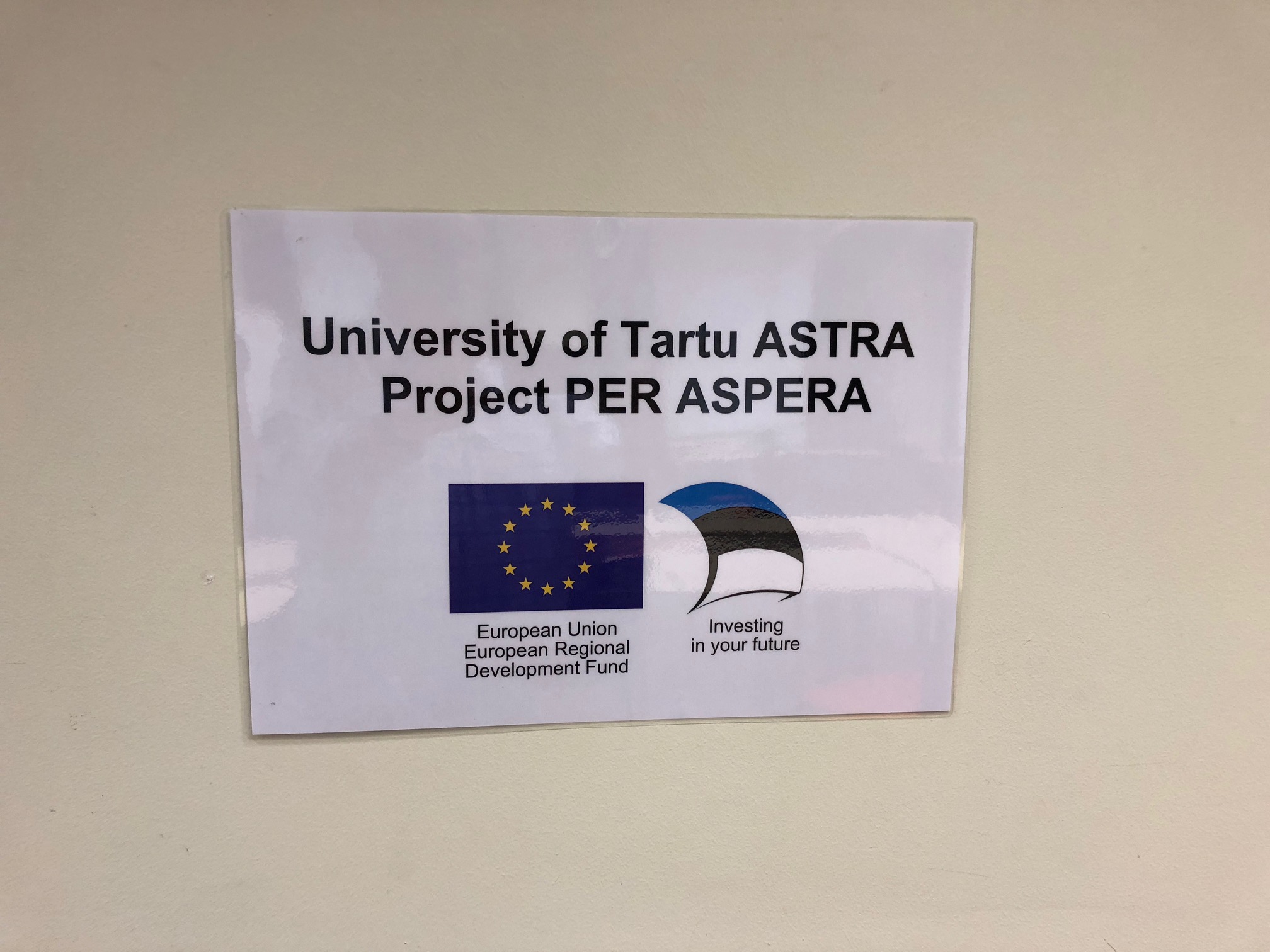
My course on “Getting the Most Out of Peer-Review” was generously supported by the European Union, thus this sign was posted during class sessions.

From colleagues in these departments, I also gained a deeper understanding of their impressive publishing work. Highlights include the Journal of Ethnology and Folkloristics (which I have long admired) and Studia Vernacula and a great diversity of monographs and edited volumes. Publication work in my fields is very advanced in the UT departments. The well-researched and beautiful books being produced related to Estonian craft techniques and histories are a marvel–little work of this quality is found in the United States.

I could continue at near endless length, but this is enough for now. I close for the moment with warm appreciation for all of the staff, faculty, and students who worked hard to make my visit possible and who shared so much of their work and passion with me. Thanks also go to the Fulbright Specialist Program and to the European Union, the University of Tartu, and other funding agencies that supported my activities.

IMG_5448

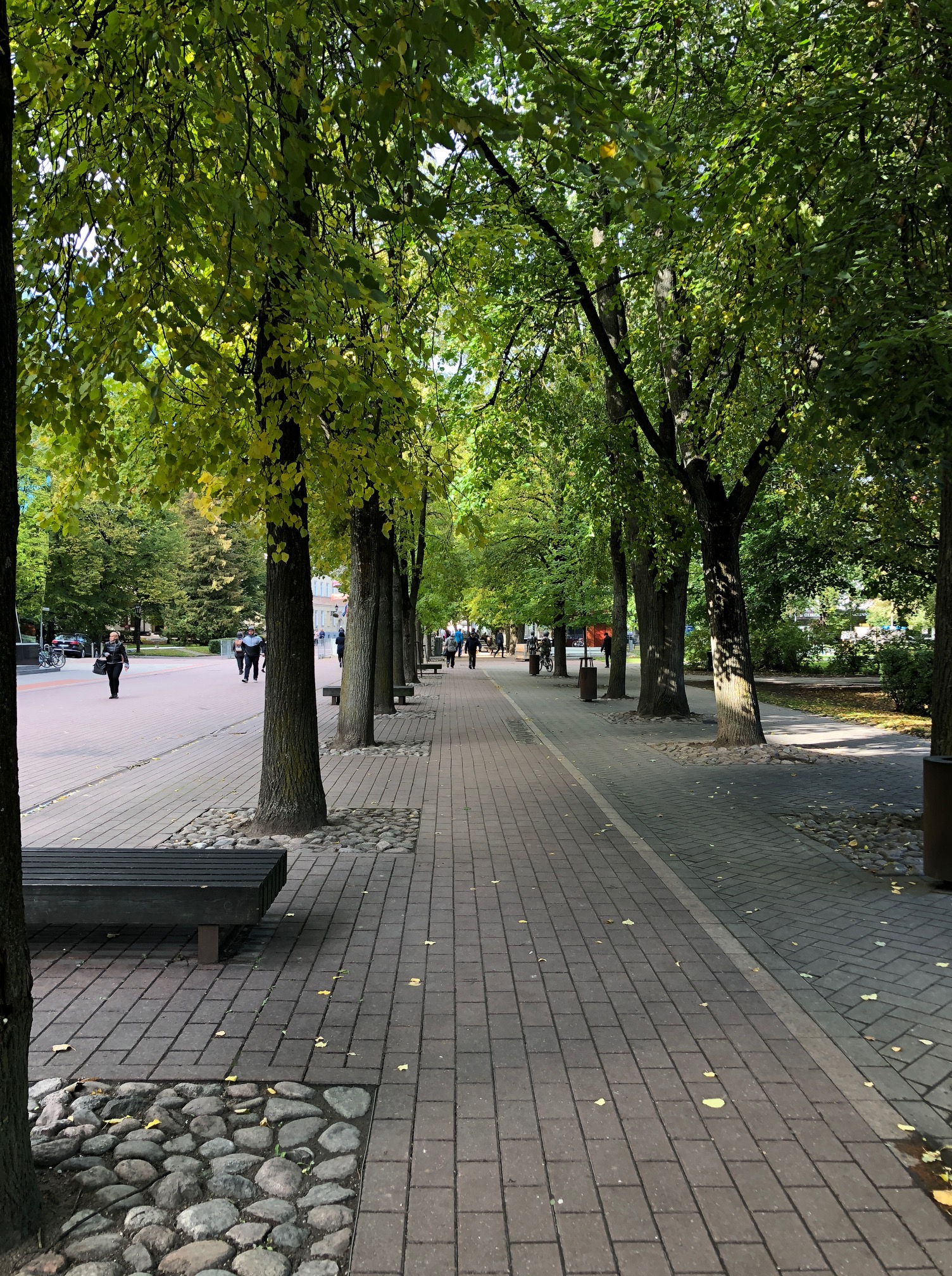
In downtown Tartu.

Material Culture Seminar, Spring 2019

Material Culture Flyer B

A Gallery Talk at Sam Noble Museum in Conjunction with the Putting Baskets to Work in Southwest China Exhibition

Chinese Baskets Talk Image

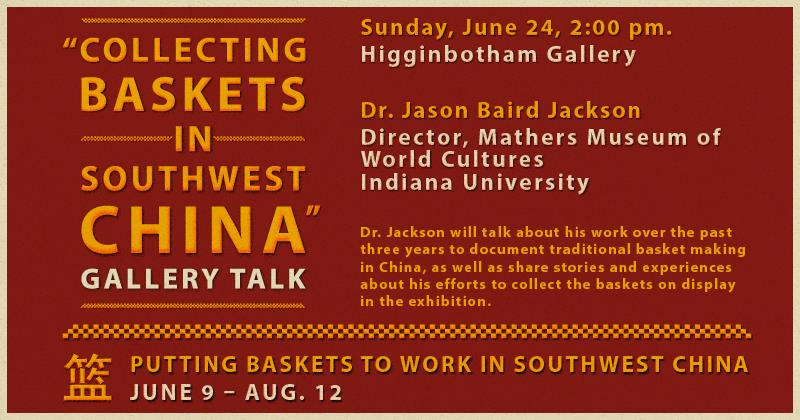
I will be doing a gallery talk at the Sam Noble Museum on Sunday, June 24 at 2:00 pm in the Higginbotham Gallery, which is where the exhibition Putting Baskets to Work in Southwest China is now on display.

Information on the event is available here: http://samnoblemuseum.ou.edu/calendar/gallery-talk-collecting-baskets-in-south-west-china/

The exhibition is discussed here: http://samnoblemuseum.ou.edu/permanent-exhibits/current-exhibits/

Everyone is welcome! Anyone who loves, for instance, river cane baskets (Cherokee, Choctaw, Creek, etc.) will enjoy seeing these bamboo work baskets.


The Mallet: Making a Maul in a Baiku Yao Community

This guest post by Jon Kay, Curator of Folklife and Cultural Heritage at the Mathers Museum of World Cultures provides Jon with the opportunity to share the first of the documentary videos arising from work that he and colleagues pursued together in Nandan County, Guangxi Zhuang Autonomous Region in December, 2017. It is the final post in a eleven-part series relating to travel in China and specific work in Nandan County that began with a post on January 2, 2018 and continued most recently through post 9, a guest post by Carrie Hertz of the Museum of International Folk Art. These earlier posts are accessible here 1, 2, 3, 4, 5, 6, 7, 8, 9, 10.

IMG_0770

Lu Bingzhao uses a billhook to make a wooden mallet or maul. December 15, 2017. Photograph by Kurt Dewhurst.

I was in Southwest China as part of a joint team of researchers from the United States, the Anthropological Museum of Guangxi, and the Nandan Baiku Yao Eco-Museum who were documenting basket and textile traditions of the Baiku Yao people in Nandan County, in the Guangxi Zhuang Autonomous Region.

Our team visited a home in Manjiang village to inventory the baskets collected and used by a local family. As the fieldworkers worked photographing and measuring baskets, Mr. Lu Bingzhao came into the house and picked up a mallet, which he showed everyone and then went outside. I did not speak Mandarin or the local Baiku Yao dialect, but I felt he had something he wanted to show us. I went outside and saw him lay the mallet on the trunk of small felled tree in order to get a rough measurement; it was then that I realized he was going to make a mallet. I grabbed my camera and began shooting. I didn’t have a tripod with me, so I didn’t expect to shoot the entire process, but I became enthralled with how the elder worked. Two of his grandchildren played nearby, and they often stopped to watch him work and to interact with him.  Neighbors and family members stopped by to visit as they returned home from picking greens.  Mr. Bingzhao worked steadily as people came and went. He was skilled at using the billhook. With heavy chops, he used the hook to quickly remove the excess wood. Then he delicately shaved the mallet’s handle smooth, using a pulling motion. Finally at the end of the video, just as he completes the mallet, he gives it to his daughter-in-law. Tree became tool and gift in little more than an hour.

I was told that mallets, like the one made in this video, are commonly used to pound rice straw for sandals and to set the poles for warping a loom, the later activity I witnessed the next day when a group of weavers came to the Nandan Baiku Yao Eco-Museum office, where I was staying. I am sure the mallet probably has many other uses in the daily life of the community. For sure, the young woman would find utility in the gift. This video was totally unplanned, as the shaky recording and odd camera angles reveal, but I was compelled to edit this footage into this short portrait, to document the making of this tool. Reflecting reoccurring themes in my scholarship, it also demonstrates how craft can connect an elder to his family and community.”


Technical Note: The video was shot with a Canon 80D camera with a RØDE stereo microphone attached to the camera’s hot-shoe mount.

Fieldwork: Highlights from the Textile Group

This post in the recent series on December 2017 research and travel in Guangxi, China was written by Carrie Hertz, who also provided the photographs.

In this post, I complement Jason’s series of field reports (1, 2, 3, 4, 5, 6, 7, 8, 9) on our December 2017 trip to China with some highlights from the research team focused on Baiku (White Trouser) Yao textiles.

The textiles most visible in daily life are traditional baby carriers and women’s dress. December 15, 2017.

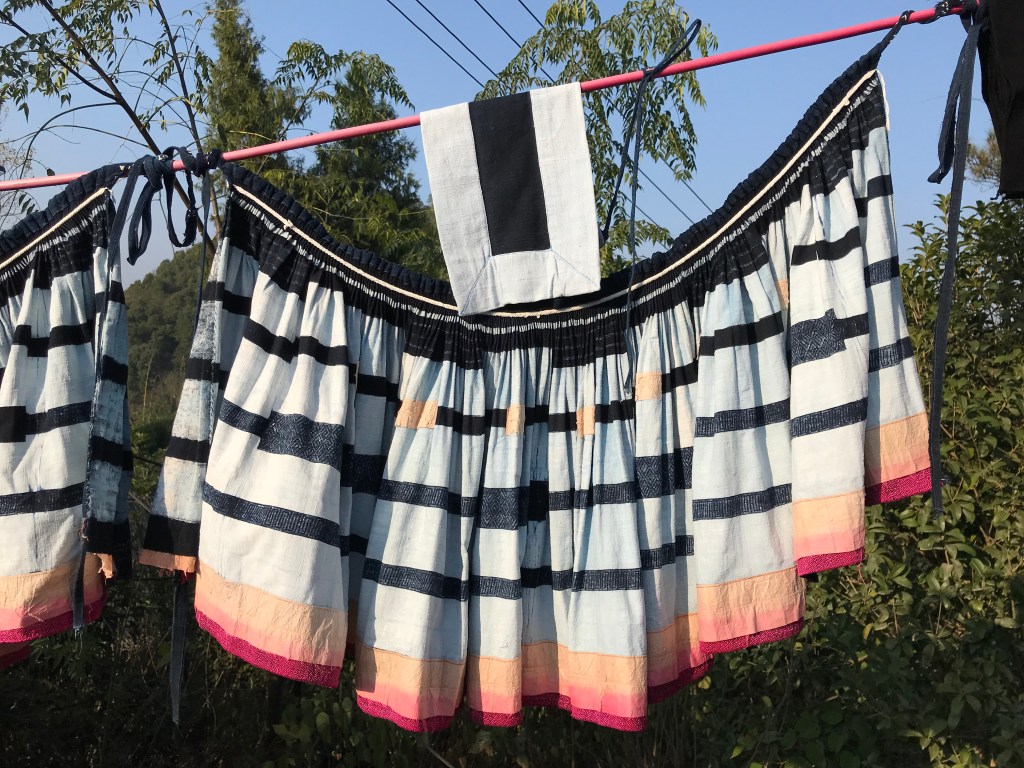
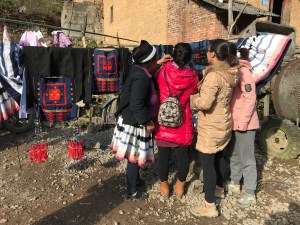
Textile making traditions are extraordinarily strong in Huaili village. In most households you can find a floor loom, an indigo dye pot, and a cache of tiny silkworm eggs. Because of the damp climate, most families hang their laundry out to dry. Strung out like banners across rooftops, balconies, pathways, and side yards, the clotheslines offer a visual inventory of typical wardrobes.

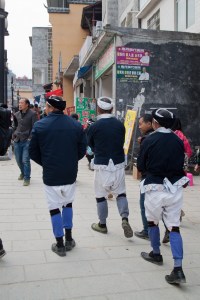
Daily dress combines traditionally made and mass-produced garments. Most women have several sets of indigo-dyed skirts, aprons, jackets, and tunics in regular rotation, the finest serving as festival dress when new, and as daily wear when faded. With age, the natural red dyes of embroidered skirt hems bleed, creating a beautiful ombre effect, and the appliqued silk felt disintegrates, taking on a feathery appearance.

A beautifully aged skirt hung out to dry. December 17, 2017.

Each garment represents countless hours of skilled labor, spread out throughout the year. Winter, while fields lie untended, is a busy time for textile production. Throughout the village, small groups of women huddle around fires on their front stoops, busy with embroidery or winding spools of cotton.

Lu Xiao Mei works on her embroidery while visiting with Li Xiu Ying and Wang Lian Mei holding her baby. December 15, 2017.

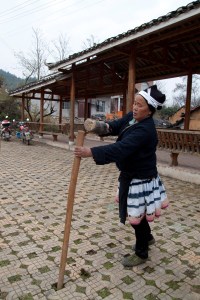
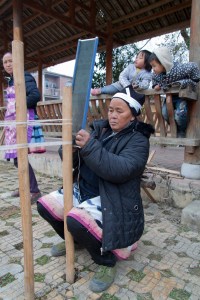
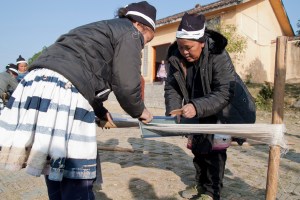
Winter is also a good time for warping looms. Women help each other, taking over the village courtyard. It takes the better part of a day to set up warp poles and wind the approximately 80 meters of thread in a spiral pattern around them.

The tree sap used to draw intricate resist patterns on clothing is harvested in winter. The bark is scarred and glistening where people have gouged it with their knife blades.

December 14, 2017.

We had the great fortune to spend two days with a recognized master textile artist, He Jinxiu. She is considered the most skilled and knowledgeable needleworker in Huaili village and teaches embroidery and resist dyeing to all of the girls attending the local primary school. At her home, she brought out stacks of textiles that she was currently working on as part of a yearly cycle of production. Together we inventoried these materials, along with the tools, techniques, and terminology important to their creation. We diagrammed garment patterns. We filled notebooks with the local names for various motifs and their significance.

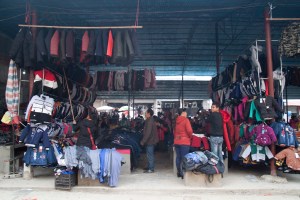
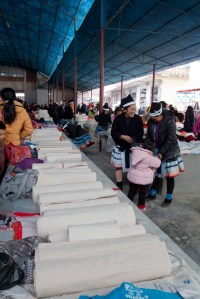
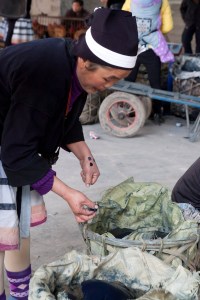
The home production of textiles is supplemented with supplies and finished goods purchased in the Lihu Town market. Alongside the many stalls stuffed with factory clothes and accessories, vendors sell silk embroidery thread, stylus for batik, and bolts of undecorated, hand woven cloth. A large area is devoted to selling indigo. One half kilogram costs about 6 RMB. In addition to being an important venue for textile sellers and makers, market days are for dressing up, for looking and being seen.


We also had opportunity to interview Li Xiu Ying, the primary textile producer in her family. For most of her life, her mother made her clothes, but now she makes clothes for her mother, using the skills her mother imparted.

Li Xiu Ying wears a handmade needle case hanging from her belt. Her nail beds are ringed with blue from indigo dye. December 15, 2017.

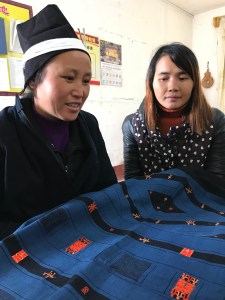
With Mrs. Li, the textile team examined a traditional burial cloth, part of the ecomuseum’s permanent collection. Every household hopes to always have a few of these on hand. When villagers die, the cloth is laid over the body and a series of smaller cloths, thirteen layers for men and fourteen for women, cover the face.

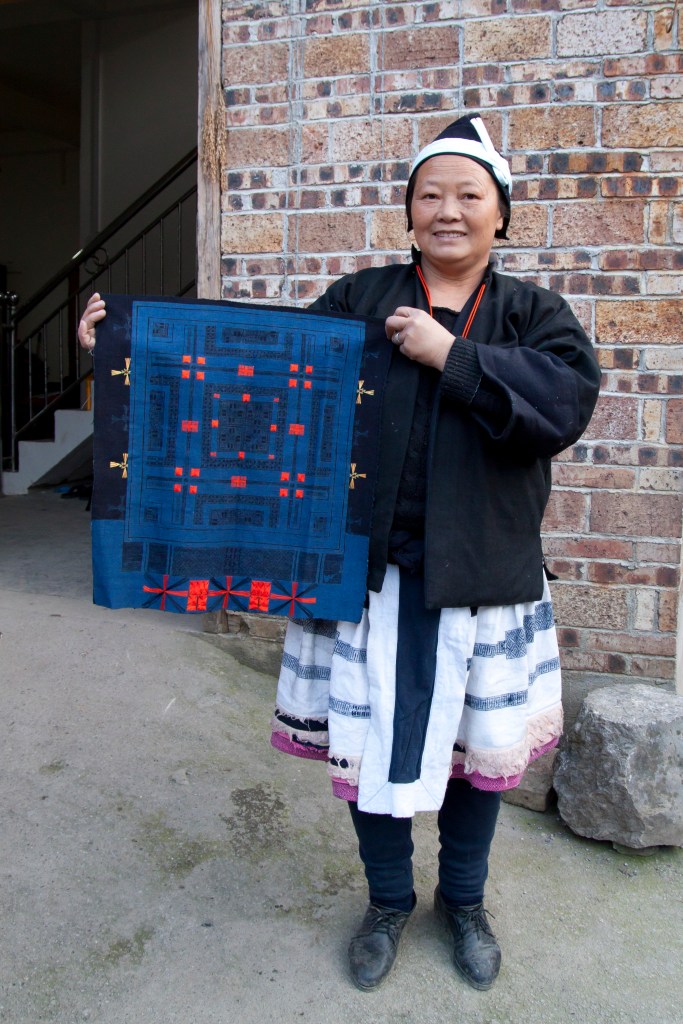
A woman’s burial face cloth made by He Jinxiu is now in the collections of the Museum of International Folk Art.


He Jinxiu holding up a woman’s burial face cloth that she made, now in the collections of the Museum of International Folk Art. December 17, 2017.

The textile research team feels incredibly grateful to those who shared their time and knowledge with us. These brief highlights merely touch upon what we learned and experienced during our visit.

Carrie Hertz is Curator of Textiles and Dress at the Museum of International Folk Art and a participant in the China-US Folklore and Intangible Cultural Heritage Project.

The Ethnic Costume Museum at the Beijing Institute of Fashion Technology (12/9)

In the previous post in this series, I described how my traveling companions and I visited Beijing’s 798 Art Zone. (For the series in order, see 1, 2, 3, and 4.) After that stop on December the 9th, we visited one more Beijing museum. This one was a new one for everyone. Carrie researched it and put it on our agenda—The Ethnic Costume Museum at the Beijing Institute of Fashion Technology (BIFT). We were uncertain what to expect, but we speculated that it would be a small university museum.

It won’t take many words to tell the story. We were extremely impressed. The museum is not richly contextualizing and interpretive in approach (as more and more university museums work to be) but its collections are outstanding and they are beautifully presented in large, comfortable galleries. For scholars interested in dress, adornment, and textile history in China, it is a definite must-see.

The museum is located on an upper floor of a multi-use academic building in the midst of the BIFT campus. Discovering this, one presumes further that the space will be small, as many similar university galleries in the United States often are. But on arrival up the stairs, this speculation is dispelled. The galleries go on and on. You can check out an English language web page for the museum here: http://english.bift.edu.cn/department/ethniccostumemuseum/index.htm It begins:

The Costume Museum at the Beijing Institute of Fashion Technology (BIFT), founded with the approval of Beijing Municipal Administration of Cultural Heritage, is the first museum specializing in ethnic costumes in China. The Museum is also a cultural research institute integrating collection, display, research, and teaching.

BIFT Costume Museum covers a floor space of 2,000 square meters, with several major exhibition halls: Han Nationality Costume Hall, Ethnic Minority Costume Hall, Miao Nationality Costume Hall, Metalworking Jewelry Hall, Brocade Embroidery and Wax-printing Hall, Olympic Uniform and Ceremony Costume Hall, Picture Hall, and Hands-on Workshop (for teaching and academic exchange).

As the top specialized costume museum in China, it has a fine collection of over 10,000 pieces of costume, accessories, fabric, wax printing, and embroidery. The collection is displayed in different categories, such as costumes of Miao nationality, metalworking jewelry, folk wax printing, and fabric. The museum also has a collection of nearly 1000 precious photographs taken during the 1920s and 1930s featuring the ethnic costumes of Yi, Zang, and Qiang nationalities.

That is all true. Here I share some of our photographs from the visit, which was the high point of our day and great preparation for the work we would begin in Guangxi the next day.

When we arrived, we noticed a sign that indicated that no photography was allowed. This left us crestfallen. We started taking in the exhibitions and noticed that all the other visitors were taking pictures and that the staff was completely aware of this. On investigation, it was flash photography that was prohibited. As a result of these factors, as well as the appropriately dark galleries (appropriate because textiles are being put on display for extended periods, raising the problem of light damage) our photographs are dark and rushed.

In honor of our generous hosts in Nandan County, I present the Baiku Yao men’s outfit on display at the museum before posting a sample of other images from the museum.

IMG_0209

The “Men’s attire of the white-pants Yao branch of the Yaozu people” at the Museum of Ethnic Costumes. December 9, 2017. Photograph by Jason Baird Jackson.

The IU Gateway Office and Tsinghua University Art Museum (12/8)

This post is about a portion of my recent trip to China. The main focus of this trip was collaborative ethnographic research in Guangxi Zhuang Autonomous Region, but other activities happened along the way. This post about the morning of December 8, 2017 and my companions for the day were two friends and colleagues–Dr. Carrie Hertz, Curator of Textiles and Dress at the Museum of International Folk Art and Dr. Jon Kay, Director of Traditional Arts Indiana and Curator of Folklife and Cultural Heritage at the Mathers Museum of World Cultures, Indiana University.

After traveling from the U.S. to Beijing, our first morning in China was devoted to a visit to the Indiana University China Gateway Office, which is adjacent to Tsinghua University in Beijing. There we met with China Gateway Director Steven Yin and IUPUI Recruitment Coordinator and Assistant Office Manager Peter Wen. We spent some time at the Gateway discussing China-related projects (including our own) and then Peter walked us across the Tsinghua campus for our visit to the remarkable Tsinghua University Art Museum (TAM), where Steven had arranged for us to meet with colleagues and see the museum.


At TAM we met with Ge Xiuzhi from the research department and Wang Ying from the education and external relations department. They were generous hosts with whom we shared tea and luxurious visits to the museum’s spacious and beautiful galleries. Our interests gravitated to some of our favorite topics–textiles and dress, architecture, and furniture. Here are some images from “Architecture China,” an exhibition that tells the story of a group of vernacular architecture researchers while also introducing architecture students (and everyone else) to the key techniques in the national architectural tradition.


A key exhibition at TAM at present is a large overview exhibition titled “Tsinghua Treasures: Exhibition of Tsinghua University Art Museum Collection.” It is very large and presents a rich sample of the museum core collection. As reflected in this sample of our images, we devoted a lot of time to the textile section, which is rich in items of dress and adornment.


We could have spent more than one day just studying the various sections of Tsinghua Treasures. We regretted neglecting some wonderful sections, including those devoted to ceramics, painting, and calligraphy.


We focused intently on the furniture gallery. As with the architecture exhibition, there were excellent hands-on educational stations in this gallery that helped one better understand the techniques and woods used in Chinese furniture.


Staff from the Tsinghua University Art Museum visited Indiana University during May 2017. On that visit I attended a presentation at the Eskenazi Museum of Art at which the Eskenazi staff (and I) were given a exciting overview of this new museum’s work and collections. It was wonderful to be able to follow up on this presentation and to see the TAM itself in the company of very generous hosts and my wonderful colleagues.

Our visit to the Tsinghua University Art Museum

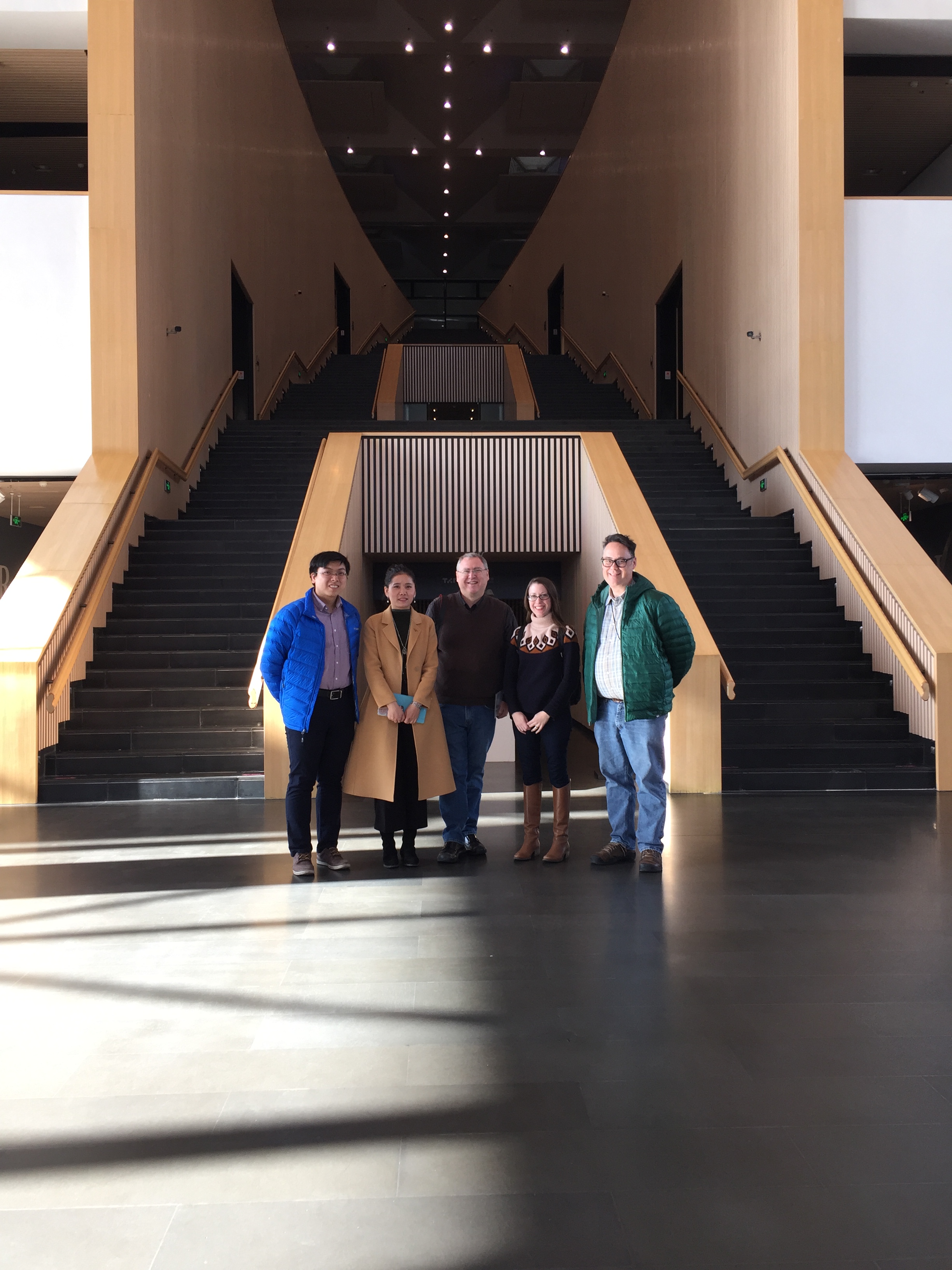
A view of our group and the grand staircase at the Tsinghua University Art Museum. (L-R) Peter Wen, Ge Xiuzhi, Jon Kay, Carrie Hertz, Jason Jackson. December 8, 2017. Photograph courtesy of Ge Xiuzhi.


Framing Sukkot: Tradition and Transformation in Jewish Vernacular Architecture

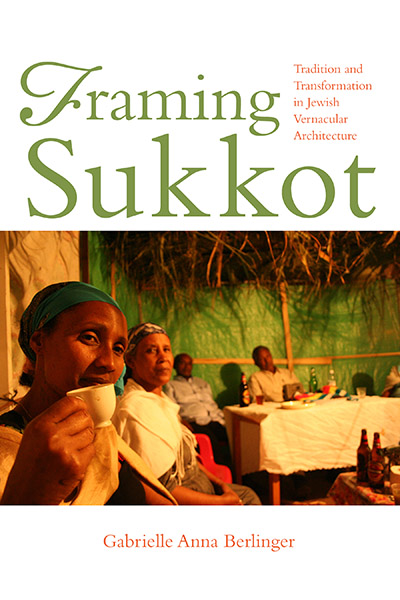
Just in time for the holiday that is at its center, I am happy to trumpet the publication of Framing Sukkot: Tradition and Transformation in Jewish Vernacular Architecture by Gabrielle Berlinger. Framing Sukkot is the third title in the Material Vernaculars series and it is appearing in the world just as the Jewish holiday of Sukkot is about to begin for 2017/5778!

Here is how Indiana University Press introduces Professor Berlinger’s new book:

The sukkah, the symbolic ritual home built during the annual Jewish holiday of Sukkot, commemorates the temporary structures that sheltered the Israelites as they journeyed across the desert after the exodus from Egypt. Despite the simple Biblical prescription for its design, the remarkable variety of creative expression in the construction, decoration, and use of the sukkah, in both times of peace and national upheaval, reveals the cultural traditions, political convictions, philosophical ideals, and individual aspirations that the sukkah communicates for its builders and users today.

In this ethnography of contemporary Sukkot observance, Gabrielle Anna Berlinger examines the powerful role of ritual and vernacular architecture in the formation of self and society in three sharply contrasting Jewish communities: Bloomington, Indiana; South Tel Aviv, Israel; and Brooklyn, New York. Through vivid description and in-depth interviews, she demonstrates how constructing and decorating sukkah and performing the weeklong holiday’s rituals of hospitality provide unique circumstances for creative expression, social interaction, and political struggle. Through an exploration of the intersections between the rituals of Sukkot and contemporary issues, such as the global Occupy movement, Berlinger finds that the sukkah becomes a tangible expression of the need for housing and economic justice, as well as a symbol of the longing for home.

As I noted in discussing the edited collection Material Vernaculars: Objects, Images, and Their Social Worlds last fall, it is my hope that many readers will purchase a beautiful paper or hardback edition of Framing Sukkot, thereby helping support the work of a great university press. One of the things that makes IU Press great is its commitment to building strategies for free and open access to scholarly writings. The Material Vernaculars series, co-published with the Mathers Museum of World Cultures, is part of that commitment. So, first let me note that you can buy copies of the book from a range of online booksellers, including Amazon and the IU Press itself. Secondly, let me show you where the free digital edition of the book lives. Hopefully by the time Sukkot ends, people around the world will be reading this great new book.

To access the free PDF version, click on the image below or go to this URL https://scholarworks.iu.edu/dspace/handle/2022/21232

Once you are there, click on the “View/Open” link as shown in the image. Clicking should enable you to download a copy of the book.

Dr. Berlinger is an Assistant Professor of American Studies and Folklore at the University of North Carolina at Chapel Hill, where she is also the Babette S. and Bernard J. Tanenbaum Fellow in Jewish History and Culture within the Carolina Center for Jewish Studies. In addition to the new book, you can find a moving Sukkot-oriented post by Dr. Berlinger on the IU Press blog.

Check out Framing Sukkot!

Guest Post: An Encounter with Basket Traditions in Zanzibar City

I am very happy to here share a guest post by Kurt Dewhurst and Marsha MacDowell of the Michigan State University Museum, East Lansing, Michigan, USA.

Traditions of handmade, woven basketry is alive and well in communities around the world. After attending the launch of the Alliance for African Partnerships organized by Michigan State University with African partners in Dar es Salaam, Tanzania, in July 2017, we decided to journey to the island of Zanzibar where we stayed in Stone Town. Stone Town (the old portion of what is also known as Zanzibar City) was designated as a UNESCO World Heritage Site in 2010. It takes its name from the coral stone buildings of the 19th century that were constructed on the site of an old fishing village.

Unknown

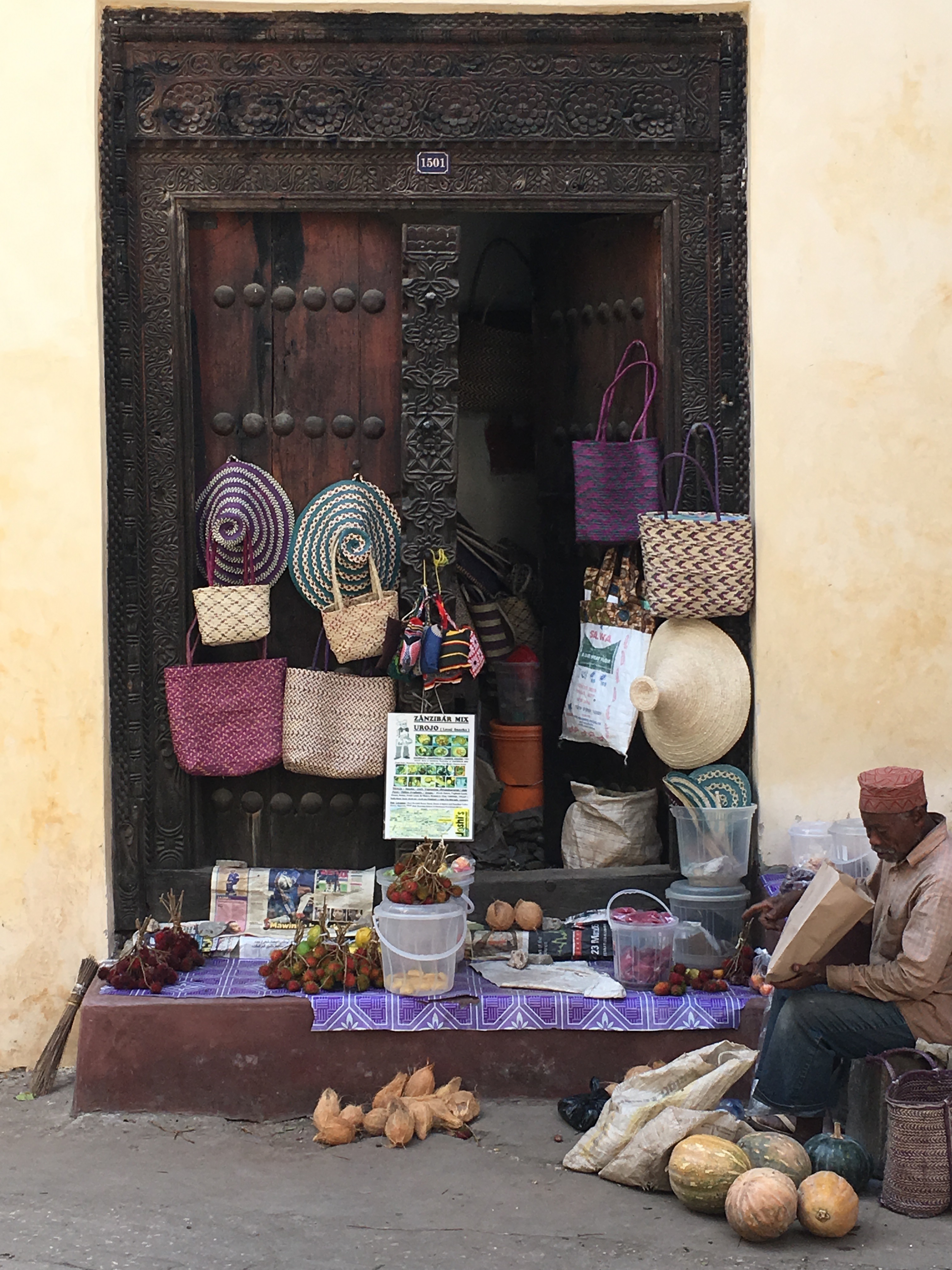
Figure 1: A Vendor selling baskets, vegetables, and other items next to Emerson Spice Guest House

Immediately after disembarking from the ferry from Dar es Salaam, we found ourselves in a truly mesmerizing environment. Stone Town, perhaps best known for its contested colonial past and a legacy of being a major site for the slave trade in East Africa, is replete with tall houses of Arabic and Victorian-era architecture, women garbed in beautiful kanga textiles, and maze-like thoroughfares so narrow that pedestrians, bicyclists, and moped riders all work hard to avoid collisions. The sounds of muezzin making calls to prayer five times daily from the over fifty mosques in Stone Town create a memorable soundscape. The sounds and visuals create a unique cultural space where the convergence of historical influences of Arab, Persian, Indian, and European cultures can be readily glimpsed.

Unknown-1

Figure 2: The Malcolm X shop selling baskets, fez, clothing, and food

We found ourselves exploring alleyways filled with small stalls and stores catering to the tourist trade that carries the Stone Town economy today. As folklorists with a passion for seeking out locally made material culture and with a deep interest in basket traditions, we found ourselves drawn to the presence of new and old baskets that were being used functionally for a variety of purposes as well as being sold along with other crafts, paintings, and clothing. In many displays of items for sale, baskets were often carefully arranged to aesthetically appeal to customers.

Unknown-2

Figure 3: The Moto Women’s Craft Cooperative

We were pleased to find traditional Zanzibar baskets being sold in several tourist-oriented shops, and were especially pleased to find one shop–Moto Cooperative–that represented many examples of baskets made by women in a craft cooperative. The stated goal of the Moto (Swahili for “heat”) Cooperative is to support the development of the rural economy. The project aims to recover and sustain high quality traditional weaving and to seek out new markets locally and internationally to support the weavers and weaving families. The cooperative stresses that they are “empowering women, reviving a cultural heritage, and building sustainability.” Currently Moto has nine villages and 19 cooperatives with over 200 women (and some men) engaged in this effort.

Unknown-3

Figure 4: Display of baskets, hats, and purses at Moto Women’s Craft Cooperative

The baskets made in this cooperative are produced in the centuries-old ukili weaving tradition. Relying on soft palm fibers from mkindu and mvumo palm trees, the weavers seek to revive the tradition in the face of the growing replacement of traditional baskets by plastic bags and mass produced forms. They do this not only through weaving in traditional techniques and patterns but also by planting palm trees for future materials for their baskets. They use mostly natural dyes and, in a quest for sustainable resources, incorporate solar cookers to prepare the dyes.

Unknown-4

Figure 5: “Pointy cone-style” baskets at the Moto Women’s Craft Cooperative

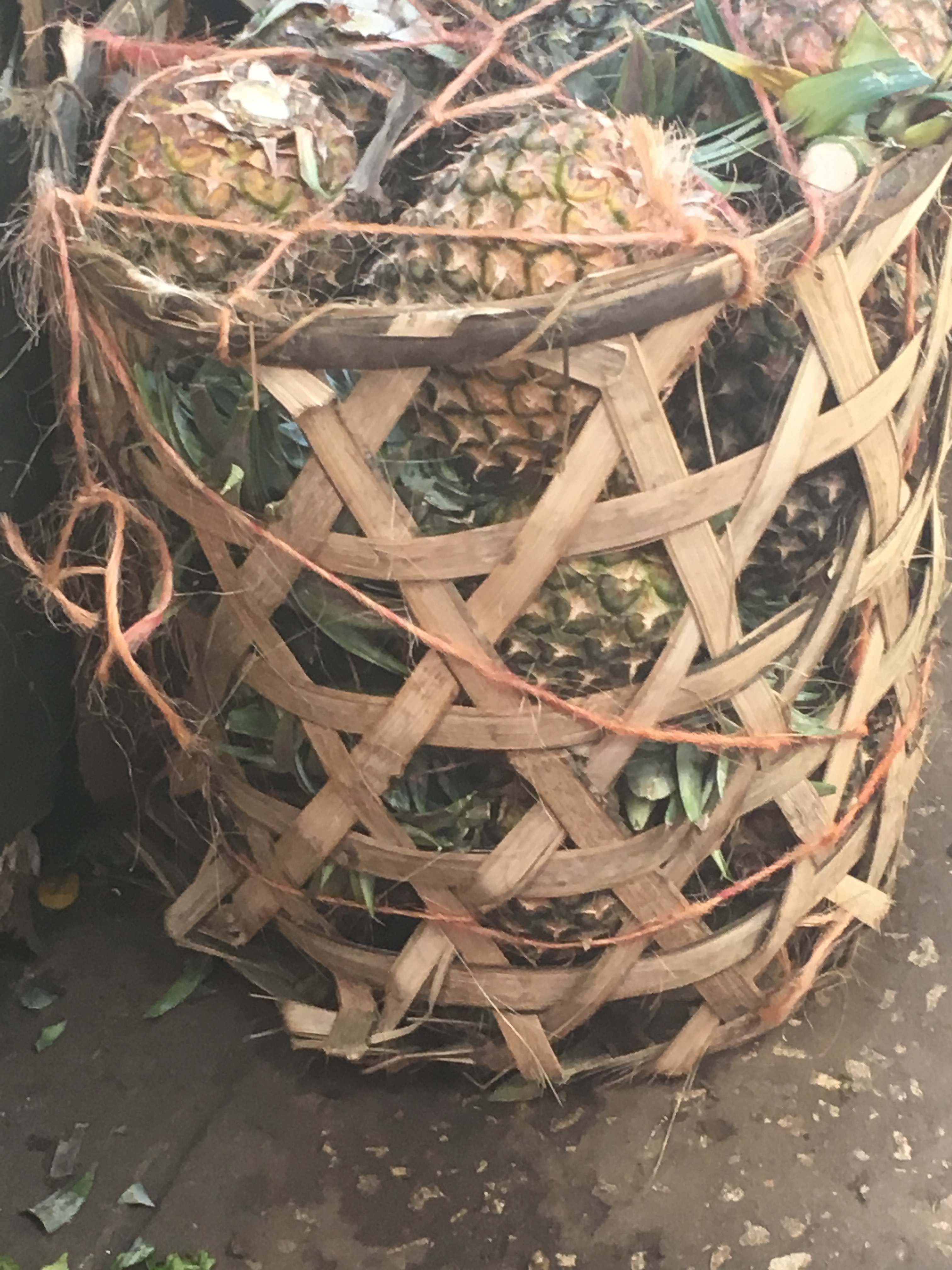
It was wonderful to see the prevalence of large, open-weave bamboo working baskets being used by vendors in the fruit, spice, vegetable, and fish markets. In fact, we saw these rough-hewn, large, durable baskets in many sizes and shapes being used by individuals to carry almost any item – by hand, bike, or truck. We had seen similar kinds of working baskets in China, but made there primarily of bamboo. These baskets seem to have been made by flexible wooden fibers from local trees and they were woven and then tied off with strands of wood fiber. We learned that there was a place on the edge of Stone Town where most of these baskets were made and sold for local vendors or workers. We look forward to investigating that on a future trip We came away inspired to learn more and share our experience in the hopes that we might connect with others who know much more about the basket making traditions of Zanzibar.

IMG_1102

Figure 6: A work basket at rest in Stone Town

IMG_1162

Figure 7: A bicycle basket in Stone Town

IMG_1166

Figure 8: A basket of pineapples in Stone Town

IMG_6849

Figure 9: A motorbike basket in Stone Town