Skip to content

Posts from the ‘Material Culture’ Category

Museum Anthropology 32(2) and IU Folklore and Ethnomusicology

This past summer, my editorship of Museum Anthropology slowly wound to a stop. I saw tonight that the final issue of my term has now been posted online (behind a toll wall) in Wiley InterScience. It should thus appear in AnthroSource very soon and then it will show up in mailboxes. One of the consistent pleasures of the editorship has been publishing the work of smart and talented colleagues with whom I work here at Indiana University. The final issue 32(2) contains reviews or review essays by several of these friends.

Arle Lommel provided a review essay titled “From Galleries and Catalogues to Websites: Three Online Musical Instrument Exhibitions” (pp. 111-113).

Gabrielle A. Berliner authored two reviews for the issue.  One of the digital exhibition “Keeping the Faith: Judaica from the Aron Museum” (pp. 117-118) and one is of the book Jews and Shoes edited by Edna Nahshon (pp. 152-154).

Teri Klassen reviewed the book Texas Quilts and Quilters: A Lone Star Legacy by Marcia Kaylakie with Janice Whittington (pp. 134-135), while a second quilt book–Contemporary Quilt Art: An Introduction and Guide by Kate Lenkowsky (pp. 160-161) was reviewed by Janice E. Frisch.

Michael Dylan Foster’s contribution to the issue is a review of How to Wrap Five Eggs: Traditional Japanese Packaging by Hideyuki Oka and Michikazu Sakai (pp. 154-155).

An alumnus of our department, Katherine Roberts (now on the faculty of the University of North Carolina Chapel Hill) reviewed the book Sacred and Profane: Voice and Vision in Southern Self-Taught Art edited by Carol Crown and Charles Russell (pp. 122-124).

Finally, a DVD produced by our colleague Jon Kay (who is the director of Traditional Arts Indiana) was reviewed by Chris Goertzen of the University of Southern Mississippi. The film is Crafting Sound: Indiana Instrument Builders and it appear on page 119-120 in the new issue.

Thanks to everyone in (and of) the Department of Folklore and Ethnomusicology who worked so hard to help Museum Anthropology thrive over the past several years.

Teri Klassen in JAF

Congratulations to Teri Klassen on the appearance of her latest research article “Representations of African American Quiltmaking: From Omission to High Art” in the new issue of our field’s flagship journal, The Journal of American Folklore.  The article can be found online in ProjectMuse and in the paper issue, which should be hitting mailboxes soon.

100 Summers Exhibition Opens at SNOMNH

I am pleased to note the openning of the “One Hundred Summers: A Kiowa Calendar Record” exhibition at the Sam Noble Oklahoma Museum of Natural History in Norman. I have not yet heard how the openning events have gone, but I look forward to seeing the exhibition myself this summer.  Learn more about the show here.  Find the associated book, authored by Candace Greene and published by Nebraska, here.

New Exhibits!

I am late posting on them, but I want to celebrate two new exhibitions at the Mathers Museum that were curated by IU doctoral students, both of whom are minoring in Folklore. Jim Seaver (an alum of my Curatorship and Theories of Material Culture courses and a history doctoral student) curated “A World of His Own: The Uncommon Artisty of Chester Cornett.” The exhibition looks at the work of a Kentucky chairmaker whose life and art were originaly documented in the dissertation and later books produced by folklorist Michael Owen Jones. The Mathers staff really outdid itself in helping Jim realize his vision. The exhibition includes a number of innovate custom display elements, incuding a shotgun house with a front poarch on which to display Cornett’s chairs.

The second new exhibition is “Clothes, Collections and Culture… What is a Curator? Undertaken by Lori Hall-Araujo, a doctoral student in the Department of Communication and Cuture, the exhibition utilizes the Royce Collection of Isthmus Zapotec Textiles and Clothing to examine the behind the scenes work of museum curators.

Both exhibitions are visiually and intellectually compelling and both were vigorously celebrated at a joint exhibition openning last Friday evening. Congratulations to Lori and to Jim and to the entire Mathers Museum staff. Wonderful!  Learn more here and here.

Cashman on the Visual Culture of Northern Ireland

Congratulations to Ray Cashman, who has just published an article in the Journal of Folklore Research (JFR) interpreting the verbal and visual culture of Northern Ireland. JFR is as toll access journal, but I can pass on the abstract and encourage everyone to track the article down in print or behind the pay wall.

Murals, graffiti, flags, and annual commemorative parades are common in urban Northern Ireland where Irish Catholic nationalists and British Protestant unionists use these vernacular forms of custom and material culture to reiterate their differential identities in terms of ethnicity, denomination, and politics. Rural areas, on the other hand, present a very different visual scene with far fewer public visual displays broadcasting political messages and affiliations. Nevertheless, this lack does not necessarily signify that rural dwellers are somehow less politically minded or more peacefully integrated in comparison to their urban counterparts. Moving beyond the visual scene alone, we must pay attention to how rural dwellers contextualize their seemingly unmarked environment through oral legendary and personal narrative. In particular, the oral traditions of one rural, majority-nationalist community in County Tyrone demonstrate significant differences between urban and rural ways of imagining and internalizing the Irish Catholic nationalist cause. Many urban murals, for example, focus outward, gesturing to a secular, cosmopolitan, and international consciousness, while the Tyrone landscape—as contextualized by oral tradition—focuses inward on the local, autochthonous, and sacred. Despite advances in an on-going peace process, this rural, radically emplaced vision of the Irish nationalist cause may well have significant staying power.

Ray Cashman (2008 ) “Visions of Irish Nationalism.” Journal of Folklore Research: An International Journal of Folklore and Ethnomusicology. 45(3):361-381.

Summer Institute in Museum Anthropology

From a Dear Colleague Letter from Candace Greene, Director of the Smithsonian Institution Summer Institute in Museum Anthropology (SIMA):

Dear Colleagues – I am pleased to announce a new research training initiative being launched by the Smithsonian Department of Anthropology with support (pending) from the National Science Foundation.

The Summer Institute in Museum Anthropology is an intensive four-week training program that will teach graduate students how to use museum collections in research, incorporating Smithsonian collections as an integral part of their anthropological training. Support from the Cultural Anthropology Program at NSF will cover full tuition and living expenses for 12 students each summer.

Please help us get the word out on this program, which will begin in June 2009 and is already accepting applications. Full information including application instructions and dates is available at http://anthropology.si.edu/summerinstitute.

Candace Greene
Director, Summer Institute in Museum Anthropology
Ethnologist, Collections and Archives Program
Department of Anthropology
National Museum of Natural History
Smithsonian Institution

One Hundred Summers

I am pleased to note that One Hundred Summers: A Kiowa Calendar Record, a book by my friend Candace S. Greene, has just been released by the University of Nebraska Press. Candace’s study is an important outcome of a project that I initiated while serving as Assistant Curator of Ethnology at the Sam Noble Oklahoma Museum of Natural History. Through text and color images, the book presents and interprets a remarkable pictoral calendar by the Kiowa artist Silver Horn.  Covering 100 years of Kiowa tribal history, the calendar was donated to the museum during my tenure at SNOMNH. With IMLS funding, teaching materials have been prepared to faciliate use of the calendar in K-12 contexts. In addition, my friend Daniel Swan, the current SNOMNH curator of ethnology is preparing an exhibition focused on the calendar. In the period since the project began, the fragile calendar has been completely conserved and stabilized with funding provided by the Save America’s Treasures program. My friend Victoria Book, SNOMNH’s conservator supervised this effort working with paper conservation specialist Ellen Livesay-Holligan.

The University of Nebraska Press has done an exceptional job in designing the book. It is really beautiful. Check it out and help spread the word.

100_summers

Teri Klassen on Depression-Era Quilters and their Uses of Domestic Space

Congratulations to Teri Klassen on the publication of her new paper “How Depression-Era Quiltmakers Constructed Domestic Space: An Interracial Processual Study” in the journal Midwestern Folklore (Klassen 2008). This fine peer-reviewed paper draws upon research reported in her M.A. thesis (Klassen 2007) exploring neglected aspects of the wider social history of quilting in the United States.

Klassen, Teresa Christine

2007 Historical Ethnographies of Quiltmaking. M.A. Thesis, Department of Folklore and Ethnomusicology, Indiana University.

Klassen, Teri

2008 How Depression-Era Quiltmakers Constructed Domestic Space: An Interracial Processual Study. Midwestern Folklore. 34(2):17-47.

Gabrielle Berlinger Defends M.A. Thesis

Congratulations to Gabrielle Berlinger who completed her M.A. in Folklore in the Department of Folklore and Ethnomusicology at Indiana University today with a very successful oral exam covering her studies in general and her thesis project “Ritual Interpretation: The Sukkah as Jewish Vernacular Architecture” in particular. Her well recieved thesis is an ethnography of Sukkot observance in Bloomington, Indiana, with an emphasis of the physical structures built and used by families and community organizations here. A significant contribution to research on Jewish material culture and to the study of Jewish life in the smaller communities of North America, the study is also a pilot project for future examinations of the topic in other communities elsewhere in the world. Her committee was uniformly pleased with her efforts and I am very proud to have served as her chair. Well done.

On The Grace of Four Moons

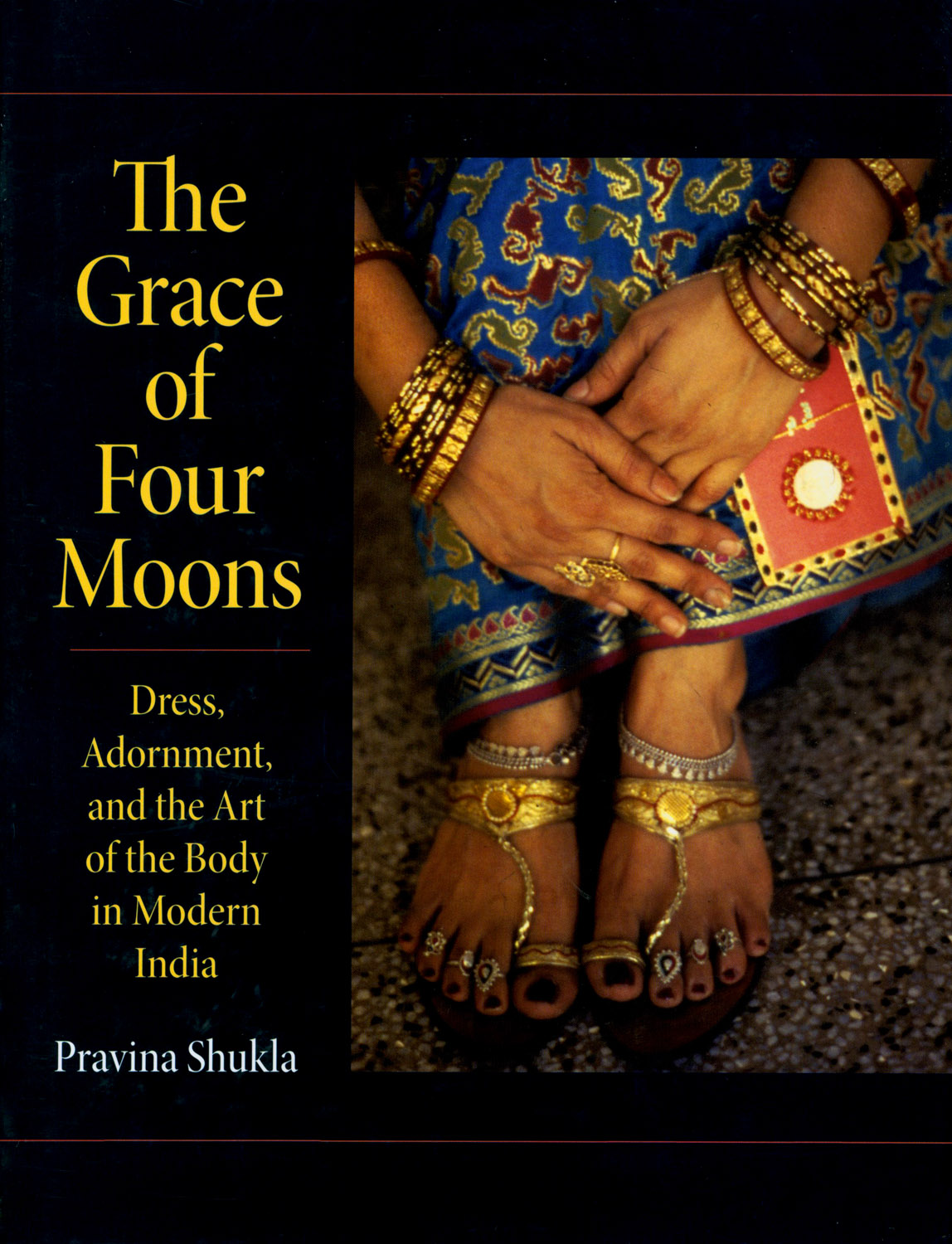
IU media relations has distributed a press release profiling my colleague Pravina Shukla’s fine ethnography of dress and adornment in India, The Grace of Four Moons, recently published by Indiana University Press. Find the release online here. (Image: Courtesy of Indiana University.)

The Grace of Four Moons (cover)

The Grace of Four Moons (cover)