Skip to content

Posts from the ‘Material Culture’ Category

Looplore: DIY/Crafts Summer Camp for Grownups

Folklorist Kelley Totten (MA, U Oregon) will soon join the Ph.D. program in folklore at Indiana University. (Welcome Kelley!)  Before arriving here, she and some colleagues are organizing the second Looplore event on July 22-24, 2011 at the Indian Henry Campground near Estacada, Oregon.  The first such gathering was held last year and it looks like it was a great success.  This DIY/crafts/music/food  summer camp for grownups looks to be even better this year.  To secure the longer term future of the gathering, the organizers have a Kickstarter campaign underway.  Even if you are unable to make a small donation to support them, seeing the excellent Kickstarter video that they made is a great way to learn both about the event and about what a wonderful resource Kickstarter is.  Check it out at http://www.kickstarter.com/projects/looplore/the-looplore-experiment .  Learn everything you might wish to know about the Looplore event at their website:  http://thelooploreexperiment.wordpress.com/

Tipi: Heritage of the Great Plains

I am very pleased to note the publication of the exhibition catalog Tipi: Heritage of the Great Plains. This book has been published by the Brooklyn Museum in cooperation with the University of Washington Press on the occasion of an exhibition of the same name that has been organized by the Brooklyn Museum and that will travel to the Autry National Center for the American West in LA and the Minnesota History Center in St. Paul. It is a beautiful book on a topic that long been of scholarly and general interest. The project has been organized by and the catalog edited by Nancy B. Rosoff and Suzan Zeller of the Brooklyn Museum. I am taking special notice of the book here because it includes contributions from three of my close friends and collaborators.  Daniel C. Swan and Michael P. Jordan (Sam Noble Oklahoma Museum of Natural History) have published a chapter titled “Tipis and the Warrior Tradition,” which focused on their collaborative work with Kiowa people and organizations and Christina E. Burke (Philbrook Museum) has published a chapter on “Growing Up on the Plains,” which explores child raising and associated material culture among the Native peoples of the Plains in the context of the tipi as vernacular architecture.

Time to Apply: Summer Institute in Museum Anthropology #SIMA

Summer Institute in Museum Anthropology (SIMA)
Supported by the Smithsonian Institution and the National Science Foundation
June 27 – July 22, 2011
Application deadline: MARCH 1

SIMA is a graduate student training program in museum research methods offered through the Department of Anthropology at the Smithsonian Institution’s National Museum of Natural History.  During four weeks of intensive training in seminars and hands-on workshops at the museum and at an off-site collections facility, students are introduced to the scope of collections and their potential as data.  Students become acquainted with strategies for navigating museum systems, learn to select methods to examine and analyze museum specimens, and consider a range of theoretical issues that collections-based research may address.  In consultation with faculty, each student carries out preliminary data collection on a topic of their own choice and develops (and continually refines) a prospectus for research to be implemented upon return to their home university.

Application Information

Who should apply?

Graduate students preparing for research careers in cultural anthropology who are interested in using museum collections as a data source. The program is not designed to serve students seeking careers in museum management. Students at both the masters and doctoral level will be considered for acceptance. Students in related interdisciplinary programs (Indigenous Studies, Folklore, etc.) are welcome to apply if the proposed project is anthropological in nature. All U.S. students are eligible for acceptance, even if studying abroad, as are international students enrolled in universities in the U.S.A. NOTE: First Nations people of Canada are eligible.

Costs

The program covers students’ tuition and housing, which is provided at a local university. A small stipend will be provided to assist with the cost of food and other local expenses. Participants are individually responsible for the cost of travel to and from Washington, DC.

Application deadline – MARCH 1, 2011

SIMA dates for 2011: June 27 – July 22

For more information and to apply, please visit http://anthropology.si.edu/summerinstitute/
Additional questions? Email SIMA@si.edu

CFP: Making Sense of Visual Culture

From a circulated call for papers and participation…

Call for Participation

“Making Sense of Visual Culture”
An interdisciplinary conference sponsored by the Graduate Program in 
Visual and Cultural Studies at the University of Rochester
April 1st-3rd, 2011, Rochester, New York

Sound, taste, touch and smell. The institutionalization of the field of Visual Culture has coincided with a proliferation of methods to investigate a range of sensory experience.  More than conceiving of Visual Studies as an historical intervention into disciplinary art history, we seek to explore its ongoing development as a clearing house for investigation of what the visual does, and doesn’t do. With these concerns in mind, the Graduate Program in Visual and Cultural Studies at the University of Rochester invites scholars from across disciplines to discuss the evolving institutional and methodological contours of our field.  From April 1st-3rd, 2011, “Making Sense of Visual Culture” will address large-scale disciplinary questions as well the development of new approaches to an expanded range of sensory objects, phenomena, and practices.

In order to create a space for new voices on these topics, we have decided to eschew the standard figure of the keynote speaker and its implied authority.  Instead, we invite innovative work by graduate students and non-tenured faculty for a series of round-tables, workshops, and panels that will address the two major, interlinked concerns of the conference: sensory experience and the future of the field.

To this end, we envision this CFP functioning not just as a traditional call for papers, but also as a call for participation.  There are many ways to participate in this discussion, even if you cannot join us in April.

1. We are circulating a questionnaire. All responses will be posted to an open access website to create a broad dialogue. We are asking all scholars with an investment in the future study of visual culture to respond.  Select respondents will be invited to participate in a roundtable discussion at the conference.

2. We solicit 300-word abstracts for 20-minute paper presentations on work that exemplifies, challenges and expands the field of visual studies. Possible topics include, but are not limited, to:

– multi-sensory approaches to material culture and memory
– the “hegemony of the visual”
– the practice of visual culture as method, discipline or sensibility
– visualizing sensory experience
– cultural difference and the senses
– epistemology of the senses
– histories of perception
– lending form to affect
– synesthetia
– the interface of vision and touch
– changing practices of visualizing information
– the present and future of medium specificity (in both artistic and scholarly practices)
– the role of technologies in sensory perception

Please include a brief CV with your submissions.  Deadline: January 15, 2011.  Please email these documents to submissions@makingsenseconference.com

Daniel Swan on Osage Uses of the North American Lotus

Ethnobotany Research and Applications is an important gold open access journal in the field of ethnobotany. It is now in the midst of publishing its 8th volume. I am pleased to note that my friend and collaborator Daniel C. Swan has just published a paper in this journal. “The North American Lotus (Nelumbo lutea Willd Pers.) – Sacred Food of the Osage People” draws upon his long-term research with Osage people in present-day Oklahoma and grows out of his studies of both Osage cultural performance and expressive culture and his interest in plant use in Native North America. The paper also reflects Dan’s commitment to open access publishing. It has been a good month for him in this connection, as earlier this month another paper of his appeared in Museum Anthropology Review, this one on the decorated boxes made and used by members of the Native American Church.

Congratulations Dan!  Congratulations too to all those countless folks who would like to read such papers but who usually cannot afford to access them.

Fall Conference #5: SIMA Board Meeting and the AAA Annual Meeting #AAA2010

Last week I went quickly to New Orleans. I had not planned to go to the American Anthropological Association meetings this year, but my friend Candace Greene called a meeting of the Advisory Board for the Smithsonian Institution Summer Institute on Museum Anthropology. Candace direct’s this important NSF-funded summer training program (more about it soon) and I have been involved in its development since its formative stage. This coming summer will be the program’s third year of providing a month-long intensive training program in the use of systematic museum collections for advanced research in cultural anthropology and neighboring fields. The program attracts graduate students from across the United States and really fills an important need.

I arrived in New Orleans in time for an all-afternoon SIMA advisory panel meeting.  The program is preparing plans for its next three year cycle and our conversations focused on assessing what has been accomplished and building out for the future.  The meeting ended in time to catch up with fellow Oklahoma-ists Dan Swan, Michael Jordan, Jessica Walker and John Lukavic.. After dinner, I was able to attend one of many solid museum anthropology and material culture studies panels on the conference program.  John was a presenter on this panel (Making Meaning with Objects: Community Processes and Museum Practices) and presented a talk titled “Circulating Property and Knowledge: Intellectual Property and Cultural Knowledge Systems of the Southern Cheyenne.” John’s paper was one of many fine contributions to this panel.

The next day, before heading home, I was able fit in several meetings and a couple more excellent panels.  Two of my meetings were with journal editors eager to trade notes on the changing world of scholarly communication, including the practical possibilities of shifting to open access strategies.  The paper panel was “Museum Ethnography in Theory and Practice” organized by Jennifer Shannon and Christina Kreps.  I was not able to hear all the papers, but all that I did hear were excellent, as was the commentary provided by Eric Gable and Ann McMullen.  I also went quickly to see the poser session organized by Dan Swan–“Applying New Theories to Old Things: Museum Research Today.” The posters (and the projects that they represent) were all great.

Getting caught up in open access talk, I had to race to catch my plane with a real sense of anxiety.  I took the most impressive cab ride of my life.  The driver had no choice but to take me into some terrible rush hour traffic on I-10 going to the airport.  He used so many tricks to get there fast that it was mind boggling.  On many occasions, he bypassed long stretches of gridlock by exiting and then creatively cutting from off-ramps to on-ramps thereby getting back onto the interstate ahead of big blocks of stopped and slowed cars.  Had I been a driver in the vicinity I would have been out of my mind with irritation at his antics, but as a passenger worried about missing a flight, I was full of admiration.  It really was movie-quality cab driving.  It took an hour to get there and I know that he saved me 30 or more minutes.  NOLA has flat rates from downtown to the airport and this instance was the first time in which I thought that a taxi rate seemed way too low for the work done.  Needless to say, I was a generous tipper.  This cab ride may be the thing I remember most about the trip.

I left way early in the meeting and missed tons of promising panels and missed seeing scores of friends and colleagues.  Perhaps I can make a longer trip of it next year.

Congratulations to Virginia Luehrsen!

Congratulation to Virginia Luehrsen on the successfully passing her folklore M.A. oral exams today. While a student at Indiana, Virginia pursued the joint M.L.S. degree in our School of Library and Information Science and M.A. in folklore in the Department of Folklore and Ethnomusicology. Her thesis project, which was discussed extensively in today’s exam, is a study of intangible cultural heritage issues in libraries. She builds upon work undertaken in ethnographic museum contexts (by museum anthropologists, indigenous activists and others) carrying the insights and experiences found in this domain into the neighboring–but less well developed–domain of library collections, including library special collections and archives. Virginia is already a doctoral student in the School of Information at the University of Texas at Austin. At UT, she is studying with my friend and collaborator Patricia K. Galloway and is the co-organizer of the recent Engaging in the Preservation of Cultural Heritage (EPOCH) conference. Well done Virginia!

Klassen, Ingalsbe Awarded Research Support

Congratulation to Teri Klassen on being named the IU Department of Folklore and Ethnomusicology’s Harry M. and Alma Egan Hyatt Graduate Fellow for 2010-2011. Teri is completing work on her dissertation, a historical and material culture studies focused project that explores quilting by African American and European American members of a rural community in western Tennessee.

Congratulations to Suzanne Ingalsbe on being awarded a travel grant from the Council for Museum Anthropology. This CMA funding will help Suzanne attend the 2010 American Anthropological Association meetings in New Orleans in November. At these meetings she will present collections and archival research that she conducted at the National Museum of Natural History, Smithsonian Institution. The focus is on so-called “prayer rugs” in the NMNH Collection, particularly those collected for the museum by Ethel-Jane Westfeldt Bunting. Suzanne is a doctoral student in the IU Department of Folklore and Ethnomusicology focused on the architecture and material culture of religious spaces vis-a-vis museum spaces.

Depressing: My Contribution to the Berg Encyclopedia of World Dress and Fashion

Update: Today (9-13-2010) I received my author copy of the book version of this project. I am happy to report that the two images that I provided showing contemporary dress (including that worn by women) are included in it. As discussed below, they do not appear in the online/database version.

Last night I saw one of two published versions of my contribution to the monumental (10 volume) Berg Encyclopedia of World Dress and Fashion (New York: Berg, 2010). It is the chapter titled “The Southeast” and it is one of a series of long, regionally focused essays on the dress and body adornment practices characteristic (past and present) of Native North American Indian societies. (My contribution is about 9000 words.)

As often happens with encyclopedias and other works of this type, I did not get a chance to review page proofs or the final copy edited manuscript. This has resulted is some less that ideal outcomes. I may eventually have the patience to write a full erratum to the piece, but here are some items that I want to apologize for.

I have only seen the version appearing in the Berg Fashion Library database. The print version may be different in some ways of which I am as yet unaware. The following comments are based on the Berg Fashion Library version.

The publisher was provided with a number of images illustrating contemporary Native American people wearing the kinds of clothing discussed in the essay. None of these were put to use and (if those that I had provided were not suitable) I was not engaged to find alternatives. Only two historic paintings by non-native artists and one object image of museum artifacts are used. This omission unfortunately fosters the general misconception that Native American lifeways are a thing of the past and that they are only preserved (via ethnographic documentation) by and for non-natives. I hope that my text (as published) sufficiently counters this widespread tendency. I have no idea why it had to be this way.

The publisher provided a caption to one of the images that was used that is misleading. From among the images that I suggested, they chose to publish the image of a native man from (what would be) Virginia associated with the artist John White.
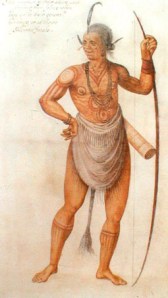
Because in the chapter I discuss tasseled yarn belts and sashes, this image was captioned: “A North American Indian wearing a tasseled sash, ca. 1590, from a painting by John White.” I would certainly not have captioned this particular image in this particular way. The apron worn in this image is relatively anomalous for the dress of the region and for Native North America in general. It appears to be tied in the back and what we see hanging in the back (between the man’s legs) seems to be the apron ties (of animal hide?) presented in a unusual but decorative way. The closest thing to this in the documentary record or present-day practice, are the animal tails worn by some men when playing “match game” (stickball), as among the Oklahoma Muscogee (Creek) and Oklahoma Seminole today (and the Choctaw historically). In the Mississippian engraved shell images, the historic-period paintings, and today, yarn sashes with tassels are worn so that the tassels fall from one or both hips (or are tied at one hip). This can be seen in the painting of a Seminole man by Charles Bird King that was also published in the article and in the shell images and contemporary photographs that I suggested but that were not used. I did suggest the use of this early Virginia image, but only because I had devoted considerable space to discussing the total Virginia corpus as a source of information on dress and adornment in the contact era. I had asked that it be paired with an image of a woman from the same time and place so as to insure gender balance across all of the images. As published online, there are no women’s objects shown or images of women wearing native dress. I apologize for this unanticipated and regrettable outcome.

The copy editing introduced various infelicities that didn’t need to be there and that degraded the work. Here are a couple to illustrate:

My sentence: “The Yuchi have a different colonial-era history and continue, into the twenty-first century, to speak their own unique language—a language isolate unrelated to other known tongues.” in which I used the technical term “language isolate” but then preceded to explain the meaning of this terminology became: “…unique language—a language isolated and unrelated to other known tongues.” This just does not mean anything sensible and it is the typical kind of “improvement” that a copy editor wanting to enhance the accessibility of an work would make in the absence of any specialist knowledge. I do not mind this as one step in the process, but it never works in an context in which the scholarly author lacks the ability to catch problems introduced by the process.

Similarly, describing Mississippian period body adornment, I mention “gorgets.” The copy editor sought to help general readers make sense of this perhaps unfamiliar term and introduced “(neck coverings)” after the word. This is a particularly interesting problem (if sad) for a work on the history of dress and body adornment in general, from a worldwide perspective. Historical period gorgets in the Southeast were mainly trade objects. Look up “Gorget” in Wikipedia (as of today) and you can see a painting of Colonel George Washington (later to become the first U.S. President) wearing exactly the same kind of silver gorget that the Seminole John Hicks is wearing in the King portrait included with my article. This crescent-shaped metal plate worn as a necklace is derived historically from European armor, as the wikepedian’s kindly tell us:

A gorget originally was a steel or leather collar designed to protect the throat. It was a feature of older types of armour and intended to protect against swords  and other non-projectile weapons. Later, particularly from the 18th century onwards, the gorget became primarily ornamental, serving only as a symbolic accessory on military uniforms.

Because, in the historic period, this elaborate necklace-strung item of adornment–a large curved object worn suspended on the upper chest–was known in English as a gorget, scholars of the region like me (perhaps too sloppily) have extended the terminology back to refer to large shell decorations worn similarly. Those obviously do not derive from European armor and they two kinds of adornment provide an illustration of the kind of convergence of European forms and Native styles that I was trying to discuss in the essay. In any event, the copy editor was seeking to help readers by introducing a definition of gorget, but the definition is anachronistic in that Southeastern people did not wear armor-like neck coverings. I would have been very happy to have helped fix this mistake if I could have.

The published version includes a list of references but the citations that had been provided in the manuscript linking particular statements to particular works were removed in conformity with the style of the volume. I am sorry about this. Thankfully the reference list itself was preserved. If a work appears there, it was used with direct citation in the original manuscript.

I wish that I had a way to share the original manuscript but this was a project that I was recruited to participate in before I had given up engaging with commercial publishers all together. Maybe someday I will have a chance to try to address the topic again in a different and more open venue.

Although I am disappointed with this sort of outcome, I do not want to sound overly bitter. I appreciate the work that the publishers and editors have created and nothing about this experience is particularly out of the ordinary for the commercial encyclopedia publishing space.  For those who can get access to it, some good information, I hope, can still be found in my contribution. The kinds of frustrations that accompany, or are generated in, projects like this motivate my enthusiasm for doing scholarly publishing in new, better, and more open ways that are less impacted by the ramifications of hard business decisions made in a dysfunctional marketplace.

Dr. Arle Lommel

Congratulations to Arle Lommel on the successful defense today of his Ph.D. dissertation in folklore. His dissertation is titled Semiotic Organology: A Peircean Examination of the Bagpipe and Hurdy-Gurdy in Hungary. His innovative project unfolds at the intersections of Hungarian ethnography and general ethnomusicology, organology, folklore studies (especially of “folk revivals”), material culture studies, and semiotic theory. It was a pleasure to be member of Arle’s dissertation committee.