Skip to content

Posts from the ‘Material Culture’ Category

People Make Collections: Anthropologist Michael Davis (1942-2012)

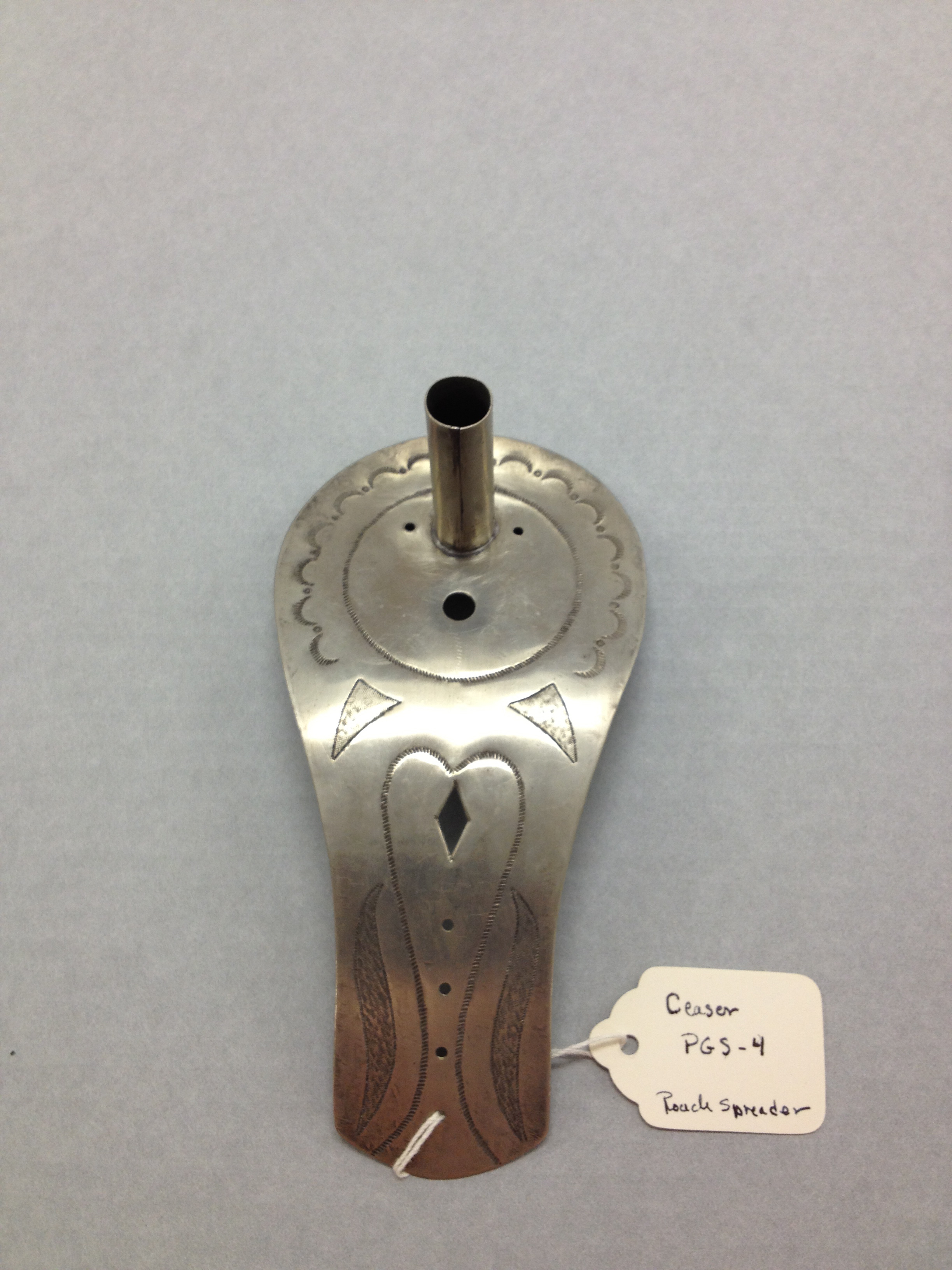
Museum collections are made by people who gather together the things that other people make. Earlier this week I was looking at a group of objects in the William C. Sturtevant Collection that were gathered together and documented by then-University of Oklahoma doctoral student Michael Davis. This is an exceptional collection of German silver jewelry made in the 1960s by an impressive number of Native American artists working on the Southern Plains.

After his OU studies, Michael Davis went on to become a Professor of Anthropology at Truman State University in Kirksville, Missouri. I wanted to congratulate him on the quality of the collection that he made and the exceptional way in which he documented it. Thinking about getting in touch, I discovered sadly that he passed away a few months ago. An obituary appears in the Kirksville Daily Express and is available online.

One reason that we make museum collections is to preserve something of the past for the sake of the future. I hope that Professor Davis, as well as the artists whom he documented, would be pleased to know that their work is being appreciated by those who have come along after them.

A German silver roach spreader by Pawnee smith Julius Ceasar (1910-1982) collected for the National Museum of Natural History by Michael Davis (1942-2012) and found as part of the William C. Sturtevant Collection, Department of Anthropology, National Museum of Natural History.

Yesterday was a Patchwork Day

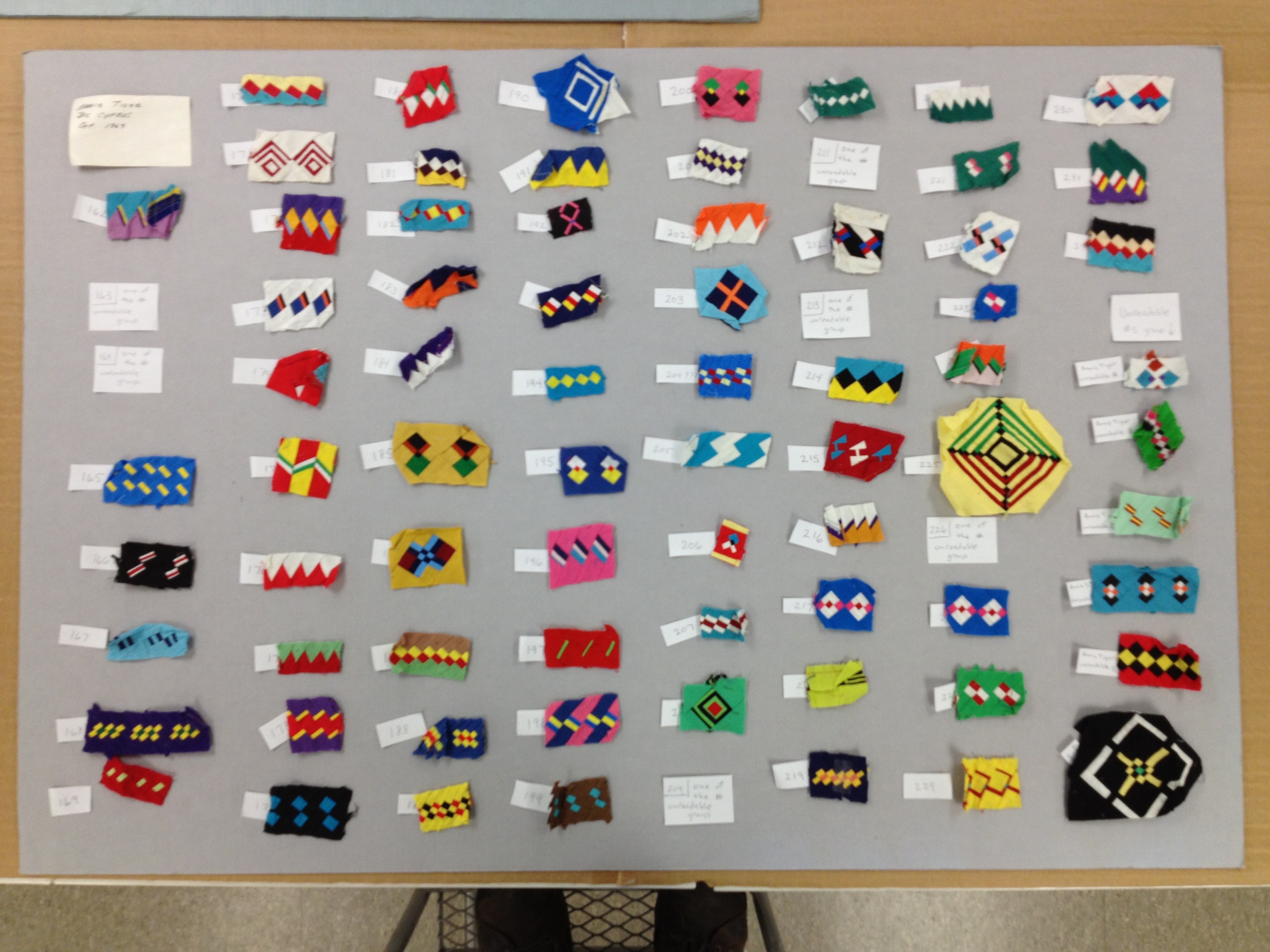
I was not able to put together a post last night, so here is just one of the couple hundred pictures I shot yesterday. This one is another array of Florida Seminole patchwork samples. These were all collected in 1969 and are by the same seamstress. As with the other objects that I am looking at, they are destined for the collections of the Department of Anthropology, National Museum of Natural History, Smithsonian Institution.

Tweezers!

I encountered a large number of objects in my work with the William C. Sturtevant Collection today. An important sub-set of the objects that I looked at today was a collection of “German silver” (a.k.a. nickel silver) jewelry made by a diversity of native silversmiths from central and western Oklahoma. These works were made during the 1960s and sold a trading posts in western Oklahoma.

Alongside earrings, finger rings, bracelets, broaches, buttons, stickpins, scarf slides and other items worn for adornment are nice two examples of an interesting–but not-widely known form–men’s tweezers, used for plucking hair from one’s beard. These stamped German silver tweezers from Western Oklahoma are beautiful. Older native men that I have known in Eastern Oklahoma would use tight commercial springs to achieve the same goal.

Much more can and needs to be said about the objects, the artists, the materials, the contexts of use, the contexts of sale, collecting, etc., but here is a glimpse at these two tweezers. (I still have a lot of data organizing to do before tomorrow.)

The first example (below) was made by the Kiowa smith Murray Tonepahote. It is WCS 599 in the National Museum of Natural History, Smithsonian Institution. (All photographs by me.)

Tweezers by Murray Tonepahote (Kiowa)

Tweezers by Murray Tonepahote (Kiowa)

A side view will help make sense of the object for those who have not seen such tweezers previously.

Side View of Tweezers by Murray Tonepahote (Kiowa)

Side View of Tweezers by Murray Tonepahote (Kiowa)

(BTW: Murray Tonepahote’s work as an artist is a subject taken up in the scholarship of his granddaughter, Dr. Jenny Tone-Pah-Hote, an assistant professor at the University of North Carolina.)

A second example (below) of such tweezers in the Sturtevant collection is by a Cheyenne (?) artist named Bushyhead. I will see fuller documentation for these objects tomorrow and can learn then which member of the Bushyhead family was the maker of this object–my guess is that it was made by Henry Bushyhead. This object is WCS T343, PGS-1.

Bushyhead Tweezer

Tweezers by Bushhead

As noted above (for contingent reasons) I have not yet seen the documentation that accompanies these objects. Needless to say there is much more to say about these two objects. If I have made any errors here, I will correct them a.s.a.p.

Pot Holders, Or William C. Sturtevant Collections Research, Day 1

I am in Washington at the start of a period of research studying the collection of objects gathered over much of the career of Smithsonian anthropologist William C. Sturtevant (1927-2007). (For background on W.C.S., see this biographical sketch that I posted to the Museum Anthropology weblog and this Washington Post obituary by WP staff writer Louie Estrada.)

While Dr. Sturtevant was long associated with the Smithsonian, his individual research collection grew and grew over the course of his career and was not accessioned into the holdings of the National Museum of Natural History until after his death in 2007. My work with the objects is an extension of the Southeastern Native American Collections Project (SNACP), but it also aims to assist the museum in the work of organizing and cataloging the Sturtevant Collection.

Today was mainly a get organized day, but I can share a glimpse of the objects that was looking at.

Dr. Sturteveant worked throughout his career on issues in Florida Seminole ethnography, linguistics, ethnology, and ethnohistory. He was always particularly interested in material culture and he went to considerable lengths to document the rich visual and material culture of the Seminole people living in my home state. (I first met Dr. Sturtevant while still an undergraduate when he attended a conference on Seminole folk art not far from my family home.)

It will take a very long time to sort out the details, but I began (metaphorically) unraveling the threads of his collection and its history with initial study of eight relatively simple objects–patchwork decorated pot holders made for sale to non-Seminole tourists by Seminole women during in the 1980s. In addition to their aesthetic richness and visual interest, such objects speak to the complex ways that the Seminole people have adapted to life in one of the most complex corners of North America. The Seminole engagement with tourism began in the early 20th century, it continued through the period represented by these pot holders, and it continues up to the present-era, in which the Seminole Tribe of Florida is the force behind a myriad of tourist destinations, including the global Hard Rock cafe and casino enterprise.

For four of the eight pot holders that I looked at today, I already know the name of the artist. A few of the as-yet artist-unidentified objects are pictured below. All objects are from the collections of the Department of Anthropology, National Museum of Natural History. I especially thank the department’s staff for hosting my research visit. Photographs shown here are my own quick and simple iPhone snapshots. (Better photographs can come later.)

Sturtevant Collection T162

Patchwork Pot Holder, Florida Seminole

(Above) Patchwork Pot Holder, Florida Seminole, Sturtevant Collection T162, Department of Anthropology, National Musuem of Natural History, Smithsonian Institution. Photograph by Jason Baird Jackson

Patchwork Pot Holder, Florida Seminole

Patchwork Pot Holder, Florida Seminole

(Above) Patchwork Pot Holder, Florida Seminole, Sturtevant Collection T111A, Department of Anthropology, National Musuem of Natural History, Smithsonian Institution. Photograph by Jason Baird Jackson

Patchwork Pot Holder, Florida Seminole

Patchwork Pot Holder, Florida Seminole

(Above) Patchwork Pot Holder, Florida Seminole, Sturtevant Collection T111B, Department of Anthropology, National Musuem of Natural History, Smithsonian Institution. Photograph by Jason Baird Jackson

Patchwork Pot Holder, Florida Seminole

Patchwork Pot Holder, Florida Seminole

(Above) Patchwork Pot Holder, Florida Seminole, Sturtevant Collection T111C, Department of Anthropology, National Musuem of Natural History, Smithsonian Institution. Photograph by Jason Baird Jackson

I have a lot of data management work to accomplish before tomorrow, but I could not resist sharing this glimpse.

Time to Apply to Participate in the Summer Institute in Museum Anthropology

Happy New Year! With the new year comes the season in which thoughts turn towards summer plans. A great summer program for graduate students interested in material culture studies is the Summer Institute in Museum Anthropology (SIMA). Held at the Smithsonian Institution’s National Museum of Natural History and funded by the [U.S.] National Science Foundation, this is a month-long intensive course focused on promoting “broader and more effective use of museum collections in anthropological research by providing a supplement to university training.”

“Working intensively each summer with 12-14 students interested in museum research, the institute: [1] introduces students to the scope of collections and their potential as data, [2] provides training in appropriate methods to collect and analyze museum data, [3] makes participants aware of a range of theoretical issues relating to collections, [and 4] positions students to apply their knowledge within their home university.”

Graduate students in anthropology and neighboring fields (including folklore studies) can find full information and application instructions on the SIMA website. As noted there: “The program covers students’ room, board, and tuition. Housing is provided at a local university and a small stipend will be provided for food and other local expenses. Participants are individually responsible for the cost of travel to and from Washington, DC. This is an intensive residential program and the participants are expected to devote full time to the training. Preparatory readings are assigned to ensure that students arrive with comparable background knowledge.”

This is a great program and a great opportunity. Please consider applying.

Sukkot=Time to Check Out Gabrielle Berlinger’s Beautiful Photographs of People, Buildings, and Food

It is Sukkot time again and I urge everyone to check out Gabrielle Berlinger’s beautiful photographs. She is at the end of her current fieldwork period in Tel Aviv where she has been studying many interlocking topics, with Sukkot at the center of things. Her reporting and her photographs are beautiful. Don’t miss out.

On Museum Anthropology Review

I am very happy to report that the final material for Museum Anthropology Review 5(1-2) was published today, bringing the 2011 volume/issues to a close.

This was the first time that an issue was published with an initial bundle of content and then added to as the year progressed. This represents a kind of transitional strategy bridging older journal publishing norms, in which an issue is prepared and then released into the world as a fully prepared bundle, and the newer pattern in which content is prepared and released into the world as soon as it is ready, item by item. The older pattern has certain hallmarks that many are still fond of, including sequentially paginated pages (in paper-like PDF format) and a table of contents in which articles appear at the top and reviews appear at the bottom. For authors, this format makes for objects that look familiar (to custom-minded observers) on such things as C.V. and annual reports. The cost, of course, is delay in publication, as works pile up in preparation for being bundled up as issues.

The newer approaches leverages the advantages of digital publication platforms and get information in circulation as quickly as possible, something that helps the research community in many ways.

MAR is moving from the older to the newer framework and will probably use the approach adopted for volume 5 again at least for volume 6 next year. This means that volume 6(1) will appear as soon as possible and will initially contain a group of materials from the “top” of the table of contents. Additional reviews will be added to the issue’s table of contents up until the point that additional articles or other content from the top of the table of contents are ready. At that point the effort will switch over to issue 6(2).

Publishing a combined “1-2” issue for 2011 was a valuable step for me personally–beyond these considerations. It allowed me a bit more time this summer to work on other projects, something that I have sorely needed to do. While I had the help of a wonderful graduate student/editorial assistant through the middle of 2010, last academic year (2010-2011) was the first in which I handled the day to day editorial tasks on my own. This was fun and informative, of course, but there is only so much time in the day and it was nice to be able to focus this past summer on other obligations. The combined issue helped make that possible.

From a substantive point of view, 5(1-2) is full of interesting stuff and I am very thankful to the many authors, peer-reviewers, librarians, editorial board members, publishers, and other friends of MAR who have made it possible.

At 154 pages volume 5 is only #4 of 5 in terms of page length, but with 42 discrete contributions it covers a lot of interesting territory, from Captain Cook to the alternative globalization movement; from the history of shoes to the material realities of the current economic crisis. As has been true throughout the MAR experiment, contributions cover a wide diversity of world regions and theoretical, topical, and disciplinary concerns. I am especially proud of the ways that the journal continues to showcase work by the most distinguished senior scholars–generous colleagues such as Richard Bauman, Keith Hart, Marsha MacDowell, Edward T. Linenthal, and Aldona Jonaitis–alongside leading younger scholars, including folks like Karin Zitzewitz, Beth A. Buggenhagen, Elizabeth Hutchinson and so many others. I am also happy that the journal brings together, in what I think is a healthy way, the twinned and entwined concerns that are its focus—museum studies and material culture studies. Rooted in anthropology and folklore studies, MAR has been an effective meeting ground for scholars working in a great many fields. Alongside its folklorists and anthropologists, 5(1-2) features scholars representing the fields of comparative literature, history, art history, fashion studies, architecture, design, communications studies, and religious studies. This diversity is a great strength.

Also speaking to the journal’s diversity aspirations, 5(1-2) was the second issue to feature content in a language other than English. MAR 4(1) had included both French and English versions of Christian Bromberger’s commentrary on the Musée du Quai Branly and now, with 5(1-2) MAR has published a book review concurrently in Portuguese and English. Thanks go to author Lori Hall-Araujo and translator Roberta Crelier for the work on Lori’s review of Mestre Vitalino e artistas pernambucanos.

In conclusion, I wish to especially thank the authors of the issue’s peer-reviewed articles. Richard Bauman’s “Better than any monument”: Envisioning Museums of the Spoken Word is a great contribution to the history of the field, exploring the intersections of linguistic anthropology and museum anthropology. The paper continues his vital research work on the social history of early recording technologies and their intellectual and cultural ramifications. Thanks go to Carrie Hertz’ for her Costuming Potential: Accommodating Unworn Clothes. The article is a rich contribution to contemporary material culture studies, particularly relating to questions of consumption, circulation, reuse, and disposal.

The submission mailbox is always open. Please consider Museum Anthropology Review as a robust not-for-profit, gold open access publishing option for your work in museum and material culture studies.
What Marketers Can Learn from the Food-Truck Trend – Grant McCracken – Harvard Business Review

What Marketers Can Learn from the Food-Truck Trend – Grant McCracken – Harvard Business Review.

Mathers Museum, Glenn Black Lab Merger Yields Cultural History Powerhouse

IU news announced back home:

Mathers Museum, Glenn Black Lab Merger Yields Cultural History Powerhouse

This is a big deal for the students with whom I work, the colleagues with whom I collaborate, and the collections that I have been studying.

Colorado College Road Trip to the Denver Museum of Nature and Science and the Denver Art Museum

I have always wanted to visit the Denver Art Museum and the Denver Museum of Nature and Science. Today I had my chance and it was great. As part of my “Introduction to Folklife” course at Colorado College, my class and I had the chance to go north to Denver for the day and to visit both museums. Both are impressive. Both have great collections and deep traditions of excellent work in those areas that matter most to me—world ethnography and Native American studies/Native American art. There was no way we could see more than a small portion of both museums, but what we saw in both institutions was great. Colorado is very lucky.

At DMNH we were generously hosted by Steve Nash, who showed us around behind the scenes in the Department of Anthropology (which he chairs). We also got to see Chip Colwell-Chanthaphonh, who was busy working on the next issue of Museum Anthropology (Steve and Chip took over editing the journal from me in 2009 and are doing great work with it.)

Our focus at DMNS was the Native North American culture halls, where we saw objects relating to our current reading and research project (centered on Daniel C. Swan’s book Peyote Religious Art: Symbols of Faith and Belief) and our next one (focused on Claire Farrer’s Thunder Rides a Black Horse: Mescalero Apaches and the Mythic Present). Organized on the basis of cultural areas, the DMNS exhibitions (which are steadily being updated and improved by Chip and Steve) do a great job of providing an basic orientation to the diversity of Native North America. This was evident when we got to the Denver Art Museum and the students had a better ability to appreciate the contexts for the work that is presented in a art museum mode there.

At DMNH we also had a chance to see the strange and remarkable carved gemstone sculptures made by Vasily Konovalenko to portray aspects of Russian peasant folklife. One could talk and think about them for hours and they were a great conversation point for our class and a great reminder of how complex not only art and material culture are, but how complex issues of cultural representation are, in general and under the banner of folklife in particular.

After short drive downtown and a quick street-side gyro, we hit the art museum. Like DMNS it is huge and impressive and impossible to see properly on a single day trip. Here our foci were the Native American and non-western art halls, as well as the galleries devoted to the art of the Western United States. We saw the galleries for the arts of Oceania, Africa, Asia, and Native North America. DAM was among the first U.S. art museums to get serious about Native American art and their collections are stunning.  In my own area of special interest, the DAM is currently exhibiting 5 (!) beaded bandolier bags from the Southeast. This is simply dumbfounding and a reminder of how deep the collection is.  All the galleries provided rich learning opportunities for me and for the students. I was reminded of how fun it is to teach in the presence of rich collections well-displayed. (I really missed being a curator today.)

The students seemed to have good time. They were easy, engaged, and wonderful travel companions and all the logistics went off without a hitch.

Colorado College and its amazing block plan (which makes such trips possible through its one class at a time format) are at the root of the day’s success. Many people did great behind-the-scenes administrative work to enable me (as a new to CC  visitor) to take this trip with the students. Thanks to everyone who heaped to make it happen.