Skip to content

Posts from the ‘Material Culture’ Category

Candace Greene Wins Ames Prize; Summer Institute in Museum Anthropology Recognized

I learned great news today. My friend, colleague and collaborator Candace Greene (National Museum of Natural History) has been selected as this year’s recipient of the Michael M. Ames Prize for Innovative Museum Anthropology, awarded by the Council for Museum Anthropology.
In a letter sent to Candace and quoted from in an announcement making the rounds, Alex Barker, CMA President, wrote: “The award recognizes your groundbreaking work in developing and implementing the Smithsonian Institution Summer Institute in Museum Anthropology, and particularly the transformational potential of the program. Museums are more than just collections of things, after all. They’re also collections of people, and the SIMA program provides crucial training and educational opportunities, enriching the discipline of museum anthropology and embodying the innovative spirit the award recognizes.”

I am not attending the American Anthropological Association meetings and will unfortunately miss it, but there will be a formal announcement and presentation during the current AAA meetings during the Council for Museum Anthropology’s reception on Saturday, November 17 in the San Francisco Hilton’s room Imperial A. The reception runs from 6:30 – 8:30 p.m.

I am super pleased with this wonderful news of recognition well-deserved. Candace has been a great leader in the museum anthropology community and her vision for the creation of SIMA, together with her hard work to make it a success, have been amazing. This is an important award, well-bestowed. Congratulations to Candace and to everyone involved in making SIMA a thriving endeavor.

Director, Smithsonian Center for Folklife and Cultural Heritage

Having been asked to do so, I am happy to share news that the Smithsonian Institution is seeking applications for the position of Director of the Center for Folklife and Cultural Heritage. This is an important and exciting post. See the details below:

The Center for Folklife and Cultural Heritage, Smithsonian Institution, is accepting applications and nominations for a Director. The Center for Folklife and Cultural Heritage is responsible for planning, developing, and managing programs which have as their major objectives the research, documentation, presentation and conservation of living traditional and grassroots folk cultures of the United States and of other countries. The director is responsible for the administrative direction and management of all Center program activities including the Smithsonian Folklife Festival, Smithsonian Folkways Recordings, Ralph Rinzler Folklife Archives and Collections, exhibitions, symposia, scholarly research, cultural heritage policy, educational projects and all media, as well as the participation of other Smithsonian museums and programs in national celebration events and National Mall events. The Director represents, at national and international levels, Smithsonian concerns relating to the understanding of the cultural representation of living heritage, as well as public sector folklore, and policies related to them. The Director will have a proven track record of leadership, management and fundraising skills to run a unique multi-disciplinary cultural organization. The successful applicant must have a degree in a relevant field, management level experience in public programming, and have earned a presence in the scholarly and/or cultural community. The Smithsonian offers a competitive salary commensurate with experience and a comprehensive benefit plan including a lucrative, fully vested retirement program with TIAA- CREF. For detailed information on the position, qualifications and application instructions, go to http://www.sihr.si.edu/jobs.cfm and scroll to position announcement EX-13-01. We are only accepting online applications for this position. For questions or additional information, contact Tom Lawrence, 202-633-6319 or lawrencet@si.edu. The Smithsonian Institution is an Equal Opportunity Employer.

A First Rate Podcast: Artisan Ancestors Visits the Summer Institute in Museum Anthropology

A perfect example of how scholarly research in folklore and anthropology can be made accessible and interesting for a wider audience is the Artisan Ancestors podcast produced and hosted by my friend and colleague Jon Kay. (Jon is, among other roles, the Director of Traditional Arts Indiana.) If you have not yet encountered the Artisan Ancestors show, I urge you to check it out. As Jon describes it, the focus of the show is on strategies for “researching creative lives and handmade things.” Jon does interviews with people involved in such work with the goals of encouraging and guiding newcomers to such studies and of expanding the horizons of those already deeply involved. Long adept in the skills of the public folklorist, Jon has mastered the podcast genre. He is a great interviewer and he knows how to do in interview with the needs of his audience and the requirements of the medium in mind. The production values are high but it is clear that he has worked out a system that gets good results without endless, expensive work.

In his newest episode (#26) Jon interviews Dr. Candace Greene, another friend and the Director of the Summer Institute in Museum Anthropology (SIMA). The interview explores the purposes and goals of SIMA in a way that not only introduces this training program (for which I was a faculty member this past summer) but also encourages deeper understanding of the broader value of museum collections for research in social and cultural history. It is a great interview and listening to it will illustrate not only the value of the SIMA effort but also suggest the value of podcasting initiatives such as Artisan Ancestors. Kudos to Jon and Candace for their great job with this episode.

A Very Small Pot by Maude Welch, Eastern Cherokee Potter

A very small “wedding jug” by Eastern Cherokee potter Maude Welch (1894-1953). William C. Sturtevant collected this piece from Ms. Welch on September 15, 1951, about two years before her death. Drawing upon her experience visiting Catawba potters, Mrs. Welch was central to the revitalization of pottery making among the Eastern Cherokee.  A rich profile of her and her work is available online from the Western Carolina University library. It was authored by M. Anna Fariello.

This piece (which is only about 2″ in all dimensions) is in the William C. Sturtevant Collection, Department of Anthropology, National Museum of Natural History, Smithsonian Institution. For those who are interested in such things, Sturtevant paid Mrs. Welch’s asking price of 50 cents. (Fifty cents is about $4.00 today, if adjusted for inflation.)

A Sea Island Basket by National Heritage Fellow Mary Jane Manigault

The William C. Sturtevant collection includes a nice group of coiled, sea grass baskets created by the African American weavers of the Sea Island region near Charleston, South Carolina. The better documented of these were collected by William C. Sturtevant in 1959. In this group is the basket shown above. It was made by Mary Jane Manigault (1913-2010), a basket maker who would go on (25 years later) to be awarded a National Heritage Fellowship from the National Endowment for the Arts in 1984.

There is a rich literature about the Sea Island basketry tradition. A recent work is the exhibition catalog Grass Roots: The African Origins of an American Art. The volume was edited by Dale Rosengarten, Theodore Rosengarten, and Enid Schildkrout and published by the Museum of African Art in 2008. The associated exhibition led to free online resources on the subject being made available through the Museum of African Art, the National Museum of African Art, and the McKissick Museum at the University of South Carolina.

Interestingly, one of William Sturtevant’s photographs from his 1959 visit to the Sea Island region was featured in the Grass Roots exhibition’s online presence. It is an image of Pearl Dingle weaving a basket at her family’s stand in Mt. Pleasant South Carolina. You can see it on the McKissick website.

The rich obituary for Mrs. Manigault published on the website for the documentary film Bin Yah: There is No Place Like Home is definitely worth checking out. It notes that her baskets are among those in the amazing Sea Island collection curated at the Mathers Museum (at Indiana University) where I work as a Faculty Curator. The NEA National Heritage Fellow profile for her is another great online resource.

This basket is currently identified as T331 and is from the William C. Sturtevant Collection, Department of Anthropology, National Museum of Natural History, Smithsonian Institution.

Coconut Rattles in Florida and Oklahoma

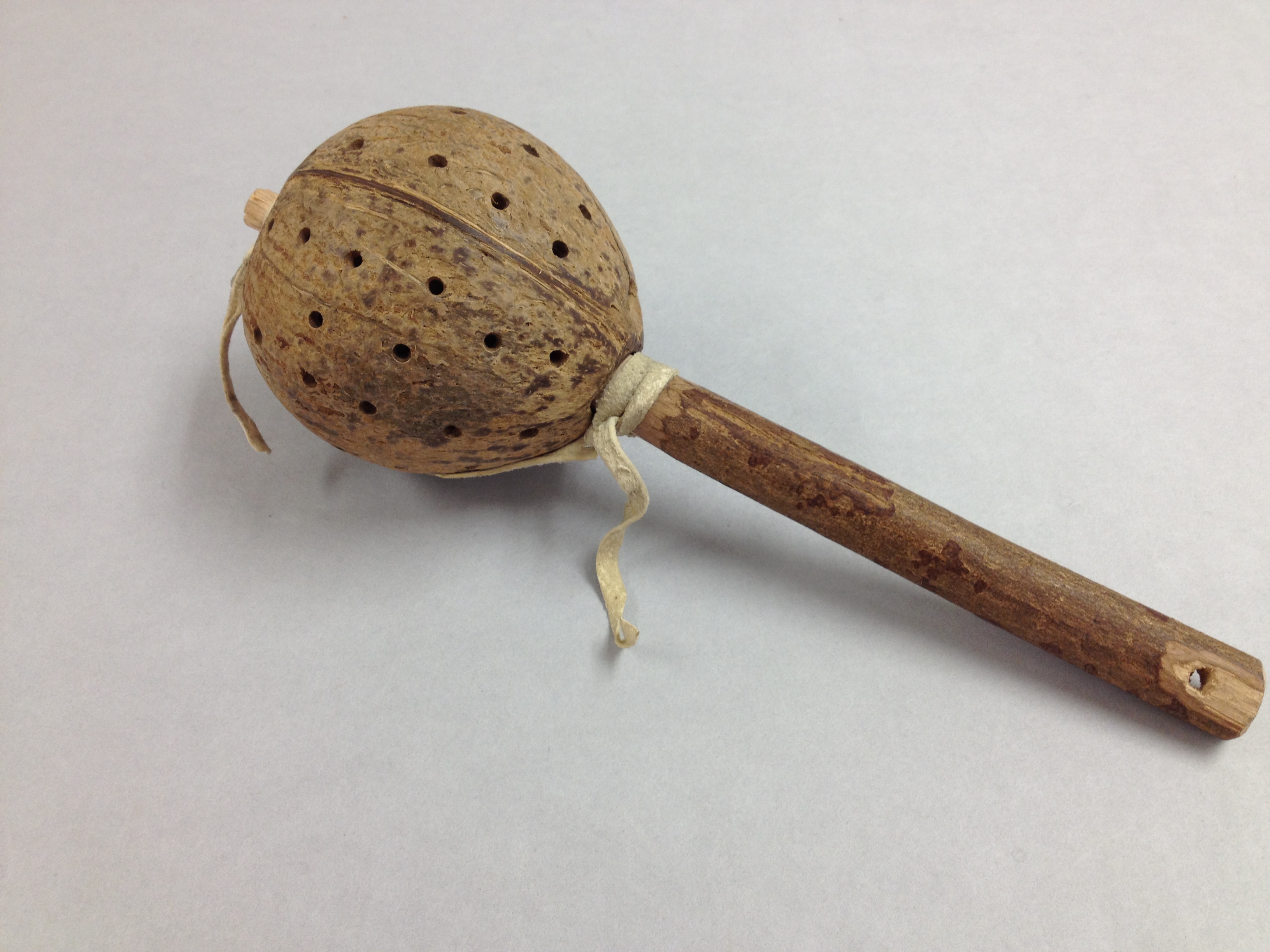
The diversity of materials used by Native peoples in the Americas to make hand rattles is pretty staggering. Among the farming peoples of the Southwest, Plains, Northeast and Southeast, gourds are one important material used for this purpose. Having the same basic form as gourd rattles, but unique to some Southeastern Indian peoples, are rattles, such as this Florida Seminole example, made from coconuts. William C. Sturtevant provided the coconut used here to Jack Motlow, from whom he commissioned it for $2.00 in 1951. This Florida Seminole example is made exactly like those used among the Southeastern peoples in Oklahoma, including among the Yuchi. (I commissioned Yuchi examples for the Gilcrease Museum in Tulsa during the later 1990s.) Such rattles are called “gourds” in English in Oklahoma and are particularly suited to the outdoor dances of the region. Such rattles are loud and thus sound great when used, as they most often are, outside, in open spaces. (The holes drilled in the coconut amplify the rattle’s sound.)

This example is #301 in the William C. Sturtevant Collection, Department of Anthropology, National Museum of Natural History, Smithsonian Institution.

(The Seminole Tribune has published biographical profiles of two of Jack and Lena Motlow’s daughters. These profiles are of Louise Motlow and Mary Motlow Sanchez and are online.)

A Chitimacha Basket

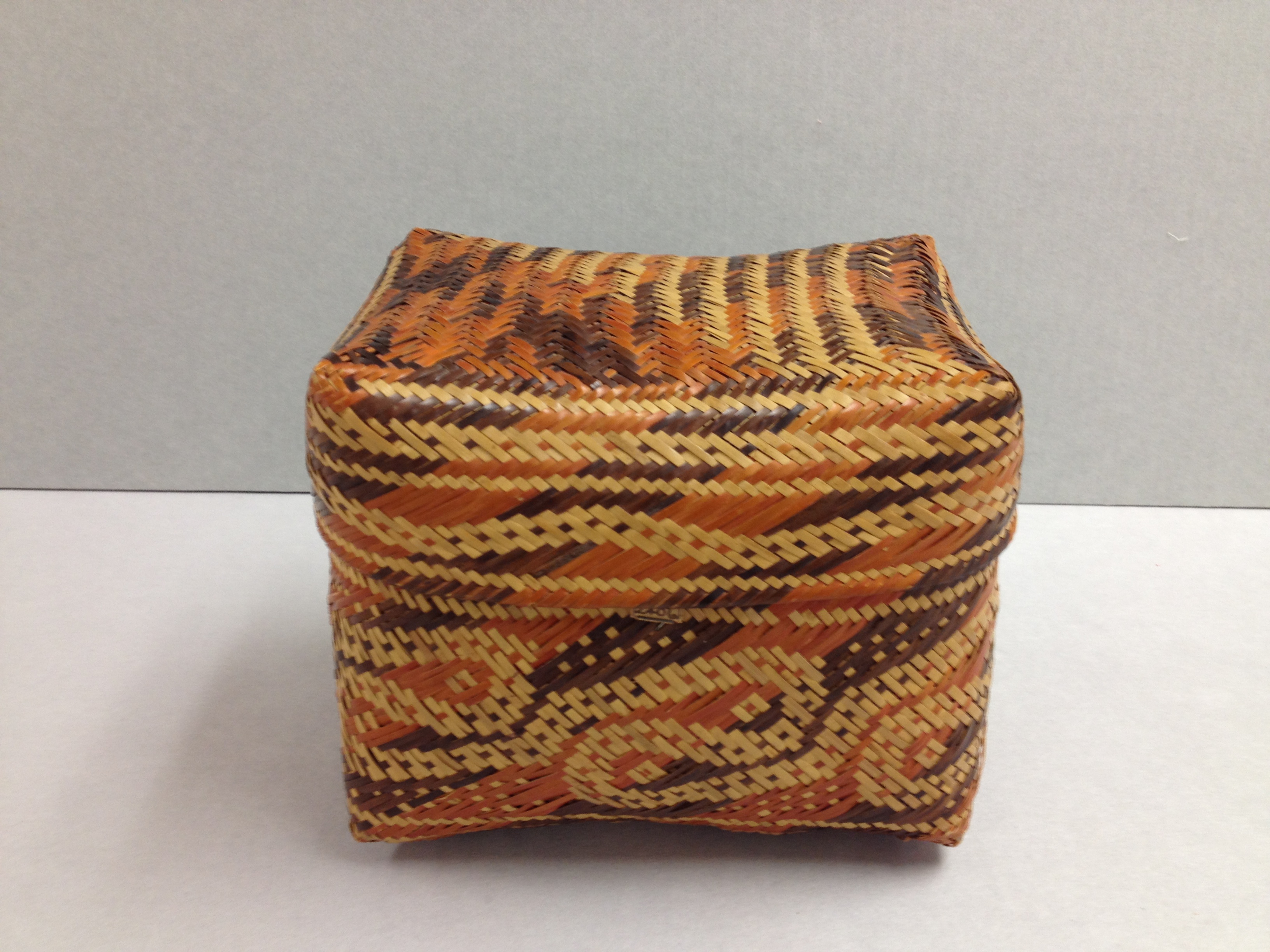
Here is an image of a double woven river cane basket with lid from the Chitimacha people of Louisiana. It was purchased at auction in 1972 by William C. Sturtevant and is now in the collections of the Department of Anthropology, National Museum of Natural History, Smithsonian Institution (T070).

Baskets from Choctaw Fair, 1961

William C. Sturtevant’s collection includes a group of baskets purchased in 1961 at the Choctaw Indian Fair near Philadelphia, Mississippi. This example (above) is part of this group. It is number 580 and I have not yet learned who the artist who made it is. This basket is made from rivercane, a plant related to bamboo that is indigenous to the Southeast of North America.

To gain a sense of native basket making in the South as a dynamic cultural activity, check out these photographs from the 1st Gathering of Southeastern Indian Basketweavers in 2002. This was an event organized by the Louisiana Regional Folklife Program and the Williamson Museum.

Here is another basket from this group. A rivercane tray, it is number 576. Both are in the collections of the Department of Anthropology, National Museum of Natural History, Smithsonian Institution.

People Love Tiny Baskets

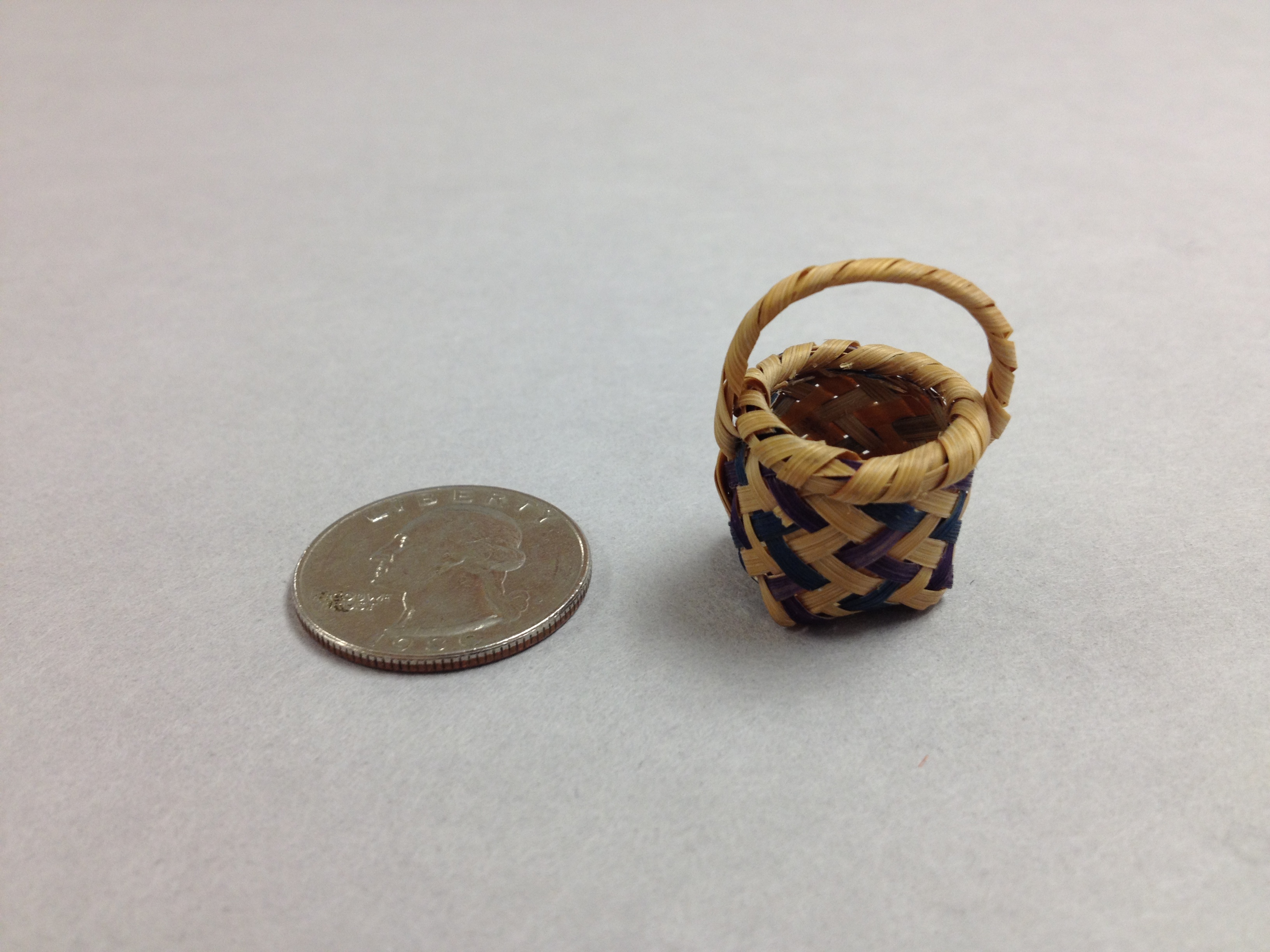
When wearing my curator hat, I have seen how ubiquitous love of tiny baskets seems to be, at least among fans of hand made objects. While I am sure that some engineer is doing nano-scale weaving already, tiny-scale seems good enough for fans of Native American basketry. The best known heroes in this area are the basket weavers of California, particularly the Pomo with their amazing feather covered baskets, but the art of the tiny basket has also been pursued in the native South. This impulse is reflected in this Choctaw basket by “Sweeny Willis” that was collected by John Mann Goggin among the Choctaw residing near Philadelphia, Mississippi. Ms. Willis’s name is spelled “Sweenie” elsewhere, such as in the records associated with pottery that she made that is in the collections of the National Museum of the American Indian.

This single weave river cane basket is currently referred to as #494 in the William C. Sturtevant Collection, Department of Anthropology, National Museum of Natural History, Smithsonian Institution.

For a bit of theorizing, look below the fold.

Read more

Put a Bird On It

I have been offline and not able to post on the Smithsonian work over the past few days. Today I need to get back to work, so here is a quick picture post. Shown above is a pine needle basket made by Rosa J. Pierite. In the artist’s information tag that accompanies the basket, she (?) identifies her tribal background as Choctaw-Tunica. Elsewhere (as in this Louisiana Folklife Center artist profile of Mrs. Pierite’s daughter, also a basketweaver), her tribal heritage has been noted as Choctaw-Biloxi.

Such pine needle baskets in the shape of a variety of animals–turkeys, alligators, etc.–are a remarkable basketry innovation from the Native peoples of Louisiana, but they are poorly represented in museum collections because earlier collectors and curators often ignored them as tourist arts. It is great that this example, along with three other pine needle baskets by Mrs. Pierite (not animal shaped) will be joining the collections of the Department of Anthropology, National Museum of Natural History, Smithsonian Institution. This example is currently accounted as number T-006.

Please forgive the pop culture reference in my post title.