Skip to content

Posts from the ‘Material Culture’ Category

Open Access Book: Indiana Folk Arts

IFA CoverThis year is a big year for the Mathers Museum of World Cultures in a number of respects. Two of these weave together. Its the state bicentennial for Indiana and we are engaging with it in a big way through the exhibition Indiana Folk Arts: 200 Years of Tradition and Innovation. That exhibition is now traveling across Indiana along with with a deep roster of presenting artists and craftspeople. The exhibition and associated in-person demonstrations are happening at state parks and festivals around Indiana and the exhibition will also be presented at the Indiana State Fair, later this summer. The exhibition brings together more than a decade of research by Traditional Arts Indiana and was also an project worked on by the Laboratory in Public Folklore graduate course taught in the IU College of Arts and Sciences’ Department of Folklore and Ethnomusicology. Working with TAI Director and MMWC Curator of Folklife and Cultural Heritage Jon Kay, a large number of students have been involved in all aspects of the exhibition and associated programs, products, and events.

2016 is also slated to be a big year for book publishing at MMWC. We have a number of books in the cue for fall. The first to become available is the catalogue for Indiana Folk Arts. Edited by Jon Kay with chapters authored by a large and talented group of graduate students, the volume enriches the exhibition while also standing alone as a contribution to scholarship on Indiana craft and art. At exhibition events and here at the MMWC, the book is being distributed for free in a beautiful full-color print edition. In keeping with our institutional commitment to increased and open access to scholarship, the volume is also available electronically and permanently via the IUScholarWorks Respository. Licensed under a CC-BY license, it can be found online here: https://scholarworks.iu.edu/dspace/handle/2022/20893. Its the first MMWC publication for which we obtained an ISBN number (two actually, one for the print edition and one for the PDF edition), which is also pretty neat.IFA Front Page

Congratulations to Jon Kay, the volume’s editor, to all of its contributors, and to the talented artists, craftspeople, and tradition bearers featured in the book. Welcome readers–72 beautiful pages await you, wherever in the world you live. If you like the book and support the work behind it, spread it widely. Tell your friends and colleagues so that they can enjoy it too.

Two Euchee (Yuchi) Baskets in the Collections of the Philbrook Museum of Art

The basketry traditions of the Native South have experienced divergent histories from a common regional tradition of work basketry. Among the North Carolina Cherokee, for instance, the indigenous river cane basketry tradition was augmented with the adoption of an old European white oak splint basketry practice and a more modern vine runner basketry practice using Japanese honeysuckle. The two older traditions are focused on workbasket forms, even as these have increasingly become works of art and heritage appreciated as aesthetically compelling collectables rather than tools of labor. The vine runner basketry made in honeysuckle added graceful forms intended by their makers to be visually appreciated more than used for rough labor. The richness of Cherokee basket making, up to the present, has been facilitated through an arts and crafts market fostered by the location of the Eastern Cherokee community in a key tourism destination at the eastern gateway to the Great Smoky Mountain National Park. While workbaskets were, for a time during the early 20th century, presented for sale to outsiders among the Florida Seminole, Florida Seminole basketry shifted in that century to decorative craft baskets made from coiled sweet grass. As in Cherokee, North Carolina, these baskets were crafted with non-Seminole tourist-collectors in mind.

Not all Southern Native communities reside in locales where tourism and tourist craft markets could foster (and reshape) local basketry practice. In many native communities, local baskets were used less and less for work—replaced by commercial containers—and thereby they became less and less common, as did knowledge of their construction and use. In some contemporary Native communities, a commitment to revitalize tribal cultures has more recently led to a renewal of basketry practices, not so much for external consumption but as heritage endeavors celebratory of local traditions. This dynamic is found among the Catawba (ex: “Catawba Indian basket maker revives almost-lost ancient tradition”) and among numerous groups—such as the Chickasaw—who have begun regularly organizing basketry classes (ex: “Chickasaw Nation to host basket weaving class”).

While revivals of the sort that numerous communities are pursuing can be initiated in the near or distant future, there are some communities in which basketry has quietly fallen into obsolescence. As with heritage languages, we might describe basketry in such communities as “sleeping”—especially when extant baskets are present in museums and some ethnographic documentation of basket making or use has been made. As with “sleeping languages,” sleeping basketry traditions are capable of being revitalized, especially when knowledge can be gained from basket makers among neighboring peoples sharing similar practices.

While they are an extraordinarily vital community in many other ways, sleeping describes the present state of basketry among the Euchee (Yuchi) people now residing in Tulsa, Creek, and Okmulgee Counties in (present-day) Oklahoma. (For the remainder of this note, I will just use the “Euchee” spelling.) To my knowledge, eight Euchee baskets are curated in museum collections. Then a Ph.D. student in anthropology, Frank G. Speck collected five Euchee baskets in the Sand Creek tribal town near Bristow, Indian Territory in 1904. These were purchased with funds from the American Museum of Natural History and are preserved in its collections. They can be studied in the AMNH’s online database and were discussed in Speck’s Ethnology of the Yuchi Indians, a book-length study that is now freely accessible via the HathiTrust Digital Library and the Internet Archive (see pages 31-34). [If consulting the AMNH database, see numbers 50 / 5368, 50 / 5369, 50 / 5370, 50 / 5371, and 50 / 5372]

One Euchee basket is cared for by the Columbus Museum in Columbus, Georgia. (I hope to report on it later.)

Of interest here are two baskets close to the present-day Euchee community, at the Philbrook Museum of Art in Tulsa, Oklahoma. These two baskets (I believe, the only ones in Oklahoma museum collections) are significant in a number of ways that I will narrate here.

They are, to my knowledge, the most recently collected baskets from among the Euchee. Some Euchee families preserve heirloom objects from the past, but I have not been shown or told about old workbaskets in the possession of the Euchee families that I know. There is a chance that these two were among the last in Euchee hands.

They were collected by famed basketry collector Clark Field. One can learn more about Field and his collection in the volume Woven Worlds: Basketry from the Clark Field Collection edited by Lydia L. Wyckoff and published by the Philbrook Musuem of Art. Field collected these two baskets from Johnson Tiger, then living in Kellyville, Oklahoma. [Kellyville is a municipality in the territory of the Yuchi Tribal Town known as Polecat (after nearby Polecat Creek)].

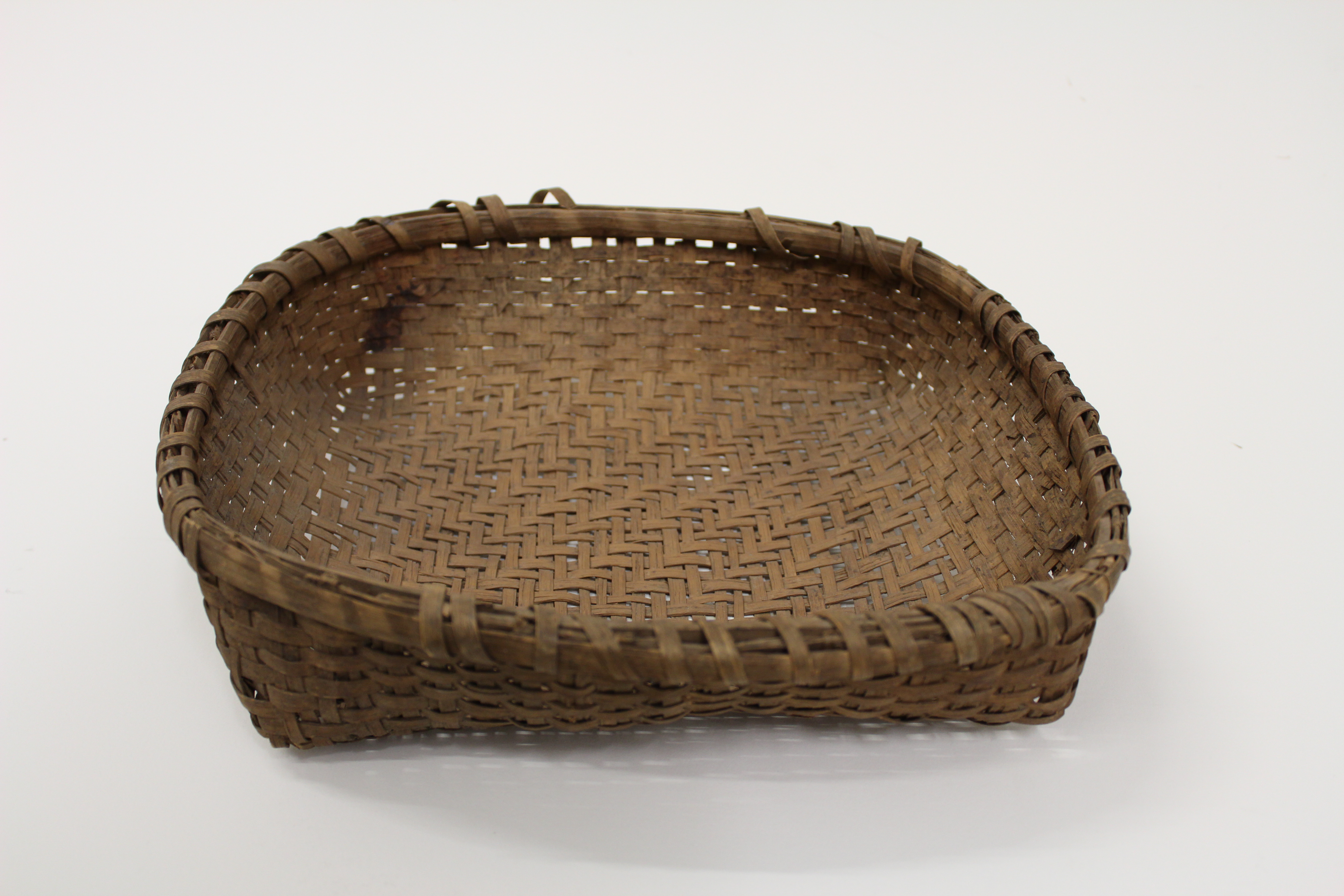
Tiger indicated for Field that the first of the baskets (catalog number 1963.13.2) was made by his grandfather George Fulsom and dated to 1875. George Fulsom was age 57 at the time of the 1910 census and thus he was born around 1853. If the basket was actually crafted in 1875, this would have been when George Fulsom was about 22 years of age. Field paid Tiger $27.50 for the basket in 1962, which would be about $218 in 2016 dollars. (As noted below, it may be that this amount was the price paid for both baskets.)
IMG_5425

Euchee tray or fanner basket of river cane. Collected from Johnson Tiger in 1962 and attributed to his grandfather George Fulsom. Late 19th century. Polecat Tribal Town. Philbrook Musuem of Art #1963.13.2. Used with permission of the Philbrook Museum of Art.

This plaited basket is made of river cane, the primary material out of which baskets were historically made in the Native South, but a plant that was and is increasingly rare generally and that is particularly rare on the western edge of its range in Oklahoma. Like most of the known Euchee baskets, this example was one of two fundamental tools used in processing corn for food. (It could be used, of course, for other activities, including other food processing ones.) With a solid bottom, this kind of basket was used to both catch grain falling through a sifter (sieve) basket and for fanning grain that has been pounded (or ground) so as to separate the grain from the chaff.

As J. Marshall Gettys has noted, this basket is interesting because it is made of rivercane (the region’s old material) but it has a reinforced rim assembled in a style more common in European American basketry styles. In river cane trays or sifters in the South, a braided rim (as found in the second basket, below) would be more common (Gettys 2001:182).

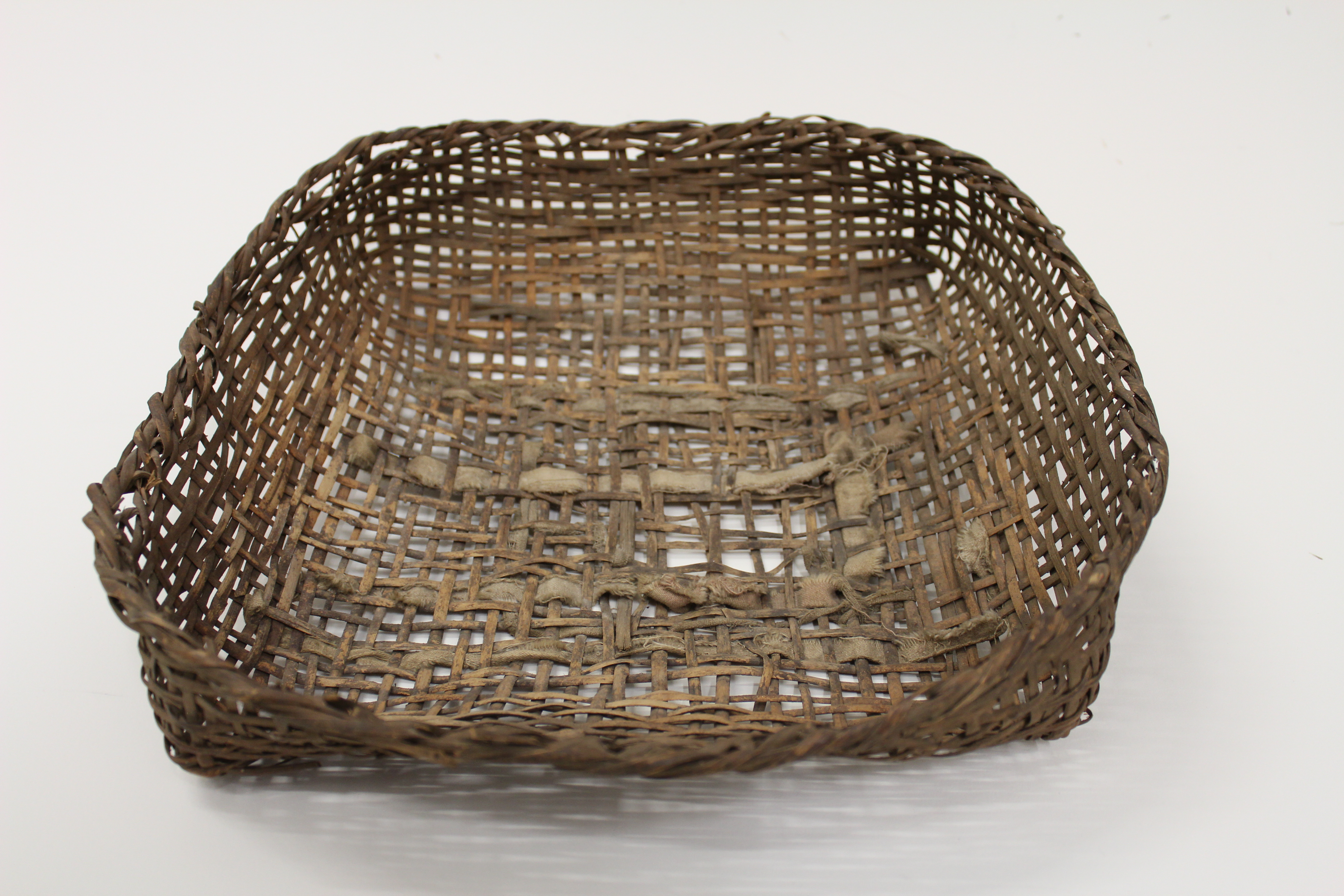
The second basket was likely long used as a pair with the first one. It (catalog number 1963.13.3) is a sifter basket or sieve. Johnson Tiger told Field that Fannie Fulsom, his grandmother and the wife of George Fulsom, made this basket. As with the first basket, he dated it to 1875. According to the 1910 census, Fannie Fulsom was 45 in 1910, indicating that she was born around 1865. If this is correct and if the basket were made in 1875, then she would have been age ten at the time of its manufacture. While it is possible a ten-year-old made it, my intuition is that it was either made at a later (but still probably nineteenth century) date or by a different maker. Like all of the other Euchee baskets in museum collections, this (and the other Philbrook basket) shows extensive wear from practical use. Especially noteworthy is the way that the basket was patched with cloth strips. Because they are woven with evenly sized openings in their bases (bottoms), sifter baskets are more fragile than fully woven trays, such as the other Philbrook basket.
IMG_5454

Euchee sifter basket or sieve in river cane style but made with hardwood splints, probably hickory. Collected from Johnson Tiger in 1962 and attributed to his grandmother Fannie Fulsom. Late 19th century. Polecat Tribal Town. Philbrook Musuem of Art #1963.13.3. Used with permission of the Philbrook Museum of Art.

The Philbrook records do not preserve a purchase price for the second basket. It is possible, but unproven, that the price recorded for the first basket was a price for both baskets.

While this basket has a braided rim in the region’s aboriginal style, it is made not of river cane but of narrow splints of hardwood (probably hickory). My interpretation of this material is that it represents an Indian Territory (/Oklahoma) adaptation in a setting in which river cane was difficult to obtain. To my knowledge, it is only in Oklahoma that we find Southern river cane-based forms produced in materials other than river cane. Elsewhere in the South, newer materials were utilized in altered, adopted, or innovated forms.

Euchee basket making may continue to sleep. If it does, that should not be taken to mean that Euchee people lack appreciation for the baskets, basket making, and the basket-using of their ancestors. Elders I have known, from the 1990s to the present, have often recalled memories of how baskets such as these were used. These stories were never simply for my benefit. They are regularly shared with audiences of younger Euchee people. The tellers of such stories are eager to preserve a memory of past Euchee ways of life. The moral of such stories often center on how hard older Euchee people worked to care for their families and communities and how they possessed and use specialized cultural knowledge to sustain a rich and self-sufficient social life in the face of hardships and limited financial resources. In the late 1990s, I worked with cultural leaders from the Euchee community to organize an exhibition at Tulsa’s Gilcrease Museum. For this exhibition, two of the AMNH baskets were lent and displayed. Euchee elders noted how well-worn these baskets were. This prompted not only an appreciation for their industry of their ancestors, but also laughter at the thought that the baskets unnamed Euchee owners turned a nice profit selling end-of-life, totally worn out, baskets to an earnest young scholar from the East. They also appreciated the fact that some Euchee work baskets still existed in the world and would thus be available for future generations to see and appreciate. These thoughts apply, I think, to the two baskets that Johnson Tiger sold to Clark Field in 1962.

Thank you to my friend Christina Burke, Curator of Native American and Non-Western Art at the Philbrook Museum of Art for letting me spend time with these two baskets, not once but twice. Thanks also to the Euchee elders who have shared their people’s past and present with me.
Theories of Material Culture: Two Highlights

I am now concluding my graduate course Theories of Material Culture. I have taught this course several times previously and I always enjoy it. This year, the students who gathered with me were more diverse than usual. Beyond the normal folklorists and cultural anthropologists, there were practicing artists, a learning scientist, a fashion scholar, and an ethnomusicologist. In comparison to past instances, this made the course simultaneously more interesting and a more challenging exercise in translation. I am thankful for the chance to work with students whose interests intersect with mine in such stimulating ways. Interacting with these students was a big highlight of my distractingly busy semester.

k10581
Intentionally, I have made the Theories of Material Culture a weird course. In response to students who rightfully complained about constantly noting how key book-length works were often mentioned* in our courses but not assigned, the only readings in the course are books. Many books. Experience shows that, as part of a more diverse reading diet, this course pattern helps students in noticeable ways later–during qualifying exams, research planning, and dissertation writing. Some works have reappeared in different versions of the course, but some are always new to the course and occasionally some are new to me. This semester, I added two titles that, while I had not yet read them because they were brand new, seemed like sure bets. And they were. The were most beloved by the students and they provoked particularly rich discussions. These were Pravina Shukla’s Costume: Performing Identities Through Dress (Bloomington: Indiana University Press, 2015) and Anna Lowenhaupt Tsing’s The Mushroom at the End of the World: On the Possibility of Life in Capitalist Ruins (Princeton: Princeton University Press, 2015).

9780253015778_lrg
I cannot spare the time now to comment properly on these two excellent books, but I note here that they were highlights for me and for the students. I eagerly recommend them to you. Of reviews of Costume, I like the one written by Brandon Barker for JFRR. For The Mushroom at the End of the World, I note Eugene N. Anderson’s review in Ethnobiology Letters. (These two journals are both wonderful open access publications, by the way.)


* Particularly unnerving to students is the faculty habit of mentioning canonical books as if everyone in the room had not only heard of them previously but had read them and long ago assimilated their lessons. (I know I to am guilty of this tic too.) Books do of course get assigned in our classes, but usually a smaller number are balanced with a mixture of works in other genres. This normal pattern is true of my other courses too.

Active Collections: A Brown Bag Talk with Rainey Tisdale

tisflyer.final[3]

Call for Applications: Summer Institute in Museum Anthropology

SIMAHere is a call for applications for next year’s Summer Institute in Museum Anthropology, which will be held again at the National Museum of Natural History, Smithsonian Institution, in Washington, DC. I post it here on behalf of SIMA Director Candance Greene. This is a wonderful program that has made a big difference for the training of graduate students for collections research. Note that the program now includes Faculty Fellows as well as graduate student participants.

Dear Colleagues,

We are now recruiting prospective graduate student participants, as well as Faculty Fellows, for the 2016 Summer Institute in Museum Anthropology (SIMA). We hope you will forward this announcement to interested students and colleagues and re-post to relevant lists. SIMA is a graduate student summer training program in museum research methods offered through the Department of Anthropology at the Smithsonian Institution’s National Museum of Natural History with major funding from the Cultural Anthropology Program of the National Science Foundation. Summer 2016 dates are June 27-July 22. Student applications are not due until March 1, 2016, but now is the time for students to investigate the program and begin to formulate a research project to propose. Decisions on Faculty Fellows will be made in December.

During four weeks of intensive training in seminars and hands-on workshops in the research collections, students are introduced to the scope of collections and their potential as data. Students become acquainted with strategies for navigating museum systems, learn to select methods to examine and analyze museum specimens, and consider a range of theoretical issues that collections-based research may address. In consultation with faculty, each student carries out preliminary data collection on a topic of their own choice and develops a prospectus for research to be implemented upon return to their home university. Instruction will be provided by Dr. Joshua A. Bell, Dr. Candace Greene and other Smithsonian scholars, plus a series of visiting faculty.

Who should apply?: Graduate students preparing for research careers in cultural anthropology who are interested in using museum collections as a data source. The program is not designed to serve students seeking careers in museum management. Students at both the masters and doctoral level will be considered for acceptance. Students in related interdisciplinary programs (Indigenous Studies, Folklore, etc.) are welcome to apply if the proposed project is anthropological in nature. All U.S. students are eligible for acceptance, even if studying abroad. International students can be considered only if they are enrolled in a university in the U.S. Members of Canadian First Nations are eligible under treaty agreements.

Costs: The program covers students’ tuition and shared housing in local furnished apartments. A stipend will be provided to assist with the cost of food and other local expenses. Participants are individually responsible for the cost of travel to and from Washington, DC.

SIMA dates for 2016: June 27 – July 22
Application deadline – March 1, 2016

NEW opportunity for faculty: We are now also offering fellowships for faculty to develop courses in museum anthropology. Interested faculty members should see the information included on the SIMA website.

I will be at the AAA meetings in Denver from November 18-22 and would be glad to discuss and answer any questions about the program. Email me at greenec@si.edu if you would like to schedule time to meet.

Want to discuss a project proposal? We’d love to hear from you. Email SIMA@si.edu
For more information and to apply, please visit http://anthropology.si.edu/summerinstitute/

Regards,

Candace Greene

Putting Baskets to Work in Southwestern China || 百工之篮 | 中国西南篮子展

Putting Baskets to Work in Southwestern ChinaI am very enthusiastic about the fact that the second of the Mathers Museum of World Culture‘s three Themester 2015 exhibitions about basketry opens tomorrow (September 1, 2015). It is titled Putting Baskets to Work in Southwestern China (百工之篮 | 中国西南篮子展) and I co-curated it with Dr. Lijun Zhang of the Guangxi Museum of Nationalities. As always, the MMWC staff has worked hard to bring the script and objects and images to life and to get the word out. Support for the exhibition project has come from Themester, a project of the IU College of Arts and Sciences. The exhibition, like its two companions, relates to the 2015 theme @Work: The Nature of Labor on a Changing Planet. In the case of the MMWC exhibitions, grouped together as @Work with Basketry on a Changing Planet, we are looking at the changing story of baskets made and used for work and the story of the changing work of making baskets.

The baskets featured in the exhibition were collected for the museum by me during trips made to Southwestern China as a participant in the American Folklore Society‘s China-US Folklore and Intangible Cultural Heritage Project, specifically its current phase focused on Intangible Cultural Heritage and Ethnographic Museum Practice. (For funders of the ICH project, see here).

I hope that many visitors will get a chance to stop by the museum and see the exhibition. It has been a lot of fun to learn about the rich basket culture of Southwestern China and to find ways to share a bit of it with museum guests, including the students participating in Themester programming.

Don’t Miss Viki Graber’s Artist in Residence Visit to the Mathers Museum of World Cultures, Exhibition Opening

It will be a great semester at the Mathers Museum of World Cultures. The first of our three At Work with Basketry on a Changing Planet exhibitions has already opened. Willow Work: Viki Graber, Basketmaker opened on August 18, but it is just getting started. This coming week will feature Viki Graber visiting the museum and demonstrating her work as Artist in Residence. Come meet her and see her work 11 am-2 pm on Wednesday (26th), Thursday (27th) or Friday (28th). On Wednesday the 26th at 4:30, we’ll formally open the exhibition with a reception. Everyone is welcome!!!!!

See the whole fall lineup below. The front and back of our postcard here are jpg files. If you have difficulty reading them, full details are on the museum website. Learn more about Viki Graber’s work on her website and Facebook page.

Putting Baskets to Work in Southwest China will open September 1st. Working Wood: Oak Rod Baskets in Indiana will open on September 8. (The photograph on the postcard, showing Bruce Hovis making an oak rod basket, relates to this final exhibition of the three part series.)

The exhibitions and associated programs have been supported by the 2015 Themester program of the College of Arts and Sciences, Indiana University. (The Themester theme for this year is @Work: The Nature of Labor on a Changing Planet.)

The front of the At Work with Basketry on a Changing Planet postcard.

The front of the At Work with Basketry on a Changing Planet postcard.

The back of the At Work with Basketry on a Changing Planet postcard.

The back of the At Work with Basketry on a Changing Planet postcard.

Summer 2015 Roundup

Sherds and Patches has been neglected. My summers are always busy, but this year has been really busy. As the fall semester is about to begin, I feel like I should at least take stock of where I have been. A surprising number of folks visit this site and seemingly find something that they are looking for. In hopes of leading online visitors to some of the exhibitions, projects, etc. that I have been involved in this summer, I offer this roundup with relevant links. Packing a summer into one post, please excuse the length (about 1600 words). Skimmers welcome.

When the spring semester ended, my Mathers Museum of World Cultures colleagues and I, together with MMWC Policy Committee Chair Eric Sandweiss, poured our energies into hosting Museums at the Crossroads: Local Encounters, Global Knowledge. Held at the museum between May 14 and 21, the workshop was supported by the IU School of Global and International Studies and the College of Arts and Sciences. It gathered museum professionals and other scholars from numerous institutions and various countries for generative discussions and activities aimed at considering the state of museums in changing social contexts around the world. I am thankful for all who journeyed to Bloomington to join the discussion. Thanks too go to the MMWC staff members who helped organize the gathering and to the School and College for their generous support. Learn a bit more about Museums at the Crossroads from this IU press release. SGIS published a wrap-up story about Crossroads.

Before and after Museums at the Crossroads, I worked as a lead investigator on a Andrew W. Mellon Foundation-funded research/planning project considering the viability of alternative, sustainable financial models for university press monograph publishing in the humanities and interpretive social sciences. This is a project being pursued concurrently on the University of Michigan and Indiana University campuses. I am the researcher for the IU component of the project. A glimpse of the project is available in this IU press release (where our project is the second of two being discussed). A story last summer in the Chronicle of Higher Education provides additional context for the models that I have been discussing with IU faculty and administrators as well as with our UM/IU, research team.

Another big project that came to fruition in the days after Museums at the Crossroads is the Mathers Museum of World Cultures exhibition Cherokee Craft, 1973. This is an exhibition that I have looked forward to doing since the early 1990s. As I student, I first studied the museum’s collections made among the Eastern Cherokee. I knew then that they would make a great exhibition. That moment came this summer. Originally, I was going to curate the exhibition with help from graduate students Emily Buhrow Rogers and Kelley Totten but by the time we finished, it was Kelly and I helping Emily with her exhibition. What Kelly and Emily came up with is infinitely better than the simple exhibition that I had originally imagined. Cherokee Craft, 1973 opened June 16. Here is how we have described the exhibition in promotional materials.

Cherokee Craft, 1973 offers a snapshot of craft production among the Eastern Band Cherokee at a key moment in both an ongoing Appalachian craft revival and the specific cultural and economic life of the Cherokee people in western North Carolina. The exhibition showcases woodcarvings, masks, ceramics, finger woven textiles, basketry, and dolls. The works presented are all rooted in Cherokee cultural tradition but all also bear the imprint of the specific individuals who crafted them and the particular circumstances in which these craftspeople made and circulated their handwork.

What that description does not explain is that the presentation for the exhibition creatively evokes the Qualla Arts and Crafts Mutual, Inc. gallery (ca. 1973), from which the museum obtained its collection. Come by and see the exhibition at MMWC and find the real co-op as it is today on its website.

After a quick but wonderful visit to Oklahoma for Green Corn, I headed off to the Smithsonian Institution to again serve as a visiting faculty member at the Summer Institute in Museum Anthropology, which is led by Candace Greene and funded by the National Science Foundation. I have discussed SIMA previously. It is a great program and this was a another great year. If you are new to SIMA, check out the SIMA information page. On top of the great SIMA stuff, I even had a bit of time to see the Chinese basketry in the NMNH collections!

A basket cataloged as Chinese in the collections of the National Museum of Natural History, Smithsonian Institution. ET08510

A basket cataloged as Chinese in the collections of the National Museum of Natural History, Smithsonian Institution. ET08510

SIMA was followed by a quick family trip to Santa Fe, where I got to attend the International Folk Art Market (which was great as always) and see the exhibition “The Red that Colored the World” at the Museum of International Folk Art. The “Red” exhibition is a tour de force. Simply amazing. I hope that many many more people get to see it in Santa Fe or on the tour to come. You can read about the Red exhibition in many places, including this NEH story by Peter BG Shoemaker in Humanities magazine.

While in Santa Fe, I purchased (at the market) two willow baskets by Blaise Cayol, a remarkable French basket maker. Learn about his basketry on his website Celui qui Tresse.

I collected Blaise Cayol’s baskets for a lot of reasons, including wanting them to help expand on the story that the Mathers Museum of World Cultures is telling in the exhibition Willow Work: Viki Graber, Basketmaker, which opens tomorrow. It is a great exhibition focused on the work of a great basket maker. Quoting from our exhibition announcement:

Willow Work: Viki Graber, Basketmaker presents a weaver of willow baskets from the Mennonite community of Goshen, Indiana, where she has lived for 25 years. Graber learned willow basket weaving at the age of twelve from her father, who was recognized by the National Endowment for the Arts as a 2009 National Heritage Fellow. Where once her family plied their talents to make utilitarian workbaskets, today she works full-time weaving baskets for collectors and to sell at art shows and galleries. While using the same tools and methods as her great-grandfather, Graber’s keen sense of color and innovative designs have elevated her family’s craft to a new aesthetic level.

Jon Kay curated Willow Work, drawing upon work done for Traditional Arts Indiana. Get details on the exhibition on the MMWC website. Learn more about Viki’s basketry on her website, Confluence of Willows.

Willow Work: Viki Graber, Basketmaker is one of three exhibitions that we (MMWC) are organizing for Themester. I will post (I hope) about the two that are still to come, but I note here that a second one has been curated by Jon Kay. Here is the description. Working Wood opens on September 8.

Working Wood: Oak-Rod Baskets in Indiana presents the work of the Hovis and Bohall families of Brown County, Indiana, who made distinctive white-oak baskets for their neighbors to carry everyday items and to gather corn. However, by the 1930s, the interest of urban tourists transformed these sturdy workbaskets into desirable souvenirs and art objects. In recent years, these baskets have come to be called “Brown County” and “Bohall” baskets, perhaps because of the great number of baskets made by the Bohall family in Brown county during the 1920s and 1930s. Nevertheless, the history of this craft is more complex these names reveal. Using artifacts and historic photographs, this exhibit explores the shifts in the uses and meanings of these baskets as they changed from obsolete, agricultural implements, into a tourist commodity. Using the lens of work, this exhibition tells the story of these oak-rod baskets and the people who made and used them, and how local makers strived to find a new audience for their old craft, and how ultimately the lure of steady work in the city contributed to the end of this tradition.

Between now and then, we will be working to finalize an third basketry exhibition that I have co-curated with Lijun Zhang of the Guangxi Museum of Nationalities. Opening September 1, It focuses on work baskets in Southwestern China. We describe it in this way.

Putting Baskets to Work in Southwestern China explores the contemporary the use of basketry in urban and rural labor in contemporary China drawing upon a newly acquired representative collection of bamboo baskets documented as active tools of labor in the region around Dali, in Yunnan province, and in Guizhou and Guangxi provinces. The collection was acquired and documented by Jason Baird Jackson, Director of the Mathers Museum of World Cultures, who will co-curate the exhibit with Lijun Zhang, Research Curator at the Guangxi Museum of Nationalities in Guangxi, China.

All three of these work-related basketry exhibitions have been organized for the Fall 2015 Themester, which is themed “@Work: The Nature of Labor on a Changing Planet.” Our museum programs are organized under the rubric “@Work with Basketry on a Changing Planet.” The College of Arts and Sciences at IU has contributed to these projects and the public programs that will accompany them. Learn more about Themester 2015 on the Themester website. Learn more about the exhibitions and programs on the MMWC website.

In the background, Emily Buhrow Rogers and I have been finalizing a double issue of Museum Anthropology Review. We look forward to sharing it in the next couple of weeks. See some of its content online in preview mode at the journal website.

In the midst of all of this, I have—with the support of numerous friends and colleagues—been preparing my faculty promotion case. Time will tell how that turns out.

This is just some of the high points. Its been a busy summer. Whether relaxing or busy, I hope that your summer was excellent.

Chief’s Coats, Brides, and Drumkeepers: The Development of Osage Bridal Attire

NAL15_OsageWeddingFlier_Color[1]Another community gathering for the Osage Weddings project is scheduled for this Sunday. This is a really exciting project with lots of opportunities for community involvement.

Instruments of Prayer: Musical Instruments in the Expressive Cultures of the Native American Church

Flyer promoting a lecture by Daniel Swan at the Mathers Museum of World Cultures.